




 English (pdf)
 Article in xml format
 Article references

 Automatic translation
 Send this article by e-mail
 Cited by SciELO
 Cited by Google
 Similars in
SciELO
 Similars in Google

 Permalink


1. Introduction
In general terms, the coffee plant originates from Ethiopia, was introduced to Brazil, and from there spread to other Latin American countries (Pizarro et al., 2016). Additionally, coffee fruits and beans are from the Coffea species, a plant predominantly cultivated in Colombia and derived from the botanical species Coffea arabica Linnaeus. The coffee plant belongs to the Rubiaceae family, specifically to the Coffea genus, which encompasses approximately ten cultivated species and around fifty wild species. The most prominent plants are Coffea arabica (known as Arabica coffee) and Coffea canephora Pierre ex Froehner (also known as the Robusta coffee species) (Unidad de Planificación Rural Agropecuaria - UPRA, 2022).
Colombia has achieved an effective production level, positioning coffee as a flagship product, strengthening the economy, and providing income support for coffee-growing families (Fernández et al., 2020). Colombia is a global leader in producing mild coffee, with land conditions favorable for cultivating Coffea arabica, which includes varieties such as Castillo, Caturra, Typica, Maragogipe, Bourbon, and a unique variety called Colombia. The area dedicated to coffee cultivation and harvest covers approximately 974,019 hectares, located across 53% of Colombia's municipalities. Currently, over 553,000 families are involved in coffee production, representing 25% of the rural population.
Regarding commercialization, by the end of 2022, December exports showed a 10% decrease, equivalent to 1.2 million bags compared to 1.3 million bags exported in the last month of 2020. Moreover, Colombia's exports dropped by 1%, resulting in 12.4 million bags of 60 kg of green coffee produced in 2021, contrasted with 12.5 million bags exported in 2020. Another variation to compare is the period from October to December 2021, during which exports reached 3.3 million bags of 60 kg, showing a 9% decrease compared to 3.6 million bags exported in the same period of the previous year (Federación Nacional de Cafeteros - FNC, 2022).
In Caquetá, there are very few areas suitable for coffee cultivation; however, municipalities like Puerto Rico, El Paujil, Valparaíso, and Doncello have implemented small-scale coffee crops for self-consumption and local trade (Alcaldía de El Doncello, 2020; Dussan, 2017), indicating the product’s acceptance in the local context. Nevertheless, consolidating coffee production and commercialization from this region presents challenges such as low levels of technology, lack of organization and management, and external factors like geographic distance. These aspects have limited significant production in terms of quantity, price, and consequently, commercialization (COFENAC, 2011).
In Caquetá, coffee production serves as an alternative income source compared to traditional activities in the region, like cattle farming. This highlights the need for production strategies that contribute to economic, social, technical, and even environmental sustainability. The latter is particularly important, given that cattle farming is the region's dominant activity and a significant cause of deforestation (Gobernación del Caquetá, 2020).
One of the noteworthy achievements is the consolidation of the Asociación de Mujeres Cafeteras de El Paujil Caquetá (AMUCAPA), an association of women who have responsibly undertaken socioeconomic development for both their individual and collective benefit. Their distinctive approach has been environmental conservation through implementing good environmental practices (GEP) in their production processes (Macías, 2018).
However, efforts remain focused on production, which must be complemented with commercialization-a phase that enhances the interrelationship of participating stakeholders and completes the value chain. These circumstances raise the question for the focal area of analysis: How can commercialization strategies be generated to support the sustainability of coffee enterprises in Doncello, Caquetá, Colombia? Therefore, the objective is to propose commercialization strategies for the sustainability of coffee enterprises in Doncello, Caquetá, Colombia
2. Theoretical Framework
The concept of sustainability seeks a balance between human existence and economic growth, using innovation in production systems and the value chain (Martínez et al., 2022). The goal is to create favorable environments with global development without depleting environmental capacity for future times. In line with this, governments and business units focus efforts on addressing issues of lag, as these lead to social shortcomings, such as conditions of inequality (Acosta et al., 2021).
This situation calls for an organizational and strategic structure, as Olaya & Flórez (2019) highlight the importance of examining current conditions in terms of capacity, facilities, incurred costs, services provided, logistical process failures (receiving and delivery), and current strategies for market participation and market share expansion, with particular emphasis on startups, as they are productive units emerging in a highly competitive environment.
Consequently, SMEs in Colombia need to incorporate digital components and examine tools and methods to strengthen their commercial management (Hoyos & Sastoque, 2020). This requires keeping up with the current theoretical and contextual renewal of the strategic approach, involving the use of digital marketing tools and actions that are implemented dynamically and tailored to the type and level of reach to be achieved (Núñez & Miranda, 2020).
According to Zambrano et al. (2022), the goal is to capture markets, gain visibility and positioning, carry out commercial activities that improve competitiveness, and establish strategic alliances that lead to the sustainability of the economic activity. Therefore, it is important to note the existing lack of knowledge regarding sales management through digital actions and commercial cooperation, a shortcoming that also becomes an obstacle, as startups are characterized by high vulnerability and are the first to be impacted during prolonged periods of economic crisis. Hence, there is a need for training in structural and strategic areas that promote sales, commercial relationships, visibility, and positioning (Jiménez et al., 2022).
3. Materials and Methods
The methodology for this research addressed the following aspects: a constructivist methodological approach defined by Hernández (2014) as one that focuses on information provided by the study participants. The research utilized a qualitative typology, understood as a set of ordered processes that view reality holistically, relying on naturalistic observations and using comprehensive and in-depth models, understanding knowledge in a constructivist and dialogical manner (Hernández & Torres, 2018; Otero-Ortega, 2018). This was complemented by a descriptive character to explore and gather customs, characteristics, situations, and behaviors through detailed descriptions of people, the processes they undertake, objects, and activities (Nieto, 2018).
The study used non-probability convenience sampling, as it allows sampling based on criteria predetermined by the researchers (Hernández 2014). The units of analysis were social actors (10 participants) involved in coffee production in the El Berlín village of the municipality of El Doncello, Caquetá, identified by the Municipality's Department of Rural Development. Data collection aimed to understand the dynamics of Amazonian coffee commercialization, achieved through the use of a semi-structured interview, a technique consistently employed in research processes of interest (Rossell & Rodríguez, 2017). In this case, it was supported by a session guide as an instrument, which set the following main questions: Do you use technology and machinery for the production process? and What advertising strategies do you use to sell the product? These two questions outline the current situation of coffee growers in Doncello, Caquetá. This information was analyzed using SPSS software, an ideal tool for processing the results obtained.
The instrument was validated by marketing experts through a validation format, ensuring validity and reliability criteria that guide a sequence of assessments for exploration, as established by various researchers, including Hernández & Mendoza (2018).
Additionally, a document review was conducted for later triangulation of the information and proposal of strategies. These strategies are essential for decision-making, defined based on the internal and external environment of an organization, project, or specific setting (Dyson, 2004). This approach enabled reaching coherent conclusions through a cross-sectional analysis.
4. Results
According to data from the International Coffee Organization - ICO (2016), the main coffee bean exporters are: Brazil, consolidated as the world's leading producer (2.904 million tons), followed by Vietnam (1.650 million tons), Colombia (0.870 million tons), and Indonesia (0.690 million tons). Coffee cultivation, from processing to commercialization and transportation, employs millions of people, making it a high-value primary product for global trade (Hernández, 2009).
In developing countries, exports represent a considerable portion of foreign exchange earnings, reaching over 80% in some instances (Figueroa et al., 2015). Therefore, coffee is considered a staple product of commercial significance in the main markets worldwide, specifically in New York and London (ICO, 2020).
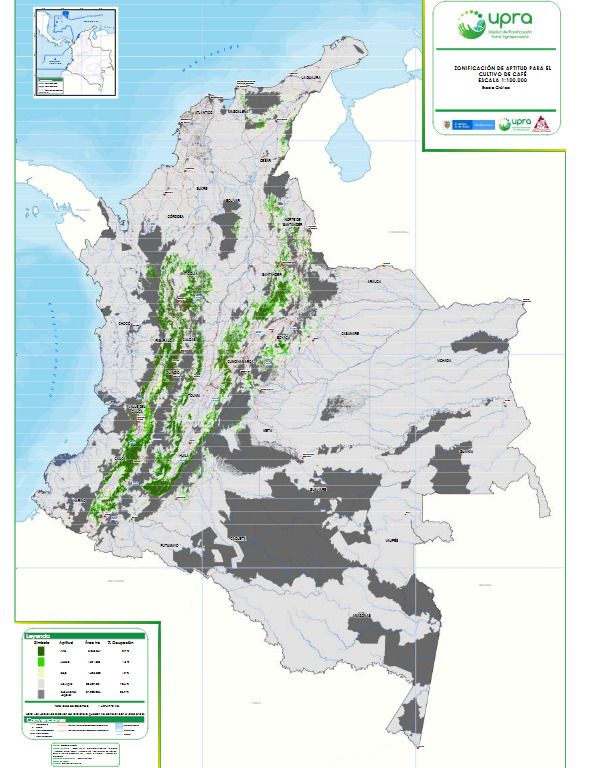
In Colombia, generating coffee crops requires studies to identify suitable areas, which include zoning and coffee-growing ecotopes. The zoning processes are carried out by the Rural Agricultural Planning Unit - UPRA, aiming to identify areas of the country with the highest aptitude for productive activities (Unidad de Planificación Rural Agropecuaria - UPRA, 2022).
Figure 1 shows the case of Colombia's zoning for coffee production, with a categorization of A1, A2, A3, N1, and N2. This allows for the visualization of territories suitable for cultivation; it is noted that Caquetá has very few areas suitable for coffee cultivation. However, municipalities such as Puerto Rico, El Paujil, Valparaíso, and Doncello have implemented coffee crops for self-consumption and local trade (Dussan, 2017).
Source: Unidad de Planificación Rural Agropecuaria (2022).
Figure 1 Zoning of suitability for coffee cultivation in Colombia, at a scale of 1:100,000
In general terms, coffee growers in Caquetá tend to sell their coffee in two forms: first, as dried parchment coffee, which is purchased in rural centers, local associations, and main municipalities by the Caquetá Coffee Growers Cooperative (COCAFICA), FondePaz, and other private buyers. FondePaz and COCAFICA recognize the producers’ work, and in 2021 they paid a premium of up to 90,000 pesos per arroba. This trend reflects the purchasing demand due to the quality of the coffee, which has been rated as high-quality (Garrido et al., 2022).
The second form is as a final product (ready for consumption), processed artisanally with the help of a third party who provides the machinery, as neither the producers nor the Cooperative have access to it. One study participant noted, "We could earn an additional profit, which would benefit us, but to implement that, we would need to have the machinery to process it" (Interview, Coffee Grower 1, 2024).
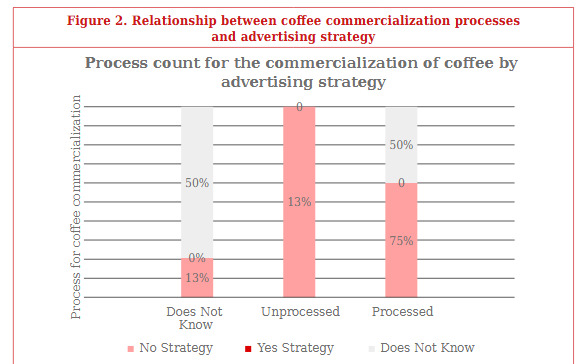
For the investigative process conducted in Doncello, Caquetá, the starting point was the responses collected from the coffee growers in the municipality. Regarding commercialization, it was found that three (3) out of ten coffee growers prefer to sell their coffee by word of mouth, while seven (7) prefer to ensure its distribution and commercialization through the coffee growers' association located in the village of El Berlín, Doncello, Caquetá (Interview, Coffee Growers, 2024). These are the main methods used for commercialization (See Figure 2).
Source: Own elaboration with SPSS (2024).
Figure 2 Relationship between coffee commercialization processes and advertising strategy
Additionally, it was determined that most producing organizations commercialize coffee in processed form, with an absence of marketing strategies. This is primarily directed towards markets with low demands for quality standards and low production volumes. This approach contributes to reducing the value chain through various collaborative strategies among stakeholders, serving as an alternative fair trade mechanism with added value (Díaz & Hartley, 2014).
This scenario reveals weaknesses among producers regarding commercialization, as follows: the region does not allow for the production and sale of coffee in large quantities. Information and Communication Technologies (ICT) and social media are not the strength of coffee growers. Moreover, due to the geographical location, telephone and internet networks are unstable, which hinders product promotion (Interview, Coffee Growers, 2024). Consequently, the primary advertising method is word-of-mouth.
Thus, the advertising strategies of the production units in northern Caquetá are related to associativity. According to a local expert (2024), it is necessary to integrate “sustainability from the start, during, and after coffee production for sale.” This perspective is supported by Flores (2013), who defines sustainability and associativity as the ideal combination for the economic and social development of organic coffee-producing communities.
However, this is not possible without an active sales dynamic. Hence, there is a need to develop strategies that enable consistent and planned actions for managing interactions involved in product marketing, aiming to achieve objectives of increased sales and market participation in quantitative or reach terms (Arechavaleta, 2015). The following semantic map presents some situations faced by coffee producers in the village of El Berlín, in the municipality of El Doncello, regarding production and commercialization, involving factors of state participation, technological development, and consumption (See Figure 3).
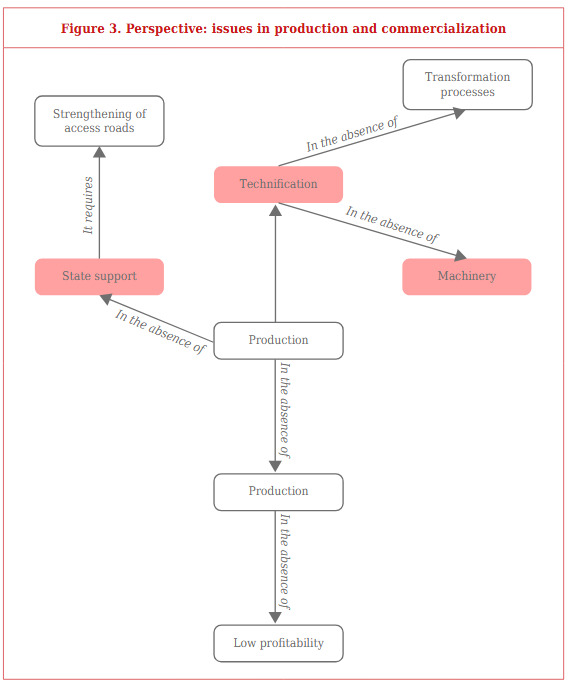
The previous results allow us to argue that the situation of coffee growers in El Doncello shows low production, combined with the fact that coffee consumption within the municipality is limited (Arteaga & Guzmán, 2008). However, it is expected to increase. The coffee growers carry out the work on their own farms, and in most cases, it is a task done with the help of their families. It is important to note that they lack machinery, industrialized infrastructure, and easily accessible mechanisms for promotion and sales, which leads to artisanal production and the lack of product visibility beyond the local context (Aristizábal & Duque, 2006).
Therefore, these farms require resources, technological advancement, and campaigns to promote recognition and commercialization of the product. Such improvements lead to impacts on production and sales processes. Regarding the first, the emergence of so-called specialty coffees is possible, a feature that enhances the quality of the product, which in turn results in higher commercialization rates (Orjuela & Sierra, 2001). As for the second, it encourages entrepreneurial ventures to develop business models with a focus on sustainability, providing a strategic argument for operating in a market with trends toward organic, Amazonian, natural, and quality products (Delgado Tello, 2021; Salazar et al., 2022).
The aspects mentioned refer to the sustainable development of business units that aim to meet these requirements, becoming economic alternatives for their owners (Murillo, 2019). In this sense, the central topic of analysis is the commercialization of coffee in Doncello, Caquetá, where producers suffer from the unjust poverty gap and inefficient social infrastructure. Their source of income is the sale of coffee production, but doing so without methodologies that contribute to and improve the results does not allow the consolidation of economic sustainability for the businesses, their families, and those involved in general. This economy, in turn, affects the social sustainability of the territory.
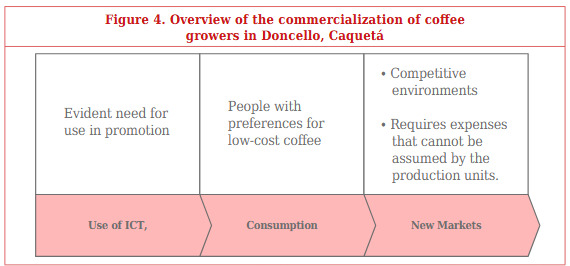
Additionally, it can be stated that the economic sustainability of coffee entrepreneurs suffers from instability due to fluctuations in coffee prices, as well as stagnation due to factors such as geographic isolation, which is a reality for many coffee growers in Doncello. They must bear high costs for the purchase of tools and supplies, as well as for transporting the harvest. Ultimately, for those who rely entirely on the activity under analysis here, access to education, housing, sustenance, healthcare, and other basic human needs is limited. Addressing such needs through business development could be a mechanism for generating generational change in the countryside (Hembuz, 2022). Figure 4 groups and describes the coffee trade scenario generated by the coffee growers in the study area.
5. Discussion
It can be stated that coffee growers prefer to commercialize their products in two ways: by word-of-mouth, and by ensuring distribution through the association located in the village of El Berlín. This highlights the need to rethink this process; this is where strategies that contribute to the sustainability of coffee entrepreneurship come into play, particularly in the commercial area, which ultimately has a direct relationship with the client or, in the absence of one, the end consumer.
Since every business, regardless of its size, must remain competitive to sustain itself over time, this is argued by Larrea & Loor (2020), who state that the level of competition is achieved through solid structures, oriented towards both internal and external processes, allowing them to participate in the dynamics of new markets. In this regard, the result of implementing the suggested strategies (which can be adjusted based on the specific conditions of each producer) will yield good sales statistics that ensure the positioning of the product or service (Red Summa, 2019).
The proposal as a whole can be supported by García et al. (2021), who express that promotional variables are aimed at stimulating demand to capture it; considering not only potential clients but also the global market, with the goal of promoting the product until sales are generated. This line of action ultimately aligns with the goals and objectives of any productive unit. Therefore, it is considered that the following strategies will enhance the commercial scenario (See Table 1), as they are created based on sector identification, which takes into account the capabilities, needs, and potential opportunities to be generated, such as entry into markets, participation in fairs with lower requirements, among other opportunities that may arise (Benavides & Redondo, 2021).
Table 1 Strategies to expand the market share of coffee growers in Doncello
| Action | Objective | Description |
|---|---|---|
| Product launch or relaunch scheduling (Initially, carry out a launch or, if necessary, a relaunch through samples in the rural and urban areas of the municipality under analysis and nearby municipalities). | Introduce the product and its processing to prospects in hard-to-reach areas. | Product presentation in local markets. Where the product's particularities, management, production processes, and other aspects that demonstrate its value will be directly exposed. This activity allows for real and close contact with potential markets and/or consumers, where the characteristics and needs of both parties are recognized, an essential aspect for achieving sustainability in trade (Ramírez, 2019). |
| Attendance at fairs or farmers' markets | Introduce the product in spaces with greater reach. | Directly and professionally showcase the characteristics of the coffee, in order to create an image of it. |
| Strategic alliances with micro-entrepreneurs in the food and beverage consumption sector (restaurants, cafes, and ice cream shops) | Provide markets with practical access. | This coffee economic sector already has solid competition with vast experience; therefore, the right option is to target local markets with significant reach and ease of entry. |
| Buzz marketing | Increase recommendations in a natural way. | The experience and the group of coffee consumers will be leveraged. |
| Create virtual identity | Integrate the results of the first four strategies to consolidate an image. | The difficulties in accessing information and communication in the territory are recognized; however, the need to create a brand with mass reach should not be overlooked. To this end, it is suggested to consolidate an alliance that allows for assuming the responsibility of virtual promotion. A space on the web will enable the exhibition of products with the characteristics they possess; from there, there will be possibilities for receiving orders and generating a feedback channel regarding the products sold (Pintado and Sánchez, 2017). |
Source: Own elaboration (2024).
Considering the methodology of the proposed actions, physical barriers, space limitations, visibility issues, and consequently limited markets will be overcome. Since actions that can be planned and implemented in mass-reaching media are integrated, i.e., developing a solid online presence (action 5), it complements the network effect (action 4) of visibility that the product needs. These two actions show a correlation in increasing brand recognition, thereby increasing purchase possibilities. These outcomes are also made possible with action 2, as fairs are a platform to attract strategic business alliances that increase sales levels and, consequently, installed capacity, which is also achievable through the development of action 3, ideal for utilizing already existing markets and installed capacities. With this, the costs incurred due to distance are mitigated, and since these are alternative strategies with or without the use of ICT, they can be adapted according to the circumstances at hand, without overlooking the instability of the network in the territory. Additionally, the strategies presented are low-cost, as they focus on the ability to envision and act to generate changes in sales management. In this way, the producer who adopts them can do so within their reach, even enhancing one of the current sales mechanisms (direct sales to their close contacts). Thus, participating in different scenarios where the product with Amazonian quality is the main focus.
6. Conclusions
It is concluded that coffee producers in Doncello, Caquetá, Colombia, require marketing strategies for the sustainability of their ventures. The proposed approach addresses the identified lack of installed capacity, the use of technologies in both the production and sales processes, and considers other social and territorial factors, such as access limitations, socioeconomic conditions in the study area, and factors that have led to the backwardness in their production and economic systems. One of the most significant factors, although not the focus of the research but inherent to the residents of the department, is the historical armed conflict, which today is reflected in the Territorial Development Programs - PDET (Ardila, 2022).
Therefore, the strategies were designed based on the current capacity of the producers and their environment, making them easy to implement. Thus, for the territory in general (the department of Caquetá), implementing these suggested actions represents the starting point for generating innovation in promotion, outreach, and even customer service. These are marketing strategies aimed at consolidating adaptable distribution channels and spaces, with the goal of establishing direct and alternative markets to existing ones. They also aim to address the backwardness and enter the digital space, the latter being a direct channel for participation in e-commerce (Ramírez, 2020). Ultimately, the marketing strategies serve as a basic guide, which, with strategic capacity, can help activate the economy of this economic sector in Doncello, Caquetá, Colombia, and its surroundings.
7. Recommendations
The implementation of the suggested strategic actions within the digital realm must acknowledge the existing regulations that govern supply and demand dynamics in this context. At a global level, there is the Digital Services Act, which aims to create secure digital spaces, protecting user rights, and establishing equal competitive conditions for businesses operating in these spaces (European Commission, 2023). In Colombia, there is Decree 1412 of 2017, which regulates the ICT sector with the aim of strengthening the development of content and applications to promote the industry and foster economic growth and competitiveness within the country's economy (Departamento Administrativo de la Función Pública, 2017). Additionally, there is the CONPES 4012 document, which serves as the national e-commerce policy. This guideline encourages the evolution of marketing dynamics, directed toward new markets and business models, allowing companies to transform the country into a global driver of economic growth and development (Departamento Nacional de Planeación, 2020).
On the other hand, those involving programming and the development of events are essential for establishing interpersonal relationships and business links that impact at a mass level, amplifying new scenarios, designing commercial strategies, and all efforts leading to achieving goals related to brand positioning. Thus, the territory in general must invest in complementing the value chain from this perspective.

