




 English (pdf)
 Article in xml format
 Article references
 Automatic translation
 Send this article by e-mail
 Cited by SciELO
  Cited by Google
  Similars in
SciELO
Similars in
SciELO  Similars in Google
 Permalink

INTRODUCTION
Green onion is a widely cultivated vegetable in Asia, where China, Japan, and the Republic of Korea are the leading global producers (Sánchez León et al., 2012; DANE, 2015; Galeano et al., 2018; Padula et al., 2022; Tsuji et al., 2023; Kim et al., 2023). In Latin America, Colombia is the main producer of green onion, which is locally known by various names such as “junca” onion, “tallo” onion, “hoja” onion, and “larga” onion. In this country, it stands out for its cultivated area, the value of production, and per capita consumption. Additionally, it is an essential ingredient in Colombian cuisine. It is used as a seasoning in the preparation of various dishes and has nutritional and medicinal properties that contribute to its high consumption (Sánchez León et al., 2012; DANE, 2017; Pinzón, 2004). Given the importance of this vegetable, various studies have been conducted in Colombia and other countries worldwide, where several promising green onion clones were agronomically evaluated, some with the potential to be registered as new varieties (Carrera et al., 2009; Pinzón, 2009; Segura et al., 2015; Polanco & Betancur, 2018; Imran et al., 2025); such is the case of Corpoica Aquitania-1, the first material in Colombia registered with the Colombian Agricultural Institute (Cerón et al., 2015).
In Colombia, in 2022, the area cultivated with green onion was 13,841 ha, representing 0.26% of the national agricultural area. The national production was 354,548 tons, with an average yield of 25.61 tons/hectare/cutting. Although this crop thrives in different climates or environments (altitude 1500 to 3000 meters above sea level and average temperatures of 12 to 20 °C), the main producing departments in the same year were Boyacá (24.30%), Santander (19.07%), and Nariño (17.55%). Other producing departments were Magdalena, Norte de Santander, Antioquia, and Valle del Cauca, with 28.4% of the national production (Chaparro & Peñalosa, 2012; DANE, 2017; UPRA & Agronet, 2022a; Rodríguez-Robayo et al., 2022).
In the department of Nariño, green onion is a crop of high socioeconomic importance, generating income and providing employment in the region. Around 2,158 farmers are dedicated to the cultivation of this vegetable. In 2022, an area of 2,429 ha was reported, representing 0.82% of the agricultural area of Nariño, with a production of 51,233 tons per year. In 2016, the average production cost for one hectare of green onion was approximately USD 7,909 (Noreña et al., 2016). The municipalities with the largest cultivated areas were Potosí, Pasto, and Córdoba, with 1,760, 614, and 75 ha, respectively. However, several other municipalities are involved in the production this crop (UPRA & Agronet, 2022b).
In Nariño, for more than 50 years, a single regional crop known as “Pastusa” has been cultivated and is widely accepted for its culinary characteristics. However, in recent years, its yield has been declining due to its susceptibility to limiting diseases that affect he production, such as the case of the pseudostem and root rot complex (Botrytis allii, Burkholderia cepacia, and Fusarium spp.), downy mildew (Peronospora spp.), and tip blight (Heterosporium allii) (Jacobs et al., 2008; Sánchez León et al., 2012; DANE, 2015; Elshafie & Camele, 2021; Tsuji et al., 2023), which have significantly increased production costs, requiring intense phytosanitary management for their control. Therefore, it is necessary to identify clones with good agronomic performance (high yields and quality of pseudostems) that improve the productivity and competitiveness of producers in this region. In this regard, variables such as yield, length, and pseudostem diameter are determining factors when evaluating onion germplasm because they are attributes of great interest to all stakeholders (producers, marketers, and consumers) in the green onion supply chain. This is because the pseudostem is one of the edible parts of the plant with the greatest consumption and trade in Colombia. In order to contribute to diversifying the onion varietal offer in the region, this research was conducted. The objective was to evaluate the adaptation (performance or agronomic behavior) of nine green onion clones.
MATERIAL AND METHODS
Location
This research, led by the Corporación Colombiana de Investigación Agropecuaria - AGROSAVIA, was conducted between January and December 2015. An Agronomic Evaluation Test (AET) for green onion was established in three high-altitude tropical environments of the department of Nariño, Colombia, located in the municipalities with the largest cultivated areas in recent years (UPRA & Agronet, 2022b). The geoclimatic characteristics of each environment are indicated in Table 1.
Table 1 Location and geoclimatic characteristics of the evaluation environments for green onion clones in Nariño, Colombia, 2015.
| Environment | Coordinates | Altitude (msnm) | Average T (°C)1 | Precipitation (mm) | Soil | |||
|---|---|---|---|---|---|---|---|---|
| Texture | pH | % OM | Fertility | |||||
| Obonuco (Pasto) | N 01°11’18,78” W 77°18’24,78” | 2,923 | 11.3 | 670 | Clay loam | 5.86 | 6.87 | Half |
| Buesaquillo (Pasto) | N 01°13’38,40” W 77°14’30,3” | 2,840 | 13.13 | 654 | Clay loam | 5.20 | 7.40 | Low |
| Mueses (Potosí) | N 00°47’23,10” W 77°34’7,80” | 2,946 | 12.64 | 831 | Sandy loam | 5.70 | 6.50 | Half |
Source: Instituto de Hidrología, Meteorología y Estudios Ambientales (2015). T: Temperature, % OM: % Organic Material
Agronomic Management of the Agronomic Evaluation Test (AET)
In all the experiments, the same agronomic management was applied, considering the customary practices of the producers of green onions in the region. To prepare the soil, it was plowed, raked twice, and furrowed manually. In each experimental unit, 40 sites of each clone were planted, four pseudostems per site at 0.4 m between plants and 0.9 m between rows. Fertilization was done manually, one month after planting with organic fertilizer (3 t/ha) and after each cutting with 10-30-10 fertilizer (800 kg/ha) and agrimins (30 kg/ha) as a source of minor elements. Weekly monitoring was carried out to detect the presence of common pests such as thrips and diseases such as pseudostem rot, downy mildew, and tip blight, to manage them promptly. During the crop cycle, three harvest cuttings were made.
Evaluated Materials
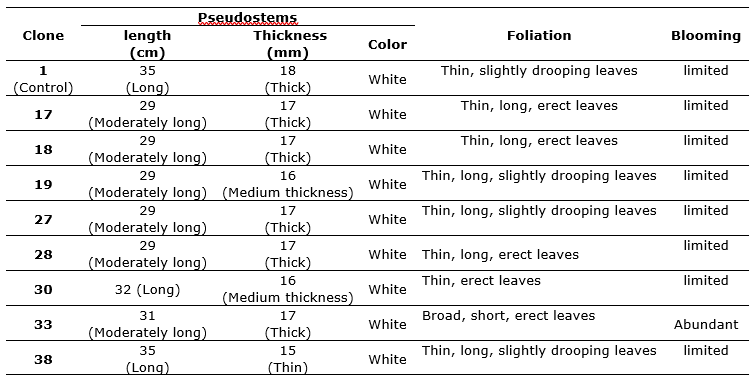
In each experiment of the Agronomic Evaluation Test, nine different varietal clones of green onion were evaluated (Table 2). These clones were selected from an initial group of 62 accessions due to their outstanding agronomic behavior in terms of yield and tolerance to biotic factors (Burkholderia cepacia and Peronospora sp.) in preliminary studies conducted by AGROSAVIA between 2012 and 2014 in the Cundiboyacense plateau (Galeano et al., 2018). These clones come from the Colombian nation’s Germplasm Bank, managed by the Corporación Colombiana de Investigación Agropecuaria.
As a control, clone 1 (Table 2) was used. This clone corresponds to the “Pastusa” variety, the most widely cultivated in Colombia. It has long, thick stems of excellent quality and a longer vegetative period than other varieties (Segura et al., 2015).
Table 2 Characteristics of green onion clones (Allium fistulosum L.) evaluated in three environments in Nariño, Colombia. 2015
Experimental design
The experiments of the Agronomic Evaluation Test were established under a randomized complete block design (RCBD) in each environment. There were nine treatments (clones) and four replications, and each experimental unit had an area of 14.4 m².
Evaluated Variables
During the evaluation period (one year), three cuttings or harvests were made per experiment. For each cutting, the methodology described by the International Plant Genetic Resources Institute (IPGRI et al., 2001) was followed to measure yield, pseudostem length, and diameter.
Pseudostem yield (t/ha). The yield of pseudostems (t/ha) was determined by harvesting the entire experimental unit (40 plants), leaving four pseudostems per site as asexual seeds for the next harvest. The production was weighed and transformed to t/ha. The first cutting or harvest was made six months after planting, and then every three months, for a total of three harvests, until completing one year.
Pseudostem length (cm). At the time of harvest, in each experimental unit, the length of the pseudostems from ten plants (25% of the experimental unit), selected randomly, was measured with a graduated ruler. This variable was measured in centimeters from the base to the beginning of the leaves, where they start turning green.
Pseudostem diameter (mm). After having removed the dry or almost dry leaves, ten plants selected randomly from each experimental unit had the diameter (mm) measured at the midpoint of the pseudostem with a digital micrometer or caliper.
Statistical analysis of the results
Initially, the Bartlett test of homogeneity of variances was conducted to test whether the variances are equal across all samples (Gutiérrez & De la Vara, 2008), and the Kolmogorov-Smirnov normality test determined that the data followed a normal distribution (p < 0.05). The information was analyzed using a multifactorial statistical model, considering factors such as genotypes or clones (9), environment (3), and cutting or harvest (3). A combined analysis of variance was performed to evaluate the main effects of each factor and their interactions.
The statistical model was as follows:
Yijk = μ+ Ai + Gj + Ck + (AGC)ijk + Eijk
Where Yijk is the average yield of genotype j in environment i; μ is the general mean; Ai is the main effect of environment i; Gj is the main effect of genotype j; Ck is the main effect of cutting k; AGCijk is the effect of the interaction between environment i x genotype j x cutting k; and Eijk is the average of the errors in the blocks that receive the treatment in the environments.
When significant statistical differences were found, multiple comparisons of means were conducted using Tukey's test (0.05) for the dependent variables: yield, length, and diameter of the pseudostem. The statistical analysis was performed using R software, Version 3.6.0 (R Core Team, 2020), and the “agricolae” package within this program.
RESULTS AND DISCUSSION
Pseudostem yield
The adaptation of nine green onion clones was evaluated in three environments within the production area of Nariño. The combined analysis of variance for pseudostem yield showed highly significant effects (p < 0.001) for environments, genotypes (clones), and cuttings (harvests) individually. However, no significant statistical effects were found for the genotype × environment × cutting and genotype × environment interactions (Table 3), which may be because the genotypes exhibited similar behavior across environments and cuttings during the research. This is important in plant breeding since it indicates that all clones possibly exhibited similar phenotypic stability or uniform and predictable behavior across environments (Allard & Bradshaw, 1964; Finlay & Wilkinson, 1963; Vallejo-Cabrera & Estrada-Salazar, 2002), which facilitates the process of selecting genotypes to release varieties.
Table 3 Combined Analysis of Variance for pseudostem yield (t ha-1) of branch onion
| Source of Variation | Degrees Freedom | Sum Sqares | Mean Squares | F value | p (>F) |
|---|---|---|---|---|---|
| Block | 3 | 8550 | 2850 | 8.94 | 1.23 e-05 *** |
| Environment | 2 | 22657 | 11329 | 35.52 | 3.06e-14 *** |
| Genotype (clone) | 8 | 41123 | 5140 | 16.12 | < 2e-16 *** |
| Cutting | 2 | 17228 | 8614 | 27.01 | 2.63e-11 *** |
| Environment × Genotype | 16 | 3732 | 233 | 0.73 | 0.76 |
| Genotype × Cutting | 16 | 5531 | 346 | 1.08 | 0.37 |
| Environment × Genotype × Cutting | 32 | 10616 | 332 | 1.04 | 0.41 |
| Residuals | 240 | 76536 | 319 |
p: Probability; *** Highly significant (p < 0.001)
Considering that statistical differences were found individually in the environmental factors, genotypes, and cuttings, the results are provided below:
In the three environments, clones 1-Control, 33, 38, and 30 stood out with statistical differences among them and performed above the general average (42.95 t/ha/cutting). The highest average yields were observed in clones 1-Control and 33, with 65.24 and 53.18 t/ha/cutting, respectively. The latter clone did not show significant differences from clones 38 and 30, which also achieved yields above the general average of 42.95 t/ha/cutting (Table 4).
Table 4 Average pseudostem yield (t/ha/cutting) of nine green onion clones (Allium fistulosum) across three cuttings and three environments in Nariño, Colombia. 2015
| Green onion clones | Environments | Clone Averages | ||
|---|---|---|---|---|
| Obonuco | Buesaquillo | Mueses | ||
| 1-Control | 72.62 | 76.85 | 46.26 | 65.24 a |
| 33 | 55.21 | 57.47 | 46.86 | 53.18 ab |
| 38 | 65.00 | 58.86 | 32.58 | 52.15 b |
| 30 | 57.83 | 49.12 | 36.02 | 47.66 bc |
| 27 | 41.19 | 44.58 | 25.60 | 37.12 cd |
| 17 | 40.23 | 41.72 | 22.57 | 34.84 cd |
| 28 | 37.95 | 38.96 | 23.08 | 33.33 d |
| 19 | 38.56 | 36.37 | 22.85 | 32.59 d |
| 18 | 33.80 | 35.91 | 21.50 | 30.40 d |
| Environment averages | 49.15 a | 48.87 a | 30.81 b | 42.95 |
*Data from the experimental unit (40 plants)
Regarding environments, high average yields (t/ha/cutting) were found in Obonuco (49.15) and Buesaquillo (48.87), with averages significantly higher than Mueses (30.81) (Table 4).
The highest yields were found in the Obonuco environment, possibly because the soil in this locality had medium fertility, with 670 mm of precipitation, and the soil had a loamy texture, which may have favored moisture retention and nutrient absorption, similar to Buesaquillo (654 mm), where the yield was comparable. In contrast, in Mueses, where there was 831 mm of precipitation, the soil is sandy loam, with a lower capacity for moisture retention and a higher likelihood of nutrient leaching (Sadeghian et al., 2015), which may have influenced the lower yield. This indicates that water is an essential factor in increasing crop productivity, as it is crucial for harnessing the soil's productive potential and for crops to fully utilize other production factors that enhance yields (Zúniga & Mendoza, 2021). Certainly, these yield results were not only affected by the parameters mentioned in Table 1; other aspects must also be taken into account, such as the planting season, cloud cover, the depth of the arable layer, and other chemical and physical soil parameters, which were not measured in this study but differ in the three localities due to their distinct geographical locations.
For clones, the highest yields were achieved by clone 1 (the control) and clone 33; however, the latter can be considered a good option for commercial validation because it also showed good pseudostem thickness. Similarly, clones 38 and 30 did not surpass clones 1 and 33, but they exceeded the general average and have desirable characteristics such as pseudostem length and diameter, attributes that directly influence marketability. Similar evaluations were conducted by Corpoica (now Agrosavia) in the department of Boyacá, where clones 38, 33, 30, and 28 were selected as candidates for registration with ICA due to their good agronomic performance (Segura et al., 2015; Rodríguez et al., 2021).
In 2015, clone 30, evaluated in different locations of the Cundiboyacense plateau, was released as the Corpoica Aquitania - 1 variety, with average yields of 30.05 t/ha/cutting (Cerón et al., 2015). Although this clone did not achieve the highest yield in the trials in Nariño, it was in the group with high yields (47.66 t/ha/cutting). Therefore, it may be considered to request from the Instituto Colombiano Agropecuario (ICA) the extension of registration as an onion variety for the production area of Nariño after carrying out a commercial validation.
Considering the three cuttings made during the year, significant statistical differences were observed among the three cuttings, with the highest yield in the third cutting (51.70 t/ha), followed by the second cutting (43.30 t/ha), and the first cutting (33.85 t/ha). These results greatly exceed the average of 13 t/ha calculated for green onion in Colombia (Galeano et al., 2018). In this study, it was noted that yields progressively increased across the three locations, with the highest average yield in the third cutting, as the crop had achieved a better establishment by that point (better root development and more tillering), which is a factor that influences crop yield (National Administrative Department of Statistics, 2015). Additionally, the planting system used in this research (planting and production up to the third cutting) suggests that, at least until the third cutting, good yields can be obtained that are technically and economically justified. This aligns with what was mentioned by Pinzón (2004) and Galindo et al. (2024), who state that the quality of the harvest decreases as the number of cuts increases and suggest renewing the crop every third cut to maintain the competitiveness and economic sustainability of the production system.
Pseudostem length
The analysis of variance for pseudostem length across the three environments indicated highly significant effects (p < 0.001) for the factors of environment, genotype, cutting (harvest), and the interaction of environment × genotype × cutting. Additionally, significant effects (p < 0.05) were observed for the interaction of environment × genotype (Table 5).
Table 5 Combined Analysis of Variance for pseudostem length (cm) of branch onion
| Source of Variation | Degrees Freedom | Sum Squares | Mean Squares | F value | p (>F) |
|---|---|---|---|---|---|
| Block | 3 | 11.3 | 3.75 | 1.25 | 0.29 |
| Environment | 2 | 118.1 | 59.06 | 19.68 | 1.22e-08 *** |
| Genotype (clone) | 8 | 1871.2 | 233.90 | 77.93 | < 2e-16 *** |
| Cutting | 2 | 262.3 | 131.14 | 43.69 | < 2e-16 *** |
| Environment × Genotype | 16 | 93.8 | 5.86 | 1.95 | 0.02 * |
| Genotype × Cutting | 16 | 92.5 | 5.78 | 1.93 | 0.02 * |
| Environment × Genotype × Cutting | 32 | 274.5 | 8.58 | 2.86 | 2.74e-06 *** |
| Residuals | 240 | 720.4 | 3.00 |
p: Probability; * Significant ( p < 0.05); *** Highly significant ( p < 0.001)
In the environment × genotype × cutting interaction (Figure 1), for the pseudostem length variable, the environment with the highest average was Mueses (34.03 cm), while Buesaquillo (32.58 cm) and Obonuco (29.90 cm) had lower values. In the first cutting (Figure 1), for the Buesaquillo environment, the clones with the greatest pseudostem length (cm) were 1 (Regional Control), 38, 30, and 33, with averages ranging from 38.66 to 35.00 cm. These same clones also performed well in Mueses, with pseudostem lengths between 36.92 and 34.58 cm, and in Obonuco, clones 38, 1, and 33 stood out with values between 34.46 and 32.33 cm.
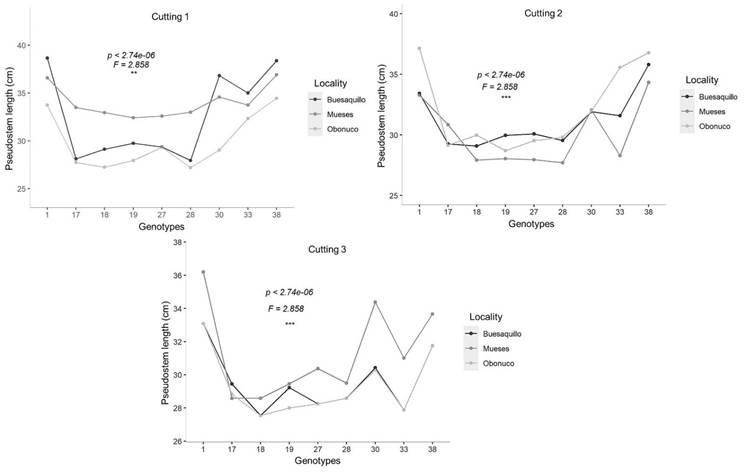
Figure 1 Interaction of environment × genotype × cutting for the pseudostem length variable (cm) of nine clones of green onion (Allium fistulosum) in three environments of Nariño, Colombia, 2015.
In cutting 2 (Figure 1), there were no significant differences between environments; however, the environment with the highest average pseudostem length (cm) was Obonuco (32.06), followed by Buesaquillo (31.18) and Mueses (30.12). In Obonuco, the clones with the best length were 1, 38, and 33, with averages between 37.12 and 35.57 cm. These same clones also stood out in Buesaquillo with averages between 35.79 and 31.58, and in Mueses clones 38, 1, and 30 with averages between 34.33 and 32.04 cm.
In cutting 3 (Figure 1), the environment with the highest average pseudostem length (cm) was Mueses (31.48), while Buesaquillo (29.24) and Obonuco (29.17) reached lower averages. In the three environments, clones 1, 38, and 30 stood out for the greatest pseudostem length, where they reached averages between 36.20 and 34.38 cm in Mueses, 33.08 and 30.42 cm in Buesaquillo, and between 33.08 and 30.29 cm in Obonuco.
Considering the pseudostem length variable, it was observed that in all environments and cuttings, clones 1, 38, 33, and 30 stood out. In terms of pseudostem diameter, clones 33 and 1 stood out in most locations and cuttings. This study found higher averages for pseudostem length compared to those reported in the Cundiboyacense plateau; for example, clone 30 (Corpoica Aquitania -1) had a value of 26.53 cm there, while in Nariño, it was 32.38 cm.
Pseudostem diameter (mm)
In the analysis of variance for pseudostem diameter, very highly significant effects (p < 0.001) of the factors environment, genotype, cutting (harvest), and the interaction environment × genotype and highly significant effects (p < 0.01) of the interaction environment × genotype × cutting were presented (Table 6).
Table 6 Combined Analysis of Variance for pseudostem diameter (mm) of the branch onion
| Source of Variation | Degrees Freedom | Sum Squares | Mean Squares | F value | Pr (>F) |
|---|---|---|---|---|---|
| Block | 3 | 9.2 | 3.07 | 1.06 | 0.36 |
| Environment | 2 | 48.6 | 24.29 | 8.43 | 0.00029 *** |
| Genotype (clone) | 8 | 190.3 | 23.79 | 8.25 | 7.15e-10 *** |
| Cutting | 2 | 243.0 | 121.48 | 42.15 | < 2e-16 *** |
| Environment × Genotype | 16 | 150.2 | 9.39 | 3.26 | 3.94e-05 *** |
| Genotype × Cutting | 16 | 71.1 | 4.44 | 1.54 | 0.08597 |
| Environment × Genotype × Cutting | 32 | 162.4 | 5.08 | 1.76 | 0.00952 ** |
| Residuals | 240 | 691.6 | 2.88 |
p: Probability; ** Highly significant (p < 0.01); *** Highly significant (p < 0.001)
For pseudostem diameter (mm), in the interaction environment × genotype × cutting (Figure 2), and according to the test of comparison of means, the most favorable environment was Obonuco (16.15), surpassing Mueses (15.64) and Buesaquillo (14.92). In cutting 1 (Figure 2), in Obonuco, the clones with the highest average pseudostem diameter were 1, 17, 28, 27, and 38, with averages that ranged between 17.61 and 16.68 mm; in Mueses, clones 33 stood out with 16.94 mm and 27 with 16.63 mm; in Buesaquillo, clones 33 with 16.34 mm and 1 with 15.91 mm.
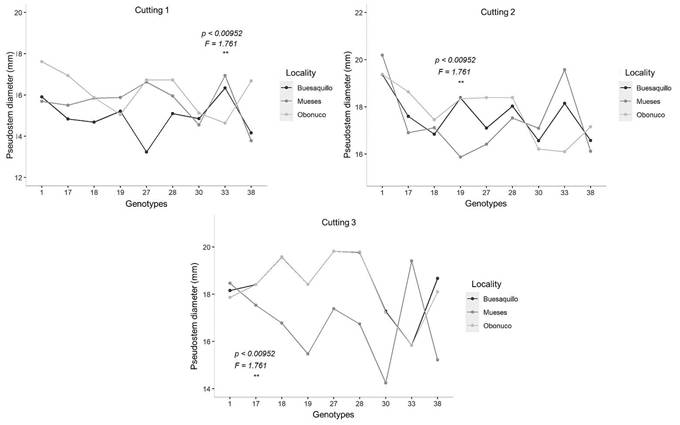
Figure 2 Interaction of environment × genotype × cutting for the pseudostem diameter variable (mm) of nine clones of green onion (Allium fistulosum) in three environments of Nariño, Colombia, 2015
In cutting 2 (Figure 2), no significant differences were found between environments. The averages ranged from 17.09 to 17.30 mm. In this cutting, the clones that stood out for their larger diameter in Obonuco were 1, 17, 28, and 27, with averages ranging from 19.37 to 18.40 mm. In Mueses, clone 1 with 20.18 mm and clone 33 with 19.58 mm were prominent; these two clones also had similar performances in Buesaquillo, with averages of 19.37 and 18.15 mm.
In cutting 3 (Figure 2), the environments with the largest pseudostem diameters (mm) were Obonuco (18.33 mm) and Buesaquillo (18.31 mm), surpassing Mueses (16.03 mm). In both Obonuco and Buesaquillo, the clones that stood out with the highest averages were 27, 28, and 18, with averages ranging from 19.82 to 19.58 mm and 20.24 to 19.57 mm, respectively. In Mueses, the prominent clones were 33 with 19.40 mm and 1 with 19.16 mm.
This study found average pseudostem lengths superior to those reported in the Cundiboyacense plateau. For instance, clone 30 (Corpoica Aquitania -1) presented a value of 26.53 cm, while in Nariño, it reached 32.38 cm.
Comparing the results of this research with the information reported for a study in the Cundiboyacense plateau, a general average of 15.74 mm was found, which is lower than the average values of 17.9 mm presented in the Cundiboyacense plateau when the same clones were evaluated (Cerón et al., 2015).
Both pseudostem length and diameter are highly important variables because they enhance the commercial value of the product in the market. Therefore, they are agronomically significant quantitative traits that are useful in the description of onion germplasm (IPGRI et al., 2001; Jaramillo & Baena, 2000; Polanco & Betancur, 2018). Considering this, it is likely that these clones constitute a good genetic resource to advance the development of new varieties.
CONCLUSIONS
According to the variables evaluated, the best adaptation of the clones was observed in Obonuco and Buesaquillo. Clones 38 and 33 presented good agronomic performance; they obtained yields statistically similar to the control clone (clone 1), which makes them a good option to diversify the supply of cultivated varieties in the production area of Nariño following the respective process for national registration of cultivars, according to the regulations of the Instituto Colombiano Agropecuario (ICA).
The agronomic evaluation of clones 38 and 33 was crucial in determining their adaptation to the evaluated environments. However, it is necessary to expand this study to other locations and assess quality parameters such as pyruvic acid content (pungency), reducing and total sugars, and total protein, in addition to including commercial validation.
The yield, length, and pseudostem diameter variables are very important when evaluating the adaptation of green onion planting material, as they are attributes of great interest to producers, marketers, and consumers.
Considering the importance of green onion cultivation in Colombia, it is essential to continue studies that evaluate and identify genotypes or clones with desirable traits for all stakeholders in the production system (producers, marketers, and consumers). This will contribute to the development of varieties with agronomic and quality characteristics that enable an expanded offering in the region.

