




 English (pdf)
 Article in xml format
 Article references
 Automatic translation
 Send this article by e-mail
 Cited by SciELO
  Cited by Google
  Similars in
SciELO
Similars in
SciELO  Similars in Google
 Permalink

1. Introduction
To achieve success, modern organizations must adjust their management methods by transforming their capabilities through innovation and the adoption of new knowledge, as well as leveraging emerging technologies. This is essential for ensuring the efficiency and continuity of their processes [1]. The ability to constantly adapt becomes crucial for maintaining quality and positioning in the global market, achieving a balance between long-term results and day-to-day decisions [2].
In this sense, it is evident that knowledge plays a fundamental role in organizational maturity. This involves acquiring new resources, developing capabilities, and promoting a corporate culture that encourages creativity, adaptability, and the adoption of best practices in internal processes and management. These elements become a crucial differentiator, allowing organizations to anticipate market needs, improve performance indicators, and offer products and services that more effectively meet the demands of the environment [3]. To drive organizational transformation, dynamic absorption capabilities become a crucial element in the design and adoption of quality management systems (QMS) [4]. These capabilities are implicitly defined as the ability of an organization to manage knowledge and create value, which involves the acquisition, assimilation, transformation and exploitation of knowledge [5].
From this perspective, quality can be understood as a key factor in the design of processes, products, and services, thereby generating a competitive advantage [6]. However, in recent years, quality management theory shows less transformation, neglecting innovation and leadership among professionals working in this field [7]. This stagnation has resulted in a disconnection between quality management systems (QMS) and organizational knowledge management, affecting the robustness and transformation of the designed and adopted standards [8]. Likewise, although the combination of quality management systems with innovation and knowledge management can generate significant synergistic benefits, organizations face considerable obstacles, such as the availability of human talent with the required skills, the high costs associated with innovation, and the need to promote a corporate culture that values and encourages knowledge management as a key element in organizational strategy [9].
On the other hand, the fourth industrial revolution, or Industry 4.0, proposes the digital transformation of industries through innovative tools and approaches that could redefine organizational quality management [10]. Integrating advanced technologies such as the Internet of Things, artificial intelligence, and data science into quality management systems could serve as a gateway to the emerging concept of Quality 4.0, which promises to enhance the effectiveness, transparency, and adaptability of quality processes within organizations [11]. However, a low level of digital skills development has been identified as the main barrier to transforming quality management systems, followed by the erosion of quality culture and the presence of obsolete systems that hinder the transition to modern and efficient methodologies [12]. As evidenced, there is a significant challenge in the sustainable implementation of quality management systems (QMS) supported by knowledge management processes and digital industry tools. The gap between quality practices and their effective implementation raises multiple questions [13].
In this context, the need to evolve the quality management systems currently used by organizations becomes evident, adapting them to the new demands of the environment. This transformation requires the adoption of new knowledge, which necessitates the development of capabilities focused on the identification and transformation of knowledge, specifically dynamic absorption capacities. Thus, the question formulated to guide this research was:
RQ: Is there a relationship between the development of dynamic absorption capacities and the maturity level of its quality management system?
2. Theoretical Framework
2.1. Organizational capabilities
An organizational capability can be defined as the configuration of routines and resources that enables an organization to achieve its objectives [14]. This capability is reflected in activities that produce results important for the survival of the organization and prosperity [15,16]. In this sense, organizational capability is understood as an ability to efficiently carry out internal activities [17]. Organizational capabilities are key to acquiring new information, knowledge, and skills that support the competitive advantage. [18]. Furthermore, as capabilities become repetitive, they transform into organizational memory and constitute routines. Organizations gain advantages when they develop appropriate routines that allow them to achieve their objectives through the efficient use of resources [19].
Organizational capabilities arise when a company combines the competencies and skills of its employees, facilitating teamwork and thus transforming their technical knowledge into tangible results [20,21]. In this way, capabilities emerge from the collective learning of the organization, particularly those related to the coordination of production techniques and the integration of technologies [22]. On the other hand, a company’s capabilities are strengthened through its internal routines and a formal learning process, which is considered a key factor for the organization to fulfill its productive tasks and ensure its survival [23].
Consequently, capabilities emerge from learning, resources, and organizational history [24]. Companies must develop their organizational capabilities to improve performance and face the complexity and turbulence of markets. These capabilities are essential for creating and maintaining a sustainable competitive advantage in highly dynamic business environments, characterized by a wide dispersion of organizational sources of innovation and production [25].
From the perspective of business growth, Penrose [26] argues that the key lies in the control and efficient use of resources to generate differentiation and achieve a competitive advantage. Tangible and intangible assets are essential for strengthening its capacity for adaptation, innovation, and growth in a dynamic business environment [27]. However, resources alone are not sufficient to achieve business growth; it is the organizational skills and capabilities that emerge from the interaction of these resources that drive such growth. These organizational skills are developed through continuous learning and adaptation over time [28].
Therefore, resources define the boundaries and structure of the organization, and their uneven distribution creates significant differences in capabilities and competitive strategies. This diversity motivates organizations to seek competitive advantages based on specific resources that are valuable, rare, difficult to imitate, and that can be effectively leveraged to achieve their strategic objectives [29].
2.2. Dynamic Capabilities
Dynamic capabilities are defined as the organizational and strategic routines that managers use to modify the resource base of their companies. This is achieved through the acquisition, elimination, integration, and recombination of resources to generate new assets that create value [30]. A business capability can be understood as a set of activities that use productive resources to create products and services. These capabilities can be classified into two kinds: ordinary and dynamic. Ordinary capabilities refer to the performance of administrative, operational, and governance functions necessary to carry out routine tasks. On the other hand, dynamic capabilities involve high-level activities that allow the company to direct its ordinary activities toward high-performance efforts, especially in rapidly changing environments [31].
Consequently, dynamic capabilities are the skills that companies develop to integrate, build, and reconfigure their resources, adapting to rapidly changing environments [32]. These capabilities define how easily organizations achieve new and innovative forms of competitive advantage. Dynamic capabilities allow companies to renew their resources as needed to innovate and respond to environmental changes [33]. Furthermore, the connection between continuous learning, knowledge sharing, and integration is essential for business success and the internal functioning of the organization [34]. In conclusion, capabilities are configurations of routines and resources, while dynamic capabilities reflect a company’s ability to reconfigure its capabilities and adapt to its environment [35].
2.3. Absorption capacities
Absorptive capacities have been used to explain the cognitive structures and knowledge retention in individuals and firms [36]. A dynamic absorptive capacity can be defined as the company’s ability to recognize, assimilate, and apply new knowledge [37]. Absorptive capacities recognize the value of new information and its application to improve organizational performance, primarily through innovation [38]. Absorptive capacity is a capability that the firm develops over time through the accumulation of a relevant knowledge base. The assimilation process is influenced by the tacit knowledge the company has regarding the established systems for processing knowledge [39].
In this sense, Mowery and Oxley [40] define absorptive capacity as a broad set of skills for managing and applying transferred tacit knowledge, as well as the frequent need to modify external knowledge to adapt it to specific contexts. It is not just about acquiring knowledge, but also about managing its tacit nature, which involves an active process of interpretation and adaptation to maximize its value within the organization [41].
Therefore, absorptive capacity requires the ability to learn and solve problems. In this way, learning capacity reflects how easily a company understands and assimilates new knowledge [42]. Similarly, problem-solving capacity involves the ability to generate new knowledge that enables the company to innovate [43]. Organizations that foster continuous learning and promote a culture of problem-solving can improve both their performance and organizational effectiveness [44].
2.4. Dynamic absorption capacities
Absorptive capacity can be understood as a dynamic capability, encompassing a set of skills that an organization needs to manage knowledge and create value. This set includes the acquisition, assimilation, transformation, and exploitation of knowledge [45]. In this sense, they can be classified into potential absorptive capacity and realized absorptive capacity. Potential capacity encompasses the acquisition and assimilation of knowledge through the reconfiguration of the resource base and the deployment of capabilities, while realized capacity focuses on its transformation and exploitation through the development of new products and processes. Both capacities, potential and realized, complement each other to generate a positive effect on the organization’s competitive advantage [46].
Within the model proposed by Zahra and George [45], four factors are identified: triggers of activation, mechanisms of social integration, and appropriability regimes. Triggers of activation are situational factors that influence the capacities of a company and intention to utilize acquired knowledge. On the other hand, mechanisms of social integration help reduce barriers between assimilation and transformation, thereby increasing absorptive capacity. Finally, appropriability regimes refer to the different systems or mechanisms that an organization uses to control and benefit from the acquired knowledge [47].
In conclusion, potential dynamic absorptive capacities represent the integration of external knowledge into a company's knowledge repository, while realized dynamic absorptive capacities refer to its combination, utilization, and application. Value creation is considered a dependent variable of dynamic capability [48].
2.5. Quality management systems
Quality has become a key component that supports organizations in their pursuit of increasing competitiveness through performance improvement [49]. Quality is considered one of the most effective approaches to optimizing organizational outcomes [50]. Quality management stands out as one of the most significant advancements in the business realm because it not only contributes to performance improvement but also drives the generation of competitive advantages and plays a crucial role in the survival of organizations [51]. Additionally, the rapid expansion of quality management systems has emerged as a response to environmental challenges and greater attention to issues of planning, assurance, control, and quality improvement [52]. Table 1 shows the concept of quality.
Table 1 The concept of quality.
| Author | Concept |
|---|---|
| Walter A. Shewhart | Quality consists of two elements: a subjective one that reflects the expectations and desires of the customer, and an objective one that refers to the fulfillment of the physical properties of goods and services. |
| Edwards Deming | Quality is everything that the consumer needs and wants. Since these needs and desires are constantly evolving, it is essential to continuously redefine quality criteria based on the consumer. |
| Joseph Juran | Quality refers to the suitability of a product for use. In this sense, it implies the absence of deficiencies in the characteristics that satisfy the customer. |
| Kaoru Ishikawa | Quality is part of the education of individuals and managers in companies. |
| Philip Crosby | Quality is defined as meeting established requirements, emphasizing that the only acceptable performance standard is to achieve zero defects. |
| Armand Feigenbaum | Quality is a corporate way of life, a way of managing an organization. The concept of quality involves planning and control. From this, it proposes the creation of a quality system to provide technical and managerial procedures that ensure customer satisfaction. |
| American Society for Quality (ASQ) | In the technical realm, quality can have two main meanings: the characteristics of a product or service that affect its ability to meet explicit or implicit needs, and the absence of defects in a product or service. |
| ISO 9000:2015 | Quality is the degree to which a set of inherent characteristics of an object meets the requirements. |
Quality management has undergone significant evolution in the last century, considerably expanding its scope in business implementation [58,59]. As a result, the term "total quality management" was adopted, which has been used for approximately a century in productivity generation, statistical quality control, and the application of techniques aimed at improving the quality of products and services [60]. Total quality management has evolved over the past few decades to become one of the most widespread management approaches that support the improvement of products, services, and processes to achieve greater organizational competitiveness [61]. Table 2 shows the evolution of quality management.
Table 2 Evolution of quality management.
| Period | Authors | Concept |
|---|---|---|
| Inspection | Radford | The detection of defective products is carried out through the active search for potential imperfections. This practice formally links inspection with the concept of quality and is considered a direct responsibility of management. |
| Statistical Quality Control | Walter A. Shewhart W. Edwards Deming | Productivity improves by reducing variation, using techniques such as statistical quality control. This includes the application of control charts and scientific thinking through the dissemination of the PDCA cycle (Plan, Do, Check, Act). In 1951, JUSE established the Deming Quality Awards, which over time became a strong incentive for improvement. |
| Quality Assurance / Total Quality Control | Joseph Juran Kaoru Ishikawa Philip B. Crosby | The concept of quality evolved from a narrow, manufacturing-focused perspective to an intervention in quality efforts in areas such as design, engineering, planning, and service activities. The concept of quality costs began to be introduced, providing a powerful economic foundation for the quality movement. Quality circles were formalized to train supervisors and workers. The zero defects approach was created, emphasizing quality as a matter of motivation and expectations. |
| Total Quality Management | W. Edwards Deming ISO | The principles on which an organization’s management should be based to continuously improve its competitiveness are presented. The ISO 9000 series of standards emerged, aiming to unify and standardize the different approaches to quality assurance systems that existed up to that point. |
| Strategic Quality Management | Motorola ASQ EFQM | The Six Sigma (6σ) methodology began to be implemented, and in the United States, the Malcolm Baldrige Quality Award was established by government decree. The EFQM Quality Awards were also established. |
Based on the consulted authors, organizational maturity can be defined as a pathway to achieve continuous process improvement, where at each stage, the appropriation of a series of knowledge and the development of certain capabilities are highlighted [66]. In this sense, maturity is related to an organization's ability to consistently implement good quality practices, aligning strategy, culture, and organizational structure [67]. Furthermore, organizational maturity is characterized by promoting a culture of innovation that fosters an environment of creativity and adaptability to change [68]. The integration of processes and technology positively impacts the efficiency and responsiveness of organizations [69].
In accordance with the theoretical framework presented, the research hypotheses are proposed, relating the potential and realized dynamic capabilities of absorption with the maturity level of quality management systems. Fig. 1 shows the relationships between the identified variables and the research hypotheses:
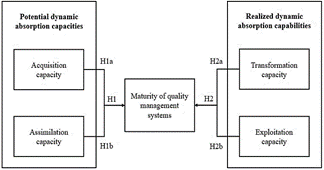
H1a. The dynamic capability of acquisition is positively related to the maturity of quality management systems.
H1b. The dynamic capability of assimilation is positively related to the maturity of quality management systems.
H2a. The dynamic capability of transformation is positively related to the maturity of quality management systems.
H2b. The dynamic capability of exploitation is positively related to the maturity of quality management systems.
3. Methodology
This research was descriptive, qualitative, non-experimental, hypothetical, and deductive [70]. A non-probabilistic convenience sample of 100 quality leaders from companies located in the city of Bogotá - Colombia, classified in sectors such as construction, technology, industry, finance and health were selected. Minimum experience of 5 years leading quality management system was required. The selected quality leaders were contacted via email. The data collection method was through an electronic form. Table 3 shows the main characteristics of the sample.
Table 3 Characteristics of the sample.
| Topic | Description |
|---|---|
| Number of quality management system (QMS) leaders surveyed (sample size) | 100 |
| Data collection period | June to December 2023 |
| Position of the respondents surveyed | Managers, directors, coordinators, and auditors of QMS |
| Average years of experience of quality management leaders | 8.5 years |
| QMS leaders surveyed from the construction sector | 24 |
| QMS leaders surveyed from the technology sector | 19 |
| QMS leaders surveyed from the industry sector | 37 |
| QMS leaders surveyed from the finance sector | 17 |
| QMS leaders surveyed from the health sector | 3 |
| Companies with certified QMS | 100 |
| Average age of QMS | 7 years |
| Average number of members in quality management teams. | 3.7 |
Source: The authors.
Based on the five variables identified in the theoretical framework (acquisition, assimilation, transformation, exploitation, and maturity) a customized survey was designed, consisting of 25 questions grouped into 5 sections, along with 5 control questions. A 5-point Likert scale was used to collect responses: (1) Totally disagree, (2) Disagree, (3) Neither agree nor disagree, (4) Agree, (5) Totally agree. Subsequently, to validate the survey, a pilot test was conducted with a subgroup of 7 quality management system leaders. The data collected yielded a Cronbach's Alpha index of 0.897, indicating a high reliability of the data.
The processing of the collected data was carried out in three stages: (1) through a correlational analysis, the existing bivariate relationships between the variables studied were identified, (2) using an exploratory factor analysis, the underlying structure of the indicators that make up the selected variables, (3) finally, the research hypotheses were contrasted using a structural equation model.
4. Results
The results obtained in each of the proposed stages are presented below:
4.1. Correlational analysis
To understand the relationship between dynamic absorption capacities, potential and realized, and the maturity of quality management systems, the Pearson correlation coefficient was calculated. Table 4 shows the results obtained.
As shown in Table 4, the dynamic absorption capacity for acquisition is positively related to the maturity of quality management systems (0.85). In this sense, the dynamic absorption capacity for assimilation is also positively related to the maturity of quality management systems (0.83). Similarly, the dynamic absorption capacity for transformation shows a positive relationship with the maturity of quality management systems (0.87). Finally, the dynamic absorption capacity for exploitation has a positive relationship with the maturity of quality management systems (0.86). These results suggest preliminarily that dynamic absorption capacities positively explain the maturity of quality management systems.
4.2. Exploratory factor analysis
As a second step for data processing, exploratory factor analysis using the principal components method was utilized. This method allowed for the validation of the items included in the survey and determined whether they measured the variables proposed in the conceptual model. Additionally, the method also allowed for the evaluation of the causal relationships needed to apply the structural equation modeling in the third step [71]. Table 5 shows the results obtained.
As shown in Table 5, the correlation levels between the studied variables are above 0.83 and can be classified as high. Likewise, the result obtained in the determinants is close to0, ensuring the correct aggregation of the repeated data, which is a positive outcome for the research. In turn, the result obtained in the calculation of the communalities of the studied variables has values close to 0, which is interpreted as low variability for each of the studied factors. In the case of the KMO test, the results for each of the variables are close to 1, showing a balance between the observed correlation coefficients and the partial correlation coefficients. In this regard, Bartlett's test of sphericity shows a positive and significant relationship between each of the studied latent variables. Finally, the reliability of the collected data was validated through Cronbach's alpha and the Composite Reliability Index (CRI). Each of the studied variables obtained values above 0.7, thus ensuring the consistency of the data.
Table 5 Exploratory factor analysis.
| Variable | acquisition | assimilation | transformation | exploitation | maturity QMS |
|---|---|---|---|---|---|
| Correlation | 0,83 | 0,85 | 0,88 | 0,87 | 0,84 |
| Level of Correlation | High | High | High | High | High |
| P Value | 0.000 | 0.000 | 0.000 | 0.000 | 0.000 |
| Determinant | 0.007 | 0.005 | 0.003 | 0.005 | 0.008 |
| Communality | >0.81 | >0.83 | >0.85 | >0.81 | >0.87 |
| Level of communality | Good | Good | Good | Good | Good |
| Kmo | 0.901 | 0.899 | 0.877 | 0.875 | 0.912 |
| Bartlett | 0.000 | 0.000 | 0.000 | 0.000 | 0.000 |
| Cronbach alpha | 0,917 | 0,931 | 0,899 | 0,889 | 0,952 |
| Cri | 0,954 | 0,923 | 0,911 | 0,899 | 0,932 |
Source: The authors.
4.3. Structural equation model
As a first step to test the research hypotheses, the statistical fit of the conceptual model proposed in Fig. 1 was calculated. To calculate the degrees of freedom of the model, the chi-square index (CSI), root mean square error of approximation (RMSEA), comparative fit index (CFI), and incremental fit index (IFI) were used. The obtained results show that the proposed model exhibits a good statistical adjustment. According to the obtained data, the chi-square index (CSI) is double the degree of freedom. Additionally, the root mean square error of approximation (RMSEA) is close to 0. In this regard, the comparative fit index (CFI) and the incremental fit index (IFI) are greater than 0.9. Table 6 shows the obtained results.
Table 6 statistical adjustment
| Index | Expected value | Calculated value | Adjustment |
|---|---|---|---|
| CSI | Double the degrees of freedom | CSI: 1533 DF: 517 | Acceptable |
| RMSEA | 0,05< and >0,08 | 0,017 | Acceptable |
| CFI | 0,90 to 1 | 0,917 | Acceptable |
| IFI | 0,90 to 1 | 0,923 | Acceptable |
Source: The authors.
On the other hand, several statistical models were used to validate the research hypotheses. The first was the effect index (EI) to assess the magnitude and direction of the relationship between two variables. The second was the measurement error (ME) to identify whether there is any difference between the obtained value and the estimated value. The third model used was the critical ratio (CR) to determine the inferential representativeness of the bivariate relationships of the studied variables. Finally, Fisher's significance model (P) was used to confirm the validity of the hypotheses. Table 7 shows the obtained results.
Table 7 Validation of hypotheses.
| RH | Relationship | EI | ME | CR | P | Decision |
|---|---|---|---|---|---|---|
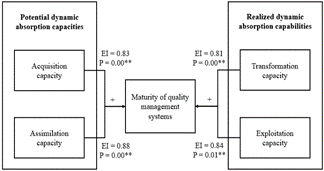
| H1a | Acquisition - Maturity | 0,83 | 0,11 | 2,2 | 0.00 | Accepted |
| H1b | Assimilation - Maturity | 0,88 | 0,15 | 2,5 | 0.00 | Accepted |
| H2a | Transformation - Maturity | 0,81 | 0,22 | 2,7 | 0.00 | Accepted |
| H2b | Exploitation - Maturity | 0,84 | 0,17 | 2,9 | 0.01 | Accepted |
Source: The authors.
As seen in Table 7, there is a positive relationship between the studied variables: dynamic capabilities of absorption, assimilation, transformation, and exploitation, and the maturity level of quality management systems. Firstly, the effect size index is classified as large [72], which highlights that the dynamic capabilities of absorption have a significant effect on the maturity level of quality management systems. In this regard, the measurement error results are relatively low. Finally, the critical ratio index and the p-value show a positive, directly proportional relationship between the studied variables, which allows for the empirical validation of the proposed hypotheses and acceptance of their interdependence. Fig. 2 presents the proposed structural model.
5. Discussion
Based on the results obtained, a strong correlation is observed between the processes of knowledge appropriation and the maturity index in organizational management. This conclusion aligns with the studies of Zhang [73], which indicate that effective knowledge management can enhance decision-making, foster innovation, and increase operational efficiency, thereby enabling organizations to better adapt to their environment and improve competitiveness. Todorova [74] complements this idea by pointing out that effective knowledge management is essential for organizations to develop dynamic capabilities that enhance their performance. Absorptive capacity involves not only the acquisition and assimilation of knowledge but also the transformation and exploitation of that knowledge within the organization.
In relation to organizational maturity, De Bruin [75] connects it with continuous improvement processes and the adaptability of companies. A structured approach to organizational maturity enables organizations to identify their opportunities for improvement, adopt best practices more effectively, and optimize their performance. Mature organizations are open to change and innovation, allowing them to respond effectively to the needs of their environment. This viewpoint aligns with that of Goetsch [76], who emphasizes the maturity of quality management systems as a mechanism to enhance organizational performance. A mature quality management system allows organizations to adapt to environmental needs and acquire the necessary knowledge to improve efficiency and effectiveness, significantly contributing to competitiveness through a culture of continuous improvement.
In addition to the previous paragraph, Chiarini [77] argues that dynamic capabilities enable organizations to maintain their quality management systems while also evolving and continuously improving in response to environmental changes. Organizations that mature their dynamic capabilities are more sustainable and effective in implementing good quality management practices. De Silva [78] emphasizes that dynamic capabilities are key to organizational development through effective quality management systems that facilitate adaptation to environmental changes and emerging market needs. Therefore, the organizational development of absorptive dynamic capabilities positively impacts the maturity of quality management systems, with knowledge management processes serving as a reliable source of differentiation for companies [79-82]. Although the surveyed leaders work in companies from different sectors and sizes, and their quality management systems exhibit various degrees of maturity, a direct relationship can be observed between the efforts made by top management to acquire and appropriate knowledge, and the level of quality achieved in the management of their processes, as well as in the development of their products and services. Economic growth is positively related to the ability to adequately manage knowledge.
6. Conclusions
Through this study, significant evidence was presented that absorptive dynamic capabilities are positively related to the maturity index of quality management systems. This conclusion is based on the collected data and the applied statistics, and the results align with the arguments put forth by several authors. In this regard, knowledge management processes are highlighted as a clear source of organizational differentiation. The proposed hypotheses were validated, achieving a high level of significance between the studied variables.
Under the organizational dynamic capabilities approach, absorptive capabilities are emphasized for their ability to capture knowledge and adapt it to the specific needs of each company. This process requires an organizational culture focused on innovation and continuous improvement, where human talent is the key factor for achieving transformation. The dynamic nature of these capabilities is characterized by the permanent changes in the current environment, which demand continuous learning from workers and an objective understanding of the realities of organizations and their environment.
Quality management systems are mechanisms to ensure organizational effectiveness. In this regard, they must be flexible and capable of responding to the needs arising from constant change. Quality management systems should evolve alongside organizations, which is achievable if knowledge also transforms and is transferred effectively. A static quality management system loses its meaning and organizational value. Quality assets are what allow the generation of a competitive advantage; in this case, knowledge is the primary quality asset. Promoting the development and transformation of absorptive capabilities within companies ensures, to some extent, the evolution of knowledge.
Strengthening dynamic absorption capabilities will enable organizations to improve the maturity of their quality management systems. To achieve this, it is essential to define concrete actions focused on promoting continuous learning, organizational flexibility, and collaborative work. It is crucial to identify and value the new knowledge emerging from technological, economic, social, and cultural trends, thus preparing human talent to adopt it for the benefit of organizational maturity and the appropriation of best practices. In this regard, leadership, teamwork, and effective communication are key pillars of a coherent knowledge management model. Strengthening relationships with market-leading companies will provide access to valuable knowledge; however, workers must be able to absorb and apply it for the benefit of the organization. Human talent is the fundamental driver of economic and social development.
Finally, in the second phase of this research, a more detailed analysis is expected to be developed in a specific sector, incorporating a larger sample of quality leaders, which will allow for balancing the proposed model. Additionally, as a case study, the obtained results will be documented and compared with the previously presented ones. This will enable the necessary adjustments to be made and the research results to mature.

