




 English (pdf)
 Article in xml format
 Article references
 Automatic translation
 Send this article by e-mail
 Cited by SciELO
  Cited by Google
  Similars in
SciELO
Similars in
SciELO  Similars in Google
 Permalink

1. Introduction
Retail Analytics (RA) is broadly defined as applying data-driven techniques to optimize various facets of retail operations, including consumer behavior insights, inventory management, and sales forecasting. By analyzing vast datasets, RA enables retailers to make informed decisions that enhance performance and customer experience. The discipline integrates advanced technologies such as Machine Learning (ML), big data analytics, and predictive modeling to uncover consumer purchasing patterns and improve operational efficiency [1,2]. It has evolved to address complex challenges, such as intermittent demand and sparse sales data, through sophisticated models that enhance predictive accuracy [3].
One of the critical strengths of RA is its ability to merge online and offline consumer behaviors, providing a comprehensive view that traditional methods often miss [4]. This holistic view allows retailers to optimize pricing strategies, forecast demand more accurately, and personalize customer experiences, all while improving store segmentation and management [5,6]. Integrating data analytics with store operations has become critical in achieving competitive advantages as the retail landscape shifts towards increased digitization, especially in brick-and-mortar stores [7,8]. Innovations like mobile location data and intelligent shelf systems enable real-time insights into customer preferences and shopping behaviors, enhancing operational decisions and customer satisfaction [7,9].
Moreover, RA plays a strategic role in aligning supply chain operations with retail objectives. Analyzing large data sets helps businesses anticipate market trends, improve product placement, and refine inventory control strategies. The fusion of RA with supply chain management provides retailers with the tools necessary to adapt to fluctuating market conditions, thus reinforcing its indispensable role in gaining a competitive edge [10,11]. As the field continues to evolve, it is becoming increasingly crucial for driving superior performance and maintaining market relevance in today's highly competitive retail environment [8].
This article aims to provide researchers and practitioners with a profile of the most relevant literature on RA. This paper seeks to understand the body of literature on RA and characterize significant topics and key researchers to provide a clear picture of the field. This work answers four research questions:
What are the emergent topics in the literature?
The answers to these questions provide usable intelligence, which researchers and practitioners can use to make strategic decisions.
The rest of this paper is organized as follows: Section 2 discusses the methodology used. Section 3 presents the results. Section 4 discusses the findings. Finally, Section 5 presents the conclusions.
2. Materials and Methods
2.1. Study Design
Scopus was chosen as the bibliographic database because of its extensive coverage and relevance to the RA research topics. Its vast collection of peer-reviewed literature ensures access to high-quality, multidisciplinary resources. The search strategy is designed to capture published documents on RA that are indexed in Scopus, maximizing the breadth and depth of relevant material for this study.
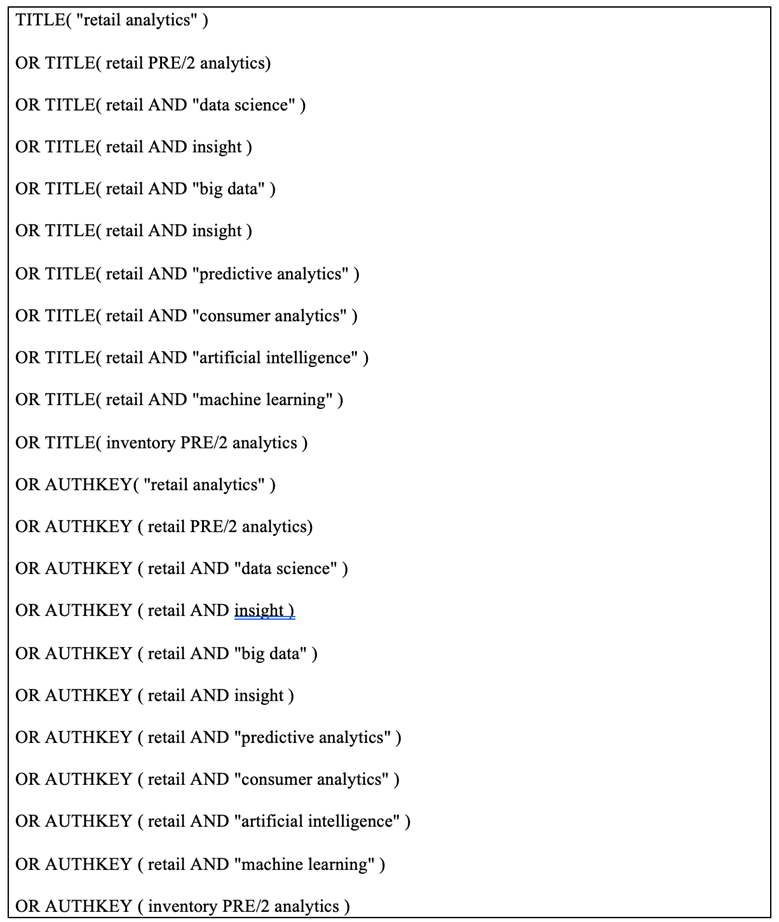
The design of the search string used in Scopus followed an iterative process. Initially, a search was conducted for documents containing “retail analytics” in the title or author keywords without any time restriction. A manual analysis of the titles, author keywords, and index keywords from each retrieved document was performed to identify additional terms and refine the Scopus search operators. Each time a new term or variation of the search operators was identified, it was incorporated into the search string, and the search and analysis processes were repeated. This process continued until no new terms were found. The final search string is presented in Fig. 1.
Inclusion and exclusion criteria were established to ensure the relevance and quality of the selected documents. The inclusion criteria encompassed peer-reviewed articles, conference papers, and book chapters. Exclusion criteria eliminated any articles that fell outside the scope of RA.
The search string presented in Fig. 1 was applied on Scopus on August 2, 2024, retrieving 635 documents. A time restriction was used during the screening phase to focus the analysis on the last ten years, excluding 46 papers published before 2014. The titles and abstracts of the remaining 582 papers published since 2014 were reviewed during the eligibility phase. As a result, 26 papers were excluded for being irrelevant to RA. The final database consists of 563 documents.
2.2. Data Treatment
In line with widely accepted practices in the lierature, bibliographic data from Scopus was downloaded in CSV format for further analysis. The dataset included document titles, abstracts, author and index keywords, author affiliations, source titles, and bibliographies. To ensure the data was accurate and consistent, a combination of computational methods and manual adjustments was applied to the dataset, including:
- Converting text to uppercase.
- Changing British spelling to American.
- Eliminating extra spaces within strings.
- Standardizing hyphenated terms.
During the data treatment phase, different text analysis techniques were applied to improve the dataset for the analysis. The most essential applied process was the extraction of noun phrases from titles and abstracts. A new column titled “descriptors” was added to enable more in-depth analysis, consolidating noun phrases, author keywords, and index keywords. This “descriptors” column played a crucial role in identifying the emergent themes within the literature.
Next, a cleaning process was applied to the “descriptors” column. This process aimed to identify and unify “conceptual synonyms,” representing the same idea or concept. This phase was particularly challenging due to the large volume of terms that needed to be analyzed and standardized. By consolidating these conceptual synonyms, the analysis became more cohesive and accurate, allowing for more precise identification of emergent topics and ideas within the literature.
2.3. Data Analysis
Key bibliometric performance indicators have been computed and presented for the curated database of selected documents. These indicators, which assess the impact and influence of the publications, are based on the methodologies outlined by Aria & Cuccurullo [12] and Donthu et al. [13].
The detection of emerging topics, presented in Section 3.9, is closely linked to the concept of emergence, as discussed in the literature on innovation in science and technology [14], [15]. This study applies this concept to identify RA topics that are objectively gaining attention in current research. Emergence is defined by four key elements: novelty, persistence, community, and growth. Ten years is typically analyzed to detect emerging themes. The first three years serve as the base period, while the following seven years comprise the active period, with the last three years representing the recent period. The parameters used in this analysis are as follows:
Novelty: A topic that could have been more present or received more attention during the base period. The descriptor appears in less than 15% of the records from the base period.
Persistence: The topic has been studied over multiple periods and holds some significance. The descriptor appears in at least seven documents and spans three or more periods (not necessarily consecutive).
Community: Two or more independent research groups address the topic, indicating its importance to the academic community. As a criterion, two or more organizations must independently study the subject.
Growth: There is increasing interest in the topic within the academic community. As a criterion, the growth in research during the recent period must be at least double that of the base period.
Once emerging descriptors are identified, the Louvain clustering algorithm is applied to extract the corresponding themes. The values of these parameters are based on the works of Garner et al. [15] and Porter et al. [14].
3. Results
This section presents the basic bibliometric indicators of the analyzed dataset on RA.
3.1. Publication Trend
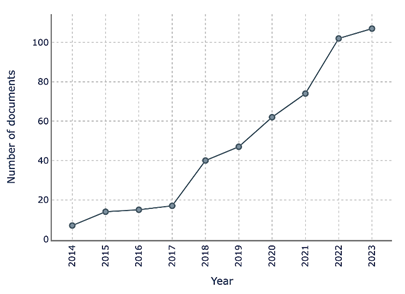
Over the past decade, there has been a notable increase in interest in RA, as evidenced by the steady rise in the number of publications per year. Fig. 2 plots the number of documents published by year. In 2014, there were only seven publications on the topic, but by 2023, this number had escalated to 107. The data demonstrates a consistent upward trajectory, with an annual growth rate of 49.0%. The number of documents surged from 17 in 2017 to 102 in 2022, reflecting RA's growing importance and relevance in academic and practical domains. The data for 2024 is partial, and this year is not included in the plot.
3.2. Leading Scopus Subject Areas
This section presents an analysis based on the subject areas provided by Scopus. These subject areas are assigned to the document sources and not individually to the papers. Subject areas can indicate the disciplines involved in the research about RA. The 563 papers used in this research are associated with 20 subject areas (Scopus has a total of 27), and five subject areas are associated with 47 or more documents. The leading subject areas are:
3.3. Cited References
The 563 documents selected for this analysis cite 20,017 documents (12,591 of them in Scopus). The most cited sources include the Journal of Retailing and Consumer Services (301 documents), the Journal of Business Research (249 documents), Expert Systems with Applications (184 documents), Management Science (160 documents), and the Journal of Retailing (145 documents).
It is interesting to note that other documents in the same database reference 117 papers from within the database, and 15 of these papers are cited by at least 5. The most locally cited papers include the works of Huber and Stuckenschmidt [16], Pillai et al. [17], and Weber and Schütte [18]. Using machine learning methods, The work of Huber and
Stuckenschmidt [16] addresses demand forecasting challenges on special calendar days for a bakery chain. This paper demonstrates that classification approaches outperform regression-based methods in accuracy and suitability for large-scale retail demand forecasting scenarios.
Pillai et al. [17] explore the antecedents of consumer intention to shop at AI-powered automated retail stores, integrating the Technology Readiness and Acceptance Model with AI-specific constructs like perceived enjoyment, customization, and interactivity. Based on a survey of 1250 consumers, this research reveals that innovativeness, optimism, perceived ease of use, and perceived usefulness significantly predict shopping intention, while insecurity negatively affects perceived usefulness.
The study by Weber and Schütte [18] explores the current application of AI in the retail industry, focusing on value-added core tasks. Through scientific database searches and an empirical analysis of the ten largest international retail companies, it is found that AI adoption varies widely. While AI is highly developed in areas like marketing and replenishment, where forecasting is crucial, market adoption ranges from extensive integration to little or no usage. This research is one of the first to analyze AI's impact across core retail processes.
3.4. Similarity among Scopus subject areas
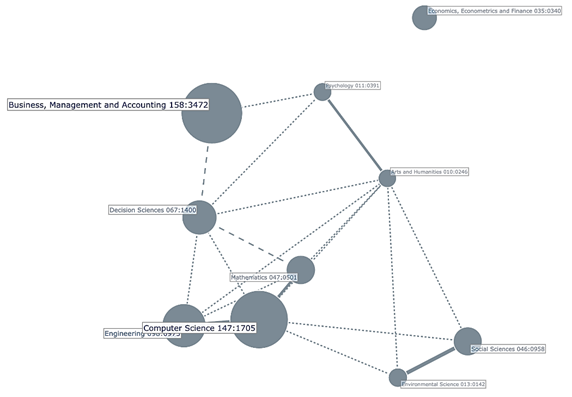
Fig. 3 presents a cross-correlation map of the subject areas in Scopus crossed with the cited journals. This map offers a perspective of how the publications are interrelated regarding the subject areas. The numbers following the subject area name represent the number of documents and citations. The links between nodes represent similarity. The size of the nodes is proportional to the number of records. The map shows a well-connected research area, with a unique isolated node corresponding to the “Economics, Econometrics, and Finance” subject area.
3.5. Leading Countries
The inspection of the dataset reveals that the documents are authored in institutions located in 79 countries. The leading countries are India (with 125 papers), the United States (78), China (59), and the United Kingdom (56). The rest of the countries have 36 published documents or less.
3.6. Leading Institutions
Another perspective on the dataset can be gained by analyzing the authors' affiliations. The dataset includes 883 different institutions. The leading contributors are Maynooth University (Ireland), with eight papers, followed by the University of Applied Sciences Upper Austria (Austria) and Amity University (India), each with six papers. Additionally, the University of Duisburg-Essen (Germany), University of Bristol (UK), Dublin City University (Ireland), Massachusetts Institute of Technology (USA), and University of Moratuwa (Sri Lanka) each contributed five papers.
3.7. Leading Publication Sources
The 563 documents in this dataset were published across 395 different sources. The top sources are the Journal of Retailing and Consumer Services (18 papers), Lecture Notes in Networks and Systems (14 papers), Lecture Notes in Computer Science (10 papers), the International Journal of Retail and Distribution Management (9 papers), ACM International Conference Proceeding Series (9 papers), and Advances in Intelligent Systems and Computing (8 papers). All other sources have published five or fewer documents.
3.8. Most Cited Documents
Table 1 presents the papers with the ten highest global and ten highest local citations. It includes citation indicators for 16 papers. The two rank columns show the position of each paper when considering all the documents analyzed in the study. Notably, four papers [17,19-21] appear globally and locally cited.
Table 1 Most Cited Documents in Retail Analytics.
| Title | Authors | Document Type | Rank Global Citations | Global Citations | Rank Local Citations | Local Citations |
|---|---|---|---|---|---|---|
| Shopping intention at AI-powered automated retail stores (AIPARS) | Pillai et al. [17] | Article | 1 | 201 | 2 | 13 |
| A study on investments in the big data-driven supply chain, performance measures Stuckenschmidt [*142*] and organizational performance in Indian retail 4.0 context | Gawankar et al. [19] | Article | 2 | 130 | 7 | 6 |
| Shopping with a robotic companion | Bertacchini et al. [20] | Article | 3 | 127 | 4 | 9 |
| Big data analytics and demand forecasting in supply chains: a conceptual analysis | Hofmann and Rutschmann [22] | Article | 4 | 111 | 16 | 4 |
| Consumer engagement via interactive artificial intelligence and mixed reality | Sung et al. [23] | Article | 5 | 103 | 52 | 1 |
| Drivers and impact of big data analytic adoption in the retail industry: A quantitative investigation applying structural equation modeling | Lutfi et al. [24] | Article | 6 | 95 | 27 | 3 |
| Retail business analytics: Customer visit segmentation using market basket data | Griva et al. [25] | Article | 7 | 91 | 11 | 5 |
| Agent-Based Modeling of Retail Electrical Energy Markets with Demand Response | Dehghanpour et al. [26] | Article | 8 | 91 | 117 | 0 |
| Indian shopper motivation to use artificial intelligence: Generating Vroom’s expectancy theory of motivation using grounded theory approach | Chopra [21] | Article | 9 | 87 | 5 | 8 |
| Retail sales forecasting with meta-learning | Ma and Fildes [27] | Article | 10 | 86 | 12 | 5 |
| Daily retail demand forecasting using machine learning with emphasis on calendric special days | Huber and Stuckenschmidt [16] | Article | 11 | 80 | 1 | 16 |
| State-of-the-art and adoption of artificial intelligence in retailing | Weber and Schütte [18] | Article | 18 | 70 | 3 | 12 |
| Revolution of Retail Industry: From Perspective of Retail 1.0 to 4.0 | Har et al. [28] | Article | 32 | 49 | 8 | 6 |
| Artificial intelligence in retail: applications and value creation logics | Cao [29] | 40 | 43 | 6 | 8 | |
| Low-cost embedded system for increasing retail environment intelligence | Pierdicca et al. [30] | 49 | 37 | 9 | 6 | |
| Incorporating big data within retail organizations: A case study approach | Aversa et al. [31] | Article | 58 | 31 | 10 | 6 |
Source: The authors.
Gawankar et al. [19] investigate how big data-driven retail supply chains in the Indian Retail 4.0 context influence supply chain and organizational performance. Through a survey of 380 respondents from Indian retail organizations, the research highlights the importance of governance structure and provides insights for planning big data analytics investments.
Bertacchini et al. [20] present a robotic shopping assistant with a cognitive architecture to study human-robot interaction in smart retail settings. Using machine learning systems and social robotics, the robotic assistant interacts socially with customers, influencing shopping behavior by recognizing emotional states and providing human-like companionship. Thus, it enhances customer acceptance of advanced technologies.
Hofmann and Rutschmann [22] examine the role of big data analytics in enhancing demand forecasting accuracy within retail supply chains. The study develops a conceptual framework combining scientific literature and industry knowledge, illustrating how integrating different data sources in demand forecasting can guide meaningful big data analytics initiatives. It emphasizes the need for data scientists and appropriate technological foundations.
Sung et al. [23] investigate consumer responses to an AI-embedded mixed reality exhibit in a retail/entertainment complex. Findings reveal that the quality of AI, such as speech recognition and machine learning, enhances mixed reality immersion, leading to increased consumer engagement and purchase intentions. The study highlights the potential of interactive AI and mixed reality technologies to open new avenues for consumer engagement.
The work of Lutfi et al. [24] explores the drivers and impact of big data analytics (BDA) adoption in the retail industry in Jordan, utilizing the technology-organization-environment framework and resource-based view theory. Findings indicate that factors like relative advantage, organizational readiness, and top management support significantly influence BDA adoption, which, in turn, positively impacts firm performance.
Griva et al. [25] propose a business analytics approach based on market basket data for customer visit segmentation. The study identifies shopping missions behind visits and suggests a semi-supervised feature selection approach to enhance data mining results. The approach is demonstrated in a real case with a significant European FMCG retailer, supporting decisions on marketing campaigns, store layout redesign, and product recommendations.
Dehghanpour et al. [26] study the behavior of a retail electrical energy market with demand response from air conditioning loads through a hierarchical multi-agent framework using a machine learning approach. The model optimizes retail prices and consumption patterns, maintaining consumer data privacy. Simulation results show reduced overall power consumption costs and maximized retailer profit, with implications for managing peak loads under high penetration of photovoltaic power.
Chopra [21] explores the motivation of young Indian consumers to use AI tools like chatbots and voice assistants in shopping. Using a grounded theory approach, the study generates Vroom's expectancy theory and finds that motivation to use AI tools is driven by factors like ease of use, tool competence, and satisfaction. The findings have substantial implications for retailers in developing countries.
Ma and Fildes [27] introduce a meta-learning framework for retail sales forecasting. The framework uses deep convolutional neural networks to learn feature representations from raw sales time series data. It combines base forecasting methods and shows superior performance compared to state-of-the-art benchmarks. The study suggests building a pool of base forecasters for optimal combination forecasts, though challenges remain with feature interpretability.
3.9. Exploring Emerging Topics
3.9.1. Emerging Topics
As previously discussed, descriptors (a combination of noun phrases, author, and index keywords) were prepared for analysis using text analysis techniques. By applying the concept of technology emergence indicators, 131 descriptors demonstrating a notable acceleration in research attention were identified. Table 2 shows the 40 most frequent emergent descriptors, which include a mix of terms related to consumers, AI, ML, and retail issues. Some general terms, such as “management” and “insights,” are also included, though they are less informative in context.
Table 2 Highly emerging terms.
| Emergent Term | Records | Emergent Term | Records |
|---|---|---|---|
| Artificial Intelligence | 350 | Data Analytics | 31 |
| Retail Industry | 111 | Random Forest | 31 |
| Prediction | 78 | Customer Experience | 29 |
| Retail Organizations | 75 | Insights | 28 |
| Retail Sector | 70 | Analytics | 26 |
| Learning Systems | 53 | Decision Trees | 26 |
| Electronic Commerce | 50 | Internet of Things | 25 |
| Decision Making | 49 | Classification | 25 |
| Consumer Behavior | 44 | Retail Location | 22 |
| Supply Chain | 37 | Covid 19 | 21 |
| Neural Network | 36 | Management | 21 |
| Predictive Analytics | 36 | Customer Satisfaction | 21 |
| Learning | 35 | Demand Forecasting | 21 |
| Deep Learning | 34 | Supply Chain Mgmt | 20 |
| Customers | 34 | Digital Transformation | 19 |
| Retail Sales | 33 | Information Systems | 19 |
| Commerce | 33 | Data Science | 19 |
| Customer Behavior | 33 | Social Media | 18 |
| On-line Retailers | 32 | Competition | 18 |
| Data Mining | 32 | Sales Forecasts | 18 |
Source: The authors.
Table 3 presents four dimensions of analysis (journals, countries, organizations, and authors) related to the emergent topics. This table was generated using only the database documents containing the emergent topics. It lists the ten most frequent and cited items within each dimension.
Table 3 Dimensions for analysis of emerging topics.
| Journals | Rank Occurrences | Occurrences | Rank Citations | Citations |
|---|---|---|---|---|
| Journal of Retailing and Consumer Services | 1 | 18 | 1 | 632 |
| Lecture Notes in Networks and Systems | 2 | 14 | 56 | 25 |
| Lecture Notes in Computer Science | 3 | 10 | 16 | 79 |
| ACM International Conference Proceeding Series | 4 | 9 | 42 | 37 |
| International Journal of Retail and Distribution Management | 5 | 8 | 3 | 232 |
| Advances in Intelligent Systems and Computing | 6 | 8 | 74 | 18 |
| Sustainability (Switzerland) | 7 | 5 | 12 | 95 |
| Lecture Notes in Electrical Engineering | 8 | 5 | 92 | 12 |
| International Journal of Production Research | 9 | 4 | 2 | 246 |
| Procedia Computer Science | 10 | 4 | 13 | 93 |
| Annals of Operations Research | 19 | 3 | 9 | 116 |
| International Journal of Information Management | 29 | 2 | 4 | 182 |
| European Journal of Operational Research | 30 | 2 | 5 | 162 |
| Computers in Human Behavior | 31 | 2 | 6 | 148 |
| International Journal of Logistics Management | 32 | 2 | 7 | 131 |
| International Journal of Physical Distribution and Logistics Management | 33 | 2 | 8 | 118 |
| Expert Systems with Applications | 34 | 2 | 10 | 99 |
| Countries | ||||
| India | 1 | 124 | 2 | 1131 |
| United States | 2 | 69 | 1 | 1190 |
| China | 3 | 56 | 5 | 429 |
| United Kingdom | 4 | 51 | 3 | 1020 |
| Germany | 5 | 35 | 4 | 497 |
| Italy | 6 | 20 | 6 | 412 |
| Canada | 7 | 20 | 8 | 188 |
| Russia | 8 | 18 | 25 | 63 |
| Brazil | 9 | 14 | 7 | 215 |
| Ireland | 10 | 13 | 9 | 188 |
| Hong Kong | 21 | 7 | 10 | 177 |
| Organizations | ||||
| Maynooth Univ. (IRL) | 1 | 8 | 9 | 129 |
| Univ. of Appl. Sciences Upper Austria (AUT) | 2 | 6 | 5 | 158 |
| Amity Univ. (IND) | 3 | 6 | 36 | 76 |
| Univ. of Bristol (GBR) | 4 | 5 | 14 | 107 |
| Dublin City Univ. (IRL) | 5 | 5 | 37 | 76 |
| Massachusetts Inst. of Technol. (USA) | 6 | 5 | 58 | 55 |
| Univ. of Moratuwa (LKA) | 7 | 5 | 204 | 14 |
| Univ. of Duisburg-Essen (DEU) | 8 | 4 | 20 | 100 |
| Univ. of Tennessee (USA) | 9 | 4 | 33 | 81 |
| Univ. of Bologna (ITA) | 10 | 4 | 59 | 55 |
| Swansea Univ. (GBR) | 37 | 2 | 1 | 242 |
| Montana State Univ. (USA) | 38 | 2 | 4 | 194 |
| Univ. of Mannheim (DEU) | 39 | 2 | 6 | 156 |
| Pune Inst. of Bus. Manag. (IND) | 116 | 1 | 2 | 201 |
| Sri Balaji Univ. (IND) | 117 | 1 | 3 | 201 |
| California State Univ. (USA) | 118 | 1 | 7 | 130 |
| Nac. Inst. of Ind. Eng. (NITIE) (IND) | 119 | 1 | 8 | 130 |
| Università della Calabria (ITA) | 120 | 1 | 10 | 127 |
| Authors | ||||
| Razmochaeva N.V. | 1 | 7 | 117 | 46 |
| Bezbradica M. | 2 | 5 | 57 | 76 |
| Cirqueira D. | 3 | 5 | 58 | 76 |
| Helfert M. | 4 | 5 | 59 | 76 |
| Klionskiy D.M. | 5 | 5 | 240 | 21 |
| Griva A. | 6 | 4 | 12 | 122 |
| Frontoni E. | 7 | 4 | 17 | 103 |
| Pantano E. | 8 | 4 | 20 | 103 |
| Frazzon E.M. | 9 | 3 | 15 | 106 |
| Pereira M.M. | 10 | 3 | 16 | 106 |
| Huber J. | 33 | 2 | 4 | 156 |
| Stuckenschmidt H. | 34 | 2 | 5 | 156 |
| Dwivedi Y.K. | 137 | 1 | 1 | 201 |
| Pillai R. | 138 | 1 | 2 | 201 |
| Sivathanu B. | 139 | 1 | 3 | 201 |
| Gawankar S.A. | 140 | 1 | 6 | 130 |
| Gunasekaran A. | 141 | 1 | 7 | 130 |
| Kamble S. | 142 | 1 | 8 | 130 |
| Bertacchini F. | 143 | 1 | 9 | 127 |
| Bilotta E. | 144 | 1 | 10 | 127 |
Source: The authors.
3.9.2. Clustering the Emerging Topics
The emergent descriptors were clustered into themes using a recursive version of the Louvain algorithm. The key objective of this process was to identify emergent themes for further analysis. Table 4 presents the 12 themes identified. They are analyzed in the next section. The themes of “retail sales prediction,” “AI-driven consumer insights,” and “consumer behavior and price dynamics” dominate the table.
Table 4 Emergent topics clusters.
| Cluster Name | Num Terms | Percentage | Main Terms |
|---|---|---|---|
| Retail Sales prediction | 9 | 12.5 | Prediction; Retail Sales; Sales Forecasts; Sales Data; Time Series; Retail Trade; Strategic Decisions; Sales Promotions; Sales Prediction |
| AI-Driven Customer Insights | 9 | 12.5 | Artificial Intelligence; Retail Industry; Retail Organizations; Customer Satisfaction; Artificial Intelligence Technology; Computer Vision; Experience; Information Technology; Business Performance |
| Consumer Behavior and Price Dynamics | 8 | 11.1 | Consumer Behavior; Insights; Retail Operators; Data Sets; Consumption Behaviors; Customer Engagement; Price Dynamics; Pricing |
| ML for Predictive Modeling | 7 | 9.7 | Random Forest; Decision Trees; Retail Location; Logistic Regression; Predictive Models; Support Vector Machine; Boosting |
| AI-driven Retail Performance | 7 | 9.7 | Learning Systems; Neural Network; Deep Learning; Convolutional Neural Networks; Radio Frequency Identification; Performance Metrics; Supervised Learning |
| Data-Driven Social and Consumer Dynamics | 6 | 8.3 | Social Media; Consumer; Retail Banks; Finance; Robots; Retail Data |
| Customer-Centric Data-Driven Strategies | 6 | 8.3 | Customers; Data Mining; Customer Relationship Management; Business Analytics; Electronic Commerce Websites; Mobile Devices |
| Consumer-Centric Experience | 5 | 6.9 | Customer Experience; Management; Customer Service; Customer Data; Consumer Data |
| Predictive Customer Behavior Systems | 5 | 6.9 | Customer Behavior; Information System; Recommender Systems; Transaction Data; Customer Demands |
| Predictive Customer Behavior Systems | 4 | 5.6 | Decision Making; Decision Support Systems; Decisions; Efficiency |
| Human-Centered Business Process Strategy | 3 | 4.2 | Strategy; Business Processes; Human Resource Managers |
| Fashion Analytics | 3 | 4.2 | Data Science; Data Analysis; Fashion |
Source: The authors.
4. Discussion
4.1. Retail Sales Prediction
The emergent cluster uses predictive analytics, particularly time series forecasting, to enhance retail sales strategies. Predictive models, built on historical sales data, external factors like weather, and promotional events, enable retailers to make informed decisions about inventory management, supply chain operations, and sales promotions [22,32-34]. Accurate forecasting is essential for optimizing stock levels, mitigating demand uncertainty, and aligning product availability with expected sales, reducing risks of overstocking or stockouts [35-39]. Studies highlight that integrating advanced machine learning techniques improves sales pattern identification and seasonality forecasting, supporting strategic decisions and maximizing the effectiveness of sales promotions [39-43]. Furthermore, these models help retailers navigate fluctuating market conditions, improving long-term viability, customer satisfaction, and competitive positioning through better inventory and promotional strategies [35,44-46]. Thus, predictive analytics is pivotal in driving retail performance by minimizing uncertainty and enhancing decision-making [38,45].
4.1.1. AI-Driven Customer Insights
The second emergent cluster emphasizes the transformative role of AI in enhancing customer satisfaction and optimizing business performance in the retail industry through various advanced technologies, including computer vision, machine learning, and data-driven insights [47-49]. AI enables personalized shopping experiences by automating decision-making processes and providing tailored recommendations, fostering stronger consumer-brand relationships [48-50]. This technology significantly improves operational efficiency, particularly in areas like inventory management, customer engagement, and product displays, which positively affect profitability and customer retention [51,52]. However, the ethical challenges AI poses, such as privacy concerns and trust, highlight the need for Corporate Digital Responsibility (CDR) to ensure that AI is used responsibly and ethically [53]. While AI improves business performance, it must do so within an ethical framework that addresses performance risks and fosters trust between consumers and AI-driven systems [53,54]. Overall, AI's integration into retail is critical for maintaining a competitive edge, enhancing both the customer experience and operational outcomes, but it requires balancing technological advancements with ethical considerations [49,55,56].
4.2. Consumer Behavior and Price Dynamics
This cluster integrates insights into consumer behavior, pricing dynamics, and customer engagement, highlighting the growing importance of data-driven strategies in the retail sector. Retail operators leverage large data sets and real-time data to analyze consumption patterns and adjust pricing strategies, enhancing profitability and customer satisfaction [57-59]. The integration of ML and AI further enables retailers to predict consumer behavior, optimizing pricing decisions and engagement strategies [60]. Studies emphasize how inflation and external economic stressors, like the COVID-19 pandemic, impact consumer price sensitivity and reshape consumption behaviors, underscoring the need for adaptable pricing mechanisms [61,62]. By aligning pricing strategies with consumer engagement and behavioral insights, retailers can remain competitive, ensuring customer satisfaction and operational efficiency [63-65]. Empirical research, such as studies on Dutch consumers during the pandemic, illustrates how shifts in price elasticity for essential and non-essential goods drive pricing adjustments, further supporting the role of real-time data in strategic decision-making [62].
4.3. ML for Predictive Modeling
This emergent cluster centers on integrating predictive modeling techniques, particularly machine learning algorithms like Random Forests, Decision Trees, and Support Vector Machines, to enhance decision-making processes in retail analytics. These models are pivotal for predicting customer behavior, optimizing retail locations, and managing customer churn, improving operational efficiency and sales forecasting [35,66,67]. These models provide critical insights into demand fluctuations and uncertainties by analyzing promotional pricing, retail location, and customer behavior [33,35]. Ensemble methods, including boosting and logistic regression, further refine predictive accuracy, capture non-linear relationships, and enhance performance in applications like fraud detection and inventory management [36,68]. Incorporating geographic information systems (GIS) into predictive models allows for practical spatial analysis, helping retailers identify key variables influencing store success [69]. Overall, this thematic focus highlights the transformative role of machine learning in retail, enabling businesses to leverage data-driven insights for strategic planning, resource allocation, and improved customer experiences [70-72].
4.4. AI for Retail Optimization and Operation
The cluster emphasizes the integration of advanced learning systems, particularly neural networks and deep learning techniques like convolutional neural networks (CNNs), to enhance operational efficiency and decision-making in retail environments. This thematic area explores the application of supervised learning models, focusing on optimizing tasks such as demand forecasting, inventory management, and customer behavior analysis. For instance, Radio Frequency Identification (RFID) systems with CNNs improve real-time inventory accuracy and customer tracking, enhancing responsiveness and strategic decision-making [73], [74]. Additionally, deep learning systems process real-time data to analyze consumer traffic and emotional responses, providing insights crucial for optimizing store design and marketing strategies [75,76]. The convergence of these advanced machine-learning techniques supports the development of predictive models that enhance retail operations' reliability and performance metrics and quantify the efficiency and effective learning systems in retail applications [77,78].
Moreover, the convergence of these intelligent systems drives innovations in customer behavior prediction, inventory management, and resource allocation, demonstrating a transformative shift toward more intelligent retail operations [75,79]. By continually adapting to retail demands, AI-driven learning systems facilitate enhanced decision-making and operational precision, pushing the boundaries of traditional retail through innovative technological advancements [80-82]. Thus, this thematic cluster represents a critical intersection of machine learning techniques and retail performance metrics, fostering data-driven insights and predictive capabilities essential for modern retail success.
4.5. Data-Driven Social and Consumer Dynamics
The seventh thematic cluster emphasizes the integration of AI, social media, consumer behavior, and robotics within the retail finance sector. Social media serves as a crucial consumer data source, enabling retailers and banks to understand preferences, enhance engagement strategies, and deliver personalized experiences based on consumer behavior [83]. AI technologies, including autonomous decision-making systems and chatbots, facilitate improved interactions, shaping consumer trust and influencing purchasing decisions [56]. The deployment of robotic automation in retail processes further enhances efficiency by analyzing large consumer datasets and automating tasks, thus optimizing customer interactions and financial transactions [84,85]. Integrating retail data with advanced automation reflects a significant shift towards personalized service delivery and operational effectiveness. This suggests that the convergence of consumer insights from social media and robotics is redefining the retail-finance relationship [6,86]. However, challenges related to the accuracy, security, and psychological impacts of AI and automation remain, particularly in finance, necessitating careful management of consumer trust and reliability issues [70,87]. This cluster illustrates the growing reliance on technology-driven strategies to enhance retail bank performance and consumer retention [88,89].
4.6. Customer-Centric Data-Driven Strategies
The eighth thematic cluster emphasizes the integration of data mining and business analytics with Customer Relationship Management (CRM) systems to enhance customer engagement, mainly through electronic commerce websites and mobile devices [51]. Businesses can develop personalized marketing strategies and optimize customer journeys by leveraging customer data from diverse sources. This integration allows anticipating customer preferences and improving acquisition, retention, and overall customer satisfaction [90]. Supported by predictive analytics, CRM systems facilitate real-time insights that enhance engagement strategies and foster brand loyalty [74]. Additionally, mobile devices are essential platforms for continuous customer interaction, enabling businesses to tailor experiences based on real-time data collection [85]. The development of predictive models further aids in creating dynamic feedback loops, driving personalized offerings, and strengthening customer relationships [91]. This cluster highlights the significant role of technology in managing customer relationships and optimizing marketing performance through data-driven insights and advanced analytics in an increasingly digital marketplace [63,86].
4.7. Consumer-Centric Experience
The cluster emphasizes the strategic integration of customer and consumer data to enhance customer experience and optimize service management. It highlights the evolving role of data-driven decision-making, where businesses leverage vast datasets to forecast consumer behavior and personalize interactions, significantly improving customer satisfaction and retention [1,48,60]. Companies can analyze customer behavior using ML and AI to craft tailored recommendations and refine service strategies for online and brick-and-mortar environments [92,93]. This cluster underscores the necessity of balancing personalization with operational efficiency in service delivery as firms strive to adapt to shifting customer expectations through advanced analytics [94-96]. Additionally, the relationship between customer data management and service optimization is evident, revealing how retailers can create meaningful interactions and foster loyalty by anticipating customer needs and preferences [97,98]. The focus on leveraging consumer insights for informed decision-making reflects a broader trend toward innovative service models that meet the demands of hypercompetitive markets, positioning customer data as a cornerstone of effective business strategies [99,100].
4.8. Predictive Customer Behavior Systems
This cluster emphasizes the critical intersection of customer behavior, information systems, and recommender systems, focusing on leveraging transaction data to predict and respond to customer demands. This integration facilitates the development of advanced recommender systems that analyze past behaviors and real-time interactions to deliver personalized recommendations, enhancing customer satisfaction and optimizing retail strategies [101,102]. The relationship among customer behavior, transaction data, and information systems underscores the importance of accurate data-driven insights for strategic decision-making in rapidly changing retail environments [103,104]. Moreover, these systems address immediate purchasing decisions and refine long-term customer relationship management strategies by forecasting customer needs and aligning product offerings with evolving preferences [105-107]. As businesses increasingly depend on sophisticated predictive models, the utilization of transaction data becomes pivotal in enhancing operational efficiency and maintaining a competitive advantage, ultimately reflecting a significant shift toward customer-centric retail strategies [108-110], [111]. This cluster thus highlights the necessity for robust information systems that can process vast amounts of data to provide actionable insights, ensuring that retailers can effectively respond to dynamic customer demands [101].
4.9. Human-Centered Business Process Strategy
The cluster focuses on the intersection of strategic decision-making, human resource management (HRM), and the optimization of business processes within the context of RA. Central to this cluster is the role of human resource managers in shaping business strategies that drive organizational efficiency and adaptability. As crucial actors in strategic planning, HR managers align workforce capabilities with business objectives, ensuring that human capital is effectively utilized and a driver of process innovation and competitive advantage [112]. This cluster reflects the growing importance of integrating human resources with broader business processes in retail analytics to respond to dynamic market demands and technological advancements [113]. The relationship among these elements highlights a critical view of HRM as not merely administrative but a strategic partner in fostering innovation, improving business performance, and supporting organizational agility, mainly by deploying tailored business processes that maximize workforce potential [114].
4.10. Human-Centered Business Process Strategy
The eleventh thematic cluster delves into the intersection of data science and the fashion industry, highlighting how advanced data analysis, ML and AI revolutionize decision-making processes in fashion supply chains. This cluster emphasizes the utilization of predictive analytics to gain insights into consumer behavior, forecast demand, and optimize inventory management, addressing the complexities of fluctuating customer preferences and product availability. ML facilitates enhanced customer profiling and strategic retail operations, allowing brands to personalize fashion experiences and improve operational efficiency [34,115].
Furthermore, integrating data science into fashion retail promotes sustainability and profitability by streamlining supply chains and reducing waste [116]. Despite the current limitations in research, the potential for data-driven methodologies to transform decision-making is significant, as they help fashion stakeholders—from customers to supply chain managers—navigate the combinatorial explosion inherent in online fashion retail [105]. This cluster underscores the critical balance between technological advancements and the human aesthetic aspects of fashion, raising questions about the role of creativity in a data-centric industry [117]. Ultimately, it positions fashion analytics as a vital area for innovation, fostering consumer loyalty and maximizing sales.
4.11. Fashion Analytics
The last cluster emphasizes the intersection of data science, ML, and fashion retail, where predictive analytics, classification algorithms, and AI play a crucial role in enhancing decision-making processes across customer behavior forecasting, inventory management, and supply chain optimization [98,114,118]. These techniques are vital in predicting customer churn, improving loyalty, and addressing the assortment problem, which involves distributing products across regions with diverse preferences [119]. Data science tools, particularly AI-driven decision support systems, help fashion retailers adapt to dynamic customer needs and market fluctuations by providing personalized experiences and product recommendations [105]. Integrating AI and machine learning is also critical in tackling industry challenges like sustainability, waste reduction, and trend prediction [116]. Despite the transformative potential of these tools, the limited research on customer models highlights a gap in fully leveraging AI's capabilities in fashion retail supply chains [105]. As fashion retailers increasingly adopt data-driven innovation, balancing advanced analytics with cost-effectiveness while ensuring high customer satisfaction remains a central concern [115], positioning data science as a critical driver of competitive advantage in the sector [34,114].
5. Conclusions
RA has emerged as a transformative force, utilizing data-driven insights to enhance various aspects of the retail industry, including operational optimization, personalized customer experiences, demand forecasting, and supply chain efficiency. This bibliometric study, which analyzed 563 documents indexed in Scopus, offers a comprehensive view of the evolution of retail analytics over the past decade. Key findings reveal 131 emerging topics, organized into 13 core trends, including Retail Sales Prediction, AI-Driven Customer Insights, and AI and Machine Learning applications across diverse retail challenges. Additionally, the study provides a detailed examination of publication trends, highlighting leading countries, organizations, authors, and journals in the field. These insights map the current landscape of retail analytics research and point to future directions for innovation and development within the industry.

