




 English (pdf)
 Article in xml format
 Article references
 Automatic translation
 Send this article by e-mail
 Cited by SciELO
  Cited by Google
  Similars in
SciELO
Similars in
SciELO  Similars in Google
 Permalink

1. Introduction
With the development of society, noise has become one of the factors contributing to environmental pollution. Today, we can speak of noise pollution, which affects human health and the environment, making it necessary to counteract its effects.
In most countries, noise is the most common harmful agent in the workplace. Its presence in industrial activities is compounded by its widespread use in urban and social environments, especially during leisure activities. This almost universal spread of noise in social and work environments becomes even more significant when considering that hearing damage is irreversible, and that exposure produces other disorders-organic, physiological, and psycho-emotional-that translate into a clear reduction in the quality of life and health of workers [1].
Various construction companies and businesses have conceived noise reduction as one of the strategies to ensure competitiveness in the market by preserving worker health, customer satisfaction, and environmental integrity paying particular attention to technologies and materials that are capable of keeping noise levels below the standards established in each country, since these factors are currently evaluated by consumers, especially those in demanding markets [2].
Architects and contractors must make a space as aesthetically pleasing and functional as it is acoustically pleasing; this has been framed under the term: architectural acoustics. The design must take into account the acoustic absorption properties of materials to create a desired interior sound environment in the design of buildings, performance halls, recording studios, etc., to achieve favorable moods in a particular enclosed space, which is what is known as acoustic comfort. Acoustic comfort constitutes a state of satisfaction with acoustic conditions, with the opportunity to perform acoustic activities without disturbing other people [3].
In order to comply with this parameter, when designing a work, the materials must be correctly selected according to the purpose and objective of the work. Over time, the materials used in construction have been diversified and improved to achieve better environments, aesthetic, acoustically comfortable, durable and adaptable to the needs of man and the functions for which they are conceived. For the treatment and acoustic conditioning of premises, different types of noise absorbing materials are used, which control interior noises, reverberation time and eliminate echoes; according to the classification of acoustic materials reported in [4], for this research porous absorbent materials (mineral wool panels, polyester fiber) and panel resonators (EchoPanel) were selected, considering their shape, structure and energy absorption coefficient (α ≥ 0.45) to ensure acoustic comfort in the intervened spaces.
To control the reverberation of a room, it is essential to know the behavior of the materials that form or cover the room, defined by the sound absorption coefficient of the material for the different frequencies of the octave band (63 Hz, 125 Hz, 250 Hz, 500 Hz, 1000 Hz, 2000 Hz and 4000 Hz. [5].
Internationally, each country has its own noise regulations where the admissible limits are established. The most generalized criterion is the exposure limit of 85 dBA. In Cuba, the following standards stand out: NC 26 (2007), NC 871 (2011) and Law 81 of the Environment, related to noise. NC 871 (2011) [6], a reference standard for the evaluation of occupational noise, proposes a maximum permissible of 85 dBA (Leq-noise not constant) and 80 NdB (Criterion N-noise constant). Noise is a disturbing agent of city life, especially in large cities and tourist areas. Noise impacts have become a worldwide inconvenience and its effects are not limited to a specific sphere, but affect a wide range of sectors that is increasing every day; its scope is not limited to the manufacturing industry and other traditional sectors, but also to services.
For indoor spaces such as hotel rooms and restaurants, NC 26:2007 - 'Residential areas and public spaces' - sets stricter limits (e.g., 50 dB(A) for the nighttime period in bedrooms) than the occupational limits of NC 871:2011. Furthermore, Law 81/97 'On the Environment' provides the legal framework to protect citizens from noise pollution, reinforcing the need for these interventions.
The parameter of acoustic comfort has a significant value in the service sector and specifically in tourism activities where customer satisfaction is a determining factor. This is evidenced by [7], when expressing that acoustic comfort has become one of the main demands for hotel customers.
At present, Cuban tourism is very demanding, demanding privacy, a quiet and silent space where they can rest and disconnect from their daily tasks and the stress of work, so hotels must have acoustic solutions to avoid uncomfortable situations. However, the tourism sector in Cuba faces an environment of noise pollution due to a reality that ranges from problems of technological obsolescence to social indiscipline according to [8]. Many times, the lack of materials, resources and even culture and knowledge, have caused buildings to be destined or conceived for certain purposes, without studying if they comply with all the established quality and safety requirements. The design of hotels and the culture of their workers have a decisive influence on the presence of noise [9].
In addition to the identified structural problems, the proposal is based on decision-making criteria such as the hotel management's interest in improving customer satisfaction, the feasibility of investing in sustainable acoustic solutions, and legal compliance under Environmental Law 81/97 and Cuban regulations NC 26:2007 and NC 871:2011, which is crucial in a competitive tourist destination like Varadero.
The tourist destination of Varadero is one of the most affected by noise. The Be Live Experience Tuxpan Hotel, which has been in operation for 31 years, stands out as one of the most affected by noise pollution. Acoustic measurements made by [10] yielded values of 89.0 dB(A) in the pool snack bar during show hours, 87.3 dB(A) in the Cristal buffet restaurant, 68.5 dB(A) in rooms 313, 315, 317 and 319 during the hours of the La Bamba discotheque, which exceed the normed limits in all cases and have repercussions on the image of the identity. Therefore, this hotel was selected as the object of study of this research.
Hence, the objective was: to design intervention solutions that guarantee regulatory standards for acoustic comfort in the facilities of the Be Live Experience Tuxpan Hotel.
2. Materials and Method
In order to meet the objective of the research, this section presents the procedure to diagnose the acoustic comfort in the affected areas of the Be Live Experience Tuxpan hotel with the purpose of designing feasible solutions with suitable noise absorbing materials. A methodology based on the one proposed by [8] is elaborated, with modifications that allow its application in these spaces.
The characterization of the premises is carried out taking into account the following criteria:
Description of the materials covering the premises.
Explanation of the activities that take place in each room.
Identification of the type of noise and the source.
Measurement of existing noise levels using a certified sound level meter, recording continuous equivalent levels (Leq) by frequency.
Define permissible noise levels according to NC 871 (2011).
Basis of the constructive state of the premises.
Explanation of the relationship between the constructive technical condition and the generation of noise.
For the acoustic treatment of premises, the following procedure is proposed, taken from [8], with some modifications given by the inclusion of the calculation of the reverberation time before and after the design as a parameter of effectiveness of the measure.
Step # 1: calculation of reverberation time.
From a search of the expressions for the calculation of the reverberation time, the ones proposed by [11] were detected.

Where:
Tr: Reverberation time [s]
V: Room volume [m³]
Atot: Total absorption [sabino]
M: Sound attenuation constant in air [m−1].
Sound attenuation in air (M), is calculated as follows:

Where:
γ: attenuation in air in dB/100 m .
The total absorption is calculated:

Where:

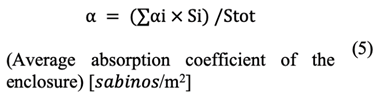
α = absorption coefficient of surface “i”
Si = area of surface “i” [m2]
Step # 2: determine the sound pressure level to be attenuated (NR).

Where:
NR: reduction level [dB].
Lex: existing sound pressure level [dB].
Lrec: recommended sound pressure level [dB].
Step # 3: Determine the material to be used.


Where:
A2: equivalent absorption of the room after treatment [sabinos].
St: treated area [m2].
Aat: absorption of the area to be treated before treatment [sabinos].
αt: absorption coefficient required for treatment [sabinos/m2].
In this step, αt is cleared. Its result will tell the material to be selected based on that absorption coefficient.
Step # 4: determine the optimum area to be coated (AOR).


Where:
AOR: optimum area to be coated [m2].
αr: reduction absorption coefficient [sabinos/m2].
αat: absorption coefficient of the treated surface material before treatment [sabinos/m2].
The AOR determines the amount of m2 that need to be coated with the selected material to comply with the NR.
Highlight in this case that:
When performing the calculation of A2 and Atot all objects in the room must be taken into account.
The absorption coefficient of open windows and doors is 1 sabino/m2.
One person absorbs approximately 0.57 sabinos/m2.
Step # 5: recalculation of the reverberation time.
Step # 6: calculation of the decrease in reverberation time.

Where:
ΔRT: decrease in reverberation time [s].
RTa: reverberation time before treatment [s].
RTd: reverberation time after treatment [s].
The software used for the plan and 3D design of the rooms are AutoCAD and SketchUp, both in their 2021 version.
3. Results
Based on the proposed methodology, the areas identified as critical by [10] were characterized. For a clear and systematic comparison, Table 1 consolidates the initial acoustic conditions of each intervened area.
Table 1 Comparative acoustic characterization of the study areas prior to the intervention.
| Variable | Rooms 313, 315, 317, 319 | Snack-bar Pool | Buffet Restaurant Glass |
|---|---|---|---|
| Covering Materials | Concrete walls, sliding door with acoustic duplex glass, concrete ceiling, ceramic floor. | Concrete walls, wooden plateau, tile ceiling with plasterboard false ceiling, columns and wooden beams, ceramic floor. | Concrete walls, glass walls with metal edges, concrete columns, tiled countertops, plasterboard false ceiling, ceramic slab floor. |
| Function | Standard room (max. 2 clients). | Service of drinks and snacks. | Buffet service (breakfast, lunch, dinner). |
| Noise Source & Type | La Bamba discotheque (non-constant). Located below the rooms. | Audio amplification equipment during shows (non-constant). | Handling of crockery/cutlery, verbal communication, kitchen area noise (non-constant). |
| Permissible Level (dB(A)) | 50 | 70 | 50 |
| Existing Level (dB(A)) | 68.5 | 89 | 87.3 |
| Tr Before (s) | 1.33 | 0.26 | 0.63 |
| Construction Condition | Good | Good | Good |
Source: own elaboration.
As evidenced in Table 1, all areas studied exhibited sound pressure levels that exceeded the permissible limits established by NC 871:2011, confirming the impact of noise pollution. It should be noted that, although the construction condition of the premises is good, the lack of specific insulating and absorbent elements limits their ability to guarantee acoustic comfort. Furthermore, the reverberation time (Tr) in the rooms (1.33 s) significantly exceeds the value recommended for residential spaces (<1 s), which worsens noise perception and affects sleep quality.
3.1. Rooms 313, 315, 317 and 319
Covering materials: Enclosed space. Concrete walls, sliding door to the balcony of acoustic duplex glass, concrete ceiling, ceramic floor.
Function: Standard room with a maximum capacity of 2 clients per room.
Type of noise and source: Non-constant noise, which attacks the tranquility and disturbs guests' sleep, caused by the La Bamba discotheque that operates at night from 11:00 pm - 4:00 am, only on Saturdays, and provides services to both hotel guests and external clients. The discotheque is located below these rooms, and the vibrations and sounds are highly perceptible.
Permissible noise levels according to NC 871 (2011): 50 dB
Existing noise levels: The affected frequencies are: 250, 500, 1000 and 2000 Hz with 60 dB, 72 dB, 73 dB respectively. (Most affected rooms 317 and 319). Equivalent continuous noise level: 68.5 dB (A) at La Bamba time.
Construction condition: Good.
Relationship between technical construction condition and noise generation: Despite the building's good technical construction condition, the lack of sound-insulating elements limits its ability to guarantee acoustic comfort.
3.2. Snack-bar pool
Covering materials: Open space outdoors. Concrete walls, wooden plateau, tile ceiling with false ceiling of plasterboard (poorly placed and without acoustic absorbing elements), columns and wooden beams, ceramic floor.
Function: Service of drinks and snacks to take away or enjoy on site.
Type of noise and source: Noise not constant. Recreation with audio amplification equipment in the show area is a source of noise that directly affects the acoustic comfort of the pool snack bar during show and entertainment hours.
Permissible noise levels according to NC 871 (2011): 70 dB(A)
Existing noise levels: The affected frequencies are: 125, 250, 500, 1000, 2000 and 4000 Hz with 72 dB, 80 dB, 85 dB, 87 dB, 85 dB and 74 dB respectively. Equivalent continuous sound level: 89 dB(A).
Construction condition: Good.
Relationship between technical construction condition and noise generation: Although the building is not in a bad technical construction condition, it does not have enough insulating construction elements or good acoustic absorbers, so it does not respond to the activity it performs with the most adequate and comfortable environment that should be ensured to the client.
3.3. Buffet restaurant Glass
Covering materials: Enclosed space. Concrete walls, glass walls with metal edges, concrete columns and walls, tiled countertops, false ceiling of plasterboard, ceramic slab floor.
Function: Buffet service for breakfast, lunch and dinner.
Type of noise and source: Non-constant noise. Handling of crockery and cutlery, verbal communication of customers and the kitchen area whose access is located near the service tables affect the acoustic comfort of the premises.
Permissible noise levels according to NC 871 (2011): 70 dB.
Existing noise levels: The affected frequencies are: 250, 500, 1000, 2000 and 4000 Hz with 74 dB, 83 dB, 93 dB, 90 dB and 86 dB respectively. Equivalent continuous sound level: 87.3 dB(A)
Construction condition: Good.
Relationship between technical construction condition and noise generation: Despite the building's good technical construction condition, the lack of sound-insulating elements limits its ability to guarantee acoustic comfort.
After a study of the different surfaces existing in the area under study, their area and the absorption coefficient of each material, a summary of the results of the calculated reverberation time index is shown in Table 2.
Table 2 Results of the reverberation time index (Tr).
| Areas under study | Result of the index Tr (s) |
|---|---|
| Rooms 313,315,317,319 | 1.33 |
| Snack-bar pool (show area) | 0.26 |
| Buffet restaurant Glass | 0.63 |
Source: own elaboration.
The recommended reverberation times for these premises (residential type building) should be less than 1, but not all the reverberation times obtained in the calculation comply with this condition. In the rooms under study, 1.33 seconds are necessary for the sound pressure level to decrease by 60 db after the noise emission ceases.
Based on the elements analyzed, proposed solutions for noise control of the affected premises are designed.
3.4. Control solution at La Bamba discotheque
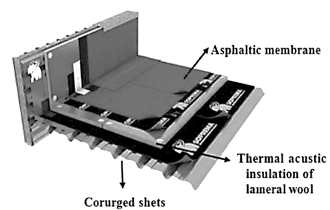
To directly control the noise coming from inside La Bamba, a Deck roof is proposed (Fig. 1), on top of the corrugated tiles that make up the exterior roof of the discotheque. This roof will be composed of the existing corrugated tiles, on top of a thermal and acoustic insulation panel of mineral wool covered by a waterproof asphalt blanket. The thermal and acoustic panel will not only act as sound insulation, but will also control the heat from the sun, which hits the roof all day long, so that it does not penetrate the interior of the building and keeps it cool. The drainage of the roof will be with downspouts.
3.5. Control solutions in rooms 313, 315, 317, 319
For the acoustic solution in the rooms located near the discotheque:
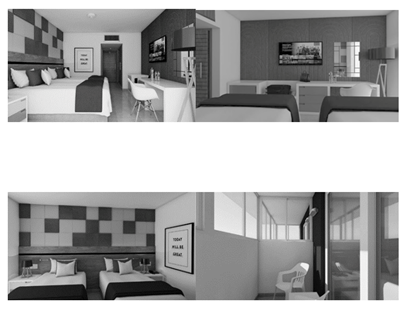
Decorative walls with acoustic panels will be placed. On the wall behind the bed, an acoustic panel in the form of mosaic tiles, made of fabric, model CM30E/CM60E/CM120E with an absorption coefficient of 0.8 will be used. The wall in front of the bed will be covered with EchoPanel Empire type panel, composed of polyethylene terephthalate (PET), which is a type of plastic commonly used in containers and bottles, with very good properties of resistance to wear, chemicals, and is fully recyclable, with an absorption coefficient of 0.45.
The back of the bed will be replaced with a wooden headboard.
The chest of drawers will be replaced with a multifunctional wooden cabinet (dresser-luggage cabinet-minibar).
Black out curtains and a net curtain will be installed, which will act as a filter for noise coming from the outside, dampen sound inside the room and control the penetration of daylight.
Four sliding windows will be placed on the balcony. This will enable a double filter for the penetration of external noise; if the client wishes, he can keep it open or close it in case the noise bothers him during the discotheque hours.
The above proposals were modeled in Sketchup 2021 software for a more realistic visualization of the results (Fig. 2).
3.6. Control solutions in the pool snack bar
For the acoustic solution of the pool snack bar located in front of the show area:
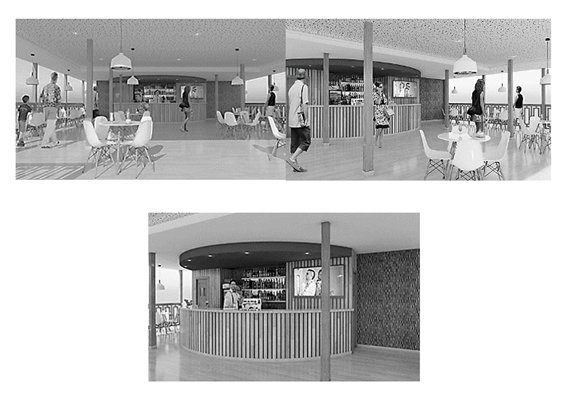
The design of the false ceiling will be changed to plasterboard, with a central area of false cassette ceiling, made of Cement Board perforated acoustic panel, model Sound BC A-8-15-20. It is a perforated laminated gypsum board, ideal for a multitude of interior applications, cladding, ceilings and partitions. Its dimensions: 2400 mm x 1200 mm, thickness: 12.5 mm and absorption coefficient: 0.8.
Absorbent panels will be placed on the walls of the EchoPanel Frequency model, composed of polyethylene terephthalate (PET). It is recyclable, available in a wide range of neutral, mid-tone and vibrant colors, dowelable, durable, lightweight and easy to cut and install, making it ideal for a multitude of interior applications. Available in 7mm, 12mm and 24mm thicknesses. Its dimensions: 2800mm x 1200mm, thickness: 12mm and absorption coefficient: 0.45.
The plateau and the wall behind it will be covered with IdeaTEC model wood slatted panels; these are slotted panels, separated between pieces, which will help reduce noise and reverberation.
Dimensions: 1800x600x44mm. Slats of 22(A) x45(B) mm. With separation of 41(C) mm.
Absorption coefficient: 0.8.
Fig. 3 shows the design proposal for the pool snack bar.
3.7. Control solutions in the Cristal buffet restaurant
For the acoustic solution of the Cristal buffet restaurant:
Decorative walls with EchoPanel Frequency acoustic panels will be installed.
A false coffered ceiling will be installed with perforated acoustic panels made of Cement Board, model Sound BC A-8-15-20.
Acoustic totems will be installed as column-shaped elements that function as acoustic absorbers, divide spaces and are aesthetically attractive. Echo Panel Hanging Pendants panels, made of polyethylene terephthalate, were selected for this purpose. It is a space-dividing system, including pendants, freestanding room dividers and workstation screens.
These products allow open plan spaces, typical of modern work and hospitality environments, to be divided with ease and flexibility while reducing reverberant noise to improve both comfort and productivity. It is recyclable, available in a wide range of neutral, mid-tone and vibrant colors. Available in 7mm, 12mm and 24mm thicknesses.
Dimensions: 2400mm x 1200mm
Thickness: 12mm
Absorption coefficient: 0.45
Furniture design will be changed to textile and sponge chairs.
Common wood coverings will be replaced by IdeaTEC pine wood panels and polyester fiber.
The previous proposals were modeled in Sketchup 2021 software for a more realistic visualization of the results.
Then, the materials and coatings that will make up the new proposals are related, with their absorption coefficients, to obtain the total absorption of the enclosure after the proposed treatment, and the recalculation of the reverberation times, in order to compare the effectiveness of the changes made in the design.
Table 3 below shows the comparison of parameters and noise levels before and after the proposed treatment.
Table 3 Comparison of acoustic parameters before and after treatment.
| Parameters | Rooms 313,315,317,319 | Snack-bar pool | Buffet restaurant Glass |
|---|---|---|---|
| Absorption of the room before treatment (A1) [m2] | 7.08 | 44.17 | 265.29 |
| Absorption of the room after treatment (A2) [m2] | 104.8 | 175.1 | 539.44 |
| Tr before [s] | 1.33 | 0.26 | 0.63 |
| Tr after [s] | 0.089 | 0.058 | 0.019 |
| Decrease in Tr (∆RT) [s] | 1.23 | 0.2 | 0.61 |
| SPL before [dB] | 68.5 | 89 | 87.3 |
| Decrease in SPL (∆) [dB] | 11.7 | 6.0 | 3.5 |
| SPL after [dB] | 56.8 | 83 | 83.8 |
Source: own elaboration.
4. Discussion
The tourist destination of Varadero is one of the most affected by noise. Recent research by [8,9,12] proved by measuring sound pressure levels, the existence of noise pollution in certain hotel premises in the tourist pole, in which the most affected areas were reflected in noise maps and coincided with the highest number of complaints reported by customers.
The relevance and scientific novelty of the research in this sense lies in:
The conception of a research that values the analysis of acoustic comfort as an element to be highlighted within the influences on customer satisfaction in the hotel tourism sector.
The use of graphic acoustics for the design of noise control solutions to improve acoustic comfort conditions in tourism facilities, specifically in the Be Live Experience Tuxpan hotel.
The implementation of a group of methodologies that have a novel character in the context of tourism to solve problems related to acoustic comfort.
The calculation of the material absorption coefficients to be used for the diagnosis of the premises of the hotel under study to reduce or eliminate noise levels in tourism facilities and its application in the affected premises of the Be Live Experience Tuxpan hotel.
The analysis of acoustic comfort in the premises of the Be Live Experience Tuxpan hotel reveals the critical importance of designing effective interventions to mitigate noise, especially in a tourist environment where customer welfare is paramount. The results obtained reflect a significant reduction in sound pressure levels (SPL) and a considerably lower reverberation time (Tr) after the implementation of the proposed solutions, aligning with the recommendations of the international literature on acoustic control in similar spaces.
The literature on acoustic design in residential and commercial environments supports the need for adequate sound absorption to ensure occupant comfort. According to [13], optimal reverberation times for lodging premises, such as hotel bedrooms, should be kept below 1 second to avoid noise buildup and interference in verbal communication. In this study, the rooms evaluated had an initial Tr of 1.33 seconds, which exceeds the recommendations. However, the interventions implemented were able to reduce the Tr to 0.089 seconds, meeting the recommended comfort standards.
The approach adopted at the Be Live Experience Tuxpan hotel, based on proven methods for sound control and the use of sustainable materials, not only provides a more compassionate and efficient acoustic environment, but also aligns the project with best practices in modern architectural design. This type of innovation can serve as a model for future interventions in similar spaces, promoting a balance between comfort, aesthetics and environmental sustainability.
The significant reduction in SPL, with variations of up to 11.7 dB in the guest rooms, 6.0 dB in the snack bar and 3.5 dB in the restaurant, demonstrates that the proposed modifications not only meet comfort requirements, but also improve the overall sound experience for guests. This correlation suggests that taking care of acoustic details can result in higher guest satisfaction and thus better ratings for the hotel.
The implementation of a comprehensive acoustic design that encompasses both internal noise control and the prevention of noise transmission from the outside is a novel approach that, to our knowledge, has not been sufficiently explored in the local literature. The use of the SketchUp 2021 tool to model acoustical solutions prior to implementation is another contribution that allows the potential impact of modifications to be visually assessed. This method can serve as a model for future studies and projects, making it easier for designers and architects to visualize and justify proposed acoustic interventions.
5. Conclusions
On the basis of the literature consulted, it was possible to define the main characteristics and parameters for measuring and controlling noise, as well as the related legal framework, and the application of various absorbent materials and methods for its control. The proposed methodology and its deployment procedures for noise management that integrate: the characterization of the premises, the inclusion of acoustic comfort criteria in the evaluation processes based on the levels and indexes established by NTP 503:1998, and a series of control methods selected for application in the facilities affected by noise. The solutions designed for the control of noise in the propagation media and the results presented before the before-after comparison, allow concluding that the objective of the research was met, from the implementation, modeling and/or estimation of the proposed control measures in three noisy areas of the hotel under study, the decrease of the NPS that influenced the rest and satisfaction of customers, as well as improvements in the acoustic comfort parameters. The selection of materials such as mineral wool, polyester fiber (PET), and perforated gypsum board was based not only on their acoustic performance but also on their availability and growing use in the Cuban construction and tourism markets. Their properties, such as recyclability (in the case of PET panels) and local manufacturing potential, make them viable and sustainable options for similar projects in the country's hotel infrastructure.

