




 English (pdf)
 Article in xml format
 Article references

 Automatic translation
 Send this article by e-mail
 Cited by SciELO
 Cited by Google
 Similars in
SciELO
 Similars in Google

 Permalink


1. Introduction
The mining industry plays a fundamental role in the economy of various countries; however, extraction activities involve significant risks to workers' safety, especially during the drilling process [1]. These tasks are characterized by high levels of exposure to physical and mechanical hazards, which have contributed to an increase in the incidence of occupational accidents [2]. Although the mining sector employs only 1% of the labor force, it accounts for approximately 8% of occupational accidents with fatal outcomes [3].
Mining is a fundamental pillar of the national economy of Mexico. According to data from the National Institute of Statistics and Geography, in 2021, the mining and metallurgical sector contributed 8.6% to the industrial Gross Domestic Product and 2.5% to the National Gross Domestic Product [4]. Furthermore, statistics from the Mexican Social Security Institute indicated that, in 2023, extractive industries presented an incidence rate of 2.0 occupational accidents per 100 workers [1]. In addition, reports from the Mexican Mining Chamber (Camimex) show that affiliated mining and metallurgical companies recorded an incidence rate of 0.90 accidents per 100 workers in 2022. During the same year, Camimex reported a total of 4,247 non-disabling accidents, 981 reportable accidents (969 disabling and 12 fatal), and 209,804 lost workdays (137,804 days lost due to accidents and 72,000 days lost due to fatal accidents) [1].
In the literature, four stages are commonly recognized in the development of occupational safety research within the mining industry: (1) safety engineering, (2) policies and procedures, (3) behavior-based safety, and (4) behavior-based safety culture [5]. According to Bloch [6], approximately 95% of accidents and incidents occurring during the first two stages can be attributed to human error. Ismail et al. [5] classify the main causes of mining-related accidents into 16 categories, including: human error, unsafe behavior, unsafe acts, lack of safety training, insufficient safety education, worker inexperience, poor supervisory leadership, mechanical failures, organizational deficiencies, geological factors, inadequate working conditions, and the absence of a safety culture. Fu et al. [7] argue that human safety skills-such as knowledge, habits, and psychological factors-alongside safety culture, tend to be overlooked components. Additionally, lack of work experience-understood as the set of skills and knowledge acquired by a worker in a specific activity over a given period-is regarded as one of the most prevalent causes of accidents across multiple sectors [3, 8]. Moreover, several authors highlight that human error remains one of the primary risk factors in occupational accidents, often resulting from inadequate training and the absence of a structured system for competency assessment in safety practices [7,9,10].
Several studies have identified a direct correlation between worker age and work experience, suggesting that although aging may increase accidents severity and rates-due to the decline in motor skills and physical capabilities-experience can help reduce both the frequency and severity of risks [3,8,11]. Nuñez and Prieto [12] point out that workers lacking the necessary skills to perform their tasks may focus excessively on meeting performance targets, while neglecting occupational hazards and the proper use of safety equipment. This behavior increases the likelihood of work-related injuries. Moreover, Nuñez and Prieto [12] and Rahman et al. [13] emphasize that the incidence of accidents and fatalities can be reduced through appropriate training and the proper installation and maintenance of safety devices-areas in which safety competencies play a critical role.
This study aims to identify the core safety competencies associated with the job profile of open-pit mine drill operators, using DACUM (Developing a Curriculum) and functional analysis as methodological frameworks.
1.1. Risks in mining
Mining is a multidisciplinary industry that operates under dynamic conditions within a complex sociotechnical system, where human interactions with technical processes pose significant challenges to the development of effective risk management policies [14], particularly in the identification and assessment of risks [15].
A typical mining project life cycle is divided into four main phases: exploration (7-10 years), development (5-10 years), operation (2-20 years), and closure (2-10 years) [15]. The exploration phase includes activities aimed at identifying the materials to be extracted and supports both cost-benefit analysis and the documentation required for the business plan. The development phase begins with the planning and construction of the project. It is characterized by the recruitment of various industrial profiles (civil, mechanical, electrical engineers, geologists, among others), making it the most resource-intensive phase. It is during this stage that the drill operator becomes directly involved. The third phase is mainly concerned with the commercialization of production, while the final closure phase consists of dismantling and relocating facilities and equipment.
Occupational health and safety issues are present throughout all stages of the mining cycle and can be classified into the following categories: hazardous substances, use of explosives, heat stroke and electrical hazards, physical hazards, ionizing radiation, thermal stress, noise and vibration, as well as hazards specific to underground mining such as fire, explosions, confined spaces, and atmospheres with insufficient oxygen levels [16]. Workers are also exposed to airborne dust and gases generated during blasting or rock drilling, the adoption of non-ergonomic working postures, and the operation of heavy machinery and vehicles, among other risks [14].
Zhou et al. [17] report that among drilling tasks, the most significant hazards include entrapment by objects, equipment-related injuries, and physical overexertion, while hazards involving lower levels of risk include exposure to substances or environmental conditions, as well as to fire and explosions.
1.2. Safety competencies
Safety culture is defined as the combination of a set of values and behaviors that determine how a safety process is managed within organizations [18]. However, despite the strong interest of companies in promoting and implementing safety culture and behavior-based safety programs, workplace accidents will continue to occur if workers still lack safety competencies [19,20]. According to Tetzlaff et al. [21] the absence of risk awareness, poorly designed training systems, and occupational stressors are pre-existing hazards that make organizational systems vulnerable and cause failures. Therefore, the authors recommend implementing training programs to produce qualified personnel who are fully aware of occupational hazards.
The Mine Safety and Health Administration (MSHA) indicates that the adoption of safe work practices, such as workplace examinations, is crucial to protect mining workers from the hazards to which they are exposed [22]. In this context, MSHA standards emphasize the need for competent personnel to perform such examinations.
A competent worker is defined as someone who possesses the skills and experience that fully qualify them to perform their assigned tasks [23]. Additionally, such a worker must be capable of identifying hazards and adverse conditions that either an average worker may recognize or that a worker familiar with the mining industry could reasonably predict [22]. Competency is understood as the combination of knowledge, skills, abilities, and attitudes required to perform a task efficiently [18]. In this regard, competencies enable organizations to make better-informed decisions and increase the likelihood that individuals faced with abnormal situations will have the knowledge and skills necessary to respond appropriately [24].
1.3. Techniques for identifying competencies
There are various analytical techniques used to identify occupational competencies, including Developing a Curriculum (DACUM), the AMOD model, the Studied Typical Employment Method (ETED), and Functional Analysis [25].
The DACUM technique enables a practical and rapid description of occupational content based on three core principles: (1) expert workers can describe their work more accurately than anyone else; (2) an occupation can be defined by describing the tasks performed by expert workers; and (3) all tasks require the application of knowledge, behaviors, and skills, as well as the use of tools and equipment. The AMOD technique is a variant of DACUM, distinguished by organizing tasks according to their complexity [26]. Functional analysis is a logical-deductive process that allows the progressive breakdown of functions performed within an organization or productive sector [25]. The ETED technique is a constructivist approach that emphasizes the variability of work and prioritizes technical aspects such as the use of machinery, implementation of work methods, regulatory compliance, and material [27].
According to the International Labor Organization (ILO) [25], the methodology for developing a technical competency standard requires:
1.4. Current regulations
In Mexico, the Secretariat of Labor and Social Welfare (STPS) is the authority responsible for regulating working conditions through the enforcement of mandatory labor regulations. In the mining sector, the STPS issued the Official Mexican Standard NOM-023-STPS-2012, which governs the operation of both underground and open-pit mines [28]. Section 5 of this standard outlines employer obligations, while section 9.2 provides specific guidelines for conducting excavations in open-pit mining. However, these provisions are general in nature and must be complemented by detailed and effective training programs to ensure the safe execution of mining activities.
At the international level, various standards exist to support hazard identification and risk assessment in the workplace. One such standard is ISO 45001, which establishes the requirements for the implementation of an Occupational Health and Safety Management System. The standard emphasizes the importance of adopting a systematic approach to hazard identification, risk assessment and control, as well as ensuring the active participation of workers in occupational health and safety management [29].
2. Methodology
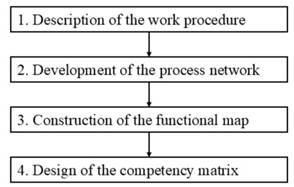
To determine the safety competencies associated with the drill operator profile, the methodology proposed by the ILO [25] was adapted. This methodology implements a mixed-methods approach based on functional analysis and the DACUM technique, as illustrated in Fig. 1 and described in the following sections.
Source: Author's own creation
Figure 1 Mixed-methods approach based on functional analysis and the DACUM.
2.1. Description of the work procedure
Table 1 presents each of the sequential stages involved in the drill operator's work using portable equipment.
Table 1 Portable Drilling Procedure.
| Step Sequence | Responsible Party |
|---|---|
| Conduct checklist verification. | Drill operator |
| Transport equipment to drilling site. | Drill operator, assistants, operations and safety personnel |
| Align drilling machine. | Drill operator, assistants |
| Prepare the drill pattern. | Drill operator and assistants |
| Assemble core barrel. | Drill operator and assistants |
| Assemble inner tube. | Drill operator and assistants |
| Place barrel onto head and foot clamp. | Drill operator and assistants |
| Start drilling (bit entry). | Drill operator |
| Retrieve inner tube. | Drill operator and assistants |
| Assemble second inner tube. | Drill operator’s assistant |
| Inject water to reach bottom of hole. | Drill operator |
| Prepare additional tube. | Drill operator and assistants |
| Empty inner tube. | Drill operator’s assistants |
| Arrange rock samples in boxes. | Drill operator’s assistant |
| Secure boxes for client delivery. | Drill operator’s assistant |
Source: Author's own creation
2.2. Development of the process network
This step identifies the drill operator’s involvement in operational activities and allows for visualization of how the drill operator profile interacts with other roles (Table 2). In this study, it is possible to observe the interactions of the drill operator with their assistants (two, according to the working scheme of the company analyzed) and with the drill pattern supervisors.
Table 2 Process network.
| Subprocess | Procedure | Main Activities | Job Profile |
|---|---|---|---|
| Site Preparation | Drill pattern marking | Drill pattern layout, materials transport, use of pack animals | Drill pattern supervisors |
| Equipment Installation | Drilling machine setup | Wireline cable installation, drill rig alignment, pipe adjustment | Drill operator and assistant |
| Operation and Drilling | Handling of rods and tools | Use of polymers, hand tools, rod feeding, diamond drilling | Drill operator and assistant |
| Safety and Procedures | Safe operation of drilling equipment | Operation of portable, mobile, underground, pneumatic, and hydraulic drill rigs | Drill operator and assistant |
| Recovery and Deinstallation | Recovery and disassembly of equipment | Core and pipe retrieval, pipe rescue, drill rig removal | Drill operator and assistant |
Source: Author's own creation
2.3. Construction of the functional map
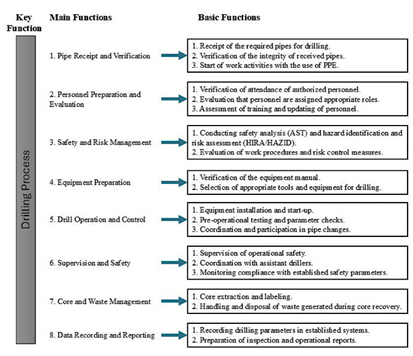
A functional map is a graphical representation that breaks down the key objective of the job profile into specific activities. Within this methodology, the main and basic functions of the drilling process were identified (Fig. 2).
2.4. Identification of critical competencies
Using the DACUM methodology, this stage involves identifying the corresponding process phase for each competency, detailing the related tasks and activities, required skills and knowledge, tools and equipment utilized, as well as associated risks and the necessary safety measures.
2.5. Design and validation of the assessment instrument
The assessment instrument was developed with 23 items, of which completion of at least 19 is required to consider a worker competent. Given the presence of critical competencies, certain evaluation criteria were established: the mandatory use of personal protective equipment, ensuring that only authorized personnel perform specific tasks, and conducting machine operational tests are essential prerequisites for competency certification. Conversely, failure to maintain continuous supervision over the installation of safety guards is deemed sufficient grounds to classify a worker as not competent.
For validation purposes, the instrument was reviewed by the company’s most experienced drilling personnel, who provided valuable feedback on the terminology and critical elements of the tool. In total, three experts (drill operators) with more than 12 years of experience and certifications in drilling machinery operation, as well as training in industrial safety provided by international mining companies and STPS, participated in the review process.
3. Results
Table 3 presents the competencies identified for each of the main and basic functions outlined in Fig. 1. These competencies are described in terms of the skills and knowledge necessary to safely perform the tasks or activities. The skills and knowledge considered include effective communication, knowledge of roles and responsibilities, competency assessment, safety and task-specific risks knowledge, waste management, documentation, among others.
Table 3 Competency Matrix for the Drill Operator Profile.
| Process Stage | Tasks and Activities | Skills and Knowledge | Tools and Equipment | Hazards / Risks |
|---|---|---|---|---|
| Receipt and Verification of Core | Receipt of core Verification or confirmation of core Start activity with PPE | Identification of drilling materials Effective communication Entry logbook Radio communication for core reporting - Visual and documentary review | Entry logbook - Radio to communicate core status | Providing incorrect location or activity information -Visual and documental revise - Risk of run-over if site operators do not identify the core team |
| Personnel Preparation and Evaluation | Review attendance lists of authorized personnel Verify work team attendance Complete equipment checklist Review training and authorization of personnel. | Knowledge of roles and responsibilities Competency assessment Knowledge of job requirements Safety knowledge Equipment knowledge Attention to detail | Authorized personnel lists Attendance lists | Errors in task assignment Non-compliance with safety regulations |
| Safety and Risk Management | Conduct Risk Analysis before starting activities Identify and evaluate potential operational risks | Knowledge of specific drilling risks Control measures evaluation Knowledge of unsafe acts and conditions - Risk and hazard awareness | - Risk documents and control measures | Exposure to hazardous conditions Non-compliance with safety protocols |
| Equipment Preparation | Verify manual and select tools Select drilling tools and supplies. | Interpretation of equipment manuals - Knowledge of drilling tools | Equipment manuals - Lists of tools and supplies | Equipment damage due to incorrect use Selection of inappropriate tools |
| Drill Operation and Control | Move equipment in case of new drill site Machine alignment Installation, testing, and coordination in drilling Equipment installation and tests 5. Coordination and participation in steel changes | Specific operational skills Coordination with assistants and operators Use of alignment tools Ability to adjust and align machine Knowledge of topographic plans | Drilling equipment Alignment equipment | Accidents during drilling Failures in operational coordination |
| Supervision and Safety | Monitor conditions and incident recording Stop activities if dangerous or risky conditions are found 3. Document any anomalies during activities | Supervision skills Safety data recording | Safety data recording formats | Risks associated with supervision Incidents not properly recorded |
| Core and Waste Handling | Store cores according to client specifications Register cores according to client specifications | - Knowledge of core and waste handling - Information recording | Storage containers | Contamination due to improper handling - Loss of critical information |
| Data Recording and Reporting | Record data and prepare reports of meters drilled, recirculated water, and amount of additives used | Documentation skills Use of recording systems Use of digital tools to send documentation | Recording formats | Documentation errors Loss of important data |
Source: Author's own creation
In relation to NOM-023-STPS-2018, the matrix presented in Table 3 supports compliance with the employer’s obligation to identify and evaluate the risks to which workers are exposed, as well as to communicate these hazards to the occupationally exposed personnel. Competency assessment also enables the definition of a training program by identifying weaknesses in competency fulfillment, in addition to establishing the mandatory theoretical and practical knowledge regarding the use of personal protective equipment (PPE) and safety procedures.
Regarding international standards such as ISO 45001, which focuses on Occupational Health and Safety Management Systems, the proposed model and the identified competencies facilitate systematic risk management and encourage the active participation of exposed personnel in hazard identification and risk assessment, emphasizing the importance of each safety aspect considered in the execution of their activities. Once the competencies presented in Table 3 were established, a sample of eight drill operators was selected to complete the assessment instrument through a theoretical-practical evaluation. The results indicate that 75% of the evaluated operators meet the required competencies to perform drilling activities safely (Table 4). Operators who did not achieve competence in safe work were subsequently trained on the relevant topics and successfully approved the competency evaluation in a second assessment. occupationally exposed personnel. Competency assessment also enables the definition of a training program by identifying weaknesses in competency fulfillment, in addition to establishing the mandatory theoretical and practical knowledge regarding the use of personal protective equipment (PPE) and safety procedures.
Table 4 Evaluation results.
| Drill operator | Item | Result | ||||||
|---|---|---|---|---|---|---|---|---|
| 1 | 3 | 11 | 12 | 16 | Other | Total | Conclusion | |
| 1 | 1 | 1 | 1 | 1 | 1 | 18 | 23 | Competent |
| 2 | 1 | 1 | 1 | 1 | 1 | 18si q | 23 | Competent |
| 3 | 0 | 0 | 0 | 0 | 1 | 18 | 19 | Not competent |
| 4 | 0 | 0 | 0 | 0 | 1 | 18 | 19 | Not competent |
| 5 | 1 | 1 | 1 | 1 | 1 | 18 | 23 | Competent |
| 6 | 1 | 1 | 1 | 1 | 1 | 18 | 23 | Competent |
| 7 | 1 | 1 | 1 | 1 | 1 | 18 | 23 | Competent |
| 8 | 1 | 1 | 1 | 1 | 1 | 18 | 23 | Competent |
Source: Author's own creation.
Regarding international standards such as ISO 45001, which focuses on Occupational Health and Safety Management Systems, the proposed model and the identified competencies facilitate systematic risk management and encourage the active participation of exposed personnel in hazard identification and risk assessment, emphasizing the importance of each safety aspect considered in the execution of their activities.
Once the competencies presented in Table 3 were established, a sample of eight drill operators was selected to complete the assessment instrument through a theoretical-practical evaluation. The results indicate that 75% of the evaluated operators meet the required competencies to perform drilling activities safely (Table 4). Operators who did not achieve competence in safe work were subsequently trained on the relevant topics and successfully approved the competency evaluation in a second assessment.
In Table 5, the impact of competency-based training on the company´s safety indicators is shown. It is possible to observe a decrease in lost-time injuries and restricted work cases after implementing the evaluation instrument and providing training to non-competent workers.
4. Conclusions
This study proposes a set of competencies for open-pit mine drilling personnel, described in terms of skills, knowledge, tools, and specific hazards to which workers are exposed. The competence model developed provides a formal basis for the safe execution of drilling activities, supports efficient risk management, and facilitates compliance with national regulations (NOM-023-STPS-2012) and international occupational health and safety standards (ISO 45001).
Furthermore, the methodology applied (integrating DACUM and functional analysis) is effective in identifying the key tasks, tools, and knowledge gaps associated with the drill operator role. The use of these techniques allows companies to design training and assessment programs tailored to their operational realities, thereby improving individual and organizational outcomes.
The results suggest that the professionalization and empowerment of workers through continuous skills development and active worker participation in risk identification and mitigation improves mining safety culture and ultimately reduce not only the frequency but also the severity of occupational injuries.
Due to the nature and duration of mining projects, the results were obtained from a small sample of workers from a company in the northwest region of Mexico. Therefore, it is recommended to replicate the study in other companies within the region to increase the number of workers involved. This approach could enable the generalization of the findings. Finally, continuous evaluation and training should be viewed as a dynamic component of the mining safety policy and culture.

