




 English (pdf)
 Article in xml format
 Article references

 Automatic translation
 Send this article by e-mail
 Cited by SciELO
 Cited by Google
 Similars in
SciELO
 Similars in Google

 Permalink

INTRODUCTION
The normal intravenous human immunoglobulin is a sterile liquid or lyophilized, with immunoglobulin, especially immunoglobulin G (IgG) of normal individuals [1, 2].
The production method includes one or several steps that eliminate or inactivate the known infection agents. It should show that the residues in the final product of the substances used in the processes aimed at inactivating the virus do not have any adverse reaction in the patients treated with immunoglobulin [1, 2].
The safety immunoglobulin assays in Brazil are sterility and RPT. However, the European Pharmacopoeia admits bacterial endotoxin assay as an alternative test to the in vitro method [2].
Parenteral preparations have to be pyrogen-free because the administration of pyrogens may induce fever, shock, or even death. This safety test is extremely important, because immunoglobulin is used for the treatment of individuals with significant comorbidities such as primary immunodeficiency as well as a number of neurological indications, including chronic inflammatory demyelinating, polyneuropathy, and idiopathic thrombocytopenic purpura, especially in impaired individuals who had received intravenous human immunoglobulin [3, 4]. Endotoxins represent the lipopolysaccharides (LPS) of the cell wall of Gram-negative bacteria (Figure 1).
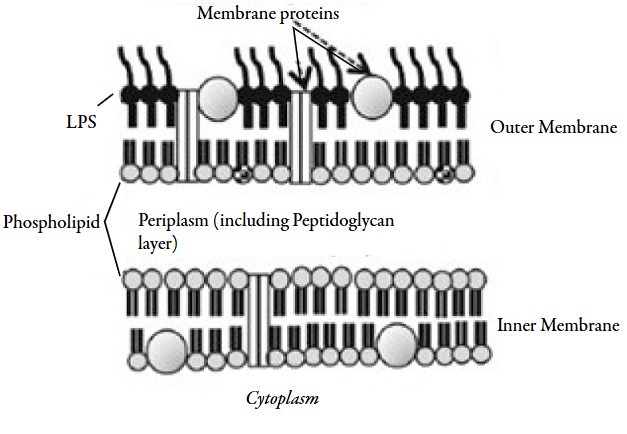
Because endotoxins are the most common and potent pyrogens, the LAL testing has successfully replaced the rabbit pyrogen test for many products [5].
Each batch of human immunoglobulin is sent for evaluation at the National Institute for Quality Control in Health (NIQCH), Fiocruz, where biological safety tests are carried out [6].
The in vivo pyrogen assay involves raising the temperature of rabbits after intravenous injection of a test solution into the ear vein. In Brazil, the pyrogen test in human immunoglobulin is performed according to the Brazilian Pharmacopeia, and the recommended injection volume is 1 mL/kg of body weight [1].
Although the European Pharmacopoeia already recommends the alternative in vitro bacterial endotoxin method, the assay is not yet recommended in the Brazilian Pharmacopoeia as an alternative to the rabbit pyrogen assay in normal human immunoglobulin [1].
In NIQCH, the Kinetic Chromogenic LAL Assay is used, which is a quantitative kinetic assay for the detection of Gram- negative bacterial endotoxin. An endotoxin catalyzes the activation of a proenzyme in the LAL. The initial activation rate depends on the concentration of the endotoxin. Endotoxin turns a proenzyme into an active enzyme. The enzyme para- nitroanillin (pNA) release produces a yellow color, which is measured photometrically at 405 nm. The intensity of the color corresponds to the activity of endotoxin present in the system [7].
The concentration of unknown samples can then be calculated from a standard curve. It is the chromogenic nature of the Kinetic Chromogenic LAL Assay that makes it the most appropriate choice for testing small volume parenteral solutions, vaccines, antibiotics, and biologicals [8].
This work was aimed at comparing the pyrogenic assays in rabbits and bacterial endotoxins in the immunoglobulins received by the NIQCH.
METHODOLOGY
To assess the sensitivity of animals at the threshold dose that causes fever in rabbits and humans, periodic dose- response curves are performed using standard Escherichia coli lipopolysaccharide (LPS) solution at non- pyrogenic (0.5 ng/mL), limit (1 ng/mL) and pyrogenic (2 ng/mL) concentrations. In the in vivo pyrogen assay, the product is injected into the marginal vein of the ear of three rabbits with a volume of 1 mL/ kg, and the individual variations in body temperature of the animals are evaluated. In order for the product to be considered satisfactory, no animal can have a temperature variation equal to or greater than 0.5 °C. If this occurs, a retest is performed using five new rabbits. In this case, out of a total of eight animals, only three can have a temperature variation equal to or greater than 0.5 °C and the sum of the temperatures cannot exceed 3.3 °C. If any of the cases occurs, the product is considered pyrogenic.
The tests on rabbits were authorized by the Ethics Committee for the Use of Animals of the Oswaldo Cruz Foundation, license LW- 1/23.
Before LAL assay the Maximum Valid Dilution (MVD) was determined in dilutions 1:50, 1:80 e 1:100 to verify the interference- free dilution, according to the equation [9]:
In the presence of endotoxin, the lysate will begin to cleave the chromogenic substrate, causing the solution to become yellow. The concentration of unknown samples can then be calculated from a standard curve and the Kinetic- QCL™ Assay with a sensitivity of 0.005 EU/mL. The assay requires the use of a standard endotoxin termed "positive product control" (PPC), which is a known amount of endotoxin mixed with a test material to confirm the absence of interference, and the endotoxin recovery in positive control (%PPC Recovery) is within the range of 50% to 200%. The maximum specification of bacterial endotoxin considered was inferior to 0.5 EU/mL of immunoglobulin, according to the European Pharmacopoeia [2]. Labeled sensitivity λ was confirmed by using 4 replicates expressed in EU/mL of the lysate reagent before to use in the test. This confirmation was carried out for each lysate batch before being used in the test and this is carried out when the investigators use the batch of lysate for the first time.
RESULTS AND DISCUSSION
The MDV resulted in a 1:100 dilution, however, we chose to test in lower dilutions, as using the maximum dilution is not routine in our laboratory, where we could run the risk of not detecting endotoxin in the highly diluted sample.
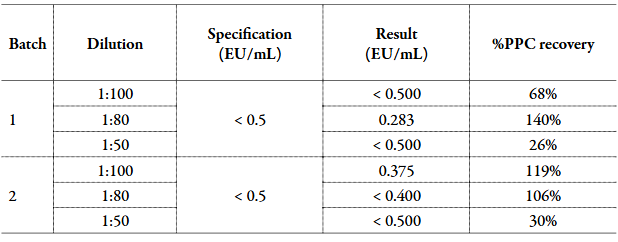
The two dilutions 1:80 and 1:100 resulted in a %PPC recovery, showing the absence of interferents. Therefore, we chose to use the 1:80 dilution for all batches. Table 2 shows that, out of a total of 11 samples analyzed, 3 batches were retested in more 5 rabbits and one batch showed fail result, coinciding with the endotoxin assay. However, one sample only failed in the endotoxin assay and the rabbit pyrogen test was negative for the pyrogenic substance. The sample 11 failed in the first pyrogen test on rabbit and was satisfactory in the retest requested by the distributor. The endotoxin assay was satisfactory from the first test (Table 2).
The pyrogen detection limit does not exceed 50-350 picograms (i.e., 0.5-3.5 EU) of lipopolysaccharide per rabbit kg [10].
The rabbit pyrogen test was studied in the context of the importance of alternatives that could contribute towards its replacement. There are three broad categories of bioassays which are commonly used for biological products: binding assays, cell- based assays, and whole animal assays. These assays can be more variable than binding assays and must be performed carefully to ensure consistent results. Whole animal assays are time consuming and highly variable. These assays are used for pyrogen assays, general safety assays, and potency assays. Binding assays typically have coefficient of variation (CV) in the 5 to 20 % range. Cell and whole animal assays may have variability above 50% [11]. In our tests, a CV of 10% is used.
Table 2 Results from ten human immunoglobulins (HIG) batches evaluated in the rabbit pyrogen and in the endotoxin (LAL) assays.
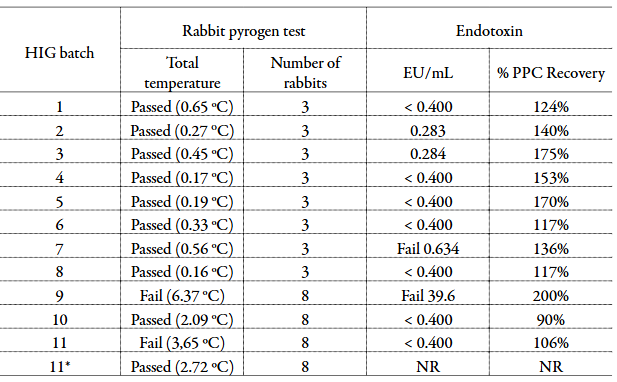
* Retest requested by the distributor
NR – No Retest
The 3Rs - Replacement, reduction and refinement - concept has become a standard in legislation and guidelines concerning animal experimentation in many countries. Replacement involves the replacement of an in vivo assay with relevant non- animal based methods. The use of biological products must comply with the pyrogen test, according to the regulatory standards of each country. It is a qualitative test in animals, which verifies the absence or presence of contaminants. Among the most relevant factors that can interfere with the final result of in vivo tests are the temperature and exhaustion of the test room, sensitivity, infections by microorganisms, and the diet of the animals [12, 13]. The substitution of in vivo methods with non- animal assays for the quality control and batch release testing of biological products is already being introduced and recognized by some regulatory authorities [8]. Each monograph needs to be examined individually to verify whether the pyrogen test can be replaced either by the LAL test or by an in vitro pyrogen test. The European Pharmacopoeia has set up a Group of Experts to develop in vitro alternative tests for pyrogen testing. It is foreseen that when a validated in- vitro pyrogen test is available, it will be included in the European Pharmacopoeia together with appropriate guidelines for validating the in vitro for pyrogenic substances assays as a replacement of the pyrogen test [14].
The production process of biological products must be aimed at obtaining products of quality, safety, and efficacy. The processes used must comply with a quality assurance system and Good Manufacturing Practices (GMP) and, therefore, monitoring is necessary during the production stages, including obtaining water, reagents, and containers used for collecting blood, plasma, formulation, and final packaging. Therefore, if all measures to detect the critical steps in obtaining the products are applied, it could significantly reduce the probability of introducing agents that generate pyrogenic contamination [15].
In Brazil, the National Council for the Control of Animal Experimentation (CONCEA) published a Normative Resolution in 2016, recognizing the bacterial endotoxin assay to evaluate the pyrogenic contamination in injectable products [16].
Currently, the NIQCH receives approximately 700 batches of normal human immunoglobulin for tests per year, which requires at least 4,200 rabbits, including manufacturers, to perform the pyrogen test.
CONCLUSION
A wide range of animals is used for the manufacture or quality control of biological products. The National Institute of Quality Control in Health presented criteria to use bacterial endotoxin assay as an alternative method for the use of the rabbit pyrogen test in determining the pyrogen substances in order to comply with the CONCEA in the substitution of animals according to the 3 Rs. The Brazilian Pharmacopoeia should be updated, as the use of rabbits for pyrogen substance identification will be prohibited in the end of 2024. Both methods (LAL test and RPT) used for endotoxin detection can be applied for various biological products including therapeutic proteins, vaccines, and other biological products. However, the LAL test is more accurate, fast, economical, and sensitive than RPT. Thus, the use of the bacterial endotoxin assay would be a feasible alternative for animal test to detect pyrogenic substances in normal intravenous human immunoglobulin on the replacement of rabbit pyrogen testing.

