




 English (pdf)
 Article in xml format
 Article references

 Automatic translation
 Send this article by e-mail
 Cited by SciELO
 Cited by Google
 Similars in
SciELO
 Similars in Google

 Permalink


Introduction
Lipids are biological molecules that contribute significantly to the function of cells and organisms1 and play an essential role as structural elements in cell membranes, enabling cell integrity and homeostasis, as well as being key molecules in energy metabolism.2 Cholesterol and phospholipids are essential components of all cell membranes and are necessary to maintain cell functionality and survival.2
It has been described that cholesterol serves as a basis for the synthesis of steroid hormones and that triglycerides (TG) are an essential source of energy for the human body as they contain fatty acids.1, 2 Since lipids such as cholesterol and TGs are insoluble in water, they must be carried in the bloodstream by hydrophile-lipophile particles known as lipoproteins.3
Apolipoprotein E (ApoE) is a protein that plays an important role in the transport of lipids into cells through its interaction with different cell-surface receptors4 and is found in several classes of lipoproteins, including chylomicrons, very-low-density lipoproteins, and high-density lipoproteins (HDL).5 Furthermore, by interacting with different receptors, this apolipoprotein promotes the clearance of chylomicrons and very-low-density lipoprotein remnants through the liver,5 which means that any variation in the genes coding for ApoE can alter this process and, as a result, contribute to the development of primary hyperlipidemia.2
The gene encoding the ApoE protein is located on the long arm (q) of chromosome 19, at position 13.2-13.3 (19:q13.2-q13.3).6 Its mutation is autosomal dominant and consists of a single-nucleotide polymorphism, resulting in three isoforms (ApoE2, ApoE3 and ApoE4)5 that are distinguishable by the presence of arginine (Arg) or cysteine (Cys) at positions 112 or 158, which determines receptor affinity.6- 9
The E3 isoform (112 Cys, 158 Arg) is the most common and is considered to be the reference protein.10 The E2 isoform, with Cys in both positions, has a low affinity for low-density cholesterol (LDL) receptors, which can be associated under certain conditions with dysbetalipoproteinemia. However, ApoE2 plasma concentrations are usually higher than those of other isoforms due to a positive feedback process, leading to an association of ApoE2 with lower levels of total cholesterol (TC) and LDL compared to E3 and E4 isoforms. In this context, ApoE2 is regarded as a protective factor for adverse cardiovascular events such as myocardial infarction.10- 12
Opposite to E2, the E4 isoform is characterized by its high affinity for receptors as it contains Arg in both positions, leading to a negative feedback process that reduces expression for the LDL receptor as well as serum ApoE4 concentrations. Consequently, this isoform is associated with elevated levels of TC and LDL cholesterol,10, 13 which, in turn, increases the risk of atherogenesis.12
Activation of inflammatory pathways plays a central role in the regulation of key processes in the development of atherosclerosis involving interleukins (IL).14 It has been demonstrated that patients with advanced atherosclerotic plaques and poor lipid control have higher levels of IL-1β because of the activation of inflammasomes due to the presence of cholesterol crystals.15 These elevated IL-1β levels are also associated with worse cardiovascular outcomes and mortality in patients with acute myocardial infarction.16 Moreover, IL-1β triggers a cascade of intracellular molecular events that amplify inflammatory response, thereby elevating tumor necrosis factor-α (TNF-α) and IL-6 levels.14 This intensification of inflammation leads to an increase in the expression of metalloproteinases, enzymes that degrade the extracellular matrix, weakening the plaque structure and making it more prone to rupture.14
It has been reported that individuals that carry at least one copy of the APOE ε4 allele have an increased chance of developing atherosclerosis,17 which in turn increases the risk of heart attack and stroke, conditions recognized by the World Health Organization as the first and second leading causes of death worldwide.18
ApoE polymorphism has been studied in different places of Colombia such as the Caribbean and Pacific coasts, the eastern plains, the Amazon region,19 Bogotá,19, 20 Buenaventura,21 Barranquilla,22 Quindío,23 Valle del Cauca,24 and Antioquia.25 To the best of our knowledge, only one study on the ApoE polymorphism has been conducted in the department of Risaralda, which was carried out in individuals with Down syndrome and their parents, who came not only from Risaralda, but also from Quindío.26
In view of the above, the objectives of the present study were to determine the genotypic frequency of the APOE gene polymorphism and to evaluate its association with lipid profile and inflammatory markers in university students in Pereira (Risaralda, Colombia).
Materials and methods
Study population and sample
The study population comprised all students from the first to fifth semesters of higher education programs offered in the faculties of Medicine, Dentistry, Veterinary Medicine, and Law at the Institución Universitaria Visión de las Américas, located in Pereira (Risaralda, Colombia), with an active enrollment between February and November 2019 (N=930).
Participants were recruited by convenience sampling (face-to-face visit to classrooms to inform students about the study and invite them to participate), taking into account the following inclusion criteria: being between 18 and 30 years of age, being born in Risaralda, having at least one parent and one grandparent born in Risaralda, voluntarily accepting to participate in the study, and signing the informed consent form. Of the 930 students, 95 met these inclusion criteria and were administered an ad hoc questionnaire of 23 questions, which inquired about their sociodemographic information, family medical history, consumption of medications, consumption of psychoactive substances, level of physical activity, academic information, and dietary patterns.
Based on the results of this questionnaire, 5 students were excluded because they used antihypertensive, hypoglycemic or anti-inflammatory agents; used anabolic steroids; consumed psychoactive substances; and were active smokers and/or resided with a smoker. In addition, 13 individuals were excluded because they did not attend the anthropometric measurements and blood sampling session, procedures performed at the Biomedicine Research Laboratory of the Institución Universitaria Visión de las Américas, Pereira, obtaining a sample of 77 students. It is worth noting that this rigorous exclusion process was carried out to guarantee the integrity and homogeneity of the sample.
Variables
Using the ad hoc questionnaire, the following information was obtained for each student: age, sex, academic program, semester, weekly physical activity level (exercising less than 3 days a week or 3 days or more a week), dietary pattern (Mediterranean, defined as consumption of vegetables, fruits, whole grains, and foods that are not highly processed or contain saturated fats,27 or non-Mediterranean in the remaining the cases), and family medical history (defined as having a first- to third-degree blood relative with a history of hypertension, dyslipidemia, and/or coronary artery disease).
Regarding anthropometric measurements, height, weight, and waist circumference (cut-off points: 90cm for men and 80cm for women) were recorded. Also, body mass index was calculated using the formula weight(kg)/height(m2).
In order to obtain information on APOE gene polymorphism, lipid profile, and inflammatory marker levels, each student had two 10mL blood samples drawn after 10 hours of fasting, one in an ethylenediaminetetraacetic acid (EDTA) tube, which was used for deoxyribonucleic acid (DNA) extraction, and one in a plain tube, which was used for biochemical analysis of the blood.
DNA isolation and genotyping of the APOE gene polymorphism
Genomic DNA was isolated using a Promega Wizard® Genomic DNA Purification kit (cat.# A1120) following the manufacturer's instructions. The quality of the isolated DNA was assessed with agarose gel. ApoE genotypes (rs7412 and rs429358) were determined by means of real-time polymerase chain reaction (RT-PCR) employing TaqMan probes (ThermoFisher Scientific cat.# 4351374, 4351379) and using QIAGEN's Rotor-Gene Q real-time PCR thermal cycler.
The ApoE polymorphism was classified into three categories: carriers of the ApoE rs7412 C/C genotype, carriers of the ApoE rs7412 C/T genotype, and carriers of the ApoE rs429358 C/T genotype.
Lipid profile
Lipid profile measurements included LDL (normal: <100mg/dL, near optimal: 100-129mg/dL, borderline high: 130-159mg/dL, and high: ≥160mg/dL), TC (Healthy: <200mg/dL, borderline high: 200-239mg/dL, and high: ≥240mg/dL), TG (normal: <150mg/dL, borderline high: 150-199mg/dL and high: ≥200mg/dL), and HDL (desirable: ≥40mg/dL for men and ≥50mg/dL for women). LDL was calculated using the Friedewald equation,28 and the cut-off points for each marker were those proposed by the Adult Treatment Panel III.29
All samples were processed in the Biomedicine Laboratory of the Institución Universitaria Visión de las Américas using the diagnostic IHR kit for TG, CT, and HDL, which employs an enzymatic colorimetric method.
Finally, dyslipidemia was defined as any alteration in TC, TG, HDL, and LDL levels according to the cut-off points mentioned above.
Measurement of IL-1β, IL-6, and TNFα
The following inflammatory markers were considered: IL-1β, IL-6, and TNFα. The levels of these markers were quantified by ELISA (enzyme-linked immunosorbent assay) using the ELISA MAX™ Deluxe Set Human IL-6, IL-1β, TNFα kit (BIOLEGEND, cat.# 430504, 437004, and 430201, respectively), following the manufacturer's instructions. Concentrations of IL-1β, IL-6 and TNFα were interpolated on standard calibration curves; sample dilutions were performed according to the manufacturer's specifications.
Statistical analysis
The data collected were entered and organized in a spreadsheet created in Microsoft Excel for subsequent processing in SPSS (version 23). Data are described using absolute frequencies and percentages for categorical variables and means and standard deviations (SD) or medians and interquartile ranges (IQR), according to the distribution of the data (Shapiro-Wilk test), for continuous variables.
In addition, a bivariate analysis was performed to evaluate the association between the presence of dyslipidemia and the levels of inflammatory markers, sex, weekly physical activity level, and dietary patterns using the Chi-square or Fisher's exact tests for categorical variables and Student's t-test or Mann-Whitney U test (according to the distribution of the data) for continuous variables. A statistical significance level of p<0.05 was considered.
Ethical considerations
The study followed the ethical principles for biomedical research involving human subjects established in the Declaration of Helsinki30 and the scientific, technical and administrative standards for health research in Resolution 8430 of 1993 of the Colombian Ministry of Health.31 In addition, it was endorsed by the Research Ethics Committee of the Institución Universitaria Visión de las Américas according to minutes No. PS020 of October 1, 2019. Similarly, informed consent was obtained from all participants.
Results
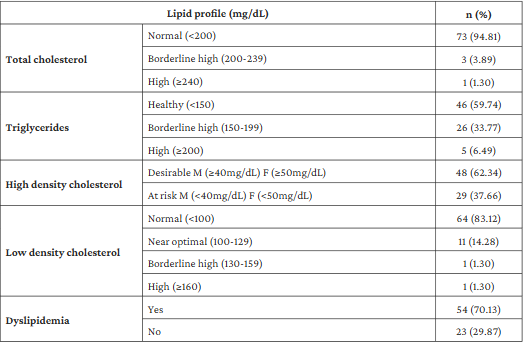
The median age of the participants was 19 years (IQR: 18-21 years), 62.34% were female, and 55.84% were enrolled in the medical program. The median body mass index was 23.98kg/m² (IQR: 21.23-26.73), 61.04% did physical activity less than 3 times a week, and 70.13% had dyslipidemia. Regarding genotypic distribution, all students expressed the ApoE rs429358 C/T genotype, 97.40% expressed the ApoE rs7412 C/C genotype, and only 2.60% expressed the ApoE rs7412 C/T genotype. With regard to the inflammatory markers evaluated, the median levels of IL-1β, IL-6, and TNFα were 11.74pg/mL (IQR: 7.27-16.21pg/mL), 3.72pg/mL (IQR: 1.60-5.84pg/mL), and 86.59pg/mL (IQR: 51.06-122.12pg/mL), respectively (Tables 1 and 2).
Table 1. Characteristics of the university students from Pereira (Colombia) included in the study (n=77).
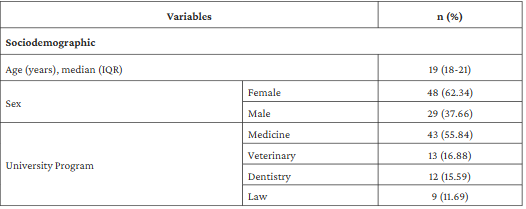
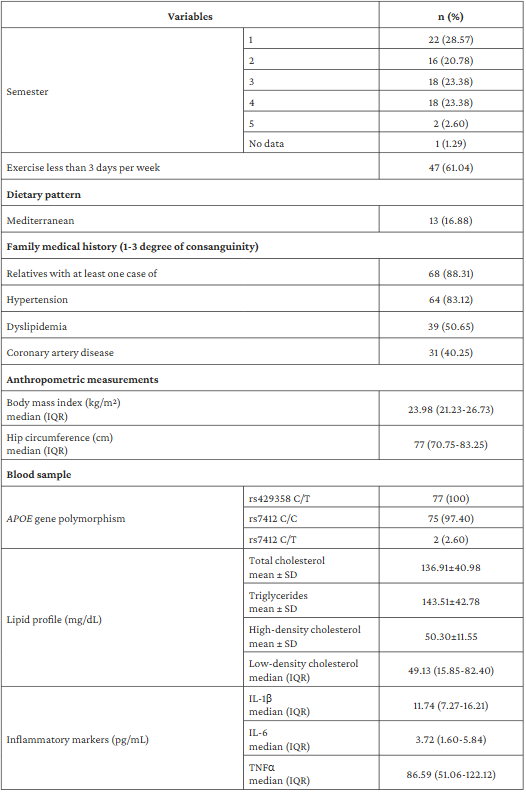
APOE: apolipoprotein E; IQR: interquartile range; SD: standard deviation; IL: interleukin; TNF: tumor necrosis factor.
Concerning the association between the presence of ApoE genotypes, lipid profile, and inflammatory markers, we found that students with ApoE rs7412 C/C genotype had higher serum levels of TC, TG, LDL, HDL, IL-1β, and IL-6 compared to those carrying the ApoE rs7412 C/T genotype (Table 3).
Table 3. Serum parameters according to ApoE genotype.
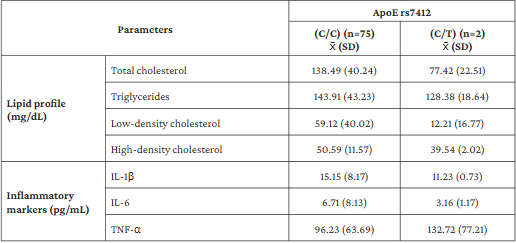
X: mean; SD: standard deviation; ApoE: apolipoprotein E; IL: interleukin; TNF: tumor necrosis factor.
On the other hand, participants with dyslipidemia had higher levels of IL-1β, IL-6, and TNFα compared to those without dyslipidemia, but these differences were not statistically significant. Furthermore, it was found that in both subgroups (with and without dyslipidemia), there was a predominance of women, individuals who did physical activity less than 3 times a week, and students who did not follow a Mediterranean dietary pattern, without any of these differences being statistically significant (Table 4).
Table 4. Distribution of inflammatory markers, sociodemographic factors, and dietary pattern according to the presence of dyslipidemia.
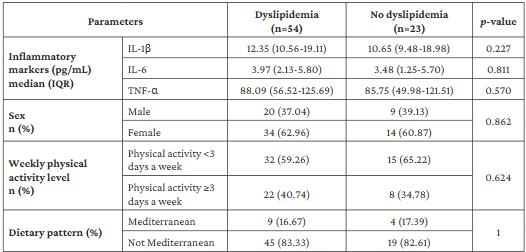
IL: interleukin; IQR: interquartile range; TNF: tumor necrosis factor.
Note: It should be noted that the values of the inflammatory markers in the bivariate analysis were expressed as medians (IQR) and, therefore, the Mann-Whitney U test was used. For the remaining variables, data were expressed as frequency (%), and the Chi-square test was used, except for diet, which was analyzed using Fisher's exact test.
Discussion
The APOE gene encodes ApoE, a polymorphic protein involved in lipid metabolism.10 Furthermore, it has been reported that this protein and its different isoforms are associated with variations in lipid and lipoprotein levels and, therefore, with cardiovascular risk.10, 13 Dyslipidemia and a proinflammatory state are part of the pathophysiological mechanism for the development of atherosclerosis, the main risk factor for cardiovascular disease (CVD), which is the leading cause of death worldwide.14 The genotypic distribution of the APOE gene polymorphism and its relationship with the lipid profile and inflammatory markers of university students in Pereira was analyzed in this study, being this the first research of its kind in Colombia.
In the present study, the majority of participants were female (62.34%), a finding that is in agreement with what has been reported in similar studies, in which a higher frequency of women was described (54.6%-59.02%).32- 34
Also, the most frequently expressed genotype was the polymorphic form ApoE rs429358 C/T (100%), followed by the non-polymorphic form ApoE rs7412 C/C (97.40%), and the polymorphic form ApoE rs7412 C/T (2.60%). This finding is consistent with what has been described in international and national studies in the sense that the polymorphic form ApoE rs429358 is expressed more frequently than the polymorphic form ApoE rs7412 (10.4-21.4% vs. 1.8-7.8%),21, 22, 32 but it differs in that said studies report that the non-polymorphic form of ApoE rs429358 is more frequent than the polymorphic form.21, 22, 32, 35
Since the polymorphic form ApoE rs429358 determines the presence of the ApoE ε4 allele, it can be stated that all participants in the present study have a genetic tendency to develop dementia, CVD, and cerebrovascular diseases because this allele has been associated with elevated carotid intima-media thickness (average difference: 0.013mm, 95%CI: 0.003-0.023mm),36 lobar intracerebral hemorrhage (OR=3.66, 95%CI: 1.28-10.43; p<0.02),37 cerebral infarction (OR=1.822, 95%CI: 1.390-2.388; p<0.001),38 secondary chronic heart failure (OR=4.339, 95%CI: 2.986-5.723; p=0.028),39 coronary artery disease (OR=2.15, 95%CI: 1.40-3.28; p<0.001),40 all-cause dementia (OR=2.14, 95%CI: 1.74-2.63; p<0.0001), and Alzheimer's disease (OR=3.27, 95%CI: 2.35-4.55, p<0.0001).41
In the present study, it was also observed that carriers of the non-polymorphic form ApoE rs7412 C/C had higher levels of TC, TG, LDL, and HDL compared to carriers of the polymorphic form ApoE rs7412 C/T. In this sense, considering that being a carrier of the polymorphic form ApoE rs7412 conditions the presence of the ApoE ε2 allele, it could be said that these results for TC and LDL are similar to those reported by Nuinoon et al.42 in a study conducted in southern Thailand with 459 healthy individuals, in which carriers of the non-polymorphic form of ApoE rs7412 (expressed in 74.29% of the population) had higher levels of TC and LDL compared to carriers of the polymorphic form of ApoE rs7412 (10.13%). However, bearing in mind that there were only 2 carriers of the ApoE rs7412 C/T allele in the present study, a relationship of statistical significance could not be established.
Concerning the association of the APOE gene polymorphism with inflammatory markers, participants with the rs7412 C/C genotype showed higher serum levels of IL-1β and IL-6 and lower levels of TNFα compared to carriers of the rs7412 C/T genotype. It should be noted that there were no studies on similar samples; however, these results are comparable with those found by Fan et al.43 in a study involving 375 individuals from the Wenzhou region of China (case group: 185 Alzheimer's patients, average age: 67.85 years; control group: 190 healthy individuals, average age: 67.35 years), in which IL-1β and IL-6 levels were higher in both the control group and the case group for carriers of the ApoE rs7412 C/C allele.
It should be noted that individuals with high levels of CRP, IL-6, and TNFα have a higher risk of developing diabetes mellitus (OR=5.71, 95% CI: 1.07-30.63; p<0.042)44 and that high levels of IL-1β have been associated with increased mortality (HR adj=2.78, 95%CI: 1.61-4.79; p=0.0002) and increased risk of major adverse cardiovascular events (HR adj=2.42, 95%CI: 1.36-4.28; p=0.002) in patients with ST-elevation acute myocardial infarction.16
In the present study, university students with dyslipidemia had higher levels of IL-1β, IL-6, and TNFα compared to those without dyslipidemia, although the differences were not statistically significant. This finding is similar to that reported by Hong et al.45 in a study of 1 397 adults (mean age 41.75 years) from the east coast of Fujian, China, in which they reported that IL-6 and TNFα levels were significantly higher in individuals with dyslipidemia (p<0.001). Nevertheless, since our study was carried out in a healthy population, the elevation of inflammatory markers is attributed to lipid disorders, and it could be inferred that dyslipidemia leads to a proinflammatory state.
According to their lipid profile, 54 participants (70.13%) had dyslipidemia, and most of them were women (62.96%; n=34). This finding is similar to that reported by Galvis et al.46 in a study conducted in Medellín (Colombia), in which 74.7% of the 6 384 participants (median age: 61 years) had dyslipidemia and 78.7% of them were women. Cardona et al.47 also reported that in a study carried out on 151 Emberá-Chamí indigenous people in Caldas (Colombia) (45% aged between 21-44 years), 68.2% of the participants had dyslipidemia, with a higher proportion of women (71.9%). These findings show a tendency of the native and female population to suffer from dyslipidemia.
Furthermore, physical activity and dietary patterns have been described as modifiable risk factors associated with dyslipidemia.27, 29 This could explain why there was a higher frequency of participants in the subgroup of students with dyslipidemia who did physical activity less than 3 times a week (59.26%) and consumed a non-Mediterranean diet (83.33%).
The limitations of the present study include its cross-sectional nature and the fact that convenience sampling was used, which could lead to selection bias; the impossibility of evaluating confounding factors that may alter lipid profile in a statistical model, given that the sample size did not allow for multivariate analysis and covariate adjustment; and the inclusion of students from only one university in the department, which limits the extrapolation of the results to students from the entire region. Therefore, to better understand the impact of the ApoE polymorphism on the lipid profile and inflammatory markers of this population in the region, studies conducted at several universities, with larger sample sizes and random sampling, are required. Likewise, it is suggested that these future studies analyze the association between dyslipidemia and serum levels of these inflammatory markers.
Conclusions
In the present study, the ApoE rs429358 C/T polymorphism was expressed in all participants, which, according to the literature, suggests a genetic predisposition of these individuals to the development of dementia, CVD, and cerebrovascular diseases. Moreover, it was observed that students carrying the ApoE rs7412 C/C polymorphism had higher levels of TC, TG, LDL, HDL, IL-1β, and IL-6 but not of TNF-α, compared to those with the ApoE rs7412 C/T polymorphism, which may indicate that lipid profile and inflammation markers are linked to the specific expression of the APOE gene genotypes. However, the sample size was limited and further studies are required to analyze this association. In turn, individuals with dyslipidemia had high levels of IL-1β, IL-6, and TNFα, which supports the hypothesis that lipid disorders may induce a proinflammatory state, even in an apparently healthy population. Finally, the prevalence of dyslipidemia was higher in the group of participants with a sedentary lifestyle and a non-Mediterranean diet, highlighting the importance of modifiable risk factors in preventing this condition.

