




 English (pdf)
 Article in xml format
 Article references
 Automatic translation
 Send this article by e-mail
 Cited by SciELO
  Cited by Google
  Similars in
SciELO
Similars in
SciELO  Similars in Google
 Permalink

INTRODUCTION
The black soldier fly (Hermetia illucens), a member of the Stratiomyidae family, is native to the American continent and has successfully adapted to tropical and temperate regions worldwide (Sheppard et al., 2002; Surendra et al., 2020). Large-scale breeding of this insect has garnered significant attention (Park, 2016) due to the ability of its larvae (BSFL) to consume a diverse range of organic materials, making them valuable tools for managing urban, agricultural, and organic waste (Yu et al., 2019; Kabir Ahmad, 2021). BSFL holds promise as a sustainable protein and fat source for poultry, fish, and pig diets (Rehman et al., 2019). Beyond larval utilization, the insect's frass, a byproduct of the bioconversion process, has emerged as a valuable biofertilizer with the potential to reduce reliance on synthetic fertilizers in agricultural systems (Mertenat et al., 2019; Alattar et al., 2016).
Bioprospecting, defined as the systematic exploration of biodiversity for commercial purposes, is a relevant approach to unlocking the full potential of H. illucens. (Castree, 2003). After emerging, the fly lives for about a week. During this short lifespan, it will mate and, in the case of females, lay eggs. As adults, BSF does not feed (Dortmans et al., 2021). The production of large quantities of good-quality eggs is a crucial step in the industrial breeding of this species to ensure the continuity of breeding and, simultaneously, the recycling of large volumes of organic matter (Hoc et al., 2019; Lopes et al., 2022). During BSF artificial breeding, adult flies are kept in a mating cage to provide a continuous supply of eggs. When increasing production, it is important to encourage females to lay eggs in a specific location to facilitate collection. Insect farms typically use attractants associated with oviposition sites to achieve this. In nature, females lay eggs in dry crevices near moist, decomposing organic matter, which will serve as a food source for their larvae (Sheppard et al., 2002). Adult black soldier flies require adequate hydration to carry out the egg-laying process. Therefore, providing a container with a moistened sponge is essential (Dortmans et al., 2021). Additionally, keeping the cages damp can help maintain optimal humidity levels (Palma et al., 2020). The flies then copulate and lay their eggs in conditioned areas or slots near the attractant substrate (Muñoz Granada & Parada Esquivel, 2022).
On the other hand, the size of the cage is a determining factor for the mass breeding of black soldier flies. Under artificial conditions, the recommended density is 6,500 flies per cubic meter to maintain an efficient breeding system (Hoc et al., 2019). A cage can be filled with approximately 10,000 newly emerged flies, equivalent to about 84 cm³ per fly (Dortmans et al., 2021). In short, standardizing the critical points in a black soldier fly breeding unit can improve the production of eggs and 5-day-old larvae (5-Dol) to establish bioconversion processes in various agricultural systems that demand this process (Cheng et al., 2017). The present work aimed to optimize five key phases in the developmental stages within a black soldier flies (Hermetia illucens) rearing unit to determine the most suitable materials and methodologies for the constant production of 5-Dol larvae capable of transforming organic waste in the Caldas Department.
MATERIAL AND METHODS
The experiment was carried out in a 30 m² greenhouse at the University of Caldas botanical garden under semi-controlled environmental conditions with temperatures ranging from 20°C to 33°C and an average relative humidity of 75%. Five distinct zones were delineated for the development of the insect's life cycle: egg, larva, prepupa, pupa, and adult. Additionally, a breeding unit with marginal conditions for the insect's life cycle was used. From egg to adult, the life cycle takes approximately 42 days: eggs hatch on the fifth day, the larval stage lasts up to 17 days, the prepupal stage takes 15 days, and the adult stage lasts between 5 and 9 days (Figure 1).
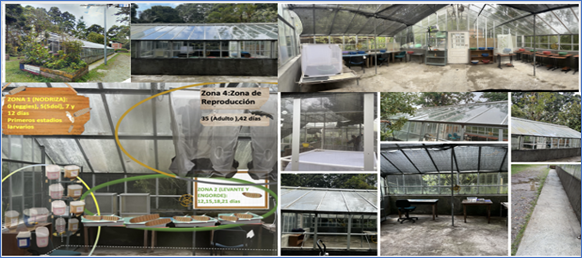
Figure 1. Areas designed for the development of Hermetia illucens life cycle at Universidad de Caldas’s botanical garden.
Once each of the sites was sectored for the development of the insect's life cycle, five key phases were established for each of the development stages: Adult Stage (Reproduction Cycle): 7 days, Eggs (Collection and treatment of eggs): 5 days, 5-Dol (Nursery: First 5 days of hatching): 5 days, 17-Dol (Larval rearing and fattening stage): 12 days, Prepupae and Pupae (Harvesting, dark phase): 15 days.
Breeding sample
To initiate the Hermetia illucens breeding process, 10 grams of eggs were obtained through an agreement with the Universidad Autónoma de Querétaro (Mexico). To introduce the BSF material, an authorization Form, permit, or certificate for the import, export, or re-export of wildlife specimens, parts, and derivatives was presented. When establishing the breeding unit, comparisons were made at each critical point to standardize the development process in different stages.
Treatments (Cage size, Attractant, Hydration sites, and posture sites)
Two types of cages, two hydration sites, three attractant types, and three oviposition sites were used during the experiment (see Figure 2). The life cycles of three adult stages were evaluated. Additionally, the number of adults showing mobility within the cages (zero, high, or low) was quantified and measured daily for seven days. Furthermore, adults in the dome process were quantified using the methodology described by Üstüner et al. (2003) to differentiate the sex of adults by observing the end of the abdomen and at a ratio of 1:1 (♂:♀). A total of 500 individuals (in the pupal state) were introduced into each cage (six in total, three large and three small) as a sample for evaluation. The breeding unit where the study was carried out is adjacent to the facilities of the Colombian Institute of Agriculture, and from the said institution, it was possible to process the Animal Health Import Document (DZI) once the quarantine process approved by the ICA was completed.
In each of the six cages (three for each dimension), three attractant types were introduced, each with three types of oviposition sites, for a total of 18 attractants and 48 oviposition sites. Prostrated adults were quantified on the oviposition sites (as an effect of the attractant).
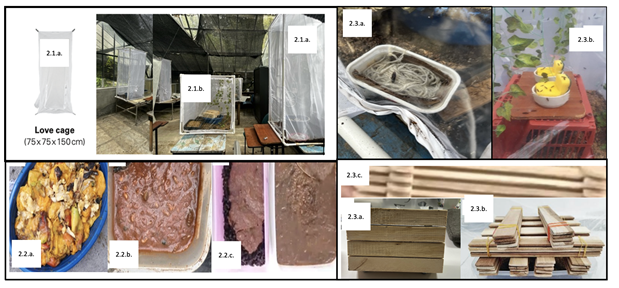
2.1) Cage size: 2.1.a) Cages Size 75x75x150cm. 2.1.b) Cage size 35x35x75cm. 2.2) Attractant. 2.2.a) Fresh organic waste 2.2.b) Fermented waste 2.2.c) mixture:100 grams of treatment B with 100 grams of dead adult. 2.3 Hydration sites. 2.3.a) container (200ml size). 2.3.b) container (200ml size). 2.4) Posture sites: 2.4.a) 4 Walnut boards 45cmx12cmx7cm size. 2.4.b) 4 Walnut logs 24cmx7cmx 3cm size. 2.4.c) Ice cream sticks 12cmx1.2cmx0.5cm size.
Figure 2. Treatments to be evaluated
Six hydration sites were placed in each cage (3 with cotton and 3 with sponges), for a total of 36 units distributed across 6 cages. Drinkers' impacts were measured daily by counting the number of effective ovipositions on them (recorded at 10:00 a.m.).
The same experimental design used to measure the effect of the attractant was implemented for the oviposition sites (48 laying sites, 9 for each cage). The grams of eggs harvested at each site were quantified daily, and the weight of the eggs was measured using an analytical Scout Pro. The number of potential individuals to hatch per treatment was calculated.
Copulation, individuals the number and locomotion
Copulation: To quantify the doming process inside the cages, measurements were made daily at 2:00 PM. Following Wong (2020), adults exhibiting greater mobility, such as those flying and mating, were recorded with a value of one.
Number and Estimate of Potential Individuals: By observing the insect's 12 life cycles under these marginal conditions, an approximate estimate of 10,000 potential individuals per gram of egg was determined.
Motion: To quantify locomotion within the cages, a scale of values from zero to two was used. Individuals were categorized as: Zero: No mobility (inertia), One: Moved from one place to another but did not fly, and Two: In flight at the time of measurement.
Experimental Design: A subdivided plot design was employed, with two cage types, three attractant types, two drinker types, and three laying sites, each with three replicates, for a total of 108 experimental units (see Figure 3).
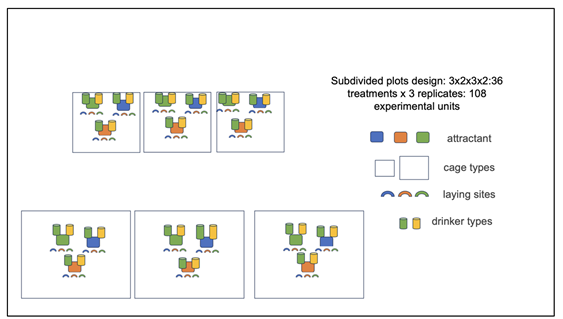
Figure 3. Subdivided plot design of used during the experiment.
The S.A.S. program (version 9.4) was used for data analysis. Analysis of variance (ANOVA) and Tukey's HSD (Honestly Significant Difference) test (p < 0.05) were conducted. Tukey's HSD is used to create confidence intervals for all pairwise differences between factor-level means while controlling the family-wise error rate at a specified level.
RESULTS AND DISCUSSION
Cage Size: The cage size effect was determined by the number of Hermetia illucens individuals copulating, the number of adults prostrated daily on the laying sites, and the use of drinkers. Highly significant differences were observed in favor of the cage recommended by the Universidad de Caldas (35x35x75cm). Better responses were obtained for all three variables, resulting in improved development of the Black Soldier Fly's life cycle (i.e., better egg weight, 5-Dol larvae, and consequently, higher individual production).
Statistical analysis of the doming variable showed that the cages recommended by Dortmans et al. (2021) had significantly lower values (0.31 pairs per day) compared to those recommended by the Universidad de Caldas (15.31 pairs per day). In the case of the number of flies per laying site (using three types of wood), a direct proportional relationship was found, with significantly higher values (13.51 flies per laying site) in small cages compared to large cages (2.2 individuals). Finally, regarding drinkers (two types), significantly more individuals were found in cages recommended by Gold (2020) (8.68 individuals) compared to small or reduced-sized cages (11.29 individuals) (Figure 4).
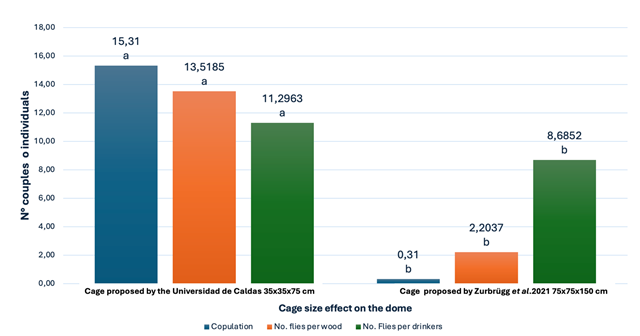
Figure 4. Cage size effect on the dome, the adults prostrated daily on the lying sites, and the drinkers measured by the standardization of the main factors to establish a breeding unit of Black Soldier Fly (Hermetia illucens). Different letters indicate significant statistical differences (p<0.05).
The locomotion exhibited by the flies in the cages showed significant differences, with a 95% confidence level. The cage proposed by the Universidad de Caldas demonstrated a higher estimated mobility value of 1.85 on a 0-2 scale compared to the 0.2 value reported in the literature. This suggests that the smaller cage is more suitable for developing a mass breeding unit of Hermetia illucens for the coffee region (Figure 5).
From this initial analysis, significant differences were observed in other experimental variables, such as egg yield and the estimated number of potential individuals (assuming 10,000 potential individuals per gram of egg). In the standardization of factors, the main differences in the breeding unit showed significant differences at a 95% confidence level. The cage proposed by the Universidad de Caldas yielded 0.2345 grams of eggs, while the cage proposed by Gold et al., 2020 yielded 0.0016 grams. Similarly, the estimated projection of individuals in these cages was directly positively correlated with the egg weight, with an average projection of 2345 individuals in the cages proposed by the Universidad de Caldas compared to 16.1 individuals in the other cage (Figure 5).
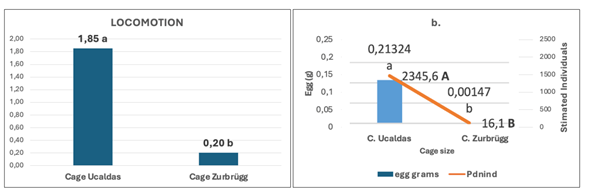
Figure 5. Cage size effect on locomotion, egg quantity (g), and estimated production of individuals in the standardization of the main factors to establish a breeding unit of Black Soldier Fly (Hermetia illucens). Different letters indicate significant statistical differences (p<0.05).
The love-cage presented can hold up to 10,000 flies, equating to approximately 84 cm³ per fly. The flies remain in the love-cage for 4 days to mate and lay eggs (Gold et al., 2021). The love-cage presented by the Universidad de Caldas can hold 5,000 flies, equating to approximately 44 cm³. However, when comparing the results obtained during the doming, locomotion, and other variables, it can be concluded that under marginal conditions, reducing the cage size is advisable to promote reproduction and interaction between individuals. According to the standardization study of Hermetia illucens for artificial reproduction, the recommended density is 6,500 flies per cubic meter to maintain an efficient breeding system (Hoc et al., 2019). Since 500 flies were used in the experiment, the cage suggested by the Universidad de Caldas yielded better results. Reducing the cage size by 50% increased interaction between adult Hermetia illucens, optimizing the dispersion of the attractant within the cage, reducing the number of individuals in a state of inertia at the top of the cage, and resulting in a greater quantity of black soldier fly egg weight and, consequently, a higher number of potential individuals (Dortmans et al., 2021). Following the recommendations of Mertenat et al. (2019), it is important to implement cages that include a compartment serving as a connector between the cages used at the Universidad de Caldas and other cages isolated from light (in dark materials). This can help avoid mechanical damage to adults during handling, which can affect the doming process. In a study conducted by A. Sumba (2016) in Guayaquil, Ecuador, using cages with dimensions of 50x50 cm and introducing 200 flies, 0.101 grams of eggs were obtained. Similarly, Ewusie et al. (2019) in Ghana obtained 0.103 grams of eggs using the same dimensions. Comparing these results to the behavior of the cage proposed by the Universidad de Caldas, better egg production and a higher number of potential Hermetia illucens individuals were observed.
Attractant Effect: To determine the effect of attractants, the variables of doming, the number of individuals found on oviposition sites, and the use of drinking fountains were measured. Significant differences were observed at the 95% confidence level for all variables. The attractant mixture containing dead black soldier fly adults yielded the best results for all three variables evaluated. For the doming variable, a value of 8.9 pairs was achieved, significantly different (p < 0.05) from the 6.7 pairs obtained with fresh residue and the 7.9 pairs with fermented residues.
Regarding the number of adults that prostrated themselves on the wood in the attractant containing dead soldier fly adults, values of 11.3 individuals were found, with no significant differences compared to fermented residues (10.7 individuals). However, significant differences (p < 0.05) were observed for fresh residue (8 individuals) compared to the other treatments. Similarly, significant differences (p < 0.05) were found in the number of adults that prostrated themselves on the drinkers, with the treatment containing dead black soldier fly adults (16 individuals) showing higher values compared to fermented waste (4.1 individuals) and fresh residues (2.5 individuals) (see Figure 6.1).
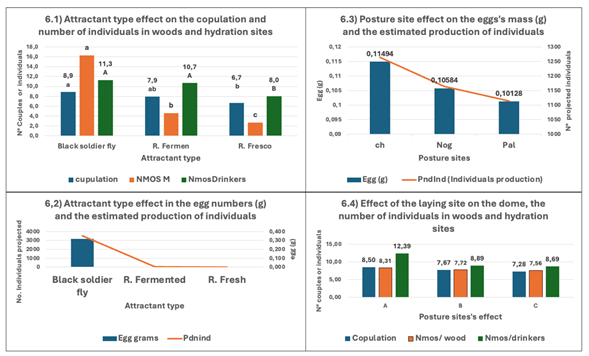
Figure 6. Results and Discussion Figures. 6.1) Attractant type effect on the copulation, 6.2) Attractant type effect in the egg numbers, 6.3) Posture site effect on eggs, and 6.4) Effect of laying site on the dome.
According to Dobermann et al. (2018) and Raksasat et al. (2020), dead adults and larvae of Hermetia illucens secrete pheromones that attract females to lay eggs, leading to gregarious populations of larvae at the same feeding point. This is why it is recommended to add dead individuals to the attractant to complete the cycle and stimulate oviposition. Gold et al. (2020) suggests using attractants with smelly liquid substances, such as fermented fruit, dead flies, or debris, to attract female black soldier flies to lay eggs. Additionally, Cammack and Tomberlin (2017) discovered that Hermetia illucens eggs themselves act as attractants. Therefore, it is recommended to avoid collecting eggs daily, as the presence of eggs can attract other females. This explains why the treatment containing fermented waste and dead soldier fly adults yielded the most significant results.
On the other hand, for the attractant effect on egg yield and the potential number of projected individuals, it was found that the attractant containing the mixture of black soldier fly adults yielded 0.32 grams of eggs, corresponding to 3,516 projected individuals. The attractant with fermented residues yielded 0.002 grams of eggs, corresponding to 20 projected individuals. No insect eggs were found in the fresh residue treatment (See Figure 6.2).
On the other hand, for the attractant effect on egg yield and the potential number of projected individuals, it was found that the attractant containing the mixture of black soldier fly adults yielded 0.32 grams of eggs, corresponding to 3,516 projected individuals. The attractant with fermented residues yielded 0.002 grams of eggs, corresponding to 20 projected individuals. No insect eggs were found in the fresh residue treatment (see Figure 6.2).
Regarding the effect of drinker type on egg yield and the potential number of projected individuals, highly significant differences (p < 0.05) were found. Drinkers containing sponges yielded an average of 0.111 grams of eggs (1,226 potential individuals), while troughs containing cotton yielded an average of 0.1022 grams (1,124 potential individuals). The egg weight collected at the laying sites serves as evidence of effective oviposition within the cages. (see Figure 6.2).
In a study by Gold et al. (2020), an attractant was prepared by mixing 100 grams of dead flies, 200 grams of fresh waste, and 200 grams of fermented waste in one liter of water. Every 10 days, the attractant was replaced and covered with a mesh to attract female flies and stimulate egg deposition. Additionally, Muñoz Granada and Parada Esquivel (2022) demonstrated that flies copulate and lay eggs near attractant substrates. This suggests that using black soldier fly individuals as attractants can increase egg production by attracting females for oviposition. As a result, treatments containing this type of mixture yield higher egg harvests than those without it.
Regarding the effect of drinker type on egg yield and the potential number of projected individuals, highly significant differences (p < 0.05) were found. Drinkers containing sponges yielded an average of 0.111 grams of eggs (1,226 potential individuals), while troughs containing cotton yielded an average of 0.1022 grams (1,124 potential individuals). The egg weight collected at the laying sites shows effective oviposition within the cages.
Within the breeding unit, during data collection, adult flies were found drowned in cotton drinkers after attempting to hydrate. Additionally, in cages with only cotton drinkers, flies were never observed hydrating or preparing for flight. Some dead adult flies with green abdomens were found, indicating a potential issue with the doming process (Cammack & Tomberlin, 2017; Spranghers et al., 2017). Once sponges were implemented as drinkers, increased mobility within the cages and the first ovipositions were observed.
According to Dortmans et al. (2021), during the mating period, adult black soldier flies need to hydrate and organize their wings after emerging from the pupa to initiate the doming process. Therefore, the environment should be equipped with a damp cloth for fly hydration. Mertenat et al. (2019) recommends using a clean container filled with water, and covering it with a cloth that is partially submerged in the water. These methods provide hydration sites within the cages that prevent drowning.
Sponges as drinkers allow adults to hydrate without the risk of submersion. This method yielded the best results in terms of the number of individuals that prostrated on the water troughs and wood, leading to higher egg weights (see Figure 6.4).
Dortmans et al. (2021) and Barry, T. (2004) used small wooden planks (12 cm long, 1 cm thick) as oviposition sites, stacked in groups of three and secured with plastic clamps and elastic bands. They recommend placing the collector on top of the container with the attractant in a shaded, dry location. Holalla (2021) found that female black soldier flies lay approximately 500 eggs in dry places near a food source, allowing the larvae to feed 3-5 days after hatching. The food source should have 60% humidity to facilitate larval feeding. Hoc B et al., (2019) reported that during mating, male black soldier flies become territorial with females for two days, after which females lay eggs in dry places near a food source. Based on these findings, the size and material of the oviposition site do not appear to be significant variables, as no significant differences were observed among the different types of oviposition sites used in the experiment (p < 0.05) (Figure 7).
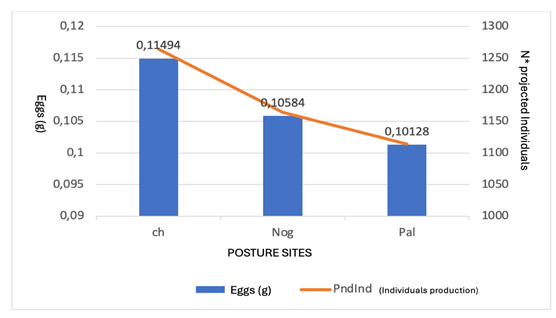
Figure 7. Attractant type effect on the copulation and number of individuals in woods and drinkers to standardize of the main factors to establish a breeding unit of Black Soldier Fly (Hermetia illucens). Different letters indicate significant statistical differences (p<0.05).
To determine the effect of hydration sites, the variables of copulation, the number of individuals prostrating on the wood (oviposition sites), and the use of drinkers were evaluated. Highly significant differences (p < 0.05) were found between troughs containing sponges (17.6 individuals) and those containing cotton (0.39 individuals). No significant differences were observed for the number of domes or adults prostrating on the wood(Figure 8).
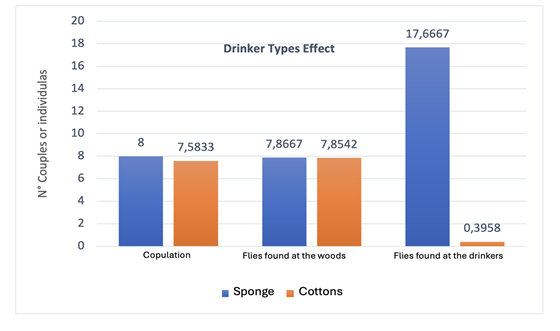
Figure 8. The effect of the type of drinker on the dome, the number of individuals in the woods and drinkers, for the standardization of main factors in the establishment of a breeding unit in the Soldier Fly Hermetia illucens. Different letters indicate significant statistical differences (p<0.05).
CONCLUSIONS
The combined effect of the cage size (proposed by Universidad de Caldas), sponge drinkers, and the attractant mixed with 100 grams of adult black soldier flies had a significant impact on oviposition and the projection of 5-Dol larvae in the rearing unit. These findings suggest that under marginal conditions, these three factors can be combined for the mass production of black soldier flies, establishing a breeding unit for bioprospecting purposes in agricultural systems within the influence of the University of Caldas.
Thanks to studies like this and the use of the black soldier fly for bioprospecting purposes, agricultural inputs such as fertilizers and livestock feed can be obtained. With the assistance of the autonomous university of Querétaro's research team and their knowledge of working with black soldier flies, we employed a technique involving the observation of the green color in the abdomen of adult flies, which indicates the presence of sperm in the spermathecae, eliminating the need for dissecting the insects.
The primary objective of this study was to determine the effect of different approaches to increase egg production in a breeding unit under marginal conditions. As suggested by the peer reviewers, a second publication will be prepared to conduct a bioprospecting analysis of the insect. This analysis will involve a thorough evaluation of the composition (secondary metabolites, differences between individuals raised under various conditions) of individuals obtained under marginal conditions.

