




 English (pdf)
 Article in xml format
 Article references
 Automatic translation
 Send this article by e-mail
 Cited by SciELO
  Cited by Google
  Similars in
SciELO
Similars in
SciELO  Similars in Google
 Permalink

INTRODUCTION
The cherry tomato (Solanum lycopersicum L.) has its origins in Central and South American countries, though some reports attribute it to Mexico, and it has now spread to all five continents (Peralta et al., 2006; Knapp & Peralta, 2016; FAOSTAT, 2020). Its antioxidant properties, such as vitamin C, carotenoids, flavonoids, and phenols, along with its sensory appearance, taste, quality, and exquisite aroma, have facilitated its rapid acceptance in markets. It is commonly used for fresh consumption or in salads (Leyva et al., 2014; Liu et al., 2018; Sinha & Purcell, 2019; García-Alonso et al., 2020; Guo et al., 2021; FAO, 2021).
In 2022, tomatoes became the second most-produced vegetable globally, with 186,107,972 tons produced over 4,917,735 hectares, yielding 37.84 tons per hectare (FAOSTAT, 2024). In that same year, the top five countries in tomato production were China, India, Turkey, the United States, and Egypt. In Colombia, tomato production reached 875,436 tons, making it the second most significant crop after onions (FAOSTAT, 2024).
In 2019, global pesticide use reached 4,196,533 tons, representing an increase of 27,755 tons (0.67%) compared to the previous year (4,168,778 tons) (FAOSTAT, 2019). Many Latin American countries have banned pesticides containing highly toxic ingredients, such as chlordane, DDT, endosulfan, hexachlorobenzene, aldicarb, captafol, carbofuran, and monocrotophos, due to their harmful effects on air, soil, water, plants, and animals (Pesticideinfo, 2022).
In Colombia, despite banning 34 harmful pesticides-such as alachlor, aldicarb, carbofuran, and endosulfan-the country consumed 69,862 tons of pesticides in 2019, ranking tenth worldwide (FAOSTAT, 2019; Pesticideinfo, 2022). These bans are based on inadequate usage practices, such as lack of personal protective equipment, the exceeding of recommended doses, the improper disposal of plastic waste without sufficient washing, the leakage of ingredients at storage sites, and the release of waste into soil and water sources, among others.
Additionally, these pesticides have been associated with diseases such as cancer and Parkinson's disease, autism spectrum disorders, and acute human poisoning through the consumption of contaminated food. Chronic environmental exposure has also been linked to ecological degradation and long-term toxicity (Cremlyn, 1990; Iizuka et al., 2013; del Puerto Rodríguez et al., 2014; PAN 2021; Guo et al., 2021).
In Colombia, tomato production is generally carried out through conventional agriculture, which has enabled mass, stable food production. However, the high frequency of pesticide usage has led to high residual concentrations such as pyrimethanil, carbendazim, dimethomorph, and acephate in the fruit (Arias et al., 2014). In some cases, these concentrations have exceeded the maximum residue limits permitted, such as carbendazim (0.74 mg·kg-1) and thiocyclam in fruits (0.79 mg·kg-1), indoxacarb in leaves (24.81 mg·kg-1), and dimethomorph in soils (44.45 mg·kg-1) (Arias et al., 2014; Pérez-Consuegra, 2018; Arias et al., 2021). It is important to maintain food safety standards, a priority for public health, and an essential step to achieving food security while complying with the maximum levels set by the Codex Alimentarius (Iizuka et al., 2013; Saidi et al., 2017). The use of natural compounds and alternative substances is another possible solution to reduce the entrance of pesticides into the food chain and environment (Bakhtiarizade & Souri, 2019; Ebrahimi et al., 2021a, and Ebrahimi et al., 2021b).
The production of many crops, including tomatoes, largely depends on the application of chemical fertilizers, the main being nitrogen fertilizers in the form of nitrates (NO3 -) and ammonium (NH4 +) (Souri et al., 2009; Souri, 2010). Many N forms are more readily soluble in water, meaning their effects on the plant are seen in a short space of time due to the high concentration of available nitrogen (Qahraman et al., 2020; Kai et al., 2020; Guo et al., 2021). Furthermore, the use of inorganic fertilizers combined with eutrophication can create a nutrient imbalance that restricts the uptake of other essential nutrients and causes soil acidity, reducing crop productivity (Ojeniyi, 2000; Sharma, 2017; Kumar Bhatt et al., 2019; Nosheen, 2021). For example, in Guangdong, China, it has been reported that the application of 100% nitrogen, phosphorus, and potassium (NPK) inorganic fertilizers increased the tomato yield by 72.9%; however, soil quality deteriorated significantly as a result (Wu et al., 2022).
In nature, a significant portion of nutrients exists in forms unavailable to plants. Thus, the use of microorganisms presents an alternative to nutrient solubilization (Rawat et al., 2018). Clean production offers an alternative to conventional agriculture, which helps to reduce the need to rely on artificial phytosanitary inputs, create environmentally friendly agronomic practices, produce low-contaminant foods, and ensure high levels of soil biodiversity and quality. (Mącik et al., 2020). Within clean production systems, the cultivation of vegetables with organic amendments has gained global traction due to the minimal environmental pollution it causes and the satisfactory outcomes it has produced. Therefore, the concept of efficiently recycling organic waste from agricultural activities using organic fertilizers has been revitalized, aiming to minimize the indispensable use of synthetic fertilizers for plant nutrition (Truong et al., 2018).
One of the organic fertilizers providing significant nutrient absorption and retention capacity is vermicompost, characterized by a finer structure and larger surface area compared to other fertilizers (Truong et al., 2018; De Matos et al., 2021). According to reports from the University of Campina Grande in Brazil, using vermicompost (2 L per plot) as fertilizer for tomato cultivation resulted in fruits with a longitudinal diameter of 21.3 mm, surpassing the diameter of tomatoes treated with NPK chemical fertilizer by 0.9 mm and exceeding the control treatment by 3.3 mm. Similarly, the tomato yield with vermicompost was 0.045 kg higher compared to the control plants. It is concluded that vermicompost fertilization can fully replace chemical fertilization under similar conditions without compromising yield or fruit quality (De Matos et al., 2021). Furthermore, a study conducted at the National Pingtung University of Science and Technology in Taiwan found that a substrate mix of vermicompost, rice husk ash, and coconut fiber increased the substrate pH from 4.7 to 6.5. Additionally, both the tomato plants and fruits thrived and developed favorably in this substrate mix (Truong et al., 2018).
In the past few decades, significant progress has been made in the production and utilization of biofertilizers containing bacteria from genera like Rhizobium, Pseudomonas, Bacillus, Klebsiella, Azotobacter, and Azospirillum. These bacteria, known as plant growth-promoting rhizobacteria (PGPR), can: colonize roots; enhance soil structure and fertility; improve tolerance to biotic and abiotic stress; facilitate nutrient uptake; ensure optimal crop yield; and reduce the dependency on agrochemicals (Murray-Núñez et al., 2011; Pathania et al., 2020; Kour et al., 2020; Zainuddin et al., 2022).
One of the globally recognized PGPRs is Bacillus subtilis, known for its ability to fix nitrogen and solubilize phosphates through enzymes like nitrogenases and phytases (Corrales Ramírez et al., 2017). It is also notable for its ability to enhance the productivity potential of various crops (Corrales Ramírez et al., 2017; Shafi et al., 2017). Chowdappa et al. (2013) discovered that applying B. subtilis to tomato seeds resulted in an average root growth of 14.9 cm, which was higher than the 10.6 cm observed in control plants. Similarly, the leaf area of seedlings increased by 3.1 cm2 compared to control seedlings with a leaf area of 3.4 cm2. Furthermore, it is noted that by inoculating B. subtilis on tomato seedlings at planting and re-inoculating the bacteria twice after planting (20 days apart), the incidence of gray mold disease (Botrytis cinerea) was reduced by 84%.
Given the above, the present research aims to evaluate the effect of the combination of PGPR bacteria Bacillus subtilis, Bacillus thuringiensis var. kurstaki, Bacillus pumilus, and Bacillus amyloliquefaciens, as well as vermicompost, individually or in combination, on the growth and development of cherry tomato fruits.
MATERIAL AND METHODS
The research was conducted from August 2022 to March 2023 in the Vanegas village of the Sogamoso municipality, Boyacá, with coordinates of 5°42′57″ N, 72°56′00″ W and an altitude of 2,569 meters. The average temperature was 17°C, and the relative humidity was 76%. The soil's chemical characteristics were as follows: pH of 6.05; high content of B (0.52 mg·kg⁻¹), Ca (9.27 cmol·kg-1), K (0.86 cmol·kg-1), Fe (337.11 mg·kg-1), Mn (15.31 mg·kg-1), and Zn (10.77 mg·kg-1). The soil had an electrical conductivity (EC) of 0.45 dS m-1, free of salts, and a medium organic matter content (5.26 g per 100 g-1, organic carbon 3.05), P (26.10 mg·kg-1), S (12.04 mg·kg-1), Cation Exchange Capacity (12.69 cmol·g-1), Mg (2.49 cmol·kg-1), Cu (2.26 mg·kg-1), Na (<0.14 cmol·kg-1), and Al and K saturation percentages were within normal parameters.
The soil in the plots was prepared using a hoe and disinfected with a 3% hydrogen peroxide solution sprayed directly onto the soil using a sprayer. After one week, furrows were created, each measuring 9.80 m in length, 0.60 m in width, and 0.40 m in depth, with a spacing of 0.80 m between furrows. The seedlings were germinated from seeds in a substrate consisting of enriched soil, peat, humus, and vermiculite (25:40:25:10), and they were initially grown in a germination tray.
On August 27, 2022, cherry tomato seedlings were transplanted in the furrows. These seedlings had an average height of 7 cm with four true leaves and were 30 days old. The seedlings were planted at a depth of 5 cm and spaced 50 cm apart, with a total area of 7.73 m in width by 9.86 m in length.
Experimental design. A completely randomized block design was established with four treatments (including the control) and three replications. The evaluated treatments were as follows: 1. Vermicompost (112 g). 2. Vermicompost (112 g) in combination with a mixture of Bacillus genus bacteria, including B. subtilis, B. thuringiensis var. kurstaki, B. pumilus, and B. amyloliquefaciens, each at a concentration of 1x10⁸ colony forming units per milliliter CFU mL-1 (3 cm³·L⁻¹). 3. A mixture of Bacillus genus bacteria including B. subtilis, B. thuringiensis var. kurstaki, B. pumilus, and B. amyloliquefaciens, each at a concentration of 1x10⁸ CFU mL-1 (3 cm3·L-1). 4. Control (untreated soil). The vermicompost dosage for treatments 1 and 2 was based on soil analysis, while the bacterial mixture dosage followed the recommendations in the product's technical data sheet. The treatments were applied directly to the soil around the root zone of each plant, at the time of sowing and after sowing, with a frequency of 15 days until the flowering period.
Throughout the crop cycle, manual weeding was performed every 15 days. Additionally, foliar applications were carried out once a week using a rechargeable sprayer, with extracts of chili pepper (Capsicum pubescens) and garlic (Allium sativum) in a ratio of 2:1. Furthermore, a neem oil solution (Azadirachta indica) was applied directly to the soil at the base of each plant. The neem oil solution was prepared at a dosage of 3 cm3 per liter of water. This application aimed to control pests such as the African land snail (Lissachatina fulica), cutworms (Agrotis ipsilon), and beetles (Diabrotica barberi).
Evaluated variables. The harvest was conducted from January 10th to March 12th, 2023, when the tomatoes reached a maturity index of 5 according to the Castro et al. (2009) scale. A total of 23 samples were harvested over eight weeks. For each sample, the following variables were recorded every six days:
Weight (W) in grams (g): The fruits were weighed using digital scales accurate to 0.01 g (PLU reference: 102132826) with a capacity of 500 g.
Horizontal diameter (Hd) in millimeters (mm): Measured using a Vernier caliper, a metal ruler with a length of 6 inches (150 mm) across the width of the fruit.
Vertical diameter (Vd) in millimeters (mm): Measured using the caliper, perpendicular to each of the harvested tomatoes (1.536).
Representative samples of the fruits from each treatment were also taken and sent to the AGRILAB® laboratory for conventional analysis of the plant material.
Statistical Analysis. A one-way analysis of variance (ANOVA) was conducted to identify the presence of statistical differences among the treatments, and Tukey's honestly significant difference (HSD) test at a 95% confidence level was performed to determine the grouping of means and their differentiation (Lagos-Burbano & Criollo-Escobar, 2019; Legarda et al., 2001). Analyses were conducted and assumptions were verified using coding routines in the statistical software R version 4.3.0 (R Core Team, 2023). Residual normality, homogeneity of variances, and data independence were assessed using the Shapiro-Wilk, Bartlett, and Durbin-Watson tests, respectively (Lawal, 2014). Non-parametric Wilcoxon tests were used to evaluate differences in the chemical composition of the fruits, as the data did not follow a normal distribution (Ramachandran & Tsokos, 2021).
RESULTS AND DISCUSSION
The ANOVA detected statistical differences (p < 0.1) in fruit weight among treatments. Subsequently, Tukey's HSD test revealed the formation of three groups: treatments 2 and 3 exhibited statistical equivalence (p < 0.1) and were superior to treatments 1 and 4. Treatments 1 and 4 showed statistical differences between each other (Table 1). In contrast, no statistical differences were found for the vertical and horizontal diameter variables among treatments. However, treatment 2 yielded the highest mean values and the greatest percentage differences for all three evaluated variables (Table 2); for example, the fruit weight of treatment 2 showed an increase of 28.37% compared to treatment 4, while concerning treatment 1, the increase in this variable was 19.1%.
On the other hand, the absence of statistical differences in the horizontal and vertical diameter variables is because the percentage differences did not exceed 8% (Table 2).
Table 1 Analysis of Variance (ANOVA) of Tomato Fruit Weight, Horizontal Diameter, and Vertical Diameter.
| Treatment | Weight (g) ± Standard deviation | Horizontal diameter (mm) ± Standard deviation | Vertical diameter (mm) ± Standard deviation |
|---|---|---|---|
| 1 | 12.73 a ± 0.69 | 27.28 a ± 0.52 | 24.33 a ± 0.54 |
| 2 | 15.21 b ± 0.98 | 25.95 a ± 0.76 | 23.29 a ± 0.59 |
| 3 | 12.99 b ± 0.92 | 25.86 a ± 0.73 | 23.2 a ± 0.5 |
| 4 | 11.86 c ± 1.68 | 25.7 a ± 1.41 | 22.63 a ± 1.4 |
The means with different letters are statistically different.
Table 2 Differences in the mean of treatment 2 about 1, 3, and 4.
| Treatment | Weight (g) | Horizontal diameter (mm) | Vertical diameter (mm) |
|---|---|---|---|
| 1 | 2.48 g (19.51 %) | 1.34 mm (5.15 %) | 1.13 mm (4.88 %) |
| 3 | 2.23 g (17.14 %) | 1.43 mm (5.52 %) | 1.7 mm (7.52 %) |
| 4 | 3.36 g (28.37 %) | 1.59 mm (6.2 %) | 1.04 mm (4.45 %) |
The effect of Bacillus spp. on weight has been reported in various studies; for example, Uysal & Kantar (2020) found that in field conditions, inoculating potato tubers (Solanum tuberosum L.) with the mixture of Bacillus subtilis and Bacillus amyloliquefaciens (concentration of 1x10⁹ UFC mL⁻¹) presented a difference of 6.47g when compared to the control (68.89g). Likewise, Shafi et al. (2017) found that applying spore suspensions of the OTB1 strain of Bacillus spp. to tomato seeds led to vigorous growth and development in the seedlings. Similarly, Hussain & Hasnain (2015) found that when inoculating cucumber cotyledons (Cucumis sativus L.) with Bacillus licheniformis, there was a difference of 31.55g in comparison to the control (water), which was larger by 2.04g with Bacillus subtilis.
In this research, treatment 1 (12.73 g) presented a difference of 1.27 g in fruit weight compared to the control, which weighed 11.54 g. This difference was greater than that reported by Márquez-Hernández et al. (2006) in greenhouse-grown cherry tomatoes. In their study, the application of 13 kg of worm humus to a substrate composed of 53 kg of sand and perlite resulted in a difference of 0.2 g in fruit weight compared to the control, which reached a weight of 11.2 g. The combined application of Bacillus spp. and worm humus not only increases the weight of plant organs but also provides nutrients to the crop and promotes ecosystem preservation (Velasco Sánchez et al., 2017).
On the other hand, the horizontal and vertical diameters exhibited statistical equality with p-values of 0.3 and 0.19, respectively (Table 1). This can be attributed to the lower percentage difference between the treatment means (Table 2). However, highly significant correlations (p < 0.01) were observed, with a correlation coefficient of 0.86 between the horizontal and vertical diameters and correlation coefficients of 0.94 and 0.87 between the weight and the horizontal and vertical diameters, respectively.
Regarding the horizontal and vertical diameters, treatment 2 exhibited greater differences in means (1.98 cm and 4.44 cm) compared to the control (25.46 cm and 23 cm) in the given order (Table 1). The difference observed in the horizontal diameter exceeded that reported by Zulueta-Rodríguez et al., (2020), which was 0.05 about the control (23 cm) when Bacillus subtilis was inoculated in hybrid Caporal tomato fruits. It has been observed that the increase in weight, diameter, and organ development in plants may be linked to the stimulation of cytokinin production caused by Bacillus spp., which plays a role in cell division and plant development (Amara et al., 2015).
In general, the values of the variables obtained in this research exhibited a decreasing trend throughout the harvest period; the average weight of the fruits from sample 1 was 18 g, and that of sample 20 reached 9 g (Figure 1). However, the decreasing trend in the weight, horizontal diameter, and vertical diameter of the fruits from the first harvest (January 10, 2023) to the last one (March 12, 2023) (Figure 1) is associated with severe frost occurring 15 days after the first harvest, during which 100% of the flowers dropped to the ground. Although 70% of the formed fruits were preserved, 30% also fell. Following these losses due to extreme temperature conditions, a reduction in the values of the mentioned variables was observed. As reported by Raza et al. (2021), freezing stress can lead to partial or complete fruit loss and plant damage due to the formation of intercellular ice that causes cell and tissue injuries. Similarly, Thakur et al. (2010) mention that extremely cold temperatures result in yield losses due to interference with sexual reproduction (meiosis), leading to flower abortions, infertility, and impaired fruit filling.
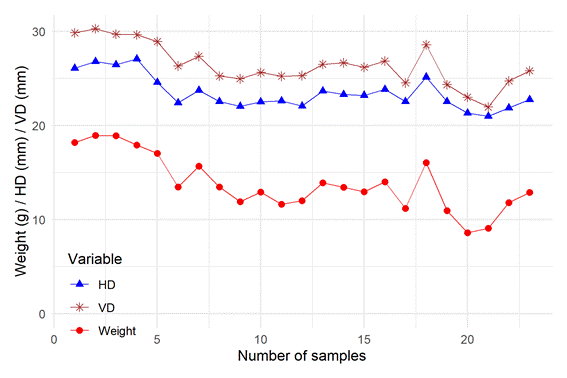
Figure 1 Behavior of the mean values of the weight, horizontal diameter, and vertical diameter of the cherry tomatoes during the harvest period (23 samples).
The results of the chemical analyses (Table 3) describe that the nutrient content of N, P, K, Ca, S, Mg, Fe, Mn, Cu, Zn, B, and Na increased with treatment 2 compared to the other treatments. This higher content of Fe, Cu, and Zn is reported to be associated with the ability of Bacillus spp. to produce siderophores or chelating compounds for Fe3+ and Zn2+, which enhance the solubility and availability of micronutrients for plants (Thomine & Lanquar, 2011; Maheshwari, 2012; Wairich et al., 2019).
Differences in the chemical element content in the fruits were analyzed using the non-parametric Wilcoxon test. Before analysis, the values of each parameter were standardized between 0 and 1, as shown in Table 2. Additionally, in Figure 2 and Table 4, it can be observed that treatments 1 and 4, as well as treatments 2 and 3, form two statistically distinct groups (p < 0.01 between groups), while being statistically similar (p < 0.01) within each group.
Similarly, the greatest variations in nutrients were observed in the Ca/B ratio (Table 3). This could be associated with the high maturity index of 5 at which the fruits were harvested, along with the close relationship between these elements in cell wall formation and fruit ripening (Bolaños et al., 2004). Similarly, Bouček et al. (2023) reported an increase in nutrients such as P, K, Ca, Mg, and S in potted tomatoes treated with earthworm humus and B. amyloquefaciens compared to untreated soil. Moreover, Etesami et al. (2023) mention that the use of Bacillus spp. can enhance the availability of nutrients such as N, P, K, Fe, Mn, Cu, and Zn for plant uptake, consequently promoting plant development and growth.
Table 3 Nutrient content, saturation, and exchangeable base ratios in fruits from Vanegas, Sogamoso (Boyacá).
| Variable | Expression | Unit | Treatment outcomes (standardized values) | |||
|---|---|---|---|---|---|---|
| 1 | 2 | 3 | 4 | |||
| Moisture | N.A. | % | 90.9 (0.2477) | 92.7 (0.2526) | 91.0 (0.248) | 92.4 (0.2518) |
| Nitrogen (a) | N Organic | % | 2.13 (0.2396) | 2.30 (0.2587) | 2.36 (0.2655) | 2.10 (0.2362) |
| Phosphorus | P | % | 0.387 (0.2323) | 0.433 (0.2599) | 0.468 (0.2809) | 0.378 (0.2269) |
| Potassium | K | % | 3.52 (0.2383) | 3.88 (0.2627) | 3.95 (0.2674) | 3.42 (0.2316) |
| Calcium | Ca | % | 0.136 (0.2252) | 0.176 (0.2914) | 0.160 (0.2649) | 0.132 (0.2185) |
| Magnesium | Mg | % | 0.157 (0.252) | 0.157 (0.252) | 0.169 (0.2713) | 0.140 (0.2247) |
| Sulfur | S | % | 0.213 (0.2396) | 0.232 (0.261) | 0.244 (0.2745) | 0.200 (0.225) |
| Iron | Fe | mg/kg | 35.8 (0.2358) | 40.1 (0.2642) | 37.1 (0.2444) | 38.8 (0.2556) |
| Manganese | Mn | mg/kg | 5.90 (0.2582) | 6.01 (0.263) | 6.37 (0.2788) | 4.57 (0.2) |
| Copper | Cu | mg/kg | 8.43 (0.242) | 10.5 (0.3015) | 8.23 (0.2363) | 7.67 (0.2202) |
| Zinc | Zn | mg/kg | 16.5 (0.2416) | 18.3 (0.2679) | 17.9 (0.2621) | 15.6 (0.2284) |
| Boron | B | mg/kg | 11.8 (0.2495) | 11.9 (0.2516) | 12.6 (0.2664) | 11.0 (0.2326) |
| Sodium | Na | mg/kg | 351 (0.2623) | 332 (0.2481) | 369 (0.2758) | 286 (0.2138) |
| Potassium Saturation | Sat. K | % | 82.0 (0.2491) | 82.1 (0.2494) | 82.2 (0.2497) | 82.9 (0.2518) |
| Calcium Saturation | Sat. Ca | % | 6.18 (0.2361) | 7.26 (0.2774) | 6.49 (0.248) | 6.24 (0.2384) |
| Magnesium Saturation | Sat. Mg | % | 11.8 (0.264) | 10.7 (0.2394) | 11.3 (0.2528) | 10.9 (0.2438) |
| Calcium / Magnesium Ratio | Ca/Mg | Adimensional | 0.525 (0.2233) | 0.680 (0.2892) | 0.574 (0.2442) | 0.572 (0.2433) |
| Calcium / Potassium Ratio | Ca/K | Adimensional | 0.075 (0.2358) | 0.089 (0.2799) | 0.079 (0.2484) | 0.075 (0.2358) |
| Mg / K Ratio | Mg/K | Adimensional | 0.143 (0.2634) | 0.130 (0.2394) | 0.138 (0.2541) | 0.132 (0.2431) |
| (Calcium + Magnesium) / Potassium Ratio | (Ca+Mg)/K | (Ca+Mg)/K | 0.219 (0.2541) | 0.219 (0.2541) | 0.217 (0.2517) | 0.207 (0.2401) |
| Nitrogen / Sulfur Ratio | N/S | N/S | 10.0 (0.2495) | 9.91 (0.2473) | 9.67 (0.2413) | 10.5 (0.262) |
| Nitrogen / Phosphorus Ratio | N/P | N/P | 5.50 (0.2569) | 5.31 (0.248) | 5.04 (0.2354) | 5.56 (0.2597) |
| Calcium / Boron Ratio | Ca/B | Ca/B | 115 (0.2255) | 148 (0.2902) | 127 (0.249) | 120 (0.2353) |
| Iron / Manganese Ratio | Fe/Mn | Fe/Mn | 6.07 (0.2244) | 6.67 (0.2466) | 5.82 (0.2152) | 8.49 (0.3139) |
Table 4 Comparison of treatments using the Wilcoxon test.
| Comparison of medians | W | p | |
|---|---|---|---|
| T1 | T2 | 119 | 0.000492 |
| T1 | T3 | 162 | 0.00937 |
| T1 | T4 | 357.5 | 0.152 |
| T2 | T3 | 339 | 0.293 |
| T2 | T4 | 491 | 0.0000284 |
| T3 | T4 | 455 | 0.000574 |
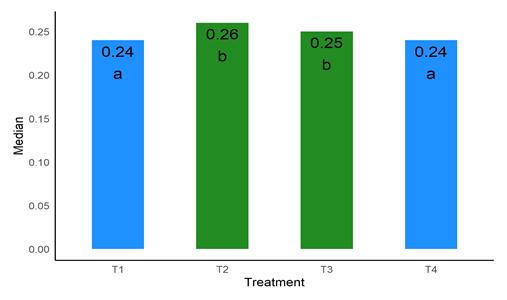
On the other hand, it is important to mention that in this research, the tomato crop was not affected by pests and diseases due to the applications of garlic and chili extracts on the plants in a 2:1 ratio per liter of water, in addition to the applications of neem oil solution that were applied directly to the soil of each plant. Mfarrej & Rara (2019) and Rajamani & Negi (2021) mentioned that the use of neem oil and garlic extract is effective for insect control and is also environmentally safe. Similarly, Hollensteiner et al. (2017) explain that the use of B. thuringiensis inhibits the growth of pathogens in plants due to the production of toxins that assist in the control of insects and fungi.
CONCLUSIONS
In the conditions observed in Vanegas, a village in the municipality of Sogamoso (Boyacá), the application of vermicompost (112 g) combined with a mixture of Bacillus genus bacteria, including B. subtilis, B. thuringiensis var. kurstaki, B. pumilus, and B. amyloliquefaciens (1x10⁸ CFU mL⁻¹) at a dose of 3 cm³ L⁻¹ of water, applied directly to the soil of each plant for three months, increased the weight of cherry tomato fruits by 17.14% to 28.37% compared to the other treatments. With the application of the combined treatment (treatment 2) and the individual treatment of Bacillus bacteria (treatment 3), the availability of nutrients such as N, P, K, Ca, S, Mg, Fe, Mn, Cu, Zn, B, and Na in the fruits increased to a greater extent. Conversely, the individual application of 112 g of vermicompost (treatment 1) and the control (treatment 4) exhibited similar behavior, with the lowest nutrient contents.

