


 English (pdf)
 Article in xml format
 Article references
 Automatic translation
 Send this article by e-mail
 Cited by SciELO
  Cited by Google
  Similars in
SciELO
Similars in
SciELO  Similars in Google
 Permalink

Grasping children’s career expectations is essential for understanding their educational choices, particularly within the domains of science, technology, engineering, and mathematics (STEM). These disciplines offer substantial long-term benefits, such as higher economic outcomes, increased social mobility, and national progress (National Science Foundation, 2021). Additionally, research shows that children with high expectations for a STEM career are more likely to engage with STEM subjects, perform better academically, and persist in STEM-related fields through higher education (Chen et al., 2024; Yeung, 2024). Therefore, encouraging engagement with STEM from early stages is crucial. However, disparities in representation persist, with women and individuals from lower socioeconomic status (SES) being underrepresented in STEM occupations (Hansen et al., 2023; Turner et al., 2019).
Consequently, identifying factors that influence early interest in STEM is important, particularly to address gender and socioeconomic disparities. Nonetheless, there remains a significant gap in the literature regarding STEM career expectations and the drivers that may promote interest at the middle school level, especially in the global South (Conlon et al., 2023). Therefore, this study aimed to explore the STEM career expectations of middle-school Chilean children, focusing on how parents’ career expectations and children’s early skills are associated with the likelihood of children gravitating towards a STEM career path.
Why middle school
Very little research has focused on STEM career expectations at the middle school level. This gap may stem from the perception that middle school students are relatively distant from making definitive career choices or selecting their fields of study compared to those in secondary or tertiary education. However, focusing on middle school students is critical for several reasons. Middle school is a period when children begin to form more concrete ideas about their future careers and develop the skills and knowledge that will influence their academic paths (Aschbacher et al., 2014; Conlon et al., 2023). Additionally, this developmental stage is pivotal for identity formation and the development of self-efficacy beliefs (Kinkopf & Dack, 2023), which can profoundly impact children’s perceptions of their abilities and their likelihood of pursuing STEM careers (Aschbacher et al., 2014). Consequently, understanding career expectations at the middle school level is fundamental for developing strategies to nurture an early interest in STEM subjects, as this is when their academic interests and self-efficacy beliefs are being shaped.
Factors associated with children’s career expectations in STEM
According to the expectancy-value theory (Wigfield et al., 2009) and the updated situated-expectancy value theory (Eccles & Wigfield, 2020), children’s decisions to participate in academic activities, such as STEM fields, are influenced by a balance between (i) the value they assign to these activities; (ii) their anticipated success (expectancy); and (iii) contextual influences. The value children place on academic activities is shaped by interactions with influential figures, such as their parents. As principal role models, parents convey their beliefs and attitudes toward STEM through their behaviour and interactions at home, potentially impacting their children’s career expectations (Pinneo & Nolen, 2024; Zhan et al., 2023). For instance, review studies have shown that parents’ expectations for their children’s STEM achievement explain variations in children’s achievement motivation, performance, and career choices related to STEM (Šimunović & Babarović, 2020), including specific populations such as Latin American families (Starr et al., 2022). This idea is further supported by the parent socialisation model (Eccles, 1993; Soto-Lara & Simpkins, 2022), which posits that parent’s beliefs about their children’s abilities and potential in various domains, along with their behaviours, practices, attitudes, and indirect modelling, can significantly influence children’s values towards certain academic fields. For example, children are more likely to lean toward STEM careers when their parents not only work in these fields but also actively promote science-related activities at home (Tilbrook & Shifrer, 2022).
Regarding children’s anticipated success in academic activities, evidence suggests that early competencies are indicative of future career expectations. The OECD’s International Early Learning and Child Well-being Study (2021) highlighted the association between young children’s cognitive, linguistic, and socio-emotional skills (e.g., self-regulation, empathy, interpersonal skills) and their future occupational expectations. Specifically, five-year-olds with STEM inclinations demonstrated advanced cognitive and language abilities, while their counterparts with preferences for the arts or education exhibited pronounced socio-emotional competencies. Socio-emotional skills are important for overall academic success (Jones et al., 2019), although children with strong socioemotional skills may exhibit a preference for careers that involve prosocial behaviours and nurturing roles, such as those in the arts, education, or healthcare sectors (Gamboa et al, 2023). Further research involving 12-year-old Australian children found that general cognitive and language abilities predict both children’s and their parents’ expectations for high-status professions, with parental aspirations showing a stronger correlation with the child’s cognitive skills (Creed et al., 2007). However, longitudinal research linking early childhood abilities to subsequent career expectations remains sparse.
Contextual influences also play a critical role in shaping children’s STEM career expectations, as highlighted by the revised situated-expectancy value theory (Eccles & Wigfield, 2020). These influences include social, cultural, and situational factors that interact with individual beliefs. Thus, societal expectations and genderrelated stereotypes, for instance, can significantly impact vocational interests from an early age (Dunlap & Barth, 2019). Conventional gender stereotypes often associate females with nurturing and prosocial skills, while males are linked to analytical and technical abilities (Eagly & Wood, 2012). Despite this understanding, there remains a dearth of research examining the combined effects of parental career expectations for their children (values towards STEM), children’s early competencies (anticipated success), and contextual factors on future STEM career aspirations.
The case of Chile
Understanding the effect of parental expectations and children’s early skills on STEM career prospects is especially important in regions where research is scarce, such as in many countries in the global south. Findings from studies in western, educated, industrialised, affiuent, and democratic societies cannot be universally applied. Therefore, there is a need to explore these under-researched regions to design educational programmes tailored to their distinct contexts.
Chile offers an intriguing context attributable to two important factors. First, there is a prominent gender and socioeconomic disparity in mathematical proficiency among Chilean children. Chile is among the six countries identified in the Programme for International Student Assessment (PISA) where the gender gap in math scores exceeds 20 points, with males outperforming females (OECD, 2021). Furthermore, this gap is mirrored in national educational metrics, as evidenced by the Measurement System of Education Quality (SIMCE). The latest SIMCE findings indicate an early emergence of this gender gap, which has historically narrowed among adolescents but is now evident from the fourth grade. SIMCE’s data also reveal that higher SES children consistently achieve better results in maths (Educational Quality Agency, 2023).
Secondly, Chilean parental expectations exhibit gender biases regarding their children’s career paths. Approximately half of Chilean parents are inclined to support their sons in pursuing STEM careers, an expectation that drops to about 20% for their daughters (OECD, 2015). This discrepancy in parental expectations, alongside the gender gap in math achievements, is likely influencing the underrepresentation of women in STEM fields in Chile. For example, the gender distribution in tertiary education entrants in STEM disciplines shows that women represent only 18% of newcomers (OECD, 2021).
Current study
The current study had two aims. First, to explore the STEM career expectations of Chilean children aged 10 to 12, examining how parents’ career expectations (STEM vs. non-STEM) and children’s early skills (i.e., communication, cognitive, socio-emotional skills, and executive functions) are associated to the likelihood of children inclining towards a STEM career path. Second, to explore whether children’s gender and family SES moderate these associations.
We hypothesised that parental STEM expectations would increase the likelihood of children’s inclination toward a STEM path (Tilbrook & Shifrer, 2022). Additionally, we expected that enhanced early cognitive and communication skills would be positively associated with the probability to lean towards a STEM career, while stronger socio-emotional skills may decrease this likelihood, potentially favouring alternative career paths (Gamboa et al, 2023; OECD, 2021). Furthermore, we anticipated that the associations between parental career expectations and children’s early skills with children’s STEM career expectations would be moderated by children’s gender and family SES (Hansen et al., 2023). This study has been pre-registered with the Open Science Framework (https://osf.io/mch2y/?view_on- ly=cd23b7542d6441b18927bf55db8c061f).
Method
Participants
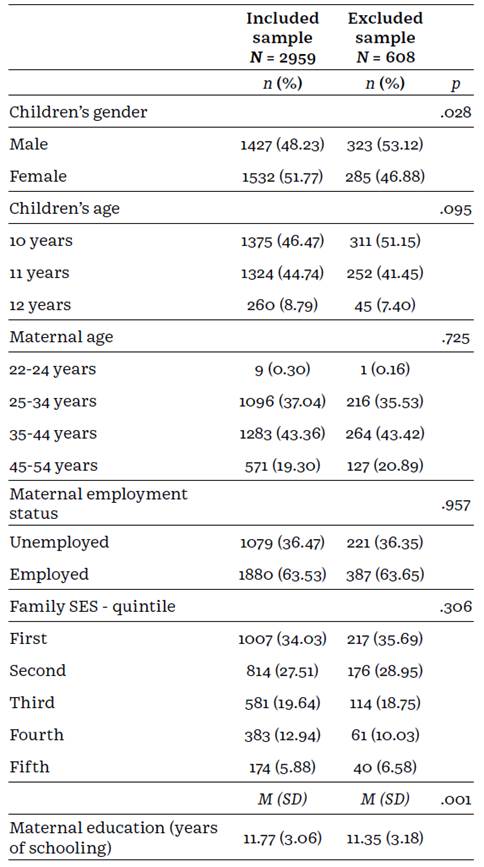
Data for this study were sourced from the survey ‘Encuesta Longitudinal de la Primera Infancia’ (ELPI; Longitudinal Survey of Early Childhood), a nationally representative cohort study of Chilean children conducted between 2010 and 2017. The study included 3,567 children from 10 to 12 years of age who self-reported future career expectations in the 2017 wave, as these questions were only administered to children of those ages in the third wave. Subsequently, assessments from the second wave (2012) were also incorporated (when children where aged between five to seven years old), comprising 2959 children with complete data across both waves. Significant differences were observed between the included children and those excluded due to missing 2012 data. The analytical sample had more females and higher average maternal education years, with no significant differences in other sociodemographic variables (See Table 1). To address attrition, longitudinal sampling weights were used to enhance the generalisability of the findings by aligning sample distributions with population characteristics. The final analytical sample included 2959 children (51.8% females), with a mean age of 11.7 years (SD = 3.06) in 2017 and 5.5 years (SD = 0.65) in 2012. Over half of the sample (62%) belonged to the two most socioeconomically deprived quintiles (first and second). Detailed sociodemographic information of the sample is provided on Table 1. Ethical approval for the ELPI cohort was obtained from the ethics committee of the Pontificia Universidad Católica de Chile.
Data collection procedure
The ELPI study gathered information through two sources during sequential visits: a socio-demographic interview and a battery of assessments for cognitive and socioemotional development. Table 2 during the first visit, a socio-demographic interview was conducted with the main caregivers, and a self-report interview was administered to children aged seven years or more. The second visit involved a trained psychologist visiting the selected child’s home to administer the assessment battery. For a more comprehensive understanding of the recruitment see Behrman et al. (2010).
Measures
Outcome: Children’scareerexpectations(Wave 3, 2017). Children from 10 to 12 years of age were asked the open-ended question: ‘What job do you think you will do when you grow up?’ The ELPI research team subsequently coded these responses into 95 distinct occupational categories. Given the focus of this study on STEM occupations, these categories were then aggregated into two broader groups: STEM and non-STEM occupations. This was done according to the established criteria set forth by Conlon et al. (2023). STEM occupations include biological and agricultural sciences, earth, atmospheric and ocean sciences, engineering, mathematics and computer sciences, physical sciences, and general scientific roles. Non-STEM occupations encompass health, education, humanities, arts and entertainment, business and management, other non-science fields, and jobs that are either non-existent or unrealistic (see Supplementary Material I for career examples). The categorisation process was conducted by the research team in a blinded fashion to avoid bias, without access to the children’s sociodemographic information. Whenever job categorisation was uncertain, the team engaged in discussions and held consensus meetings to clarify any ambiguities. Parent’s expectations (Wave 3, 2017). Primary caregivers were asked about their child’s future career prospects through an open-ended question: ‘What job do you think your child will do when he/she grows up?’. The ELPI team coded responses into 93 distinct career paths, which were then grouped into STEM and non-STEM categories, following Conlon et al.’s (2023) framework.
Children’s early skills (Wave 2, 2012). Communication skills: Assessed using the Battelle Developmental Inventory Screening Test, Second Edition (BDI-ST2) (Newborg et al., 1984). This instrument is designed for children from birth to eight years of age in order to identify developmental strengths and weaknesses. The communication subscale measures proficiency in both receiving and expressing information, thoughts, and ideas through verbal and non-verbal means (e.g., the child follows three-step verbal commands; the child describes the actions depicted in an illustration). The subscale demonstrated adequate reliability at the sample level (Cronbach’s a = 0.84).
Socio-emotional skills: Assessed using the Battelle Developmental Inventory Screening Test, Second Edition (BDI-ST2) (Newborg et al., 1984). This subscale assesses the frequency and quality of interactions with caregivers and peers, emotional expression, self-concept, and social competence, including collaborative abilities and the comprehension of social roles (e.g., the child recognises the feelings of an adult). The subscale demonstrated adequate reliability at the sample level (Cronbach’s a = 0.85).
Cognitive skills: Assessed using the Battelle Developmental Inventory Screening Test, Second Edition (BDI-ST2) (Newborg et al., 1984). This subscale focuses on conceptual skills and abilities, including perceptual discrimination (e.g., sensorimotor interactions with their immediate environment), memory capabilities (e.g., information recall given appropriate cues), and reasoning skills (e.g., critical thinking for problem-solving, judgment, and idea evaluation) (e.g., the child groups objects according to their shape and colour). The subscale demonstrated adequate reliability at the sample level (Cronbach’s a = 0.75).
Executive functions: Assessed using the Backward Digit Span test, a component derived from the ‘Digit Span’ subtest of the Wechsler Intelligence Scale. This evaluation focuses on short-term memory and measures the capacity to retain an instruction in its working memory and operate with it (e.g., the child repeats numerical sequences from memory). No item-level data were available on this scale to calculate reliability measures.
Sociodemographic covariates (Wave 3, 2017). Primary caregivers provided sociodemographic details such as the child’s gender, age, maternal age (grouped into 22-24, 25-34, 35-44, and 45-54 years), maternal education (years of schooling), and employment status (employed or unemployed). Family SES was determined using income quintiles provided by ELPI, with lower quintiles indicating lower SES.
Data analyses
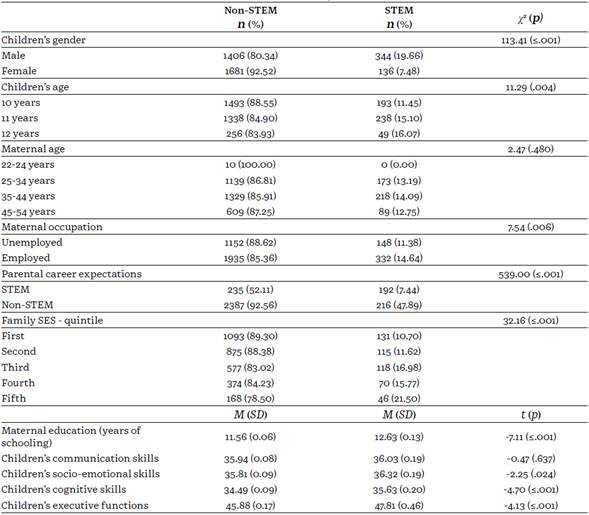
Frequencies of children’s STEM and non-STEM expected occupations were initially examined in relation to parental career expectations, children’s early skills (i.e., communication, socio-emotional, cognitive, executive functions), and sociodemographic factors. Bivariate comparative analyses utilised c2 tests for categorical variables and independent sample t-tests for continuous variables. Subsequently, a logistic regression model was employed to identify predictors of children’s career expectations (STEM vs. non-STEM). Following the principle of parsimony, the multivariable model incorporated only variables significant at the bivariate level. Lastly, after mean centring continuous predictors, interaction terms of child gender and family SES were incorporated into the model. Where significant moderation effects were found, simple slope analyses were conducted for interpretation. Longitudinal sampling weights were used to improve the generalisability of findings. All data analyses were performed using Stata V.18.
Results
Association of parental expectations and children’s early skills with children’s career expectations
Bivariate analyses revealed significant differences between children leaning towards STEM and non-STEM careers. Thesedistinctionswereapparentinparentalcareer expectations, children’s early skills (socio-emotional, cognitive, executive functions), and several sociodemographic factors (children’s gender and age, maternal education, maternal occupation, family SES). No significant differences emerged concerning children’s communication skills and maternal age (see Supplementary Material II).
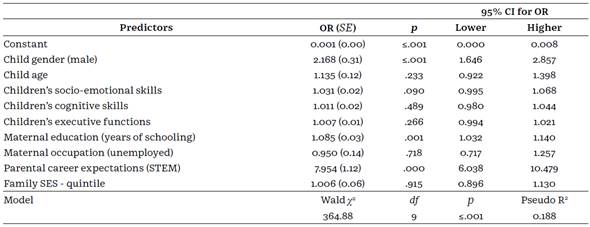
A subsequent multivariable logistic regression model was conducted, incorporating nine predictors identified as significant at the bivariate level (Wald c2 (9) = 364.88, p ≤ .001). Child gender, maternal education, and parental career expectations emerged as significant predictors for STEM career preferences. Specifically, boys whose mothers possess a higher educational level and whose primary caregivers anticipate their children pursuing STEM careers exhibited an increased likelihood of preferring STEM career paths in the future (Table 2). Conversely, children’s early skills (socio-emotional, cognitive, executive functions), along with the other sociodemographic factors (children’s age, maternal occupation, family SES), were not significantly predictive of the children’s career preferences.
Moderation effects of children’s gender and family SES
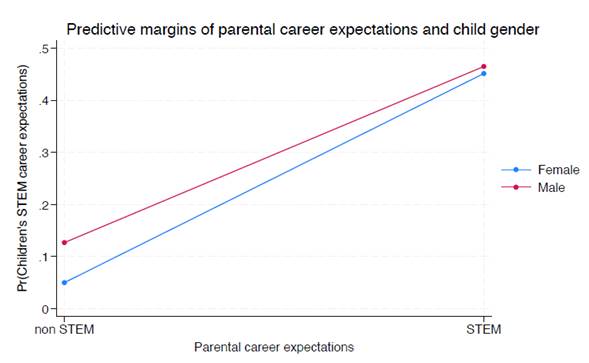
Results indicated a significant moderation effect of children’s gender on the association between parental career expectations and children’s STEM career expectations (p ≤ .001). Specifically, the likelihood of girls preferring a STEM career increased by 0.400 units (p ≤ .001) when their parents held STEM career aspirations for them. In contrast, it only increased by 0.334 units (p ≤ .001) for boys, suggesting a more substantial association of parental STEM expectations with daughters than with sons (Figure 1). No other gender-based moderation effects were found.
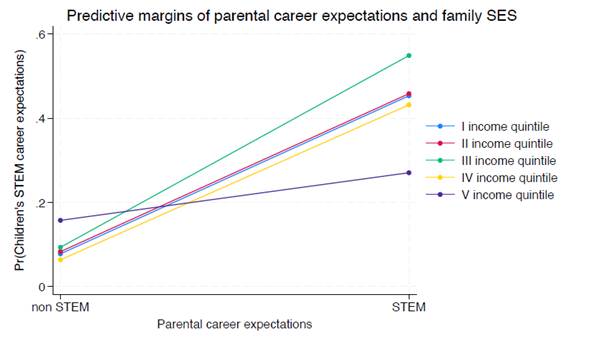
The analysis also identified a significant moderation effect of family SES on the association between parental career expectations and children’s STEM expectations (p = .002). Specifically, from the first to the third income quintile (lower to higher SES) an increasing trend was observed in the likelihood of children preferring STEM careers when their parents also expected a STEM occupation for them, corresponding to predicted increases of 0.348 (p ≤ .001), 0.371 (p ≤ .001), 0.463 (p ≤ .001), espect-
tively. However, a deviation from this trend was observed in the fourth quintile, with a slight decrease to 0.397 units (p ≤ .001). For the fifth quintile, the association between parental expectations and children’s STEM career preferences was not significant (0.126 units, p = .162) (Figure 2). No other significant SES-related moderation effects were observed.
Discussion
Using a large population cohort from Chile, this study aimed to explore children’s STEM career expectations at the middle school level, focusing on: (i) the association of parents’ career expectations and children’s early skills with the likelihood of children inclining towards a STEM career path; and (ii) the moderating effects of children’s gender and family SES on these associations.
The study contributes novel insights to the literature by examining the combined effect of parental expectations and children’s prior skills during a developmental stage that has largely been overlooked. Findings could inform early interventions at the middle school level designed to encourage STEM career paths, promoting equitable career opportunities.
STEM career expectations: Parental expectations and children’s early skills
Findings regarding the first study aim were partially aligned with our expectations. Among the nine factors evaluated in the multivariable model, only three significantly increased the probability of children’s future preference for a STEM career, including child gender, maternal education level, and parental career expectations. Specifically, boys were found to be 117% more likely than girls to aspire to STEM-related careers (Conlon et al., 2023; Oliveira et al., 2020). This finding may be attributed to prevalent math-gender stereotypes in Chile, which associate math predominantly with males. These stereotypes are observed among children as young as five in Chile (del Río et al., 2016; 2019) and may discourage girls from engaging with STEM fields from an early age (Espinoza & Taut, 2020).
In relation to parental characteristics, children of mothers with higher years of education and expectations of STEM careers for their offspring were more likely to show an inclination towards STEM fields in middle school. More specifically, an additional year of maternal education increased the likelihood of children aspiring to a STEM career by 8.5%. Previous studies have posited that parents with higher educational attainment are more likely to value and understand the importance of STEM education, thereby fostering an environment that encourages the pursuit of STEM-related paths (Pinneo & Nolen, 2024). These parents often possess a greater awareness of the career opportunities available within STEM fields, which in turn influences the educational resources and experiences they provide for their children.
Furthermore, findings revealed that children whose parents have expectations for them to pursue STEM careers are 695% more likely to imagine a future within a STEM occupation themselves. This emphasises the pivotal role of parents, particularly within educated family contexts, on shaping their children’s career aspirations. The situated-expectancy-value theory (Eccles & Wigfield, 2020; Wigfield et al., 2009) and the parent socialisation model (Eccles, 1993; Soto-Lara & Simpkins, 2022), suggests that student’s decisions to engage in academic activities are influenced by the balance between their expected success, the value they attribute to these activities, and contextual influences. Accordingly, children’s values towards STEM activities are shaped through their interactions with influential figures, primarily their parents. Serving as primary role models, parents transmit their own beliefs and attitudes to STEM activities, both explicitly and implicitly, via their behaviours and interactions at home (Eccles, 1993; Simpkins et al., 2015; Soto-Lara & Simpkins, 2022). This plays a key role in the formation of their children’s attitudes and values towards STEM activities and, by extension, their career expectations (Pinneo & Nolen, 2024; Zhan et al., 2023).
Contrary to our expectations, children’s early skills (i.e., socio-emotional, cognitive, and executive functions), children’s age, maternal occupation, and family SES were non-significant antecedents to explain children’s STEM expectations. Even if all these variables were significant at the bivariate level -suggesting that older children from higher SES, with higher socio-emotional, cognitive, and executive functions, and employed mothers could be more inclined towards STEM fields- they were non-significant when their joint associations were explored in the multivariable model.
Regarding children’s early skills, existing literature indicates that advanced cognitive and language skills at the age of five (OECD, 2021), as well as general cognitive abilities at the age of twelve (Creed et al., 2007), are predictive of an inclination towards STEM fields and high-status careers, respectively. However, these associations were identified cross-sectionally, and to our knowledge, there has been no longitudinal examination of their contribution to later career expectations. Consequently, the present findings challenge the long-term predictive effect of early skills for future STEM interests, at least during middle school. On the other hand, in the context of the expectancy-value theory (Eccles & Wigfield, 2020; Wigfield et al., 2009), it appears that children’s career expectations might be more influenced by the value they assign to the STEM field -largely shaped by parental expectations (Eccles, 1993; Simpkins et al., 2015; Soto-Lara & Simpkins, 2022)- than by their expected success or competence in this area based on their previous abilities. It is conceivable that the balance between expected success and the value attributed to STEM becomes more pronounced at later educational stages, when academic tasks become more specialised and directly related to STEM, potentially giving greater importance to their skills (Mayerhofer et al., 2024).
In relation to the sociodemographic factors that did not yield significant results, the lack of a significant association with family SES is particularly surprising, given existing literature that highlights its influence on children’s STEM career aspirations (Hansen et al., 2023; Turner et al., 2019). However, it is important to note that in Chile, educational attainment and SES often intersect, as individuals from economically vulnerable backgrounds tend to achieve lower levels of education (Valenzuela et al., 2014). Consequently, the non-significant association between family SES and children’s career expectations may reflect the mediating role of maternal education in shaping these expectations.
Children’s gender and family SES moderation effects
With respect to the second aim, findings partially aligned with our hypotheses (Hansen et al., 2023; Turner et al., 2019). We observed that the association between parental career expectations and children’s STEM career expectations was moderated by the child’s gender and family SES. Conversely, in the association between children’s early skills and STEM career expectations, neither gender nor family SES played a moderating role. Concerning the gender moderation effect on parental expectations, our results revealed a more pronounced impact of parental STEM expectations for girls than for boys. This gender difference underscores the nuanced role that socialisation plays in shaping career development. While boys may benefit from a more generalised societal endorsement of STEM careers, which could make them less reliant on parental encouragement, girls might still perceive STEM fields as traditionally less ‘female’. Thus, parental encouragement could be a key factor in enabling girls to view these careers as viable and desirable options. However, this finding challenges the results from a study conducted using a similar age range in Korea by Lee et al. (2020), which found that parents’ beliefs significantly predicted their sons’ motivation towards STEM but had a non-significant impact on their daughters’. These divergent findings may indicate varying cultural and societal norms surrounding gender roles in STEM fields across different countries that were not considered in any of these studies, such as teachers’ values and media representation.
Regarding the moderation effect of family SES, our results exposed a complex association between parental and children’s expectations. In the first three income quintiles, representing lower to middle SES, there was a clear increasing trend: as family SES increases, so does the impact of parental expectations on children’s preference for STEM careers. This finding supports the notion that within lower socioeconomic groups, parental expectations play an important role in shaping children’s expectations towards STEM fields, potentially due to the perceived socioeconomic advantages of these careers. However, this increasing trend did not hold in the upper SES ranges. Specifically, a slight decline in this effect was observed in the fourth quintile, whereas the highest SES group, exhibited a non-significant association. This might indicate a ceiling effect at higher socioeconomic levels, where children from more affiuent families have access to a broader spectrum of resources, potentially diminishing parental expectations’ key role in determining their career choices. This observation is consistent with existing literature suggesting that individuals from higher socioeconomic backgrounds benefit from a wider array of opportunities and support systems (Tan et al., 2023), likely attenuating the association of parental expectations with their career decisions.
Limitations
While the study provides valuable insights into the factors shaping children’s STEM career expectations in Chile, it is not without limitations. First, the use of self-reported data for capturing both children’s and parents’ career expectations may introduce social desirability bias. Second, the binary classification of careers into STEM and non-STEM categories may oversimplify the diverse nature of career paths, potentially obscuring more subtle trends in children’s expectations. For example, international and Chilean studies indicate larger gender participation gaps in computer science, engineering, and technology compared to other STEM subfields related to health, such as biology and chemistry (Cheryan et al., 2017; Chilean Education Ministry, 2024). Thus, future research could explore more specific career paths to uncover more nuanced gender differences within STEM fields. Moreover, employing a STEM classification system developed in the United States (Conlon et al., 2023) raises concerns about its cultural fit in Chile, despite its alignment with a similar open-ended question and age range as our study. Future studies should strive to create culturally tailored classification guidelines. Another limitation is the study’s cross-sectional analysis of parental career expectations, which hinders our ability to infer conclusions about their impact on children’s STEM interests. While longitudinal data was used to assess children’s early skills, the unavailability of data on parental expectations from the 2012 ELPI wave limits our understanding of how these associations develop over time. Consequently, future research should investigate the longitudinal associations of parental expectations to ascertain the likely dominant causal direction between parental and children’s expectations.
Practice implications
The findings from this study offer several implications for practice, especially in the realms of educational policy aimed at increasing equitable participation in STEM fields among middle school students. Parental expectations emerged as a significant determinant of students’ STEM ambitions, signalling the necessity for educational strategies that encompass family engagement. Schools might introduce initiatives that inform parents about the opportunities within STEM fields, fostering a supportive environment that nurtures their children’s scientific interests (e.g., Harackiewicz et al., 2012). Providing guidance for families to encourage STEM exploration at home is key, with special attention to removing gender and socioeconomic barriers.
The study demonstrated that girls are more likely to envision themselves pursuing a STEM career when their parents hold such expectations for them. Therefore, targeted parental encouragement could be a key strategy to counteract gender stereotypes that discourage girls from STEM participation, as indicated by interventions aimed at addressing gender biases in STEM (e.g., Liben & Coyle, 2014). Furthermore, addressing socioeconomic disparities also requires nuanced approaches. Interventions tailored to the unique circumstances of lower and middle SES groups are likely to be more impactful than one-size-fits-all strategies. It is essential to focus attention on classrooms serving the most disadvantaged SES backgrounds and actively engage their families, particularly those with lower educational levels.