




 English (pdf)
 Article in xml format
 Article references
 Automatic translation
 Send this article by e-mail
 Cited by SciELO
  Cited by Google
  Similars in
SciELO
Similars in
SciELO  Similars in Google
 Permalink

1 Introduction
In an influential essay, Hal Foster (2004) argued that archival art is characteristic of our times: an artistic response to a culture that can no longer be understood through the grand historical narratives and large-scale theories that defined modernity. His diagnose seems corroborated by the fact that since the 1990s, “archive” has become a key term in the art world. Countless artworks are based on archival material, are partly constituted by an archive, or are interpreted as some kind of archive. There has also been a proliferation of exhibitions and seminars dedicated to understanding the relationship between art and archive, its history, poetics, and politics. “Archival art,” though difficult to define precisely, is now a widely used category, and several important works have attempted to trace its historical emergence and development (Alphen, 2017; Callahan, 2022; Guasch, 2011; Zacarias, 2017).
Ibero-American art is no stranger to archival fever. In addition to the large number of artworks that have been labeled as “archival art,” “archive” has become a key term in criticism, cultural studies, art history, and aesthetics in this part of the world. Some recent panoramic reviews of Ibero-American Art use it as a historical category (Giunta, 2014; Giunta & Flaherty, 2017); the subject has brought together artists, archivists, curators, museographers, philosophers and art historians in events that have resulted in some important books (Carvajal et al., 2019, 2022a; Museo Universitario de Arte Contemporáneo & Ex Teresa Arte Actual, 2019). Despite the liveliness of the subject, however, there are no general overviews of archival art in Ibero-America. The closest is Anna Maria Guasch’s (2011) now classic book, Arte y archivo, 1920-2010: genealogías, tipologías y discontinuidades, but it has a more global claim, presents few Latin American artists and authors, concentrates on works (not discourses), and, since it goes up to 2010, leaves out recent developments.
This article offers a critical analysis of the use of the term “archive” in discussions about visual arts in Ibero-America between 2011 and 2022: Why has this term gained currency in the Ibero-American art world during the last decades? What is it used for? How do artworks function when they are understood as archives? What are the main themes in these discussions?
We propose to frame our analysis in four interpretive hypotheses. 1) The use of the term “archive” in discussions on contemporary Ibero-American visual arts can be understood through the model of the machine, that is, in terms of certain functions archives perform. 2) Archives in Ibero-American visual arts have three basic functions: collecting, montaging and mobilizing.3) Archives are communitarian machines: they emerge from communities, create communities, and require communities for their operation. 4) Archives are time machines: they shape time to sustain, construct and critique memory, and, in addition, to create the future.
An overview like the one we propose is essential for several reasons. It helps to make visible the artistic, academic, and activist work on art and archives in Ibero-America. It is significant that Art + Archive: Understanding the archival turn in contemporary art (Callahan, 2022), the most important recent review on the subject, does not take the region into account, despite the wealth of academic production in Spanish and Portuguese on the subject. This is also a transnational phenomenon, promoted by regional networks and rooted in shared social and cultural dynamics. Its critical analysis is also important in order to evaluate the risks of certain archival readings of Ibero-American artistic practices, which can subtract ambiguity and poetic-political power to turn them into digestible commodities for the market (Gentile, 2017; Lopes & Longoni, 2019; Rolnik, 2008). Jorge Blasco and Fernando Estévez (2010) argue that the indiscriminate use of the term “archive” can lead to a “disappointing deactivation of its possibilities” (p. 13).
Another reason why the study of this phenomenon is important is that the archival turn in the humanities and the arts has transformed the very notion of archive, and has prompted archival science to broaden its own theoretical and methodological horizons (Alphen, 2018; Ketelaar, 2017). New paradigms in archival science, such as the Records Continuum Model (Upward et al., 2011), the Social Justice Approach (Dong et al., 2017), and Radical Empathy in Archival Practice (Caswell & Cifor, 2016), benefit from experimental artistic practices.
2 Methodology
Our corpus of texts includes curatorial scripts, articles, books, book chapters, event proceedings, theses, and websites that apply the term “archive” to the interpretation of artworks or reflect on art archives in Ibero-America. We paid special attention to collectives and meetings that deal with these issues. We have chosen the years 2011-2022 as our time frame, since 2010 is the last year covered by Guasch’s aforementioned book, which represents a turning point in the discussion of these problems in the Spanish-speaking world.
An initial survey of search engines and databases in English, Spanish, Portuguese, and French yielded a total of 260 references dealing with visual arts and archives in Ibero-America. Of these, 109 were selected because they were more pertinent to answer the research’s guiding questions: What is meant by “archive” in discussions of artistic practices in Ibero-America? How does the term “archive” function in these discussions? What archival actions can be traced? What are the aesthetic-political potentials of archive art? What are the relationships between art, archives, and the politics of memory? On which theorists are these reflections based? Which artists, works and archives are mentioned? (Table 1) Which exhibitions and events have driven the discussions? It is not possible to include all the references reviewed here, nor have we been able to consult all the production on the subject, which grows larger every day. Our intention is not to exhaust the field, but rather to provide an initial mapping.
A first analysis of the texts of the corpus allowed us to formulate four reading hypotheses that seek to bring to light the nodes of the discussion on art and the archive in Ibero-America. The first is that “archive” can understood through the model of the machine. The second is that these machines have three basic functions: to gather, to montage, and to mobilize. The third is that archives are community machines: they emerge from communities, create communities, and require communities to operate. The fourth is that archives are time machines that give shape to memory and to the future.
3 Results
3.1 Hypothesis 1: An “archive” is a machine
Christian Bendayán’s El descubrimiento del Amazonas is a boldly colored, naive looking painting that at first glance has nothing to do with the documentary, bureaucratic, serial aesthetic associated with the term “archive.” For Vidarte (2018), however, “Bendayán creates paintings that function as hybrid archives” (para. 20). For Daly (2017), Bendayán “frames” the Peruvian art archive through the appropriation of botanical and historical painting about explorations in the Amazon.
Table 1 Artists discussed in two or more references included in the review
For Campuzano et al. (2015), he reactivates the images and imaginaries of the Amazon, constructing a new archive that problematizes contemporary Iquitos. What is interesting about these interpretations is the elasticity of the term “archive,” its capacity to absorb meanings and transform the interpretation of artistic practices that, at first glance, seem to have little to do with it
In discussions of the archive in contemporary Ibero-American art, the term “archive” is generally used but not thematized, problematized, or explicitly defined. On the rare occasions when a definition is offered, it tends to be highly abstract. “The archive,” in the singular, is defined as a device that embodies a dominant power, and that determines narratives about the past and the social processes of remembering and forgetting, preserving and eliminating. These approaches are mainly supported by Michel Foucault’s (1970) The Archaeology of Knowledge and Jacques Derrida’s (1997) Archive Fever, although they are not always cited (Ansa, 2019; Arantes, 2021; Camerino, 2019; Gómez-Moya & Pastor, 2022).
This somewhat general and promiscuous use of the term by artists and cultural theorists has led to tensions with archival science (Bravo, 2019; Caswell, 2021), but also to fruitful exchanges. Ernst van Alphen (2017) argues that “the archive as metaphor has repercussions for real, material archives” (p. 14). One of these repercussions is the development of an expanded notion of archives that includes “oral and written records, literature, landscape, dance, art, the built environment, and artefacts” (McKemmish, 2005, p. 3).
How can this situation be addressed? One approach would be to develop a broad definition of the archive, encompassing all the different meanings and current uses of the term. However, this would lead to an inflationary use of the term that would probably render such a definition useless: a definition must exclude something, and if everything is an archive, then nothing is. Another approach would be to propose a normative definition of the archive, that is, to offer a disciplinary criterion for deciding when it is correct to call something an archive and when it is not, or when one speaks of an archive in the literal sense and when one speaks of an archive in the figurative sense. However, this runs the risk of ignoring the extent to which actual practices give content and meaning to the concept of the archive.
Instead of proposing a broad definition or a normative one of what is an archive in these discussions, we think it is more productive to question the use of the term “archive” and foreground its strategic value in discussions of contemporary art. Our center is not the nature of the archive, but the potential that is released when artworks are considered as archives. When we call something an “archive,” what capacities do we endow it with? What can artworks do when they are called “archives”? A similar intention guides the work of Taylor (2019) and Callahan (2022).
We propose that we can better understand the use and the appeal of archives in contemporary Ibero-American art if we think of archives as machines, that is, if we pay attention to how artworks and artistic practices function when we consider them as archives. Authors such as Jacques Derrida (1997), Eric Ketelaar (2006), Pedro G. Romero (2009), Andrés Tello (2015), Cristian Gómez-Moya and Luciana Pastor (2022) have used some variation of the term “archive machine,” although giving it meanings that differ from the one we elaborate here. We think of the machine as a model to analyze current discussions on art and archives. As Ricoeur (2001) has pointed out, a “model is essentially a heuristic instrument that attempts, by means of a fiction, to break through an inadequate interpretation and to open the way to a more adequate one” (p. 316f). The model of the machine underlines the active character of archives and of the term “archive” itself. A machine is an organized system composed of disparate elements that uses energy to perform a specific function or task in a specific environment (Simondon, 2007). Accordingly, archival machines are not stable objects that simply need to be identified, recognized, or appreciated. They are complex sets of institutions, collections, technologies, and practices that are constantly adapted, reconfigured, and reinvented by various agents to achieve their goals, and can only be understood in terms of those goals that give them sense. The hypotheses presented here explore the implications of this model for our understanding of discussions of the archive in contemporary art.
3.2 Hypothesis 2: Archives are machines with three basic actions
If archives are machines, how do they function? What is their materiality? What energy do they consume? What are their operating conditions? What are they used for? In what spheres do they operate, and who operates them? What expertise do they require? Above all, what kind of actions or work do they perform? We believe that the answers to these questions in the texts reviewed can be grouped under three basic actions: gathering, montaging, mobilizing (Tobón & Giraldo, 2022). It would be possible to identify other actions that are variations or intersections of these three (Figure 1).
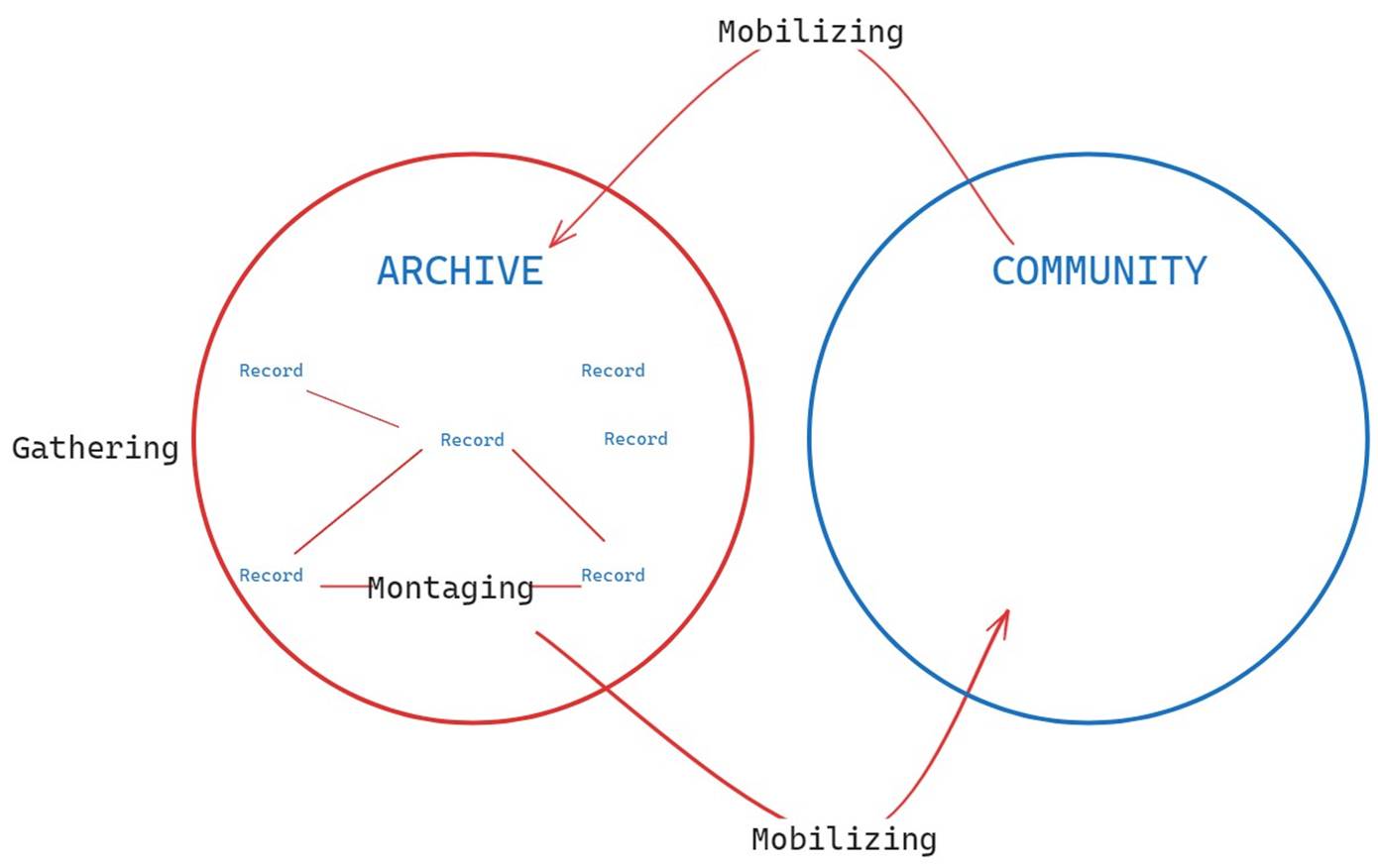
Gathering: creating an archive by selecting and accumulating objects.
Montaging: creating orders that connect the objects in the archive.
Mobilizing: activating the archive, giving it new meanings through uses that generate effects outside the archive.
3.2.1 Gathering
Gathering is probably the action that gives birth to any archiving machine. An archiving machine is born when different objects begin to accumulate, when they become part of a whole. The basic requirement is that this accumulation results in a relatively stable entity. Starting from an interest, a question, a theme or a desire, the gesture of gathering traces a circle that embraces various objects, separating them from everything that does not belong to the archive and elevating them to the status of documents: evidence or testimony of something that has happened.
Artists who work with archives do not create something out of nothing. Rather, they are researchers and recyclers. They immerse themselves in the remnants of the past, searching for documents, paintings, sculptures, sounds, images, bones, or inventories that they can recover and make work in a different way. These materials can be of very different types, but the main thing is that a certain affective, political, vital or cultural energy can be detected in them, no matter how anodyne and inert they may seem at first glance.
José Alejandro Restrepo has gathered fragments of texts, quotations, and images from art history books, popular magazines, scholarly books, and television programs. This compilation constitutes a dense visual research on the images of war and the war of images in Colombia (Tobón & Giraldo, 2022). Margo Steinwasser gathers fabrics and scraps of all kinds (tablecloths, Ziploc bags, socks, shower curtains...), which she sews into a large ball that has been growing since 2007. “Each piece of fabric contains its own unique and unrepeatable story. Together they make up my ‘textile archive’” (Steinwasser cited in Arfuch, 2015, p. 7). Teresa Burga builds an archive with “documents, images, diagrams, and objects deployed in an installation that procures a sort of cut in one’s own becoming” (Tarazona, 2011, p. 19). Rosângela Rennó gathers photographs of workers who participated in the construction of Brasilia, making visible a social experience that had been ignored (Boero et al., 2018; Cámara, 2018; Garramuño, 2015). Christian Bendayán works from murals and littleknown works, tracing the homoerotic desire that inhabits the images of the Amazon (Daly, 2017; Vidarte, 2018). Mayra Barraza, in 100 días en la república de la muerte, records those killed by acts of violence in two newspapers in El Salvador, noting her reflections, conversations with friends, and messages from readers, from which she constructs several series of paintings (Pleitez, 2019). Voluspa Jarpa and Fabiola Ferrero are said to assemble “an archive of archives” (Cardona, 2022, p. 14; Taccetta, 2017, p. 248). Other projects collect digital data, such as Santiago Ortíz’s Personal Knowledge Database (Plazas, 2018) and Rafael Lozano-Hemmer’s Nivel de confianza (Yepes, 2021). Many other cultural works and projects gather materials from social outbursts and historically excluded communities, an issue we will touch on in the section on mobilization. The act of gathering is constitutive of all archival art, and, therefore, it is not strange that it appears in such dissimilar works: it is probably this gesture of gathering and selection that invites us to apply this category.
3.2.2 Montaging
If gathering refers to the selection and accumulation of objects, montaging refers to their arrangement, to the generation of sequences or possibilities of interpretation. In the visual arts, montage refers to the display of the work, its installation, that is, the way in which each component relates to the others and to its spatial and institutional environment. But montage is also a way of generating narratives. In analogy to film montage, archival art makes it possible to connect documents, events, or temporal layers and suggest stories. Archival machines “montage” in an expository and narrative sense. According to Graciela Carnevale (2019), “the way the archive is organized generates a text and therefore a meaning, each document has multiple layers to be read and discovered and can be articulated in different narratives” (p. 104). For Restrepo (2017), the work of the archive is “identical to the work of the editor or montage maker: collecting, selecting, connecting, interpreting, and disseminating” (p. 219). A recurring concern is how to prevent the narratives that guide the constitution and exhibition of art archives from imposing a univocal interpretation. Graciela Carnevale (2019) emphasizes the need to maintain the Tucumán Arde archive as “a space open to interpretation and discovery, a space that is presented as an invitation to investigate, to look, to interrogate, and not as a ruin or a corpse” (p. 104). Irina Garbatzky (2014) calls for Roberto Jacoby’s archive to be “revisited, commented on, and rearticulated by the gaze of the author, historians, and interviewers” (pp. 318-319). As contexts and needs evolve, montage should be an ongoing process.
Our research has revealed several types of montages, which we can distinguish according to their materials. The analyzed authors point out that some artists montage works from different periods and genres. Bendayán links “works by Otto Michael, César Calvo de Araújo, or botanical drawings” with portraits of contemporary subjects (Vidarte, 2018, para. 28). Others assemble images of the same person (in personal or family archives). Marcelo Brodsky (2017) composes his own photographs with explanatory texts that allow the viewer to reconstruct the artist’s life and connect it to the social memory of repression in Argentina (Santos, 2013, p. 164). The exhibition Anarchivo SIDA treats HIV-AIDS as a visual and affective paradigm shift of neoliberalism through the montage of medical, artistic, popular, and other images and texts (Equipo re, 2016). Others assemble images and texts that create anachronistic connections (perhaps following Aby Warburg’s lead). Fernando Bryce constructs Atlas Perú from “magazines, newspapers, pamphlets, flyers, political manifestos” (Hernández, 2016, p. 51). Raúl Eduardo Stolkiner (RES), in the series La ruta de Cortés, performs “an archaeological work of tracing back to different times” from photographs of historical remains (Bertúa, 2017, p. 230).
In the analyzed corpus, montage has two main functions:
to reveal what is hidden in history in general, and 2) to critically revise the canonical narratives of art history.
Revealing the hidden. Every claim to historical truth refers to the archive. For historiography, the archive fixes the fact and transforms it into an event that can be referred to, that is, it creates the epistemological conditions in which the dialog that makes past and present intelligible is possible. For many contemporary artists, the montage of archival documents is attractive because it makes it possible to critically reconstruct the past, to show silenced aspects of history, to trace the deep roots of our fantasies and fears, and to counterbalance the oblivion of certain events. Fernando Bryce’s Atlas Perú reveals “the imaginary built around Peru and “the Peruvian” from the mid-thirties to the turn of the century,” its archetypes, problems, and illusions (Hernández, 2016, p. 51). La huella invertida, by François Laso, shows the concealment of Ecuador’s indigenous roots (Laso, 2016). In Empalme, Patricio Larrambebere juxtaposes “anachronistic aspects that in turn respond to different cultural systems” (Díez, 2014, p. 66). Ángela Bonadiés makes visible the desires of Venezuelan architectural and urbanist modernity, its concrete realizations and its ruins in photographic series such as La Torre de David (with Juan José Olavarría) and Estructuras de excepción (Muñoz, 2020; Vásquez-Ortega, 2020). In La ruta de Cortés, RES is interested in “the memory of the oppressed, the failure of emancipatory attempts, and the traces of massacre inscribed in the social imaginary of Latin American history” (Bertúa, 2017, p. 230). Voluspa Jarpa condenses a complex image of Latin America through the montage of declassified documents produced in the context of the Cold War, so that “the montage operations (in each material and between the different sections of the exhibition) constitute ways of aesthetically-politically combating the conventionalized views of history” (Taccetta, 2017, pp. 244-245). Immemorial, by, Rosângela Rennó arranges photographs of workers in a way that simultaneously evokes both a cemetery and a site of memory (Cámara 2018), demonstrating how “the obsolete, the out-of-fashion, what had been discarded, always had significant critical potential” (Garramuño 2016, p. 65).
Revising art history. The term “archival art” is also applied to virtual curatorial projects or imaginary museums that assemble works by different artists and periods in order to revise the canon of art history and reveal forgotten, excluded, or relegated artists or forms of production. The Museo Travesti del Perú gathers, alters, and falsifies works from other museums to generate divergent readings that allow us to see aspects “that have remained ignored and therefore silenced. [...] the transvestite has been part of history from the beginning, which highlights the fact that officialdom has been built on the virtue of endless silences” (Campuzano et al., 2015, p. 48). Archiva, by Monica Mayer (2014), selects 76 works of Mexican feminist art to “counteract the processes of invisibilization and self-invisibilization to which women’s art is subjected” (p. 2). Several authors have argued for the importance of archives in rewriting Ibero-American art history (Arantes, 2015a, 2019; Freire, 2019; Giunta, 2012; Longoni, 2018; Lopes & Longoni, 2019; Varas, 2018; Vidal, 2012).
3.2.3 Mobilizing
To mobilize an archive machine is to do something with it. This use of the archive unfolds its potential in relation to a community of spectators, users, or co-creators. Mobilization must therefore always be understood in a double sense: it refers both to the archive and to those who use it. An archive is mobilized when it is appropriated, used and modified by different agents. An archive, in turn, mobilizes individuals and collectives to the extent that it enables them to achieve certain goals, to the extent that it inspires and enables certain actions. As some contemporary archivists point out, the meanings of the archive lie not only in its contents, but also in who, how, and with what intentions uses it: “Each activation leaves fingerprints which are attributes to the archive’s infinite meaning” (Ketelaar, 2001, p. 137).
Mobilizing is a particularly important action in discussions of archives and art in Ibero-America, given our shared history of colonization, slavery, and violence. In the second half of the 20th century, countries in the region suffered dictatorships and other forms of political repression in the context of the Cold War. In response, various networks of solidarity and denunciation emerged among human rights organizations. In this context, archival art took a decidedly political and critical stance. Some artists work with official archives, emphasizing the processes of declassification (Boero et al., 2018). Voluspa Jarpa assembles and intervenes in the declassified archives of North American intelligence agencies, pointing out all that they hide and show with their absences, blackouts, and deletions, thereby creating different historical and geopolitical images of Latin America. This would be an “artistic declassification” that “proposes a new documentary ordering, that is, redistributes the conditions of the gaze” and thus empowers its public becoming (Olivarí, 2018, p. 16). The artistic-political collective Desclasificación Popular has challenged the Chilean state by demanding access to the documentary archive created by the National Commission on Political Imprisonment and Torture (Valech Commission) and the “declassification of documents related to human rights testimonies during the dictatorship, in particular those extracted from testimonies” (Gómez-Moya, 2018).
In Operação Condor, João Pina constructs a kaleidoscopic image of this transnational repressive project by combining photographs from archives of public protests, police archives, photographs and interviews with survivors and relatives of disappeared persons, portraits of military personnel accused of crimes against humanity, and photographs of torture centers. “Pina’s images depict a common representation of Condor which erases borders and gathers together sites of torture from distinct places, and that become part of the same story, linked by their account of suffering and violence” (Preda, 2020, p. 258).
The question of how to mobilize archives is fundamental for art collectives engaged in political, social and cultural struggles. Graciela Carnevale (2019) has constituted an archive whose core is the work of the Grupo de Arte de Vanguardia de Rosario, especially that related to the action Tucumán Arde (1968), to which she later added documentation of artistic-activist practices, Latin American artists’ meetings, and political violence (Carnevale et al., 2015). Carnevale (2019) wonders how to avoid the decontextualization and depoliticization of these materials, “how to ensure that this tension is preserved and made productive and not neutralized by the system?” (pp. 103-104). In this sense, she calls for avoiding its confinement in a purely artistic space and for finding ways to reactivate its “poetic-disruptive potential” (p. 106). Mobilization is the raison d’être of these artistic-activist practices, and archives can only be faithful to this origin if they maintain their poetic-political potency. This requirement affects decisions about what materials can be integrated into the archive, how to balance use and preservation, and what strategies of public projection must be undertaken (Olivarí, 2018).
These are archives that not only preserve or refer to the past, but should also serve as a seedbed for present and future mobilizations. The Anarchivo Sida emerged in 2013 as “a research and archival production project on cultural responses to the HIV/AIDS crisis, focusing on Spain and Chile” (Arriola, 2019, p. 83). The Hilos de sangre project (Bedoya & Motta, 2023) collects testimonies, documents, actions, and artworks related to HIV/ AIDS in Colombia. Registro Contracultural is a Chilean web platform that collects, compiles, and makes visible records of political performance, especially in public spaces, in addition to generating events and content. In Archivo caminante, Eduardo Molinari (2020) explores the relationship between art, history and territory from an ecological perspective to mobilize hidden narratives related to the consequences of transgenic soybean crops in Argentina. These projects demonstrate how archival strategies can strengthen aesthetic activism by creating connections between art institutions and generating wider visibility.
Countless digital archiving projects of artistic and cultural activism processes have come into existence in the last few years. It is not possible to list them in this article, but we can highlight the Archivo Yeguas del Apocalipsis, SOS Medellín, Archivo del Paro #28A, Desobediente, La Ciudad como texto, Archivo de la Memoria Trans México, Archivo Contra la Pared, several of the collections gathered in Red Csur’s initiative Archivos en uso, the Museo callejero del estallido social and the Archivos del Colectivo AberturaVaginal. Also, a considerable amount of physical Ibero-American art archives have been partially digitized (Gentile, 2018). For Diana Taylor (2019), digitization makes it easier to mobilize archives, in that it allows “making them widely and easily accessible” and “pushes the past and present to be increasingly thought of in relation to their preservation and access in the future” (pp. 41-42). Digitization, however, is no panacea, as it does not guarantee long-term preservation nor does it entirely solve the problem of access, which remains subject to other obstacles, less visible but no less real (Carvajal et al., 2022b; Sedán 2022). Managers of art archives are quite aware of this and cannot be accused of technological messianism.
Archival art almost always has a critical moment of dismantling a previous archive or narrative that supports a hegemonic narrative. This moment is particularly clear in the actions of gathering and montaging: gathering implies a redefinition of what is included or excluded from an archive, and montaging deconstructs established orders and transgresses the boundaries between categories. The moment of mobilization, on the other hand, has a more proactive orientation, as it requires that what has been collected and montaged be projected into the future in ways that help to sustain, transform, or create communities.
On a general note, it is perhaps necessary to remark that the three basic actions we have described are interdependent. Gathering already implies at least a minimal order and therefore certain possibilities of montage. Mobilization often takes the form of an intervention in the montage or in the criteria of inclusion or exclusion that constitute the archive. Finally, gathering and assembling are meaningful because of the mobilization they make possible.
3.3 Hypothesis 3: Archives are community machines
Our corpus includes texts dedicated to visual arts and personal or official archives. However, most analyses deal with community archives, i.e., archives that come from a community, require a community to manage them, or build a community around them. Frequently these three features converge, as when communities constitute themselves around an archive that they create, manage, and mobilize.
The Archivo de la Memoria Trans gathers photographic and documentary archives of Argentine trans people from the beginning of the 20th century to the 1990s. The archive has prompted a lively community project, connected to other trans-feminist archives, and which has spawned radio soap operas, artistic exhibitions, public demonstrations, and books. The archive aims to protect, build and vindicate trans memories. To protect, because the memory of trans communities is as fragile as their lives, which take place on the margins of society, in contravention of norms and laws, far from families and other social frameworks of memory and, therefore, under the constant risk of disappearance. To build, because collective memory is a living fabric that requires a space where experiences, dreams and nightmares can be shared. To vindicate, because placing these images in a public space that until then has made them invisible is a demand for recognition: it vindicates the material reality of their existence and their dignity.
This is an example of what we could call archives of “subterranean lives,” which document precarious forms of life made invisible by official history, but which never cease to seek other forms of aesthetic and political expression. Among these are the archives dedicated to the underground scene of Buenos Aires in the 1980s (Lucena & Laboureau, 2019), to AIDS sufferers or the movida Madrileña in Spain (Nichols & Song, 2014), and the archives of LGTBIQ+ experiences in Colombia, Mexico, Peru, and Argentina.
The concern for community is nourished by the yearning to reconnect art and life that has characterized Western art since the emergence of the avant-garde, which has emphasized the “critical interrogation of a community’s issues and meanings” (Arfuch, 2015, p. 3). It is also supported by contemporary developments in archival science, for which the values and culture of each community constitute the context for the creation and use of documents (Cook, 2013). Specifically, in the Ibero-American artistic context, “an archival imagination rooted in the politics of the commons” has been invoked, which assumes from a careful practice the challenge of “collectively recovering the use value of archives” (Carvajal et al., 2022b, p. 147). Unlike in other latitudes (Caswell, 2021), in this region we find initiatives that are forged out of a confluence of interests between those who, from creation, criticism, curatorship, research or art history, think of the “archive” in the singular and those who, from archival science, work with “archives” in the plural. This study has identified straightforward signs of a fruitful convergence for the development of a committed and situated archival practice, guided by affection and care.
For example, the Red Conceptualismos del Sur was created to “find collaborative forms of production, organization, and circulation of knowledge that function outside of state structures” (Brives & Prieto, 2019, p. 12). It seeks to maintain the integrity and indivisibility of collections related to “Latin American critical artistic practices,” creating conditions for preservation and dissemination, but without depriving collectives or individuals of their documents. Representatives of archival science propose that “it is not the papers that we preserve in our archives, but the community that produced them, the collective that gives evidence of its existence and its political project through its documentary production” (Bravo, 2019, p. 131). The goal is not only to preserve, but to promote access and collaboration.
These community practices are opposed to the logics of circulation of knowledge and cultural goods in the neoliberal economy (Carvajal et al., 2022a; Gentile, 2018; Richard, 2021). Moreover, the existence of community archives and their use “puts in tension the figure of the state as a privileged agent to decide what to remember and what not” (Bravo, 2019, p. 130). As we will see, this is a key point in the discussion on the role of the archive in the politics of memory.
Initiatives such as Archivos del Común, the CSur Network, and ExTeresa Arte Actual are clearly committed to activating the potential of the common uses of archives, and seek to bring together agents, collectives, and institutions to share strategies and work methodologies. It can be speculated that one of the reasons why the term “archive” is so important in contemporary art is that it is a fertile meeting point for projects and networks.
3.4 Hypothesis 4: Archives are time machines
Archives are time machines because they shape time into complex structures that superimpose different layers, transform the past, and connect it to the present and the future. The traditional image of the archive depicts it as a remnant, a vestige of a static and monolithic past. In contrast, the discussion of the archive in contemporary art foregrounds a multiplicity of relationships between shifting temporalities: time lags, anachronisms, polychronies, imaginary pasts, and alternative futures. It thus speaks of a time that is twisted or spatialized (Hernández, 2016, p. 48; Taccetta, 2017, p. 237) and suggests that it is in the unfolding of these multiple temporalities that “the archive acquires its strength as an image that resists” (Delle Donne, 2018, p. 34). As we shall see, this is related to a renewed emphasis on the uses of the archive in the present and in the past future as a characteristic temporality of the archive.
We propose to distinguish four basic functions of the archive as a time machine in contemporary art: preservation of records, reactivation of memory, critique of the narratives of the past, condition of possibility of the future.
3.4.1 Preservation of records
Contemporary art is increasingly dependent on the archive. One of the reasons is the dematerialization of the artistic object, diagnosed by Lucy Lippard (2004) since the 1960s. Performances, installations, happenings, etc., are ephemeral and survive only in records, that is, under some form of archivalization. This dematerialization has had a profound political significance in Latin America, allowing the circulation of works that would have been censored in conventional exhibition spaces (Richard, 2021). If today we are able to learn about the actions and interventions of the Grupo de Vanguardia de Rosario, it is because Graciela Carnevale et al. (2015) carried out a careful documentation work. The project as an artistic form also requires the archive, since the objects in which it is materialized have a documentary nature, that is, they are not works of art in themselves, but part of the archive of the work. Moreover, the constitution of archives has become one of the dominant poetics of contemporary art: The File Room by Antoni Muntadas, Archivo F.X. by Pedro G. Romero (2009), or Altercartografías by Rogelio López Cuenca (Lapeña, 2022) are projects that collect and preserve ephemeral materials that seem to have no cultural value, not only to preserve them but also to classify, reclassify, and declassify them according to certain aesthetic and political interests.
3.4.2 Reactivating memory
Many works use archival strategies to fix and reactivate key historical moments of political repression. Fabián Taranto’s Búsqueda en proceso recalls some of the foundational events of social resistance movements in Argentina during the dictatorship (1976-1983). Video art and video performances such as El muro de las voces (Roberto Larraguibel, Nury Gaviola, Víctor Larraguibel and Lotty Rosenfeld), Archivo Huelga de Hambre en la CEPAL (Verónica Troncoso) or Lecciones Nocturnas (Guillermo Cifuentes), address “the mechanisms of memory construction, the relationship with the archives, and the way the history [of the Chilean dictatorship (19731990)] is told” (Montero, 2015, p. 587).
Some authors suggest that art has an affective power that allows to reactivate and fix these key moments, embedding them more deeply in the memory of the viewer (Báez et al., 2017; Bertúa, 2017; Carnevale, 2019; Taccetta, 2017). Others emphasize how a connection to the present is created through these affects and emotions (Carvajal & Tapia, 2019).
3.4.3 Critique of the narratives of the past
The discourse on archival art insists on its critical relationship with memory and history: it is an art that elaborates traumatic moments and reveals what is hidden in traditional history, the mechanisms of oblivion, the traps of memory. These critical dimensions are interrelated. Certain works by Marcelo Brodsky (2017) would allow “not to repeat the memories and experiences presented [but] [...] to elaborate one’s own memories regarding this experience that deals with the military dictatorship in Argentina” (Santos, 2013, p. 89). Rosana Paulino’s Atlântico vermelho (2017) unearths archival images of Brazil’s slave-owning past, exposing some of the ways in which this past has been justified and revealing the survival of racism in the present (Dias, 2020). The works of José Alejandro Restrepo dislocate the linear historical narrative, listening to the echoes of images and mapping their secret lives, the survival of myths, the clashes and displacements of temporal layers (Tobón & Giraldo, 2022).
For several authors, archival art allows for a radically critical relationship with the past, through works that give a paradoxical presence to what is not there: they show the constitutive absences of the archive, pointing to beings and events that were never included, that can neither be recovered nor forgotten. To name this “presence of absence,” they have used terms such as survivals, fragments, remains, ruins, voids, silences, shadows, or “the unforgettable” (Acosta, 2019). Florencia Garramuño (2015) contrasts survival and reconstruction, arguing that Rosângela Rennó and Jorge Macchi do not try to recover the past, but rather show it as a ruin, thus destabilizing the very possibility of a history that provides “the last word in the account of what happened. (pp. 64- 65). RES treats the colonial past as “ruins, residues, or monuments” in a way that emphasizes its irredeemably fragmentary character while simultaneously highlighting its impact on the present (Bertúa, 2017, p. 216). These interpretations highlight the capacity of archival art to raise historical questions (which it does not necessarily resolve) (Olivarí, 2018). Other authors are interested in decolonial readings of the Latin American past (Almaraz, 2022; Masotta, 2011; Rigat, 2021; Silva, 2021).
3.4.4 Making the future possible
Carlos Granés (2022) maintains that the preoccupation with the archive in contemporary Latin American art is nothing more than another expression of the self-victimization and political correctness that supposedly dominate it, and the result of its eagerness to construct a traumatic cultural identity from which to derive political gains. Granés’(2022) stance, however, obscures the complexity of the temporal and political dimensions of archives, specifically its orientation to the present and the future (Callahan 2022, chap. 8).
Archival art, Claire Bishop (2013) reminds us, “requires us to think in several tenses simultaneously: the past perfect and the future anterior” (p. 24). One cannot deny archival art’s preoccupation with the past, but neither can one avoid its interest in the present and the future (Guasch, 2022). We have previously noted that mobilization refers to the ways in which the archive can serve as a “toolbox with use-value in the present” (Carnevale, 2019, p. 109). We must now add that artists, managers, and theorists are aware that only the horizon of the future justifies the existence and use of archives. For Voluspa Jarpa (2014), “the archive is the origin of the future; it only makes sense to keep it if I have that future as a perspective. In the present, it is encoded; one could say that it is a kind of latent (possible) future” (p. 22). This is the central problem in all discussions about the activation or neutralization of archives of artistic/political practices or social movements: how to keep their poetic and political potentials alive in an institutional and market context that threatens to fossilize them (Rolnik 2008; Gentile 2017; Carnevale 2019). Bruscky’s work, for example, would not only refer to the past, but would always keep open a path to the future, to what is not given, what one does not manage to see completely, what is becoming or untimely (Britto 2011). Ibero-American art does not return to the archive simply to cling to the past. Rather, it uses the archive as an opportunity to break the melancholic relationship with the past: an opportunity to open a way to overcome the trauma, to mourn and to propose a future that does not simply repeat what we have already lived.
4 Conclusions
The corpus of texts analyzed in this research shows that the vitality of artistic practices and discussions about archives in visual arts in Ibero-America is the result of a confluence of factors: the multiplication of conceptualist strategies in art, the boom of memory, the many transformations brought about by the Internet, the archival practices of civil society and minority communities, the various attempts to link art and politics. In our region, these factors have taken on a specific form and urgency because of the shared desire to come to terms with violent pasts and histories of exclusion, the need to strengthen public deliberation, and the defense of democratizing processes. In this context, archival art has made it possible to address history against the grain and to articulate the work of artists, archive managers, and communities with the concrete demands of indigenous, queer, feminist, and other social movements. The region shares historical, cultural, and linguistic characteristics, including the common experience of colonialism, dictatorships, armed conflicts, and civil wars. In addition, there are some global phenomena, such as the struggles of minorities for recognition and the challenges faced by societies in the digital age. As we have seen, archival art has worked on these traumas and experiences, appealing to a shared sensibility that has facilitated its transnational circulation through works, exhibitions, shows, publications, and academic events.
In this article we tried to reconstruct these discussions through the archive-machine model and its three basic actions: gathering, montaging, and mobilizing. This model allowed us to distance ourselves from both the traditional conception of the archive (neutral, objective, state-run) and the metaphorical-philosophical definition with Foucauldian and Derridean roots. While many authors do indeed resort to some variation of the idea that the archive is the law of what can be said, if we focus on the strategic uses of the term, what emerges in the texts is, on the contrary, an eagerness to break this law and its compulsion to repeat. One cannot describe the poetics of contemporary archival art in terms of “a mechanical sequence, [...] an endless repetitive litany of reproduction that develops with strict formal rigor and absolute structural coherence an ‘aesthetic of legal-administrative organization’” (Guasch, 2011,p. 9). Contemporary archival art is much more diverse, playful, and festive. These archives are machines that produce the new: new documents; new affective, political, and identity communities; and new temporalities that offer alternatives to colonialism, neoliberalism, or authoritarianism. Paying attention to the past does not mean forgetting the future. On the contrary, reflections on visual arts and archives insist on their mutual dependence: a past without a future is blind, a future without a past is empty. What is yet to come must be preserved in the archives and, at the same time, the archives can only have the forms given to them by the future.
This research leaves multiple lines of investigation open. We have consulted many materials from Brazil, Argentina, Spain, Chile, Colombia, and some from Peru, Ecuador, Venezuela, Guatemala, Paraguay, Uruguay, El Salvador, Bolivia. We did not address materials on the Caribbean or other Central American countries. We have not discussed the use of the archive in other arts (literature, dance, theater, or film), nor have we done justice to studies on artists’ archives, the problems arising from the commodification of archives, or the importance of their preservation and access for art history. There would also be a need for a more in-depth analysis of the ways in which the humanities and the arts can stablish a productive dialogue with archival science and, as Ketelaar (2017) points out, take advantage of the results that this discipline has achieved in its most recent theoretical and methodological transformations.

