




 text in
  English (pdf)
 Article in xml format
 Article references
 Automatic translation
 Send this article by e-mail
 Cited by SciELO
  Cited by Google
  Similars in
SciELO
Similars in
SciELO  Similars in Google
 Permalink
Introduction
Acute diarrheal disease (ADD) is one of the main causes of morbidity and mortality in children, the elderly and immunocompromised people, and is currently a worldwide public health problem 1-3. In 2015, ADD was responsible for approximately 1.3 million deaths around the world, with a higher impact in low-income countries, where there is more exposure to environmental risk factors 1,4. In Colombia, there are records of approximately 2,473,253 cases per year between 2008 and 2015 5, a figure which should probably be higher, taking underreporting into account 6. This represents a public health problem with a high impact on the low-income population, and, therefore, appropriate detection and treatment is important 7.
Currently, stool tests and culture are used as the initial diagnostic tests in most clinical settings, despite their poor sensitivity and specificity 8,9. According to the microscopic findings in fecal matter, empirical antimicrobial treatment may or may not be started while waiting for the results of the definitive culture. This result can take 48 to 72 hours 10, 1992, with the limitation that it does not always produce a microbiological isolate. Beginning in 2014, the Food and Drug Administration (FDA) authorized the use of molecular tests known as gastrointestinal panels 11. This technique is based on real-time polymerase chain reactions (RT-PCR) 11, whose purpose is to identify multiple microorganisms in a single test, leading to greater sensitivity and specificity 12,13. This test covers up to approximately 22 pathogens, with results available in one to two hours 14,15.
The gastrointestinal panel is an efficient and accurate diagnostic tool that provides an advantage in clinical practice when beginning targeted and timely treatment, especially in immunocompromised individuals or those at high risk for clinical deterioration 16-18. In addition, it identifies coinfections, decreases the length of antibiotic use and hospital stay and favors cost-effectiveness 15,19. However, the evidence of the potential application and usefulness of gastrointestinal panels in Colombia is limited, and there are few reports in the literature of the prevalence of the etiological agents in adults, as the available evidence, even within the Latin American region, is concentrated in reports of microorganism frequencies, mainly in the pediatric population 20,21. For these reasons, this study described the adult population undergoing gastrointestinal panel testing at a quaternary care hospital in Colombia.
Materials and method
This was a cross-sectional study of a convenience sample. The target population was adult patients with diarrheal disease hospitalized in a quaternary care Colombian hospital who underwent a gastrointestinal panel and stool test between November 1, 2015, and March 31, 2019.
The data were collected from the medical charts of patients who met the stated inclusion criteria. The gastrointestinal panel results were found in the hospital's laboratory system.
Relative and absolute frequencies of the qualitative variables were determined for the univariate analysis. Measures of central tendency and dispersion were used for quantitative variables, according to their distribution. Differences were explored by subgroups based on clinical and paraclinical variables, comparing means, medians or proportions, according to the nature of the variables.
Results
A total of 807 patients were included, 50.2% (n:405) of whom were male. The patients' mean age was 54.7 years. Regarding the patients' comorbidities, 5.5% had cirrhosis (n:45), 5.5% had HIV (n:68), 5.9% had inflammatory bowel disease (n:48) and 16.4% (n:133) had a history of cancer being treated with chemotherapy. Also, 13.75% of the patients had had transplants (n:111), 5.45% of which were kidney (n:44), 5.08% were liver (n:41), 0.99% were lung (n:8), 1.24% were heart (n:10), 0.74% were bone marrow (n:6) and 0.25% were double (liver-kidney) transplants (n:2). Altogether, 40.3% of the patients (n:325) had another comorbidity (hypertension, lupus, chronic obstructive pulmonary disease). On the other hand, 142 people had no comorbidities (17.5%). The remaining clinical and laboratory variables are described in Table 1.
Table 1 Clinical and laboratory characteristics of the study population.
| Variable | Total sample | Mean | SD | Median | Q1 | Q3 |
|---|---|---|---|---|---|---|
| Age (years) | 807 | 54.7 | 20.1 | 57 | 37 | 71 |
| Number of microorganisms | 807 | 0.9 | 1.1 | 1 | 0 | 1 |
| Days of diarrhea | 805 | 11.3 | 52 | 3 | 1 | 7 |
| Number of stools | 807 | 6.3 | 4.5 | 5 | 3 | 8 |
| Heart rate (beats per minute) | 807 | 88.7 | 17.6 | 88 | 76 | 101 |
| Fever (T >38°C) | 807 | 37 | 0.88 | 36.8 | 36.4 | 37.4 |
| SBP (mmHg) | 807 | 115.1 | 21.7 | 114 | 100 | 128 |
| DBP (mmHg) | 807 | 65.5 | 13.2 | 66 | 56 | 75 |
| Leukocytes cells/u | 807 | 10 | 8.9 | 8.4 | 5.22 | 12.6 |
| Neutrophils cells/u | 807 | 6 | 7.5 | 6.35 | 3.28 | 10.1 |
| Lymphocytes cells/u | 807 | 1.3 | 1.2 | 1.1 | 0.62 | 1.74 |
| Eosinophils cells/u | 807 | 0.1 | 0.4 | 0.04 | 0.01 | 0.14 |
| Hemoglobin (g/dL) | 807 | 12.3 | 3.2 | 12.2 | 9.67 | 14.7 |
| Platelets cells/u | 807 | 236.2 | 153.4 | 217 | 138 | 308 |
| Creatinine (mg/dL) | 807 | 1.7 | 2.1 | 0.9 | 0.7 | 1.5 |
| Blood urea nitrogen (mg/dL) | 807 | 26.3 | 22 | 18 | 12 | 32 |
| Serum sodium (mEq/L) | 806 | 136.6 | 6 | 137 | 134 | 139 |
| Serum potassium (mEq/L) | 806 | 4.1 | 0.7 | 4 | 3.6 | 4.4 |
| Time to antibiotic initiation (days) | 571 | 6.4 | 27.8 | 2 | 0 | 5 |
| Time to antibiotic change (days) | 243 | 2.7 | 5.3 | 2 | 1 | 3 |
Regarding the stool test results, the mean pH was 7.9 and the mean red blood cell count was 2.7. The occult blood test was positive for 36% (n:148) of the samples with a final bacterial result, 9.65% (n:39) of the samples with a viral etiology and 4.46% (n:18) of the samples with a final parasitic result. Positive occult blood was reported in 56.87% (n:166) of the samples with a final negative result on the gastrointestinal panel. Altogether, positive occult blood was reported for 515 patients, amounting to 63.81% of the sample. Reducing sugars were found in 22.8% (n:184). Mucus was found in 329 patients (40.76%) and was positive in 34% (n:75) of the bacterial isolates, 11.4% 25 of the viral isolates and 5% (n:11) of the parasitic isolates. Altogether, 54.4% (n:260) of the negative isolates had mucus on the stool test.
According to the final gastrointestinal panel isolation, for bacteria, the mean pH on the stool test was 7.86 (SD 1.09), the median leukocyte count was 0 (IQR 0-5) and the median red blood cell count was 0 (IQR 0-0). For viruses, the mean pH was 7.7 (SD 1.13), the median leukocyte count was 0 (IQR 0-2), and the median red blood cell count was 0 (IQR 0-0). For parasitic isolates, the mean pH on the stool test was 8.1 (SD 1.02), the median leukocyte count was 0 (IQR 0-6) and the median red blood cell count was 0 (IQR 0-1). A total of 202 parasitic structures were reported, accounting for 25%, and only 4.4% (n:4) were positive with a final parasitic isolate on the gastrointestinal panel. The mean time elapsed until the final stool culture report was 53.8 hours, and it was only positive in 243 patients (30.22%).
Out of all the gastrointestinal panel samples (n: 807), 45.6% were negative; however, 54% had a microbiological isolate (29.5% isolated one germ and 24.7% detected coinfection by two or more microorganisms). In this population, the most common etiology was bacterial (49.2%), with enteropathogenic E. coli being the main cause (18.6%), followed by enteroaggregative E. coli (16%). The second most frequent etiology was viral (10.1%), with norovirus GI/GII being the most common microorganism, and, lastly, parasitic (3.7%), with Cryptospiridum being the most representative parasite (1.7%) (Figures 1-A, 1-B, and 1-C).
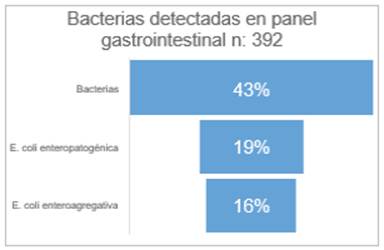
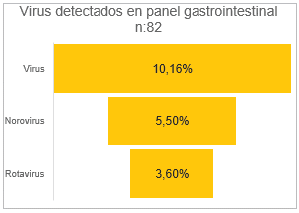
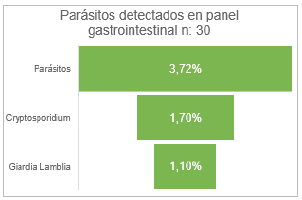
When the most frequent etiology was evaluated by comorbidity, bacteria continued to be the most frequent in each subgroup, with enteropathogenic E. coli and enteroaggregative E. coli being the most common microorganisms. However, Campylobacter jejuni was one of the most predominant isolates in patients with HIV, inflammatory bowel disease and liver transplant. On the other hand, Clostridium difficile was a common microorganism in patients with cancer being treated with chemotherapy, chronic kidney disease and kidney transplantation (Figure 2).
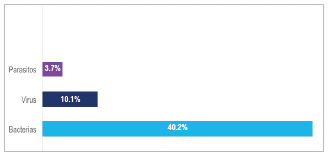
Figure 2 The microorganisms most frequently detected by the gastrointestinal panel in the overall population and some subgroups.
The empirical antibiotic most often used was ampicillin/sulbactam, with the second most frequent being metronidazole; however, in 29.4% of the cases, empirical antibiotic treatment was not begun. Out of all the patients with a gastrointestinal panel, the antibiotic was changed in approximately 56%, and it was discontinued in 18%. The most common reason for these changes was the gastrointestinal panel result (79.4%).
The time elapsed between the onset of signs and symptoms and the beginning of empirical antibiotic therapy was 6.4 days, and the time elapsed to a change in antibiotic due to the results of the gastrointestinal panel, signs and symptoms, or stool test was 2.7 days (Table 1).
Discussion
Acute diarrheal disease is one of the main causes of morbidity and mortality in children, the elderly and immunocompromised people, and is currently a global public health problem 1-3. In 2015, this condition was responsible for approximately 1.3 million deaths, worldwide, with a greater impact in low-income countries, where there is greater exposure to environmental risk factors 1,4. It constitutes a public health problem with a high impact on the low-income population, which is why appropriate detection and treatment are important 7. However, there is little evidence regarding its use and usefulness in adults in Colombia and Latin America.
The gastrointestinal panel has proven its usefulness in different hospital settings since it was approved by the FDA for diagnosing the etiology of diarrheal disease 12. However, thus far, the studies evaluating the usefulness of the gastrointestinal panel in Latin America have done so in children 20, and there are no records regarding its use in Colombia. This study, meanwhile, is a pioneer in describing the clinical, laboratory and etiological characterization of adult patients undergoing a gastrointestinal panel test since its introduction in a high complexity center in Colombia. Historically, it has been established that the main cause of most diarrheal episodes is viral 22,23. However, our study showed that the main cause of diarrhea in hospitalized adult patients is bacterial, mainly due to enteropathogenic E. coli and enteroaggregative E. coli, secondly viral, and lastly parasitic. This finding was similar in the characterization by subgroups according to comorbidity and in healthy patients.
Empirical antibiotic treatment is not generally recommended for acute diarrhea, except for immunocompetent adults with documented fever, dysentery, or abdominal pain (with or without tenesmus), or a history of international travel with a fever ≥38.5°C or associated sepsis; and for immunocompromised patients with dysentery or severe disease. In these cases, quinolones or azithromycin are the antimicrobials of choice 24. However, these recommendations are based on United States epidemiology. In Colombia, there are no specific recommendations regarding empirical treatment, given the poor characterization of diarrhea in adults. The current study found that ampicillin/sulbactam was the most commonly used antibiotic, together with metronidazole, even in cases where the indication for empirical use was not well established. With these findings, it can be inferred that ampicillin/sulbactam is a viable option for empirically treating adults hospitalized for diarrhea, since bacterial etiologies are the main cause; however, the role of metronidazole in empirical treatment would be questionable.
On the other hand, intestinal parasites are a public health problem in Colombia, based on data primarily from the pediatric population 25. In turn, approximately 14.5% of adults have parasites, almost half of whom may have clinical manifestations like diarrhea 26. These findings have led to a general habit of beginning empirical treatment with metronidazole in clinical practice settings. However, parasites were the least frequent etiology in the adults in this study. This finding could have implications for empirical treatment, since this medication would therefore not be helpful for empirical use.
The implementation of the gastrointestinal panel in clinical practice not only has implications for a specific etiological diagnosis, but also optimizes patient treatment and, in turn, reduces costs 15,27. These findings are similar to those of our study, in which the gastrointestinal panel result, in most of the patients who had one, led to changing or discontinuing antibiotic treatment. This is an advantage in the rational use of antibiotics; however, simply finding some isolates, such as the different types of E. coli, does not always mean that they should be treated with antimicrobials. Rather, this should be interpreted within the clinical context, as most times these enteropathogens should not be treated with antibiotics, unless the diarrhea is severe or the patient is immunosuppressed.
This study has several limitations. First, the study design did not allow associations to be evaluated to determine if any clinical or laboratory findings were suggestive of a given etiology (bacterial, viral or parasitic), given the difference in populations between the subgroups, and the lack of a comparator group. Likewise, being a descriptive study with a nonprobabilistic convenience sample at a single institution in the north of the capital of Colombia, statistical inferences cannot be made for populations other than the one studied, and therefore the external validity of this study is limited.
Furthermore, the socioeconomic status within the sample was not determined, which could have provided additional findings in the subgroup analysis, as it is well known that this is a determinant factor favoring some diarrheal etiologies. Parasitic etiologies were the least frequent; however, an association cannot be made with the stool test findings, since the parasitic structures found were not specified. Another factor to keep in mind is that the study population was hospitalized and most had comorbidities, with the most common being cancer with chemotherapy and transplants.
Despite these limitations, this is the first study to characterize the adult Colombian population with acute diarrheal disease in a quaternary care hospital. Most of the patients had some comorbidity, diarrhea was acute, bacterial etiologies were the most common, and the panel result was relevant for changing or discontinuing the empirical antibiotic treatment. The gastrointestinal panel is a diagnostic aid which was useful for detecting the etiology of diarrheal disease, in most cases, and has implications for deciding which antibiotic treatment to use.
In conclusion, bacterial etiologies were the main cause of diarrhea in the general hospital population, both in healthy people as well as those with comorbidities, and the result of the gastrointestinal panel was relevant for changing the antibiotic treatment used or discontinuing it, and therefore was a useful diagnostic tool in dealing with patients with diarrhea and impacting on the rational use of antibiotics. In patients with an indication for antimicrobial treatment, ampicillin/sulbactam is an appropriate institutional approach to empirical treatment, since bacteria were the most common etiology, while metronidazole should be restricted until a parasitic etiology has been confirmed, in light of the scant proportion of patients with this cause.

