




 English (pdf)
 Article in xml format
 Article references
 Automatic translation
 Send this article by e-mail
 Cited by SciELO
  Cited by Google
  Similars in
SciELO
Similars in
SciELO  Similars in Google
 Permalink

Introduction
The nutritional attention to children and youngsters enrolled in public education in Colombia started to play a main role in educational policy since 2006-although it started in 1941-. As it fosters the access with permanence in the education system, whereas it promotes their learning abilities.
The School Feeding Program (Programa de Alimentación Escolar (PAE) -because of the initials in Spanish-) has had a positive impact on absenteeism, desertion and student repetition. During the period 2012-2019, students receiving food supplements were 32.5% and 39.2% less likely to be absent and to desert the education system (respectively) than those not receiving them, while the student repetition decreased by 13.7% (Ministerio de Educación Nacional & UApA, 2022).
Nevertheless, according to the World Bank (2019) the people’s plurality in Colombia hinders the operation of the PAE, that is the reason why its implementation should be adapted to the context and population (World Bank, 2019, as cited in Ministerio de Educación Nacional & UApA, 2022). Differential treatments identify the diversity of conceptions, feelings, and thoughts of people and the disproportionate and differentiated impact of policies on them to respond to their needs, protecting and restoring their rights (Bolaños & Flisi, 2017). Therefore, promoting the implementation of an educational policy with a differential approach broadens its impact, since it is based on the recognition of the particularities of each population group.
Then, the National Government implemented a program with a differential approach for indigenous communities -through Resolución 18858 de 2018- with the objective of contributing to their access with permanence to education. The above, through the delivery of a food supplement that helps to recover and strengthen cultural feeding processes (Resolución 18858 de 2018).
Thus, the main objective of this document is to determine if the enrollment of indigenous children has raised due to the implementation of the School Feeding Program for Indigenous Peoples (Programa de Alimentación Escolar para Pueblos Indígenas (PAEPI) -because of the initials in Spanish-). To fulfill this goal, a Difference-in-Differences model was estimated, showing that the PAEPI’s implementation has the potential to encourage the access with permanence of indigenous children and youth.
Thereby, this document is divided as follows. In section I, the educational context is introduced. Section II outlines the characteristics of the PAEPI. The data and empirical strategy are presented in sections III and IV respectively. Section V exhibits the results, and finally, section VI presents the conclusions.
Access and Permanence in the Colombian Education System
During the period 2002-2013, the net enrollment rate in each level of education increased. Based on the OECD (2016), the proportion of children enrolled in preschool education rose from 36% to 45%, in secondary education from 59% to 70% and in middle education from 30% to 41%.
However, there are many obstacles which impede the access to education in Colombia. There is a lack of educational opportunities, in addition to issues such as poverty, conflict and violence (OECD, 2016). In consequence, although the National Government has implemented a set of policies to improve the access to education, there are many challenges in terms of coverage.
According to Fernández et al. (2021), the coverage in pre-school education for kids of 3, 4 and 5 years old is of 53%, 58% and 62% respectively, while in most OECD countries they are between 90% and 100%. In addition, the net coverage for secondary and middle education was of 77.47% in 2018, which is below the OECD and Latin America average.
Furthermore, the Colombian education system does not guarantee the completion of the educational cycle. Approximately one in five students does not continue studying after primary school (OECD, CAF, ECLAC, 2014); as secondary education has a higher annual dropout rate (4.5%), compared to primary (3.2%) and middle education (3.1%) (Ministerio de Educación Nacional, 2015). Even if school life expectancy increased by 2 years during the period 2000-2010, only children between 7 and 13 years old are close to have universal access to education, while most OECD countries ensure it for children between 5 and 14 years (OECD, 2016).
This problematic is even more acute in rural areas, especially in middle education. As reported by Fernández et al. (2021), the impact of policies such as free middle education has not been as expected in rural areas, since coverage at this educational level has been reduced to 26.4%. As well, in rural areas, there is a structural deficit of supply and non-attendance increases to about half of young people in this level of education (Forero, 2022).
Moreover, Colombia has one of the highest repetition rates among the countries participating in the OECD’s Programme for International Student Assessment. “In 2012, 41% of 15 years old had repeated at least one grade, compared to the OECD average of 12%” (OECD, 2013, as quoted in OECD, 2016, p. 151). The above increases the risk of desertion, as the opportunity cost of remaining in the educational system is higher (OECD, 2016).
Indigenous Population and Educational Gaps
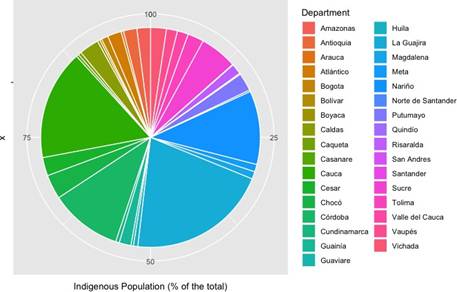
According to the census elaborated in 2018, the indigenous population in Colombia consists of 1.905.617 people, i.e., around 3.95% of Colombia’s population. As it can be seen in Figure 1, it is mainly concentrated in La Guajira, Cauca, Nariño and Córdoba, with 20.7%, 16.7%, 10.8% and 10.6% of the total indigenous population in the country respectively. However, the departments with majority indigenous population are Vaupés, Guainía, Vichada and Amazonas, in which 81.7%, 74.9%, 58.7% and 57.7% of their population is recognized as indigene.
Source: Own elaboration based on DANE (2019).
Figure 1 Geographic distribution of indigenous population in Colombia (% of the total)
As reported by Delgado (2014), most of the indigenous people live in rural areas, where the population faces more adverse socioeconomic conditions compared with urban dwellers. People in rural areas have higher rates of poverty, malnutrition, teenage pregnancy and violence, also they tend to have less access to educational opportunities and less academic achievements (OECD, 2016).
In consequence, the population that recognizes itself as belonging to an ethnic group is at a clear disadvantage. Although “flexible educational models, ethnic education, school meals and transportation have contributed to reaching disadvantaged groups; socioeconomic background, geographic location, ethnicity and gender still largely condition the educational opportunities of children” (OECD, 2016, p. 34). Therefore, according to González (2016), serious gaps persist that disadvantage the rural population and, especially, indigenous and afro-Colombian children.
Trends in Indigenous Enrollment
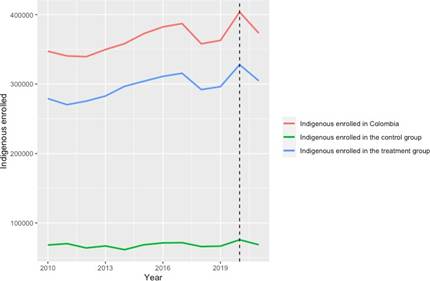
As it can be seen in Figure 2, there is a rising trend in the indigenous enrollment during the period 2011-2017. However, this trend is not followed by the departments that have implemented the PAEPI -from now on the control group-, which only shows a growing trend between 2014 and 2017, and during the rest of the period shows increases followed by declines in the level of enrollment.
Likewise, during the period 2010-2021 between 79.2% and 82.8% of the indigenous children and youth enrolled in the education system were part of the departments that have not implemented the PAEPI or have tried unsuccessfully -hereafter treatment group-. In this regard, the majority of the indigenous students were beneficiaries of the differentiated feeding policy.
It should be noted that even though it was expected a decrease on the total number of indigenous students in 2020, due to the pandemic, in both the treatment and control groups there was a rise in enrollment. Furthermore, in 2020, the maximum of the series was observed. The above is a first indicator of the impact of the education policy implemented on indigenous enrollment.
School Feeding Program vs. School Feeding Program for Indigenous Peoples
According to Moreira-Mora (2007), the socioeconomic background and family context condition school desertion, through conditions of poverty and marginality, early job placement, family anomie, etc. In consequence, educational systems have a low retention capacity of children and youngsters, especially during the transition from primary to secondary school (Espíndola & León, 2002).
Therefore, as stated by Chica et al. (2012), policy makers should correct the shortcomings associated with the socioeconomic level of the students, carrying out programs that guarantee nutrition, health, transportation, among others. This is how, throughout the world, school feeding programs have been developed not only for nutritional purposes, but also to encourage school enrollment and attendance, as it is an incentive for families to send their children to school (Cohen & France, 2005, as quoted in Archbold et al., 2017).
In this sense, Law 1096 of 2006 led to the transformation of the School Feeding Program (PAE) from its initial nutritional focus into a pivotal instrument for the attainment of educational objectives. Consequently, the nutritional attention to children and youngsters in Colombia began to be employed as a strategy to facilitate the access with permanence in the education system, through a food supplement for consumption within the public educational institutions (Gironza & Puerta, 2018).
The PAE has shown a positive impact on absenteeism, desertion and student repetition. During the period 2012-2019, students receiving food supplements were 32.5% and 39.2% less likely to be absent and to desert the education system (respectively) than those not receiving them, while the student repetition decreased by 13.7% (Ministerio de Educación Nacional & UApA, 2022).
Nonetheless, as it is shown by the Contraloría General de la Nación (2019), generally the PAE’s menus do not consider sociocultural and medical particularities of children -this was the third most mentioned problematic in the axe quality and safety of the PAE-. Not considering these differences should decrease the impact of the policy in enrollment and permanence for the specific groups that are not considered.
Integrating a human rights perspective into public policies related to food is essential to ensure the dignity and well-being of all people. This holds particular significance for indigenous peoples, as the processes involved in sourcing food, gathering ingredients, and food preparation are part of their cultural identity (FAO, 2009).
School feeding programs have emerged as a strategy for creating intercultural societies (BID & WFP, 2023). The BID & WFP (2023) recommend the implementation of school feeding programs tailored to the nutritional and cultural needs of indigenous communities. This approach acknowledges the cultural significance of food and its close tie to identity and territory (ICBF, 2010), fostering an intercultural environment that encourages mutual respect for cultural and socioeconomic diversity (BID & WFP, 2023). This recognition of diverse food knowledge serves to highlight the valuable cultural contributions of indigenous communities to the society (ICBF, 2010).
Hence, the National Government has developed a differential policy through the Resolución 18858 of 2018. The PAEPI is a strategy aimed at “enhancing access with permanence for indigenous children and youth to the education system” (Resolución 18858 de 2018, Art. 2, Núm. 1.1). The above by providing a nutritional supplement that not only reduces absenteeism and dropout rates, but also promotes healthy lifestyles considering, recovering and strengthening cultural feeding processes (Resolución 18858 de 2018). Thus, “in educational establishments that serve a majority indigenous population and those located in indigenous territory, the school feeding program must follow the cultural particularities of each indigenous community” (Resolución 18858 de 2018, Art. 2, Núm. 1.3).
As the program aims to encourage regional diversity and to reinforce indigenous feeding practices, it is based on concertation processes with indigenous peoples. Indigenous communities determine the menus served at educational institutions through the ‘olla comunitaria1’ scheme (Resolución 18858 de 2018).
They define a diverse range of twenty complete menus, with recipes and preparation guidelines, along with a list of required food items. These menus ensure a balanced nutritional intake, encompassing proteins, carbohydrates, fats, vitamins, and minerals, providing a minimum of 20% of daily calorie requirements for smaller meals and 30% for lunch supplements (Resolución 18858 de 2018, Art. 2, Núm. 2.8).
Furthermore, menu planning considers the availability of regional foods and seasonal harvest calendars, as well as indigenous culinary traditions (Resolución 18858 de 2018).
In addition, Ministerio de Educación Nacional and the territorial entities make a call and socialization of the program with the indigenous communities, promoting their participation as operators of the PAEPI (World Bank, 2022). In this way, “they can decide to take charge of the school feeding operation in a timely and informed manner” (World Bank, 2022, p. 7), and if they have the experience and administrative capacity, they can be contracted (Resolución 18858 de 2018).
As well, “the resolution proposes the adaptation and implementation of the PAEPI’s monitoring, follow-up, and control model to suit the unique context of each indigenous community, ensuring compliance with current regulations” (World Bank, 2022, p. 43). Additionally, it underscores the importance of monitoring the food component “in accordance with the food referral procedures to be carried out by the respective operator, as well as utilizing the Kardex format designed for the attention to the indigenous population” (Resolución 18858, 2018, Art. 2, Núm. 12). Lastly, it places the responsibility on indigenous communities to actively engage in social oversight and report any irregularities (Resolución 18858 de 2018).
Within the framework of the PAEPI, territorial entities and educational institutions have the opportunity to promote indigenous food knowledge, contributing to the preservation of indigenous cultural values. In this regard, territorial entities can implement measures to prioritize the procurement of locally grown and produced food (Resolución 18858 de 2018). According to the World Bank (2022), cooking local food nurtures their feeding culture, whereas strengthens local production and empowers indigenous communities. Additionally, the encouragement of knowledge-sharing and research initiatives can facilitate feeding practices rooted in the indigenous worldview (Resolución 18858 de 2018).
Limitations of the PAEPI
Nevertheless, fostering collaborative processes with indigenous communities poses a significant challenge in ensuring the program’s effectiveness. As indigenous communities are often geographically dispersed, communication barriers can emerge between the territorial entities and these communities.
Consequently, the PAEPI may predominantly benefit nearby communities, a situation encountered by some territorial entities during the implementation process (World Bank, 2022), limiting its reach and coverage.
Moreover, the National Government cannot ensure the active engagement of indigenous communities; the extent of their involvement in program planning and operation significantly influences its success and cultural relevance. In this regard, some territorial entities have observed that indigenous communities are sometimes disinterested in participating (World Bank, 2022).
In addition, the huge diversity among indigenous peoples presents additional challenges for the program. Given that each community possesses its own unique dietary culture and preferences, adapting the program to satisfy their needs can prove to be a significant undertaking. Thus, “even 33,3% of the indigenous leaders surveyed during the World Bank’s program evaluation expressed that the PAEPI is not tailored to the specific needs, expectations, capacities, and knowledge of their community” (World Bank, 2022, p. 59).
Data
The model was constructed with annual data of 24 departments of Colombia for the period 2017-2021. These departments are divided into two groups considering the information provided by the World Bank (2022). The first group is composed by the departments that have implemented the PAEPI2-treatment group-, whereas the second is conformed by the departments that have not carried it out3 yet or tried unsuccessfully to implement it4 5 -control group-, despite having (both) indigenous territories or majority indigenous population.
Considering that this public policy should increase the access to education of indigenous children, the dependent variable is a proxy6 of the total number of indigenous children enrolled in school. For 2017 and 2020, this information is taken from the Ministerio de Educación Nacional. Meanwhile, given that the information on enrollment in preschool, elementary and middle school education from 2018 to 2021 reported by the Ministerio de Educación Nacional was not consistent with the reality, for the years 2018, 2019 and 2021, observations were estimated through the total number of children and youth enrolled considering the average percentage of indigenous enrolled for each department during 2010-2017 and 2020.
As the objective is to identify the impact of the PAEPI on indigenous enrollment, the Did estimator -interaction between the time in which the policy was implemented and the treatment group- is its main variable. As well, the model is explained by a dummy variable of the PAEPI, which takes the number 1 if in the department it was implemented and 0 otherwise, and a dummy variable of time which takes the number 1 for the period when the policy was implemented and 0 otherwise.
Likewise, the model is explained by some control variables. to mitigate the potential omitted variable bias7. Therefore, the total forced displacement events8 is included, as Gamboa et al. (2019) prove that the probability of leaving the educational system increases to the extent that the child has been a victim of forced displacement. The total anti-personnel mines, unexploded ordnance and improvised explosive device events9 is included as a proxy of the violence in the department, since desertion is pushed by illegal recruitment (Perfetti, 2004) and the actions of illegal armed groups, including armed strikes, can prevent children from going to school. In addition, a higher departmental gross domestic product10 should increase the enrollment since a better economic performance should lead to more investment in education. Finally, the PAE11 encourages the access with permanence to education, whereas the pandemic12 had a negative impact on it.
Empirical Strategy
To approximate the impact of the implementation of the PAEPI, the model was estimated using the Difference-in-Differences (Did) method, since DiD is frequently used in impact evaluation studies with non-experimental settings (Fredriksson & Oliveira, 2019; Roth et al., 2022). This approach enables us to estimate the causal effects of the program through a combination of “cross-sectional treatment-control comparisons and before-after studies for a more robust identification” (Fredriksson & Oliveira, 2019, p. 520).
As there is heterogeneity between the departments, and this is what the literature notes as a natural experiment, the model was controlled by individual effects (α i ). Therefore, the following model was estimated:
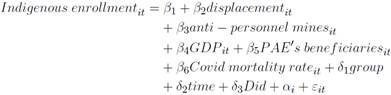
The identification with DiD is based on the parallel trends assumption (Fredriksson & Oliveira, 2019), which means that the treatment group without the implementation of this policy would have had the same trend in the enrollment of indigenous children as the control group. Hence, if the coefficient δ 1 is found to be statistically significant, it provides evidence that this assumption is violated, as it indicates if there are differences between the control and treatment group (Aguilar, n.d.). Since δ 1 was found non-significant, it was assumed that the parallel trends assumption is satisfied, thereby the estimation using the DiD method is valid.
Finally, the homoscedasticity and no serial correlation assumptions were tested with the Breusch-Pagan and Breusch-Godfrey statisticians, respectively13. Since the model was found to be heteroscedastic and heteroscedasticity invalidates the hypothesis tests (Wooldridge, 2016), we reestimated the variance-covariance matrix.
Results
From the estimation of the model, it was obtained that the variables are statistically significant with an 85% confidence level, except for the forced displacement and the Did estimator. Despite this fact, the model predicts the expected sign for these variables. Specifically, the analysis reveals that the greater forced displacements, the lower access to education, whereas the implementation of the PAEPI may increase the indigenous enrollment in education.
Hence, this study provides evidence of the potential positive impact that the PAEPI can have. The findings suggest that this policy increases indigenous enrollment -which was its expected impact-, indicating that the introduction of indigenous cultural background into the feeding school policy might reduce educational disparities, providing access for indigenous students.
Thus, the behavior of the indigenous enrollment in education during the period 2017-2021 can be explained by the pandemic, the PAE, the gross domestic product of the department and the anti-personnel mines, unexploded ordnance and improvised explosive device events. As expected, the pandemic had a negative impact on enrollment, whereas a higher number of beneficiaries of the PAE enhanced it. Nonetheless, it must be noted that even though the departmental GDP and the anti-personnel mines, unexploded ordnance and improvised explosive device events are statistically significant, they do not have the expected signs.
Although an increase in the department’s income should increase educational enrollment, there is a negative relationship between these variables. However, as it was shown before, the indigenous population is mostly concentrated in the departments with lower income levels. Then, the departments with a lower GDP may be the ones with higher enrollment rates of indigenous children and youth.
Besides, albeit violence would be expected to discourage educational access, it is shown a positive relationship. This may be because with higher levels of violence, the parents tend to enroll their children to keep them away from the armed conflict.
Table 1 Impact of the implementation of the PAEPI on the indigenous enrollment14
| Dependent variable | |
| PAE beneficiaries | 0.023 (0.015) |
| GDP | -0.314 (0.200) |
| Forced displacement | -0.065 (0.112) |
| Antipersonnel mines | 48.093* (28.617) |
| Covid | -11.503** (4.519) |
| Treatment group | 815.688 (809.799) |
| Time | 1459.116** (587.739) |
| Did estimator | 447.215 (666.754) |
| Constant | 9243.408*** (635.709) |
Note: *p < 0.1; **p < 0.05; ***p < 0.01
Source: Own elaboration.
Conclusions
The School Feeding Program has discouraged absenteeism, desertion and student repetition, whereas it has promoted the learning abilities of students. Nonetheless, as the significant plurality in the Colombian population hinders the operation of the PAE, the National Government implemented the PAEPI with the objective of contributing to the access with permanence to education of indigenous children and youth, since it is based on the recognition of their cultural background.
In 2020, the PAEPI significantly extended the coverage of indigenous beneficiaries in the PAE, providing attention to 14 departments with a high proportion of indigenous children. According to the World Bank (2022), 84.8% of indigenous children and youth enrolled in school received a nutritional supplement, which meant an increase of 5.6 percentage points compared to 2019. Hence, more than 25 thousand indigenous students became beneficiaries of the PAEPI.
The results of this study offer valuable insights into the impact of the PAEPI on indigenous enrollment in education during the period 2017-2021. Although this study reveals that the impact of the PAEPI on indigenous enrollment is not statistically significant the model predicts the expected sign, providing evidence of the potential effect that this policy can have. The findings suggest that this policy increases indigenous enrollment, indicating that the PAEPI may play a role in addressing educational disparities for indigenous communities.
According to the World Bank (2022), families were more willing to enroll their children in school since the implementation of the PAEPI, as it provided them access to healthier and more culturally appropriate meals. The above, in addition to the rise in the number of indigenous students in the educational system in 2020, show evidence of the potential of this policy to encourage indigenous enrollment.
On one hand, the lack of statistical significance in the study’s findings may be attributed to the temporal context of the program’s implementation and several implementation shortcomings. Firstly, the impact of the program could have been hindered by the pandemic, which may have limited its effectiveness. Additionally, the World Bank (2022) has highlighted certain implementation issues, in addition to the operational challenges posed by the pandemic for territorial entities and indigenous peoples.
There are problems of interpretation by the ETCs and indigenous peoples with respect to Resolución 18858, which often delay or discourage the adoption of the model, […] [and] in some cases, lead to less inclusion of indigenous foods, preparations and practices. […] [As well,] the qualifying requirements create barriers to contracting with indigenous peoples, especially for those of smaller size and organizational level. [Furthermore,] disagreements between communities or indigenous peoples delay and complicate the concertation processes to the point of completely obstructing [its] implementation, [and] a lack of coordination and clarity of some ETC discourages indigenous communities and peoples from participating (pp. 60-65).
On the other hand, considering the limited sample size, because this impact assessment was realized considering solely departmental data, the results of this study are not conclusive. The sample size used may not have been large enough to detect significant differences. Thus, further research should be done to accurately determine the impact of the PAEPI on indigenous enrollment.
Finally, this study provides evidence of the potential benefits of adopting differential treatments to enhance the impact of public policies. By considering the particularities and requirements of the target population, policymakers can identify their unique needs and design policies, accordingly, ensuring that they meet their goal(s), increasing their effectiveness. Hence, it is necessary to continue the work with indigenous communities and make indigenous students more involved in the implementation process of the PAEPI.

