




 English (pdf)
 Article in xml format
 Article references
 Automatic translation
 Send this article by e-mail
 Cited by SciELO
  Cited by Google
  Similars in
SciELO
Similars in
SciELO  Similars in Google
 Permalink

INTRODUCTION
Academic interest in the determining factors of entrepreneurial intentions among higher education students is nascent in Latin America (Krauss-Delorme et al., 2018; Tarapuez-Chamorro et al., 2018b), despite the existence of some works oriented towards a comparative analysis (Céspedes Gil et al., 2021), as well as the positive perception of entrepreneurship (Rubio Hernández & Lisbona Bañuelos, 2023), given its contribution to innovation, economic growth, and employment (Laguía et al., 2017; Valencia-Arias et al., 2022). The countries where perhaps the greatest research advances have been recorded are Brazil, Mexico, Chile, and Argentina, among others. However, Colombia's research in this area remains limited.
An opposite situation is observed in Europe and Asia, continents where theoretical and empirical contributions related to the different manifestations of emotional intelligence have been remarkable in recent years.
According to Tormo-Carbó et al. (2024), entrepreneurship has expanded in Asian countries with greater intensity than in Europe, especially in Southern Europe, which they consider "unfavorable contexts", and they classify Spain as a "relatively hostile" context, in contrast to Anglo-Saxon countries, which show a more favorable position.
Hence, the purpose of this work is to explore the advances achieved by Colombian and foreign researchers in the analysis of the entrepreneurial intention of students with higher education, in the context of university entrepre-neurship, and, in this way, to be able to have a better understanding of one of the most relevant phenomena in the development of emerging economies (Anderson, 2023; Bigos & Michalik , 2020; Talukder et al., 2024).
At the same time, it is expected that this article will help to identify new lines of research and provide input to educational institutions and public policy makers to strengthen policies and incentives for young entrepreneurs.
ENTREPRENEURSHIP IN THE CONTEXT OF YOUTH EMPLOYMENT IN COLOMBIA
There are trends in the Colombian labor market that do not favor young people (people between the ages of 15 and 28). Youth employment and unemployment rates are lower in the first case and higher in the second case than those observed in the country as a whole. Between 2010 and 2024, the average youth employment rate was 48.9%, while the unemployment rate stood at 16.8%, which contrasts with the record for the country as a whole: 59.7% and 9.7%, respectively. The most critical year was 2020, when the coronavirus pandemic broke out, with this decline more pronounced among young people than in the country as a whole (Table 1, Figure 1).
Table 1 Labor market indicators in Colombia
| Year | Young People ER (%) UR (%) | Total Colombia ER (%) UR (%) | ||
|---|---|---|---|---|
| 2010 | 50,1 | 18,8 | 60,9 | 10,9 |
| 2011 | 53,1 | 16,8 | 62,9 | 9,6 |
| 2012 | 51,7 | 16,9 | 61,9 | 9,5 |
| 2013 | 52,5 | 14,6 | 62,3 | 8,5 |
| 2014 | 52,2 | 14,9 | 62,3 | 8,4 |
| 2015 | 52,8 | 14,2 | 62,6 | 8,3 |
| 2016 | 51 | 15,2 | 61,7 | 8,5 |
| 2017 | 49,6 | 15,6 | 60,7 | 8,8 |
| 2018 | 48,7 | 17,1 | 59,5 | 9,5 |
| 2019 | 48,2 | 16,6 | 58,6 | 9,9 |
| 2020 | 43,3 | 22,6 | 53,7 | 14,4 |
| 2021 | 43,6 | 19,2 | 55,1 | 11,5 |
| 2022 | 46 | 16,7 | 57,4 | 9,8 |
| 2023 | 46 | 16,5 | 58 | 9,4 |
| 2024* | 45,2 | 15,7 | 58,1 | 8,8 |
ER: Employment rate. UR: Unemployment rate. *Data for 2024 correspond to September-November.
Source: DANE (2024), October-December of each year.
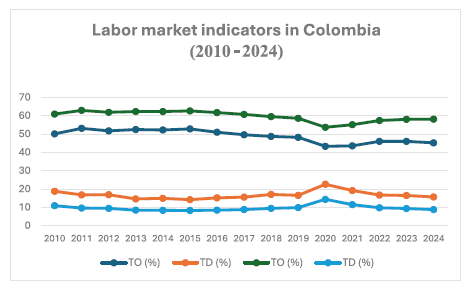
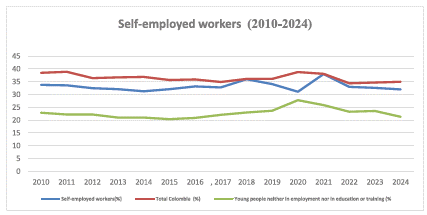
During the reference period, the occupational position of self-employed workers, a manifestation of the entrepreneurial spirit (Lihua, 2022), and self-employment, has maintained an important weight within the segment of 11 million young people, which represents a third of this (33.2%), distant by only three percentage points from the total average (36.5%), which shows the relevance of self-employment as a job option among young Colombians.
However, in 2020, due to the stagnation of the economy, which was caused by the severe effects of the Coronavirus pandemic, the proportion of self-employed workers in the country increased. This phenomenon may be attributed to the adaptation of employed individuals to the challenging conditions of the labor market (see Table 2 and Figure 2). The augmentation of the occupational category of young self-employed workers has the potential to mitigate the escalating trend of young people who are neither enrolled in school nor employed in Colombia (exceeding 2 million), which, on average, constituted 22.7% of the population between the ages of 15 and 28.
Table 2 Evolution of young self-employed workers and the total in Colombia
| Year | Self-employed workers (%) | Total Colombia (%) | Young people neither in employment nor in education or training (%) |
|---|---|---|---|
| 2010 | 33,8 | 38,5 | 22,9 |
| 2011 | 33,6 | 38,9 | 22,2 |
| 2012 | 32,5 | 36,4 | 22,2 |
| 2013 | 32,1 | 36,7 | 21 |
| 2014 | 31,3 | 36,9 | 21 |
| 2015 | 32,1 | 35,7 | 20,4 |
| 2016 | 33,2 | 35,9 | 20,9 |
| , 2017 | 32,8 | 34,9 | 22,1 |
| 2018 | 36 | 36,1 | 23 |
| 2019 | 34,1 | 36,1 | 23,7 |
| 2020 | 31,1 | 38,8 | 27,8 |
| 2021 | 38 | 38,1 | 25,9 |
| 2022 | 33 | 34,4 | 23,3 |
| 2023 | 32,6 | 34,7 | 23,6 |
| 2024 | 32 | 35 | 21,3 |
* Data for 2024 correspond to September-November.
Source: DANE (2024), October-December of each year.
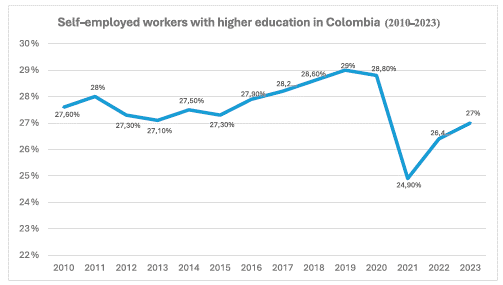
As stated, a significant vector of entrepreneurship and entrepreneurial intention is represented by young people who have received a higher education and who are employed as self-employed workers. In the Colombian context, this phenomenon has exhibited a moderate yet sustained growth trajectory over the past two decades, representing an average of 27.5% of the young population (see Figure 3). However, a curious decline was observed during the post-pandemic economic recovery period, despite a 10.8% rebound in the gross domestic product (GDP) (Banco de la República, 2025). However, the transformation of entrepreneurial attitude and intention into business behavior among young university students involves risks (Chien-Chi et al., 2020). In Colombia, according to the Confecámaras association (2023), only 33.5% of the companies created in 2017 survived in 2022. In contrast, in the OECD, this indicator exceeds 40%.
LITERATURE REVIEW
This article is predicated on the theory of planned behavior (TPB), which, according to Ajzen (1991), posits that the entrepreneurial intention of students in disparate university ecosystems is differentially influenced by attitude, self-efficacy (perceived behavioral control) and subjective norms (Anderson, 2023; Chin et al., 2024; Talukder et al., 2024; López Sánchez et al., 2024). It is important to note that self-efficacy is the primary predictor of entrepreneurial intention, which is reinforced by the enhancement of emotional competencies. This assertion is supported by researchers such as Bigos Michalik (2020) and Huezo-Ponce (2021), who consider cognitive and emotional factors. Conversely, Chien-Chi et al. (2020) emphasize the environmental conditions that influence the behavior of entrepreneurial individuals who initiate a business venture.
Entrepreneurial intention precedes entrepreneurial behavior (Fayolle et al., 2006) and is a voluntary, conscious and deliberate action, latent or potential, of individuals to create a company or business (Ajzen & Fishbein, 2005; Krueger & Kickul, 2006).
Thus, behind the entrepreneurial action is the entrepreneurial intention (Krueger, 2007), which seeks to evaluate and exploit existing opportunities, which translates into a favorable attitude to undertake a business initiative (Alvarez & Barney, 2007).
Among the various approaches to the analysis of entrepreneurial intentions that emerged in the 1980s and 1990s (Fernández-Pérez et al., 2019), special mention can be made of the Theory of Planned Behavior (TPB) proposed by Ajzen (1991), perceived as a variant of the Theory of Reasoned Action (TRA) formulated by Fishbein and Ajzen (1975), which incorporates each individual's perception of their ability to influence the outcome of their actions through control at will.
Fishbein and Ajzen (2011) established a link between cognitive factors, including attitude and subjective norm, and control over perceived behavior or self-efficacy. These factors contribute significantly to intention and the intended entrepreneurial behavior. The realization and success of entrepreneurial intentions depend on environmental perceptions and self-perceptions, as well as the recognition of emotional competencies (Boyatzis, 2008) and the uncertain conditions under which individuals operate (Baron, 2008). Subjective norms, self-efficacy, and entrepreneurial attitude have been shown to reinforce each other to produce entrepreneurial intention (Fini et al., 2012). These factors have been identified as good predictors, though with different levels of influence and explanatory power on the latter.
The entrepreneurial intention construct has been the subject of analysis by various authors, who have understood it as a powerful indicator of entrepreneurial potential (Akbari et al., 2024; Nayak et al., 2024).
In contemporary literature, recent writings focus on the TCP and the three main predictors of entrepreneurial intention: attitude, subjective norms and entrepreneurial self-efficacy. Schmutzler et al. (2019) review the main contributions from the different theoretical perspectives on understanding the interaction of these variables, as noted by Liñán and Fayolle (2015).
In the last decade, an array of contextual factors -beyond cognitive perceptions- have come to the fore in Latin America and Colombia. These include social, psychosocial, parental, cultural, institutional, and environmental factors, which have been the focus of research by Henley et al. (2017), Laguía et al. (2017), Martins and Pérez (2020), and Fleck et al. (2021), Romero-Colmenares and Reyes-Rodriguez (2022), Olarewaju et al. (2023), Leiva et al. (2021), Barrera-Verdugo et al. (2024), González-Tamayo et al. (2024), Tormo-Carbó et al. (2025), and Afshar et al. (2025), among others.
Now, one of the key elements of entrepreneurial intention is entrepreneurship education (Tormo-Carbó et al., 2024), which strengthens self-efficacy, which, in turn, acts as a moderating variable in the relationship between emotional competencies and entrepreneurial intention (Chien-Chi et al., 2020).
On the other hand, Lihua (2022) emphasizes the relevance of youth entrepreneurship in university classrooms as a strategy for economic growth and social development in emerging economies, especially in the case of self-employment. However, there is a notable gap between the intention to start a business or enterprise and the possibility of taking advantage of an opportunity to carry out such activities (entrepreneurial behavior), which, according to these authors, goes beyond the theoretical framework of the TPB.
Tingting et al. (2022) conducted a bibliometric study covering the period 2000-2020 to establish international trends on entrepreneurial intention. The study identified 454 articles registered on the Web of Science Core Collection that were associated with entrepreneurial intention among university students. This measure identifies two central aspects: hotspots and trends in international research on entrepreneurial intention.
The focus of research is on topics such as TPB (widely accepted theoretical foundation), entrepreneurship education as a basic predictor of entrepreneurial intention, in addition to mediating variables, quantitative research methods, among others.
The search for this study yielded 685 records, of which 470 were identified through an exhaustive review and 454 were ultimately included, exclusively concerning university students. Moreover, it was ascertained that approximately 41% of the articles (184) are predicated on the TPB approach, wherein the antecedents of entrepreneurial intention, action, and performance are situated. The findings of this research demonstrate that the three predictor variables account for 59% of the variance in entrepreneurial intention, which is significantly higher than the 30-45% range reported in previous studies.
METHODOLOGY
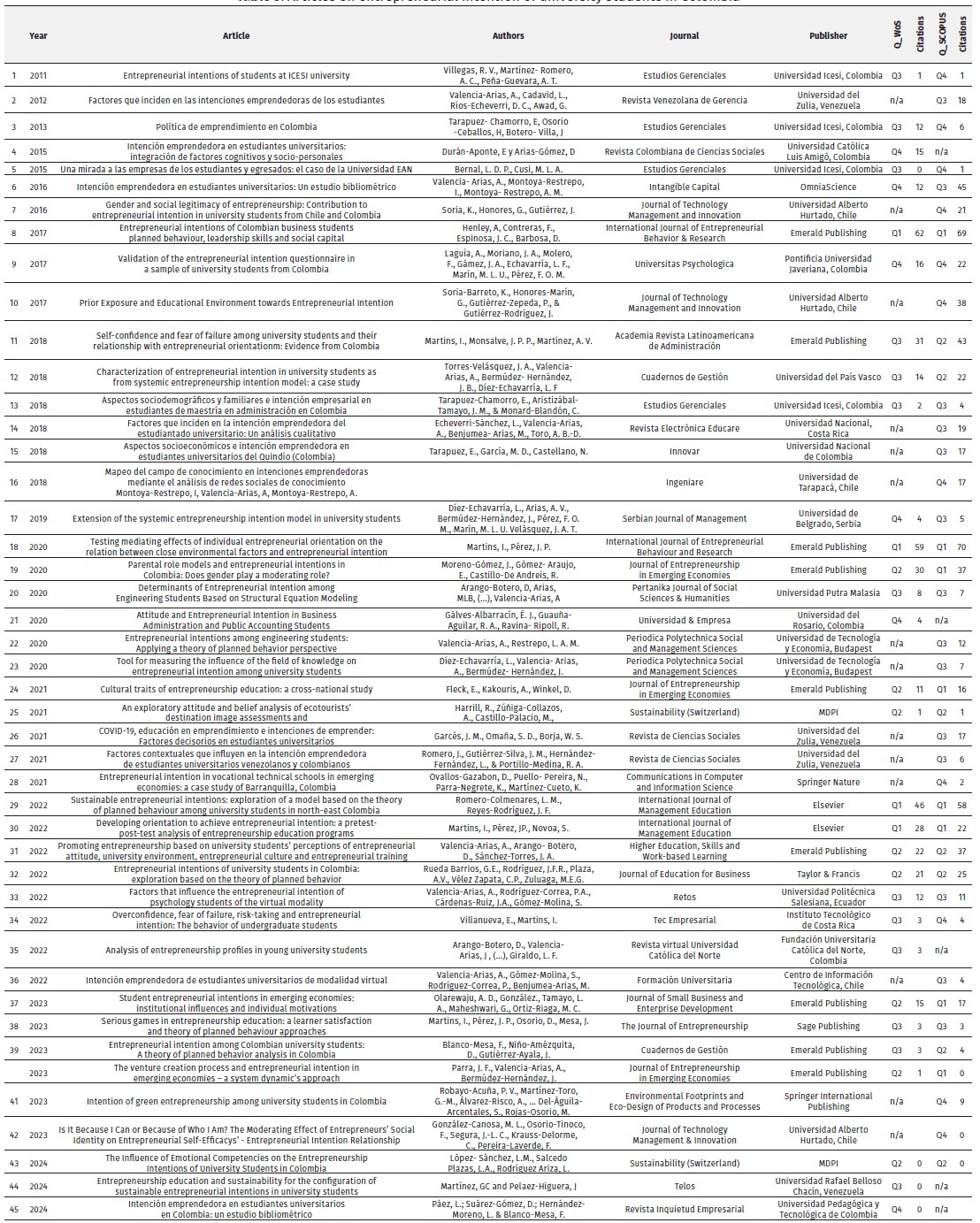
The present research is of an exploratory and descriptive nature. Therefore, a systematic review of the literature about entrepreneurial intention in Colombia was conducted. The analysis period was from 2012 to 2024, and the Web of Science and Scopus databases were used. Keywords such as "entrepreneurial intention, Colombia, TPB, and university students" were used in the data search. In order to select the articles written on this topic, inclusion and exclusion criteria were applied. The quality of the articles was identified according to the quartile in Web of Science, Science and Scopus (Table 3).
Furthermore, the most relevant data from the selected articles were obtained and, through their analysis, patterns and trends were identified, among which the explanatory factors of entrepreneurial intention (subjective norms, entrepreneurial attitude and self-efficacy) stand out.
To determine the relevance of the articles within the analysis carried out, those investigations with the highest number of citations (> 10) were prioritized, taking as a reference the quartile of the respective journals (Table 4).
RESULTS
In Table 3, which covers information from the period 2011-2024 obtained from the two databases consulted, it can be observed that, according to WoS, academic production, after an inertial trend from the beginning of the decade until 2017, recovered in 2018, reached its peak in 2022 and declined in the last two years.
According to Scopus, the increase in research on entrepreneurial intentions coincides with the WoS, with 2018 being a boom year for scientific productivity, two years with similar levels in 2020 and 2023, and a decline in 2024.
The most notable periods of article production were in the case of WoS, 2022-2023, with 22.2%, while in the case of Scopus, 2018-2023, corresponding to 68.8% of the published studies (Figure 4).
On the other hand, the journals of greatest academic relevance are International Journal of Entrepreneurial Behavior & Research and International Journal of Management Education, followed by Journal of Entrepreneurship in Emerging Economies, ranked in Q1 and Q2, respectively. The publishers with the highest visibility are Emerald Publishing and Elsevier, an indicator of authors' preferences when submitting their research.
Table 3 Articles on entrepreneurial intention of university students in Colombia
n/a: not available.
Source: Own elaboration based on searches in Web of Science and Scopus.
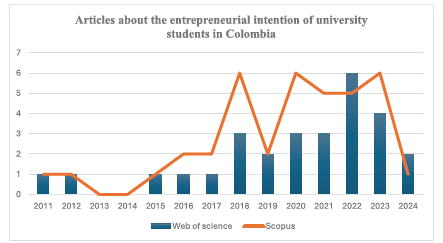
Source: own elaboration.
Figure 4 Articles about the entrepreneurial intention of university students in Colombia.
As regards the authors of the most cited articles, Henley stands out et al., Martins and Pérez, Moreno et al., and Romero and Reyes, who together represent 92.1% of the citations according to WoS, and a smaller proportion in Scopus records (75.7%). In addition, other authors stand out, such as Valencia-Arias et al., who report fewer citations, perhaps due to the recent publication of the studies (2022).
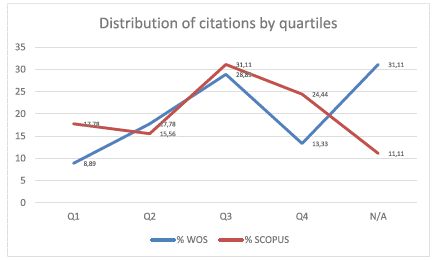
Source: Own elaboration based on searches in Web of Science and Scopus.
Figure 5 Distribution of citations by quartiles.
As illustrated in Figure 5, during the analysis period, the concentration, according to quartiles, of the articles obtained in the two consulted databases is different; while in WoS 8.9% of the articles are ranked in the Q1 quartile, in Scopus this indicator is twice as high. This discrepancy may be attributed to the coverage of the journals, the periodicity of the platforms' updates, and the research area.
A different situation is observed with the Q2 quartile, which shows a very similar situation in the two databases (17.8% and 15.6%, respectively). It is worth highlighting the high weight of the Q3 quartile in the consulted databases: 28.9% in WoS and 31.1% in Scopus. The Q4 quartile reveals a visible difference, distancing itself by about 10 points (13.3% and 24.4%). At the same time, the record of articles not yet referenced in these information systems is striking, which represent a third of this set of articles, perhaps due to their limited dissemination.
As previously mentioned, a notable academic interest has emerged in Colombia over the last two decades concerning the exploration of the explanatory factors of entrepreneurship and, consequently, of entrepreneurial intention among higher education students. This research is primarily framed within the TPB, a psychological model that aims to understand the relationship between psychological factors and behavior. This approach facilitates the validation of the influence of each predictor of entrepreneurial intention, in addition to the incorporation of other factors. It also allows for the consideration of specific contexts, such as the entrepreneurial ecosystem in Colombia, which plays a crucial role in understanding the nuances of entrepreneurial behavior within the country.
Most of the selected articles, published during the period 2017-2024, used a quantitative methodology and a Likert-type scale to measure the impact of the independent variables (the TPB constructs) on the dependent variable (entrepreneurial intention).
The extant studies identified the effects of the dimensions of the TPB model and validated their relationship, positive or negative, direct or indirect, on entrepreneurial intention. They also extracted recommendations to reformulate and improve the strategies currently carried out by educational institutions as a natural setting for entrepreneurship. Furthermore, the study recommended the formulation of public promotion policies that could fortify the environment and conditions in which the actors responsible for the entrepreneurial ecosystem, both public and private, operate. This recommendation is particularly salient within the context of a developing economy such as Colombia's, where entrepreneurship has emerged as a viable strategy to mitigate youth unemployment.
For Romero and Reyes (2022), the research carried out in Colombia on entrepreneurship has had a visible bias: socioeconomic (Tarapuez et al., 2018a), parental role (Moreno-Gómez et al., 2020), personal skills, perceived benefits and limitations (Rueda Barrios et al., 2022). Similarly, with regard to sustainable entrepreneurship, studies have focused on education in sustainable entrepreneurship (Campos et al., 2021; Ciruela-Lorenzo et al., 2020).
The selected articles are the studies with the highest scholarly impact (citations greater than 10) and scholarly quality (quartile) during the period 2017-2023, specifically in WoS. The selection is presented in Table 4.
Table 4 Most relevant articles on entrepreneurial intention of university students in Colombia (citation > 10)

Source: Own elaboration based on searches in Web of Science and Scopus.
The most cited authors within the sample of the 13 articles selected for the specific analysis object of the present study (given that they exceed 30 references in WoS) are, in order: Henley et al., Martins et al., Romero and Reyes, and Moreno et al., which represent 62.1% of the citations (367). On the other hand, the quartiles with the highest weighting are Q1 and Q2, with a contribution of 30.8% and 38.5%, respectively, which indicates the academic level of the selected studies. The Q3 quartile contributes 23.1%.
Considering the academic impact of research, the predominant publishers are Emerald and Elsevier, where 69.2% of the articles were published.
CONTRIBUTIONS OF RESEARCH ON ENTREPRENEURIAL INTENTION
When pointing out in the articles that are the subject of this investigation, Henley et al. (2017), in their article Entrepreneurial Intentions of Colombian Business Students: Planned Behaviour, Leadership Skills and Social Capital, using the TPB model, analyzed the influence of social cognitive theory (leadership skills) and social capital, as external factors, in addition to traditional constructs such as entrepreneurial attitude, self-efficacy and subjective norms, on the entrepreneurial intentions of business students at a private university in Bogotá (Colombia).
The theoretical approach adopted is that of the TPB, proposed by Ajzen, due to its explanatory scope and the possibility of involving external factors, apart from the three known dimensions, which are presented here as perceived desirability (attitude towards entrepreneurship), perceived feasibility (self-efficacy) and social norms.
The information was collected in 2012 and 2013 from a survey of 322 students out of a total of 1,768 students enrolled in the business program. 55.6% of the students surveyed were female and the average age was 19.8 years.
The research concluded that both perceived desirability and feasibility are relevant factors, with the latter being a determining factor. In addition, it was found that leadership skills, as an indicator of social capital, significantly and positively influence the entrepreneurial intention of the students in the study. Similarly, considering that social norms and the perception of self-efficacy are key components of entrepreneurial intention, it is inferred that it is convenient to foster leadership skills to promote entrepreneurship among university students in Colombia, particularly those belonging to the most vulnerable sectors.
On the other hand, the article "Validation of the Entrepreneurial Intention Questionnaire in a Sample of University Students from Colombia," written by Laguía et al. (2017), focused their analysis on validating the Entrepreneurial Intention Questionnaire (CIE), initially proposed in Spain by Rueda et al. (2015) , as an instrument to corroborate the influence of psychosocial factors on the intention to undertake in a context of increasing growth of university entrepreneurship, as is the case in Colombia.
The theoretical model employed in this study is the TPB, which involves the performance of its three fundamental components as pivotal predictors of entrepreneurial intention. The sample consists of 316 university students enrolled in courses such as Business Administration, Accounting, Engineering, and Medicine, with women constituting 63.6% and men 36.4% of the sample. The age range of the participants is from 18 to 43 years.
The information was collected using the Entrepreneurial Intention Questionnaire (CIE), which is considered a valid and reliable instrument, and the components were measured using seven-point Likert-type scales. The authors conclude that the three components have a positive relationship with entrepreneurial intention. Entrepreneurial attitude is the strongest predictor, accompanied, to a lesser extent, by self-efficacy and subjective norms, which is why it is suggested that entrepreneurship education be promoted.
Similarly, Torres et al. (2018), in the article entitled "Characterization of Entrepreneurial Intention in University Students as from Systemic Entrepreneurship Intention Model: A Case Study," seek to identify the factors that shape the entrepreneurial intention of students from three educational institutions in Medellín (Colombia).
The study has a quantitative methodological design, and the information collected was obtained through a self-administered questionnaire that was applied to 1,290 students, which finally validated the responses of 879 students from three higher education institutions: Minuto de Dios University Corporation (UNIMINUTO), ITM Campus Fraternity, and University of Medellín. The sample included students who were in the first five semesters of their studies, which included administration, social sciences and humanities, and other academic fields.
The results of the study revealed that factors such as perceived feasibility and attitudes towards entrepreneurship, perceived convenience and risk tolerance influence the perception of the personal and professional advantages of being an entrepreneur, which allows for an improvement in individual social status. The analysis identified three clusters of students with an attitude and motivation towards entrepreneurship and, therefore, willing to activate their entrepreneurial intention: "entrepreneurs" (positive attitude and high motivation), "neutrals" (intermediate or undecided attitude) and "non-entrepreneurs" (apathy or disinterest). In the background, the participation of educational institutions stands out as agents that promote entrepreneurship, which define and implement innovative promotion strategies that are linked to public policies that facilitate favorable environments for entrepreneurial ecosystems.
Likewise, the article "Self-confidence and Fear of Failure among University Students and their Relationship with Entrepreneurial Orientation: Evidence from Colombia," whose authors Martins et al. (2018) seek to determine the effect of two personality traits (self-confidence and fear of failure) as predictors of entrepreneurial orientation among university students enrolled in entrepreneurial education courses.
The quantitative research was obtained from an anonymous survey administered to 688 students from EAFIT University in Medellín. This number was reduced to 656 after those who did not respond correctly were excluded from the analysis. The dimensions of entrepreneurial orientation (risk taking, innovation, and proactivity) were measured using seven-point Likert scales, as were self-confidence and fear of failure.
The study found that self-confidence has a positive and significant relationship with the three dimensions of entrepreneurial orientation, in contrast to the negative effect of fear of failure on these dimensions, which acts as an inhibiting factor within the personality characteristics of university students.
It is important to acknowledge the contributions of Tarapuez-Chamorro et al. (2019), who, despite not being among the most frequently cited authors, have made significant contributions by incorporating numerous references in their work. These researchers embarked on a quest to identify the pivotal factors that influence the entrepreneurial intention of students enrolled in the Master's in Administration postgraduate program. In alignment with extant studies, the present study employs the TPB, encompassing socioeconomic variables and business facilitation resources, as delineated in Doing Business. These variables are subsequently categorized into high, medium, and low tiers.
The information used came from a survey applied to 485 students from 36 Master's in Administration programs in Colombia, offered by higher education institutions, located in the 14 most important capital cities of the country: Bogotá, Medellín, Bucaramanga, Cartagena, Cali, Barranquilla, Manizales, Armenia, Pereira, Tunja, Pasto, Cúcuta, Popayán, Florencia.
The authors of this article found the impact of nine factors on entrepreneurial intention: three associated with social norms, two related to attitudes, two to behavioral control, and two to socioeconomic aspects. The information collected corresponds to 2016.
The present study's authors posit that the highest entrepreneurial intention is associated with the combination of social norms, attitude, and self-efficacy. This descriptive study highlights Colombia as one of the countries with the best conditions to promote entrepreneurship among university youth.
In their article, "Parental Role Models and Entrepreneurial Intentions in Colombia: Does Gender Play a Moderating Role?", Moreno-Gómez et al. (2020) analyze the impact of entrepreneurial parents (parental models) on the entrepreneurial intention of Colombian university students. They also seek to determine, based on the premise of sociocultural differences and existing structural opportunity gaps, their influence in the entrepreneurship framework of a developing country like Colombia. The researchers' conclusions suggest that parental models can demonstrate cases of entrepreneurship that vary according to gender and the social norms that condition them.
The study is based on the TPB, which serves as a basis for explaining how contextual and individual factors, linked to parental models, contribute to the emergence of entrepreneurial intentions with a gender focus.
The data set used in this study was derived from the Global University Entrepreneurship Spirit Students' Survey (GUESSS) of 2016. The sample for Colombia comprised students from 10 higher education institutions, with a total sample size of 3,703 students. This allowed establishing relationships between parental models and gender (independent variables) and entrepreneurial intention (dependent variable) of the population under study.
The study concluded that men have a greater entrepreneurial intention (45.2%), far from women (32.5%). The authors attribute these differences to factors such as fewer opportunities for women, low self-confidence, and the existence of sociocultural barriers to the skills and roles that Colombian women can play. Perhaps the most important finding of this study is the assertion that parental models are a key factor in entrepreneurial intention, whose impact is conditioned by the gender of the university student, with a greater bias towards women who face sociocultural barriers that limit their participation in the entrepreneurial ecosystem.
In this direction, Martins and Pérez (2020) in their study "Testing Mediating Effects of Individual Entrepreneurial Orientation on the Relation between Close Environmental Factors and Entrepreneurial Intention" analyze the influence of the close environment (exogenous factors) on individual entrepreneurial orientation (intrinsic factors), and this, in turn, on the entrepreneur's decision, assessing, especially within the contextual factors, the weight of the stigma of failure in the entrepreneurial intention of university students.
The theoretical framework used by the authors of this article is a combination of the entrepreneurial event model and the TPB, and includes the construct of individual entrepreneurial orientation, which encompasses three dimensions: innovation, proactivity and risk taking.
The information, collected between 2017 and 2018, was obtained by applying a survey to 1,155 students (51% men and 49% women, aged between 18 and 22) from a private university in Medellín, through a structured questionnaire with questions on a 7-point Likert scale. The model adopted is a structural equation model, which allowed identifying the direct and indirect influence between the variables included.
The study found that the immediate environment exerts a positive and significant influence on entrepreneurial intention, while the stigma of entrepreneurial failure is negatively valued. In addition, there is a positive relationship between individual entrepreneurial orientation and entrepreneurial intention, with the latter acting as a key mediator, reinforcing the positive effects and neutralizing the negative effects. Thus, students with a high entrepreneurial orientation are more resilient to adverse reactions from their environment and are more tolerant and willing to undertake.
It is worth highlighting the article by Fleck et al. (2021), entitled "Cultural Traits of Entrepreneurship Education: A Cross-National Study," in which the authors examine the influence that factors such as gender, culture and context of analysis have on entrepreneurial intention, mediated by entrepreneurial education of young university students. The object of analysis of this article focuses on the need for greater knowledge and understanding of the relationship and the effect of social and cultural factors on entrepreneurial intention, preceded by entrepreneurship education.
To achieve this goal, the study uses a quantitative methodology. The information was obtained from a sample of students from eight countries (Brazil, Colombia, Germany, Lithuania, Malaysia, Mexico, Spain and the United States). The population included 5,033 responses from different undergraduate academic programs and cultural contexts in order to establish important contrasts and define national patterns of entrepreneurial intention. The young Colombians surveyed represented 10.2% of the population.
Fleck et al. (2021) conclude their article by underscoring the significance of national culture in shaping entrepreneurship education and, consequently, entrepreneurial intention. This underlines the necessity of taking specific cultural contexts into account. Furthermore, the authors allude to the differences in gender and academic disciplines that are present in entrepreneurial intention. This raises the need for pedagogical approaches that adopt practices and policies in line with these cultural realities.
Rueda et al. (2022) published the article "Entrepreneurial Intentions of University Students in Colombia: Exploration Based on the Theory of Planned Behavior", which examines the gap between entrepreneurial intention and the decision to undertake among young university students.
The research adopted the TPB approach and sought to validate, in the Colombian case, the influence of the three dimensions that encompass this model in the formation of entrepreneurial intention, in addition to the advantages and limitations present in entrepreneurship, as well as individual characteristics, taking into account the mediating role of personal perceptions and contextual factors, in a country where entrepreneurship has become a viable strategy to counteract unemployment in the youth population.
The approach used in this study is quantitative and was supported by the application of an online questionnaire, in which the basic variables of the TPB and the additional ones were measured on a five-point Likert scale. The selected sample was 4214 students who were studying different courses at a private university, such as Engineering, Social Sciences and Humanities, Economics, Business Administration, Law and Political Sciences. 54% of the respondents were women, while 45.7% were men, and 0.3% identified with another gender.
The results of this study confirmed the relevance of the TPB, highlighting the greater influence of attitudes toward entrepreneurship and self-efficacy as determinants of students' intention to become entrepreneurs, in contrast to a lesser effect of subjective norms; suggesting the incidence of perceptions of economic independence, personal satisfaction and contribution to social development, in addition to social pressures and challenges that must be overcome to undertake entrepreneur-ship in the university context. On the other hand, gender differences were found in relation to entrepreneurial attitudes, since women, compared to men, show less perceived control over behavior, which may be related to the cultural and social barriers that women face in becoming entrepreneurs.
It is imperative to underscore the salient contribution of Romero-Colmenares and Reyes-Rodríguez (2022) in their article, "Sustainable Entrepreneurial Intentions: Exploration of a Model Based on the Theory of Planned Behavior among University Students in Northeast Colombia." This article undertakes a pioneering exploration of the multifaceted factors that influence university students' entrepreneurial intentions from the vantage point of sustainability.
The research is based on the extended TPB model and includes, in addition to the three known factors, variables associated with personal values such as altruism and educational factors such as education for sustainable entrepreneurship.
The information was obtained in 2019 from 314 online surveys administered to university students studying Entrepreneurship and Social Responsibility in Bucaramanga. The variables included were measured using a five-point Likert scale. The results show that the main determinants of entrepreneurial intention are attitude towards entrepreneurship, perceived behavioral control and subjective norms. Altruism and education in sustainable entrepreneurship also positively influence entrepreneurial attitudes. In this sense, women show more favorable behavior than men, but greater barriers in the perception of self-efficacy.
In another study, Martins et al. (2022) examined the impact of education on individual entrepreneurial orientation and its relationship with entrepreneurial intention. Their study, entitled "Developing Orientation to Achieve Entrepreneurial Intention: A Pretest-Post-test Analysis of Entrepreneurship Education Programs," analyzed these factors through the three dimensions proposed by the TPB.
The authors explain the results of the article by Martins et al. (2018) on the influence of individual characteristics related to individual entrepreneurial orientation on the intention to start a business, with the mediation of entrepreneurship education. The data presented here were collected through an online questionnaire conducted between 2018 and 2019, which included 1,723 surveys distributed to university students from two higher education institutions, with 66.7% of respondents from Colombia and 33.3% from Ecuador. The main focus of the survey was on the topic of entrepreneurial education. The demographic composition of the study included 52.9% of female respondents, with an age range of 18 to 24 years. The measurement of the variables used a seven-point Likert scale.
The findings of this study demonstrate that entrepreneurship education exerts a positive and significant influence on the three dimensions of individual entrepreneurial orientation (innovation, proactivity, and willingness to take risks). Furthermore, the results indicate a direct and positive relationship between individual entrepreneurial orientation and the three dimensions of the TPB. However, the effect was found to be negative in Colombia and non-significant in Ecuador with respect to the relationship between subjective norms and entrepreneurial intention. It is noteworthy that entrepreneurial intention is not directly derived from individual entrepreneurial orientation; rather, it is influenced by cognitive and social factors, including attitudes, subjective norms, and self-efficacy.
From another perspective, Valencia-Arias et al. (2022a) examine in the article "Promoting Entrepreneurship Based on University Students' Perceptions of Entrepreneurial Attitude, University Environment, Entrepreneurial Culture and Entrepreneurial Training" the articulation between the variables entrepreneurial culture, university environment and entrepreneurial training and, consequently, their impact on the entrepreneurial intention of Colombian university students.
The study was based on the TPB, which is extended by the inclusion of factors such as entrepreneurial culture, entrepreneurial training and the university environment, showing how these decisively influence entrepreneurial intention. It is a quantitative research and uses the structural equation method. The data was extracted from the GUESSS (Global University of Technology) report. Entrepreneurial Spirit Students' Survey (Survey), on a sample of 3,005 students from ten Colombian universities, public and private, located in various cities of the country.
The findings of the study by Valencia-Arias et al. (2022a) reveal that entrepreneurial culture is positively related to the university environment and entrepreneurial attitude. At the same time, the university environment influences entrepreneurial training, which positively affects entrepreneurial attitude. There is no doubt that entrepreneurial culture is key to entrepreneurial intention, through the favorable attitude of university students towards entrepreneurship. The university environment does not directly affect entrepreneurial intention, but theoretical courses combined with active pedagogies such as experiential learning do, which incorporate modalities that develop entrepreneurial skills and are currently taught in higher education institutions, to bring academia closer to the needs of the labor market.
In a similar vein, Valencia-Arias et al. (2022b) examined the factors that influence the entrepreneurial intention of psychology students in the virtual modality in their article, "Factors that Influence the Entrepreneurial Intention of Psychology Students of the Virtual Modality." This analysis represents a novel approach, given that much of the extant research on entrepreneurial intention refers to face-to-face courses.
The authors underscore the significance of entrepreneurship as a potential approach for the labor integration of young university students and emphasize the merits of considering the individual and contextual characteristics of young entrepreneurs who are trained in higher education institutions.
The method used is quantitative; the empirical analysis was based on a sample of 178 students of different semesters and ages, enrolled in the Psychology program at the Catholic University Foundation of the North, in Medellín (Colombia).
Factor analysis revealed a significant relationship between attitude, perceived behavioral control, entrepreneurial behavior, and current behavioral control with respect to the entrepreneurial intention of young university students. Furthermore, the factor with the greatest explanatory weight was determined to be entrepreneurial attitude, suggesting that a positive perception encourages the intention to create businesses or companies, an issue that is framed within the TPB. Furthermore, the findings suggest that subjective norms do not exert a substantial influence on entrepreneurial intention, thereby reflecting the limited impact of the immediate environment on young entrepreneurs' motivation to engage in entrepreneurial activities.
It is important to highlight the importance that this study attributes to the contribution of higher education to the promotion of entrepreneurship through the inclusion of academic programs that strengthen this strategy of youth empowerment, and even more so in the conditions of distance education.
Finally, Olarewaju et al. (2023) published the study "Student Entrepreneurial Intentions in Emerging Economies: Institutional Influences and Individual Motivations", which included institutional factors, such as technological infrastructure and educational promotion, both at the micro and macro levels, to analyze their influence on the perception and desire to start businesses of university students from emerging economies, from the TPB approach.
The sample used included 757 students from three Latin American and Caribbean countries (Colombia, Dominican Republic, and Mexico) and India. 27.7% of the respondents from the four countries were Colombian students. Key variables such as attitudes, subjective norms, and self-efficacy were measured through structured surveys, and Structural Equation Modeling (SEM) was used to determine the relationships between these variables and to validate the hypotheses raised.
The findings confirmed that, despite the importance of information and communication technologies (ICT) and educational structures, these do not have a direct effect on entrepreneurial intention; however, entrepreneurial attitude and self-efficacy operate as key mediators between institutional factors and entrepreneurial intention. Furthermore, it was found that subjective norms do not directly influence entrepreneurial intention. This would indicate the convenience of promoting positive attitudes and a high perception of control in students' ability to start businesses in contexts of weak institutional conditions1.
Finally, this study suggests the adoption of practices and policies aimed at improving ICT infrastructure and educational support to promote entrepreneurship among university students.
In studies on entrepreneurship and entrepreneurial intentions, it is essential to refer to the Global University reports Entrepreneurial Spirit Students' Survey: Colombia Report (GUESSS), published since 2016, which have become a prestigious academic source of information and analysis due to its methodology, the range of topics included and the breadth of coverage of higher education institutions. The most recent report published for Colombia (Martins et al., 2024), corresponding to 2023/2024, shows that its coverage includes 57 countries and 226,000 students, of which 13,000 participants are Colombian.
It is necessary to emphasize the words contained in the prologue of this document:
It is very important for the university to go beyond traditional approaches to teaching and research and become an institution that integrates technology transfer, innovation and active collaboration with industry and society. This type of institution focuses on economic and social development, promoting the new concept of the entrepreneurial university.1 (Martins et al., 2024, p. 5)
CONCLUSIONS
The employment rate of young Colombians is lower than the national average; in the period 2010-2024 the average rate was 48.9% compared to 59.7%. Young self-employed workers represent a third of the 11 million young Colombians, which reflects the great potential for youth self-employment and, consequently, the intention to start a business in this segment of the population, particularly among those with a university education.
This study is based on a review of the literature included in the two most important databases (WoS and Scopus) during the period 2011-2024 and whose central object of analysis was the entrepreneurial intention in Colombia. After a careful screening of articles, based on inclusion and exclusion criteria, 45 articles were found, from which 13 articles were derived, taking into account impact factors (citations) and academic quality (quartiles).
It is observed, according to WoS, that after an inertial trajectory, the inflection point of academic production on entrepreneurial intention of Colombian university students occurs in 2018, reaches its peak in 2022 and decreases in the last two years. Scopus agrees with WoS in highlighting scientific productivity in 2018 and finding that 2020 and 2023 register similar levels but decline in 2024. It is worth mentioning that, in the case of WoS, the most prolific period of academic production was 2022-2023, while in the case of Scopus it was 2018-2023.
Among the journals where the most cited articles were published are International Journal of Entrepreneurial Behavior & Research and International Journal of Management Education (Q1), together with Journal of Entrepreneurship in Emerging Economies (Q2), whose publishers are Emerald Publishing (United Kingdom) and Elsevier (Netherlands).
The authors who obtained greater visibility in the two databases are Henley et al., Martins and Pérez, Moreno et al, and Romero and Reyes, who represent 92.1% (WoS) and 75.7% (Scopus); which shows a tendency towards concentration in a certain number of researchers.
The segment with the greatest weight in the positioning of the articles is the Q3 quartile, which exceeds the Q1 and Q2 quartiles in both databases, while the Q4 quartile shows a notable gap, like that existing in relation to the Q1 quartile, which can be explained by the breadth of each of these information systems. The range of unreferenced articles represents one third of the selected sample, perhaps related to the limited scope of many studies.
On the other hand, the most cited authors of the final selected sample (13 articles with citations greater than 30), which cover the period 2017-2024, are: Henley et al., Martins et al., Romero and Reyes, and Moreno et al., which represent around 62% of the total citations reported in WoS. The predominant quartiles in the consulted journals are Q1 and Q2, which contribute 69.3% of the records in this important database, reflecting the academic quality of these investigations, which were published in Emerald and Elsevier, two publishing platforms of outstanding recognition in the academic world.
Most of the published studies whose theoretical approach is the theory of planned behavior (Ajzen, 1991), were based on a quantitative methodology and Likert-type scales.
The sample of the population under analysis ranges from 120 to 500 surveyed students, belonging to public universities (National University of Colombia, University of Valle, Industrial University of Santander and Francisco de Paula Santander University) and private universities (Los Andes University, EAFIT, Del Rosario University, Xavierian Pontifical University), whose orientation differs in that the entrepreneurial initiatives of the former focus on practical activities and business leadership, while in the latter these are aimed towards social and sustainable entrepreneurship.
The studies have a wide geographic scope, since the student population surveyed is in the cities of greatest socioeconomic importance, such as Bogotá, Medellín, Cali, Bucaramanga, Barranquilla and Cúcuta.
The analysis carried out in these studies, based on different contexts, seeks to determine the causal relationships between the different predictors and the entrepreneurial intention in the case of Colombian university students, as well as to propose some recommendations to both educational institutions and public policy makers, on the promotion of a favorable environment that encourages entrepreneurial intentions and, more generally, entrepreneurship as a source of self-employment and income for young university students (López et al., 2024).
The findings of the aforementioned studies underscore the significance and differentiated impact of entrepreneurial attitude, self-efficacy, and subjective norms on the intention to undertake among university students in Colombia. This assertion is corroborated by the works of Henley et al. (2017), Laguía et al. (2017), Romero and Reyes (2022), Rueda et al. (2022), and Valencia-Arias et al. (2022), among others, concur that the entrepreneurial attitude is the most salient predictor, while acknowledging the pivotal role of self-efficacy and, to a lesser extent, the influence exerted by subjective norms on the intention to become an entrepreneur. The importance of the entrepreneurial attitude is attributed to its close association with opportunities perceived by young people, who regard self-employment as a viable alternative to address youth unemployment, particularly in university settings. In such environments, entrepreneurship education serves as a valuable source to stimulate the entrepreneurial spirit.

