




 English (pdf)
 Article in xml format
 Article references
 Automatic translation
 Send this article by e-mail
 Cited by SciELO
  Cited by Google
  Similars in
SciELO
Similars in
SciELO  Similars in Google
 Permalink

INTRODUCTION
Research in second language acquisition (SLA) has revealed that it is plausible to learn some forms without receiving any explanation from the language instructor. However, it is still unknown why students cannot learn all linguistic forms in the absence of an explanation, and why certain linguistic forms are more likely than others to be learned without instruction. There is also interest by researchers in the field to discover the type of knowledge (implicit or explicit) that is promoted by different types of instruction varying in their degrees of explicitness. Moreover, R. Ellis (2016) has emphasized the need for research that tests the impact of explicit and implicit instruction on implicit or explicit knowledge.
A variable that needs attention from SLA researchers is salience. There has been little research investigating the role of salience in instructed SLA. According to Gass and Selinker (2001), there is evidence that “not all forms are created equal to input type” (p. 325), but very little is known about the characteristics that target forms should ideally have for learners to discover them without an explanation from the teacher. There is also no clear conclusion about whether the presence of salience or lack thereof in target forms has equal effects when learners are explained a target rule or when they are given less explicit exposure such as textual enhancement.
In instructed L2 settings, students need to understand facts about the language, also known as declarative-explicit knowledge. Yet, they also need to use the L2 under time pressure. This is labeled automatized-explicit knowledge according to Suzuki and DeKeyser (2017).
There is no consensus about the necessary role of instruction (Andringa et al., 2011; De Graaff, 1997; De Jong, 2005; DeKeyser, 1995; Godfroid, 2016). Moreover, there is evidence from the last 30 years that not all linguistic forms can be learned only through exposure to input without providing a more explicit intervention (see Azaz, 2017; Comeaux & McDonald, 2018; Della Putta, 2016; Leow & Martin, 2017; Leow et al., 2003). It is challenging for L2 learners to acquire some linguistic forms even though they appear frequently in the input. For example, the accurate use of article case-marking in German is developed late by many L2 learners. Even though these forms are available in most of the input, it is difficult for learners to notice and understand their inflections. One explanation for this is that learners cannot perceive some forms because they are not very salient. According to Loewen and Reinders (2011), perceptual salience refers to “how noticeable or explicit a linguistic structure is in the input” (p. 152). Due to the lack of perceptual salience of some linguistic forms, it may be necessary for the teacher to explain the target rules for students to notice and process them. Implicit instruction primarily in the case of adults may only promote limited knowledge of the target forms, which is insufficient for learners to become highly proficient in their use of the L2, specifically in terms of communicative competence (N. C. Ellis, 2011).
There is also a need to find whether a highly explicit type of instruction such as rule explanation and a less explicit type of exposure such as textual enhancement cause a differential learning effect depending on the level of perceptual salience of the target forms that are being taught. There is scarce research investigating the role of perceptual salience in L2 learning, and according to Simoens et al. (2017)), there is a need to “investigate how L2 learners actually process L2 features with various degrees of perceptual salience” (p. 110).
Research in SLA is still not conclusive about whether explaining a target rule should be reserved only to teaching less salient forms, assuming that there is no need for providing rule instruction of the more salient forms. Only a few studies have addressed this question. For instance, Leow et al. (2003) explored the effects of textual enhancement on learners’ level of noticing the present perfect in Spanish, a salient target form, and the present subjunctive, a non-salient target form. Their results revealed no differential effects due to the type of treatment, but learners noticed the present perfect significantly more than the present subjunctive. Therefore, the authors concluded that perceptual salience played a role in increasing learners’ noticing.
Similarly, Cintrón-Valentín and García-Amaya (2021) conducted a study testing whether explicit instruction or textual enhancement in the form of captioned media of Spanish vocabulary and grammar were equally effective. They discovered that textual enhancement resulted in the learning of vocabulary, but not all grammatical forms were learned through this treatment. In their study, textual enhancement caused gains in learners’ productive abilities of gustar-type verbs, preterit, imperfect tense, and the conditional; however, learners were not able to improve in their use of the subjunctive form. Explicit instruction caused greater short-term effects for all forms except for the subjunctive.
A more recent study by Moreno-Vega and Preciado-Sánchez (2023) explored whether the effects of explicit-inductive instruction and explicit-deductive instruction respectively were mediated by the varying levels of perceptual salience of two target forms: English prepositions used for forms of transportation. A pool of 65 university students with an intermediate level of English proficiency participated in the study. Their mean age was 21 years, and they were all Mexican. They were assigned one of three conditions: control, explicit-deductive instruction, and explicit-inductive instruction. The explicit-deductive group was explained the target rules whereas the explicit-inductive group was told to discover them while they read enhanced texts. After four instructional sessions, participants in the explicit-inductive group had minor learning effects regarding the rule for use of the more salient form by, but there was no learning effect for the less salient form in/on. The explicit-deductive instruction group learned both rules. Therefore, the authors concluded that explicit-inductive instruction in their study seemed appropriate for teaching only the more salient forms, but explicit-deductive instruction appeared to be necessary for participants to learn the less salient forms.
These findings seem to indicate that the effectiveness of textual enhancement can vary depending on the salience of the target forms. However, another important factor to consider is participants’ level of processing of the forms. It is plausible that textual enhancement might only be effective if participants go beyond simply noticing the target forms, and instead they engage in deeper levels of processing. According to Leow (2015), not all the input that learners are exposed to becomes intake. Learners’ attentional capacity is limited, so they can only process so much input. Only the input that is processed can become part of the learners’ developing L2 system. Thus, Leow’s model of L2 learning process emphasizes on the distinction between perceiving, noticing and processing the input. When learners perceive or notice the input without processing it further by making form-meaning connections, the perceived or noticed data is lost (VanPatten, 2004).
However, more studies are needed to explore how learners process enhanced input and to know whether different levels of salience may trigger different levels of processing. This topic is of great interest to both researchers and L2 teachers because of its theoretical and pedagogical nature.
METHOD
When learning an L2 in an instructed setting, the aim is usually for learners to gain declarative-explicit knowledge and automatized-explicit knowledge. In this study we use the definition of declarative-explicit knowledge provided by Roehr (2006), which means “knowledge that can be brought into awareness and that is potentially available for verbal report” (p.23). It is operationalized as the participants’ ability to explain the rule of usage of a target form correctly. We also use the definition of automatized-explicit knowledge by Ullman (2015), which means knowledge that can be used under time pressure. Automatized-explicit knowledge is operationalized in this study as participants’ ability to make grammatical judgements of target forms under time pressure. The current study is concerned with the type of knowledge that results from two types of exposure: a) explaining target rules and b) providing textual enhancement. The two target rules are the use of in vs. on and the use of by in the context of forms of transportation.
Design
This quasi-experiment uses the same framework, target forms, and tests that were implemented in the research conducted by Moreno-Vega and Preciado-Sánchez (2023) but a different sample of students. It is a partial replication study and although most of the treatment conditions are the same, there are some major differences which are clarified below. The former study investigated whether the target prepositions could be learned through two different types of explicit instruction: explicit-deductive and explicit-inductive instruction via textual enhancement. As shown in Figure 1, the control group and the explicit-inductive group read enhanced texts whereas the explicit-deductive group read unenhanced texts. The study’s objective was to test if participants could learn the target rules by a) receiving instructions to pay attention to enhanced forms and try to discover an underlying rule, or b) by receiving an explanation of the target rules at the beginning of each lesson. The aim was not to test whether textual enhancement alone can lead to learning of the target forms. Instead, the participants receiving exposure to textual enhancement were the control group.
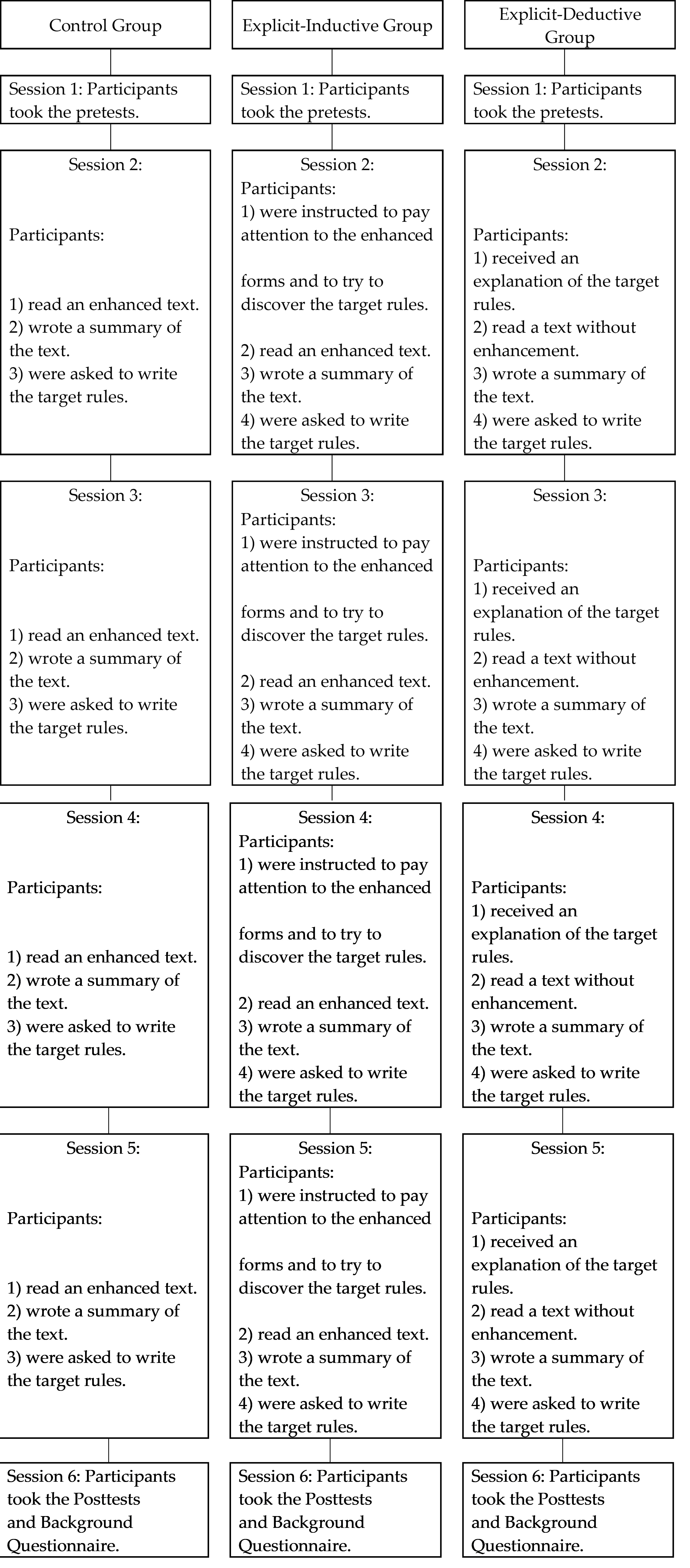
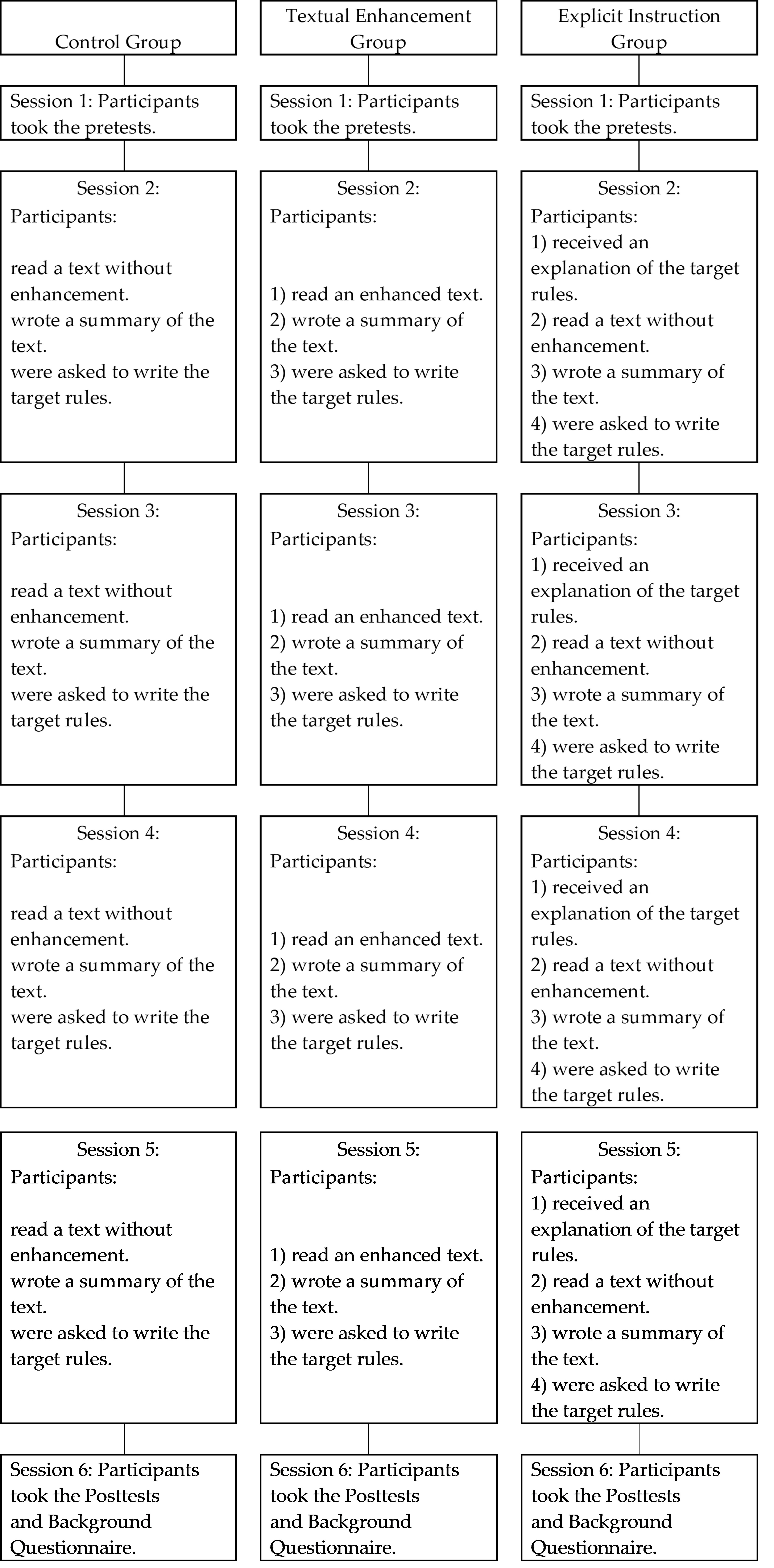
In the current study, the texts given to the control group and to the explicit group were not enhanced. Only the textual enhancement group were given enhanced texts, and there was no explicit-inductive group. Another major difference between the studies is that in the previous study, both explicit treatments were compared to a control group that comprised textual enhancement whereas in the current study textual enhancement and explicit-deductive instruction were compared against a true control condition without enhancement. As shown in Figures 1 and 2, in terms of comparability, the participants in the textual enhancement group in the current study received the same pedagogical treatment as the control group in the study by Moreno-Vega and Preciado-Sánchez (2023). In both studies, the explicit-deductive condition was the same.
Having explained the background of the study, the research questions it addresses are:
R.1 Can rule explanation and textual enhancement regarding more and less salient forms lead to either declarative-explicit and/or automatized-explicit knowledge?
Hypothesis 1: Explaining the target rules will lead to more declarative-explicit and automatized-explicit knowledge of both rules than giving learners exposure to enhanced texts. Textual enhancement will lead to automatized-explicit knowledge of the more salient form by, but no learning of the other less salient rule for in vs. on. Salience will have less of a mediating effect with rule explanation than with textual enhancement; that is, the group receiving the rule explanation is likely to learn both rules regardless of their level of salience whereas the textual enhancement group may at best learn the most salient rule.
R.2 How will the textual enhancement group in this study perform in comparison to the control group from the study by Moreno-Vega and Preciado-Sánchez (2023) which received the same treatment (textual enhancement)?
Hypothesis 2: The textual enhancement group in this study will have the same results as the control group in the previous study. They will learn the rule for the preposition by but not for prepositions in vs. on.
R.3 How will the explicit instruction group in this study perform in comparison to the explicit-deductive instruction group from the previous study which received the same treatment (metalinguistic explanation)?
Hypothesis 3: The explicit instruction group in this study will have the same learning effect as the explicit-deductive instruction group in the previous study. Both groups will learn both rules.
The purpose of our research was to find if there were different learning effects between the groups over four sessions taught once a week. It followed a quasi-experimental design consisting of three independent variables for each condition:
1) Training Condition: the three different treatment conditions comprised: a) control, b) textual enhancement, and c) rule explanation.
2) Target structures: two underlying rules governed the target items: a) the use of in or on and b) the use of by.
3) Measures: this study implemented two tests of declarative-explicit knowledge and a test of automatized-explicit knowledge.
Participants
This quasi-experiment was conducted at a public university in Mexico. Eighty-three students participated in the study. They were enrolled in an intermediate level course of English as a foreign language which corresponds to the B1 level according to the Common European Framework of References for Languages. Nine intact groups were used in total. Each group was randomly assigned to one of three conditions. Three of them were assigned the control condition (n = 27), and they read a text each lesson. Three other groups were assigned the enhancement condition (n = 24), and they read texts that had textual enhancement. Finally, the last three groups were assigned the explicit instruction condition (n = 32), and they received an explanation of the target forms at the beginning of each lesson, and then they read unenhanced texts. They were not told to pay attention to and process the target items during the reading of the texts. None of the groups was informed about the type of treatment that each would receive. To ensure that students in the three conditions were focusing on meaning, they wrote a summary of the text that they read in each lesson. Forty-three participants were female, and 40 were male. Their average age was 22.86 years. Eighty-one participants were Mexican, and two were Cuban exchange students. All the participants were native speakers of Spanish. Moreover, students had limited exposure to the target language outside of class, and English as a foreign language was taught five days a week in 50-minute sessions.
Target Items
As in the study of Moreno-Vega and Preciado-Sánchez (2023), the target items for this study were the use of prepositions in, on, and by which co-occur in the context of forms of transportation. These prepositions are frequent in the input according to Lindstromberg (2010), but they are often not perceptually salient to L2 learners, and mastering them can be puzzling as there are cases when learners may not know whether to use in, on, or whether to use by instead of in or on. According to Lam (2009), prepositions can be complicated for L2 learners because their contextual use varies between languages, and if they rely on L1 knowledge to solve problems in the L2, they usually do not use the prepositions accurately. Thus, an explicit intervention might help learners to notice, process and understand how these forms are used in the L2. The use of in or on in the context of forms of transportation is not very transparent. Lindstromberg (2010) explains that in is used when talking about a means of transportation that is not big and is not public such as a car, a truck, or a small boat. If we are talking about a means of transportation that is big and public such as a bus, a train, a ship, or an airplane, we use on. Moreover, Lindstromberg (2010) states that by is used to refer to “generic means of transportation… when we aren’t thinking of any particular machine” (p.148). For example, in the sentence: “She goes to work by car”, the preposition by implies that the speaker isn’t specifying in which car she rides to work. It could be ‘in her car’ or ‘in someone else’s car’. In addition, according to Lindstromberg (2010), “if we are thinking particularly - and therefore thinking of the scene in more detail - we may say, for instance, we came in her car or we came on the last train” (p.148). In sum, the rule of usage for in vs. on has to do with two aspects of the means of transportation: 1) its size and 2) whether it is private or public. The rule for by vs. in/on is more abstract as it has to do with how the speaker is thinking about a vehicle, and unlike with the use of in vs. on there are no visible cues that inform the speaker and the listener about whether the vehicle (e.g., a car) is a particular one, or any car.
The difference in meaning between in and on is very subtle, and consequently, it can be difficult for learners to understand. In addition, according to VanPatten’s (1984) model of input processing, there are forms that have little referential meaning, which is defined as how closely related a form is “to some semantic concept in the real world” (in VanPatten, 2005, p. 270). In this study, we used VanPatten’s model to establish that the preposition by used in the context of forms of transportation is more salient because it has an equivalent preposition in Spanish, so learners can rely on their L1 to understand its referential meaning. For example, the sentence: ‘I go to school by car everyday’ can be translated into Spanish as ‘Voy a la escuela en carro todos los días’. Both languages conceptualize a situation where the speaker does not refer to a specific car but to any car instead. In contrast, the conceptual difference between prepositions in and on in this context does not exist in Spanish. Instead, the equivalent to ‘in the car’ would be ‘en el carro’, and the equivalent to ‘on the bus’ would be ‘en el autobús’. In Spanish the distinction between in or on in the context of forms of transportation is not made. According to Vainikka and Young-Scholten (2009), when L2 forms are absent in learners’ L1, they become non-salient or unavailable. Consequently, these prepositions are an ideal target form for this study as they allow us to investigate whether their perceptual salience mediates the effectiveness of the type of instruction (highly explicit or less explicit).
According to N. C. Ellis (2016), “salience arises in sensory data from contrasts between items and their context” (p. 343). In addition, Treisman and Gelade (1980) explained that stimuli in the input that are different from the rest of the stimuli tend to stand out. In line with these definitions, in and on are typographically and phonologically very similar which makes their distinction not very salient. In contrast, by is typographically and phonologically very different from in and on, thereby raising the probability of learners noticing that some instances require by rather than in or on.
The level of perceptual salience of the prepositions in, on, and by is operationalized in this study based on two different characteristics of these target prepositions: a) their typographical similarity or difference from each other, and b) their similarity or difference from learners’ L1, which has an impact on their referential meaning.
Measures
A fill-in-the-blank (FIB) test and a metalinguistic knowledge test (MKT) were used to measure learners’ explicit knowledge, and a timed grammaticality judgment test (TGJT) was implemented to assess their automatized-explicit knowledge. Two versions of the FIB and the TGJT were designed; one was used for the pretest and the other for the posttest. Ideally, this study should have included an additional test assessing automatized-explicit knowledge, but students did not have enough time.
FIB Test
FIB tests have not been as commonly used to measure explicit knowledge as MKTs. However, they have been applied with the purpose of eliciting short answers from learners in items that require only one possible correct response. We decided to use this type of assessment based on a study conducted by Macrory and Stone (2000) that implemented a FIB test to measure participants’ explicit knowledge of the perfect tense in French. In their study, the FIB test enabled participants to show explicit knowledge of that target forms despite not being able to use the target forms spontaneously. This demonstrates that the FIB test can be optimal as an additional measure of explicit knowledge because it takes participants beyond simply judging whether a sentence is grammatical; it requires them to process the target forms. According to Peters (2016), this kind of explicit language test helps to establish form-meaning connections. Thus, in the current study we used the FIB in addition to a metalinguistic knowledge test because it is plausible for learners to acquire some explicit knowledge despite not being able to explain a learned rule with sophisticated metalanguage.
The FIB test comprised 25 items, of which 15 were target items, and 10 were distractors. Five target items assessed the use of by, and ten target items assessed the use of in vs. on. Because the rule of in vs. on comprises two prepositions rather than one, twice as many items were required to assess it. Participants were instructed to complete each sentence by filling in the blanks with the missing words. They were not allowed to use more than one word per blank. The distractors assessed the use of articles a and an, prepositions for or since, verb tenses, auxiliaries for questions and subject-verb agreement.
iTGJT
To assess if participants had gained automatized-explicit knowledge, they completed a timed grammaticality judgement test (TGJT). According to Suzuki (2017), TGJTs attract participants’ attention to form and as a result, they measure automatized-explicit knowledge instead of implicit knowledge. The TGJT had 26 items, of which 16 were target items, and 10 were distractors. Ten target items assessed the use of in vs. on. Five of these items were grammatical and the other five were ungrammatical. Likewise, six target items assessed the use of by, of which three were grammatical and the other three were ungrammatical. Following the same logic, 50% of the distractors were grammatical and the rest were not. The distractors tested learners’ knowledge of tag questions, yes/no questions, simple present conjugation, yes/no questions with auxiliary did, past progressive and the use of the articles a and an.
We recorded a native English speaker who read the sentences aloud for each target item. To determine how much time participants needed to respond to each of the items on the TGJT, we piloted the TGJT with five native speakers of English; following the studies by R. Ellis (2005) and Zhang (2015), we set the time limit in the TGJT based on the average length that it took them to respond each item plus an extra 20% of time. It took the native speakers of English on average five seconds to listen to each sentence and to make their judgment, so we decided to give participants in our study an extra second per item. They were not asked to correct any ungrammatical sentences nor to explain why they were ungrammatical. Thus, participants had six seconds to listen to every item and make a judgement, which did not necessarily restrict their access to explicit knowledge, but it potentially allowed them to use automatized-explicit knowledge. We conducted a pilot study with L2 learners of English prior to the data collection, and it revealed that six seconds was a reasonable amount of time for learners to listen to each item and to make their judgments.
MKT
After reading each text, participants completed a MKT by writing the rules of the target items they found in the text that they had read. Participants did not receive any feedback on their rules or lack thereof. There was no time restriction for this test. The objective was to discover if those participants receiving textual enhancement had discovered the rules governing the use of the target forms. Also, it was important to assess whether the participants who had received the rule explanation prior to reading each text had understood and could remember them. It is logical that after reading the first text, participants in any of the conditions would likely focus some of their attention to form and try to discover the underlying rules. In this sense, the MKT was possibly enhancing the input. However, the one-week spacing between each training session potentially reduced this risk. Also, the target rules were difficult to discover because they carry low communicative value, and there are no semantic cues that help learners to infer the rules without an explanation from the instructor. As was revealed in the study by Moreno-Vega and Preciado-Sánchez (2023), even if learners knew that they had to search for target rules, it was very challenging to discover them.
Procedures
Participants are taught English from Monday through Friday in fifty-minute lessons. Data was collected during English instruction time. The data collection consisted of six sessions lasting an average of 20 minutes each. As in the study by Moreno-Vega and Preciado-Sánchez (2023), there was a one-week interval between each session. During the first session, participants in each of the three training conditions received an information sheet and a consent form. All of them read it and signed it. Then they were given a pretest that comprised a FIB test and a TGJT. They were not told that they were being assessed. Instead, they were instructed to complete two exercises that would help them practice English.
From session two to session five, participants received their treatment, which was similar in some ways and different in others. All participants read the same four texts, one in each session. Each text had seven tokens containing the form in or on + means of transportation and seven tokens of the form by + means of transportation. Across the four training sessions, all participants had received exposure to 28 instances of the form in vs. on and 28 instances of the form by. After reading the text, all participants wrote a summary (including the explicit group) of what they had read to help the researchers verify that they had understood the meaning communicated in the texts. Furthermore, after reading each text, all participants took the MKT which asked them to explain the underlying target rules. Differences across the groups/training conditions were configured in two ways. Firstly, participants in the control and explicit instruction groups read unenhanced texts, while those in the textual enhancement group read enhanced texts. In this latter group, forms in + means of transportation, and on + means of transportation were presented in red (such as in the car, and on the bus), and the forms by + means of transportation were presented in blue (such as by train). Secondly, before reading each text, the participants in the explicit instruction group received an explanation about the two rules governing the use of in vs. on and by vs. in or on.
In session six, participants in all groups were given a FIB and TGJ posttest. During this final stage, they also completed a background questionnaire focusing mostly on their English learning process.
RESULTS
R1. Can rule explanation and textual enhancement regarding more and less salient forms lead to either declarative-explicit and/or automatized-explicit knowledge?
Before making between-group and within-group comparisons, Shapiro-Wilk tests were conducted with the FIB and TGJ pre and posttest data sets of each group to assess if they met the assumption of a normal distribution. Target items testing the use of in vs. on were analyzed separately from the target items testing the use of by. Normality tests revealed that the data were not normally distributed. We conducted a Levene’s test to check if the variance across groups was homogeneous. The variances across the three groups were homogeneous on the FIB pretest and posttest for the items in vs. on. They were also homogeneous on the TGJ pretest for the items in vs. on, but they were not homogeneous for in vs. on in the TGJ posttest. There was also homogeneity of variance across groups on the FIB pretest and posttest for the by items, and on the TGJ pretest, but not on the TGJ posttest. Because the data sets didn’t entirely meet the assumptions needed to conduct parametric tests, such as having a normal distribution and homogeneity of variance across all groups, we used non-parametric tests to compare mean scores between groups and within the groups.
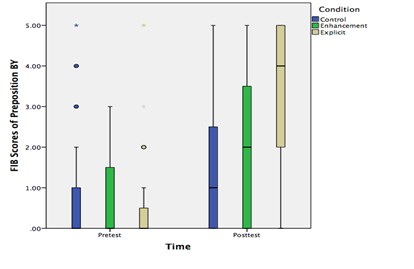
Figures 4 and 6 illustrate that a few participants scored higher than the rest of their peers. We decided to leave these outliers as part of the data because there was no valid reason to omit them. These participants in the control group and in the textual enhancement group had more declarative-explicit and automatized-explicit knowledge of the preposition by in the pretest than the average student in the data samples, but they were still not able to explain the target rules when they finished their training sessions; this was enough reason to include their data in the study. Also, we ran the statistical analysis a second time excluding the data of the outliers to confirm that the results were not skewed, and that there was not a type I error. Excluding them revealed the same learning effects as including them. Therefore, we decided to report the findings of the complete data.
Between-group comparisons
A Kruskal-Wallis test was conducted to make between-group comparisons of the FIB pretest and posttest mean scores of the target items in vs. on. No significant differences were found in the pretest between any of the groups (ꭕ2 (2, 83) = .791, p = .673). However, significant differences between groups were found in the posttest (ꭕ2 (2, 83) = 9.553, p = .008). To find where those differences lay, a series of Mann Whitney U tests were conducted. After conducting a Bonferroni adjustment for pairwise comparisons, the alpha was set at <.016. A significant difference was found in the posttest between the textual enhancement group and the explicit instruction group (U = 215.500, z = -2.818, p = .005, R = .174, r2 = .030, d = -0.811). No significant differences were found between the control group and the textual enhancement group (U = 254.500, z = -1.333, p = .183, R = .157, r2 = .025, d = 0.319) nor between the control group and the explicit instruction group (U = 296.000, z = -2.097, p = .036, R = .081, r2 = .007, d = -0.580).
The same procedure was followed to compare the mean scores of the FIB pretest and posttest of the target item by. A Kruskal-Wallis test revealed that there were no significant differences between groups in the pretest (ꭕ2 (2, 83) = .856, p = .652), but there were significant differences between groups in the posttest (ꭕ2 (2, 83) = 12.749, p= .002). To find where those differences lay, a series of Mann Whitney U tests were conducted. After conducting a Bonferroni adjustment for pairwise comparisons, the alpha was set at <.016. Significant differences were found in the posttest between the control group and the explicit instruction group (U = 223.500, z = -3.239, p = .001, R = .091, r2 = .008, d = -1.048), and between the textual enhancement group and the explicit instruction group (U = 221.500, z = -2.748, p = .006, R = .243, r2 = .059, d = -0.796), but no significant difference was found between the control group and the textual enhancement group (U = 299.500, z = -.478, p = .633, R = .104, r2 = .011, d = -0.156).
To compare between-group mean scores of the TGJT pretest and posttest of the target item in vs. on, a Kruskal-Wallis test was again conducted. No significant differences were found on the pretest (ꭕ2 (2, 83) = .413, p= .813), but significant differences were found on the posttest (ꭕ2 (2, 83) = 8.551, p= .014). To find where those differences lay, a series of Mann Whitney U tests were performed. After performing a Bonferroni adjustment for pairwise comparisons, the alpha was set at <.016. Significant differences were found between the control group and the explicit instruction group (U= 273.000, z = -2.440, p = .015, R = .101, r2 = .010, d = -0.766) and between the textual enhancement group and the explicit instruction group (U= 237.500, z = -2.450, p = .014, R = .294, r2 = .087, d = -0.755). No significant difference was found between the control group and the textual enhancement group (U= 289.000, z = -.674, p =.500, R = .236, r2 = .056, d = 0.081).
Finally, for the target item by a between-group comparison of the TGJ pretest and posttest mean scores was also conducted through a Kruskal-Wallis test. No significant differences were found in the pretest (ꭕ2 (2, 83) = 3.986, p= .136), but significant differences were found in the posttest (ꭕ2 (2, 83) = 7.895, p=.019). As with the previous data sets, Mann Whitney U tests were conducted. To adjust for pairwise comparisons, a Bonferroni adjustment was performed, and the alpha was set at <.016. No significant difference was revealed between the control group and the textual enhancement group (U = 208.000, z = -2.243, p =.025, R = .198, r2 = .039, d = -0.597), nor was there any significant difference between the enhancement group and the explicit instruction group (U = 344.500, z = -.673, p = .501, R = .008, r2 = <.001, d = -0.127). However, a significant difference was found between the control group and the explicit instruction group (U = 269.500, z = -2.517, p = .012, R = .010, r2 = <.001, d = -0.658).
Within-group comparisons
To compare if there were significant differences across time within groups, the data of items assessing the rule of in vs. on was analyzed separately from the data of items corresponding to the rule of by. The FIB test had 15 items, of which 10 assessed the rule for in vs. on, and five items assessed the rule for by. Non-parametric tests were conducted with the pretest and posttest data sets of the FIB because not all the data scores were normally distributed. Wilcoxon signed ranks tests were used with the FIB pretest and posttest scores of each group of items targeting the preposition in vs. on. Table 1 shows the pretest and posttest scores of all groups in the FIB and TGJT. Figure 3 shows the performance of each group across time.
Table 1 Within Group Differences of the FIB in vs. on Scores from Pre to Posttest
| Wilcoxon Signed Rank Test | |||||||||
|---|---|---|---|---|---|---|---|---|---|
| Pretest | Posttest | Pre to Posttest | 95% CI of the difference | ||||||
| Condition | n | M (SD) | n | M (SD) | p | z score | d | LL | UL |
| Control | 27 | 4.59 (1.73) | 27 | 5 (1.68) | 0.34 | -0.95 | 0.24 | -1.14 | 0.33 |
| Textual | |||||||||
| Enhancement | 24 | 4.37 (1.76) | 24 | 4.4.1 (2.01) | 0.97 | -0.04 | -0.02 | -0.8 | 0.72 |
| Explicit | |||||||||
| Instruction | 32 | 4.81 (1.92) | 32 | 6.15 (2.28) | 0.01 | -2.63 | -0.64 | -2.27 | -0.42 |
Note. CI = Confidence interval; LL = lower limit; UL = upper limit; maximum score = 10 points
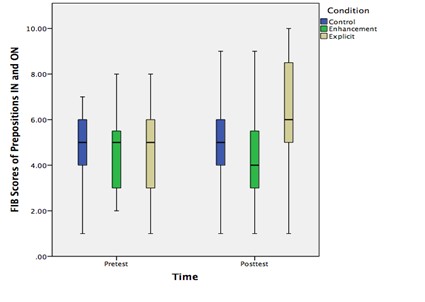
The results from the Wilcoxon Signed Ranks test in Table 1 revealed that the Control group in vs. on item scores in the FIB did not increase significantly from pre to posttest. Similarly, the textual enhancement group did not increase its in vs. on item scores in the FIB from pretest to posttest. However, the explicit instruction group target item scores of prepositions in vs. on improved significantly from pre to posttest.
A Wilcoxon signed ranks test was also conducted with the FIB pretest and posttest scores of each group targeting the preposition by. As shown in Table 2, there was no significant difference for the control group, but there was a significant difference for the textual enhancement group and the explicit instruction group.
Table 2 Within Group Differences of the FIB by Scores from Pre-Posttest
| Wilcoxon Signed Rank Test | |||||||||
|---|---|---|---|---|---|---|---|---|---|
| Pretest | Posttest | Pre to Posttest | 95% CI of the difference | ||||||
| Condition | n | M (SD) | n | M (SD) | p | z score | d | LL | UL |
| Control | 27 | 0.96 (1.55) | 27 | 1.62 (1.84) | 0.06 | -1.90 | -0.39 | -1.3 | -0.04 |
| Textual | |||||||||
| Enh. | 24 | 0.70 (1.04) | 24 | 1.91 (1.86) | 0.01 | -2.75 | -0.83 | -2.0 | -0.41 |
| Explicit | |||||||||
| Instruction | 32 | 0.87 (1.73) | 32 | 3.34 (1.73) | <.001 | -4.27 | -1.43 | -3.2 | -1.76 |
Note. CI = Confidence interval; LL = lower limit; UL = upper limit; maximum score = 10 points
The same procedure was followed to compare within-group differences across time for each group in the TGJ test. Because not all the data sets met the assumption of a normal distribution, a Wilcoxon signed ranks test was conducted with each group’s pretest and posttest scores targeting the preposition in vs. on. Table 3 contains the descriptive statistics of each group’s performance. Figure 5 shows that only the explicit instruction group had significant gains in mean scores from pre to posttest.
Table 3 Within Group Differences of the TGJT in vs. on Scores from Pre-Posttest
| Wilcoxon Signed Rank Test | |||||||||
|---|---|---|---|---|---|---|---|---|---|
| Pretest | Posttest | Pre to Posttest | 95% CI of the difference | ||||||
| Condition | n | M (SD) | n | M (SD) | p | z score | d | LL | UL |
| Control | 27 | 5.03 (1.42) | 27 | 4.94 (1.18) | 0.84 | -0.20 | 0.07 | -0.54 | 0.74 |
| Textual | |||||||||
| Enh. | 24 | 4.91 (1.55) | 24 | 4.83 (1.52) | 0.81 | -0.25 | 0.05 | -0.92 | 1.09 |
| Explicit | |||||||||
| Instruction | 32 | 4.87 (1.56) | 32 | 6.25 (2.24) | 0.01 | -2.68 | -0.73 | -2.30 | -0.45 |
Note. CI = Confidence interval; LL = lower limit; UL = upper limit; maximum score = 10 points
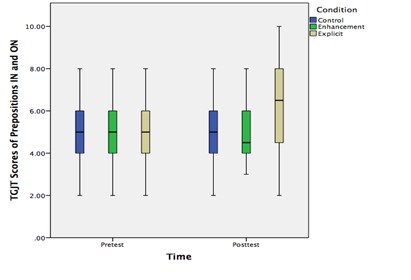
Finally, a Wilcoxon signed ranks test was also conducted with the TGJT target item scores of each group of the preposition by. Table 4 reveals that there were no significant differences from pretest to posttest for any of the groups.
Table 4 Within Group Differences of the TGJT by Scores from Pre-Posttest
| Wilcoxon Signed Rank Test | |||||||||
|---|---|---|---|---|---|---|---|---|---|
| Pretest | Posttest | Pre to Posttest | 95% CI of the difference | ||||||
| Condition | n | M (SD) | n | M (SD) | p | z score | d | LL | UL |
| Control | 27 | 2.37 (1.52) | 27 | 2.82 (.94) | 0.25 | -1.15 | -0.36 | -1.18 | 0.28 |
| Textual | |||||||||
| Enh. | 24 | 2.83 (1.20) | 24 | 3.45 (1.17) | 0.06 | -1.85 | -0.52 | -1.30 | 0.05 |
| Explicit | |||||||||
| Instruction | 32 | 3.09 (1.69) | 32 | 3.62 (1.49) | 0.17 | -1.38 | -0.33 | -1.19 | 0.13 |
Note. CI = Confidence interval; LL = lower limit; UL = upper limit; maximum score = 10 points
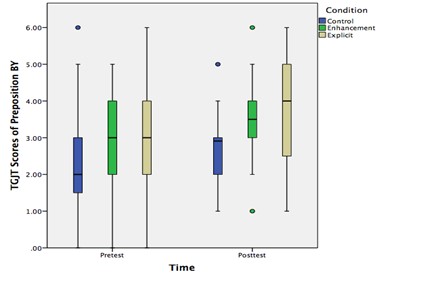
The within-group comparisons indicate that the explicit instruction group improved its scores of in vs. on from pre to posttest in both the FIB and the TGJT. As shown in Table 1, even though there was no significant difference in the FIB posttest scores of in vs. on between the control group and the rule explanation group, the latter improved significantly from pretest to posttest, and there was a medium effect size for these gains. In the case of the preposition by, rule explanation promoted learning in the FIB test, but not in the TGJT. Thus, most of the knowledge of in vs. on acquired by learners through rule explanation was automatized-explicit knowledge. Moreover, rule explanation promoted only explicit knowledge of the preposition by. As shown in Table 2, this group’s improvement of by in the FIB from pre to posttest had a medium effect size and it had significantly higher scores of by than the control group in the FIB posttest with a large effect size. Participants gained no automatized-explicit knowledge of by as shown by the TGJT results. In this study, rule explanation of a less salient target form favored primarily the acquisition of automatized-explicit knowledge of that form. On the other hand, rule explanation of a more salient target form favored the acquisition of declarative-explicit knowledge of that form.
Textual enhancement did not promote the learning of in vs. on. Tables 1 and 3 show no significant increase from pre to posttest in the FIB and the TGJT and the effect sizes were very small. This group had a significant increase of by scores from pre to posttest in the FIB with a large effect size as shown in Table 2. However, their posttest scores were not significantly higher than those of the control group, and the small effect size between the posttest scores of the control group and the textual enhancement group reveals that these marginal gains must be interpreted with caution because they were not significantly greater than those of the control group. That is, this increase was not large enough to have any meaningful theoretical or pedagogical implications. There was also no acquisition of automatized-explicit knowledge of by due to textual enhancement although the increase of scores between the pretest and posttest was approaching significance, and there was a medium effect size as displayed in Table 4. One plausible explanation for the lack of any significant learning due to textual enhancement may be due to the lack of depth of processing promoted by this type of exposure. According to Leow and Martin (2017), even though studies implementing think-aloud protocols and eye-tracking have shown that participants may pay more attention to enhanced items in comparison to unenhanced items, the increased attention to target forms does not mean that participants are engaging in higher depths of processing.
Giving learners rule explanations favored the acquisition of explicit knowledge of both target rules; this implies that it is plausible for explicit form-focused instruction (FFI) to promote explicit knowledge. The results also suggest that explicit FFI of some target forms can potentially favor the acquisition of automatized-explicit knowledge of those forms. This has important theoretical and pedagogical implications. In terms of theory, it is not surprising that a highly explicit treatment leads to explicit knowledge, as there is extensive research showing this (see Norris & Ortega, 2000; Shintani et al., 2016); however, it is interesting that it can also facilitate the learning of automatized-explicit knowledge. In relation to teaching, these findings imply that there are benefits to explaining to students the rules of certain target forms that don’t carry a very transparent meaning. Nevertheless, the pedagogical value of these results should also be carefully considered. As Macrory and Stone (2000) explained, high scores in a FIB test do not necessarily mean that students have gained better productive language skills, and conversely, learners’ low performance in a FIB test may hide their successful development of a target form.
Textual enhancement of the target forms in this study didn’t lead to automatized-explicit knowledge or declarative-explicit knowledge. There is previous research showing that textual enhancement is too subtle for participants to interact sufficiently with the input and to infer the underlying rules of the target forms (Leow, et al., 2019; Winke, 2013). None of the participants in the textual enhancement group were able to explain any of the target rules during the training sessions. In terms of pedagogical implications, these results could indicate that perhaps textual enhancement may be effective for forms which have a more transparent meaning than the prepositions in this study. Ultimately, for certain forms that are very difficult to notice, explaining to participants their underlying rules may be the only way for them to understand their form-meaning function.
R.2 How will the textual enhancement group in this study perform in comparison to the control group from the study by Moreno-Vega and Preciado-Sánchez (2023) which received the same treatment (textual enhancement)?
Textual enhancement in the current study had the same effect as the control condition in the study by Moreno-Vega and Preciado-Sánchez (2023) which consisted of giving participants exposure to enhanced target prepositions. Like in the previous study, in the current study textual enhancement was not effective at helping participants to learn the underlying target rules. It is important to highlight that in the current study, the textual enhancement group was compared with a true control group which read unenhanced texts. In contrast, in the previous study, the control group received exposure to enhanced texts.
R.3 How will the explicit instruction group in this study perform in comparison to the explicit-deductive instruction group from the study by Moreno-Vega and Preciado-Sánchez (2023) which received the same treatment (metalinguistic explanation)?
The findings of the explicit instruction group in the current study accord with those of the previous study. In both quasi-experiments giving participants an explanation of the target forms was effective at helping them learn both underlying rules. In both studies participants who received an explanation of the target forms learned more than the participants who didn’t receive this kind of instruction, as shown by the larger effect sizes.
DISCUSSION
Explaining the target rules promoted primarily automatized-explicit knowledge of in vs. on but also declarative-explicit knowledge. It also resulted in declarative-explicit knowledge of by. On the other hand, textual enhancement did not facilitate the acquisition of automatized-explicit knowledge of any of the target forms. This accords with Roehr’s (2008) claim that explanations of linguistic items tend to be more accurate than the kind of knowledge that learners reach when they discover a rule on their own.
Textual enhancement did not seem to promote sufficient processing of the target items in this study to enable participants to learn them. Evidence of this is that none of the participants in the textual enhancement condition could explain the rules for the target forms during any of the training sessions. The superior gains that resulted from rule explanation compared to textual enhancement are consistent with much of the literature in SLA. Previous research on textual enhancement (see Alanen, 1995; Indrarathne & Kormos, 2017; Shintani et al., 2016) has revealed that providing participants with explicit FFI of a target form tends to be more effective than giving them exposure to enhanced texts. In addition, three meta-analyses have also confirmed that treatments that exclude a target rule explanation have a smaller effect size than those that include it (see Norris & Ortega, 2000; Goo et al., 2015; Spada & Tomita, 2010). Szudarski and Carter (2016) explain that a treatment such as textual enhancement perhaps only helps participants attend linguistic forms; and, according to Chiuchiù and Benati (2020), it can only increase participants’ noticing of target forms but does not seem to enable them to process the forms deeply enough to internalize them (see Leow, 2015). L2 learners need to engage in deeper processing, and in some cases, a more explicit treatment is necessary for them to process the forms syntactically and semantically.
Participants receiving textual enhancement usually require more exposure to the treatment than what is usually provided during an experiment according to Comeaux and McDonald (2018) and Della Putta (2016), and they seem to benefit more from textual enhancement when they already have some previous knowledge of the target form (see Chung & Révész, 2021). After reading the first text, participants did not have declarative-explicit knowledge of the three target items as shown by the MKT. Tables 1 and 4 illustrate that participants’ performance on the pretest was relatively low for the three target items. Perhaps participants’ initial scores were not high enough for them to benefit from textual enhancement.
Indeed, explaining the target rules seems to have facilitated to some extent participants’ understanding of how the target forms are used in the specific context of forms of transportation. Nevertheless, the gains of declarative knowledge of in vs. on by the explicit instruction group were limited considering that despite receiving an explanation of these target forms, the participants seem to have developed only marginal declarative-explicit knowledge of them. This suggests that even though explicit instruction is more effective than textual enhancement, it is plausible for participants not to understand all target features even after receiving a meta-linguistic explanation.
It is plausible for explicit instruction to cause automatized-explicit knowledge and declarative-explicit knowledge; in the current study this may be explained by the greater differences in psychophysical salience of the preposition by in contrast to the use of in and on. That is, participants may detect the difference in usage of the preposition by in contrast to the use of prepositions in and on more easily than they detect the use of in vs. on, and this may trigger the use of explicit knowledge. In contrast, the perceptual similarity between in and on may cause difficulty for participants to detect that these forms follow different usage rules. If students cannot perceive the semantic difference that in vs. on convey, then it is unlikely that they can perform accurately in a FIB test which requires them to understand the difference between the two forms.
However, to generalize these findings, more studies are needed which investigate the learning of different target forms. Future research could investigate if textual enhancement can help students process and understand other non-salient forms. For example, textual enhancement could potentially be more effective for syntactic forms than for morphological forms, but this needs to be tested empirically. In addition, rule explanation appears to interact with automatized-explicit knowledge. Further research should investigate what additional features must be present in a target form for explicit instruction to lead to automatized-explicit knowledge of that form. However, as one of the reviewers indicated, future studies following this line of research should ensure that salience is studied as an independent variable.
The findings in this study can inform teachers about the pedagogical approaches that they can implement when teaching non-salient forms. For example, it should not be assumed that students will discover, process, and understand the subtle differences in meanings of forms such as prepositions. Therefore, these forms can be taught preemptively before students are given opportunities to practice them and use them in pedagogical tasks. These forms can also be taught while students are performing focused tasks that require the use of these target items or after students have performed such tasks.
While textual enhancement may under some circumstances increase the perceptual salience of target forms, this does not guarantee that students will be able to process the forms thoroughly enough, and that they will understand them. Therefore, textual enhancement should be used in addition to other instructional practices. For example, teachers can explain the use of those forms before giving students a reading activity with enhanced target forms.
Limitations
Ideally, this study should have comprised a more extended pedagogical treatment. Nevertheless, it was only possible to have four training sessions due to schedule restrictions. In the same vein, including a delayed-posttest would have assessed retention and robust learning of the target forms, and it would have provided valuable information about the effects of each type of instruction of the target forms over a longer period. However, there was not enough time available.
Also, implementing additional assessment of automatized-explicit and declarative-explicit knowledge would have offered more robust results. For example, it would have been helpful to assess the use of the target forms through learners’ spoken output. Unfortunately, it was not possible due to time limitations.
CONCLUSION
Explicit instruction in the form of rule explanation appears to be more likely than textual enhancement to cause the learning of prepositions used in the context of means of transportation. Not all forms can be learned without a rule explanation; thus, an explicit intervention is sometimes necessary. Participants may require several sessions of rule explanation to gain explicit knowledge of salient and non-salient forms. These findings also suggest that explicit FFI can be mediated by the level of perceptual salience of certain target forms.
Perceptual salience of target forms did not mediate the effects of textual enhancement in this study. The textual enhancement group did not have a significant learning effect on any of the target forms. It is plausible that with a longer treatment, textual enhancement may have caused greater improvement. Further research could investigate how different types of form-focused instruction combined with textual enhancement can help learners process salient and non-salient forms in the L2.
These results have important pedagogical implications. They suggest that it can be beneficial to explain to students how to use prepositions related to forms of transportation otherwise they are most likely not going to do this on their own. However, further research is needed to understand the type of knowledge that participants can gain depending on the level of salience of the target form and the instructional treatment. Also, future studies could investigate whether participants have a greater chance of acquiring declarative-explicit or automatized-explicit knowledge when the target form has an equivalent form in their L1.

