




 English (pdf)
 Article in xml format
 Article references
 Automatic translation
 Send this article by e-mail
 Cited by SciELO
  Cited by Google
  Similars in
SciELO
Similars in
SciELO  Similars in Google
 Permalink

Introduction
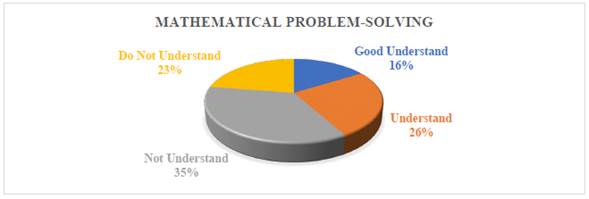
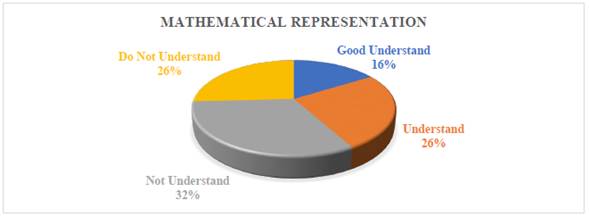
In learning mathematics, there are five basic abilities that an individual must possess. The five basic abilities, as outlined by NCTM (2000) are: (1) Problem Solving, (2) Reasoning and Proving, (3) Mathematical Connection, (4) Mathematical Communication, and (5) Mathematical Representation. In mathematical abilities, problem-solving and representation determine a person's mathematical processing results (Cragg & Gilmore, 2014, pp. 172). Therefore, it is crucial to develop problem-solving abilities and mathematical representations for educators and students, as they are the main actors in the classroom learning process (Pantaleon et al., 2018). However, the findings in the field show that prospective elementary school teacher students at University X struggle tounderstand problem-solving and mathematical representation. The results of the preliminary study can be seen in Figures 1 and 2 below:
Source: preliminary study
Figure 1 Understanding the Problem-solving Ability of Prospective Teachers
Source: preliminary study
Figure 2 Understanding of Prospective Teacher Mathematical Representations
The preliminary study results in Figures 1 and 2 show that the prospective teacher's understanding of problem-solving and mathematical representation still needs improvement. This can be seen from the fact that more than 60% of prospective teachers who are at the level of “not understanding” and do not understand both the concept of problem-solving and mathematical representation. This is in line with the research results of Bikić et al. (2016); Maulyda et al. (2020); & Sukoriyanto et al. (2016), which show that the problem-solving abilities of prospective teachers in tertiary institutions are not much different from students at the school education level. In fact, according to Muhaimin et al. (2019); & Runco (2011), elementary school teachers do not fully understand the concept of problem-solving and mathematical representation. If this phenomenon continues, the mathematical thinking skills of elementary school students will not develop optimally.
In addition to problem-solving and mathematical representation, one factor that influences the process of thinking mathematically is the level of math anxiety. According to the research finding of King (2014); Sari & Darhim (2020); and Van Garderen & Montague (2003), the level of math anxiety can affect a person's ability to solve math problems. Math anxiety often occurs due to several factors(Istikomah & Wahyuni, 2018) including (1) understanding of questions/problems; (2) mathematical concepts possessed; (3) confidence; and (4) previous experience of learning mathematics. Anxiety is an unpleasant emotion that is common in everyday life. Istikomah & Wahyuni (2018) argue that anxiety expresses personal feelings toward a situation and can be expressed in various ways, such as personal worry or mild anger. Wahid et al. (2014) state that anxiety is an affective (emotional) disorder characterized by deep and persistent feelings of anxiety and worry, without disturbances in evaluating reality, and with a relatively stable personality. It can still be manged within normal limits. Akpan (2022) adds that student anxiety can arise at any time. Mathematical anxiety can be divided into 2 categories: somatic mathematical anxiety and attitudinal mathematical anxiety (Bjälkebring, 2019).
Research on math anxiety has been carried out extensively, but studying the anxiety of prospective teachers is still rare. Wahid et al. (2014) conducted research on math anxiety in engineering students. The results of this study indicate that engineering students' math anxiety levels tend to be high. This is because the mathematics content studied in this department is often more abstract and difficult for students. This research aligns with other studies that state most students experience high levels of math anxiety (Akpan, 2022; Bjälkebring, 2019). In terms of problemsolving and mathematical representation, there has been no research that explores the relationship with anxiety levels. This can be seen from the VOS Viewer analysis, illustrated in Figure 3 below:
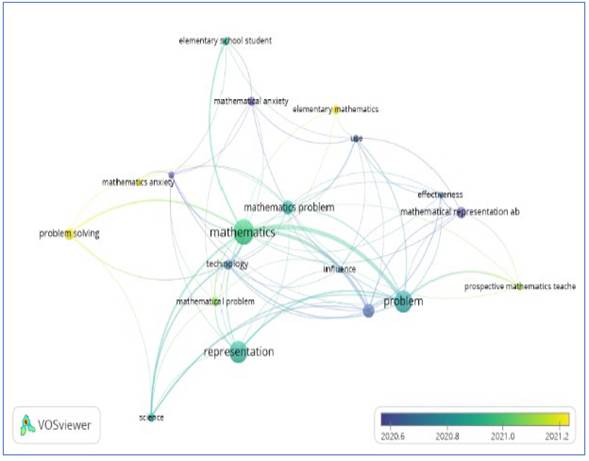
Figure 3 shows that research trends related to the following keywords: (1) Mathematical Anxiety, (2) Mathematical Representation, (3) Mathematics in Elementary, and (4) Mathematics Problem-solving, are still rarely researched. The variable of prospective teachers is still not adequately associated with the aspects of problem-solving and mathematical representation they possess. In addition, this study will also specifically examine how mathematical anxiety is affected by problemsolving abilities and mathematical representations (somatic and attitudinal anxiety). Thus, this study aims to analyze the effect of the ability to understand problem-solving and mathematical representation on the mathematical anxiety of prospective elementary school teachers.
The importance of problem-solving skills and mathematical representation in learning mathematics is, in fact, contrary to findings in the field. The preliminary study results show that the understanding of problem-solving and mathematical representation among prospective elementary school teachers still needs improvement. These abilities are critical for prospective elementary school teachers to develop. If prospective elementary school teachers do not possess good problemsolving and representation skills, the likelihood that these abilities can be developed among their students is minimal. To investigate the factors influencing this phenomenon, researchers assume that prospective elementary school teacher students are experiencing the influence of mathematics anxiety. Mathematical anxiety can lead to behaviors such as avoiding mathematics, fearing of mathematics, and lacking confidence in dealing with mathematics. To test this assumption, the researcher formulates the following hypothesis:
𝐻s0= There is no impact of problem-solving abilities and mathematical representation ability on the somatic anxiety of prospective elementary school teachers.
𝐻s1= There is an impact of problem-solving abilities and mathematical representation ability on the somatic anxiety of prospective elementary school teachers.
𝐻a0= There is no impact of problem-solving abilities and mathematical representation ability on the attitudinal anxiety of prospective elementary school teachers.
𝐻a1= There is an impact of problem-solving abilities and mathematical representation ability on the attitudinal anxiety of prospective elementary school teachers.
Methodology
1. Research Method
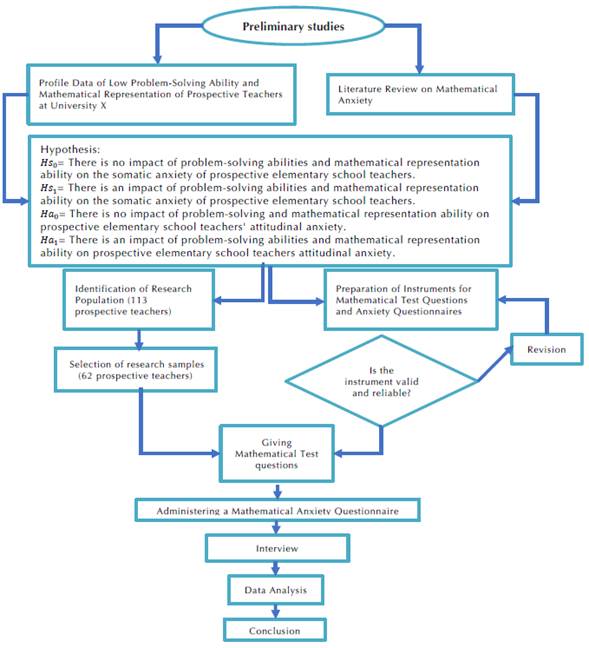
The type of research used is quantitative, with a correlational approach. Correlational research aims to see the relationship between two phenomena to discover new insights (Cresswell, 2012). This research will examine the relationship between problem-solving abilities and mathematical representations with the anxiety level of prospective teachers. The research procedure is illustrated in the following research flowchart:
Population and Sample
The population in this study consisted of 113 prospective elementary teachers who were completing their Bachelor of Education studies in their third year (seventh semester). The seventh semester was chosen because this population has completed teaching practice programs in elementary schools, giving them teaching experience that might influence their level of mathematical anxiety. A purposive sampling technique was used to ensure that the selected sample met the research needs (Jennings, 2018). The criteria used in the sampling process were: (1) Prospective elementary school teachers who had already practiced teaching at school; (2) Prospective elementary school teachers who had taken Elementary Mathematics Learning and Elementary Mathematics Education courses; and (3) Prospective elementary school teachers who were willing to follow the research procedures and participate in the study. Based on these criteria, 62 participants (54.8%) were selected for data collection.
Data Collections
The process of collecting research data was carried out in three ways, namely:
a. Giving Math Tests
Data collection began with giving a math test to the research participants. The test was given to collect data on the participants' problem-solving abilities and mathematical representations. The testinstrument consisted of 10 items validated in terms of content and construction to ensure data quality. The test results were scored on a scale of 1-10 as the basis for data analysis to examine the relationships between variables. Each of the two questions represented basic mathematical concepts that prospective elementary school teachers must understand when teaching mathematics, including (1) Number Operations, (2) Algebra, (3) Geometry, (4) Measurement, and (5) Statistics and Opportunities (Keller et al., 2001).
b. Deploying the Mathematical Anxiety Questionnaire
Data collection also involved administering a mathematical anxiety questionnaire to measure the participants' levels of mathematical anxiety. The questionnaire consisted of 10 items developed based on the indicators of mathematical anxiety shown in Table 1 below:
Table 1 Mathematical Anxiety Questionnaire Grid
| Mathematical Anxiety Indicator | |||
|---|---|---|---|
| Anxiety Level | Attitudinal | Somatic | Question Items |
| Tall | scared about what to do | having difficulty breathing | 3 |
| Currently | did not want to do what had to be done | heart beats faster | 3 |
| Low | worry about getting in trouble | feeling confused and uncomfortable | 4 |
| Total | 10 | ||
Source: Bjälkebring, 2019, pp. 5.
The questionnaire was given after the participants completed the math test. It was converted into a Google form so that it could be filled out online using their own devices. This also facilitated the data tabulation and assessment process for the researchers.
c. Conducting Cognitive Interviews
The third data collection method involved conductingunstructured interviews. These interviews were conducted to provide supporting data for the two previous data collection methods. The interviews were open-ended, allowing for flexibility in order to strengthen the results obtained from the mathematical test and mathematical anxiety questionnaire. Interviews were only conducted with a few participants who provided unique responses or who generated new findings.
4. Data Analysis
The data analysis used in this study is multiple linear regression analysis. This method was chosen because it can predict the condition of the dependent variable when two or more independent variables (predictor factors) are manipulated. This aligns with the research objectives. Before conducting hypothesis testing, several prerequisite tests were needed, namely: (1) Normality Test, (2) Multicollinearity Test, (3) Heteroscedasticity Test, and (4) Autocorrelation test (Polák et al., 2014). After this test were satisfied, multiple linear regression analysis was carried out to examine the relationships between variables. All data analysis activities were conducted using SPSS software version 25.
To maintain data validity, several methods were employed, including crosssectional data analysis and Focus Group Discussion (FGD). A cross-sectional data analysis was conducted with lecturers responsible for elementary school mathematics courses to determine whether the problem-solving skills and mathematical representations observed were consistentwith the lecturers' teaching experiences. Meanwhile, FGD activities were carried out with the head of the study program to ensure that the data obtained aligned with the documentation held by the Elementary School Teacher Education study program at University X.
Results
After testing the data, the researchers found differences in the relationship betweensomatic and attitudinal anxiety. Therefore, the results will be presented based on the relationship between problem-solving variables and mathematical representations of somatic and attitudinal anxiety.
The Effect of Problem-Solving Ability and Mathematical Representation on Somatic Anxiety
At this stage, the researchers examined the effect of problem-solving abilities and mathematical representations on somatic anxiety experienced by students. The test results can be seen in Table 2 below:
Table 2 The Effect of Problem-Solving Ability and Mathematical Representation on Somatic Anxiety Separately
| Coefficients a | |||||||
| Unstandardized Coefficients | Standardized Coefficients | Collinearity Statistics | |||||
| Model | B | std. Error | Betas | t | Sig. | tolerance | VIF |
| 1 (Constant) | 82,798 | 2,870 | 28,854 | 0.000 | |||
| Solution to problem | 0.069 | 0.030 | 0.214 | 2,297 | 0.024 | 1,000 | 1,000 |
| Mathematical Representation | -0.046 | 0.037 | -0.117 | -1,251 | 0.213 | 1,000 | 1,000 |
| a. Dependent Variable: Somatic Anxiety | |||||||
Source: own elaboration.
Table 2 shows the separate influence between problem-solving abilities and mathematical representation on the somatic anxiety of prospective teachers. The test results for the problem-solving ability variable show a significance value of 0.024. Meanwhile, the mathematical representation variable shows a significance value of 0.213. According to Hair et al. (2019), the independent variable is said to influence the dependent variable if the significance value in the coefficients table is less than 0.05. Since the significance value for the problem-solving variable is 0.024 <0.05, problem-solving ability affects the somatic anxiety experienced by prospective elementary school teachers. However, since the significance value for the mathematical representation variable is 0.213 > 0.05, mathematical representation ability does not affect the somatic anxiety experienced by elementary school teacher candidates. Table 3 below describes the effect of problem-solving abilities and mathematical representation on somatic anxiety simultaneously.
Table 3 The Effect of Problem-Solving Ability and Mathematical Representation on Somatic Anxiety Simultaneously
| ANOVA | |||||
| Model | Sum of Squares | df | MeanSquare | F | Sig. |
| 1 Regression | 111,327 | 2 | 55,663 | 3,395 | .037 b |
| residual | 1770,781 | 108 | 16,396 | ||
| Total | 1882.108 | 110 | |||
| a. Dependent Variable: Somatic Anxiety | |||||
| b. Predictors: (Constant), Mathematical Representation, Problem-solving | |||||
Source: own elaboration.
Table 3 shows that the significant value in the ANOVA table is 0.037. Since the significance value is 0.037 <0.05, the problem-solving ability and mathematical representation variables together affect the somatic anxiety experienced by elementary school teacher candidates. Thus, it can be concluded that 𝐻𝐻𝐻𝐻1 (“There is an impact of problem-solving abilities and mathematical representation ability on somatic anxiety of prospective elementary school teachers”) is accepted. Next, to see the extent of the effect of these variables, refer to Table 4 below:
Table 4 Percentage of the effect of problem-solving and Mathematical Representation on Somatic Anxiety Simultaneously Summary models
| Summary models | ||||
| Model | R | R Square | Adjusted R Square | std. The error in the Estimate |
| 1 | .243a | 0.059 | 0.042 | 4,049 |
| a. Predictors: (Constant), Mathematical Representation, Problem-solving | ||||
Source: own elaboration.
Table 4 presents the Model Summary to see how much influence problemsolving and mathematical representation have on somatic anxiety. The R Square value is 0.059, meaning that the problem-solving and mathematical representation variables explain 5.9% of the variance in somatic anxiety.
The Effect of Problem-Solving Ability and Mathematical Representation on Attitudinal Anxiety
At this stage, the researcher examined the effect of problem-solving abilities and mathematical representations on the attitudinal anxiety experienced by students.
The test results can be seen in Table 5 below:
Table 5 The Effect of Problem-Solving Ability and Mathematical Representation on Attitudinal Anxiety Separately
| Coefficients a | |||||||
| Unstandardized Coefficients | Standardized Coefficients | Collinearity Statistics | |||||
| Model | B | std. Error | Betas | t | Sig. | tolerance | VIF |
| 1 (Constant) | 84,758 | 3,937 | 21,530 | 0.000 | |||
| Solution to problem | -0.021 | 0.041 | -0.048 | -0.518 | 0.606 | 1,000 | 1,000 |
| Mathematical Representation | 0.120 | 0.050 | 0.224 | 2,391 | 0.019 | 1,000 | 1,000 |
| a. Dependent Variable: Attitudinal Anxiety | |||||||
Source: own elaboration.
Table 5 shows the separate influence of problem-solving abilities and mathematical representation on the attitudinal anxiety of prospective teachers. The test results on the problem-solving ability variable show a significance value of 0.606. Meanwhile, the mathematical representation variable shows a significance value of 0.019. According to Hair et al. (2019), the independent variable is said to influence the dependent variable if the significance value in the coefficients table is less than 0.05. Since the significance value for the problem-solving variable is 0.606 > 0.05, it is concluded that problem-solving skills do not affect the attitudinal anxiety experienced by prospective elementary school teachers. However, since the significance value for the mathematical representation variable is 0.019 <0.05, mathematical representation affects the attitudinal anxiety experienced by elementary school teacher candidates. Thus, it can be concluded that Ha0 (“There is no impact of problem-solving abilities and mathematical representation ability on attitudinal anxiety of prospective elementary school teachers”) is accepted.
Table 6 shows that the significance value in the ANOVA table is 0.055. Since the significance value is 0.055 > 0.05, the problem-solving ability and mathematical representation variables do not affect the attitudinal anxiety experienced by prospective elementary school teachers. Because the attitudinal anxiety variable is not influenced simultaneously, the researcher did not measure how much influence it has in the Model Summary table.
Table 6 The Effect of Problem-Solving Ability and Mathematical Representation on Attitudinal Anxiety Simultaneously
| ANOVA a | |||||
| Model | Sum of Squares | df | MeanSquare | F | Sig. |
| 1 Regression | 183,930 | 2 | 91,965 | 2,980 | .055 b |
| residual | 3332827 | 108 | 30,860 | ||
| Total | 3516757 | 110 | |||
| a. Dependent Variable: Attitudinal Anxiety | |||||
| b. Predictors: (Constant), Mathematical Representation, Problem-solving | |||||
Source: own elaboration.
Discussion
Based on the test results, there is a difference in the effect of problem-solving abilities and the mathematical representation abilities among prospective elementary school teachers. This difference appears in the resulting mathematical anxiety, specifically somatic anxiety, which is related to the physical condition, and attitudinal anxiety, which is related to the psychological state of prospective elementary school teachers.
Somatic Anxiety
Based on the results of the SPSS test conducted, there is an influence of problemsolving abilities on somatic anxiety experienced by prospective elementary school teachers when solving math problems. This somatic anxiety leads to anxiety behaviors that can be seen through physical characteristics, such as (1) experiencing respiratory difficulties, (2) the heart beating faster, and (3) feeling confused and uncomfortable (Lai et al., 2015). Problem-solving skills play an essential role in addressing math problems (Bikić et al., 2016). According to Morphew et al. (2020), problem-solving skills can help individuals break down math problems, especially word problems. Most individuals have difficulty solving word-based math problems because they need to understand the meaning of the given question (Rohid et al., 2019; Runco, 2011).
For this reason, individuals need to develop problem-solving skills to solve math problems effectively (Taub, 2020). Studies by Lesh & Doerr (2003), Sian et al. (2016), and Sumaji et al. (2019) show that there is a relationship between problem-solving abilities and students' mathematical anxiety. This aligns with the findings of this study, which state that the problem-solving skills of prospective elementary school teachers affect their mathematical anxiety.
More specifically, this study found that problem-solving skills affect the somatic anxiety experienced by elementary school teacher candidates. This is supported by the views of Slavin (2018) and Eggen & Kauchak (2016), who state that psychologically, anxiety arises when a person cannot solve a problem they are facing. The research results of Tello (2010) and Thomson & Østergaard (2021) also support these findings. This research used problem-solving questions to assess students' mathematical abilities. Reuter et al. (2015) also found that students who could not complete the math test questions experienced difficulty breathing and confusion- both characteristics of somatic anxiety. Thus, it can be concluded that problemsolving abilities can influence somatic anxiety in solving math problems. To strengthen these findings, researchers conducted interviews with study participants. The following is a transcript from one such interview:
Researcher : How did you feel when you took the test?
Participant : At first, I needed clarification because the questions were difficult. I couldn't solve the problem
Researcher : Were you able to work through it?
Participant : No, sir. I didn't answer the question because I was so confused.
Researcher : Were you feeling anxious?
Participant : I do not know, sir, anyway, I was sweating, and it was hard to breathe, sir.
The results of the interviews showed that the subject experienced mathematical anxiety, exhibiting physical symptoms like sweating, difficulty breathing, and a racing heart-common characteristics of somatic anxiety. These interview results support the data showing that problem-solving abilities affect the somatic anxiety experienced by prospective elementary school teachers.
In contrast to problem-solving abilities, mathematical representation abilities do not affect the somatic anxiety of elementary school teacher candidates. This is an interesting finding, considering that mathematical representationis one of the key abilities individuals must possess when studying mathematics (NCTM, 2000). However, when tested simultaneously, problem-solving and mathematical representation abilities together influence the somatic anxiety experienced by prospective elementary school teachers. This finding aligns with theory Hekimoglu & Sloan (2015), which states that the five mathematical abilities outlined by NCTM- problem-solving, reasoning and proof, mathematical connections, mathematical communication, and mathematical representations-can help students overcome anxiety when solving math problems.
Attitudinal Anxiety
The results of the SPSS test show that there is an influence of mathematical representation abilities on the attitudinal anxiety experienced by prospective elementary school teachers when solving math problems. Attitudinal anxiety can be observed through psychological symptoms, such as, (1) being scared about what to do, (2) not wanting to do what must be done, and (3) worrying about getting in trouble (Lai et al., 2015). Mathematical representation refers to the activity of interpreting and transforming it into information in solving problems (Chang et al., 2021). This ability is particularly important when individuals solve mathematical problems that involve geometric or spatial objects. Research by Van Garderen & Montague (2003), Nistal et al. (2012), and Sari & Darhim (2020) state that the ability to represent mathematically significantly aids the process of solving mathematical problems that involve various forms and mathematical expressions (symbols). Research by Deliyianni et al. (2016) and Mainali (2021) also confirms that this ability affects one's mathematical learning outcomes. If an individual has strong mathematical representation skills, they are likely to have better learning outcomes in mathematics.
More specifically, the results of this study indicate that mathematical representation ability influences the attitudinal anxiety experienced by prospective elementary school teachers. Although these candidates are training to become elementary school, at the university level, they are required to study more complex mathematical material than elementary school students (Croft et al., 2018). As a result, many math problems require prospective elementary school teachers to use mathematical representation skills. Candidates with low mathematical representation abilities find it challenging to solve various mathematical problems, such as those involving geometry, spatial reasoning, and graphs (de Walle et al., 2016). This difficulty ultimately leads to mathematical anxiety, specifically attitudinal anxiety. This is supported by the following interview conducted with one of the study participants:
Researcher : How did you feel when you took the test?
Participant : It was not straightforward, sir. I got confused by all the pictures
Researcher : Were you able to work on the problems?
Participant : There were some I could do, but many I left blank because I was afraid of getting them wrong.
Researcher : Were you feeling anxious?
Participant : I was worried because I was afraid, I would get a bad grade.
The results of the interviews showed that the participant experienced mathematical anxiety characteristics with psychological symptoms such as worry, fear, and avoidance of solving math problems-common characteristics of attitudinal anxiety. These interview findings further support the data showing that mathematical representation abilities affect the attitudinal anxiety experienced by prospective elementary school teachers.
Interestingly, the SPSS test results show that attitudinal anxiety is not affected by the problem-solving abilities of prospective elementary school teachers. When tested simultaneously, it was also found that the problem-solving and mathematical representation abilities of these candidates do not affect the attitudinal anxiety. Therefore, it can be concluded that the mathematical representation abilities of elementary school teacher candidates only influence attitudinal anxiety.
Conclusion
Based on the hypothesis testing results, it can be concluded that the problemsolving abilities possessed by prospective elementary school teachers influence the somatic anxiety they experience. This somatic anxiety tends to manifest in physical symptoms such as sweating, difficulty breathing, and a racing heartbeat. On the other hand, the mathematical representation skills of prospective elementary school teachers influence the attitudinal anxiety they experience. This attitudinal anxiety tends to manifest in psychological symptoms such as fear, worry, and avoidance of mathematical activities. Simultaneously, problemsolving abilities and mathematical representation skills only affect somatic anxiety. However, attitudinal anxiety experienced by prospective elementary school teachers is not influenced by problem-solving abilities and mathematical representation skills simultaneously.
Expanding this conclusion to a more global perspective, these findings suggest implications for pedagogical approaches not only at the national level but also on an international scale. Understanding the relationship between teachers' skills and their anxiety levels can inform educational policies and practices worldwide. By recognizing the impact of problem-solving abilities and mathematical representation skills on teacher anxiety, educators and policymakers can tailor training programs and support systems to address these factors effectively. This contributes to the broader global discourse on education by enhancing the relevance and applicability of research findings across diverse educational contexts. Additionally, fostering a supportive environment for teachers to develop these essential skills can ultimately improve the quality of mathematics education at both national and international levels, benefiting students globally.

