


 English (pdf)
 Article in xml format
 Article references
 Automatic translation
 Send this article by e-mail
 Cited by SciELO
  Cited by Google
  Similars in
SciELO
Similars in
SciELO  Similars in Google
 Permalink

The genus Boana Gray, 1825 comprises 98 species distributed in eight species groups: Boana albopunctata, B. benitezi, B. claresignata, B. faber, B. pellucens, B. pulchella, B. punctata, and B. semilineata (Lyra et al. 2020; Frost, 2021). These gladiator frogs have a large geographical distribution from Tropical, Central, and South America from Nicaragua to Argentina; Trinidad, and Tobago (Frost, 2021). Recently, Pinheiro et al. (2018) described a new species belonging to the B. albopunctata species group that occurs in Brazilian Cerrado, in the Tocantins-Araguaia River basin.
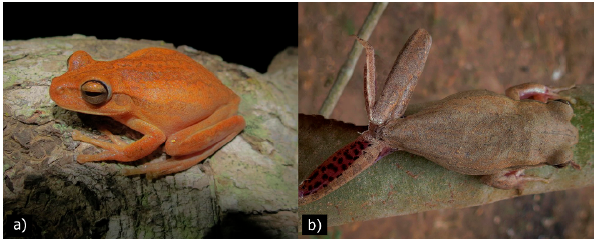
Boana caiapo is a nocturnal robust medium-sized treefrog (snout-vent length - SVL = 47.6 mm), found in open areas along with aquatic habitats and disturbed areas. In wildlife, this treefrog presents a dorsal color that varies from pale to caramel brown and some individuals have dorsal longitudinal stripes (Pinheiro et al., 2018). These species occur across the Tocantins River basin, in the states of Goiás, Mato Grosso, Pará, and Tocantins (Pinheiro et al., 2018; Silva et al., 2020). Herein, we provide a new record of Boana caiapo in Brazilian Cerrado (Neotropical Savana), updating its distribution (Fig. 1).
In August 2013, we found Boana caiapo males in vocalization activity, near a wetland, at Barra do Dia farm, Ribeirão Cascalheira municipality, Mato Grosso state (12°55'33'' N, and 51°49'48'' W; Fig. 2). The locality has the typical Cerrado vegetation comprising open areas and conserved fragments. We collected two individuals that are housed in the Laboratório de Herpetologia, da Universidade Federal do Rio Grande do Sul (acronym UFRGS 7086, 7124).
The specimens found occur sympatrically with Boana raniceps and B. geographica and are distinguished from these species by the presence of dark brown spots on the hind limbs (dark brown vertical bars in B. raniceps;Pinheiro et al., 2018) and the absence of a reticulated pattern on the palpebral membrane (present in B. geographica;Faivovich et al., 2005; Faivovich et al., 2006).
Boana caiapo is known to occur across the Tocantins River basin, in the states of Goiás, Mato Grosso, Pará, and Tocantins (Pinheiro et al., 2018; Silva et al., 2020), and here we extend its distribution in approximately 330 km Northwest from its type locality (Aragarças municipality, Goiás state) and 263 km Northwest from the nearest known locality (Cocalinho municipality, Mato Grosso state; Table 1). All localities belong to the Tocantins-Araguaia River basin, corroborating the endemism of the species to it. Studies related to the expansion of new records of species are important to reinforce conservation proposals, especially in fragments whose data on richness, abundance, and distribution are scarce (Diniz-Filho et al., 2007; Dantas et al., 2019). Our new record of B. caiapo at Municipality of Ribeirão Cascalheira, Mato Grosso state, can help better understand the geographical distribution of this species, updating the knowledge about its distribution, so as helping, and sustaining the conservation of these populations in Brazilian Cerrado (Neotropical Savana).
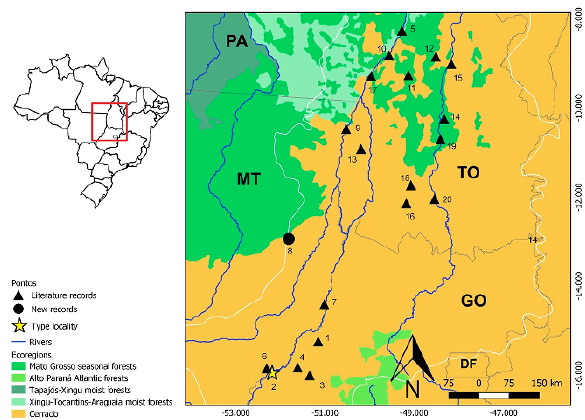
Figure 1 Geographic distribution of Boana caiapo throughout the Tocantins-Araguaia River Basin (delimited by a white line on the map). PA: Pará state; MT: Mato Grosso state; TO: Tocantins state; GO: Goiás state and DF: Federal District.
Table 1 Recorded localities for Boana caiapo. Datum of the coordinates: WGS 84.
| Points of the map | City | State | Coordinates | Distance (Km) from type-locality | Reference |
|---|---|---|---|---|---|
| 1 | Britania | GO | 15°14’29" N, and 51°9'41'' W | Pinheiro et al. (2018) | |
| 2 | Aragarças | GO | 15°53'39" N, and 51°49'23" W | Pinheiro et al. (2018) | |
| 3 | Montes Claros de Goias (Mina de níquel Votorantim) | GO | 16°01'53" N, and 51°21'11" W | Pinheiro et al. (2018) | |
| 4 | Montes Claros de Goias (Fazenda Carolina) | GO | 15°49'17" N, and 51°37'16"W | Pinheiro et al. (2018) | |
| 5 | Conceição do Araguaia | PA | 08°15'29'' N, and 49°16'11'' W | Pinheiro et al. (2018) | |
| 6 | Barra do Garças | MT | 15°53'24" N, and 52°15'24" W | Pinheiro et al. (2018) | |
| 7 | Cocalinho | MT | 14°23'50" N, and 50°59'45" W | Pinheiro et al., (2018) | |
| 8 | Ribeirão Cascalheira | MT | 12°55'33'' N, and 51°49'48'' W | 330 Km | This study |
| 9 | Santa Terezinha | MT | 10°27"39"" N, and 50°30"46"" W | Pinheiro et al. (2018) | |
| 10 | Araguacema | TO | 08°48"31"" N, and 49°33"28"" W | Pinheiro et al. (2018) | |
| 11 | Dois Irmãos | TO | 09°15'30" N, and 49°03'52" W | Pinheiro et al. (2018) | |
| 12 | Guaraí | TO | 08°50'03" N, and 48°30'37" W | Pinheiro et al. (2018) | |
| 13 | Lagoa da Confusão | TO | 10°47'37" N, and 49°37'25" W | Pinheiro et al. (2018) | |
| 14 | Palmas | TO | 10°12'46" N, and 48°21'37" W | Pinheiro et al. (2018) | |
| 15 | Pedro Afonso | TO | 08°58'03" N, and 48°10'29" W | Pinheiro et al. (2018) | |
| 16 | Figueirópolis | TO | 12°07'51" N, and 49°10'27" W | Silva et al. (2020) | |
| 17 | Caseara | TO | 09°16'42" N, and 49°57'20" W | Silva et al. (2020) | |
| 18 | Gurupi | TO | 11°28"11" N, and 48°47"19"W | Silva et al. (2020) |