


 English (pdf)
 Article in xml format
 Article references
 Automatic translation
 Send this article by e-mail
 Cited by SciELO
  Cited by Google
  Similars in
SciELO
Similars in
SciELO  Similars in Google
 Permalink

INTRODUCTION
Frogs are an important source of food for several vertebrates, and snakes have a prominent position as the most representative group among all anuran's predators (Toledo et al., 2007). The snakes from the tribe Tachymenini are known by their batracophagous eating habits, even though, other groups may be included on its diet (Bellini et al., 2013, 2014; Bernarde et al., 2003; Canhete et al., 2018). The Dryophylax chaquensis Bergna & Alvarez, 1993 occurs in Brazil, Paraguay, Argentina and Bolivia, it is distributed in Chaco, Pantanal and Cerrado (Nogueira et al., 2019). Data about its diet is resumed mainly by field observations and only anurans are known as its prey (Alves and Albuquerque, 2017; Bellini et al., 2014; Carrillo, 2017; Dias-Silva et al., 2021; Dorado-Rodrigues et al., 2012). Here we report a predation event by D. chaquensis on Elachistocleis matogrosso Caramaschi, 2010 and Boana raniceps (Cope, 1862).
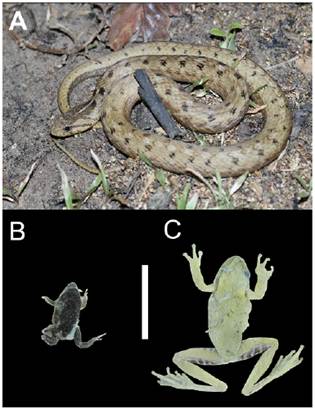
On 09th September 2021, around 19:00 h, at Base de Estudos do Pantanal (19° 34'36" S, 57° 01'09" W, 92 m elev.), in Corumbá municipality, Mato Grosso do Sul state, western Brazil, we collected an adult female of Dryophylax chaquensis actively foraging on the biomass of accumulated dead grass (ZUFMS-REP04311; snout-vent length [SVL] 341 mm, tail length 102 mm; Fig. 1a). The individual was captured and stored in a plastic bag. Around 22:00 h, when we returned to the lab, we noticed two regurgitated anurans in the same plastic bag of the snake, an adult of Elachistocleis matogrosso (ZUFMS-AMP14902; SVL 22,43 mm; Fig. 1b) and
an adult of Boana raniceps (ZUFMS-AMP14901; SVL 41,95 mm; Fig. 1c). Both species were abundant on that night, with more than 20 records of each during the fieldwork. The prey was in good condition with some parts already digested and some injuries. All species were collected and housed at Coleção Zoológica da Universidade Federal de Mato Grosso do Sul. During the three days of the expedition, we found seven individuals of D. chaquensis, six of them on the ground and one in a bush (ca. 80 cm height).
Bellini et al. (2014) suggested that D. chaquensis is a terrestrial species and its diet is based on terrestrial frogs. Our record corroborated, at least partially, with this data (Table 1). Elachistocleys matogrosso was abundant on that day and all of them were found in the leaf letter. There is already a record of D. chaquensis preying E. matogrosso (see Carrillo, 2017), nevertheless, microhylids are uncommon prey for snakes due to their fossorial habits and explosive breeders (Toledo et al., 2007). However, in situations where they are abundant, as we recorded during the field, they might become easy prey, since no defensive behavior, nor antipredator substances in their skin are recognized for this species (Mebs et al., 2010; Mira-Mendes et al., 2016). This is the first report of a Boana raniceps as prey of D. chaquensis. The hylid was also abundant that night, however, individuals were found on the trees, bushes, and on leaf litter in similar proportion. Dias-Silva et al. (2021)) recorded two events where D. chaquensis leave the ground to predate hylids, indicating that even the most part of the time it is terrestrial, usually it may climb to trees and bushes to forage, corroborating our observations. The predation on bushes is already registered for another species of Dryophylax, when Canhete et al (2018) recorded a Dryophylax hyphochonia (Cope, 1860) preying upon the treefrog Scinax fuscomarginatus (Lutz, 1925) on Cerrado area. These present records confirm the bathracophagy habit of D. chaquensis and highlight the opportunistic habit of preying on frogs that are more abundant now. Despite its preference for terrestrial prey (see Bellini et al., 2014), hylids and even microhylids are part of its diet. However, a diet study of D. chaquensis, checking prey availability, could better answer this question.
Table 1 List of prey records of Dryophylax chaquensis.
| Prey | Family | Reference |
|---|---|---|
| Unidentified Amphibia | - | Bellini et al., 2014 |
| Boana albupunctata | Hylidae | Dias-Silva et al., 2021 |
| Boana caiapo | Hylidae | Dias-Silva et al., 2021 |
| Boana Raniceps | Hylidae | This study |
| Leptodactylus chaquensis | Leptodactylidae | Dorado-Rodrigues et al., 2012 |
| Leptodactylus chaquensis | Leptodactylidae | Bellini et al., 2014 |
| Leptodactylus latrans | Leptodactylidae | Bellini et al., 2014 |
| Leptodactylus podicipinus | Leptodactylidae | Alves and Albuquerque, 2017 |
| Elachistocleys matogrosso | Microhylidae | Carrillo, 2017 |
| Elachistocleys matogrosso | Microhylidae | This study |