


 English (pdf)
 Article in xml format
 Article references
 Automatic translation
 Send this article by e-mail
 Cited by SciELO
  Cited by Google
  Similars in
SciELO
Similars in
SciELO  Similars in Google
 Permalink

Nudibranchs are mollusks in the class Gastropoda that include organisms without shells and that have secondary bilateral symmetry (Ruppert and Barnes, 1996). Most nudibranchs are benthic in their adult stage; however, organisms of the family Phylliroidae are pelagic throughout their life cycle and are part of the zooplankton (Hernández and de Vera, 2010). According to Hernández and de Vera (2010) and the records in the World Register of Marine Species (MolluscaBase, 2023) only three valid species are currently accepted in the family: Phylliroe bucephala Lamarck, 1816, P. lichtensteinii Eschscholtz, 1825, and Cephaloptyge trematoides (Chun, 1889).
Phylliroe bucephala is a holoplanktonic nudibranch known for its swimming capacity that result of its adaptation to a pelagic lifestyle, making wave movements from right to left (Goodheart and Wägéle, 2020). Moreover, P. bucephala is one of the few nudibranchs that exhibit bioluminescence (Goodheart and Wägéle, 2020; Santhanam, 2022). Phylliroe bucephala is also known for its important role in the pelagic food-web because it feeds on small planktonic cnidarians and salps, and because it parasitize the jellyfish Zanclea costata Gegenbaur, 1857 during its juvenile stage (Santhanam, 2022).
Although P. bucephala is widely distributed in tropical and subtropical waters of the Atlantic, Pacific, and Indian Oceans (van der Spoel et al., 2023), it has not been recorded in the Eastern Tropical Pacific (ETP) off Colombia. Here we report the first record of the species in the Pacific coast of Colombia and describe the main characteristics of the specimens collected. In addition, we describe the hydrographic conditions in the zone that could have enhanced the presence of the species.
Individuals of P. bucephala were collected in zooplankton samples in coastal waters off Nuquí and Pizarro (Choco), ETP off Colombia, during March-April 2022 (Fig. 1a, Table 1). The samples were collected at a total of 33 stations: 18 stations in Nuquí and 15 stations in Pizarro by performing two surface tows at each station using conical plankton nets provided with Hydrobios flow meters (net diameter: 71 cm, pore size: 200 μm and 500 μm). The zooplankton samples were preserved in 4% buffered formalin. Temperature and salinity profiles up to 70 m were taken simultaneously with a Castaway-CTD. In the laboratory, individuals of P. bucephala were sorted from the zooplankton samples and identified based on the descriptions by MacDonald (1856), Hernandez and de Vera (2010), and van der Spoel et al. (2023). Representative individuals were photographed at the Image Laboratory of the Biology Department of Universidad del Valle (Cali, Colombia). All specimens collected are deposited in the Mollusca Collection of Universidad del Valle (Cali, Colombia).
SYSTEMATICS
Phylum Mollusca Linnaeus, 1758
Class Gastropoda Cuvier, 1795
Subclass Heterobranchia Burmeister, 1837
Order Nudibranchia Cuvier, 1817
Family Phylliroidea Menke, 1830
Genus PhylliropePeron & Lesueur, 1810
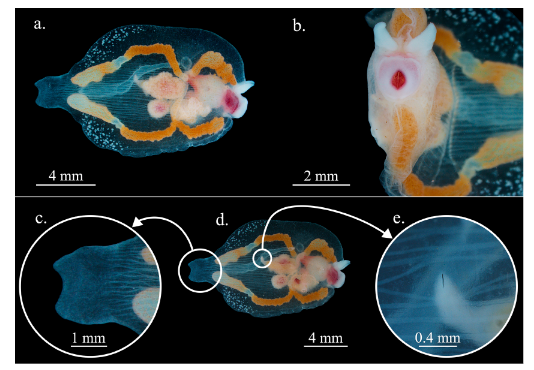
Phylliroe bucephala Lamarck, 1816 (Fig. 2)
Material examined: Pizarro, Choco, nearby the mouth of Baudo River (4°56'N,77°23'W); 27/03/2022; 2 specimens (Table 1) UNIVALLE:CRM-UV:2022-130; leg. Mauricio Jerez-Guerrero, Bellingen Valencia, Mariana Rondon, Sebastian Ortiz. Nuquí, Tribuga Gulf, Choco (5°50'N, 77°25'W); 30/03/2022-31/03/2022; 13 specimens (Table1) UNIVALLE:CRM-UV:2022-122 to UNIVALLE:CRM-UV:2022-129; leg. Mauricio Jerez-Guerrero, Bellingen Valencia, Mariana Rondon, Sebastian Ortiz.
Description: Body transparent, fish-shaped elongated, and compressed laterally (Fig. 2a). Head with two rhinophores and mouth in form of a short, truncated proboscis with a vertical opening (Fig. 2b). Bilobed square-shaped tail (Fig. 2c). Digestive glands (two anterior and two posterior) X-shaped (Fig. 2d). Stomach with a long intestine ending in the anus, the later located on the lateral right side of the body, towards the center (Fig. 2e).
Although zooplankton samples were also collected in Bahia Solano - Cabo Marzo (6°14'03"N,77°24'18"W) north of Nuquí, and during November-December 2021, January-February, June, July-August, September-October, and November-December 2022, individuals of P. bucephala were only found in Nuquí and Pizarro during March-April 2022. The presence of P. bucephala in the Colombian Pacific during March was likely favored by an increase in the availability of its prey (cnidarians), whose abundance in the Colombian Pacific tends to be higher when the temperature of the water column is lower (Baldrich-Chaparro & Lopez-Peralta, 2013). In the ETP, surface waters are characterized by warm temperatures (>25°C) and low salinities (<34) values that are particularly low in the Panama Bight due to the high precipitation levels (Fiedler and Lavin, 2017).
Table 1. Collecting sites and number of specimens of Phylliroe bucephala sampled in the Colombian Pacific.


Figure 1. a. Map of the Colombian Pacific showing the location where zooplankton samples were collected in Nuquí and Pizarro (Chocó). Symbols in red indicate the stations were individuals of Phylliroe bucephala were present. b. Vertical distribution of the temperature and salinity in Nuquí and Pizarro ETP off Colombia, during March-April 2022. Average values and 95% confidence interval were used.
Although the water column in the Panama Bight is usually stratified with a thermocline around 50 m the presence of the Panama wind Jet during the dry season (January-March) drives upwelling of subsurface waters, bringing colder, saltier, and nutrient-rich waters to shallower depths (D'Croz & O'Dea, 2007; Devis-Morales et al., 2008); Corredor-Acosta et al., 2020. During March-April 2022, surface temperatures in Nuquí ranged from 26.9 to 28.1°C and surface salinities ranged from 29.3 to 31.6 UPS, whereas surface temperatures in Pizarro ranged from 27.0 to 27.8°C and surface salinities ranged from 27.9 to 31.4 UPS (Fig. 1b). In the subsurface waters, upwelling was evident during this period at both localities, when temperatures lower than 22°C were recorded at 30 m (Fig. 1b). Because individuals of P. bucephala were only recorded during the sampling campaign carried out in March, likely the upwelling favored their presence in the coastal waters of the ETP off Colombia.
Phylliroe bucephala has a broad distribution in the Atlantic Ocean. It has been reported in Florida and Bermuda (Bergh, 1871 as P. atlantica; Abbot, 1974), as well as in the African Atlantic (Odhner, 1931; van der Spoel, 1970), particularly around the Canary Islands (Hernández and Jiménez, 1996; Hernández and de Vera, 2010). The most recent record of P. bucephala was of juveniles in the Syrian Mediterranean Sea (Durgham and Ikhtiyar, 2020). In the Eastern Pacific, this species has only been recorded in the Gulf of California (Mexico) by Fernández-Álamo (1997), Angulo-Campillo (2005), Angulo-Campillo et al. (2011). In the Colombian Pacific, the possible presence of the genus Phylliroe was reported by Kaiser and Bryce (2001) in Malpelo Island, but the authors did not confirm the identification of the species. Our study reports for the first time P. bucephala in the Colombian Pacific, expanding its distribution to the Eastern Tropical Pacific, approximately 4,000 km further south of the Gulf of California.