




 English (pdf)
 Article in xml format
 Article references
 Automatic translation
 Send this article by e-mail
 Cited by SciELO
  Cited by Google
  Similars in
SciELO
Similars in
SciELO  Similars in Google
 Permalink

INTRODUCTION
Members of the subfamily Aphodiinae Leach, 1815 (Scarabaeidae) are commonly known as small dung beetles due to their small body size when compared with its sister lineage, Scarabaeinae Scholtz and Grebennikov, 2016. However, the subfamily is relatively diverse within Scarabaeoidea, with around 3300 described species distributed worldwide Scholtz and Grebennikov, 2016; Stebnicka, 2001. Of the tribes in America, Eupariini Schmidt, 1910 is the second richest in species and genera after Aphodiini Leach, 1815 Minkina, 2020; Skelley, 2008; Stebnicka, 2009. About 28 genera and 333 species constitute Eupariini in the American continent, with members of the tribe having a wide variety of diets and behaviors Chalumeau and Howden, 1984; Deloya, 2012; Schnepp and Ashman, 2020; Skelley and Vaz-de-Mello, 2020; Stebnicka, 2007a, 2009.
This paper reports new country records of Eupariini genera and species for Colombia. In this country has been reported 72 species from 27 genera of Aphodiinae, of which 45 species from 11 genera belong to Eupariini Pardo-Locarno and Schoolmeesters, 2019; Clavijo-Bustos et al., 2021, 2024; Skelley and Keller, 2022; Skelley et al., 2022; Tovar et al., 2023; Minkina et al., 2024. However, the number of known species is lower than estimated, and it is expected that, with future sampling, the number of species will continue to increase.
MATERIALS AND METHODS
Examined specimens are housed in IAvH-E (Section of Entomology, Biological collections, Instituto de Investigación de Recursos Biológicos Alexander von Humboldt, Villa de Leyva, Boyacá, Colombia), and CECC-ALT (Colección de Escarabajos Coprófagos de Colombia- Alejandro Lopera Toro, Bogotá D.C., Colombia).
Photographs were taken with a Leica MC190 HD camera attached to a Leica S8-APO stereomicroscope, and then arranged into plates using Photoshop v.21.2.0. Maps were constructed on ArcMap 10.3, and geographic distributions were obtained from specimen's labels and literature Cartwright, 1967; Skelley and Howden, 2003; Stebnicka, 1999, 2009; Stebnicka and Skelley, 2005.
RESULTS
Euparioxides Hinton, 1936
Members of the genus are distinguished from other Eupariini by their elongate shape constricted at the middle (pronotal and elytral base); clypeus rounded on each side of median emargination and with the margin finely serrate; broad pronotum, with sides explanate and lateral edge finely serrate and sinuate; elytra infleed at intervals eight-nine, striae strongly punctured; meso- and metatibiae appearing to have a single large spur, but second spur reduced and held close to the large spur; and mesocoxae ventrally touching the elytra near base Stebnicka, 2009.
Currently, the genus comprises five species distributed in Central America and the northern part of South America, from Honduras to Peru, now including Colombia Stebnicka, 2009.
Euparioxides tachirensis Stebnicka and Skelley, 2005 (Figs. 1, 5)
Euparioxides tachirensis Stebnicka and Skelley, 2005: 26-27 (original combination)
New records. COLOMBIA. Cundinamarca, Medina, Vereda Miralindo, Quebrada La Ardita, sitio Alto del Río Gazauta, 4°35′N 73°25′W 1500 m., 1997.iii.01, F. Escobar (1 ♀: IAvH-E-213340); Norte de Santander, Parque Nacional Natural Tamá, Río Tachira sector Orocue, sitio Sendero El Arenal, 7°25′31″N 72°26′38″W, Malaisie, 1998.xi.06, A. Cortés (1 ♀: IAvH-E-213341), Santander, San Vicente de Chucurí, 6°52′5.452″N 73°23′41.884″W, En hojarasca, 2018.vii.03, D.F. Silva-Tavera (1 ♀: IAvH-E).
Diagnosis. Euparioxides tachirensis is characterized by its size (3.9 – 4.0 mm); body dorsally covered with long erect setae; lateral margins of pronotum nearly straight and complete, lacking a medial constriction; meso- and metatibiae with two apical spurs (outer one smaller) (Stebnicka and Skelley, 2005) ( Fig. 1a-1c).
Distributional and biological remarks. The species was previously known only from the holotype and paratype, both females and from almost the same locality at Táchira, Venezuela (Fig. 5a) ( Stebnicka and Skelley, 2005). With these new records, the distribution of the species is extended to Colombia with three new records (Fig. 5e).
All three specimens here reported are females; thus, the male remains undescribed. One specimen was collected with a Malaise trap, and the other manually on forest litter, similar to the holotype and paratype (Stebnicka and Skelley, 2005).
Iarupea Martínez, 1953
Members of this genus are distinguished from other Eupariini by their elongate form; head with longitudinal wrinkles; pronotum distinctly explanate laterally and with lateral margins sinuate with dense fringe of short scale-like setae, the pronotal base with a wide marginal groove; and elytral base with the fifth interval prominent and the fifth striae grooved (Stebnicka, 2009).
Currently, the genus comprises five species distributed in South America, from Colombia to Argentina (Stebnicka, 2009).
Iarupea nigricans (Westwood, 1847) (Figs. 2, 5)
Euparia nigricans Westwood, 1847: 240 (original combination) Euparia attenuata Harold, 1870: 2328 (synonym)
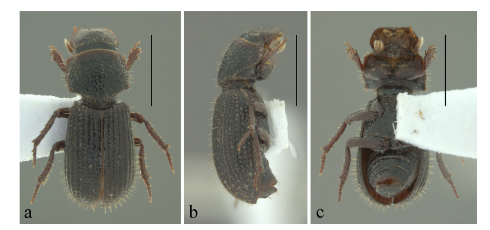
Figure 1. Euparioxides tachirensis Stebnicka and Skelley, 2005, specimen from Colombia. a) Dorsal view, b) Lateral view, c) Ventral view. Scale bars: 1 mm.
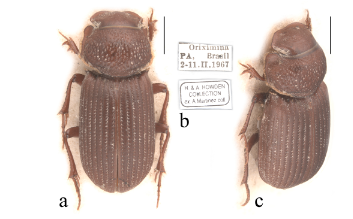
Figure 2. Iarupea nigricans (Westwood, 1847), specimen from Brazil. a) Dorsal view, b) Labels, c) Oblique view. Scale bars: 1 mm. Photos by A. B. T. Smith (Canadian Museum of Nature).
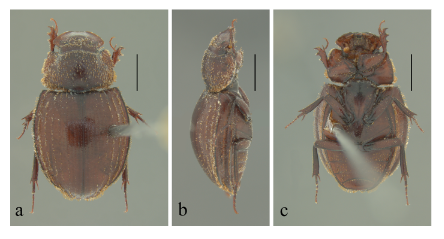
Figure 3. Lomanoxia canthonopsis Skelley and Howden, 2003, specimen from Colombia. a) Dorsal view, b) Lateral view, c) Ventral view. Scale bars: 1 mm.
New records. COLOMBIA. Meta, Puerto Gaitán, El Oasis, 3.784671°N 71.640298°W, 215 m, Colecta manual atraído a luz, 16/XI/2020, A. Lopera (1 Indet.: CECC-ALT).
Diagnosis. Iarupea nigricans is characterized by its size (4.8-5.0 mm); pronotum with coarse, irregular pits or punctures separated by less than one to three time its diameter, basal collar longitudinally strigose, each side of marginal groove convex and without prominent tubercle; elytra intervals five and seven carinate basally, lateral intervals unpunctate, striae with punctures creating the inner margins of the intervals; disc of pygidium eroded and longitudinally strigose; basal metatarsomere longer than upper tibial spur and the following three tarsomeres combined (Stebnicka, 2007b, 2009) ( Figs. 2a-2b).
Distributional and biological remarks. Iarupea nigricans was known from Guyana, Surinam, and Brazil (Fig. 5b) ( Stebnicka, 2009), but its distribution is now extended to Colombia with the new record presented here (Fig. 5e).
This species has been recorded in nests of Atta sexdens (Linnaeus, 1758) and light traps (Stebnicka, 2007b, 2009). We report the same latter collecting method.
Lomanoxia Martínez, 1951
Members of the genus are distinguished from other Eupariini by their elongate oval to strongly oval form; clypeus with margin smooth and rounded on each side of median emargination; pronotum with sides explanate anteriorly, lateral edges with fringe of setae; elytra laterally inflexed over the interval eight; mesocoxae ventrally touching the elytra near the base; and meso- and metatibia with two apical spurs (Stebnicka, 2009).
Currently, the genus comprises seven species distributed from Central America (only in Costa Rica) to Argentina in South America (Stebnicka, 2009).
Lomanoxia canthonopsis Skelley and Howden, 2003 (Figs. 3, 5)
Lomanoxia canthonopsis Skelley and Howden, 2003: 186-189 (original combination)
New records. COLOMBIA. Meta, Cubarral, Finca La Rosania, 03°49′46.56″N 73°49′59.21″W 620m Luz en Establo, IV/2018, A. Lopera, W. Chamorro (1 Indet.: CECC-ALT).
Diagnosis. Lomanoxia canthonopsis is characterized by its size (4.3-5.0 mm); pronotum smooth; elytra covered with hair-like setae, all elytra intervals with rows of setae dense and almost contiguous (the distance between bases less than setal length); and only abdominal ventrite five with longitudinal costulae (Skelley and Howden, 2003) ( Figs. 3a-3c).
Distributional remarks. Lomanoxia canthonopsis was described from Costa Rica, however, specimens from Trinidad and Bolivia were considered as this species (Fig. 5c), but have subtle differences (Skelley and Howden, 2003; Stebnicka, 2009). It is reported for the first time in Colombia (Fig. 5e) based on one specimen, more similar to those from Trinidad, having a greatly reduced humeral denticles on the elytra.
Lomanoxia costulata (Harold, 1867) (Figs. 4, 5)
Euparia costulata Harold, 1867: 82 (original combination)
New records. COLOMBIA. Meta, Cubarral, Finca La Rosania, 03°49′46.56″N 73°49′59.21″W 620m Luz en Establo, IV/2018, A. Lopera, W. Chamorro (3 Indet.: CECC-ALT).
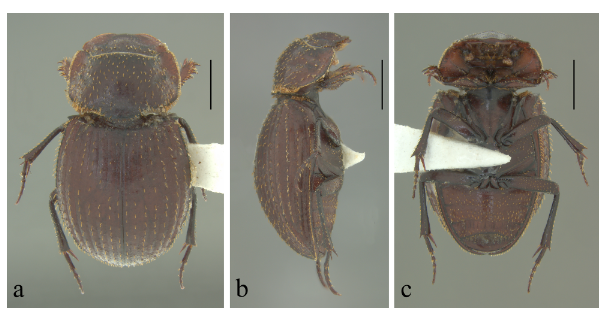
Figure 4. Lomanoxia costulata (Harold, 1867), specimen from Colombia. a) Dorsal view, b) Lateral view, c) Ventral view. Scale bars: 1 mm.
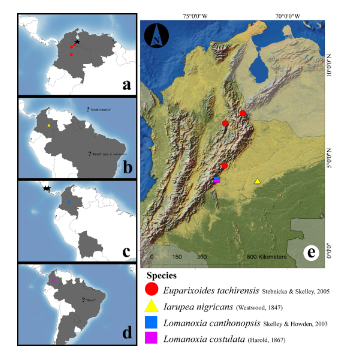
Figure 5. New records for Colombia and countries presence: a) Euparioxides tachirensis Stebnicka and Skelley, 2005, b) Iarupea nigricans (Westwood, 1847), c) Lomanoxia canthonopsis Skelley and Howden, 2003, d) Lomanoxia costulata (Harold, 1867). e) Distribution in Colombia of new country records; Black stars (★) denote accurate type localities, Question marks (?) denote wide-range type localities.
Diagnosis. Lomanoxia costulata is characterized by its size (4.5-5.0 mm); pronotum smooth, base of pronotum lobed at middle and sides continuously rounded, pronotal margins with unequal setae in size, the longest setae located over arcuate posterior angle; elytra covered with hair-like setae, all elytral intervals slightly tectiform with a median row of small granules, each bearing a short recurvate setae, and sparse and widely placed (the distance between bases greater than setal length); abdominal ventrites four-five with longitudinal costae (Stebnicka, 1999; Skelley and Howden, 2003) ( Figs. 4a-4c).
Distributional remarks. Lomanoxia costulata was known until now from Surinam, Brazil, Paraguay, Argentina (Fig. 5d) ( Stebnicka, 1999, 2009), and the new record from Colombia represents the northernmost locality where it has been reported (Fig. 5e).
DISCUSSION
The new country records increase the number of genera and species of Aphodiinae for Colombia from 27 and 72, up to 30 and 76, respectively. In this way, supporting the fact that Eupariini is the most diverse tribe of Colombian Aphodiinae (75 % of species and 47 % of genera).
The richness of Aphodiinae in Neotropical countries will probably increase as sampling efforts increase. Publications of the last years, including new country records for Colombia, distributional extensions of Neotropical species, and description of new taxa from Neotropical region (e.g., Arias Buriticá and Vaz-de-Mello, 2016; Skelley and Vaz-de-Mello, 2020; Clavijo-Bustos et al., 2021, 2024; Skelley et al., 2022; Skelley and Keller, 2022; Minkina et al., 2024), support the importance of maintaining the study of the tribe and subfamily, to learn their true richness and diversity.

