




 English (pdf)
 Article in xml format
 Article references
 Automatic translation
 Send this article by e-mail
 Cited by SciELO
  Cited by Google
  Similars in
SciELO
Similars in
SciELO  Similars in Google
 Permalink

INTRODUCTION
The littoral zones of freshwater aquatic ecosystems are key habitats for biodiversity Domozych y Domozych, 2008. These habitats host benthic-attached microbial communities and typhoplanktonic communities, which together contribute to primary productivity, substratum stability, and aquatic biodiversity. Desmids are loosely associated with macrophytes of the littoral zone and the bottom sediment and are indicative of oligotrophic and poorly mineralized environmental conditions Gonzalez et al., 2019. In these environments, desmids may respond to environmental stresses and disturbances and then contribute to the community's resilience Lyons, 2001.
The great majority of desmids taxa are of incomparable beauty and have wide geographic distributions, especially in tropical and subtropical areas. They inhabit almost exclusively freshwater aquatic environments and are characteristic of oligotrophic aquatic bodies that are well-oxygenated, of optimal ecological conditions, and with a slightly acidic pH, which makes these organisms excellent ecological indicators of water quality Coesel, 1996. Desmids do not contribute substantially to the phytoplankton diversity Coesel, 1982 but are associated with aquatic plants and lake sediments Pals et al., 2016 and represent a diverse and abundant component especially in ombro trophic peatlands Neustupa et al., 2012.
Several studies already show that Colombia, together with Brazil, is a hot spot for desmids diversity. More than 500 species have been registered and described for the country West y West, 1896; West, 1914; Taylor, 1935; Coesel et al., 1986; Coesel, 1987; Coesel et al., 1988; Coesel, 1992; Coesel, 1997. Although high mountain lakes have a particular richness and diversity of desmids species Taylor, 1935; Donato et al., 1987; Gonzalez y Mora-Osejo, 1996, the aquatic ecosystems of the Orinoquia and Amazonia contain uncommon, and interesting species Duque y Donato, 1993; 1995a; 1995b; 1996a; 1996b; Coesel, 1992; NunezAvellaneda y Duque, 2000.
The aquatic ecosystems located in the tropical savannas of the Colombian Orinoquia are characterized by a high diversity of algae, particularly desmids and diatoms. Neotropical savannas conform to an ecological-physiognomic type of natural ecosystem that is found exclusively in warm and humid tropical areas (the low-altitude wet tropics) Sarmiento, 1984. They occupy approximately 20% of the earth's surface and 45% corresponds to those located in South America Sarmiento, 1984.
The savannas are mainly located in Brazil, Venezuela, and Colombia, and dominate the landscape in the plains that surround the Orinoco River, the so-called llanos (eastern plains). The eastern plains between Colombia and Venezuela cover a surface of approximately half a million square kilometers, constituting the largest uninterrupted surface of neotropical savanna north of the Equator Sarmiento y Pinillos, 2001.
Within this complex of the middle basin of the Orinoco River, two types of aquatic ecosystems can be differentiated: i) lakes or lagoons located in the alluvial plains, known as overflow lagoons or floodplains; they are of a temporary nature and are completely dependent on the contribution direct from the main riverbed Correa et al., 2005; and ii) wetlands located in the alluvial terraces that are fed either by rains (seasonal) or by some streams and aquifers Correa et al., 2005. These wetlands are permanent elements in the Orinoco landscape. Among them, we find estuaries, morichales (Mauritia flexuosa), lakes, or small artificial reservoirs.
The littoral zones of these lakes contain a vast diversity of microorganisms associated with aquatic plants and are the habitats that mainly contribute to the richness, diversity, and productivity of oligotrophic systems Frankovich et al., 2006. Several hypotheses explain the growth of epiphytic communities and the supporting role of aquatic plants in aquatic environments. The neutral substrate hypothesis Blindow, 1987 postulates that the epiphytic structures do not interact biologically or chemically with the host aquatic plant. However, Carignan y Kalff, 1982, Mutinova et al., 2016, and Eminson y Moss 1980, highlight that macrophytes may transfer inorganic nutrients to epiphytic algae. In contrast, aquatic plants may also hurt epiphytic communities through the production of allelopathic substances or by facilitating the action of predators Hilt, 2006.
Identification of species is extremely important to properly define the structure and dynamics of biological communities Santos et al., 2018. The current research aimed to describe and report poorly common species of desmids, the majority of exclusive tropical distribution, found in a lowland lake located in the tropical savanna of the Colombian Orinoquia. I suggest that expanding the current knowledge of these taxa contributes to the identification of areas for the protection of biodiversity and the conservation of reference ecosystems.
MATERIALS AND METHODS
Study Area
The eastern tropical savanna plains of Colombia are characterized by three landscape units: foothills of the Eastern Cordillera, flood plains, and high plains. The llanos orientales of Colombia correspond to the low relief region located east of the foot of the eastern mountain range and comprise approximately 53% of the area of Colombia. Its formation began in the Andean orogeny IGAC, 1991.
This study was performed in the Carimagua Lake (Department of Meta) which lies in the llanos orientales and is located 4°34'36.3"N 71°20'18.9"W at an altitude of 172 m a.s.l. It is surrounded by open savanna vegetation and only a few patches of Mauritia - a dominating palm forest reaching to the shore.
Carimagua Lake Characteristics
Carimagua Lake consists of about 480 ha and its name comes from a community of Indigenous Guahiba and signifies "source of water". It is a tropical freshwater lake with high transparency, oligotrophic, and a littoral zone that borders the lake with aquatic plants such as Utricularia, Eleocharis, Cabomba, Nymphaea, Limnobium, Eichornia, Eriocaulon, Mayaca, Cyperus, among other.
The climate is characterized by a monomodal regime with a dry period from November to March and a rainy season from April to November. According to the Koppen-Geiger classification Aw type or savanna climate predominates: a slightly rainy and humid tropical climate. Based on the records of the Carimagua Research Station the local mean annual precipitation is 1860 mm. The mean annual temperature is 26-27°C with less than 3°C variation between monthly means Berrio et al., 2000.
The predominant vegetation is savanna (85%) and forest (15%). In the savannas Paspalum sp., Andropogon sp., Panicum sp., Axonopus sp., are the predominant grasses; while the shrubs Curatella americana, Byrsonia crassifolia and Palicorea rigida are present.
The soils are iron-based armor formations (Latosolis). The soils have moderately high organic matter and very poor drainage capacity Goosen, 1971. The predominant plintite stones are characterized by having iron in the oxidized state.
Fieldwork
An intensive sampling was performed during the dry season (March). Data on the physical and chemical characteristics of the water and on the sediments, and communities were collected. A total of 12 samples were obtained from the littoral zone and limnetic zone of the lake.
Samples of aquatic plants (Utricularia, Cabomba, Nymphaea, Limnobium, Eichornnia, Mayaca), allowing the development of rich varied tychoplankton assemblages were collected separately for study in the desmid's community. Samples from the limnetic zone were obtained with a 26μm plankton mesh. Samples after squeezing and planktonic were preserved in Transeau solution (1:1).
Water samples were collected in the field in triplicate (open water and littoral zone) for immediate measurement of pH, conductivity, temperature, alkalinity, and dissolved oxygen. A Hach Seinson 176 probe was used in the field. The concentrations NO3 - and NO2 - were determined separately, following standard APHA (1998) methods. Soluble reactive phosphorus (SRP) was measured in GF/F filtered samples, using the molybdenum-blue method (details also in APHA, 1998).
Laboratory Work
Regional keys were used for taxonomic identification, such as Förster (1964, 1969, 1974), Teiling (1967), Prescott (1966), Prescott et al., (1975, 1977, 1982), Coesel y Meesters (2007). The validity of the taxa was verified using Algae base Guiry and Guiry, 2018.
Scanning electron microscopy (SEM) observations were performed on samples placed on acetone-washed glass coverslips (10 or 12mm in diameter), then they were dried using a poly-L-Lysine solution. After fixation, it was transferred to an acetone series. Finally, the cells were dried to a critical-point with liquid CO2, and subsequently sputter-coated with gold and examined using a Transmission Electron Microscope ZEISS EM910.
RESULTS
General Characteristics of the Lake
Carimagua is a shallow lake (139 cm) of high temperatures (30.1°C) very low conductivity (≥5.9≤8.61μS cm-1) acidic pH (≥4.67≤5.41 [H+]) alkalinity (≥12.0≤15.0 mg L-1), relatively high concentrations of dissolved oxygen (≥6.72≤7.57 mg L-1), percentage of oxygen (≥95.5≤104.6 mg L-1) and low nutrient content, especially PRS (≥0.09≤0.12 mg L-1) NO3 - (≥0.12≤0.15 mg L-1) and NO2 - (≥0.08≤0.03 mg L-1).
Algal Flora
The dominant algal group was Diatoms, followed by Cyanobacteria and Desmidiaceae family. The most abundant genera of diatoms were Navicula, Gomphonema, Tabellaria, Frustulia, and Pinnularia. The most common Cyanobacteria were Anabaena and Aphanocapsa. The dominant Desmidiaceae genera were Staurastrum sp and Cosmarium sp.
Identification and Description of Desmids Taxa
We taxonomically identified 24 species of taxa belonging to 14 genera and 2 families. The majority of the species were part of the genera, Pseudomicratersis (1), Micratersis (5), Staurastrum (3), Cosmarium (2), Eustrum (2), and Closterium (1) while the other genera are 10 of the total amounts of the species.
Bambusina borreri (Ralfs) Cleve 1864
Articulated filiform filament. Cell longer (78-90 μm) than wide (32-38 μm). Semi-barrel-shaped cells (amphora) are slightly wavy in the middle part and thickened in the apical part with a truncated termination. Cell wall with signs of longitudinal striae and with remains of mucilage. Isthmus (18-20 μm) slightly domed. Strongly welded junctions between cells, as wide as they are long. According to Coesel y Meesters (2007) cell wall, particularly in the apical part of the semicell, delicately striata (rows of pores).
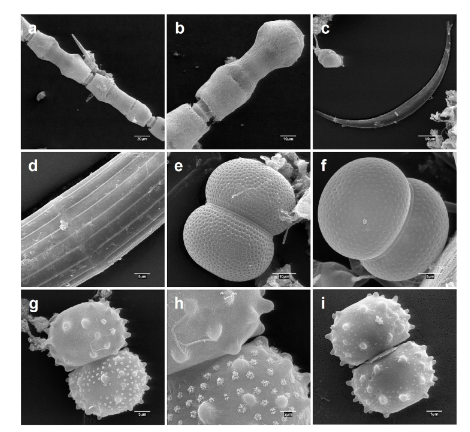
Figure 1. a-b. Bambusina borreri. a. Detail filament. b. View of the semicells junctions. c-d. Closterium porrectum. c. General detail. d. Stri a or ribs and the isthmus. e-f. Cosmarum conatum. e. Rounded apex of the semicell. f. Detail of the ornamentation of the cell wall and the isthmus. g-h-i. Cosmarum polymorphum. g. General view. h-i. Detail of the bumps and pores in the wall of the semi-cells.
Closterium porrectum Nordstedt 1870
Strongly curved (lunate) cell of medium size, cell longer than wide. Semi-cells with visible streaks or ribs (up to 8 in the frontal view) that reach the isthmus. Slightly rounded apices. L: 360-370 μm; W: 26-30 μm.
Cosmarum conatum Brébisson ex Ralfs 1848
Large cells, longer (45-50 μm) than wide (35-40 μm). Elliptical semicells and rounded apex. Cell wall perforated by pores without ornamentation but arranged radially and symmetrically. Isthmus (30-32 μm) closed by a circular structure.
Cosmarum polymorphum Nordstedt 1870
Cells longer (30-35 μm) than wide (24-26 μm). Semicells truncated at the polar apex and at the base with limits of the isthmus. Wall perforated by finely ornamented pores and numerous protrusions (more than 10 per half-cell). Isthmus (10-12 μm), narrow and open to the outside.
Docidium undulatum var. dilatatum (Cleve) West y G.S. West 1904
Cylindrical cells longer (250-300 μm) than wide (10-14 μm); semi-cells with 7-8 undulations along each margin; apices dilated, truncated, with rounded angles. Junction at the base of the isthmus showing a very prominent ring of 9 to 10 folds. Smooth cell wall. First report for Colombia.
Cosmarum crenatum Ralfs ex Ralfs 1841
Medium-sized cell, longer than wide. Sinus closed, open at the end. Lobed semicells. Lower lateral lobes rounded by a flat cleft. Truncated apex with a narrow central incision. Truncated polar lobes with rounded angles. The bumps are sculpted by pores. L: 65-70 μm. W: 25-30 μm. I: 9-11 μm.
Eustrum evolutum (Nordstedt) West y G.S.West 1896
Medium-sized cell, longer than wide. Narrow sinus, dilated to the outside. The trapezoidal. Basal corners with spines. Spiny upper and lower lateral lobes, by a separate incision and with evident and deep holes. Protruding apex, truncated, with deep central incision. Polar lobes with long terminal spine and short spines. On the sides of the polar lobes there are 2 spiny appendages. Structure in the middle part magnified and triangular with 3 protrusions, one of them the prominent central one above 2 central pores separated by another protrusion that supports the base. L: 48-50 μm. Width: 32-35 mm. I: 10-12 μm.
Hyalotheca dissiliens Brébisson ex Ralfs 1848
Cylindrical cells, longer than wide, with a cleft between the half cells that converges in a wide and evident constriction. Medium breast. Long cylindrical filaments with more than 10 cells. Mucilaginous sheath remains present. L: 25-28 μm. W: 20-22 μm. I: 14-16 μm.
Mateola curvata (Nordstedt) Coesel 1997
Quadrangular cells with 4 vigorous projections ending in a simple spine. Cells wider (including spines) than long. Tubules that firmly bind longer than wide filaments. Twisted filaments between 12 to 15 cells. Profuse mucilaginous sheath. L: 23-25 μm. W: 20-23 μm.
Pseudomicrasterias arcuata (Bailey) C.B. Araujo, C.E.M. Bicudo, Stastny y Skaloud 2022
Quadrangular cells. Smooth cell wall. Isthmus closed and prominent open to the outside. Semi-cells with slender and elongated basal and polar lobes. The basal ones have an ascending curve that brings their tips closer to the tips of the polar lobes. Pantropical distribution. L: 60-80 μm. W: 60-90 μm. I: 10-12 μm. First report for Colombia.
Micrasterias arcuata var. gracilis West y G.S.West 1896
Cells symmetrically arranged, wider than long. Basal lobes longer and so thin than the polar ones. Basal lobes, parallel to the polar lobe, exceed it in length. L: 60-80 μm. W: 80-100 μm. I: 10-12 μm.
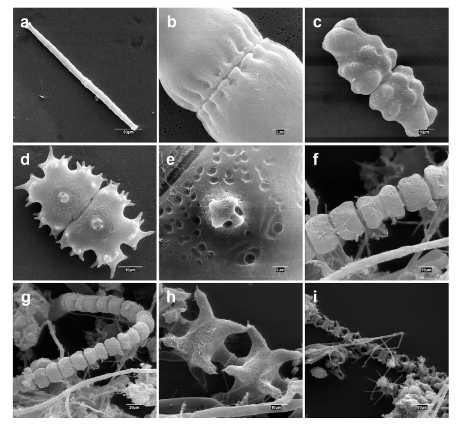
Figure 2. a-b. Dodicium undulatum var. dilatatum. a. General view. b. Detail of the folds. c. Cosmarium crenatum. c. Lateral view. The protrusions located on the wall of the semicells are evident. d-e. Eustrum evolutum. d. Front view. e. detail of the triangular structure with the protrusions and pores. f-g. Hyalotheca dissiliens. f. Details of semi-cells. g. filament. h-i. Mateola curvata. h. Detail of the cells. i. General view of the filament.
Micrasterias arcuata var. robusta O. Borge 1899
Ends of the basal lobes and the polar lobes directed upwards sharply, the pointed polar cuneate lobes. L: 55-60 μm. W: 40-42 μm. I: 7-8 μm. First report for Colombia.
Micrasterias borgei var. aequalis Willi Krieger 1939
Flat cell, longer than wide. Hemisoma with 5 lobes. Deep sinus. Prominent polar lobe, both in it and in the basal lobes with robust spines arranged laterally, symmetrically and directed upwards. Forked lobes ending in sharp forked tips. Ornate cell wall. L: 140-160 μm. W: 130-140 μm. I: 20-25 μm. First report for Colombia.
Micrasterias radiata var. gracillima G.M. Smith 1922
Cells with a globose shape, especially at the border with the isthmus. Smooth cell wall. Semi-cells bulging at the limit of the isthmus. Isthmus closed but expanded outward. The basal lobes of the semicells thin, symmetrically tapered and forked. Slightly convergent polar lobe. L: 160 (with lobules); 66.2 (no lobules) μm W: 103.3 (with lobules); 43.1 (no lobules) μm. I: 30 μm. First report for Colombia.
Micrasterias torreyi var. curvata Willi Krieger 1939
Relatively large cells with a highly constricted linear isthmus then open outward. Semicircular cells with five lobes; the basal lobe divided into two lobes; the cuneate polar lobe. Lobes bifurcated, with a lateral spine shorter than the prominent one. L: 210-220 μm. W: 220-226 μm. I: 35-38 μm. Exclusive South American or tropical distribution. First report for Colombia.
Pleurotaenium constrictum var. laeve Irene-Marie 1954
Slightly curved cylindrical cells, longer than wide, with an inflated base and ornamented by a membrane that protrudes from the base. Semi cells with dotted ornamentation, wavy wall; apex with 2 tubercles, one at each angle. L: 310-320 μm. W: 25-30 μm. I: 20-22 μm. Exclusive South American or tropical distribution. First report for Colombia.
Spondylosum pulchrum (Bailey) W. Archer 1861
Cells flattened; apices truncated. Open isthmus. Well-marked breast. Cells united by the apposition of the apices in filaments. Medium deep constriction. Tubes connecting prominent filament cells as long as wide. First report for Colombia. L: 35-38 μm. W: 45-48. I: 15-16 μm.
Staurodesmus calyxoides (Wolle) Croasdale 1957
Cells longer (40-43 μm) than wide (26-30 μm) (not including spines). Isthmus 18-20 μm. Semi-cells with 6 long spines (hexaradial symmetry) and robust in various directions. Ventral margin of the half-cells domed or slightly curved. Uniformly dotted cell wall. Isthmus completely closed. Exclusive South American or tropical distribution.
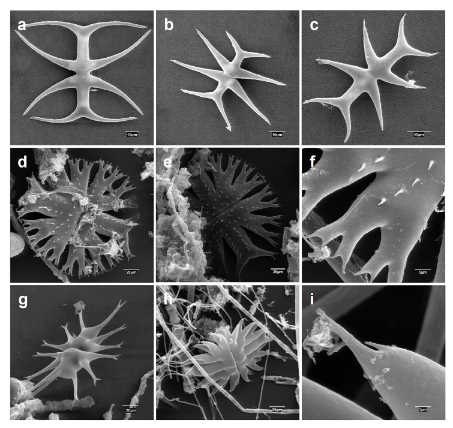
Figure 3. a. Pseudomicrasterias arcuata. a. Front view. Note the ascending direction of the basal lobes. b. Micrasterias arcuata var. gracilis. b. Cellsymetricallyarranged. c. Micrasterias arcuata var. robusta. c. Polarand basal lobes directed upwards. d-e-f. Micrasterias borgei var. aequalis. d. Front view. e. Detail of the arrangement of the spines. f. bifurcated lateral lobe. g-h-i. Micrasterias radiata var. gracillima. g. Smooth cell wall. h-i. Micrasterias torreyi var. curvata. h. General view. i. Lateral spine on the lamina of the lobe.
Staurodesmus wandae var. longissimus (Borge) Teiling 1966
Cells longer (76-78 μm not including spines; 96-98 μm with spines) than wide (50-60 μm with spines). Symmetrically dotted cuneate semicells. Isthmus broad (15-16 μm), and open. Simple and smooth pores without ornamentation. Slightly curved spines emerge at the angles on bumps. Length of cells including spines, width of cells including spines. Exclusive South American or tropical distribution. First report for Colombia.
Staurastrum leptacanthum var. borgei Kurt Forster 1969
Longer than wide triangular cell (without processes). The circular apical view. Long processes forming a medium ring with numerous processes (nine). Processes with two spines (bifurcated) at the top. L: 45-50 μm without processes. W: 35-40 μm. I: 20-23 μm. Wide geographical distribution.
Staurastrum radians West y G.S.West 1898
Cells almost twice as wide as long and with processes. Smooth cell wall. Semicells with eight arms (processes) arranged symmetrically and radially. Tridentate processes at the apex highly ornamented with spines and other protrusions. Isthmus closed slightly open outwards. L: 34-35 μm. W: 82-84. I: 16-18.
Staurastrum subindentatum var. brasiliense Borge 1918
Cells longer (100-110 μm including processes) than wide (32-35 μm). Cell wall with smooth, finely distributed pores. In each semicell, a pair of long denticulate and arcuate processes arise that end in two spines. A pair of bumps on the lamina of each half-cell. In the upper straight plane of the semicell two spines at the ends. Narrow sinus with dilations at the end. Diffuse gelatinous sheath. Isthmus 8-10 μm. Exclusive South American or tropical distribution. There is only one report for Brazil. First report for Colombia.
Triploceras gracile Bailey 1851
Cells longer (38-40 μm) than wide (2.5-3.5 μm). Semi-cells that taper towards the apex and end in three smooth spines of equal size. Smooth cell wall. Dispersed mucilaginous sheath.
Xanthidium regulare Nordstedt 1870
Cells longer (100-110 μm with process) than wide (60-65 μm with process). Hexagonal elliptical semicells (front view) with simple spines at each angle which is projected. In the equatorial plane and in the center of the semicell it is ornamented (dotted) and a spine starts in line from the same axis. Deep median constriction. Isthmus closed. Exclusive South American or tropical distribution.
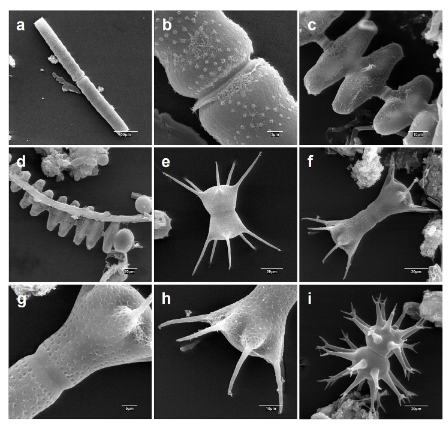
Figure 4. a-b Pleurotaenium constrictum var. leave. a. General view. b. Detail of the isthmus and ornate pits in the lamina of the semicells. c-d. Spondylosium pulchrum. c. Cells flattened. d. Filaments with mucilaginous sheath remainder. e. Staurodesmus calyxoides. e. View of hexarradial symmetry. f-g-h. Staurodesmus wandae var. longissimus. f. Front view. g. detail of the isthmus. h. Arrangement of the spines in the basal part of the semicell. i. Staurastrum leptacanthum var. borgei. i. Processes with two spines.
DISCUSSION
The Carimagua lake, hydrologically isolated, oligotrophic, and located in the tropical savanna of the Colombian Orinoquia, is habitat of many of them (Dodicium undulatum var. dilatatum; Euastrum evolutum; Mateola curvata, Micraterias arcuata var. robusta and Micrasterias arcuata var. gracilis) and interesting as Micrasterias torreyi var. curvata, Pleurotaenium constrictum var. laeve, Staurodesmus wandae var. longissimus, Pseudomicrasterias arcuate, Staurodesmus calyxoides and Staurastrum subindentatum var. brasiliense.
Carimagua lake offers the perfect location for the development of Zygnematophyceae species. High temperatures, oligotrophy, moderate size, and shallow depth facilitate the development of the littoral zone that functions as a patch of high species richness Scheffer et al., 2006. It is remarkable that this relatively small, shallow, and isolated tropical lakes develop abundant macrophyte vegetation, with the increase in the number of associated species, particularly desmids.
The richness and coexistence desmid species are striking; many of them are ticoplanktonic. These species, despite their low abundance, contribute to maintaining the properties (interactions) and functioning of the ecosystem and provide a buffer against environmental disturbances, increasing the resilience of the ecosystem Walker et al., 1999. Likewise, these rare species are indicators of habitats with a limited supply of nutrients, low conductivity, and acidic pH Coesel, 1982.
Finally, to counteract the threats to aquatic biodiversity, especially rare species and bioindicators, the management and handling strategies of oligotrophic lakes of moderate size, shallow and with aquatic vegetation must be prioritized. In conclusion, this dataset of floristic record including several relatively little know desmid taxa (Mateola curvata, Euastrum evolutum, Micrasterias borgei var. aequalis, Micrasterias radiata var. gracilima. G.M. Smith; Staurodesmus calyxoides, Std. wandae var. longissimus, Pseudomicrasterias arcuata) with widely distributed species (e.g. Bambusina borreri, Cosmarium conatum, Hyalotheca dissiliens, Xanthidium regulare).
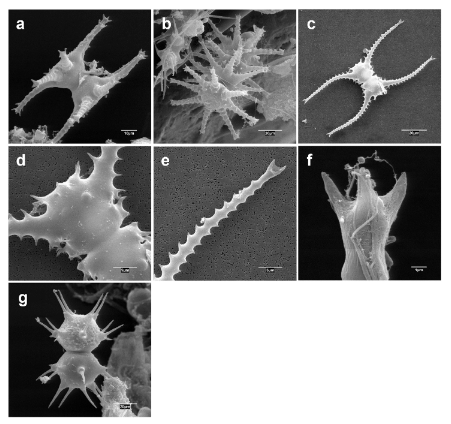
Figure 5. a-b. Staurastrum radians. a. Semicells. b. Symmetrical arrangement of the ornate arms of each half cell. c-d. Staurastrum subindentatum var. brasiliense. c. Layout of the general plan. d. Detail of the spines and protrusions in the half-cell. e-f. Triploceras gracile. e. General view of the semicell. f. Detail of the apex showing the spines. g Xanthidium regulare. g. Hexagonal elliptical semicells (front view).
These species were recorded with low abundances and can be considered locally rare species and can be used as conservation indicators Gonzalez et al., 2019 of the oligotrophic and threatened lakes of the Colombian Orinoquía.
CONCLUSIONS
The study in Lake Carimagua, in the Eastern Plains of Colombia, has revealed a remarkable diversity of desmids, with the registration of 24 taxa, of which 10 are unprecedented reports for the country. These species, indicators of oligotrophic conditions and high-water quality, underline these aquatic ecosystems' ecological importance and fragility in the region. The richness and coexistence of desmids in the lake and the presence of varied aquatic vegetation demonstrate the potential of these habitats to sustain a unique and significant biodiversity. Furthermore, the identification of these species contributes to a deeper understanding of the biodiversity of tropical savannas and reinforces the need for adequate conservation measures to protect these vulnerable ecosystems. The information obtained is crucial for future research and for the formulation of sustainable management strategies that seek to conserve the biological wealth of the Orinoquía. The study highlights the relevance of desmids as bioindicators and their role in assessing the health of aquatic ecosystems, which is vital for the conservation and management of biodiversity in this region.

