




 English (pdf)
 Article in xml format
 Article references

 Automatic translation
 Send this article by e-mail
 Cited by SciELO
 Cited by Google
 Similars in
SciELO
 Similars in Google

 Permalink


INTRODUCTION
Currently, humanization in healthcare has been intensively studied because of its impact on patient care by healthcare professionals in general and nurses in particular 1,2. One of the important dimensions of the concept of humanization is empathy 3 and, therefore, empathetic patient care. Empathy enables nurses to understand the thoughts and feelings of patients and appropriately respond from an emotional perspective 2,3. Such an attribute may be manifested through an intersubjective relationship with the patient 4. This connection is possible because of the characteristics of the dimensions that empathy has: Compassionate Care (CC), which is the emotional-affective component, Perspective Adoption (PA), and "Walking in the Patient's Shoes" (WIPS), which corresponds to the cognitive components 5. The first dimension is associated with the professional's emotions, with his or her capacity to help others and, therefore, necessarily leads to an action, a behavior. The second is associated with an intellectual understanding of the other's condition, and the third is associated with an understanding of the subjectivity of the other's thinking, but without affecting the professional's objectivity in curative or preventive actions. When empathic care is implemented, it leads to success on several levels: better adherence to treatment, increased patient trust in the caregiver, and a significant decrease in patient and family complaints about the care process, among many other benefits that have been described in detail in previous investigations 6-8.
The foregoing arguments necessitate a focus on the training of nursing students with empathy. From a neurological point of view, empathy has the limbic system as its substrate, which develops mainly until approximately 18 years of age, whereas the orbitofrontal system develops until 25-30 years of age 9-11. The former is related to emotions 12; the latter, to cognitive development 13. These two systems interact with each other through neural network structuring 14. Having stated the above, it is inferred that universities have the opportunity and the responsibility to take advantage of this space for the development of the neural substrate of empathy through didactic-pedagogical actions that involve the exogenous stimulation of the substrate of empathy and the formation of the neural networks that support it. Such actions are often referred to as "interventions", but these interventions cannot be based solely on the theory that underpins empathy; rather, they must be based on the specific findings that emanate from a study that provides insight into empathic behavior in each population of nursing students. The aim of the present work is to carry out an evaluation of empathy on the basis of the behavior of the general empathy dimensions and its dimensions.
MATERIAL AND METHODS
Design
This was a cross-sectional and correlational study (STROBE). Location: School of Nursing, University of Cali, Colombia.
Population and Sample
The population consisted of all students enrolled in the 2023 academic year. A convenience sample of 618 students (59% of the total population, N = 1043) who voluntarily responded to the measurement instruments was used.
Instruments
The Jefferson Empathy Scale for Health Professionals (JSE-HPS) was used. 15 This instrument is made up of 20 items that measure the levels of empathy with patients in health science students, independent of the discipline studied. The rating of the items responds to a Likert scale with scores ranging from 1 (Strongly Disagree) to 7 (Strongly Agree). The scale demonstrated adequate internal consistency through Cronbach's alpha (α = 0.73-0.90) and McDonald's omega (ω = 0.75-0.92) estimators. There was also a significant correlation with other psychological variables 15.
Cultural validity was achieved through several steps. First, the instrument was subjected to translation and back-translation from Spanish-English-Spanish, respectively, by two English teachers. Second, the instrument was subjected to the discretion of judges (a psychologist, sociologist, curriculum specialists, higher education specialists, and two dentists) so that they could make a judgement about the conceptual legitimacy of the back-translation, and, third, it was subjected to a pilot sample of students (n=20) belonging to all courses in order to check whether they correctly understood the questions of the instrument applied.
Proeedure
The instrument was administered in a paper format prior to the start of classes. Data were collected by professors at the School of Nursing. These evaluators did not participate in this research, but were trained in the application of the instrument, attended to the students' queries, and verified that the instrument was duly answered at the time of its delivery. Before completing the questionnaire, all students signed an informed consent form guaranteeing their autonomy, voluntariness, and confidentiality of the information.
Inelusion Criteria
All students who voluntarily agreed to participate in this research and signed the informed consent form were included.
Exclusion Criteria
All students who did not attend classes on the day of the assessment were excluded.
Data Analysis and Construct Validity
Descriptive analyses of univariate normality (skewness and kurtosis) and multivariate normality (Mardia's test) were then performed. Subsequently, confirmatory factor analysis was performed with the Maximum Likelihood Robustness Ratio (MLR) estimator since the items of the instrument have 7 response options and can be treated as continuous variables 16. The comparative fit indices (CFI), Tucker-Lewis index (TLI), root mean square error of approximation (RMSEA), and standardized root mean square residual (SRMR) were considered, whose required cut-off points were CFI ≥ .90, TLI ≥ .90, RMSEA ≤ .08, and SRMR ≤ .05 17.. Internal consistency was verified with the omega coefficient, considering that values above 70 are relevant 18. The described analyses were carried out in R with its RStudio interface, using the packages lavaan version 0.6-17, semTools version 0.5-6, and MVN version 5.9.
This study was approved by the Ethics Committee of the Department of Health of the Universidad Santiago de Cali (2023, Act N°1). The development of this study complied with national and international requirements and ethical standards in research with human subjects.
RESULTS
A mean age of 23.17 years and a standard deviation of 4.78 years were used to characterize the sample. A total of 497 (80.4% of the sample) female and 121 (19.6% of the sample) male students participated in this study.
Table shows that skewness and kurtosis are within the expected values. However, using Mardia's coefficient, no normality condition was found at the multivariate level (p <.001). Descriptive results of empathy and its dimensions are also displayed: mean, standard deviation, minimum value, and maximum value.
Table. Univariate descriptive statistics of the empathy scale items
| Items | M | DE | g1 | g2 |
|---|---|---|---|---|
| 1 | 3.97 | 2.42 | .01 | -1.63 |
| 2 | 5.98 | 1.50 | -1.25 | .33 |
| 3 | 3.96 | 1.81 | .01 | -1.07 |
| 4 | 5.87 | 1.55 | -1.08 | -.12 |
| 5 | 5.28 | 1.71 | -.64 | -.72 |
| 6 | 3.70 | 1.85 | .17 | -1.07 |
| 7 | 5.12 | 2.25 | -.75 | -1.02 |
| 8 | 4.80 | 2.16 | -.52 | -1.17 |
| 9 | 5.70 | 1.59 | -.95 | -.34 |
| 10 | 5.47 | 1.64 | -.76 | -.54 |
| 11 | 4.86 | 2.07 | -.54 | -1.09 |
| 12 | 4.81 | 2.23 | -.55 | -1.20 |
| 13 | 5.69 | 1.68 | -1.02 | -.22 |
| 14 | 5.25 | 2.11 | -.88 | -.71 |
| 15 | 5.13 | 1.87 | -.57 | -.93 |
| 16 | 5.67 | 1.61 | -.90 | -.51 |
| 17 | 5.07 | 1.82 | -.56 | -.89 |
| 18 | 3.51 | 1.89 | .15 | -1.13 |
| 19 | 5.08 | 1.99 | -.70 | -.81 |
| 20 | 5.95 | 1.59 | -1.27 | .32 |
| Empathy | M | de | Min | Max |
| E | 100.88 | 16,71 | 61 | 138 |
| cc | 37.41 | 12.55 | 8 | 56 |
| pa | 55.81 | 3.64 | 10 | 70 |
| wips | 7.66 | 3.31 | 2 | 14 |
Note. M = Mean, SD = Standard deviation, g1 = Skewness, g2 = Kurtosis; E = Empathy, CC = Compassionate care, PA = Perspective adoption, WIPS = "Walking in the patient's shoes". Min = Minimum value, Max = Maximum value.
Source: own elaboration.
EVIDENCE OF VALIDITY BASED ON INTERNAL STRUCTURE
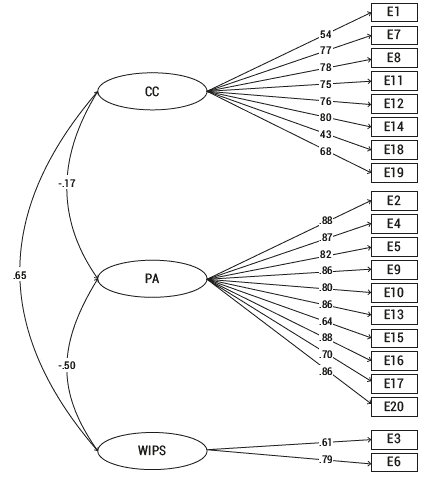
Using the CFA, the three-factor correlated measurement model of empathy obtained adequate goodness-of-fit indices: X 2 (gl) = 620.88 (167), CFI = .92, TLI = .90, RMSEA = .06 [CI90% = 0.60.071], SRMR = .09. Figure presents the structural model of the empathy scale with the factor loadings of the items and covariances between dimensions.
DISCUSSION
The results of the psychometric study presented in this article allowed us to establish that the model of the three underlying dimensions of empathy, as well as the distribution of the items in each of its dimensions, are in accordance with the theoretical model that supports this instrument 15. This study could demonstrate that psychometric property checks should be carried out on a regular basis in order to verify compliance with the theoretical model and, consequently, to ensure that the inferences drawn from the results of the application of the JSE-HPS, as well as any instrument of the same nature, have sufficient methodological support 19-21. This is particularly important, since some items may be classified in a dimension which does not correspond to the theory, and such a situation alters the estimation of the levels of these dimensions. This case can occur with large sample sizes but is especially sensitive when sample sizes are less than 200 participants 22.
The comparison of the results of the levels of empathy in general, and in each of its dimensions (Table), with the cut-off points established for Latin American nursing students 19, allows us to affirm that the mean values of global empathy (100.88 points) found in the present work can be classified as "high" and coincide with the 5th percentile of the study of the cut-off points referred to above (102 points). Meanwhile, CC (37.41) ranks in the "medium" value classification, at the 50th percentile (38 points), PA (55.81) ranks in the "very high" classification at the 5th percentile (55 points); and finally, WIPS (7.66) ranks in the "medium" value classification at the 50th per-centile (8 points).
This comparison allows for a more generalized view of the empathic behavior of groups of students in relation to the cut-off points that can be considered as established benchmarks (1921,23). From this comparison, it can be "diagnosed" that Empathy (in general) does not necessarily constitute a qualitative indicator of the empathic state of groups of students. The fact that the empathy rating is "high" does not indicate that the students tested have acceptable levels of empathy that would suggest to university authorities that the empathic training process is going well at a given institution. Indeed, the empathic training angle (reaching values above 102 points) still has room to grow, which would allow us to jump to the "very high" category. This can only be achieved by increasing the levels of the dimensions, although the results are not entirely satisfactory. However, the didactic-pedagogical process that makes this leap possible is complex. The CC and WIPS ratings were "medium," whereas the PA rating was "very high". This means that it is PA that drives the increase in the value of empathy levels, while the values of CC and WIPS modulate the increase in these values. Before finding the inferences of the findings described above, it should be emphasized that several authors 24-26 consider empathy to be a system, whose components and dimensions interact with each other and that empathy is the result of this interaction 24-27. Therefore, if empathy is a system, it means that the failure of one of its dimensions or the failure of one of its components (or a deficit in one dimension without considering it as pathological), can lead to severe empathy deficits, such as psychopathies 28,29, or simply to an attenuated empathic ability 30. Thus, it is important to consider empathy as a complex and dynamic system because its components are interconnected dialectically to produce the desired effects.
The theoretical significance of the CC dimension is related, as expressed above, to the limbic system. Typically, when students enter university, they are 18 years old, and consequently, the limbic system is already formed or is in the process of finalizing information. As a result, the student's emotionality will already be structured or be in the process of finalizing its structuring. This implies that emotionality or affectivity formation in students is complex. However, the orbitofrontal system is associated with the cognitive component of empathy (PA and WIPS), and the dimensions of this component are teachable as this system can develop until the age of 30.
The findings of the present study clearly demonstrate that the CC and WIPS dimensions should be the object of attention of university authorities and that any possible empathic intervention for students should take this situation into consideration. Although it is not part of the objective of the present work, the logical consequence of the empathic diagnosis of the students is the need to carry out an intervention aimed primarily at raising the levels of the WIPS (cognitive) and CC (emotional) dimensions. An intervention of this type must be prolonged in time (continuous) and emphasize empathic training in the preclinical and clinical areas 31,32, considering that empathy is influenced by many factors that must be considered for such an intervention 33. Indeed, the condition of a complex system in the process of empathic development is not only based on the interaction between the components or their dimensions, but also on two factors: phylogeny and ontogeny 33. The first is biological evolution and the inherent changes in biological systems, including those of the brain, which were and are extremely slow processes 34. This process serves to accumulate adaptive changes, which allowed for the emergence of the limbic system of the brain that is responsible for emotional processes and, subsequently, the development of the frontal lobe, which can be associated with the development of cognitive capacity in humans 35. Ontogeny is the process that explains the effect of all the factors that can influence a person throughout his or her existence and begins at birth 11. Therefore, it is necessary to study all factors that could contribute (positively or negatively) to the normal development of brain structures associated with empathy, including all the interconnections between the neural substrates that support the dimensions of empathy. For these reasons, an empathic diagnosis must be carried out, which is an essential step prior to the application of any intervention.
One of the limitations of this study is the small number of male participants, which prevented us from establishing factorial invariance according to gender. Specifically, determining the existence of model invariance allows for comparisons between groups in which the underlying three-dimensional model holds. In the present case, comparisons between sexes are not possible. In addition, the condition that it is a convenience sample, which affects its representativeness with regard to the population from which the sample is drawn.
LIMITATIONS
When analyzing the modification indexes, item 18 obtained a high value (110.22), suggesting that it should be transferred to the perspective-taking dimension. However, theoretically, it does not belong to the perspective-taking dimension; therefore, it is suggested that it be reviewed in future research. It is also suggested that future studies be complemented with additional evidence of validity, for example, the relationship with other variables.
CONCLUSION
Empathy is characterized by a great ability for intellectual interpretation of the patient's emotional states (PA) in nursing students. At the same time, they are characterized by a non-critical deficit of emotionality (CC), that is, a diminished ability to feel the patient's suffering as one's own and a diminished ability to penetrate the patient's thoughts (WIPS).

