




 English (pdf)
 Article in xml format
 Article references
 Automatic translation
 Send this article by e-mail
 Cited by SciELO
  Cited by Google
  Similars in
SciELO
Similars in
SciELO  Similars in Google
 Permalink

Introduction
Yacón is a native crop of the Andes region, grown at various altitudes in Peru, Bolivia, Ecuador, and Argentina. Due to its medicinal properties, it has been part of the Andean diet for centuries and has spread to other countries like New Zealand, Europe, the USA, and Japan. In Europe, the Czech Republic has pioneered its cultivation, while it is gaining importance in Brazil, particularly in the State of São Paulo. The name yacón comes from the Quechua term yaku, meaning 'water', but this crop has different names in various regions. It belongs to the genus Smallanthus, i.e., Smallanthus sonchifolius, in the family Asteraceae. In recent years, yacón has gained popularity in other areas outside its native region, given its nutritional profile and potential health benefits. It has become an important crop in some South American areas and has been exported to other countries for consumption and use in the food and supplement industry (Žiarovská et al., 2019; Choque Delgado et al., 2013).
Yacón is an Andean natural resource, similar in appearance to potatoes, with a sweet flavor and crispy pulp (Bernstein and Noreña, 2014). It has been proven that the consumption of yacón has beneficial effects on health, since it has antioxidant properties, reduces blood sugar levels, and is a potential probiotic (Valentová and Ulrichová, 2003). This is due to its high content of fructooligosaccharides and inulin, which promote the development of the colonic microbiota (Choque Delgado et al., 2013). Its consumption takes place after a period of exposure to the sun aimed at increasing its sweetness (Bernstein and Noreña, 2014). However, yacón’s high water content (83–90%) and the presence of enzymes such as polyphenol oxidase and peroxidase make it a perishable food (Shi et al., 2013). Its shelf life in fresh form is approximately seven days under ambient conditions, exhibiting constant depolymerization of the fructooligosaccharide compounds, which are of interest to consumers (Perussello et al., 2014).
Different technological alternatives are being studied to preserve yacón, transforming the product into beverages, instant powders, sweets, purées, filters, and snacks, among others (Franco et al., 2016; Choque Delgado et al., 2013), always with the aim of not reducing its nutritional or bioactive compounds (Reis et al., 2012; Campos et al., 2016).
Convective drying is widely used in the food industry due to its simplicity and versatility. It allows for better temperature control and even heat distribution around the food, which is essential for maintaining product quality. However, this method can be slow in comparison with infrared drying, and high temperatures and extended drying times can adversely affect quality in terms of the taste, color, and texture of the food (Marques et al., 2023). Convective drying is the simplest method to decrease the moisture content of a product, as heat and mass transfer occur in its surroundings (Reis et al., 2012).
Recent research has shown that pretreatments such as osmotic dehydration or the application of organic acids improve the bioactive characteristics of yacón, even when dried at high temperatures (Khajehei et al., 2018; Campos et al., 2016; Perussello et al., 2014). However, convective drying (CD) affects sensory properties such as the color and texture of foods, which is why some studies have sought alternatives to make drying processes less drastic and more economical. An example of this is vacuum drying, which has shown positive effects on yacón slices exhibiting low browning, a golden yellow color (Reis et al., 2012).
Another alternative not yet studied in yacón is drying by infrared radiation, a type of non-contact heat transfer that harnesses the propagation of electromagnetic waves and does not require a medium. Infrared energy radiates to the heated surface and penetrates directly into the inner layer of the material. This energy is absorbed by molecules in different layers of the material, causing the vibrational energy level of the molecules to rise and fluctuate, generating heat and increasing the overall temperature. This is one of the most important advantages of infrared radiation, as it avoids energy losses and considerably maintains the original quality of the product. However, the initial acquisition and installation costs of infrared equipment are typically high, and precise temperature control can be a challenging task. Moreover, the limited penetration of infrared energy can affect the uniformity of dehydration in products with irregular geometries (D. Huang et al., 2021; Zeng et al., 2019).
Infrared drying provides faster dehydration by transferring energy directly to the food, helping to preserve product quality (e.g., color and flavor). Additionally, it is more energy-efficient due to its shorter drying times.
Recent research has revealed the benefits of drying fruits using far-infrared radiation, as is the case of apples (El-Mesery and Mwithiga, 2015), kiwis (Zeng et al., 2019), and mangoes (Yao et al., 2020), among others. However, the effect of infrared drying on yacón chips at different temperatures has not yet been reported. Thus, the objective of this research was to evaluate the effects of convective and far-infrared radiation drying at three different temperature levels on the physical properties and microstructure of yacón.
This article consists of four sections. The first section covers the raw material conditioning process and provides a detailed description of the drying methods employed, as well as the analysis procedures conducted on the samples. The second section focuses on presenting the results obtained, encompassing the physical and microstructural properties of yacón chips. The third section of the article is devoted to discussing these results, which are analyzed and compared against those in the specialized literature. Finally, the fourth section provides the conclusions of this study and proposals for future research concerning the drying process of yacón chips. The results constitute a reference for studying the effects of far-infrared radiation drying on the physical quality components of yacón, aiming for a functional product with acceptable characteristics.
Materials and methods
Raw material conditioning
Yacón roots (Smallanthus sonchifolius) were purchased from the Santa Rosa market, located in the district of La Molina, Lima, Peru. The moisture content of the fresh yacón samples was analyzed via the 930.04 method (AOAC, 2005). The results showed a moisture content of 89.48 ± 0.72%, which is similar to the values reported in previous studies (Corrêa et al., 2021). A selection process was carried out, eliminating the samples that exhibited physical damage, such as bruises or signs of microbial attack, evidenced in color changes on the surface. Then, the selected roots were washed with by immersion in potable water to eliminate any residues from the harvesting process. Disinfection was carried out with sodium hypochlorite (150 ppm). The water was removed from the outer part of the roots, and they were cut into 5 mm thick slices using a vegetable slicer (CL-52, Robot Coupe, United States). Chemical bleaching was performed by immersing the yacón slices in a 2% citric acid solution for 5 min at room temperature. This was done to inactivate the enzymes present in the yacón roots that are related to enzymatic browning (peroxidase and polyphenoloxidase).
Drying process
The yacón slices were placed on stainless steel mesh trays. They were dried in a convective cabin dryer (TAAC-PC, Edibon, Spain) at an air velocity of 0.91 m/s and in a far-infrared dryer (IRCDi8, IR Confort, Spain) at temperatures of 60, 70, and 80 °C. The temperature range for dehydrating yacón was selected while considering commercial working conditions; this range efficiently expedites the moisture removal process in yacón, saving both time and energy. The infrared dryer contained eight trays whose area and power were 0.24 m2 and 221 W, respectively. Both drying operations ended when the product reached a humidity range of 8–10%. The dehydrated yacón samples were packed in polypropylene bags at room temperature for later characterization. An infrared moisture meter (MX-50, AND, Japan) was used to determine the moisture content of the dried yacón samples.
Yacón drying curves
The drying curve was constructed by plotting the moisture content vs. time, and the drying rate curve was plotted vs. the moisture content. The moisture content (X) was determined using Equation (1), which calculates the amount of water in kilograms per kilogram of dry matter.
where W represents the weight at a specific time, and Wdm denotes the weight of the dry matter.
The drying rate was calculated using Equation (2), which measures the amount of water removed in kilograms per kilogram of dry matter per hour.
where ϕ represents the drying rate (kgw/kgdm·h), X is the free moisture (kgw/kgdm), and t represents the drying time (h).
Color determination
The color of the samples was expressed in accordance with the CIELAB parameters: L* (0=black; 100=white), a* (−a*=greenish, +a*=red), and b* (−b*=bluish, +b*=yellow). The colorimeter (CR-400, Konica Minolta, Japan) was placed vertically on the surface of the sample (laid on a white surface). Measurements were taken in three replicates. The total color difference (ΔE), indicating the color change between fresh and dry samples, was calculated using the following Equation (Yao et al., 2020):
Texture analysis
The methodology proposed by Egea et al. (2012) was used, with some modifications. A texturometer (Model 3345, Instron, USA) was used, equipped with a 0.25-inch diameter plunger. The speed of the penetration test was 1.0 mm/s. The breaking point (expressed in Newtons) of the dehydrated yacón was determined.
Volumetric shrinkage (Sh)
To determine the initial volume (V0) of the yacón samples, their diameter and thickness were measured using a digital Vernier caliper with a precision of 0.01 mm. The area of each sample was digitally analyzed using the ImageJ software, and its thickness was measured at four different points using the digital Vernier. Four replicates of the measurements were performed. Sh was calculated with respect to the volume of the sample at each time (V) and its initial volume (V0) according to Equation (4) (Senadeera et al., 2020; Corrêa et al., 2021).
where V and V0 are the volume of the sample at each time and the initial volume (m3), respectively.
Rehydration
To measure the rehydration ratio, 5 g of dried yacón were soaked in 150 ml of distilled water in a 250 ml beaker at 25 °C. After 1 h, the samples were placed on a piece of paper towel to remove any excess water from the surface. The rehydrated mass was then determined three times to ensure accuracy. Three replicates of the measurements were performed. The rehydration ratio was calculated using Equation (5) (Mugodo and Workneh, 2021; Corrêa et al., 2021).
where the weights W2 and W1 (g) correspond to the drained and dried yacón samples, respectively.
Microstructure analysis
Photographs were taken using a scanning electron microscope (SEM). Fresh and dehydrated yacón chips were plated with gold under vacuum conditions using an automatic metallizer (Q150R, Quorum Technologies, England). The samples were subsequently analyzed using a SEM-Q250 from Thermo Scientific Analytical. The kV value was set as 15.00, and the gain was 300 µm.
Statistical analysis
All experiments were performed in triplicate, and the treatments were analyzed within a completely randomized design (CDR). The results were averaged, and an analysis of variance (ANOVA) was performed for each determination. Then, a comparison of means was made, using the Tukey test at a significance level of 0.05. All statistical analyses were performed using the Statgraphics Centurion XVII statistical package.
Results
Figure 1 shows the moisture contents (experimental) vs. the drying time for the two methods. The results indicate that the technique used has an effect on the drying rates of yacón. Using the far-infrared drying (ID) method increases the drying rate and reduces the time required to achieve a certain moisture content.
Figure 1 displays typical drying curves, characterized by two falling-rate periods and no apparent constant-rate period. However, it might be possible to have a very short constant-rate period at lower moisture values. The air temperature (60, 70, and 80 °C) impacted the drying kinetics of yacón (FigureFigure 1a); increasing the temperature of the drying medium increased the drying potential and the moisture removal rates.
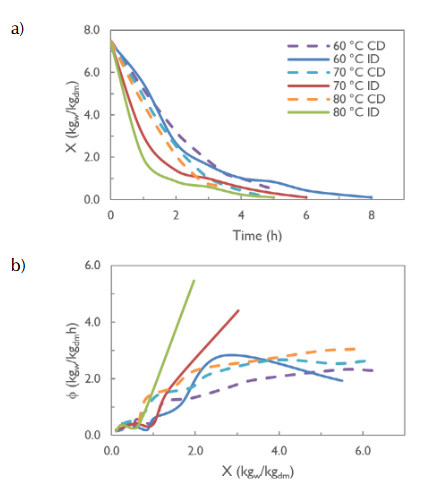
Figure 1. Drying curves of yacón for the two studied methods at different temperatures: a) moisture vs. time, b) drying rate curve. CD: convective drying, ID: far-infrared drying.
Table 1 shows the different color coordinates obtained for each drying treatment. In the case of CD, the luminosity of the yacón samples decreased as the drying temperature increased. This was also reported by ID. However, it should be noted that the greatest decrease in luminosity was obtained with ID at 80 °C. This phenomenon could be attributed to the duration of the process, since it was longer than 5 h, compared to 3 h for CD. This means that, at a temperature of 80 °C, the latter is faster than the former. The reduced values of the color coordinate a* caused yellowish tones in the yacón samples. In CD, the increase in a* was progressive as the drying temperature increased. In the case of ID, the increase in the value of a* was more abrupt, producing browner shades. As for b*, no significant changes were observed, indicating that the green tones remained constant.
Table 1. Physical properties (color coordinates and texture) of dehydrated yacón
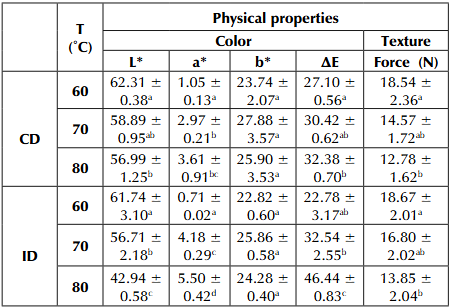
Different letters (a, b, c) within the same column show significant differences between values (p< 0.05). Data are reported as the mean of three replicates (n=3) ± standard deviation (SD).
The results showed that the greatest color variations with respect to the fresh yacón sample occurred during ID at 80 °C. On the other hand, the smallest variations were evidenced during ID at 60 °C.
Table 1 also shows the force values required to break a yacón slice. It was observed that, as the drying temperature increases, the maximum breaking point decreases. This is due to the fact that higher temperatures entail a greater removal of water from the matrix, making the product more fragile.
Table 2 summarizes the shrinkage obtained for each drying treatment. The results indicate that the drying method affects shrinkage, but the temperature has no effect. ID produced a higher level of shrinkage when compared to CD. Shrinkage is a significant physical change that can adversely affect the quality of dehydrated food.
Table 2. Physical properties (shrinkage and rehydration) of dehydrated yacón

Different letters (a, b, c) within the same column show significant differences between values (p< 0.05).
Table 2 also shows the rehydration ratios. The data indicate a significant effect of both drying method and temperature. ID produced greater rehydration in comparison to CD. Similarly, improved rehydration was observed at a temperature of 70 °C.
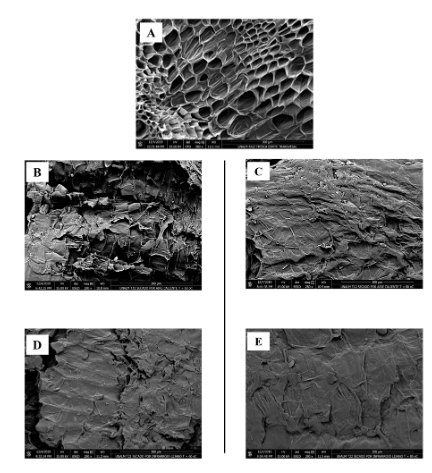
Figure 2 shows the surface microstructure of the fresh and dried yacón samples under different drying conditions. The fresh sample (Figure 2a) exhibits round, elongated, compact, and well-structured parenchyma cells. CD produced severe surface shrinkage, manifesting as a brittle and poor-quality surface (Figures 2b and 2c). In contrast, ID showed more micropores and less shrinkage and deformation (Figures 2d and 2e).
Discussion
ID was found to require shorter times than CD, as the dryer absorbs infrared radiation, causing heat to be released from the interior of the sample. As a result, water is carried from the inside of the sample to its surface, facilitating quick drying. The results were consistent with those of the specialized literature. For instance, during the drying process of Ganoderma lucidum, a study found that using an infrared dryer allowed reaching the desired moisture content faster and provided superior performance in comparison with CD (Naseri et al., 2023). The yacón chips exhibited higher initial drying rates, potentially due to the evaporation of surface moisture. As the moisture content decreased, the drying rates also decreased, suggesting that moisture diffusion played a significant role. The high drying rates observed could be linked to internal heat generation. The absence of a constant drying rate period may be due to the fact that the thin slices did not provide a consistent supply of moisture during drying (Sadeghi et al., 2020). Other studies have also reported increased drying rates with higher radiation intensity (Sadeghi et al., 2020; Naseri et al., 2023). Furthermore, the curve could indicate a constant drying rate stage if corrected for the actual exchange surface area of the sample (Marques et al., 2023).
In this study, the total color variation (ΔE) is an indicator of treatment severity with regard to coloration of the initial sample (Bernstein and Noreña, 2014; Ning et al., 2015). This can be attributed to the fact that infrared radiation generates rapid and intense heat inside the material, causing serious damage to cell tissues and increasing the likelihood of contact between the substrate and the enzymes, thereby darkening the yacón. However, Nowak and Lewicki (2005) state that drying with infrared technology can prevent the excessive browning of food, giving it a better appearance than that provided by traditional methods. The magnitudes of color variation were on the order of those reported by Bernstein and Noreña (2014), who blanched yacón slices for 4 min with steam at 100 °C before subjecting them to a first drying period at 50 °C for 5 h and a second drying period at 75 °C for 5 h.
Several studies have observed that drying with infrared technology decreases hardness in comparison with CD. This is the result of the swelling of the matrix due to the heating of the starches and the solubilization of the pectin, which can produce infrared radiation (Nathakaranakule et al., 2010; Qi et al., 2014). However, this study noted no difference in this parameter between both drying technologies. As explained above, the infrared radiation exposure time is crucial to reap the benefits of this technology. Therefore, a correct selection of power and working conditions will be crucial to obtaining better results.
Studies on the drying of persimmon and yacón using hot air at varying temperatures showed that a value of 60 °C results in minimal shrinkage (Senadeera et al., 2020; Marques et al., 2023). Furthermore, Yang et al. (2020) investigated the drying of mushrooms using different drying methods, including hot air and infrared technologies. They found that there is greater shrinkage in ID. This was also achieved in yacón slices. According to Mugodo and Workneh (2021), the techniques employed in drying mango slices significantly impact rehydration. This impact could include irreversible damage, causing cell rupture and shrinkage. This integrity loss and shrinkage subsequently decrease the hydrophilic properties of the cell. As a result, it cannot absorb enough water to fully hydrate the product (Corrêa et al., 2021).
The dried yacón microstructure was similar to that of dried hemp, kiwi, and beet products (de Jesus Junqueira et al., 2018; Jiang et al., 2018; Pham et al., 2018). The observed shrinkage is due to the heat transfer caused by CD from the outside to the inside, causing the surface water to evaporate rapidly and forming hard membranes and surface cells with irregular contractions (Zhu et al., 2022). In contrast, ID reported less shrinkage and more micropores, as one advantage of this technology is rapid heating, which causes the internal cell cavity to heat and expand, producing more micropores in the structure (X. Huang et al., 2021). This benefits the surface since the cells are subjected to less structural stress, thus forming more open structures with good morphology in the dehydrated yacón. Similarly, Puente-Díaz et al. (2020) found changes in the microstructure of dried Physalis fruit puree using the infrared-assisted refractory window method at different temperatures, obtaining a rough surface with evident water loss. In their study, Marques et al. (2023) analyzed the microstructure of yacón to explain the shrinkage phenomenon during CD. They identified two distinct cell types: xylem vessels and parenchyma cells. These researchers found that xylem vessels have thicker cell walls than parenchyma cells, making them less susceptible to collapsing during drying. Their discovery sheds light on the cause behind the cell wall collapse observed in yacón slices dried at 60 °C, and it demonstrates one of the advantages attributed to ID to improve the quality of yacón chips, in the form of enhancement in the physical structure and integrity of the product.
Conclusions
This research reported, for the first time, the effect of infrared drying on the physical and structural properties of yacón chips. It was found that a high temperature (80 °C) causes significant changes in the color and texture parameters of the product in both in infrared and convective drying. However, the most substantial changes were perceived at the structural level, as the infrared dried yacón chips showed a better morphology. Therefore, applying this technology cannot only increase the number of micropores in the internal structure. It can also improve the heat and mass transfer process, as well as the appearance of yacón. Although this work provides the first insight into the benefits of this technology, other aspects should also be explored, such as combined treatments using different technologies, pre-treatments to efficiently avoid browning, and the effect of different power levels during infrared drying.

