




 English (pdf)
 Article in xml format
 Article references
 Automatic translation
 Send this article by e-mail
 Cited by SciELO
  Cited by Google
  Similars in
SciELO
Similars in
SciELO  Similars in Google
 Permalink

Introduction
Reduced network connectivity due to infrastructure damage caused by natural disasters hinders communication between victims and rescue crew members. The main driver of this issue is the static nature of the cellular network, which makes communication efforts vulnerable to this type of emergency. Examples of this include the Turkey‑Syria earthquake in 2023, with many survivors found by rescue services several days after the incident [1, 2]; the massive destruction of infrastructure reported in the aftermath of the 2011 earthquake in Japan [3, 4]; the cellular networks rendered inoperative by massive floods during Hurricane Sandy in 2012 [5]; and the network collapse observed after the Haiti earthquake in 2010 [6]. Among the most crucial issues faced by disaster response efforts, communication constraints have been reported, a problem that is especially critical during the first 72 hours following the catastrophe, as the probability of finding survivors decreases considerably thereafter [7, 8].
Smartphone‑based ad hoc networks are commonly explored as a solution to this problem [8, 9, 10, 11], given the ubiquity and extended use of these mobile devices among the general public [12]. Consequently various paradigms have emerged for the configuration of such ad hoc networks, with varying degrees of applicability depending on the scenario [13, 14]. Even though Bluetooth was initially used for this purpose, the use of Wi‑Fi Direct technology has gained momentum in the implementation of ad hoc networks for disaster scenarios, as this standard has become the de facto technology for communication between modern devices [13, 14]. Furthermore, when using this standard, power consumption derived from data transfer is notoriously lower than that of the cellular network [8], which makes Wi‑Fi Direct more desirable in emergency situations with seriously limited power supply. This approach also has challenges, however, given that both Wi‑Fi Direct and Bluetooth only enable communication between devices in close proximity of each other, with the coverage of the latter being reportedly shorter.
Regardless of the technology in use, interoperability, i.e., any software’s ability to operate correctly in devices from different manufacturers, is a crucial ingredient for any integral application of ad hoc networks in disaster scenarios. Nevertheless, this feature remains limited, given the existing variety of paradigms for these networks. Furthermore, research on this topic has mainly focused on simulated scenarios, rather than on real implementations. Moreover, traditional approaches to implementing these networks frequently rely on gaining root access to the device, which most manufacturers disable by default due to security concerns, making solutions non‑portable [15, 16].
This article presents Conecta2, a prototype application for Android that allows for communication between the devices where it is installed, in the absence of network infrastructure. The application offers both group and one‑to‑one communication through the automated configuration of an emergency ad hoc network, using either Wi‑Fi Direct or Bluetooth. Conecta2 also includes a module to locate nearby smartphones, provides a snapshot of the current layout of such devices, and it is characterized by an easy‑to‑use user interface, guaranteeing that a user without technical skills can employ it without inconvenience. Conecta2 has been successfully tested in devices with Android versions 10.0 and 11.0 and should nevertheless run smoothly in smartphones with versions 5.0 and above.
The contributions of this article are as follows:
A prototype application for Android named Conecta2, which allows any survivor to collaborate with or request aid from other connected users (survivors or rescue personnel). The most remarkable features of Conecta2 are its simple user interface and the possibility of using either Wi‑Fi Direct or Bluetooth to connect with nearby smartphones.
A performance evaluation of the application modules, aimed at characterizing the coverage of the networks deployed with each communication technology. Such characterization is based on field measurements taken from real scenarios with and without obstacles.
This paper is organized as follows. The next section summarizes recent works on mobile applications based on the analyzed technologies, which have been designed to allow survivors to communicate in the aftermath of a disaster. Then, the three modules of Conecta2 are described: Group communication (based on Bluetooth technology), One‑to‑one communication (based on Wi‑Fi Direct), and Device location (based on Wi‑Fi Direct and Global Positioning System (GPS) technology). Thereafter, the results (based on field measurements) regarding the network performance of Conecta2 are presented, as well as the conclusions of this work.
Related work
The use of Wi‑Fi Direct and Bluetooth for the automated configuration of ad hoc networks, including their use in disaster scenarios, is not new and is featured in several proposals. However, most of the scientific literature in this regard focuses on the design of new protocols, topologies, paradigms, and technologies, while significantly fewer studies aim specifically at the development of mobile applications as a solution to the problem of communication between survivors following a natural disaster. Furthermore, the use of Bluetooth is remarkably less frequent than that of Wi‑Fi Direct, possibly due to the fact that the coverage of the latter has been reported to greatly exceed that of the former. In the literature, the performance of proposals with both technologies is generally evaluated in terms of various metrics. However, the most critical and frequently considered are the message delivery rate and the associated energy consumption efficiency. The former is clearly fundamental, since it directly addresses the main problem at hand, and the latter is also crucial, given that survivors’ access to power sources following a natural disaster is likely to be seriously limited due to infrastructure damage. This evaluation is generally conducted through simulations or field experiments, and sometimes using a combination of the two. The use of Bluetooth in the development of mobile apps for emergency ad hoc networks is notably lower than that of Wi‑Fi Direct, especially in the literature published within the last five years (as of October 2024), probably due to the former’s reportedly reduced range, which makes it less attractive in this context. This may be the reason why the most recently published studies investigating the applicability of mobile ad hoc networks using Bluetooth in disaster situations generally do so in combination with Wi‑Fi Direct or other technologies [15, 16, 14, 13].
Even though there is a diversity of messaging applications for Android that offer offline communication through either Wi‑Fi Direct or Bluetooth (or both) without the need for conventional network coverage, many of these have been designed to serve purposes other than aiding the location and rescue of survivors after a natural disaster. Applications such as Bridgefy* and Serval Mesh† have been developed as alternatives to conventional messaging services, e.g., WhatsApp and Facebook Messenger, when Internet connectivity is unavailable. Other applications have been designed primarily to address privacy concerns, especially those encountered by individuals facing persecution, such as journalists and activists. One example of such applications is Briar‡, which encrypts and syncs messages between users via Wi‑Fi Direct and Bluetooth, as well as through the Tor network§ when an Internet connection is available, in order to deliver messages to a wider range. It deliberately lacks a central server, delegating all authentication and storage tasks to each device running the software.
BeWare is an Android application developed to establish an emergency ad hoc network between smartphones using both Wi‑Fi Direct and Wi‑Fi legacy, the latter for multi‑hop communication between groups formed by the former [17]. An evaluation was conducted in an indoor space using mobile nodes, each corresponding to one model from various manufacturers, i.e., Samsung Galaxy S7, Samsung Galaxy S5, Xperia Z2, and Huawei P8. Performance was evaluated using Android Profiler¶ for measuring both network and energy efficiency, Android Debug Bridge‖ to assess packet loss, and Android Studio IDE** to measure the time required by the app to form/update groups and deliver messages between nodes. These experiments show, among other results, that group forming times increase with the number of nodes involved, and that the most critical performance metrics achieved by BeWare exceed those of previous related solutions found in the literature. Nevertheless, the authors acknowledge that further experimental work in more realistic scenarios is needed, particularly with the inclusion of obstacles, in order to more thoroughly assess the usability of the app in real life situations.
In addition to the above‑presented approaches, various proposals can be found in the literature which seek to improve the protocols and algorithms involved in the automated configuration of ad hoc networks in a variety of situations, not only disaster scenarios, although they do not necessarily contemplate the development of a mobile app designed for the average user. [18], for instance, propose a novel method for the configuration of a multi‑hop ad hoc network that first divides the disaster area into hexagonal virtual cells and then enables the formation of various Wi‑Fi Direct groups in each cell. Each group exists for a limited period of time, after which the cells are reallocated and new groups are formed, thus allowing each node to change its membership from one group to another and relay information from the former to the latter. A preliminary evaluation was conducted by the authors via simulations, showcasing the system’s effective information dissemination. Yet, the authors acknowledge that further experimental work is required, especially involving the evaluation of the information diffusion model and its performance in a realistic scenario. It is worth adding that this system is preliminary and not based on a single mobile app that an average user can use without technical expertise. In the same vein, COPE is a recently proposed scheme (not a mobile app) designed to provide an emergency communications channel for disaster survivors through the integration of various network technologies, including Wi‑Fi Direct and Bluetooth, each representing a layer in a multi‑tier architecture. In this scheme, devices are grouped by tier and thus by their corresponding coverage range and energy consumption. Additionally, the scheme contemplates the use of drones to complement communication efforts by scanning the area and relaying messages among nodes that are mutually out of range [19]. This approach was evaluated via simulations, showing effective message transmission between nodes in various disaster scenarios through self‑organizing routing by the drones while optimizing energy consumption by the connected devices. Each simulation was executed 10 times, and the performance metrics (namely energy management efficiency and message relay efficacy) were averaged over all repetitions. No field experiments were conducted. Despite these positive results, this approach does not involve a single app that can be installed and used by an average user, and it relies strongly on the use of drones in order to achieve optimal communication.
Other initiatives using either Wi‑Fi Direct or Bluetooth include the use of drones for the configuration of the ad hoc network [20], novel protocols [21], methods for enhanced connectivity [17], new algorithms for improved energy management, new mobility models, the use of Bluetooth Mesh to enable communication with household devices [22], and other similar proposals aimed mostly at optimizing Wi‑Fi Direct or Bluetooth applications [23, 24]. In the case of Bluetooth, similar attempts have been made at establishing ad hoc networks for disaster scenarios, albeit without the development of a mobile app that includes the use of novel protocols and topologies using Bluetooth Low Energy [25].
Description of Conecta2
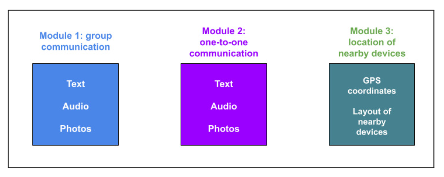
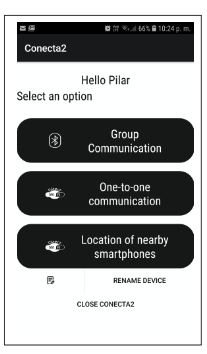
Conecta2 is the first prototype of an ad hoc network‑based emergency messaging application for Android smartphones that comprises three modules: a group communication module, a one‑to‑one communication module, and a module to locate nearby smartphones, which was developed using the architecture displayed in Fig. 1 and publicly accessible community libraries§§. The first time Conecta2 is opened, the application asks the user for a device name that will identify the smartphone in the network. Once the user enters the requested information, the application switches to the main screen, illustrated in Fig. 2, where the user may choose one of the three available modules. These are described below.
Module 1: group communication
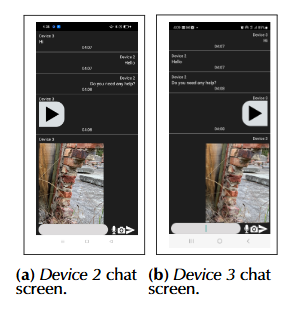
This Bluetooth‑based module allows for group communication with nearby devices, i.e., any message sent by a user will be delivered to all the users connected to the same group. When a user taps on the Group Communication button (Fig. 2), the application shows two options: Create Group and Find an Existing Group (Fig. 3a). If the first option is selected, the application creates a new Bluetooth group and waits for nearby users to join. If the second option is selected instead, the application starts searching for an existing group; when it is found, the joining smartphone issues a request to pair with any other device already in the group. The incoming smartphone joins the group if the pairing request is accepted by both devices. When no group is not found, the application informs the user that there are no nearby groups and that it will return to the main menu of the Bluetooth‑based module (Fig. 3a), so that the user can create a new group. Whether the user decides to create a group or join an existing one, the application switches to the chat screen shown in Fig. 3b. The messages aligned to the right correspond to those sent from the current smartphone, while the received messages are aligned to the left. In this screen, a user can send text messages by typing in the blank space located in the bottom line. In addition, the user can tap on the microphone icon to send voice messages or touch the camera icon to send photos to the group. Even though the current prototype’s group communication module was developed using only Bluetooth for simplicity in its implementation, future versions are planned which also incorporate Wi‑Fi Direct.
Module 2: one‑to‑one communication
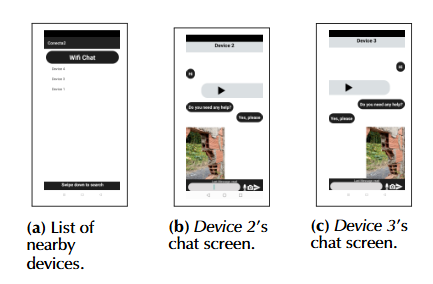
This Wi‑Fi Direct‑based module was conceived to only allow for communication between any two users, in contrast to group communication. The module is activated when the One‑to‑One Communication button is tapped in the app’s main screen (Fig. 2). In the first screen of the module, shown in Fig. 4a, a list of nearby devices can be obtained by sliding the finger from top to bottom, after which the user can tap on the name of any of the devices listed in order to start a conversation.
Upon selecting a device from the list, the application will show a connection request message in the screen of the selected device. If this incoming connection is accepted, one device will take the role of GO and the other will be the client. Then, the application on both devices will switch to the Wi‑Fi Direct‑based chat, as illustrated in Fig. 4b. Text and audio messages, as well as photos, can be sent from this screen, similarly to the group communication chat. Nonetheless, this screen has an additional feature: the sending user receives confirmation of whether a sent message was delivered to and read by the receiving user.
Module 3: location of nearby smartphones
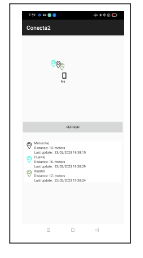
This module allows the user to search for nearby smartphones where the application is installed and estimate their location through Android’s Network Service Discovery (NSD), advantageously bypassing the need for pairing between devices. Several seconds after tapping on the Location of Nearby Smartphones button of the main screen (Fig. 2), an image similar to that shown in Fig. 5 is displayed. The module shows the current smartphone (identified by the word Me) as well as nearby devices on the map, based on geographical coordinates exchanged via Wi‑Fi Direct. The layout of nearby devices reflects their location at a given time, and it can be refreshed by touching the Refresh List button. Since this module needs to start the GPS to read the coordinates and send them to nearby devices, energy consumption is increased while it is active, so it should be used carefully to avoid battery drain.
Performance evaluation
The performance of Conecta2 was experimentally evaluated in various scenarios, both with and without obstacles, in order to determine the maximum network coverage achieved when using Wi‑Fi Direct or Bluetooth, i.e., the group and one‑to‑one communication modules, respectively. All these experiments were conducted with the conditions listed below.
Data transmission attempts were repeatedly made between two Android devices running Conecta2 as the distance between them increased by either 10 m (without obstacles) or 5 m (with obstacles), until no communication was possible (i.e., when data were not transmitted or when the devices failed to establish a piconet or a P2P group), or until 100 m were reached.
At each distance, 10 texts were sent (with 20 characters each), then 10 audios (5 s each), and, finally, 10 photos.
At each distance, all transmission attempts were conducted first through the group communication module (i.e., Wi‑Fi Direct) and then through the one‑to‑one communication module (i.e., Bluetooth).
The number of successfully delivered messages, out of the 10 attempts at each distance and with each module, was recorded.
The experiments without obstacles, carried out at the location shown in Fig. 6 and using smartphones with the characteristics listed in Table 1, can be summarized as follows.
Two users, each one with a smartphone running Conecta2, were placed one in front of the other, without objects between them to ensure a direct line of sight. The initial separation between the users was 10 m, and this distance was gradually increased in 10 m intervals. In the first set of experiments, either a piconet or a P2P group was formed when the devices were 10 m apart. Then, after group formation, the distance between smartphones was increased as previously described. At each distance, text and voice messages, as well as photographs, were exchanged between devices. The results obtained for the one‑to‑one and group communication modules are listed in Tables 2 and 3, respectively, the latter of which includes measurements at a maximum separation of 50 m between the two devices, since communication was not possible at longer distances. At various distances between the two smartphones, e.g., at 30, 60, 90, and 100 m, communication with both modules was occasionally lost while conducting the tests and needed to be reestablished in order to continue the experiment. In one exceptional case, at 30 m, one of the photos appeared to have been partially delivered to the receiving device. More specifically, communication through the group module was lost and unrecoverable at distances longer than 50 m, and an analogous situation was observed with the one‑to‑one module when the devices were more than 100 m apart. Nevertheless, both modules exhibited high message transmission rates at all the distances shown in Tables 2 and 3. At a maximum distance of 100 m, all text and audio messages, as well as 80% of the photos, were successfully transmitted via the one‑to‑one communication module. On the other hand, at a maximum distance of 50 m, all text and audio messages, as well as 60% of the photos, were successfully transmitted via the group communication module. However, in both cases, at greater distances, group formation and pairing were impossible. Therefore, only the distances shown in Table 2 and Table 3 are reported.
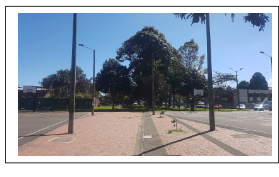
Table 1. Specifications of the smartphones used in the performance evaluation experiments

Source: Authors
Table 2. Successful message delivery rates (with 0 being the lowest value and 1 the highest) between two Android devices running Conecta2 through the one‑to‑one communication module (i.e., Wi‑Fi Direct) for each data type at various distances without obstacles

Source: Authors
Table 3. Successful message delivery rates (with 0 being the lowest value and 1 the highest) between two Android devices running Conecta2 through the group communication module (i.e., Bluetooth) for each data type at various distances without obstacles

Source: Authors
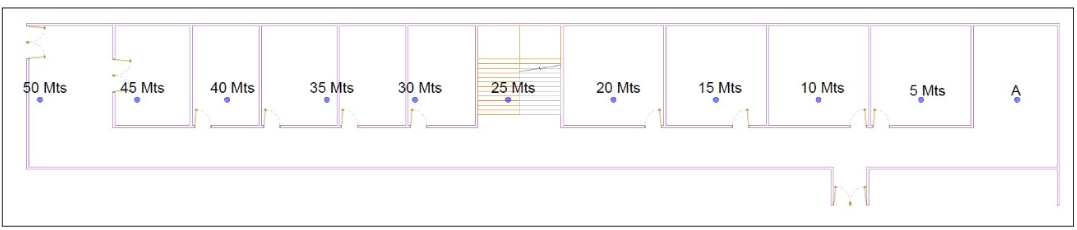
On the other hand, the experiments with obstacles were carried out inside a building with the layout illustrated in Fig. 7. The same smartphones were used, with the devices placed in different rooms, separated by brick walls and metal doors, while increasing the distance between them in 5 m intervals. The results obtained for the one‑to‑one and the group communication modules are listed in Tables 4 and 5, respectively. During these experiments, the communication between the two devices was sporadically lost and needed to be restarted in order to continue. In some cases, messages were received in an order that was different from that in which they had been originally sent. These experiments made it evident that the presence of obstacles, specifically brick walls, notably attenuate the signal. It was observed that, when sending text messages, communication through Wi‑Fi Direct was possible with a separation of up to 35 m between sender and receiver, with losses of 60%, whereas Bluetooth allowed for successful transmission at distances of up to 45 m and without data loss. However, this is different when larger messages are sent. Audio message transmission starts to fail at distances equal to or longer than 25 m when using Bluetooth (80% loss rate), while Wi‑Fi Direct is successful at distances of up to 35 m (40% loss rate). Greater distances result in loss rates of 100% in both modes. The situation becomes more critical with photo message transmission, which was observed to be limited to 15 m while using Bluetooth and 35 m while using Wi‑Fi Direct, exhibiting a 60% loss rate in both cases. Even though we expected the delivery of photos and audio messages through Bluetooth to be more challenging due to its reported lower transmission rate in comparison with Wi‑Fi Direct, it is noteworthy that Bluetooth was observed to have a greater range when sending small text messages. All transmission attempts at distances longer than those listed in Tables 4 and 5 were unsuccessful.
Source: Authors
Figure 7. Layout of the building where the experiments with obstacles were conducted. A single floor of the building was used, with 12 adjacent spaces or rooms separated by brick walls. One device was placed at point A, and transmission tests were conducted with a second device in the other rooms, at the locations indicated by the other points.
Table 4. Successful message delivery rates (with 0 being the lowest value and 1 the highest) between two Android devices running Conecta2 through the one‑to‑one communication module (i.e., Wi‑Fi Direct) for each data type at various distances with obstacles

Source: Authors

Discussion
Conecta2, an Android application designed for post‑disaster communication, presents a compelling case for utilizing ad hoc networks to bridge communication gaps when traditional infrastructure fails. This study’s findings resonate with recent research, highlighting the increasing importance of alternative communication solutions in disaster scenarios. For instance, the work by [9] underscores the potential of LoRa‑based device‑to‑device communication in crisis scenarios, aligning with Conecta2’s goal of enabling communication without relying on conventional network infrastructure. Similarly, the research presented by [10] on building dynamic multi‑hop Wi‑Fi Direct networks for Android smartphones complements this study’s exploration of Wi‑Fi Direct technology for emergency communication.
Conecta2’s emphasis on a user‑friendly interface directly addresses a critical gap identified in the related literature. While many studies focus on optimizing protocols and algorithms for ad hoc networks, Conecta2 prioritizes usability and accessibility for individuals without technical expertise. This focus on user experience aligns with the findings of [11], who emphasize the importance of effective application distribution systems for internet‑less communication during disasters.
Furthermore, Conecta2’s device location module offers a unique functionality that is often absent in other ad hoc communication solutions: the ability to estimate the location of nearby devices provides a crucial advantage in search and rescue efforts, directly contributing to the efficient location and assistance of survivors. This feature sets Conecta2 apart from applications like Bridgefy, Serval Mesh, and Briar, which primarily focus on privacy and general offline messaging, rather than on post‑disaster communication and survivor location.
The comprehensive performance evaluation conducted in this study provides valuable insights into the practical limitations and capabilities of Wi‑Fi Direct and Bluetooth in disaster‑like conditions. The findings contribute to a deeper understanding of the trade‑off between range and energy efficiency, as well as of the impact of obstacles on signal strength and communication range. This research aligns with the growing body of literature on the performance of ad hoc networks in realistic scenarios, such as the work by [16] on routing protocols for unmanned aerial vehicle‑aided vehicular ad hoc networks.
It is important to highlight that Conecta2’s development was guided by a user‑centered design approach, prioritizing the needs and limitations of disaster survivors. This approach is reflected in the application’s intuitive interface and versatile functionalities, allowing users to easily connect with others, share information, and estimate the location of nearby devices. By prioritizing user experience, Conecta2 aims to empower survivors and facilitate effective communication and coordination during critical situations.
Conclusions
This research successfully addressed the critical need for effective communication solutions in post‑disaster scenarios by developing and evaluating Conecta2, an Android application that facilitates communication and survivor location through ad hoc networks. The application’s user‑friendly interface, combined with its versatile use of both Wi‑Fi Direct and Bluetooth, provides a robust platform for communication and coordination when traditional infrastructure is compromised.
Conecta2’s ability to establish an ad hoc network using either Wi‑Fi Direct or Bluetooth offers a crucial lifeline in disaster‑stricken areas, allowing survivors and first responders to connect and coordinate rescue efforts. The device location module further enhances the application’s value by providing an estimate of the location of nearby devices, facilitating search and rescue operations and potentially saving lives.
While Conecta2 demonstrates significant potential for improving disaster communication, it is essential to acknowledge its limitations. The application’s performance can be affected by environmental factors such as obstacles and user density, which may impact signal strength and communication range. Future research should focus on addressing these limitations by exploring strategies for optimizing the app’s performance in high‑density scenarios and mitigating the impact of obstacles on ad hoc network performance.
The implications of Conecta2 extend beyond its technical functionalities. By offering a resilient and efficient communication pathway, the app can be seamlessly integrated into disaster response strategies, particularly in situations where traditional communication infrastructure is compromised. Disasters such as earthquakes, hurricanes, and floods often result in the disruption of cellular networks and internet connectivity, leaving survivors and first responders isolated and vulnerable. Conecta2’s ability to establish an ad hoc network using Wi‑Fi Direct or Bluetooth provides a crucial lifeline under these circumstances, enabling communication and coordination when it is needed most.
In conclusion, Conecta2 has the potential to revolutionize disaster communication by providing a reliable, user‑friendly, and adaptable platform for communication and coordination. Its integration into disaster response strategies could significantly improve the efficiency of rescue efforts, ultimately leading to more lives saved and a more resilient response to disaster situations. This research underscores the potential for Conecta2 to be integrated into existing disaster response strategies, potentially saving lives and improving communication efficiency in critical situations.

