




 English (pdf)
 Article in xml format
 Article references
 Automatic translation
 Send this article by e-mail
 Cited by SciELO
  Cited by Google
  Similars in
SciELO
Similars in
SciELO  Similars in Google
 Permalink

Introduction
During an earthquake, adjacent structures vibrate out of phase, and if the distance between them is insufficient to accommodate their relative motion, their different dynamic properties can lead to ollisions that generate high-impact forces, which can cause severe structural damage. This phenomenon can be avoided if a separation distance (also called seismic joint) is ensured. The dynamic behavior of structures under seismic loads depends on the interaction with the underlying soil through the foundation. In civil engineering, it is called "Soil-Structure Interaction" (SSI). This phenomenon poses particular problems in civil and geotechnical engineering, as the mechanical properties of the soil can cause strong local seismic anomalies at the surface. Therefore, when planning a building, it is necessary to evaluate the soil properties at the early stage of design 1-8.
Most seismic design codes ignore the SSI and determine the dynamic response of structures, assuming they are embedded in the ground. This hypothesis is based on the assumption that the SSI positively impacts structures by reducing the inertial forces acting on them. However, post-earthquake observations have shown that the SSI can damage some buildings built on unconventional soil 5. Recently, clauses have been introduced in some seismic regulations to optimize building designs considering the SSI effect and allowing more realistic predictions of seismic behavior.
Seismic collisions between adjacent buildings have been studied for more than 20 years in several research works 9-13, considering buildings embedded in foundations (fixed foundations) and without considering the effects of SSI. Therefore, completely ignoring SSI phenomena in this type of structure can lead to structural damage. Given the complexity of the problem, research in this area has received little attention.
One of the few studies investigating the simultaneous effects of impacts and the SSI on adjacent buildings subjected to ground motion is that of Mahmoud et al.14. They studied the effects of a collision on the dynamic response of light and flexible structures considering the SSI. The results obtained in this study showed that the SSI significantly influences the seismic response of same height buildings during impact.
Two buildings of different heights (10 and 9 floors) and two buildings of the same height (5 storeys) exposed to earthquakes, taking into account soil effects were examined. Based on obtained results, it was concluded that considering the underlying soil reduced the maximum soil displacement, impact force, and shear force at each floor 15.
Soil conditions for studying two adjacent seismically loaded buildings with different heights (6 and 12 floors), different foundation depths, and no seismic joint between the two buildings are considered 16 . Others studies analyzed collisions of fixed base buildings, isolated buildings and buildings on soft soil. 17
Basic analyses are often performed using a single degree of freedom (SDOF) system as a structural model. Such a model to conduct a study of adjacent buildings collision was used 13,18. Structural supports are considered fixed if the soil is rocky (high stiffness). In soft soils, the flexibility allows the foundation to rotate and laterally displace, reducing the stiffness of the overall structure. 18,19
To relate our problem with those mentioned in previous studies, we propose a simplified model to treat the collision phenomena of adjacent structures under the SSI effect. Soils are characterized by the shear wave velocity. The Algerian seismic code RPA99/Version 2003 20,21 proposes to divide sites into four categories: very soft soil, soft soil, hard soil, and rocky soil. This classification was based on soil mechanical properties, primarily shear wave velocity.
The study was conducted in three different configurations of two adjacent three-story buildings subjected to the 1940 El Centro earthquake. Each configuration is characterized by the mass and stiffness properties of the building. A modified linear viscoelastic model simulated the collision. We used the Newmark method to solve the dynamic equations of motion. The primary response parameters identified in this study are displacement and impact force.
Mathematical development of the proposed method
This study analyzes the coupled effect of SSI and impact between two adjacent buildings subjected to seismic excitation. The proposed analytical model consists of two sub-models: the soil-foundation rheological element and the superstructure modeled by a multi-degrees of freedom system MDOF, as shown in Figure 1.
Soil modeling
The horizontal and rotational movements of the foundation are represented by springs with stiffness  and
and  (Equation 1) and dampers with damping coefficients
  and
and  (Equation 2) 22. The soil is characterized by the Poisson's ratio
 ; its density
  and the shear modulus
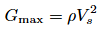
  calculated according to the shear wave velocity (Equation 3).
  and
and are the correction coefficients of the oscillator’s springs. L and B are the half-length and half-width of the foundation,
  and
and  the foundation radii for translational and rotational deformation modes,
  and
and  are cross section and the inertia moment of the foundation, respectively. (9, 23)


2.2 Collision model of adjacent structures
Modeling the collision between two adjacent buildings (Figure 2) requires the use of appropriate models of collision effects. This can be done using two different approaches that exist in the literature. The first approach considers only the energy conservation laws and deformation of structural elements during impact. However, the second one directly considers the impact force; this approach was adopted in our study. This force can be simulated using either an elastic or viscoelastic impact model.
In this study, we chose the modified linear viscoelastic model (Figure 3) (18). This model was developed firstly to eliminate the tensile forces that occur just before the separation of two structures in the linear viscoelastic model and secondly for simplicity, applicability, and accuracy in modeling the adjacent structures collision.


Determination of the dynamic response due to collision
The study consists of determining the impact forces and displacements of two neighboring structures due to their collision during an earthquake by introducing the SSI. The proposed model is based on the shear wave velocity variation which characterizes the soil foundation type.
To illustrate the procedure, we have considered the example of two structures with three degrees of freedom. The Newmark’s direct integration method was applied to numerically solve the equation of motion (Equation 4). The parameters 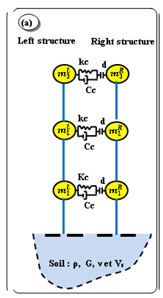 =0.5, =0.25, and a constant step of 0.001s were considered to achieve high numerical stability. The program was developed in Matlab by the authors. The effect of SSI is introduced by the impedance equations (Equations 1 and 2).
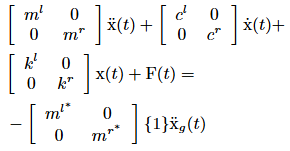
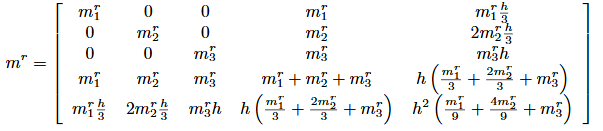
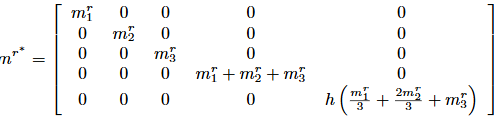
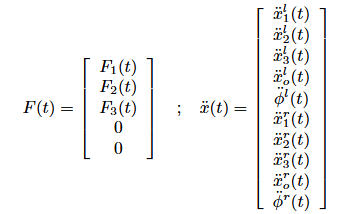
(Equation 4) can also be written in matrix form for left and right structures as (Equation 5):


Where:
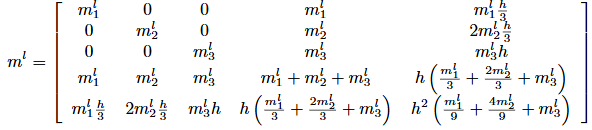
ml; mr; cl; cr; kl; kr; kd are the mass, damping, and stiffness matrices of the left and right structures, respectively;
ẍ(t) ; ẋ(t) ; x(t) ; are the acceleration, velocity, and displacement of the structures;
ẍg (t) ground acceleration vector.
F(t) impact force; determined by (Equations 13 and 14) (9):

Table 1 Structures properties
Parameters
Structure 1
Structure 2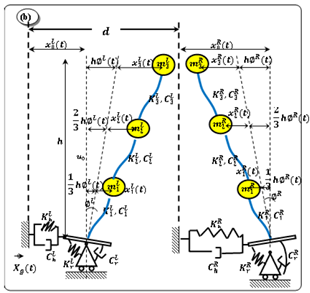
Story mass 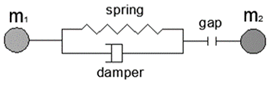
31.92 x
144.72 x
Story stiffness k,
1.37 x 
3.815 x
Story damping coefficients 
1.477 x 
4.69 x

cc, ξc are damping and damping coefficient of structure during impact determined by (Equation 15).
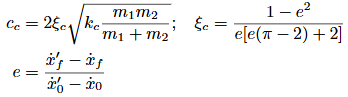
where:
: structural deformation during impact;
: structural relative velocity during impact;
Case study
4.1 Properties of the structures
In order to illustrate the phenomenon of the adjacent buildings’ collision considering the soil effect, an analysis of two three-story reinforced concrete buildings subjected to the 1940 El-Centro earthquake was performed. The displacement and the impact force are the parameters of interest in this comparative analysis.
Three configurations according to the following case are considered (Figure 4):
Case (1): The two adjacent buildings (left and right) are identical.
Case (2): The two structures have different properties, so the right structure has greater stiffness and mass than the left structure.
Case (3): the two structures have the same mass and stiffness as the structure on the right side of Case 2.
The dimensions of the two buildings are represented in Figure 5, and the mass, stiffness, and damping ratio of the two buildings are summarized in Table 1.
Characteristics of the foundation soil
To consider the effects of SSI on collision response, a comparative analysis was performed on the three cases by varying the shear wave velocity. Foundations and soil properties are summarized in Table 2.
Table 2 Foundation and soil properties
| Parameters | Values | |||
|---|---|---|---|---|
Soil density
|
1.89 x 10³ | |||
| Shear wave velocity
|
125 | 300 | 600 | 1350 |
| Soil shear modulus
|
1.18x10⁵ | 1.77x10¹⁰ | 5.32x10¹⁵ | 3.59x10²¹ |
| Poisson’s ratio
|
0.3 | |||
| Spring balancing correction coefficient
|
1 | |||
| Spring oscillation correction coefficient
|
0.5 | |||
Radius of the equivalent circular foundation for spring oscillation 
|
1.12 | |||
Radius of the equivalent circular foundation for spring balancing 
|
1.14 | |||
4.3. Buildings response considering collision and SSI
Case (1)
Figure 6 represents the temporal displacement of the two structures for the four soil types (very soft, soft, hard, and rocky) characterized by their shear wave velocities  (125, 300, 600 and 1350) m/s, respectively.
The results show that the SSI contributes significantly to increasing the top displacement of adjacent structures by about 51%, especially in very soft soil ( = 125 m/s) where the impact phenomenon is accentuated. This is due to the period lengthening and the increased damping of the SSI system. However, on rocky soil, the stiffness and displacement of the system are unaffected.
During an earthquake, if the soil is very soft, the top displacement of the two structures may approach the ultimate displacement. In this case, they can fail, if the seismic joint has not been properly dimensioned.
Figure 6 shows that the displacement of the three stories increases as the value of decreases; it increases from 0.005m to 0.0206m on the 1st floor and from 0.011m to 0.057m on the 3rd floor when =1350m/s and 125 m/s, respectively. Therefore, an increase occurs in the inter-story displacements. It is worth emphasizing the importance of this parameter, since it is directly related to the stresses in the plastic hinges and structural elements damage. Table 3 shows the inter-story displacement values, and its decrease in rocky soil due to significant energy dissipation.
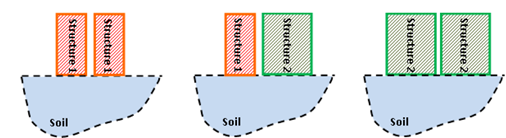
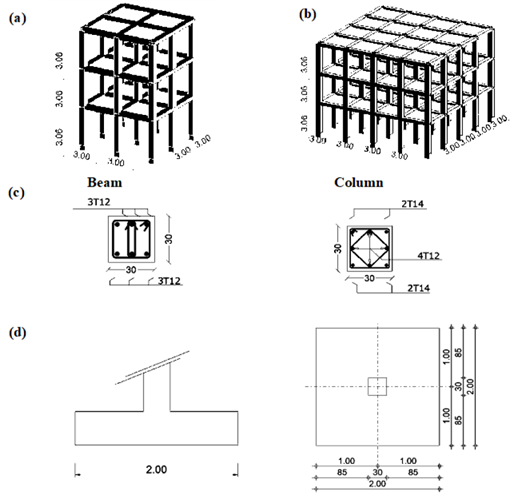
Figure 5 Geometrical properties of the structures: (a) light structure, (b) heavy structure, (c) columns and beams cross sections, and (d) foundation section
Table 3 Inter‐story displacements for different soil types
| Story | Inter‐story displacement [%] | |||
Very soft soil 
|
Soft soil
|
Hard soil
|
Rocky soil | |
| 3-2 | 0.58 | 0.14 | 0.11 | 0.0667 |
| 2-1 | 0.63 | 0.20 | 0.19 | 0.13 |
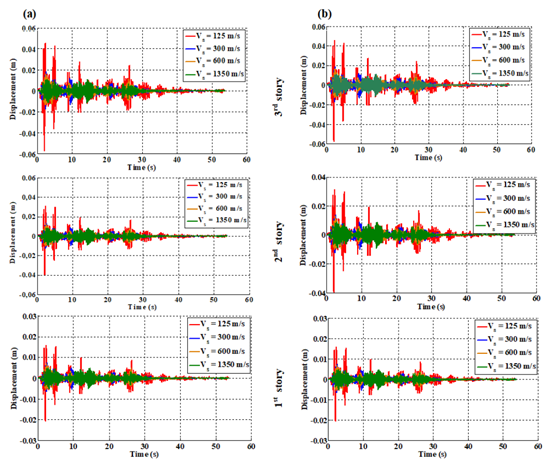
Figure 6 Displacements time-histories considering shear wave velocity variation: (a) left building and (b) right building
The effects of SSI are determined by most seismic regulations by the stiffness ratio between the structure and the soil (h/VsT) (h: effective height, Vs: shear wave velocity, and T: structure period). If (h/VsT) >0.1, the soil-structure interaction causes a period lengthening of the building, and modifies the forces distribution and structural deformation requirements. Applying this ratio to the 1st configuration case (h=6.12m; T=0.212s; Vs = 125, 300, 600, 1350m/s) gave the following values of (h/VsT) = 0, 2271, 0.095, 0.047 and 0.021 for very soft, soft, hard, and rocky soil respectively.
This ratio will be less than 0.1 when the structure is placed on soft, hard, and rocky soil. This means that the SSI does not affect its seismic behavior. However, it is greater than 0.1 for very soft soil, so taking the SSI into account is necessary.
The impact forces in Figure 7 show that the intensity of these forces also depends on soil properties and decreases as the shear wave velocity increases. For the very soft soil, we observe that the impact force between the two structures reaches a maximum value at the second floor F=2010 N at time t=2.4s.
Figure 8 shows the foundation displacement and rotation curves. These two parameters are also affected by the soil nature. It is clear that for very soft soil (Vs=125m/s) and soft soil (Vs=300m/s), displacements and rotations are greater compared to hard soil (Vs=600m/s) and rocky soil (Vs =1350m/s). The foundation flexibility can cause lateral displacements and rotations at the structure base, which can affect the ductility requirement of the structure.
Figure 9 shows the displacements and impact forces of the two structures, as well as the displacement and rotation of their foundations when the soil is very soft. The maximum impact force occurs at the 2nd floor F=2010N; however, a decrease in displacements in the three floors is observed, and the modal deformation shape has changed after the collision.
Case (2)
In the second case, Structure 1 is light, and Structure 2 is heavy.
Figure 10 represents the temporal displacement of the two structures for the four soil types. The light structure displacement is slightly greater for the same soil type than the heavy one. The displacement of both structures decreases as the shear wave velocity increases.
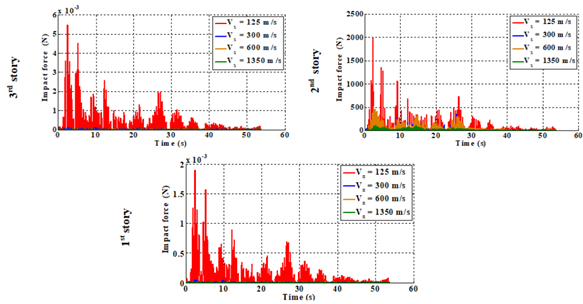
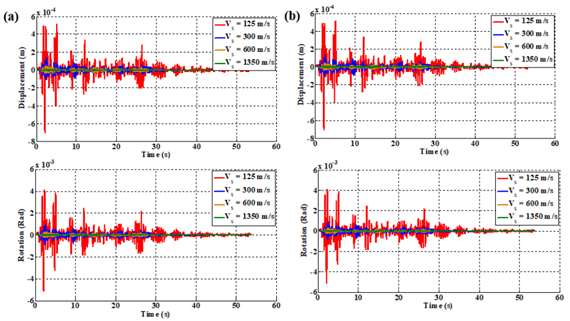
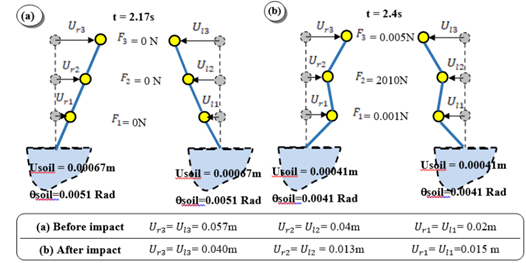
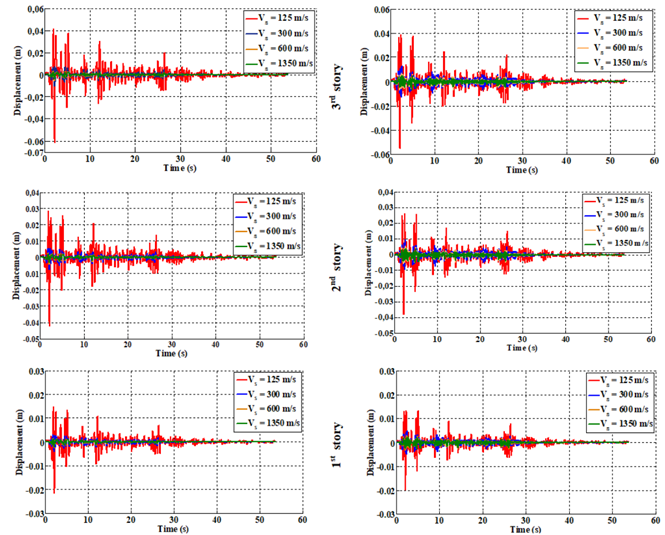
Figure 10 Displacements time-histories considering shear wave velocity variation: (a) left building and (b) right building
The maximum top displacements of the two heavy and light structures are 0.051m and 0.061m, respectively, occurring at t=2.2s. On the other hand, for rocky soil, the maximum displacements of the two structures are 0.004m and 0.006m, respectively.
Figure 11 shows the impact force of structures subjected to El Centro earthquake for each soil type. This force value decreases as the shear wave velocity increases.
The maximum impact force is 0.83.105N and occurs at t=2.29s, 0.09s after reaching maximum displacement on the 3rd story for very soft soil.
Collisions also affect the inter-story displacement and, therefore, the impact force on structures.
Figure 12 shows the displacement and rotation of foundations for the left and right buildings. For different values of  , the inter-story displacement of the two structures is calculated and compared.
A very significant increase in inter-story displacement is observed at all heavy structure levels compared to the light structure for all soil types. For example, the inter-story displacements between the third and second storeys of the two buildings are 0.46% and 0.57%, respectively, for the very soft soil. However, for rocky soil, these values are 0.02% and 0.04%.
The stiffness ratio = 0.2271, 0.095, 0.047 and 0.021 for very soft, soft, hard, and rocky soils, respectively, for the light structure and 0.12, 0.049, 0.025 and 0.011 for the heavy structure. h/(V_s T) < 0.1 for soil (soft, hard and rocky). This means that the SSI does not affect the response of the two structures. However, > 0.1 for very soft soil. So, a significant period of lengthening occurs in both structures.
Figure 13 shows that the impact force reaches a maximum value ( =553 N at t=2.29 s) at the 3rd floor, but the displacement decreases after the collision of the two structures. This is due to the energy loss during impact, which slows down the structure movement.
After the collision, displacement and rotation of structural foundations are reduced. Example of a heavy tructure: the displacement decreases from 0.0006m to 0.0003m and the rotation decreases from 0.0046 rad to 0.00026 rad.
Case (3)
When the two adjacent structures are heavy, the maximum displacement is much lower compared to the two previous cases. According to Figure 14, the displacements in the 3rd, 2nd and 1st stories are about 0.038 m, 0.026 m and 0.031, respectively. The impact force at the 3rd and 1st story is almost zero, while at the 2nd one it is 864 N (= 125 m/s). Figures 14 and 15 show that displacements and impact forces decrease with increasing shear wave velocity. Displacements in the three stories are almost zero in the case of rocky soil. Figure 16 shows that due to the importance of structure masses, Case 3 has the lowest displacements and rotations of foundations compared to the other cases.
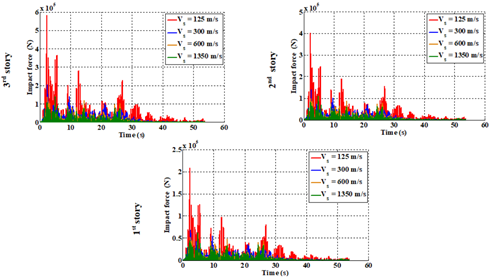
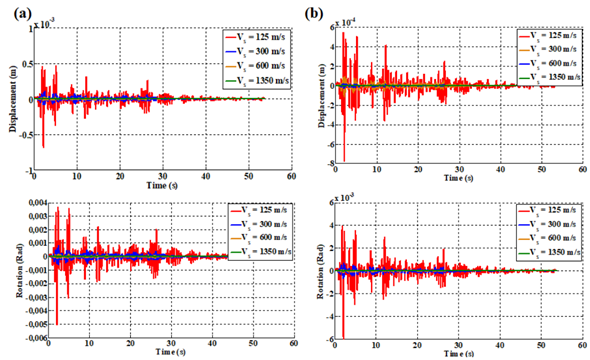
Figure 12 Displacement and rotation of foundation: (a) left building foundation and (b) right building foundation
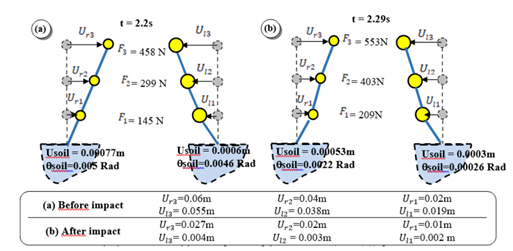
Figure 13 Displacements and impact forces of the structures (case (2)) for =125m/s at t=2.2s and t=2.29s
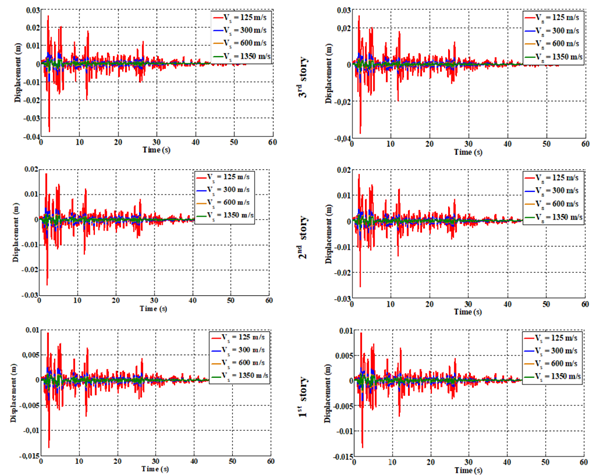
Figure 14 Displacements time-histories considering shear wave velocity variations: (a) left building and (b) right building
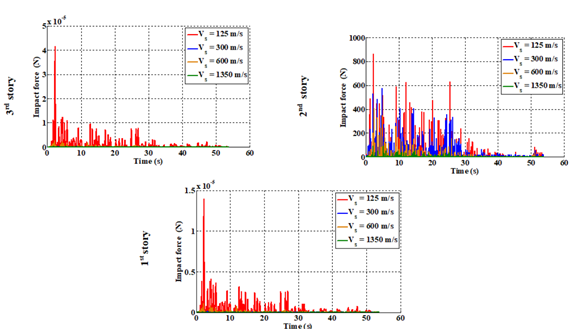
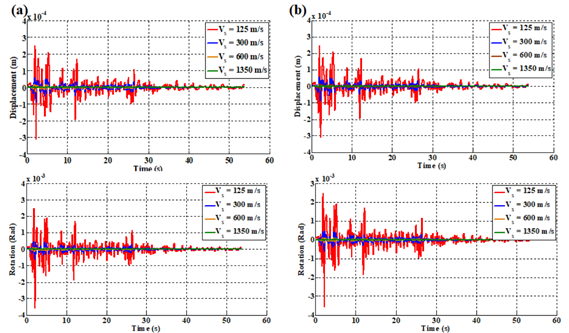
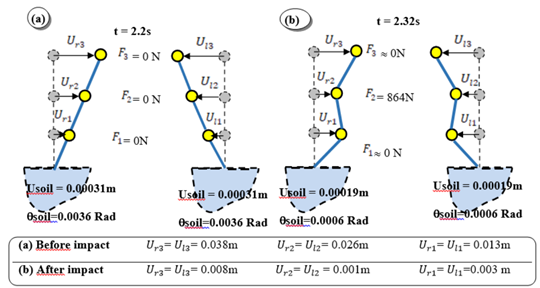
Figure 17 presents the maximum structural displacement and impact force response in very soft soil at times t=2.2s and t=2.32s. The impact force occurs seconds after maximum structural displacement, and the mass continues to displace after impact. In this case, the foundation displacement and rotation values are close to zero.
Analysis of the results for the three cases studied shows that collisions become significant when the difference in mass between adjacent buildings (light to heavy) is large. In fact, collisions significantly increase displacement, inter-story displacement, and impact force. From this, it can be concluded that the displacement and impact force depend not only on the dynamic properties of the colliding building and the characteristics of the seismic excitation, but also on the external environment surrounding the building foundation. In other words, the interaction between the structure, the foundation, and the ground.
Conclusions
In this paper, a numerical analysis was performed to study the coupled effects of collision and SSI on two adjacent reinforced concrete buildings. The most important parameters to determine are displacement and impact force. A parametric study was carried out between three configuration cases of two buildings to illustrate the proposed approach. These cases are distinguished by differences in mass and stiffness. The effect of the soil was introduced by its shear wave velocity, characterizing its nature. The soil types considered are those indicated in the classification of the RPA99 regulation version 2003, i.e., very soft, soft, hard, and rocky soils.
The main conclusions drawn from this study are as follows:
The displacements of the two structures in the three cases decrease when the shear wave velocity increases.
When the two structures have similar properties (Cases 1 and 3), displacements and maximum impact forces occur on the 2nd floor, and when their properties are different (Case 2), they occur on the 3rd floor.
When the two adjacent structures are on very soft soil, the impact phenomenon due to the top displacement of the structure becomes noticeable. However, the movement of buildings built on rocky soil is not affected by collisions.
In the structure of the first case, as the shear wave velocity increases, the impact force occurs sooner after the maximum displacement is reached.
Flexible structures on very soft soil (low stiffness) experience multiple impacts during an earthquake; unlike structures on rocky soil, the impact force stabilizes over time.
Structures with important masses and rigidities (case 3) resting on soft, hard and rocky soil have a stable impact force during the earthquake.
Displacements and impact forces depend not only on the dynamic properties of the colliding building and the nature of the seismic excitation, but also on the external environment of the structure's foundation, i.e., interaction between the structure, the foundation and the soil.
Different analysis of the effects of varying shear wave velocities in combination with the properties of adjacent structures (mass and stiffness) on the displacements and impact forces during an earthquake lead to the conclusion that the nature and soil’s conditions should be considered when determining seismic joints to avoid damage caused by collisions.

