




 text in
  English (pdf)
 Article in xml format
 Article references
 Automatic translation
 Send this article by e-mail
 Cited by SciELO
  Cited by Google
  Similars in
SciELO
Similars in
SciELO  Similars in Google
 Permalink

Introduction
Irritable bowel syndrome (IBS) is a functional gastrointestinal disorder characterized by chronic or recurrent abdominal pain associated with alterations in bowel habits, in the absence of a demonstrable organic cause. Worldwide, the prevalence of IBS is estimated at 11.2%, with a predominance in females; in Latin America, it ranges from 6.98% to 24%, depending on the Rome criteria used1. According to the global epidemiology study conducted by the Rome Foundation, which included 33 countries, the prevalence of IBS using Rome IV criteria is 4.1%, with an estimated prevalence of 4.25% for Latin America and 4.3% for Colombia-figures that are considerably lower than those obtained with Rome III due to the greater diagnostic specificity of Rome IV2.
The diagnosis of IBS is based on the Rome IV criteria, which allow classification according to the predominant symptom pattern into the following subtypes: diarrhea-predominant IBS (IBS-D), constipation-predominant IBS (IBS-C), mixed IBS (IBS-M), or unclassified IBS (IBS-U)1. IBS is among the ten most common causes of consultation in gastroenterology and primary care services; it significantly impairs quality of life and generates a high public health cost3. It is a multifactorial disease in which interactions among the gut-brain axis, the intestinal microbiota, visceral hypersensitivity, stress, and genetic factors contribute to its development and persistence4,5.
Recent studies have demonstrated that the intestinal microbiota plays a fundamental role in the pathophysiology of IBS, influencing its clinical course and predisposing to chronicity6. Among the proposed mechanisms is intestinal dysbiosis, defined as an imbalance in the composition and function of intestinal bacteria. This alteration may contribute to IBS symptoms; therefore, the presence of small intestinal bacterial overgrowth (SIBO) should be considered a possible contributing factor7.
SIBO is characterized by abnormal and excessive colonization of bacteria in the small intestine, capable of producing symptoms such as abdominal distension, flatulence, pain, diarrhea, or constipation8. The diagnosis of SIBO is established by small intestinal aspirate and culture, which is considered the reference method when bacterial growth of 10³-10⁵ colony-forming units per milliliter (CFU/mL) is observed9. However, due to its technical complexity, lactulose or glucose breath tests are commonly used; these measure the concentration of exhaled hydrogen (H₂) and methane (CH₄) after ingestion of the substrate10.
Several studies have found a high frequency of SIBO in patients with IBS, leading to the proposal that its evaluation be included as part of a comprehensive diagnostic approach11,12. Among the treatments used, rifaximin (a non-absorbable antibiotic approved by the Food and Drug Administration [FDA]) has shown efficacy in reducing gastrointestinal symptoms and improving quality of life in patients with IBS associated with SIBO13-15. Nevertheless, in Latin America there are few studies evaluating the impact of rifaximin on quality of life in patients with IBS and SIBO, particularly in the Colombian population16. Therefore, the aim of the present study is to evaluate the impact of rifaximin treatment on quality of life in patients with IBS and SIBO diagnosed by the lactulose breath test.
Materials and Methods
Study Type
We conducted a quasi-experimental, prospective, and analytical study at a medium-complexity gastroenterology center in the city of Cartagena, Colombia, between June 2023 and January 2024. Predefined interventions were applied without a comparator group (placebo or control), and the impact of rifaximin treatment on quality of life was evaluated using pre- and post-intervention measurements.
Study Population
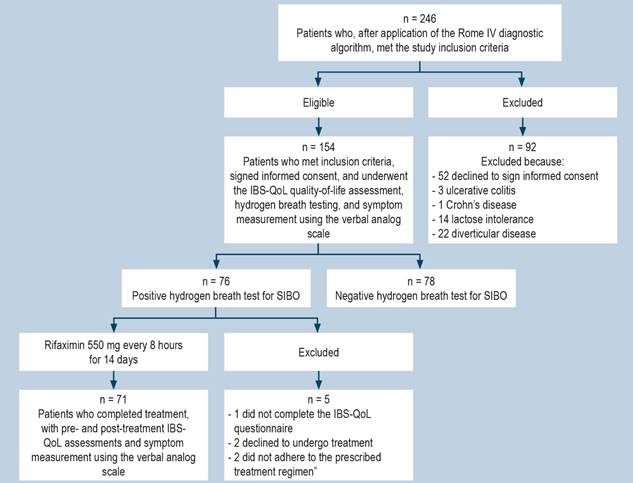
Adult patients (18-75 years) seen in outpatient care with a clinical diagnosis of IBS according to the Rome IV criteria and a positive lactulose breath test for SIBO were included. All patients provided written informed consent prior to participation in the study (Figure 1).
Exclusion Criteria
Diagnosis of neurological, psychiatric, or physical conditions that could hinder participation in clinical assessments (renal, cardiac, or respiratory failure; cancer; human immunodeficiency virus [HIV] infection; pregnancy).
Use of antibiotics or performance of endoscopic procedures within the four weeks prior to the breath test.
Baseline hydrogen values greater than 10 parts per million (ppm).
Lack of treatment adherence or loss to follow-up.
Sample Size Justification
Given that the prevalence of SIBO in patients with IBS is estimated to range from 30% to 50%6, a minimum sample size of 70 patients with confirmed SIBO was estimated, assuming a 95% confidence interval and an expected error of 10% to detect a significant change in the IBS-QoL scale. The final number of included patients (n = 71) met this estimate.
Diagnostic Procedure and Bias Control
Prior to the breath test, patients were instructed to discontinue antibiotics (at least four weeks before); laxatives, probiotics, fiber supplements, and prokinetic agents (72 hours before); and procedures such as colonoscopy during the preceding month. Certain foods (dairy products, fruits, legumes, onion, and garlic) were restricted for 24 hours before the test, and fasting for at least 14 hours was required. Smoking and chewing gum were prohibited for 12 hours prior to the examination.
Breath Test
The test consisted of oral administration of 10 g of lactulose dissolved in 200 mL of water. Measurements of exhaled hydrogen were obtained at 20, 40, 60, 80, 100, 120, 140, 160, and 180 minutes. A test was considered positive if:
An increase of ≥20 ppm above baseline occurred within the first 80 minutes.
An elevation of ≥10 ppm was associated with overt clinical symptoms such as pain, abdominal distension, flatulence, defecatory urgency, or bowel movements during the test.
Patients with baseline hydrogen levels >10 ppm were excluded due to the risk of false-positive results.
Intervention
All patients with a positive test were prescribed rifaximin 550 mg every 8 hours for 14 days, in accordance with current FDA recommendations. No concomitant treatments were administered. A post-treatment breath test was not performed; efficacy was assessed based on symptomatic improvement and the quality-of-life score.
Quality-of-life Assessment
The Irritable Bowel Syndrome Quality of Life (IBS-QoL) scale was used. This instrument, validated in Spanish and developed by the MAPI Research Trust group, comprises 34 items across eight dimensions: dysphoria, interference with activities, body image, health worry, food avoidance, social reaction, sexual function, and interpersonal relationships. Scores range from 0 (worst quality of life) to 100 (best quality of life). The scale was administered at baseline (the day of the breath test) and seven days after completion of rifaximin treatment.
Symptom Assessment
Gastrointestinal symptoms (abdominal pain, constipation, diarrhea, stool consistency, abdominal distension, bloating, and flatulence) were assessed using a verbal numerical scale ranging from 1 to 10 points, where 1 represents absence of the symptom and 10 the maximum intensity experienced. Stool consistency was also evaluated on a scale from 1 (very loose) to 10 (very hard) (Figure 2).

Figure 2 Verbal Numerical Scale. Source: Dolopedia. Unidimensional pain scales [Internet]. Dolopedia; 2024. Available at: https://dolopedia.com/articulo/escalas-unidimensionales-del-dolor 17.
Statistical Analysis
Quantitative variables were expressed as mean ± standard deviation (SD), and qualitative variables as absolute frequencies and percentages. Paired Student’s t tests (pre- vs. post-treatment) and χ² tests were used to compare proportions.
To evaluate factors associated with changes in quality of life, simple and multiple linear regression analyses were performed. The dependent variable was the difference between the global pre- and post-treatment scores on the IBS-QoL scale. A p value <0.05 was considered statistically significant. Analyses were conducted using SPSS v15™.
Results
A total of 154 patients with a clinical diagnosis of IBS were evaluated; of these, 76 (49.3%) had a positive breath test for SIBO. Five patients were excluded from the primary analysis: two did not initiate treatment, two did not complete it, and one did not complete the post-treatment questionnaire. The final sample comprised 71 patients.
General Characteristics of the Population
A total of 154 patients with a diagnosis of IBS were included. The mean age was 48.6 years (SD ± 12.4), and 81.8% were women. The most frequent symptoms were abdominal distension (86.4%), abdominal pain (80.5%), flatulence (72.7%), and a sensation of incomplete evacuation (68.8%). Clinical and demographic characteristics are summarized in Table 1.
Table 1 Clinical and Demographic Characteristics of Patients with IBS
| Variable | Total (%) | Mean ± SD |
|---|---|---|
| Age (years) | - | 48.6 ± 12.4 |
| Female sex | 81.8 | - |
| Abdominal pain | 80.5 | - |
| Abdominal distention | 86.4 | - |
| Flatulence | 72.7 | - |
| Sensation of incomplete evacuation | 68.8 | - |
| IBS-D type (diarrhea) | 38.3 | - |
| IBS-C type (constipation) | 25.9 | - |
| IBS-M type (mixed) | 31.1 | - |
| IBS-U type (unclassified) | 4.7 | - |
Author’s own research.
Symptoms Associated with the Diagnosis of Small Intestinal Bacterial Overgrowth
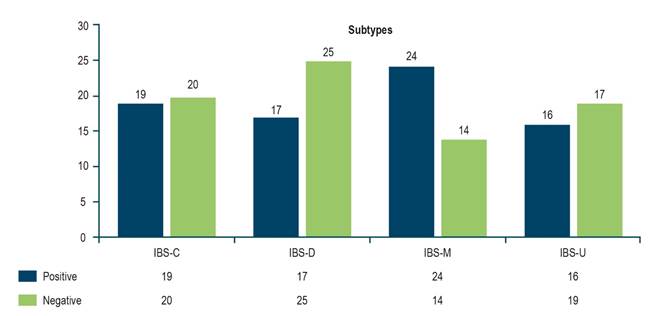
Female sex, socioeconomic status, and IBS subtype were not associated with the diagnosis of SIBO. However, the intensity of abdominal distension (7.8 points vs. 6.5 points; p = 0.005) and flatulence (7.7 points vs. 6.8 points; p = 0.049) was significantly associated with the presence of overgrowth (Figure 3).
Changes in quality of life were not associated with the diagnosis of SIBO. Quality-of-life survey results were very similar in both groups (66 points vs. 64.8 points; p = 0.73). The food avoidance subscale showed the largest differences between patients with IBS and those with IBS plus SIBO (45.6 points vs. 39.4 points; p = 0.23), followed by health worry (55.9 points vs. 51.4 points; p = 0.28). The two subscales with the smallest differences between groups were sexual function (78.04 points vs. 79.2 points; p = 0.77) and interpersonal relationships (76.1 points vs. 77.4 points; p = 0.77). None of the comparisons reached statistical significance.
Effect of Rifaximin on Quality of Life and Symptom Intensity
A statistically significant improvement (p <0.05) was observed in all symptoms and across all quality-of-life subscales after rifaximin treatment. The symptoms showing the greatest reductions in intensity were abdominal distension (-4.23 points; 95% CI: 3.3-5.09; p <0.0001), bloating (-4.3 points; 95% CI: 3.4-5.1; p <0.0001), and flatulence (-4.26 points; 95% CI: 3.3-5.1; p <0.0001) following completion of treatment (Table 2, Figure 4).
Table 2 Comparison of verbal numerical scale and IBS-QoL scores pre- and post-treatment
| IBS-QoL Survey | Pre-treatment | Post-treatment | Mean Difference | 95% CI | p-Value |
|---|---|---|---|---|---|
| Interference with activity | 66.6 (24.9) | 79.9 (18.0) | 13.3 | 19.0 to 7.5 | <0.0001 |
| Health worry | 50.9 (26.2) | 70.8 (21.9) | 19.9 | 26.7 to 13.14 | 0.012 |
| Social reaction | 71.2 (23.4) | 87.14 (18.6) | 15.9 | 21.5 to 10.2 | <0.0001 |
| Interpersonal relationships | 77.11 (26.9) | 86.7 (19.4) | 9.6 | 16.06 to 3.1 | 0.003 |
| Verbal numerical scale | |||||
| Abdominal pain | 6 (3.2) | 2.9 (2.5) | 3.09 | 2.1 to 4.0 | <0.0001 |
| Constipation | 5.7 (3.5) | 2.4 (2.3) | 3.25 | 2.33 to 4.1 | <0.0001 |
| Consistency | 6.6 (3.0) | 4.8 (1.7) | 1.87 | 1.09 to 2.7 | <0.0001 |
| Flatulence | 7.6 (2.8) | 3.4 (2.6) | 4.26 | 3.3 a 5.1 | <0.0001 |
CI: confidence interval. Author’s own research.
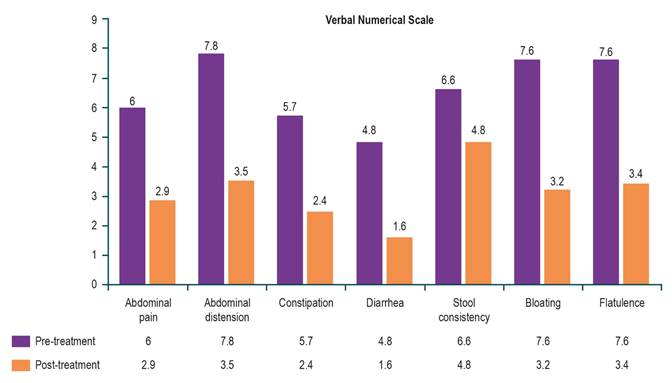
Figure 4 Comparison of gastrointestinal symptom intensity before and after rifaximin treatment according to the verbal numerical scale. Author’s file.
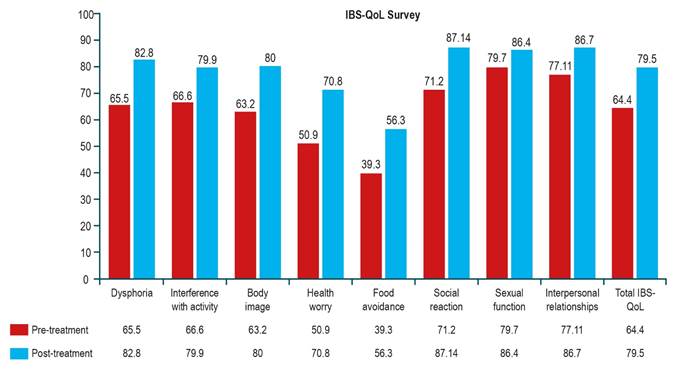
In the analysis by quality-of-life subscales, a significant improvement (p <0.05) was observed in health worry (+19.9 points; 95% CI: 26.7-13.1; p = 0.012), dysphoria (+17.2 points; 95% CI: 22.9-11.6; p <0.0001), food avoidance (+17.0 points; 95% CI: 25.1-8.9; p <0.0001), sexual function (+6.6 points; 95% CI: 13.8-0.4; p = 0.014), and interpersonal relationships (+9.6 points; 95% CI: 16.0-3.1; p = 0.003). The overall quality-of-life assessment showed a mean increase of +15.16 points (95% CI: 20.1-10.3; p <0.0001) in post-treatment results (Table 3, Figure 5).
Table 3 Univariate analysis of factors associated with changes in quality of life after treatment
| Variable | b | 95% CI | p-Value |
|---|---|---|---|
| Sex | -14.7 | -26 to -2.8 | 0.016 |
| BMI | -0.82 | -2.12 to 0.48 | 0.215 |
| Hypertension | -11.9 | -24.02 to 0.12 | 0.052 |
| Bariatric surgery | 5.92 | -18.5 to 30.42 | 0.631 |
| Abdominal pain | 1.44 | (-0.021 to 2.917) | 0.053 |
| Constipation | 1.74 | (0.39 to 3.084) | 0.012 |
| Consistency | 1.52 | (-0.047 to 3.10) | 0.057 |
| Flatulence | 0.25 | (-1.51 to 2.01) | 0.774 |
Cx: surgery; HTA: arterial hypertension; CI: confidence interval; BMI: body mass index. Author’s own research.
Factors Associated with Quality of Life after Treatment
At baseline, the global IBS-QoL survey score was 65.4 ± 22.2 points. The most affected subscales were food avoidance (42.5 points) and health worry (53.7 points), whereas the least affected were sexual function (78.6 points) and interpersonal relationships (76.7 points). These findings reflect a moderate impairment of quality of life prior to treatment.
Although patients with SIBO had lower mean IBS-QoL scores before treatment compared with patients without SIBO, the differences did not reach statistical significance (p >0.05); therefore, no true differences between groups can be established.
After rifaximin treatment, a significant improvement (p <0.05) was observed in the global quality-of-life score and in several subscales. The greatest improvements were recorded in dysphoria (+17.2 points), food avoidance (+17.0 points), health worry (+19.9 points), sexual function (+6.6 points), and interpersonal relationships (+9.6 points). The mean overall improvement was +15.16 points on the IBS-QoL scale.
In the multivariable linear regression analysis, age (b: −0.39; 95% CI: −0.66 to −0.11; p = 0.007), male sex (b: −14.6; 95% CI: −25.4 to −3.8; p = 0.009), and abdominal distension (b: 1.9; 95% CI: 0.16 to 3.6; p = 0.002) were identified as independent predictors of post-treatment quality of life. A total of 26.7% (n = 19) of patients did not respond to treatment or experienced a worsening in quality of life.
Discussion
The World Health Organization (WHO) defines quality of life as an individual’s subjective perception of their position in life, considering physical, psychological, and social well-being18,19. In the United States, the Bureau of Economic Analysis reported that gastrointestinal diseases such as IBS and SIBO increased their overall medical costs by 104.1% over the past decade, ranking 15th among the costliest conditions, surpassing diseases such as lung cancer, leukemia, or HIV20.
In our cohort, nearly half of patients with IBS had SIBO, consistent with international studies reporting prevalences between 30% and 60%, regardless of cultural or geographic factors21. This similarity supports the hypothesis that SIBO is a condition frequently associated with IBS across different clinical settings. From a pathophysiological standpoint, excessive bacterial growth may produce toxins that increase water secretion, favoring diarrhea; conversely, it may alter motility and slow intestinal transit, resulting in constipation. Shan and colleagues described diarrhea as the predominant SIBO pattern in Eastern populations8. In our study, SIBO risk was not associated with any IBS subtype, suggesting that diagnostic evaluation should be actively pursued in all patients, irrespective of clinical classification.
Although variables such as diet or prior antibiotic use were not analyzed, no association was observed between SIBO risk and socioeconomic status, suggesting that factors such as educational level or access to medications may not play a relevant role in its development in this population. Numerous studies have documented a significant reduction in quality of life among patients with IBS, comparable to chronic conditions such as diabetes, hypertension, or kidney disease18,19,22. In our study, the most affected subscales were health worry, dysphoria, and food avoidance, likely related to prescribed dietary restrictions (e.g., a low-FODMAP diet)23. Consistently, Tuteja and colleagues identified these three dimensions as the most impaired before treatment and those showing the greatest improvement after intervention16. The Persian Gulf War veterans clinical trial did not find a significant benefit after rifaximin use16; however, lower doses, a small sample size, and a population with potential psychological comorbidities were used, which may explain the differences from our findings.
Analysis of factors associated with quality of life showed that age, male sex, and abdominal distension influenced treatment response. These findings can be interpreted from behavioral and pathophysiological perspectives: older patients tend to be more concerned about their health, whereas sex-related differences in microbiota composition and treatment adherence may modify clinical response. The absence of a control group represents a relevant limitation due to the risk of selection and confounding biases. Additionally, exclusive use of hydrogen breath testing may have led to underdiagnosis of methane-dependent SIBO; however, previous studies estimate that this subtype accounts for only 14% of patients21.
Despite these limitations, this study represents the first investigation in Colombia applying Rome IV criteria and the FDA-approved treatment regimen, demonstrating significant improvement in symptoms and quality of life after rifaximin use. Nevertheless, randomized controlled clinical trials are required to confirm these results and to assess the long-term sustainability of the effect.
Conclusions
This study suggests that patients with irritable bowel syndrome and small intestinal bacterial overgrowth treated with rifaximin (550 mg every 8 hours for 14 days) experience significant improvement in gastrointestinal symptoms and perceived quality of life. The prevalence of SIBO in this cohort was high and consistent with international literature, reinforcing the importance of considering this condition in the diagnostic approach to IBS.
Although the results are promising, methodological limitations-including sample size, absence of a control group, and lack of post-treatment breath testing-preclude establishing firm causal relationships. Therefore, prospective studies and randomized controlled trials are recommended to confirm these findings and to determine the sustained effectiveness of rifaximin treatment.

