




 English (pdf)
 Article in xml format
 Article references

 Automatic translation
 Send this article by e-mail
 Cited by SciELO
 Cited by Google
 Similars in
SciELO
 Similars in Google

 Permalink

Introduction
Oil palm (Elaeis guineensis Jacq.) is a monocotyledonous and monoecious species of the Arecaceae family (Lin et al., 2017) that produces unisexual male and female inflorescences that are temporarily separated in the same plant, where allogamous reproduction cannot have self-pollination (Adam et al., 2011). OxG hybrids are the result of a cross between the American palm (Elaeis oleifera Kunth Cortes) and the African palm (Elaeisguineensis Jacq.) and are tolerant of bud rot (BR) disease (Genty & Ujueta, 2013). These hybrids have become the only economically viable alternative for the renewal of plantations in areas where BR is lethal (Chaves et al., 2018).
Occasionally, young E. guineensis palms emit a particular type of inflorescence called androgynous or andromorphic; that is, it has the appearance of a male inflorescence, but male flowers are replaced by tiny individual female flowers (Corley & Tinker, 2016). Androgyny refers to an organism that has male and female characteristics, which, in the case of E. guineensis palms, is undesirable since the spikes of male inflorescences form female flowers, giving rise to the formation of small parthenocarpic fruits that does not contain oil (Rao & Donough, 1990). In some hybrid materials, the first inflorescence emitted by palms after transplant to the definitive site is often androgynous, later developing abnormal bunches with minute fruits that are generally parthenocarpic (Hartley, 1988; Hormaza et al., 2012; Corley & Tinker, 2016) (Fig. 1). This anomaly can persist during the first years of growth or progressively decrease until it disappears, giving rise to normal inflorescences and significantly delaying normal harvests.
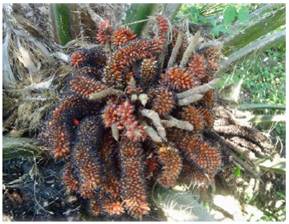
In young E. guineensis palms, the practice of ablation or castration is recommended, eliminating the first inflorescences, whether male or female, that palms emit at the end of the juvenile period (Prasad et al., 2018) to stimulate vegetative growth and root development, especially in dry climates (Corley & Tinker, 2016). This channels nutrients to vegetative development, resulting in high yields at the beginning of harvest (Nazeeb et al., 1988). This practice should be done at monthly intervals until the palms are 36 months old after transplanting to the final site (Chan & Mok, 1973; Chong Ming et al., 2016) or, at most, for 6 months (Corley & Tinker, 2016). The physiological reason for ablation is that young palms begin to emit inflorescences in advance, which produce small bunches with little oil, making harvests inefficient (Nkongho et al., 2014; Corley & Tinker, 2016), meaning it is more practical for palms to develop vegetatively before initiating normal reproductive development. Although ablation is recommended for OxG hybrids to reduce the emission of androgynous inflorescences and induce normal inflorescences (Zambrano, 2004), there are few studies on the effect of early ablation in planted hybrid materials. The objective of this study was to evaluate the effects of ablation on young palms on the subsequent emission of inflorescences (male, female, and androgynous), leaf area, dry weight, and bunch production in the 'Indupalma' OxG hybrid.
Materials and methods
The study was carried out on the Oleaginosas Las Brisas and Oleaginosas Monterrey plantations, both located in Puerto Wilches, Santander, Colombia (7°20'54" N, 73°53'54" W), at an altitude of 80 m a.s.l., with sandy loam soils, an average annual temperature of 29°C, 2,000 h year-1 of sunshine, 75% relative humidity, and average rainfall of 2,800 mm year-1. Two young, close and the same planting age (18 months after transplanting to the field) lots of the Indupalma hybrid (E. oleifera 'Coarí' x E. guineensis 'La Mé') were selected: a commercial lot in Oleaginosas Monterrey without ablation and a lot in Oleaginosas Las Brisas with ablation.
The experiment was carried out in a completely randomized design with two treatments, early ablation (EA) and no ablation (NA), with 4 replicates and 16 palms per replicate. The EA treatment began when the palms had elliptical-shaped inflorescences covered by a floral bract visible at stage 501 (Hormaza et al., 2012), which were eliminated every week for 6 months; in the control treatment (NA), they were not removed. The ablation of the inflorescences was carried out with a 0.10 m wide flat chisel attached to a 1.5 m long wooden stick.
After opening the spathes-when the sex of the inflorescence was visible-the number of female, male, and androgynous inflorescences in each palm was recorded each month to estimate the monthly emission of inflorescences per hectare. Twelve months after the start of the trial, the final number of all inflorescences was recorded.
The leaf area of leaf 17 was determined with the statistical model developed by Contreras et al. (1999) for OxG hybrids: AF17=0.639xC8, where C is the average of 8 central leaflets multiplied by the total number of leaflets. The leaf dry weight (LDW) was calculated using the formula proposed by (Corley et al., 1971).
The bunches were harvested 12 months after the start of the trial, when the first fruit fell off or the epicarp showed signs of cracking, recording the number and total weight of the bunches ha-1.
The data of emitted inflorescences, leaf area (LA), leaf weight (LW), and bunch production (BP) as responses to ablation were subjected to analysis of variance (ANOVA) using the statistical program SAS® 9.1 (SAS Institute Inc., Cary, NC, USA). To analyze the differences between the treatments, a T test was used (P<0.05).
Results and discussion
Figure 2 shows the comparative evolution of the number of inflorescences ha-1 from the beginning of the experiment until 12 months after the ablation treatments. The number of androgynous inflorescences decreased significantly in the EA and NA palms during the 12 months after ablation (Fig. 2A), but their number per month was always lower in the EA palms. The young palms of some OxG hybrids tend to emit this particular type of inflorescence, an anomaly that seems to be associated with their 'Pisifera' parent since, in experimental plots in Costa Rica, the hybrids developed by crossing E. oleifera 'Taisha' mother palms with E. guineensis 'Yangambi,' 'Ekona', and 'Ghana' showed excessive androgyny, which did not occur when the parents were Pisifera palms from the 'Compacta' population (Alvarado et al, 2013). Williams and Thomas (1970) postulated that androgynous inflorescences of E. guineensis are produced during the change from the female to male flowering cycle; the mechanism by which this phenomenon occurs is still unknown.
The emission of female inflorescences (Fig. 2B) was significantly higher in palms with EA than in the NA control, and their number per ha remained constant during the subsequent 12 months but decreased monthly in the NA palms during this period. In contrast, the emission of male inflorescences (Fig. 2C) in the NA and EA palms was negligible during the 12 months after ablation. In the E. guineensis palms, the number of female inflorescences increased, and the number of male inflorescences decreased in young palms after early ablation (Corley & Breure, 1992; Legros et al., 2009). The results indicated that ablation reversed the androgyny of these hybrids and preferentially induced the emission of normal female inflorescences. The early elimination of inflorescence sinks with ablation has an effect on sexual differentiation (Legros et al., 2009), since sex determination in E. guineensis palms occurs about 24 months before anthesis (Corley, 1977; Dufour et al., 1988) and depends on unfavorable conditions that can increase the frequency of male inflorescences (Corley, 1977); in OxG hybrids this condition is not yet known.
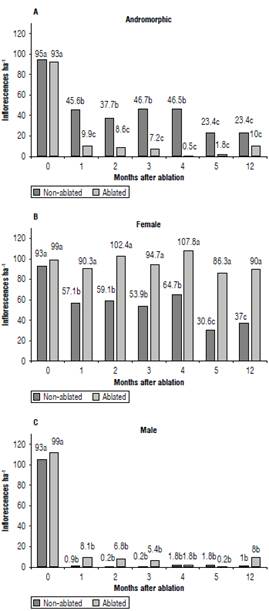
FIGURE 2 Effect of ablation on the subsequent emission of inflorescences in palms of OxG hybrid ('Coarí' x la Mé'). Androgynous (A), female (B), and male (C). In each treatment, means with the same letters are not significantly different according to the T test (P<0.05).
Figure 3 shows the effects of EA and control (NA) on the persistence of androgyny 12 months after the treatments were applied. The EA palms overcame the androgynous phenomenon and produced normal bunches (Fig. ЗА), while the NA palms continued to emit androgynous bunches (Fig. 3B). With ablation, the preferential demand for inflorescences by assimilates is eliminated, favoring their distribution towards vegetative growth (Corley & Tinker, 2016) because vegetative organs must be priority sinks for assimilates during the growth of young palms (Henson, 2007). In addition, the inflorescences and bunches of EA results in the adjustment and limitation of reproductive sinks and the availability of assimilates (Legros et al, 2009), which favors reproductive development because surplus assimilates become available for bunch production (Squire & Corley, 1987; Breure, 1988).
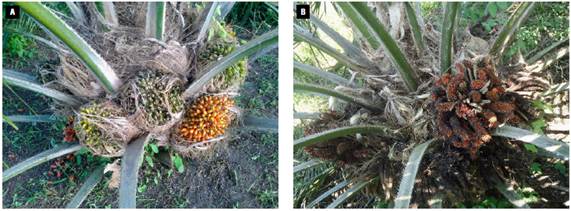
FIGURE 3 Effect of early ablation on the phenomenon of androgyny In palms 12 months after applying the treatments. Plants with ablation (A) and control plants (B).
The leaf area (LA) of the palms with ablation (EA) increased compared to the control (NA), while the dry weight (LDW) did not present differences between the EA and NA (Tab. 1). Several authors have observed that ablation carried out for long periods caused a slight increase in LA in young palms (Benard & Daniel, 1971; Corley & Breure, 1992) and that the number and total area of newly emitted leaves increased significantly with age in the EA inflorescences (Hew & Tam, 1971; Legros et al, 2009).
TABLE 1 Bunch production, leaf area, and dry weight of leaf 17 in palms at 12 months after ablation.
| Treatment | Leaf 17 | Bunch production per year | ||
|---|---|---|---|---|
| Area (m2) | Dry weight (kg) | Number | Weight (t ha-1) | |
| No ablation | 5.9 b | 1.9 | 1,310 b | 2.3 b |
| Ablation | 6.7 a | 2.0 | 1,382 a | 4.9 a |
| Significance | * | Ns | * | * |
*Significant differences according to the t-test (P<0.05), ns non-significant differences according to the t-test (P<0.05).
The number and weight of bunches were significantly increased by ablation (EA). This agrees with the results of an experiment in Indonesia in Ténera palms, in which bunch production was four times higher in palms with ablation than in palms without ablation after six months (Pallas et al., 2013). Corley and Breure (1992) also observed that mean bunch weight increased by 65% after early removal of 75% of inflorescences in Ténera palms, showing that bunch weight and the potential number of bunches increased with a greater intensity of ablation. The ablation of male and female inflorescences and small bunches lead more nutrients towards the initial vegetative development of palms instead of early reproductive development (Nazeeb et al., 1988; Corley & Tinker, 2016).

