




 English (pdf)
 Article in xml format
 Article references
 Automatic translation
 Send this article by e-mail
 Cited by SciELO
  Cited by Google
  Similars in
SciELO
Similars in
SciELO  Similars in Google
 Permalink
Introduction
Naranjilla or lulo (Solanum quitoense Lam.) is a tropical fruit belonging to the Solanaceae family (González-Bonilla & Marín-Arroyo, 2022). Naranjilla is produced commercially in Colombia, Panama, Ecuador and Costa Rica (Ramírez et al., 2021) at altitudes varying between 1,600 and 2,400 m a.s.l. (Fischer et al., 2022). This fruit has strong acceptance in international markets such as the USA and Europe (Criollo-Escobar et al., 2020; Jaime Guerrero et al., 2022). The naranjilla has an oval or round shape, depending on the variety. The diameter of the fruit can vary from 4 to 9 cm (Gargiullo et al., 2008). The surface of the fruit is covered with brown or black trichomes and the color of the epidermis changes from dark green to bright orange when it reaches physiological maturity. The pulp is translucent greenish yellow, the seeds are round and flat with a diameter of 2 mm to 3 mm, and each fruit can have between 800 to 1,200 seeds (Gargiullo et al., 2008; Ramírez et al., 2018).
As part of the group of tropical fruits considered exotic, the naranjilla is an attractive food due to its delicious acid flavor and aroma, whereas the peel has an attractive color due to the synthesis of carotenoids. This fruit has an important content of antioxidants that can improve health and it is a source of vitamins E, C, B1, B2, B3, B6, and provitamin A, minerals such as iron, calcium, phosphorus, potassium, and nitrogen, carbohydrates, and proteins (Gancel et al., 2008; Pratt et al., 2008; Ramírez et al., 2018). During ripening, naranjilla fruits change color from green to yellow because of chlorophyll degradation (Forero et al., 2014). In parallel to this process, a decrease in the pH and acidity of the fruits is generated due to the accumulation of organic acids and their subsequent degradation during respiration, while the concentration of total soluble solids and vitamin C increases until reaching maximum values during ripening (González Loaiza et al., 2014; Andrade-Cuvi et al., 2016). In ripening, naranjillas firmness is reduced; this may be the result of starch hydrolysis and enzymatic degradation of pectins and hemicelluloses (Ochoa-Vargas et al., 2016).
During postharvest, naranjilla fruit losses can be up to 50% in the stages of handling, transport, and storage (Forero et al., 2014). For this reason, the development and application technologies for maintaining the product's quality and to reduce postharvest losses have become one of the most important aspects of research at the agricultural level (Escobar Hernández et al., 2014). Several physical treatments can be applied so that the product delays its senescence and maintains the desired quality. Among these technologies are cold storage, modified atmosphere packaging (Fallik & Ilic, 2018), UV-C radiation (Zhang & Jiang, 2019), 1-meth-ylcyclopropene (Balaguera-López, Salamanca-Gutiérrez et al., 2014), UV-C and gamma radiation, and ozone application. The effectiveness of each technique will depend on the standards and conditions of their use and management to achieve the desired objective of increasing the postharvest life and reducing the losses of the naranjilla fruits.
This review is aimed to present the main physiological changes, such as respiration pattern, ethylene production, and biochemical processes related to the postharvest of naranjilla fruits, as well as the main technologies implemented to extend the fruit's shelf life and maintain its quality.
The pattern of respiration and ethylene production
The naranjilla is considered a climacteric fruit whose respiration rate is lower than that of other climacteric fruits, even when the typical climacteric peak is observed for the respiration rate vs. ripening stage curve (Acosta et al., 2009). Its respiration rate has been recorded at around 13.9 mg CO2 kg-1 h-1 at physiological maturity (Ochoa-Vargas et al., 2016) and reaches values of 28.0 mg CO2 kg-1 h-1 during the climacteric peak (Arango et al., 1999). However, studies on the development of the climacteric pattern of the naranjilla are limited and could lead to a more rigorous evaluation of the climacteric pattern of the fruit.
Ethylene is a gaseous plant hormone that acts as a key regulator of many physiological processes in plants including fruit ripening; the gas has an even more marked effect on climacteric fruits (Bajguz & Piotrowska-Niczyporuk, 2023). Ethylene generates a stimulus for the expression of genes related to the ripening and senescence of fruit and vegetables and, consequently, regulates these processes in fruits such as naranjilla at the molecular, biochemical, and physiological levels (Balaguera-López, Salamanca-Gutiérrez et al., 2014). Naranjilla fruits show changes in ethylene production rate during postharvest ranging from 1.6 to 11.8 mg C2H4 kg-1 h-1 over a period of 21 d after harvest (Andrade-Cuvi et al., 2018). However, ethylene production rates are low compared to other climacteric fruits.
The respiration and ethylene production data available for naranjilla during postharvest are still scarce and few studies describe the behavior of the respiratory rate during the postharvest stage or its relationship with ethylene production during the same stage. Respiratory intensity does not have a direct relationship with storage time, type of packaging, or storage temperature in their research (Forero et al., 2014). In naranjilla fruits treated with 1-MCP, there is a 27% reduction in the respiratory rate compared to untreated samples during the entire storage period (Andrade-Cuvi, 2018).
Changes in fruit firmness
One of the main quality factors of fruit and vegetable products during postharvest is firmness (Martínez-González et al., 2017). Extreme softening reduces the fruit shelf life and is one of the symptoms associated with senescence (Yahia & Carrillo-López, 2019; Wang et al., 2022). Textural changes in fruits during ripening and postharvest storage are mainly associated with middle lamella dissolution and primary cell wall disassembly that occur through the action of pectin methylesterase (PME), polygalacturonase (PG), cellulase (Cel), and β-glucosidase (β-glu) (Lin et al., 2020; Song et al., 2022). Quiroga Alvarez & Murillo Caviedes (2012) show that, in naranjilla fruits, the activity of the enzyme β-xylosidase increases as a function of ripening. Likewise, the authors observe a reduction in firmness and color changes that is attributed to the hydrolysis of hemicellulose present in the primary wall of the rind because of the accumulation of cellulose microfibrils and the formation of a lax network that allows cell growth. Ospina Monsalve et al. (2007) evaluate the firmness of naranjilla fruits harvested at different maturity stages. As a result they show that unripe fruits have a longitudinal load resistance of 226 N and transverse of 84.8 N, while for ripe fruits the average fracture force in longitudinal position is 180 N and transverse 68.5 N. The maximum force measured in the exocarp showed a mean value of 14.4 and 15.7 N for unripe and ripe fruits.
Pigments and color change
Fruit color is one of the key quality characteristics for consumers and determines the acceptability of a product. Therefore, color evaluation is very relevant for estimating fruit quality (Ayustaningwarno et al., 2021). González Loaiza (2014)) describe the color change of the naranjilla fruit during ripening.
During ripening, the epidermis of the fruits gradually changes from dark green to light green and then shows yellow shades along the sides until it reaches a uniform yellow color characteristic of ripe fruit. According to Casierra-Posada et al. (2004), the naranjilla fruits have five maturity stages based on the percentage variation of color. These maturity stages are used to define the harvest time of the fruit and can be considered as a reference parameter of ripening. However, the Colombian Technical Standard (NTC 5093) classifies naranjilla fruits in six ripening stages (0-5) as follow: color 0, fruits with a dark green color, physiologically ripe; color 1, fruit with dark green and light green shades; color 2, green fruits with some orange shades; color 3, fruit with orange and green glimpses towards the center of the fruit; color 4, the fruit is orange but with a few green traces; and finally, color 5, entirely orange fruits (ICONTEC, 2002).
Mejía et al. (2012) analyze the color change of naranjilla fruits at six stages of ripening and find slight visual changes during the first stages of ripening (0-2), followed by a marked increase during stages of color break (3-4) and a decrease towards the last stage of ripening. This behavior is caused by chlorophyll degradation and an increase in carotenoid pigments, processes that in turn are influenced by the activity of ethylene (Acosta et al., 2009; Andrade-Cuvi et al., 2015). Andrade-Cuvi et al. (2016) find similar results in three varieties of naranjilla, Inap-Quitoense (2009), Baeza and Agria, where the values of L* color coordinate (lightness) and b* chromatic coordinate (blue to yellow hue) increase by 20 and 30% at ripening stages and 3 to 5% in the three varieties evaluated. Likewise, Andrade-Cuvi et al. (2019) find an increase in the chromatic coordinate a* (green to red hue) from 29.2 to 30.9 in the 21 d of sampling, attributed to the accumulation of compounds such as carotenoids replacing chlorophyll that is degraded by the action of chlorophyllase and chlorophyll oxidase (Arteaga Dalgo et al., 2014; Yahia & Carrillo-López, 2019).
Carotenoids are important pigments that are synthesized during the ripening of many fruits, including naranjilla, whose content may vary according to the tissue evaluated in the fruits. Gancel et al. (2008) find that the total carotenoid contents in naranjilla fruits is 23.0 mg of β-carotene equivalents per 100 g (dry weight) in fruit skin compared to placenta tissues (5.0 mg) or pulp (7.4 mg). For their part, Acosta et al. (2009) report that carotenoid content is lower in naranjilla fruits from Costa Rica, Colombia, and Ecuador, compared to fruits such as grapefruit and nectarine with a higher concentration of 20 g-1. Acosta et al. (2009) identify β-carotene as the main carotenoid present in naranjilla fruits, of which all-trans-β-carotene and 13- cis-β-carotene stand out, as well as lutein. Similarly, they find that all-trans-β-carotene is the main carotenoid present in naranjilla fruit and can account for up to 45% of the total carotenoid content; it is found in greater proportion in the peel (36.22 g-1 of fresh weight, FW), followed by the pulp (3.80 g-1 FW) and placenta tissues (2.08 g-1 FW). The above is consistent with the color changes observed during ripening, where the peel has an orange hue, the pulp a yellow coloration, and the placenta tissues a yellowish green color.
Although color is one of the most used parameters to define the ripening stages, even for commercial purposes, González-Bonilla & Marín-Arroyo (2022) recommend the consideration of other parameter for an objective determination of the ripening stages. They conclude, as a usefule tool, it is possible to classify naranjilla fruits objectively through a limited number of non-destructive parameters from harvesting to consumption such as size and shape.
Carbohydrates
Among the metabolic changes involved in the sensory quality of fruits, the variation in the concentration of sugars and organic acids is one of the most important parameters since it affects the flavor of the product (Schulz et al., 2021). The proportion of acids and sugars establishes the organoleptic quality of the fruit. Naranjilla fruits have a concentration of total soluble solids between 1.7 and 10% (w/w) and acidity between 2.2 and 4.7%, depending on the ripening stage, type of storage, and handling during postharvest (Andrade-Cuvi et al., 2018; Torres Pintado, 2020; Escobar, 2022; Molano-Díaz et al., 2022). The main soluble sugars are fructose, glucose, and sucrose and the main organic acids are malic, citric, and oxalic (Jawad et al., 2020). In naranjilla fruits, the sugar content in the pulp of 24.57 glucose/g tissue is reported at maturity stage 5 (ripe); and in the fruit peel the values vary between 56.52-141.83 glucose/g tissue on a dry basis for maturity stages 1 and 5 (Andrade-Cuvi et al., 2021). Acosta et al. (2009) report individual values for sucrose, glucose, and fructose content of 16.0, 6.8, and 7.0 mg g-1 fresh weight, respectively.
Of the organic acids in the naranjilla fruit, citric acid is the most preponderant. Likewise, this fruit has significant levels of ascorbic acid, reporting an increase of up to 90% of this acid throughout the ripening process, from 0.0230.312 mg g-1 ml-1 of filtrate (Acosta et al., 2009; González Loaiza et al., 2014; Andrade-Cuvi et al., 2021).
Antioxidant activity
Antioxidants are compounds that provide benefits to human health since they protect the body from damage caused by free radicals (Mejía-Reyes et al., 2022). Among the antioxidant compounds present in naranjilla are chlorogenic acids and their hexosides in the pulp and placental tissues and flavonol glycosides in the skin (Gancel et al., 2008). It is also a source of vitamins E, C, B1, B2, B3, B6, and provitamin A, minerals such as iron, calcium, phosphorus, potassium, and nitrogen, carbohydrates, and proteins (Ramírez et al., 2018).
Naranjilla fruit contains between 0.11-0.13 mg ascorbic acid/g fresh weight, while the total content of soluble phenolic compounds is 0.91 mg GAE/g, and its antioxidant capacity has a value of 3.2 μmol Trolox/g (Vasco et al., 2008).
The epidermis of the naranjilla fruit has a total polyphenol content of 1.5 and 2.6 times more than the pulp and placental tissue and an ascorbic acid content of the fruit parts, placental tissue, pulp, and peel of 1.25, 0.69, and 0.20 mg/g dry weight, respectively (Acosta et al., 2009). However, the antioxidant capacity of different parts of the naranjilla fruit cannot be attributed solely to ascorbic acid (Llerena et al., 2020). The antioxidant activity of naranjilla fruit is the result of the interaction of its free water-soluble components (organic acids, vitamin C), some water-soluble phenolic compounds and carotenoids. Similarly, gallic acid levels range from 5.11 to 8.98 mg/g (Vasco et al., 2008; Acosta et al., 2009; Contreras-Calderón et al., 2011; Llerena et al., 2014).
Post-harvest technologies
Postharvest preservation technologies have been developed to maintain the quality of fruit and vegetable products for as long as possible, especially for those that are of greater interest to consumers due to their health benefits (Yahia & Carrillo-López, 2019). However, the selection, thoroughness, and application of these strategies are vital parameters to consider given that they affect the fruit physiology and the behavior of its quality characteristics. The following is a description of the technologies used in the preservation of naranjilla fruits as well as the results obtained in each study.
Temperature
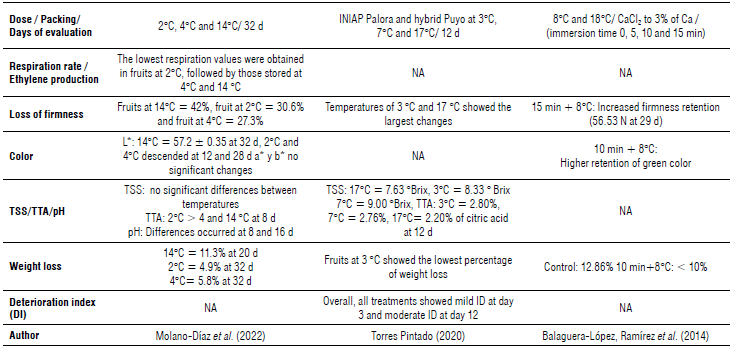
High temperatures generate rapid fruit degradation by accelerating the rate of respiration and ethylene production, as well as the development of microbial deterioration (Yahia & Carrillo-López, 2019). Consequently, the use of low storage temperatures is considered the main technique for the preservation of agricultural products given its effectiveness in delaying senescence and decreasing microbial activity (Zhao et al., 2022). The recommended storage temperature for naranjilla is 10°C with a relative humidity of 90%; under these conditions it can have a shelf life of up to 16 d (Galvis & Herrera, 1999). However, different storage temperatures have been evaluated in naranjilla fruits. Fruits preserved at room temperature (14°C), had the highest weight loss with a value of 11.3% and firmness loss of 42%, compared to the fruits in refrigeration at 2°C and 4°C, where the weight loss is of 4.9 and 5.8% and the firmness decrease is 30.6 and 27.3% (Molano-Díaz et al., 2022). Naranjilla fruits of the INIAP Palora and the Puyo hybrid varieties maintain their firmness in refrigeration at 3°C during 1-2 weeks (Torres Pintado, 2020). Finally, Balaguera-López et al. (2014) record the highest weight loss with a value of 12.86% in naranjilla fruits at room temperature, while naranjilla fruits treated with CaCl2 and refrigerated at 8°C had a higher firmness (56.53 N). Other results are presented in Table 1.
1-Methylcyclopropene
1-Methylcyclopropene (1-MCP) is a gaseous hydrocarbon used commercially to maintain postharvest product quality and extend shelf life (Blankenship & Dole, 2003; Li et al., 2022). 1-MCP is an efficient inhibitor of ethylene whose mode of action focuses on blocking ethylene signaling by irreversibly binding to ethylene receptors (ETR1) with ten times higher affinity than ethylene, and consequently it abrogates ethylene-related responses (Blankenship & Dole, 2003). This delays the fruit ripening and senescence, in addition to regulating autocatalytic ethylene production (Blankenship & Dole, 2003; Shu et al., 2020; Balaguera-López et al., 2021). 1-MCP is mostly used on climacteric fruits and its method, application time, and dosage depend on the fruit and plant to be evaluated (Li et al., 2022). During postharvest, the application of 1-MCP has shown benefits in terms of an inhibition of ethylene synthesis, preventing loss of fruit firmness, and reducing the presence of physiological disorders during storage (González et al., 2021; Li et al., 2022). In naranjilla fruits treated with 1-MCP, Andrade-Cuvi (2018) report that the respiration rate reduced by 27% compared to the untreated fruits (Tab. 2). Molano-Díaz et al. (2022) find that naranjilla fruits should be stored at 2°C with a 1-MCP dose of 560 μg L-1.
Modified atmosphere packaging
Modified atmosphere packaging (MAP) is commonly used in the preservation of fruits and vegetables to increase their shelf life (Wood et al., 2022). For products preserved without any processing, a balance between respiration and gas passage through the package must be created by decreasing the O2 concentration and keeping the CO2 concentration at the top of the package in a controlled manner (Castellanos et al., 2016). To guarantee the balance in the MAP, the most used materials are polymeric films of different calibers and sizes, which can be flexible or semi-flexible with or without perforations (Castellanos & Herrera, 2017).
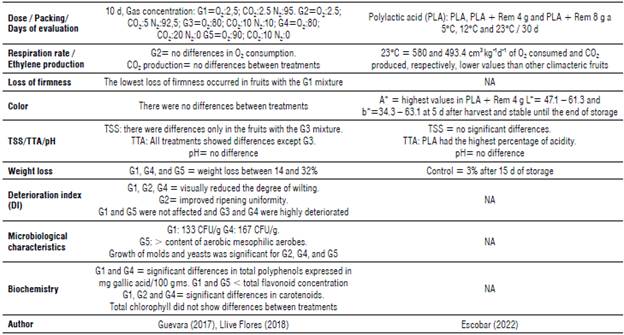
Among the benefits of MAP are the delay in product ripening, lower ethylene production, reduction of chilling injury, development of pathogenic diseases (Yahia & Carrillo-López, 2019). Despite the benefits, negative effects can also occur during storage when processes related to anaerobic metabolism occur, giving rise to alcohols and aldehydes that trigger odors and flavors that are unpleasant (De la Vega et al., 2017). In naranjilla fruits under MAP conditions, Guevara (2017), Llive Flores (2018), and Escobar (2022) report respiratory rates of 580 cm3 kg-1 d-1 of O2 consumed and 493.4 cm3 kg-1 d-1 of CO2 produced, lower concentration of total flavonoids, and lower microbial affectation (Tab. 3).
UV-C radiation
In addition to the benefits obtained from the application of methods for the preservation of product quality and extension of shelf life, the worldwide trend of environmentally friendly management also is to apply postharvest technologies. Among the so-called "emerging technologies" for fruit and vegetable preservation is the application of UV radiation; this has gained momentum given its easy implementation and high effectiveness to counter microbial activity affecting the product and its low environmental impact (Andrade-Cuvi, 2018; Michailidis et al., 2019).
The application of UV-B or UV-C radiation has a positive effect on the control of damage caused by pathogens and slows senescence, as well as color changes and the synthesis of antioxidants and phenolic compounds (Abdipour et al., 2019). The UV-C radiation (200-280 nm), with 3-5 min exposure during the postharvest period is related to slowing down the softening process and increasing secondary metabolites of fleshy fruits, while inhibiting the firmness loss and the occurrence of browning (Andrade-Cuvi, 2018; Ma et al., 2021). In naranjilla fruits, there is a reduced decay rate compared to untreated fruits, a lower firmness loss rate, and lower color changes in UV-C-treated fruits (5 kJ m-1 radiation) (Andrade-Cuvi et al., 2013).
Gamma radiation
Gamma radiation is non-thermal ionizing radiation emitted by cobalt (60Co) or cesium (137Cs) sources that generates an electromagnetic radiation of a very short wavelength, the same as occurs with X-rays, ultraviolet light, visible infrared, and microwaves (Andrade-Cuvi et al., 2019). The use of gamma radiation is focused on pest and disease control during postharvest; it does not generate environmental damage, does not alter the quality of the fruit, and it extends its postharvest shelf life (Lizarazo-Peña et al., 2022). An evaluation of the effectiveness of gamma rays shows that treated fruits have a mild deterioration index compared to control fruits that show a severe damage index (Andrade-Cuvi et al., 2019). The shelf life of naranjilla treated with 500 Gy was increased by 7 d in relation to the fruits without treatment; however, the authors indicate that its use is limited due to the cost of application for practical purposes and access to this technology (Andrade-Cuvi et al., 2019).
Ozone
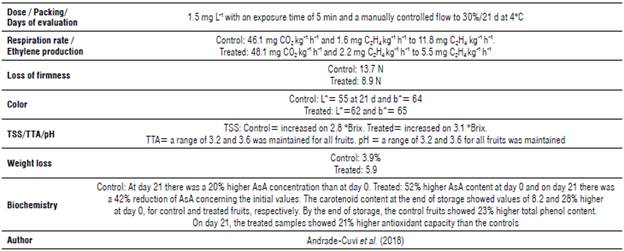
Ozone (O3) is considered an oxidizing agent for gaseous or aqueous use whose retarding effect on the loss of the physical characteristics of the naranjilla and other fruits as well as the reduction of damage by microorganisms (Oyom et al., 2022). Among the characteristics that make ozone commercially attractive for postharvest use is principally that it does not leave carcinogenic residues in treated products as occur with chemical treatments, so it has no negative effects on the health of consumers (Chen et al., 2020). In naranjilla fruits, Andrade-Cuvi et al. (2018) report that ethylene production for samples treated with gaseous ozone was half of that produced in control fruits and the antioxidant capacity of treated fruits is 21% higher compared to controls (Tab. 4).

Conclusions
The physiological characteristics of naranjilla fruits, such as their moderate-low respiration rate and low ethylene production, classify this product as perishable with a 2-3 week shelf life at room conditions. The main changes associated with ripening and deterioration are reduction in firmness, weight loss, yellowing of the peel and pulp, and fungal sporulation. For the specific case of naranjilla fruits and according to the available information, the storage at low temperatures, individually or in combination with other technologies that contribute to the reduction of physiological processes such as MAP, can result in a significant increase in product shelf life (4-6 weeks).
The use of emerging treatments such as gamma and UV-C radiation has shown positive effects on the reduction of microbial activity, as well as on the preservation of the physiochemical, and biochemical characteristics of the fruit. The application of 1-MCP and gaseous ozone has shown satisfactory results only in terms of the physical and biochemical characteristics of naranjilla fruits because its effect is only related to the control of ethylene activity.
It is advisable to carry out studies that allow a holistic understanding of the application of each technology and the possible combination between them and the effects on all aspects of product quality, such as chemical, physical, and biochemical characteristics, as well as microbial activity in naranjilla fruits to determine what technologies may be ideal for the preservation and storage of naranjilla fruit during post-harvest.

