




 English (pdf)
 Article in xml format
 Article references
 Automatic translation
 Send this article by e-mail
 Cited by SciELO
  Cited by Google
  Similars in
SciELO
Similars in
SciELO  Similars in Google
 Permalink

Introduction
Digital media and the Internet have become essential sources of information for the population, but unfortunately, they are also a source of untruthful guidance regarding diseases and public health actions1,2. Mis/disinformation is a phenomenon that escalated during the COVID-19 pandemic 3. The literature proposes the difference between misinformation as information with no intention to mislead, while disinformation seeks the deception of the message recipient 4. The World Health Organization (WHO) defined an infodemic as an overabundance of information -accurate or not - that is generated and quickly spread in the context of health emergencies, which makes it difficult for people to identify reliable information for decision-making 2,5.
People can become involved in inappropriate behaviors as a direct consequence of mis/disinformation related to health problems6. Uncertainty and fear engender polarized positions on public policies, incite violence between groups, and recommend the consumption of non-proven treatments, which can result in adverse drug events and even death 7,8. Conspiracy theories are often spread during infodemics, are commonly tied to emotions such as fear and mistrust9 and research shows that believing in them decreases the likelihood of following official preventive measures 10.
WhatsApp and mis/disinformation during the COVID-19 pandemic
Social media platforms such as Facebook, Twitter, Instagram, WhatsApp, and others were the primary means of communication during the COVID-19 pandemic 3. Different international bodies such as WHO called for the urgent need to characterize and study the infodemic messages disseminated mainly on social media platforms 2 intending to find global answers 11.
Additionally, a growing body of literature focused on developing and understanding the characteristics, drivers, and consequences of mis/disinformation transmitted by social networks 12,13 has been generated in order to provide empirical data for technological solutions. However, most analyses are quantitative 13,14 and focus on open social networks in English, mainly Facebook, YouTube, and Twitter 15. Few studies have qualitatively analyzed elements that explain the discursive keys of infodemics 16.
Given its private nature, there is less opportunity to analyze messages shared on encrypted social networks like WhatsApp. Therefore, this social network has become a common means of disseminating messages that pose a severe risk to public health, such as inadequate advice on preventing and curing COVID-19 and other health issues17.
WhatsApp, a network widely used in Latin America by a broad age group, is commonly used in countries of the Global South, such as Mexico. Mexico is the country with the highest use of social networks in Latin America 18. A survey conducted in March 2020 to explore how Mexicans receive information regarding the pandemic found that 83% of the sample claimed to have received information through social networks, particularly Facebook (41%) and WhatsApp (39%) 19.
This study explores the COVID-19-related misinformation, themes, types, and authorship analyzing clues of communication shared on WhatsApp in Mexico, during the beginning of the epidemic, a period that has been reported as key in shaping the population's perception and response 20.
This article's goal is to describe and examine the WhatsApp infodemic discourses in a sample node in Mexico during the first three months of the epidemic while analyzing deep narratives that help understand the infodemic clues and provide elements for improving contextualized responses to the infodemic.
Methodology
Study design and conceptual framework
This exploratory cross-sectional study gathered and analyzed a convenience sample of mis/disinforming WhatsApp COVID-19 messages, focusing on their features and implications during the first three months of the pandemic in Mexico.
Some authors have generated conceptual frameworks to analyze the COVID-19-related mis/disinformation messages 13,21 Brennen3 proposes detailed categories for classifying the types, sources, and contents of COVID-19 mis/disinformation messages. This exploratory study modifies these dimensions to analyze infodemics 13.
Data collection
Six authors of the research team collected all WhatsApp messages related to COVID-19 received in their personal WhatsApp mobile applications from March 18th, 2020 to June 15th, 2020, a period with an increased exchange of messages containing mis/disinformation. The authors acted as collection nodes to capture as many messages as possible, asking their contacts and extended networks to share any COVID-19-related messages. The snowball technique used in this study is a technique used by other studies to be able to collect messages that, due to the nature of WhatsApp, only circulate in private conversations 17,22,23 and to our knowledge, it's the only way to access private conversations. Because the authors asked their contacts to forward any COVID-19 messages they received, the network extended exponentially beyond their immediate contacts. This approach ensured diverse sociodemographic and educational profiles, reducing non-representation biases. The messages were collected in a platform where they were labeled depending on the temporality of their circulation. No phone numbers of senders were stored.
Data Analysis
Retrospective descriptive statistics analyzed message frequency and type. A qualitative, iterative thematic analysis was conducted, with codes generated inductively, followed by a deductive thematic analysis of WhatsApp message characteristics and topics, using methods validated by international infodemic studies 13.
Quantitative and qualitative methodologies in this study explored the themes, type, and authorship of the messages, based on the systematization proposed by Brennen and collaborators (see Annex I. Code book, for definitions)3. All messages were analyzed by two reviewers independently. The messages were divided into three blocks of 35; in pairs, six researchers independently reviewed one of the three groups of messages. Constant analysis meetings were held in the research group. When in disagreement, consensus was reached by group discussion. Inter-rater reliability results averaged 0.61 according to the inter-rater agreement.
First, topics were classified into ten different themes: the origin of the virus, characteristics of the virus, diagnosis, transmission, prevention, effect of the disease, treatment, vaccine, management of the pandemic by the authorities, as well as conspiracy as an emergent category. The categorization was not exclusive; the same message could be classified under one or more categories.
The type of content was based on a search for scientific evidence conducted on Pubmed, CDC Guidelines, FDA Guidelines, WHO Guidelines, Mexico's Health Secretariat website, as well as news verification websites, as done for previous studies13.
We distinguished the different types of messages depending on how they presented the false information following these categories: misleading content, totally false or fabricated, false connection, false context, imposter content, and spiritual content (Annex I). The categorization was not exclusive; one message included possibly two or more types of false information (Figure 1, Panel B: Type of contents).
Finally, we analyzed authorship claimed in the message: messages claimed to be authored by individuals with authority, government, or official entities, messages that claimed to be authored by a public figure, by an unknown person, or from an anonymous source. The categories were mutually exclusive.
Results
A total of 124 messages were received. Messages were excluded after being classified as memes (n = 3) or true contents (n=14), giving a final sample of 107 messages fully analyzed.
Concerning the topics of the WhatsApp messages, we found that over 75% of all message's contents were about prevention, conspiracy, treatment, how the authority handled the pandemic, and the origin of the virus. Out of the 107 messages, we chose one of the ten different topics 196 times, meaning that one message could be classified as being related to two different topics (Figure 1, Panel A). The most common type of content was fabricated, misleading, or impostered (Figure 1, Panel B). Most of the messages (73.8%) mentioned in the message claimed to be authored by an individual or group with recognized expertise (Figure 1, Panel C). Authors without medical expertise or public figures accounted for 67.3% of the sample. The remainder of the messages (18.7%) represented anonymous messages.
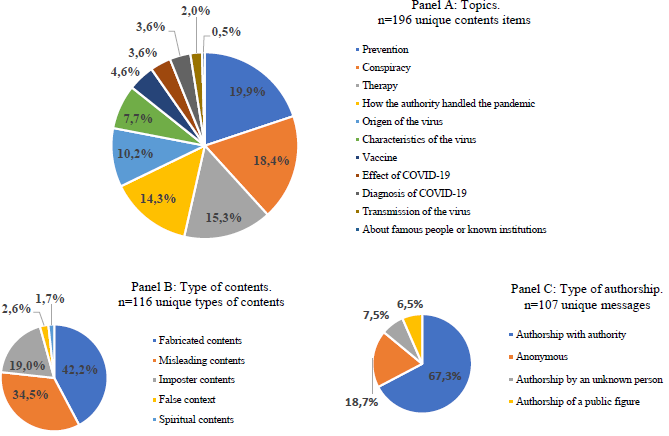
Figure 1 Descriptive analysis of infodemic messages according to topic, content type, and authorship. Source: Own creation.
Qualitative Contents of the WhatsApp Messages
Regarding the origin of the virus (14.3%), the main idea behind the messages in this category was that the virus was created to establish a new world order, a form of conspiracy as it can be read in testimonial I (TI, Table 1) (Table 1. Message extracts) and whose complexity can be seen in the dendrogram I (Figure 2. Dendrograms) although exceptional messages stated that the virus did not exist.
Table 1 Qualitative messages of infodemic. Source, own elaboration.
| Analysis of COVID-19 infodemic messages | |||||||||||||
| Messages* | By topic | By type | By authority | ||||||||||
| Origin of the virus | Characteristics, effects, and diagnosis | COVID-19 Prevention | COVID-19 Therapy | COVID-19 Vaccination | Management of the authorities | Conspiracy | Fabricated messages | Manipulated and imposter messages | Author with Authority | Author without authority | Unknown authority and impersonated identity | Anonymous messages | |
| Testimonial 1 | X | X | X | ||||||||||
| T1. The virus was created; it has AIDS inside its structure. It was made as a biological weapon to wipe out much of the population, to kill the enemies, and to sow chaos, despair, and submission in the survivors. It is intended to make a new world order, a global technological dictatorship, where the Illuminati entrepreneurs take control of governments. (#93_March 2020, Video_Daisy D, Venezuelan model+) | |||||||||||||
| Testimonial 2 | X | X | X | X | |||||||||
| T2. The Italian doctors disobeyed the World Health Law WHO, not to do autopsies on the dead of the Coronavirus, and they found that it is NOT a VIRUS but a BACTERIUM that causes death. It causes blood clots and causes the death of the patient. Disseminated intravascular coagulation (Thrombosis) [...] it is not a virus as we have been led to believe, but a bacterium... amplified with 5G electromagnetic radiation that also produces inflammation and hypoxia. (#33_ May 2020_Text_Italian Doctors) | |||||||||||||
| Testimonial 3 | X | X | X | ||||||||||
| T4. Diagnosis: Hold your breath for 10 seconds; if you don’t have tension or cough, you don’t have Covid-19. (#117_ April 2020_Video_ Ministry of Japan - supplanted identity) | |||||||||||||
| Testimonial 4 | X | X | X | ||||||||||
| T5. Family and friends, I share with you. A person who has relatives in Israel tells us that in Israel, there is no one infected with the coronavirus because everyone in Israel drinks at night a cup of hot water with lemon and a little baking soda, as this has been proven to kill the coronavirus (#8_March 2020_Text_anonymous). | |||||||||||||
| Testimonial 5 | X | X | X | X | X | ||||||||
| T6. Chlorine Dioxide is a gas that does not harm the organism or alter its functions [...] It elevates the immune system, improves the conditions of the metabolic system, regulates blood pressure and the functioning of red blood cells, excellent for treating or preventing COVID-19. They don’t want you to know (#32_March 2020_Text_Andrew Kross_ scientist) | |||||||||||||
| Testimonial 6 | X | X | X | X | |||||||||
| T10. Important notice. I have just been informed by a nurse friend of mine who works in the Social Security [institution of the Mexican health system] that the government is planning to carry out a vaccination campaign for supposed protection against COVID-19, but it is a pure farce; they are only going to inject the virus so that the nation will be infected [...]. THIS GOVERNMENT WANTS TO KILL US (#65_May 2020 _Image_anonymous) | |||||||||||||
| Testimonial 7 | X | X | X | X | |||||||||
| T12. I am a physician. My name is [xxx]. IMSS [Central hospital] specialist at the National Medical Center of the West. (...) The director of the hospital informs us that it is an indication of the Presidency of the Republic that only 3 new [COVID] cases will be reported per day and only one death every third day. (...) If we don’t do it, we will abide by the consequences that the Presidency will not guarantee our safety, and we will be replaced by military doctors. (#26_April 2021_Text_Dr. X_physician) | |||||||||||||
| Testimonial 8 | X | X | X | ||||||||||
| T15. Gargling with salt changes the PH, and the virus will die. One of the places where the virus replicates the most is in the throat. I ask the president and the press to call on the population to gargle 3 times a day. Within a week, the pandemic would be under control. (#116_ April 2020_Video_Pharmaceutical and Chemist Jose Parres) | |||||||||||||
* This table contains excerpts of infodemic messages circulating on WhatsApp. The testimonials or message excerpts are categorized by topic, type, and authority and are listed progressively. +Messages were named by an identifier constructed as follows: #93_March 2020, Video_Daisy D, where ‘#93’ identifier number in the database, ‘March 2020’ is the date on which the message first circulated in our network, ‘Video’ is the message format and ‘Daisy D’ refers to the author of the message.
The characteristics (7.7%) and effects (3.6%) of the virus were closely related categories. There was confusion about the nature of the causative agent, stating that it was not a virus but a bacterium, and on the other hand, there were doubts about the severity of the disease. These doubts can be seen reflected in T2 (Table 1). The messages on diagnosis and detection of COVID-19 (3.6%) display interpretations of conspiracy theories about the diagnostic methods proposed as effective by science, claiming that these are forms of population control and suggest home-made ways of detecting the virus (like holding your breath), as can be read in the message offered by testimonial T3 (Table 1).
Most of the messages dealt with recommendations for prevention (19.9%) and treatment (15.3%), the contents of which were closely related. In both categories, naturopathic solutions to the virus coexisted with advice on self-medication. The main drugs recommended were hydroxychloroquine, ivermectin, remdesivir, antibiotics, and chlorine dioxide, a chemical compound with no proven effectiveness. The conspiracy theme was also combined with prevention and treatment. Preventive mechanisms offered by science, such as the use of masks were questioned and homemade mechanisms to cope with the virus were promoted, T3, T4 (Table 1). Details on prevention messages can be seen in dendrograms 2 and 3 (Figure 2).
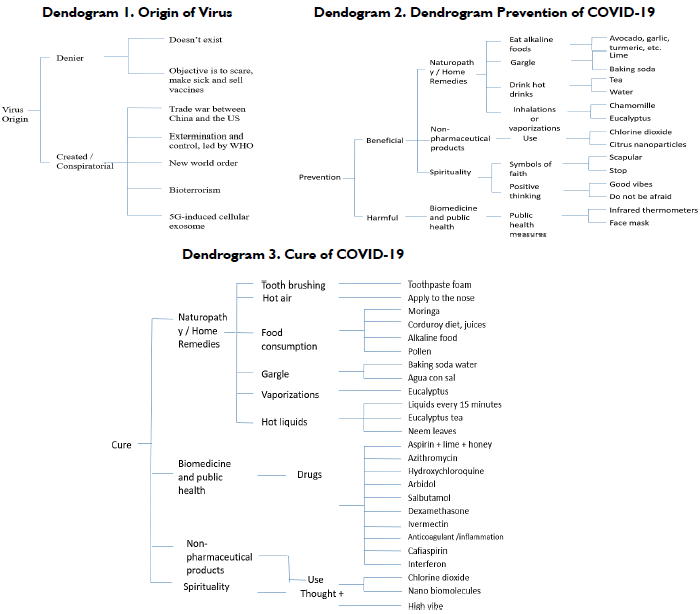
The themes concerning the vaccine (4.6%) and the authorities' handling of the epidemic (14.3%) were related to each other. The entirety of those messages stated that the vaccine would harm people, which is in turn related to distrust in the government, as can be read in quotes T6 and T7 (Table 1).
Finally, conspiracy (18.4%) emerged as a new category in the analysis, having a transversal presence in all the topics, offering detailed information and rich explanations. Messages that exclusively explained the conspiracy represented nearly 19% of the sample, however, conspiracy messages overlap with most in our sample (69.8%) (see overlapping categories Annex 2). Conspiracy becomes an explanatory axis of all aspects of the life of societies globally as it can be read in this message TI, T2, T5 - T7 (Table 1).
Figure 3 shows conspiracy arguments across all COVID-19 infodemic topics, highlighting prevalent deception. The circle size represents each topic's weight in explaining the infodemic, while the arrow size indicates the direction and strength of their connections. Text boxes highlight key findings for each theme.
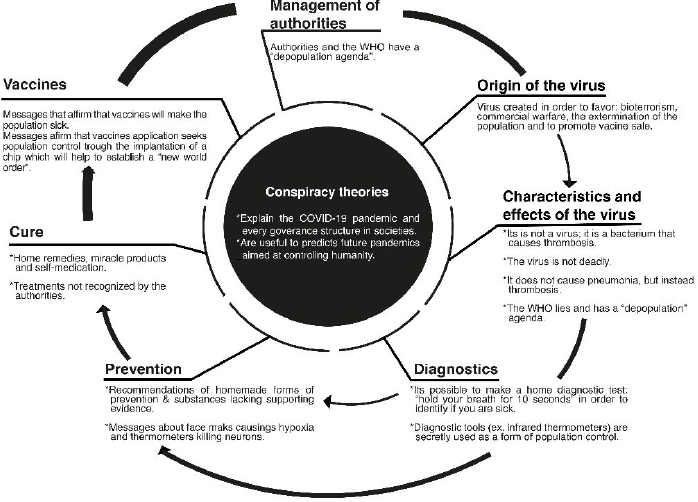
Figure 3 Graphical Representation of Conspiracy. Source, own elaboration. Identified types of mis/disinformation
Quantitatively, fabricated messages (42.2%) were the most common type of mis/disinformation found. Manipulated messages (34.5%) and impostor authorship (19%), where the author's identity is impersonated, were second and third respectively.
False or fabricated and manipulated disinformation appeared across all topics analyzed, overlapping with conspiracy themes like virus creation, 5G, and alkaline foods as prevention and treatment, as seen in testimonials TI- T5, T7 (Table 1).
Impostered messages, where the identity of an individual or an institution is impersonated by passing them off as the message's author, dealt with false scientific facts related to alleged scientific knowledge offering legitimacy to conspiracy theories T3, T7 (Table 1).
False and impersonated testimonies included messages where the author impersonated individuals or institutions, such as UNICEF, scientists from TEC de Monterrey (a Mexican University), and Japan's Minister of Health (T3) (Table 1).
Authorship
Two-thirds (67.3%) of the messages claimed authorship by health authorities like doctors, nurses, scientists, or public officials, using scientific language to bolster credibility. They often specified the author's name, profession, academic degree, career path, or institution. Sometimes, the authorship was attributed to groups like 'Italian doctors' or 'the Russian virology center.' Most of these claims were impersonated, as shown in testimonials T2, T5, T8 (Table 1).
18.7% of the messages lack an authoritative author, being attributed instead to public figures like actresses, athletes, or religious leaders, relying on their reputation for credibility as seen in excerpt TI. 7.5% of messages are from unknown individuals, featuring their face in a video or voice in audio, but without mentioning their name. The value of these messages is based on their personal experience, as shown in testimonials T4 and T6. (Table 1).
Finally, there are the anonymous messages with unknown authority (18.7%); in which case the credibility is given by one's own experience, as in testimonial T6 (Table 1).
Discussion
This study addresses a critical gap in describing and analyzing mis/disinformation narratives disseminated via WhatsApp in Mexico, a key action of social listening for developing interventions. To the best of our understanding, this is the first study in Latin America to analyze empirical COVID-19 infodemic WhatsApp narratives in México qualitatively. Unlike most quantitative studies 17,24 this paper uses mixed methods to examine key elements like subject matter, message type, and authorship. The findings offer valuable insights into social network disinformation in the global south and inform practices and policies addressing COVID-19 misinformation.
First, a key finding is that prevention and treatment content mainly promoted natural substances and self-medication claimed to be backed by medical authority. This mirrors a Spanish study of WhatsApp messages during the first 15 days of lockdown 17, as well as a study conducted in the United States that analyzes key topics in misinformation 14. A recently published study in Mexico revealed that 37.7% of patients in the third-largest public hospital network utilized social media-promoted, unproven remedies like ivermectin and chlorine dioxide as preventative or curative treatments 7.
Second, complex conspiracy theories and simple rumors pervade many WhatsApp messages in our sample. More than 60% of messages contain conspiracy ideas and nearly 20% of the messages focused exclusively on conspiracy theories like the virus being a commercial war tactic, the WHO's depopulation agenda, the 'new world order,' mask damage, or vaccines intentionally causing illness. Other Mexican studies found that 54.7% of analyzed hoaxes were conspiratorial and denialist, 24 while findings from the Andean region of Latin America highlight the significance of examining conspiracy theories as pivotal elements in understanding misinformation 9.
Several reasons explain these narratives. Our results highlight the epistemic distrust of marginalized middle classes who have lost faith in authorities. This creates opportunities for industries and politicians to advance their agendas by crafting post-truth scenarios 25. The polarized political climate in Mexico may explain the relevance of conspiracy theories. As was found in other Latin American countries 20 that contradict the widespread belief that fear is a universal precursor to conspiracy beliefs and suggest that conspiracy theories are related to anger and mistrust, particularly towards authorities, identity-bound, socially contextual, and culturally specific9 Colombia, Ecuador, and Peru participated, responding to a sociodemographic survey, the Fear of COVID-19 scale (FCV-19 S. Mexico is undergoing a democratic transition; however, corruption, mistrust between government and citizens, and a discredited political class continue to be features of the political culture 26.
Our findings hold significant implications for the field of public health. Conspiracy theories erode trust in public health authorities and scientific experts, undermining pandemic control. People who believe in COVID-19 conspiracies are less likely to practice preventive measures, perceive lower risk, and get vaccinated less often 27. The literature shows that the misinformation that was not mitigated from the beginning of the epidemic crystallized in post-truth bubbles 28, promoted by the echo chambers of social networks 29. Understanding the role and impact of conspiracy theories is essential for developing effective communication strategies and interventions to counter misinformation and enhance public culturally contextualized health responses. Hence, authorities need to debunk conspiracy theories in anticipation of their wide dissemination to effectively decrease the number of individuals believing in the conspiracy.
Third, the results demonstrate that false, manipulated, and impostored messages were the most common types of misinformation messages in our sample, results that coincide with those found for Mexico by Aguila y Pereyra-Zamora 24. Our data show that mis/disinformation messages often present an oversimplified truth, communicated as unequivocal. They typically use scientific language and medical figures to enhance credibility. The literature indicates that when faced with uncontrollable health problems, people often resort to magical thinking and form identity groups that adopt medical discourse 30.
Our study provides empirical data showing that the use of scientific language and claimed medical authorship are key tools for lending authority and credibility to messages, regardless of their type. This aligns with previously registered cues for credibility and highlights a critical feature of the COVID-19 infodemic 2.
Fourth, a central component of our study was to characterize WhatsApp messages according to their claimed authorship. Whether true or impersonated, authorship also represents a question of credibility and is essential for the spread of mis/disinformation 2,17,21.
Our study found that over half the messages claimed authorship by a person or institution with medical authority, either directly (e.g., impersonating Dr. Zhong) or indirectly (e.g., attributed to 'Italian doctors'). Some videos featured real physicians or scientists, like Andreas Kalker 31, Didier Raoult 32, Bruce Lipton 33, or Dr. Chinda Brandolino34 spreading mis/disinformation. These messages often included conspiracy theories against conventional treatments and vaccines.
Other studies have analyzed the effect of framing on the impact of infodemic messages and confirmed its relevance 13. In a study on fake news in Brazil, 26% of the false messages claim to be from Fiocruz 35, and in a study of hoaxes identified by two verification platforms in Mexico, it is reported that the message of the "Italian Doctors" was shared 260,000 times 24.
Finally, we found that mistrust in the authorities was a frequent theme in our sample of WhatsApp messages, a finding consistent with other studies conducted in the Latin American region 29. Despite daily live-streamed briefings by the Mexican government, the blend of political and scientific messages likely increased public mistrust. The Undersecretary of Health discredited unfavorable messages in press conferences 36, and the President's refusal to wear masks 37 further undermined health communication. Mexico, like other countries, must respond faster to mis/disinformation and separate scientific from political messages in the future.
Our findings can help identify deceptive intentions on social networks, differentiating between misinformation and disinformation 4. Elements such as fact manipulation, emotional appeals like anger or indignation linked to conspiracy theories, the illusion of scientific backing through scientific language or claimed medical authority and denialism of complex events are key aspects highlighted in our results for studying the infodemic 16.
Studies emphasize the need to understand infodemics to develop initiatives and interventions against them 38. Regulation by large tech companies has been suggested 39 alongside strategies like automated, web-based approaches to identify misinformation40. These systems need human-centered, qualitative data, including information from both high-income countries and the Global South on various social media platforms beyond Twitter and Facebook,41. Our findings can inform systems that effectively counter misinformation.
Discussing the study's findings in the light of its limitations is essential. Our study was limited to the early period of the pandemic. However, the early period is particularly relevant because authorities can shape the narrative, gain trust, and influence preventative behaviors. Our analysis also does not provide information on who is sharing the mis/disinformation; however, we know that the tools to combat misinformation cannot be the responsibility of the subjects, who have poor or no tools to do so, but by governments and big tech companies who can stop misinformation by identifying bots and other technological tools. Given the absence of public chats about the COVID-19 disease in Mexico and the nature of WhatsApp as a closed social media platform, we depended on the authors' networks and the networks of their networks to collect information. However, up to now, all WhatsApp studies that analyze primary data have used this snowball technique 17,22,23. Extensive social network research needs to complement the findings of this explorative study to expand our knowledge of mis-disinformation disseminated via WhatsApp.
Conclusions
This study is among the first to qualitatively explore WhatsApp-shared information in Latin America during COVID-19. It uncovers mis/disinformation that may harm public health in Mexico. Access to reliable sources is crucial for distinguishing truth from falsehood. Our findings can help Mexican and other authorities in the global south design systems to combat misinformation by focusing on effective prevention and therapy, debunking conspiracy theories, and recognizing the misuse of scientific language and medical authority. Collaboration between social media platforms, government, and civil society is essential to identify frequent misinformation spreaders and separate scientific from political messages.
More research on the characteristics of mis/disinformation of WhatsApp messages and other social media in Mexico is needed. It is, therefore, highly desirable and necessary to continue developing this line of research with the support of specific calls and funding in the area. Studies on the characteristics and implications of local and multilateral efforts to debunk mis/disinformation would be ideal.

