




 English (pdf)
 Article in xml format
 Article references
 Automatic translation
 Send this article by e-mail
 Cited by SciELO
  Cited by Google
  Similars in
SciELO
Similars in
SciELO  Similars in Google
 Permalink

As it could not be otherwise, we dedicate this work to Pablo Melogno.
His flair for philosophy could only be matched by his ability to be
a great friend to his friends. We will never forget him;
he will live on in our hearts.
1. Introduction
A starting point for the work we propose here will be Ned Hall’s work in “Two Concepts of Causation” (2004), where he basically offers a critique of the counterfactual theory of causation proposed by David Lewis (1973a; 1986a; 2000). Hall’s main argument is that counterfactual analysis requires three conditions (transitivity, locality, and the intrinsic character of causal relationships) to account for cases of overdetermination, while they need to be negated to account for cases of double prevention. Specifically, Hall points to the existence of a tension between dependence and the three conditions in cases of double prevention.
Some years after Hall’s paper was published, Pablo Melogno (2011) presented a profound analysis of his arguments, claiming that there is no such tension as proposed by Hall between the concept of dependence and the locality thesis. What he saw as a tension was merely the effect of Hall’s key example of double prevention being spurious, as it omitted essential details that completed the causal chain. Specifically, Melogno established as the core of Hall’s argument a naïve notion of “physical interaction,” which suggests a fruitful alternative to strengthen counterfactual analysis: carefully analyzing the role of physical interaction in this type of approach, thus modifying what is understood by “locality.” That is precisely the type of work we propose here, which will require an overview of Lewis’s counterfactual theory, a revision of the examples provided by Hall, as well as of the modifications complexified by Melogno, and finally of the corollaries resulting from both.
2. David Lewis’s Counterfactual Theories
David Lewis (1973b) builds his analysis of causation on the doubtful premises provided by regularist approaches to causation (which, grosso modo, claim that a cause is any item within a set of minimal real conditions which together are enough for an effect to take place, given a law that defines that every time the causes occur, the effects also occur). This type of approach has several disadvantages, the most obvious being nomic dependence, which leaves unexamined a series of specific situations where common sense clearly indicates causes and effects without there being associated empirical generalizations (e.g. the war was lost because of the death of the general, being the case that there is no natural law indicating that every war is lost because of the death of any given general).
The first version of Lewis’s counterfactual theory proposes that given two families of propositions of the same size A1, A2… and C1, C2… of which no two are jointly possible for each family if all the counterfactuals A1 → C1, A2 → C2… Aη →Cη between corresponding propositions are true, that implies that propositions C counterfactually depend on A. A second, equivalent formulation was developed for singular events, where an event e causally depends on an event c if and only if O(e) and ¬O(e) counterfactually depend, respectively, on O(c) and ¬O(c). Causal dependence is a sufficient-but not necessary-condition for causation to exist, as there can be causation without causal dependence, while the opposite is not true. Melogno (2011) sums it up as follows:
In short, e and s being two possible separate events, e causally depends on s if and only if the occurrence of s counterfactually implies the occurrence of e, and the non-occurrence of s counterfactually implies the non-occurrence of e (p. 49, translation ours).
A relevant issue that differentiates causation from causal dependence is the transitivity property: causation is necessarily transitive while causal dependence may be transitive or not. The way to ensure the transitivity of causal dependence is by demanding the existence of a causal chain, where an event d causally depends on an event c, while an event e causally depends on an event d, which makes it possible to say that c is a cause of e. It is possible to claim that an event is the cause of another if and only if there is a causal chain that leads from one to the other, going through intermediate events. The concept of causal chain will be key to what we will present next, as we will need to detail the necessary conditions that must be met if one is to claim that the causal chain exists.
Lewis (1986b) claims that dependence exists in these chains “either directly or stepwise” (216), which leads to a definition of causation as the ancestral of dependence. Finally, Lewis (2000) suggests that dependence takes place not only between two distinct events, c and e, but also in the manner in which they occur. Thus, the notion of influence becomes important: c is a cause of e if and only if the occurrence of c causes (through a chain of influence) e to occur in a manner and/or form that is different from how it would have occurred had c taken place in a different manner.
One may ask, then: do Lewis’s counterfactual theories require the condition of locality? The latter would necessarily require that the causal chain (whether of causal dependence or of influence) imply spatiotemporal continuity: if c causes d, which in turn causes e, one may say that c causes e, and that there is spatiotemporal continuity between these two events, ensured by the intermediate event d. As we will see next, Ned Hall (2004) suggests that a) Lewis’s counterfactual theories require for the locality thesis to be sustained; and b) that said thesis causes counterfactual theories to come into tension to account for double prevention situations.
3. Hall’s objections based on locality
Hall (2004) claims that counterfactual theories require a locality thesis, considering that “causes are connected to their effects via spatiotemporally continuous sequences of causal intermediates” (p. 225). Much of his critique of counterfactual theories rests on this matter.
The first question we would like to address is whether Hall is right when he proposes the relevance of locality for the functioning of counterfactual theories of causation. To be sure, our answer is negative, although some clarification is required.
Germane to the discussion are cases of trumping preemption, which are cases of asymmetric causal overdetermination because one of the causes has preeminence over the others in terms of its trumping or being more important than its competitors. For example, the general issues a command to the battalion at the same time that the colonel issues the same command, which generates an asymmetric causal redundance, as the general’s order is more important than the colonel’s.
Schaffer (2000; see also Lewis 2000), applying his proposal to deal with this type of cases, claims that implicated causal chains are usually spatiotemporally continuous, but they are not necessarily so, as causal processes may occur through “action-at-a-distance”:
Imagine that it is a law of magic that the first spell cast on a given day match the enchantment that midnight. Suppose that at noon Merlin casts a spell (the first that day) to turn the prince into a frog, that at 6:00 pm Morgana casts a spell (the only other that day) to turn the prince into a frog, and that at midnight the prince becomes a frog (Schaffer, 2000, p. 165).
This example represents another case of trumping preemption, since-just as the general’s order trumps the colonel’s qua cause-Merlin’s spell also trumps Morgana’s because it was cast earlier that same day. Through this example Schaffer 2000 (and then Lewis 2000) shows how counterfactual theories can deal with this type of situation, and it explains how locality is not a necessary thesis for them to do so. Hall’s requirement of locality does not seem to be easily refuted if the intention is for counterfactual theory to apply to the worlds scientists usually probe into.
With that in mind, we can take Hall’s presupposition for granted and delve into the core of our problem. According to him, both the requirement of locality (as well as transitivity and the intrinsic character) and counterfactual dependence are necessary to approach cases of double prevention. In what follows, Hall will offer some seemingly recalcitrant examples which we will look into to wonder whether they in fact point to tensions in counterfactual theory, especially when it comes to locality.
The following is a schematic reconstruction of Hall’s paradigmatic example:
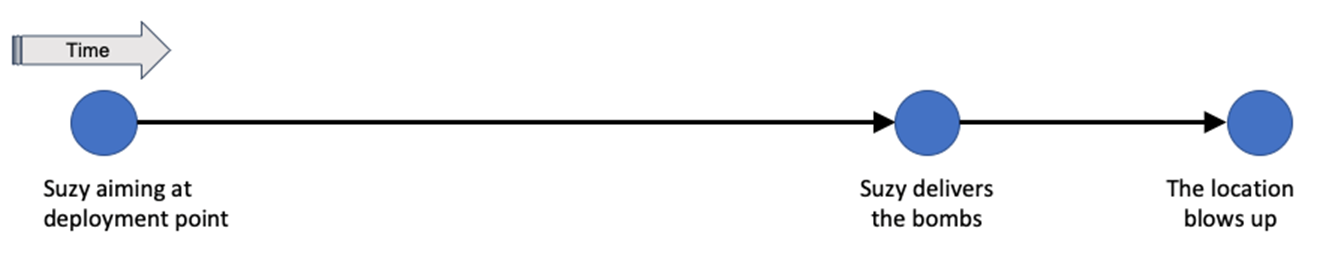
a) Suzy is piloting a bomber getting ready to bomb an enemy target (Fig. 1).
b) An enemy pilot, say Vladimir, is getting ready to attack Suzy so as to prevent the bombing (Fig. 2).
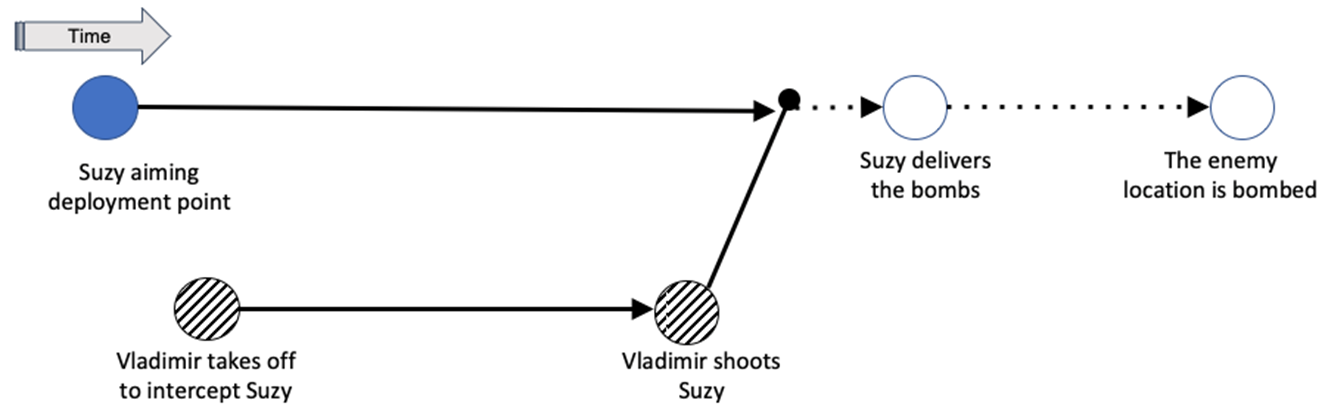
Fig. 2 Vladimir’s flight plan (arrow points indicate causing an event; lines ending in a dot indicate prevention, i.e., an omission being caused; non-empty nodes indicate an event occurring; empty nodes indicate omissions).
c) Billy is a pilot getting ready to take down Vladimir’s plane in order to prevent him from attacking Suzy’s plane thus preventing the bombing (Fig. 3)
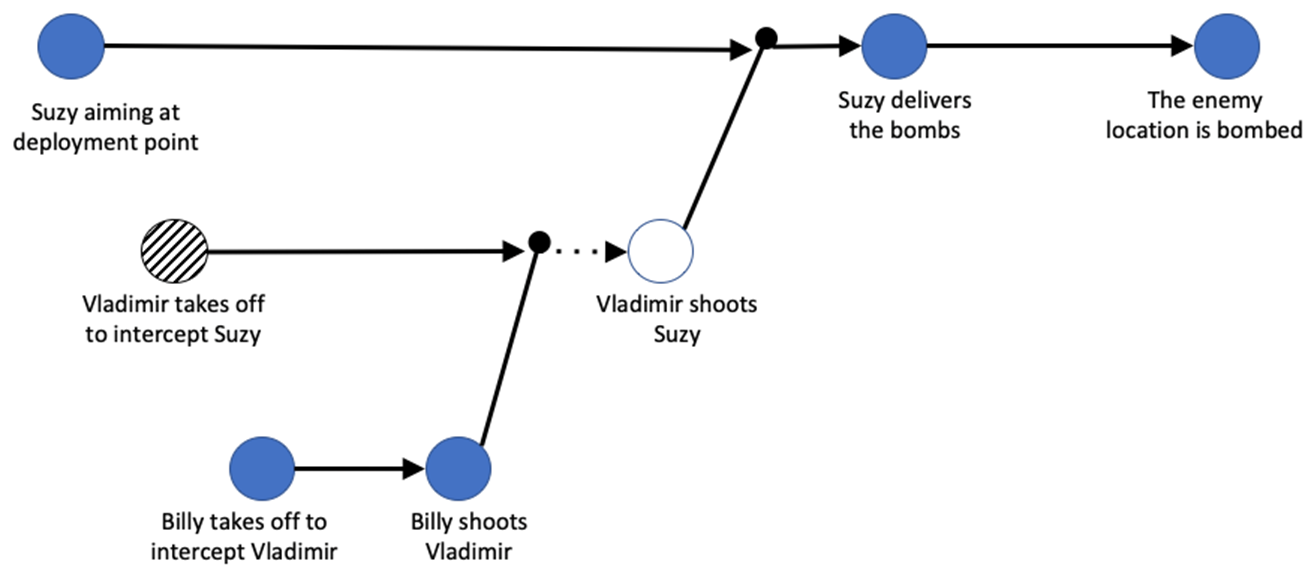
d) Billy catches up with Vladimir and brings him down in a spatiotemporally distant region from Suzy’s flight trajectory.
e) Suzy successfully bombs and destroys the enemy target.
f) Billy’s having brought down Vladimir is a cause of Suzy’s successful bombing, as it is true that “if Billy had not brought down Vladimir, Suzy would not have had successfully bombed the enemy target.” Nevertheless, because this event occurred in a spatiotemporally distant region in relation to the bombing site, the locality thesis is not successfully accomplished.
If we accept Hall’s example, we have to accept that, in fact, at least the locality thesis is in tension with counterfactual theories in this type of double prevention cases. An alternative possibility to avoid joining Hall in his conclusion is by interpreting that the type of double prevention situations exemplified by Suzy, Billy, and Vladimir’s story is precisely the type of situations that we would not have identified above. In these situations, in other words, the locality thesis is not fulfilled, but they plausibly occur in worlds close enough to our own (if is fortunate that the example does not involve the laws of magic).
However, as we will see in the following section, Pablo Melogno (2011) points to a series of problems in Hall’s example which, if convincing, would indicate that Suzy’s story does in fact comply with the locality thesis.
4. Suzy, Billy, and Vladimir on Melogno’s radar
Melogno begins his analysis of Hall’s ideas by resorting to some variations on Suzy, Billy, and Vladimir’s story. We will consider the first two as they are the most relevant to our current analysis. The first variation is the least problematic: Billy escorts Suzy, and the battle between Billy and Vladimir (which culminates in Billy’s victory) occurs only a few feet away from Suzy. The reason why this example is not problematic is that, because it occurs in Suzy’s immediate proximity, the locality thesis clearly applies. Nevertheless, Melogno claims that:
However, the idea that all are in the same region, even if self-evident, results unintelligible to define the continuous character of causal chains. When do these two events stop being in the same spatiotemporal region? If the answer is “when they can no longer engage in physical interaction,” then in this case, what is relevant is not being in the same area, but the existence of some sort of physical interaction, to wit, the fact that the events at hand are connected via a circuit of electromagnetic waves that ensure the continuity of the causal chain. It could be said that it is possible only because they occur in the same area, but if being in the same region is the condition, and not the consequence of physical interactions, then once again it is necessary to make intelligible the idea that two events occur in the same region, which is something that cannot be found in Hall’s reasoning (2011, p. 55; translation ours).
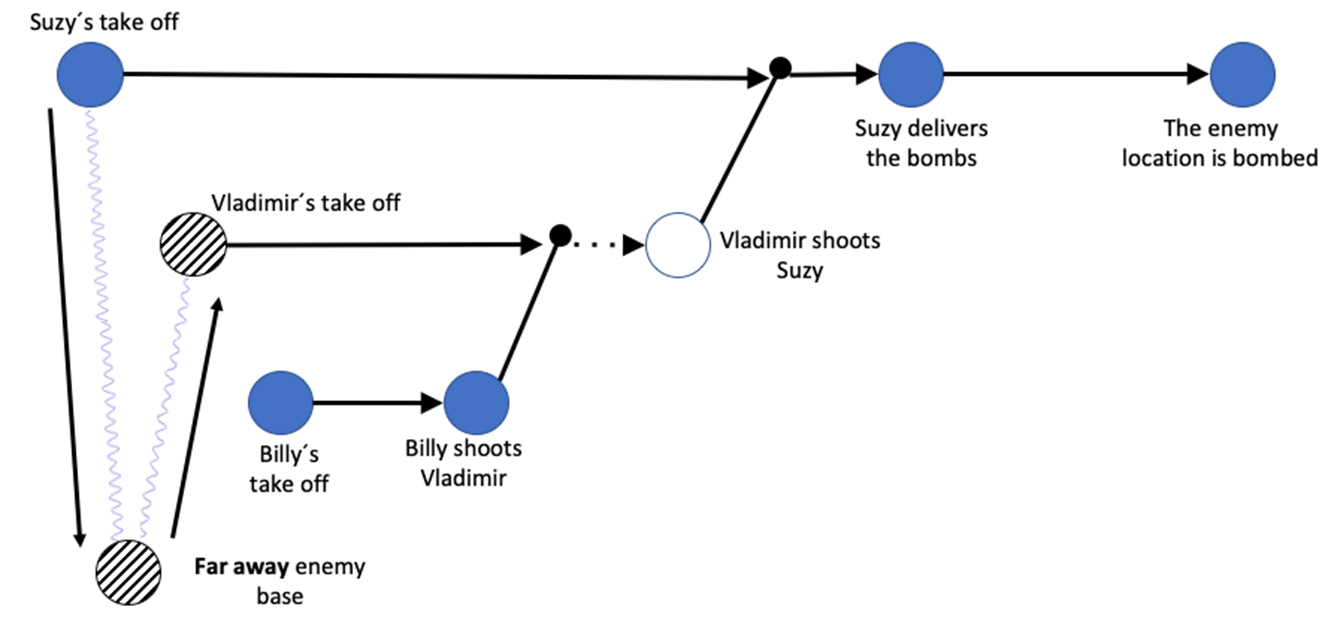
Fig. 4 Spatiotemporal connection between Suzy’s and Vladimir’s takeoffs via electromagnetic waves which are received by the radar in a faraway enemy base, warning Vladimir
Melogno’s thought-provoking idea is, precisely, that the notion “spatiotemporal region” which is found in Hall’s locality thesis is extremely vague, as it is not easy to clearly define what it means for two events to be (or not) in the same region. For us, in line with Melogno, the most plausible solution to this problem is to claim that the locality thesis applies if there is physical interaction between the two events, which-if one considers that physical interaction implies the exchange of a magnitude governed by conservation laws-would subsume Hall’s proposal under Phil Dowe’s physical causation theory (2000).
With that in mind, it becomes clear that the locality thesis applies to this variation of the example, as the events are connected by the closeness resulting from the circuit of electromagnetic waves which indubitably ensures the continuity of the causal chain as defined by Lewis (and accepted by Hall).
In the second variation of Suzy the bomber’s story, the combat between Billy and Vladimir occurs spatiotemporally far away from the place where Suzy’s plane is located; far enough for the tension between locality and counterfactual dependence to endow Hall’s complaint with some plausibility.
The example becomes now, from Melogno’s perspective, problematic. If double prevention occurs, as presupposed by Hall, it is because Vladimir knows that Suzy is getting ready to bomb his town. How does Vladimir know that Suzy is on her way? Presumably, Suzy must have been locked on by some radar (Melogno imagines an enemy base somewhere during the trajectory of Suzy’s bomber), and-in turn-the base’s personnel must have warned Vladimir so that he leaves hastily on a mission, thwarted by Billy later, to bring down Suzy’s plane and stop the bombing. According to Melogno, without these additional elements (an enemy base with a radar detecting Suzy and warning Vladimir), it is not plausible for the counterfactual proposition “if Billy had not brought down Vladimir, Suzy would not have succeeded” to be true, and consequently neither would be Billy’s actions being a cause of the bombing.
If Vladimir had not found out about Suzy’s flight, why would he try to bring her down? And why would be Billy relevant to Suzy’s actions if Vladimir had no intention of stopping her? What is interesting about Melogno’s twist is that the electromagnetic waves of the radar that detects Suzy and the radio waves used by the base to warn Vladimir do in fact generate a circuit of physical interactions linking Suzy and Vladimir (the link between him and Billy is more obvious) in spite of the distance presupposed and, consequently, the example fails to support Hall’s view: double prevention does take place, complying with the locality thesis, responding to Dowe’s formulation, which shows it as the most plausible.
In the following section, based on our own analysis of Lewis’, Halls’, and Melogno’s proposals, we will present some conceptual refinements which hopefully will reinforce counterfactual theories so that they can account for some interesting cases of causation. In this way, we hope to avoid the appeal that a physical understanding of causal interactions seems to exert.
5. The causal scene
As if it were a stage, we need to imagine our scene from a perspective that contemplates the conditions of locality that Melogno suggests, and which can offer a more precise argument to overcome intuition. In this way, we hope to move on to a more productive analysis. In this sense, it is possible to think that the causal scene cannot accommodate events outside the cone of the future of a Minkowski space based on the first event of interest. Every event is considered to be causally connected to another if it is possible for a signal to travel from one to the other with a speed equal to or less than the speed of light.
If we represent in this space the relevant events to Suzy, Billy, and Vladimir’s case, we obtain the image in Figure 5.
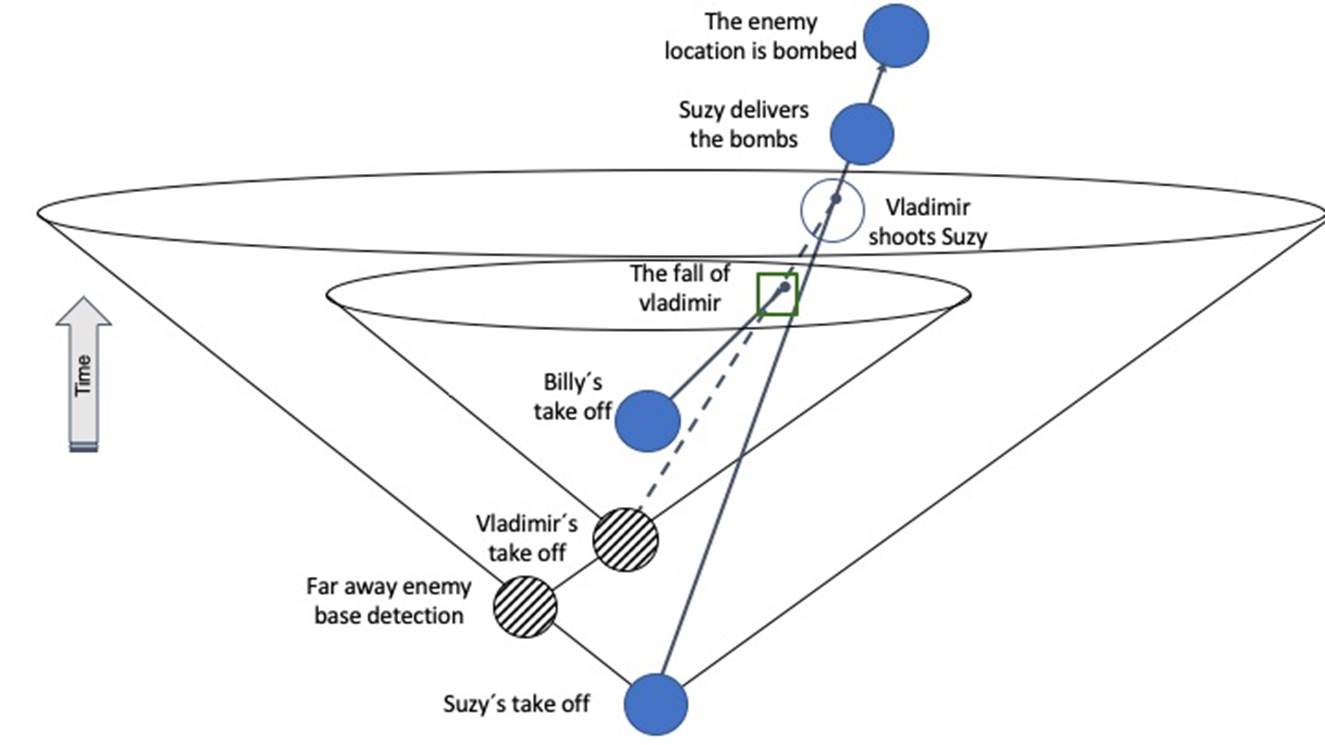
Fig. 5 Connections between causally related events cannot go through and come out the cone of the future.
We see, then, that the notion of locality proposed by Melogno gives an order-under the parameter of a possible electromagnetic connection-to the previously intuitive notion of “being in the same spatiotemporal region.” Nevertheless, it should be noted that there are two ways of understanding locality as it is usually required in causation cases. On the one hand, it is to be expected that causes and effects be events that share the same region, in the intuitive sense that the hammer must hit the nail to cause it to go into the wood. On the other hand, the light signal sent from an antenna to a satellite would indicate that the event of the signal having been cast can be considered a cause for the satellite to modify its course, provided that Melogno’s parameter of electromagnetic connection between these events applies. It is not easy, therefore, to match the commonsense idea of “being in the same place,” with the idea of locality understood as sharing the same spatiotemporal region. For this, one would have to contemplate, on the one hand, causal interactions, and, on the other, the causal processes that work as carriers for causes, as is the case of electromagnetic waves that broadcast certain specificities that can interact with the receiver. In Lewis’s own words:
A causal history is a relational structure. Its relata are events: local matters of particular fact, of the sorts that may cause or be caused. I have in mind events in the most ordinary sense of the word: flashes, battles, conversations, impacts, strolls, deaths, touchdowns, falls, kisses, …. But also I mean to include events in a broader sense: a moving object’s continuing to move, the retention of a trace, the presence of copper in a sample (Lewis, 1986b, p. 216).
By including events such as the fact that an object continues to move, or a trace being retained, Lewis is showing that some events do not look like something that takes place in self-contained scales of space and time, but that they can actually have one or more of its four dimensions extended with respect to what common sense defines as events. Thus, the existence of the ozone layer in the atmosphere is an event and may be a part of the causal history captured in the relational structure. Precisely, common sense will be challenged, since-by virtue of both changes in the state of things and the state of things themselves being treated as events-the evaluation of counterfactual conditions will be contingent on said difference. By contemplating different types of events in terms of their dimension extension may cause perplexity when one evaluates the counterfactuals that relate them.1
Looking at Figure 5, it would be tempting to think that all these events that we have been considering can come together into something we could call “causal scene.” Nevertheless, it would be premature to accept them just because the connection between them seems possible. We should take one further step in the analysis of the possibilities and the corresponding impossibilities to have an idea of how our evaluation of causal connections turns out.
Since the planes are in a scenario that is internal to a cone of the future, it is possible to see their causal connection. This possibility is factual in nature. Thus, it is not only a logical possibility-as it would not be contradictory to establish causal connections between such events-but what is even more, since signals travel at speeds less than or equal to the speed of light, our physical theories tell us that it is factually possible for one of these events to be the cause of one of the others.
Now, imagine Vladimir leaves hastily with the idea of bringing Suzy’s plane down, but he does not know that is own plane has been equipped with a type of missile the range of which is lower than the distance separating him from Suzy’s plane at the moment when he comes closest to it, just before Suzy drops the bombs. Vladimir would have to come closer to Suzy so that his missiles hit the target, bringing Suzy’s plane down, but Suzy is about to hit the spot where she will drop the bombs. Vladimir shoots before Suzy hits that spot, but the result will be that the missiles will not reach Suzy’s plane. This example shows that, even though it is factually possible for Vladimir to bring Suzy’s plane down, it is not possible for him to bring her down from a technical perspective. Technically, Vladimir is chasing a target that he cannot reach. His causal powers do not have the “technical reach” to effectively cause what he sets out to do. However, Vladimir will not find out during his flight, because before firing his missiles, he will be hit by Billy’s which will bring his plane down, and he will have to eject to save his own life, even if he loses his plane.
We can offer an image (Figure 6) of the technical reach and then evaluate the different counterfactuals.
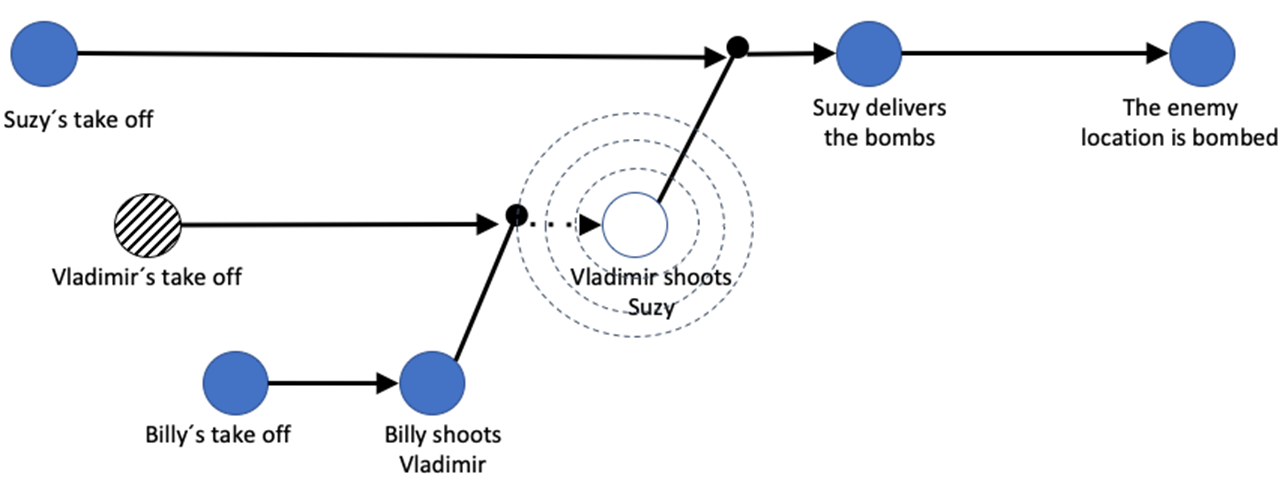
Fig. 6 Vladimir is equipped with missiles which will not reach Suzy’s plane before she gets to the point where she will release the bombs. The dotted circles represent the missiles’ area of influence.
In this situation of reduced technical reach, we may say that the counterfactual “If Billy had not brought Vladimir down, Vladimir would have intercepted Suzy” is not true. Therefore, saying “if Billy had not brought Vladimir down, Suzy would not have bombed the enemy target” would not be true either. Finally, we should conclude that it is not true that Billy has causally contributed in any way to the bombing of the enemy target. In other words, Billy having brought down Vladimir’s plane has not been a cause of the bombing.
It is clear that we have been considering a scene in which it seemed implicit that every agent had the capacity to cause that which they intended to do. Nevertheless, it is necessary to take a moment to evaluate the character of these possibilities so as not to be seduced by an extended scene in which some of the actors have no causal role. At any rate, it would be a case of purported prevention. Some actors would be trying to accomplish the impossible given their effective conditions.2
The concepts of technical reach and causal scene, inspired by considering Melogno’s critique of Hall, seem to be of great relevance to explore some other recalcitrant cases. For example, one could consider the case of a sniper aiming at and shooting a major politician at a parade. The context as we have described it implies such a link that the sniper and the politician must necessarily be located at the same causal scene (if that were not the case, the sniper could not aim with his rifle). Now, if the sniper were inexperienced and his rifle were an air rifle, and if he were 2000 feet away from his target, locality would still exist in terms of the causal scene, but there would also be a technical impossibility: a lack of technical reach. How would a court judge the inexperienced sniper? Would he be guilty or not guilty of attempted murder? One may intuitively assume that guilt should be assigned based on the sniper’s intention (since due to his lack of experience he was inclined to believe that he would kill his target), one could modify the example for it to include, instead of an air rifle, a black magic kit, including candles, a picture of the politician, a chicken with its throat slit, and different needles. This example has the same elements of the previous example (unless one actually believes in the technical reach of the black magic kit), but intuitively, in spite of the existence of intention, the adjudication of guilt could be different compared to the case of the air rifle.
The causal scene should then be filtered through the sieve of logical, factual, and technical possibilities before setting the stage and, therefore, the notion of technical reach seems relevant.
6. A Sea of Possible Worlds
As we pointed out, Lewis structures a causation theory by resorting to the existence of chains of counterfactuals which go from the occurrence of the cause to the occurrence of the effect, passing through possible intermediate events. Therefore, it is worth mentioning the conditions for a counterfactual conditional to turn out to be true or false. It will be necessary to resort to a semantics of counterfactual conditionals. This task was the subject of animated discussion based on Nelson Goodman’s seminal paper (1947), which reached its apex during the 70s and 80s.3
Lewis (1973b) offers a sufficiently robust and complex theory. Each counterfactual conditional is uttered in a certain context which fixates the collection of possible worlds worthy of being taken into account in that context. As a result, we can distinguish different spheres of accessibility around the base world in which the counterfactual is uttered and, given the content of the antecedent, it is possible to fixate which possible worlds must be considered. Within each one of these spheres of accessibility, we may establish an ordering of all the possible worlds considered by virtue of their overall comparative similarity to the base world in which the counterfactual is uttered.
Finally-and briefly-, a counterfactual will be true if out of all the possible worlds in which the antecedent holds, it is the closest worlds to the base world where the consequent also holds. Therefore, the ultimate parameter to decide whether a counterfactual is true does not refer directly to the locality thesis, but only indirectly, resulting in the fact that all the possible worlds where locality occurs (which we believe will also occur for our base world) are probably appropriately considered to be possible worlds similar to ours. Nevertheless, this will be one feature considered alongside many others to establish an evaluation of the overall comparative similarity. In other words, between two possible worlds in which the antecedent to the counterfactual holds, those more similar to ours (where the counterfactual was uttered) will be closer to it, but always in comparison to those which are less similar overall.
The result we obtain is that, on the one hand, context fixates the types of worlds to be taken into account and, on the other, that all its features must be combined to offer an overall comparative similarity perspective, in which locality becomes only one feature among others. Whereas for the purposes of physical causation locality is a sine qua non condition to consider causal interaction, for counterfactual causation it is but another element to be contemplated in the ordering of worlds that supports the truth or falsehood of the counterfactual.
7. Conclusions
Throughout this paper, we have offered a defense of Lewis’s counterfactual theory in the face of Ned Hall’s critique, following in the footsteps of Pablo Melogno. His proposal was outstanding as it offered a profound and detailed analysis of Hall’s paradigmatic example to indicate a supposed tension in Lewis’s counterfactual theory to account for cases of double prevention. This tension was purportedly the result of the non-compliance with the locality thesis, which was supposedly necessary for counterfactual theory (at least in possible worlds more or less close to our own). This example, just as Melogno denounced, works only because of the vagueness of the concept of “locality” as used by Hall. The “folk” use of the concept of spatiotemporal locality leads to paradoxes which would not occur if, just as Hall’s physical causation proposes, locality were considered as the possibility of physical interaction between the events under analysis.
With the purpose of describing in greater detail some of the potential recalcitrant situations in similar contexts to those analyzed by Hall and Melogno, we have proposed here two novel concepts. On the one hand, we have presented the idea of “causal scene,” which considers the set of “events” as factually possible (understood as those considered by Lewis in the broad sense, i.e., including here also the state of things, such as the existence of a trace or the ozone layer). On the other hand, for a more suitable analysis of true cases of double prevention, the idea of causal scene must be complemented with that of “technical reach,” a concept which takes into account that-while certain events may act as causes because they are nomically related to the effects (and are therefore part of the causal scene)-sometimes there are technical impossibilities for the counterfactuals to effectively take place. By using these concepts, we can restore the intuitive idea that not everything that is factually possible (i.e. that does not violate any law of physics) is technically possible.
These concepts, which we propose based on Melogno’s critique of Hall, could be of great relevance when exploring other recalcitrant cases.
Overall, we have proposed two concepts that complement counterfactual theory, making it possible to describe recalcitrant situations more precisely, following Melogno’s footsteps in his dissection of locality. Good philosophical work possesses precisely the virtue of inviting readers to keep working based on the traces left on knowledge.

