




 English (pdf)
 Article in xml format
 Article references
 Automatic translation
 Send this article by e-mail
 Cited by SciELO
  Cited by Google
  Similars in
SciELO
Similars in
SciELO  Similars in Google
 Permalink

Introduction
Since the First and Second World Wars, globalization has been driven by treaties and alliances that mutually benefit different populations, creating new trade relations between countries and strengthening existing ones 1. These agreements involve setting prices and profits and guaranteeing that the goods or services exchanged meet the minimum requirements of acceptance and competitiveness, facilitating market penetration 2.
Quality is understood as a property inherent to the needs of the client or buyer and aimed at promoting standardization that leads to satisfaction. Since ancient times, it has been well-known as added value 3, but its current evolution has turned it into a vital commercial requirement in all areas of human interaction focused on planning on doing, verifying, and acting 4. These quality management and assurance systems constitute a powerful tool that supports the processes by executing properly documented activities, providing traceable information that allows the implementation of continuous improvement methods at the forefront of the industry, and following market needs 5.
In the manufacturing industry and as part of it, in the food sector, multiple systems have been developed to guarantee the quality of products or services 6 from their physical, chemical, sensorial, microbiological, and other areas related to the nature of the same. 7 highlighted that those implemented by the International Organization for Standardization or ISO Standardization stand out internationally. Among them, ISO 9000:2015 and ISO 9001:2015 are the leading ones for the manufacturing sector 8 with a positive effect on consumer satisfaction 9, laying the foundation for other axes such as the environmental, safety and health at work and food safety. Of the latter, ISO 22000:2018 specifies the requirements to ensure food safety. Another important system in the agri-food sector is the Good Manufacturing Practices, which establishes the hygienic requirements for establishments or installations that involve any type of food in their production process 10, and the Hazard Analysis and Critical Control Points known as HACCP was developed to maintain a preventive approach with the establishment of immediate action measures in the event of unexpected deviations 11.
The cocoa sector at an international level focuses on strengthening the quality conditions to participate in globalized markets 12. Thus, producers must adjust their processes to guarantee this property and execute necessary actions leading to standardization and compliance with regulatory requirements established by national and international regulations 13. In the case of Colombia, being one of the 10 countries with the highest cocoa production worldwide 14, international cooperation agreements have been established, such as the one signed in 2010 in Geneva, approved by Law 2163 of 2021, as well as regulatory requirements for the chocolate sector through Resolution 1511 of 2011, to guarantee the minimum requirements for distribution of this type of products. However, no national guidelines allowed the unification of criteria for the intermediate phase of the post-harvest processes, including fermentation, drying, and storage. Therefore, the Colombian Institute of Technical Standards and the ICONTEC Certification established the Colombian Technical Standard 1252:2021, where the quality requirements of cocoa beans were registered, classifying it into Regular, Standard, and Premium/Special cocoa. As a general guideline for compliance for the industry, Resolution 2674 of 2013 applies, the evaluation list of risk-based sanitary inspections for food preparation zones 15, and resolution 2674/13, these establishing the basic hygiene conditions for food factories.
Cocoa in its post-harvest process does not have direct regulation that monitors and controls the conditions under which its processes must be carried out beyond the guides or methodologies of national or foreign research centers 16 because the fermentation and drying phases are carried out mainly on farms and, once these processes are completed, they market the grain as raw material for factories, who will obtain intermediate products and chocolate 17. Due to the associative strategies by regions or sectors in Colombia 18, the department of Huila, in turn, has adopted this system, and from 2015, collection centers managed by associations and cooperatives of cacao growers were established, and they carry out fermentation, drying, and storage on a larger scale 19. However, during the last years, the need to standardize techniques that guarantee the quality of the grain to be able to access international markets has arisen 20. As a solution to this, Instituto Colombiano de Investigación Agropecuaria (AGROSAVIA), in alliance with Universidad Surcolombiana (USCO) and Servicio Nacional de Aprendizaje (SENA), proposed as an alternative solution, the implementation of a quality assurance system under the approach of identifying critical control points designed and adjusted to the conditions of the processing plants (centrals) and taking as a starting point the progress made by AGROSAVIA, Federación Nacional de Cacaoteros (Fedecacao) and the Cocoa Network, entities of great relevance in the development of this productive chain that finance crop development projects in the country 21 and work in fruit enhancement as well as processing and quality improvement strategies 22.
Based on the above and in the absence of a diagnostic instrument adapted to the conditions and requirements of cocoa community processing plants, which impact quality by estimating the base conditions, it is necessary to build a diagnostic tool, validated and implemented, to allow the development of a continuous improvement plan as a starting point for the implementation of quality assurance systems, whose focus is the identification of hazards and critical control points that lead to obtaining standardized quality cocoa.
Materials and Methods
The GHYCAL methodology was addressed for the development of the tool. This methodology was proposed by Castro and Ramirez 23 and Gutierrez et al. 24 and replicated by Osorio and Sanchez 25 and Siancas and Quiñones 26 and comprises seven stages: 1) scientific surveillance, 2) establishment of a baseline, 3) preliminary development, 4) validation, 5) consolidation and approval, 6) application, and 7) reliability estimation.
According to the approaches of Van der Spiegel in 2003 27, scientific surveillance as an assurance system must be adjusted to the conditions of the productive activity; therefore, for the construction of the evaluation and inspection tool, the search for information regarding the subject that will be used as a starting point for the design and management of the same with direct influence on cocoa processing plants was carried out. For this, a search for previous research and applications was carried out in databases such as SCOPUS, ScienceDirect, and Google Scholar, as well as health regulations in Colombia proposed by government and private entities, among others.
After the literary review and identification of the strategies processes were carried out i.e., the baseline was established, it was found that although previous research has been developed in countries such as Peru 28, the technological conditions and regulations differ. Therefore, the need to create an instrument for evaluating sanitary requirements adapted for the processing plants of the department of Huila arose, taking as a baseline relevant information from the cocoa sector to carry out a successful approach according to the establishments or installations and their related activities.
Based on secondary information, how the evaluation list of risk-based sanitary inspections for food preparation zones 15, the preliminary development of the checklist-type tool was carried out considering 47 items that addressed criteria such as infrastructure, sanitation, training, and personnel, among others 29 with an evaluation scale such as the one used by Canto de Gante et al. 30, i.e., they used a Likert-type scale with five options according to the level of compliance.
The next stage was to validate the instrument through Delphi sessions, which allowed obtaining relevant indicators for measuring performance and validating applicability and suitability as proposed by Van der Spiegel et al. 31. For this case, Delphi sessions were carried out with nine experts related to the cocoa production chain, including the harvest, post-harvest, processing, quality, and market phases, who evaluated the entire instrument as well as each criterion.
With the feedback from the panel, the final consolidation of the tool was carried out, which, once approved, was applied in the four processing plants (centrals) of the Department of Huila in the municipalities of Rivera, Campoalegre, Algeciras, and Gigante, during the intermediate and final diagnosis phases, calculating Cronbach's alpha and determining the reliability of the results obtained according to Equation 1 32.
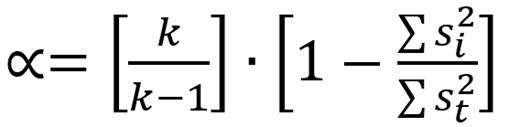 Equation 1
Where:


Results and Discussion
Monitoring and establishing a baseline
When searching for related data and selecting baseline information, the authors decided that the starting point would be the "checklist for the monitoring and control of the cocoa harvest" presented by the Cocoa Network (n.d.), whose focus is given to producers and personnel of processing and collection centers, consisting of six activities, nine sub-activities and 63 items, referenced to harvest and post-harvest tasks. Since the processing plants (centers) only carry out fermentation, drying, and storage activities, these criteria were prioritized and complemented with the requirements included in Resolution 2674 of 2013, according to the conditions these collection plants (centers) may require. The Hygiene and Quality Management model or GHYCAL (for its acronym in Spanish) addressed by Castro and Ramirez 22 was used as support, ensuring product quality without significantly affecting the structure and design of the area, in addition to Resolution 082394 of 2020 of Instituto Colombiano Agropecuario in "Annex 1 - Checklist for the certification of good practices." This checklist allows the quantification of the impact on quality based on the above and identifies that there is no instrument with direct application to this type of establishment.
Preliminary development and validation
With the above information, a set of initial or preliminary criteria was developed, which were evaluated by a panel of experts who, based on their experience, issued their opinions and recommendations so that the instrument would be more effective in following the stated objective. Based on the feedback from the evaluators of the initial version of the tool consisting of 47 items, only 28 items were approved in the first Delphi session, with the annotations of distributing the list into four large groups according to the nature of the criteria and their correlation with quality assurance factors, allowing a more significant relationship of what was evaluated with the different stages addressed in a HACCP type system. In addition, notes regarding the broad content of three items were presented, recommending that they be divided for their better understanding and judgment. For the other items, adjustments were made according to the suggested interventions. Finally, to make the tool more interactive, it was recommended to apply a scoring system that in its entirety added up to 100 since the scale proposed by adding the grades could reach a total score of 200, which could generate confusion in its global interpretation.
Consolidation and approval
After carrying out all the interventions suggested by the experts, the inspection checklist tool, consisting of 50 items, was generated and distributed in four segments (see Table 1). Each score given in the inspection partially adds up to the section to which it belongs, and to be expressed, it is divided in half, allowing a direct relationship between its score and the percentage of compliance. The criteria that were intervened and used for the final session and received approval were the following: the title of the instrument because it can be applied in different stages, not only for diagnosis but also for follow-up. The title was adjusted to "Evaluation List of Sanitary Requirements in Cocoa Processing Plants." Items 1.5, 2.9, and 3.18 were created, and semantic and writing interventions were carried out for the better understanding and coverage of criteria 1.3, 1.4, 1.7, 1.9, 1.10, 2.1, 2.3, 2.4, 2.5, 2.6, 2.7, 2.8, 3.1, 3.17, 4.1, 4.3, 4.4, 4.5, and 4.6. In addition, a bar graph was included indicating the progress of each area evaluated and a percentage of overall compliance. This instrument was approved by experts who expressed its importance at the national level in establishing improvements in the collection plants (centers) for cocoa fermentation, drying, and storage (See Annex 1).
Application
With this consolidated tool, the respective application was carried out to evaluate the state of compliance with sanitary requirements adapted to the conditions of cocoa processing plants (centers) in the Rivera, Campoalegre, Algeciras, and Gigante municipalities. The diagnosis corresponding to the phase before applying a quality system allowed formulating an improvement plan under three essential aspects: infrastructure-equipment, documentation, and management.
Reliability estimation
Cronbach's alpha was calculated to determine the reliability of the applied tool and using the results obtained, not only during the initial phase (α = 0.949) but also during the intermediate (α = 0.908) and final (α = 0.934) follow-ups carried out as a semi-annual compliance follow-up, giving high reliability of results expressed by the instrument in all three moments according to the classification addressed by Castillo-Sierra et al. 33.
Discussion
The criteria addressed by the tool applied to the processing plants (centers) are homologous to those established by Gonzales in 2014 34 for installations such as restaurants. These are basic quality aspects and provide an approach to risk identification under "Inspection, Surveillance and Control" activities, behavior expressed by Fajardo-Guerrero and Rodríguez-Mora 35. The base information constituted a fundamental pillar for developing activities that would guide an optimal final result and with an initially regional application horizon but with the capacity for national expansion to identify sanitary and productive requirements.
This tool established an appropriate improvement plan for each plant (central), focusing on designing and implementing a quality assurance system under an identification of critical control points approach. Starting from the base knowledge that, as expressed by Dudin et al. 36, it became a key axis to execute these continuous processes with a clear vision that allows establishing process improvements under standard conditions and, in this way, provides the security that cocoa or any other product, as postulated in its review and applied by Rincón-Ballesteros et al. 37, is marketed under physical, chemical, biological, sensory and safety quality conditions.
The development through four sections or axes allowed emphasizing the identification of improvement opportunities that increase the effectiveness of the actions carried out and the optimization of resources use 38. Concerning the initial information, the items were reduced because a greater link was sought between the evaluated parameters and the conditions and processes executed by the plants (centers) assessed, just as Van Der Spiegel et al. 39 sought to establish actions that would generate the most significant development impact on its production process; in this case, the objective was directed towards a homologous path.
The validation of the tool was a relevant and enriching factor since, in addition to having been subjected to comprehensive sessions by experts who oriented it towards the needs of the sector from different areas or perspectives that lead to a single objective, enhancing it and giving results of higher impact with the possibility of consolidation as a model or reference in the future, scientific support and proven reliability were also provided with the Cronbach model (α> 0.9). Just like the intention of Soriano in 2014 40 when designing an evaluative instrument, this inspection list becomes a proposal for the Colombian and international cocoa sector, which seeks strategies to improve their productive activities in the cocoa post-harvest phases that directly affect the final chocolate quality 41.
Considering the evaluation during the diagnostic, intermediate, and final phases, the influence of a HACCP-type quality assurance system designed from the results obtained was made viable, similar to that carried out by Kafetzopoulos et al. 42, who experimented with a similar methodology to determine the effectiveness of their HACCP system. Therefore, the surveillance and control characteristics required for traceability in the processing processes in community cocoa plants (centrals) in the department of Huila are met, knowing the state of progress or relevant aspects of it, to finally compare the impact of the activities developed in favor of improving cocoa quality, which generates impacts on the life quality of producers, with a view towards the economic and social development of the region as indicated by Murcia et al. 43.
Conclusions
The GHYCAL methodology allowed the development of an inspection and monitoring tool for cocoa processing plants (centrals) in the department of Huila with reliability percentages above 90%, according to the Cronbach model. This tool allows producers, associations, and cocoa companies at the national and international levels to draw up lines of action in the design of quality assurance systems throughout the agri-food chain, which positively impacts the processing processes and allows the department of Huila to position itself as a potential producer of specialty cocoa.

