




 English (pdf)
 Article in xml format
 Article references
 Automatic translation
 Send this article by e-mail
 Cited by SciELO
  Cited by Google
  Similars in
SciELO
Similars in
SciELO  Similars in Google
 Permalink
Introduction
THE NATURE of the interaction between work and family has received a great deal of attention in organizational psychology research, resulting in a large number of studies published in high-impact journals in the last five decades (e.g., Herman & Gyllstrom, 1977; Beutell & Greenhaus, 1983; Frone, Russell & Cooper, 1992; Carlson, Kacmar, & Williams, 2000; Gordon, Whelan-Berry, & Hamilton, 2007; Masuda, McNall, Allen & Nicklin, 2012; Kalliath, Kalliath, & Chan, 2017; Carlson, Thompson, Crawford, & Kacmar, 2019). This scholarly interest in work-family interface partly reflects the need to shed light on the dynamics between both domains as means to design organizational strategies and public policies that, on the one hand, buffer negative spillovers and, on the other hand, boost positive interactions (Powell, Greenhaus, Allen, & Johnson, 2019). These efforts are thus fundamental to promoting healthy work environments, long-lasting employee-employer relationships, and positive attitudes both inside and outside the organization (Carlson, Ferguson, Kacmar, Grzywacz, & Whitten, 2011).
For decades, research has approached work-family interactions from a conflict perspective, focusing on the factors and mechanisms that lead to interferences between both domains (Byron, 2005). In this context, work-family conflict (WFC) has been defined as a type of role conflict in which the demands from family and work domains are mutually incompatible to some extent, so that participation in one role makes participation in the other more difficult (Greenhaus & Powell, 2003). Thus, drawing on the so-called 'scarcity hypothesis', studies within this research stream have shown that individuals in such conditions are more prompted to experiencing a depletion of energy and valued resources (Lu & Kao, 2013), which is likely to lead to negative outcomes, such as job dissatisfaction (e.g., Shockley & Singla, 2011), burnout (e.g., Haines III, Harvey, Durand, & Marchand, 2013), marital dissatisfaction (e.g., Kalliath et al., 2017), life dissatisfaction (e.g., Zhang, Griffeth, & Fried, 2012), and health symptoms (e.g., O'Donnell et al., 2019).
Despite the fact that research on work-family conflict has certainly had a long-standing tradition in organizational psychology, a more recent set of studies has consistently demonstrated that work-family interactions may result not only in work-family inferences but also in positive spillovers between both domains (Greenhaus & Powell, 2006). In this light, work-family enrichment (WFE) reflects the degree to which the experiences in one role enhance the experiences in the other role (Carlson, Kacmar, Wayne, & Grzywacz, 2006). From this perspective, individuals' participation in one role may provide them with additional resources, such as knowledge, abilities, esteem, positive feelings and mood states, or monetary rewards, which may improve their participation in the other role (Carlson et al., 2019). Consequently, based on the so-called 'expansionist hypothesis' (see Marks, 1977), WFE is expected to lead to positive outcomes, such as job satisfaction (e.g., Carlson, Hunter, Ferguson & Whitten, 2014), marital satisfaction (e.g., van Steenbergen, Kluwer, & Karney, 2014) and life satisfaction (e.g., Lim, Song, & Choi, 2012).
In this regard, and drawing on Greenhaus and Powell's (2006) definition, Carlson et al. (2006) proposed a multi-dimensional model of WFE, in which each of these dimensions may be subsequently studied in two directions, namely, work-to-family enrichment (W→FE) and family-to-work enrichment (F→WE). Regarding W→FE, Carlson et al's (2006) model identifies three dimensions: (a) development W→FE (i.e., participation in work roles facilitates the acquisition or refinement of knowledge, abilities or ways of viewing things, which improves individuals' participation in family roles), (b) affect W→FE (i.e., involvement in work roles leads to a positive emotional state, which improves individuals' participation in family roles), and (c) capital W→FE (i.e., participation in work roles results in gains of psychosocial resources, such as security, accomplishment or confidence, which helps the individual to be a better family member). Regarding F→WE, the dimensions are: (a) development F→WE (i.e., participation in family roles facilitates the acquisition or refinement of knowledge, abilities or ways of viewing things, which improves individuals' participation in work roles), (b) affect F→WE (i.e., involvement in family roles leads to a positive emotional state, which improves individuals' participation in work roles) and (c) efficiency F→WE (i.e., involvement in family roles provides the individual with a sense of urgency, which helps them to be a better worker).
Although a few scales have been designed to examine some aspects of positive work-family interactions in general (e.g., the SWING, Survey Work-Home Interaction – NijmeGen; Geurts, Taris, Kompier, Dikkers, Van Hooff, & Kinnunen, 2005), the Work-Family Enrichment Scale (WFES; Carlson et al., 2006) is perhaps the most exhaustive and psychometrically sound instrument to measure WFE specifically. This scale has been not only validated and used in numerous studies across several countries and organizational settings, but also translated to multiple languages including Spanish (e.g., Omar, Urteaga & Salessi, 2015). In spite of the several strengths of the WFES (e.g., theoretical representativeness, strong psychometric properties, multi-dimensional measure, evidence of cross-cultural validity) its length (18 items) may limit its use in cross-sectional studies assessing multiple constructs, as well as in longitudinal or diary studies in which constructs need to be measured at different points of time (Matthews, Kath & Barnes-Farrell, 2010).
Indeed, in studies in which the length of the survey is definitely a constraint, short scales are preferable as a way to reduce participant fatigue, avoid missing data, and increase response rates (Rogelberg & Stanton, 2007). Moreover, since recent research has called for future studies that examine work-family interactions in a more integrated and holistic way (e.g., consider WFC and WFE simultaneously, include other constructs from the nomological network) an abbreviated measure of the WFES is very much needed. With these ideas in mind, Kacmar, Crawford, Carlson, Ferguson and Whitten (2014) developed and validated an abbreviated version of the WFES, which comprised only six items and showed satisfactory levels of reliability and discriminant, convergent, and predictive validity across five samples. Although it was subjected to thorough validation procedures, further evidence of its psychometric properties is required as only few studies have used it outside the United States (e.g., Haar & Cordier, 2020).
Thus, this study aims to develop and to, subsequently, validate a Spanish version of the Short Work-Family Enrichment Scale (SP-WFES-6). Drawing on cross-sectional and multi-wave data collected in Argentina, this study conducts a thorough examination of the psychometric properties of the SP-WFES-6 in terms of its internal consistency, test-retest reliability, factor structure, factor invariance, gender invariance, convergent validity, discriminant validity, and predictive validity. The article contributes to the organizational psychology literature by, on the one hand, providing additional evidence of the cross-cultural validity of the original WFES-6 outside the United States and, on the other hand, developing an instrument that is drawn from a well-established and psychometrically sound measure, and can be used in future research on WFE in Spanish-speaking countries.
Outcomes of work-family enrichment
The predictive validity of the SP-WFES-6 is assessed in this article by analyzing the relationships of both dimensions of WFE with specific outcomes from the nomological network. According to Greenhaus and Powell (2006), WFE occurs when individuals' participation in one role (e.g., work) provides them with additional resources, such as knowledge, abilities, esteem, positive feelings and mood states, or monetary rewards, that improve their participation in the other role (e.g., family). Since this process of accumulation of resources contributes to improve individuals' personal development, mood states and competences, WFE is expected to lead to positive states and outcomes (Carlson et al., 2019). Such 'expansionist approach' (see Marks, 1977) is consistent with conservation of resources theory (Hobfoll, 1989), which posits that individuals who possess a greater pool of resources are more capable of resource gain and thus are more likely to obtain new resources in the future (resources tend to aggregate in 'resource caravans' through 'positive gain spirals'), which is expected to lead to more positive experiences both inside and outside the organization (also see Hobfoll, 2011). With these considerations in mind, this paper proposes that WFE will be positively associated with job satisfaction and negatively associated with emotional exhaustion. It should be noted that the relationships among these constructs have been not only demonstrated empirically in previous research (e.g., Carlson et al., 2014), but also examined in previous validation studies involving the original WFE-6 (e.g., Kacmar et al., 2014).
Method
Translation procedures
The development of the SP-WFES-6 followed a series of forward and backward translation procedures (see Brislin 1980; Hambleton, Merenda, & Spielberger, 2006). In the first step, two researchers independently translated the instrument from English to Spanish and then reached consensus on the final translated version of the SP-WFES-6. In the next step, other two researchers performed an independent back-translation of the SP-WFES-6 from Spanish to English and then agreed on the final back-translated version of the instrument. Finally, a bilingual expert, who held a PhD degree in Linguistics, revised these documents and confirmed that the SP-WFES-6 was a linguistically equivalent and culturally appropriate Spanish version of the WFES-6.
Participants
Participants were a non-random sample of active workers from a metropolitan area of Buenos Aires, Argentina. Though a total of 464 responses to the Time 1 survey were provided, 26 duplicated cases (5.60%) were eliminated by using the 'manage duplicate information' function in Stata. This process resulted in 438 valid responses for analysis. Approximately half of the individuals who participated in the study were employees in the private sector (48.40%) and the remaining participants either worked in the public sector (23.97%) or were entrepreneurs (27.63%). In addition to their working responsibilities, a significant proportion of the participants were also active students in higher education institutions (21.46%). Most participants had a College degree (65.29%).
Participants' age ranged from 21 to 71 (M = 39.96, SD = 12.17) years. Most of them were female (63.93%) and were living with a life partner (58.90%). A smaller proportion of the participants were single (29.68%), divorced (10.27%) or widowed (1.14%). Furthermore, approximately half of the individuals reported having at least one family member (adult or child) under their care (49.09%). Only a relatively small part of the sample (27.63%) comprised individuals who were single and had no family member under their care.
Of the 438 individuals who participated in the first wave of data collection, 295 agreed to participate in a second wave (67.35%). Of these, only 103 individuals (34.92%) provided valid responses to the Time 2 survey. Participants in the multi-wave sample were mostly female (60.19%) and lived with a life partner (64.08%). Furthermore, almost half of the participants (49.51%) indicated having at least one family member (adult or child) under their care. The mean age was 39.98 (SD = 11.06) years. Regarding the educational level of the individuals who participated in wave 2, 61.16% had a College degree.
Procedure
Considering that Buenos Aires was, at the time of the data collection (October 2020 to April 2021), under quite severe restrictions associated with the Covid-19 pandemic, the potential participants were contacted through the internet by using a networking approach (see Lazzaro-Salazar, 2019). The procedure involved identifying a few local organizations and asking them to share an online survey on work-family interaction and well-being through their social media profiles. In other words, these organizations acted as gatekeepers who were willing to recruit potential participants within their own circles and networks (see Acknowledgements). Eligible participants were 18 years or older and worked at least 20 hours a week. In compliance with international ethical standards (see Declaration of Helsinki, 1964, and Declaration of Singapore, 2010), invitations to the online survey included a brief description of the purposes of the study and an electronic content form. The invitation also asked the individuals to share the link to the survey with other potential participants and included a message that asked participants if they would be interested in completing a follow-up survey 6 months later. To participate in the second wave of the study, respondents were only required to indicate their email address. This information is held confidential.
Variables and instruments
Unless otherwise indicated, all constructs of interest were measured at times 1 and 2.
Work-family enrichment
Participants completed the six items of the SP-WFES-6 (see Appendix). Responses to the survey were anchored in a five-point, Likert scale ranging from 1 (totally disagree) to 5 (totally agree). The items reflecting W→FE and F→WE, respectively, were averaged to compute a score for each dimension of WFE.
Outcomes of work-family enrichment
Two of the outcome variables measured by Kacmar et al. (2014) in their validation of the original WFES-6 were selected to test the predictive validity of the SP-WFES-6. As mentioned previously in this paper, WFE was expected to display negative correlations with emotional exhaustion and positive correlations with job satisfaction. On the one hand, the emotional exhaustion subscale of the Maslach Burnout Inventory (Maslach & Jackson, 1981) was used to measure emotional exhaustion. A sample item is "I feel emotionally drained from my work" and Cronbach's alpha coefficient was α = .89. Responses to the scale were anchored in a five-point, Likert scale ranging from 1 (never) to 5 (every day). On the other hand, job satisfaction was examined using Pujol-Cols and Dabos' (2019) Spanish version of the Brief Index of Affective Job Satisfaction (Thompson & Phua, 2012). It should be noted that this instrument comprised only four items (e.g., "I find real enjoyment in my job") and exhibited an adequate level of internal consistency in this study (α = .94). Responses ranged from 1 (totally disagree) to 5 (totally agree).
Analysis
The psychometric properties of the SP-WFES-6 were examined in terms of its internal consistency, test-retest reliability, factor structure, factor invariance, gender invariance, convergent validity, discriminant validity, and predictive validity. In the first step, a confirmatory factor analysis was performed to test whether the instrument displayed the two-factor structure proposed by Kacmar et al. (2014). Next, the factor and gender invariance of the SP-WFES-6 was further tested by conducting a multi-group confirmatory factor analysis (see Kline, 2010). Once the dimensionality of the scale was confirmed, the internal consistency of the subscales representing both WFE factors was analyzed by calculating Cronbach's alpha coefficient (see Nunnally, 1978). The reliability of the instrument was further tested in terms of its test-retest reliability, by examining the correlations between both dimensions of WFE at time 1 and both dimensions of WFE at time 2. In the next stage, following Hair, Black, Babin and Anderson (2010), the convergent validity of the instrument was examined by calculating each factor's average variance extracted (AVE) and composite reliability. Then, the discriminant validity of the scale was analyzed by comparing the shared variance of both factors with their respective AVE values (see Fornell & Larcker, 1981). Finally, the predictive validity of the SP-WFES-6 was tested by calculating the correlations between both dimensions of WFE and the outcome variables (i.e., job satisfaction and emotional exhaustion).
Results
A confirmatory factor analysis was conducted in Amos to examine the dimensionality of the SP-WFES-6 (see Figure 1). To compare the models, different goodness of fit indices were estimated (see Hair et al., 2010), including χ2 (Chi-square), CFI (Comparative Fit Index) and RMSEA (Root Mean Square Error of Approximation). As suggested by Byrne (2001), CFI values greater than .90 and RMSEA values smaller than .08 indicate an adequate fit. The hypothesized model proposed that three items would load into a W→FE factor and that the remaining three items would load into a F→WE factor. The results revealed that the two-factor model provided an adequate fit to the data, χ2 (438, 8) = 30.07, p < .01, CFI = .984, RMSEA = .079. Furthermore, an alternative model examined whether the SP-WFES-6 displayed a unidimensional structure. The fit indices indicated that the alternative model, χ2 (438, 9) = 343.79, p < .01, CFI = .760, RMSEA = .292, provided a significantly poorer fit to the cross-sectional data, ∆χ2 (438, 1) = 313.72, p < .01.
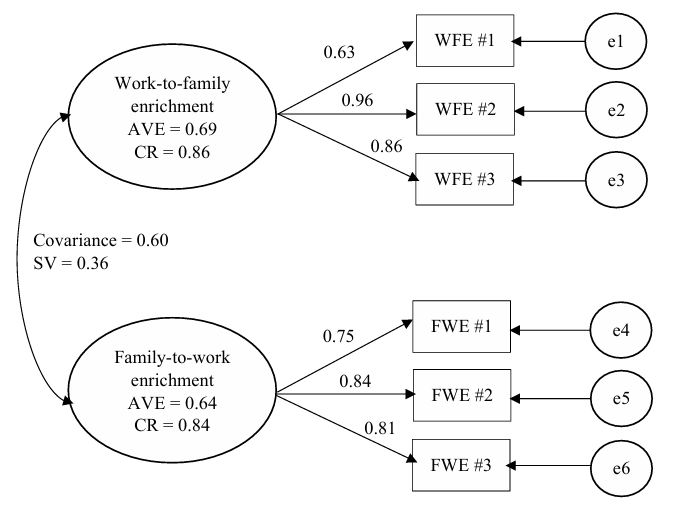
Figure 1. Confirmatory factor analysisNote. n = 438. All factor loadings and correlations are statistically significant at the p < .01 level
A multi-group confirmatory factor analysis was conducted to examine whether the dimensionality of the SP-WFES-6 was invariant across gender (Kline, 2010). Consistently with previous validation studies (e.g., Pujol-Cols, 2019), four two-group models were estimated and compared in Amos 23. The first model hypothesized the same measurement model across both groups and allowed the factor loadings, correlations, and error variances to vary freely within each sub-sample. The second model held the factor loadings invariant, but allowed the factor correlations and error variances to vary freely. The third model allowed the error variances to vary across both sub-samples, but required the factor loadings and correlations to be equivalent. Finally, the fourth model specified that the factor loadings, factor correlations, and error variances for both sub-samples should be equal.
As shown in Table 1, the baseline model provided an adequate fit to the data, χ2 (438, 16) = 40.88, p < .01, CFI = .982, RMSEA = .060. Moreover, the results showed that the baseline model was not significantly different from the second and third model. It should be noted, however, that the baseline model was significantly different from the model with the factor loadings, factor correlations and error variances held invariant, ∆χ2 (438, 19) = 31.74, p < .05. In this regard, it should be noted that other fit statistics, especially CFI, should also be taken into account when examining factor invariance, since the chi-square difference test is sensitive to sample size (Kline, 2010). In this sense, changes in CFI values lower than or equal to .01 provide evidence of factor invariance (Cheung & Rensvold, 2002). As Table 1 shows, changes in CFI values were lower than .01 across the four models and the fit statistics for the most constrained model were satisfactory. Altogether, these results supported the gender invariance of the SP-WFES-6 and thus indicated that the two-factor structure of the scale can be generalized across gender.
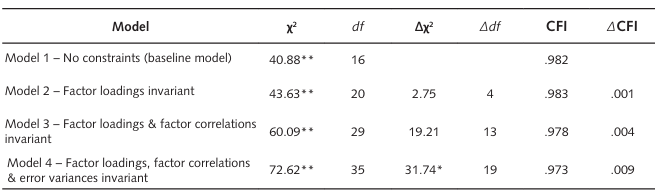
The procedure described above was also used to test whether the factor structure of the scale was invariant across samples (i.e., factor invariance). As a preliminary step, the cross-sectional sample (N = 438) was split into two random samples (n = 219). Then, four models were estimated and compared through multi-group confirmatory factor analysis in Amos 23. As shown in Table 2, the fit statistics for the baseline model were satisfactory, χ2 (438, 16) = 47.47, p < .01, CFI = .978, RMSEA = .067. Furthermore, chi-square differences were non-significant and CFI changes were lower than .01 across the four models. Taken together, these findings indicated that the two-factor structure of the SP-WFES-6 mapped well across both samples with respect to their factor loadings, factor correlations, and error variances, which provided evidence of the measurement invariance of the instrument.
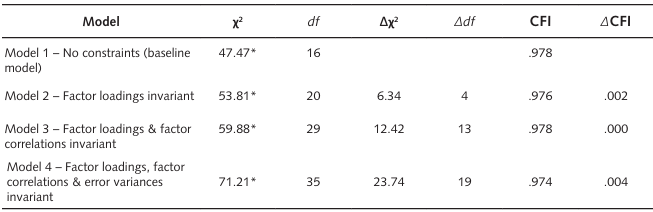
Table 3 exhibits the means, standard deviations and reliability estimates for the SP-WFES-6. As shown in this table, the descriptive statistics and Cronbach's alpha coefficients obtained for the cross-sectional sample were very similar to those reported for the multi-wave sample. In both samples, the internal consistency estimates were higher than the conventional level of acceptance of .70 (DeVellis, 2012; Nunnally, 1978).
Table 3. Descriptives and reliability estimates
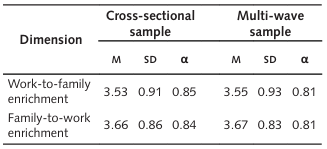
Notes. m = Mean, sd = Standard deviation, α = Cronbach's alpha coefficient.
The reliability of the SP-WFES-6 was also tested by examining its test-retest reliability. Figure 2 reports the correlations among W→FE measured at time 1, F→WE measured at time 1, W→FE measured at time 2, and F→WE measured at time 2. As shown in this figure, W→FE (t1) predicted W→FE (t2), but displayed no significant correlations with F→WE (t2). Similarly, F→WE (t1) was significantly related to W→FE (t2), but did not predict F→WE (t2).
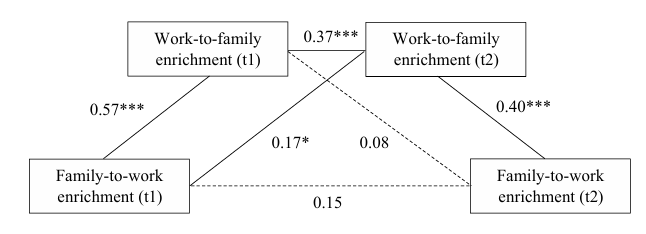
Figure 2. Test-retest reliability analysisNotes. n = 103. * p < .10, *** p < .01. Full lines indicate significant correlations. Dotted lines indicate non-significant correlations
Regarding the convergent validity of the SP-WFES-6, the results from the confirmatory factor analysis (Figure 1) revealed that the factor loadings of the six items of the scale were in most cases higher than .70. Moreover, AVE values were .69 and .64 for the W→FE subscale and the F→WE subscale, respectively, which exceeded the conventional level of acceptance of .50. Additionally, the composite reliability of both subscales was higher than .70 (.86 and .84 for the W→FE subscale and the F→WE subscale, respectively). Altogether, these findings provided evidence of the convergent validity of the SP-WFES-6 (for a more detailed description of this procedure, see Hair et al., 2010).
The discriminant validity of the SP-WFES-6 was tested by comparing each factor's AVE with their shared variance estimates (see Hubley 2014). According to Fornell and Larcker (1981), the discriminant validity of an instrument is demonstrated if each factor's AVE (e.g., the AVE of W→FE) is greater than its squared correlations (i.e., shared variance) with other factors. As shown in Figure 1, the shared variance between both factors (.36) was lower than their respective AVE values (.69 and .64), which provided evidence of the discriminant validity of the scale.
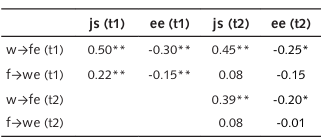
The predictive validity of the instrument was examined by analyzing the correlations between the two dimensions of work-family enrichment and two outcomes from the nomological network (see Table 4). The model hypothesized that both WFE dimensions should display positive correlations with job satisfaction and negative correlations with emotional exhaustion. As shown in Table 4, in the cross-sectional sample, both W→FE (t1) and F→WE (t1) were found to be positively correlated with job satisfaction (t1) and negatively correlated with emotional exhaustion (t1). Similarly, in the multi-wave sample, W→FE (t2) displayed positive correlations with job satisfaction (t2) and negative correlations with emotional exhaustion (t2). Finally, in the multi-wave sample, W→FE (t1) was found to be a significant predictor of both job satisfaction (t2) and emotional exhaustion (t2).
Discussion
Although numerous studies have demonstrated that the WFES is an exhaustive, robust and psychometrically sound instrument to measure WFE, evidence of its cross-cultural validity outside the United States is still very limited. With these considerations in mind, Omar et al. (2015) developed and validated a Spanish version of this scale (the SP-WFES) and reported adequate reliability and validity levels in the Argentinian context. In spite of these valuable efforts, the original WFES comprises 18 items, which may limit its use in longitudinal designs, diary studies or cross-sectional research that involves assessing multiple constructs (see Rogelberg & Stanton, 2007). Thus, this study developed a Spanish version of Kacmar et al.'s (2014) 6-item version of the WFES and examined its psychometric properties in terms of its internal consistency, test-retest reliability, factor structure, factor invariance, gender invariance, convergent validity, discriminant validity, and predictive validity.
The results from the confirmatory factor analysis revealed that the SP-WFES-6 exhibited a two-dimensional structure (i.e. W→FE and F→WE) and that this dimensionality was invariant across gender and sample, which provided evidence of measurement and gender invariance. Moreover, both factors showed adequate levels of internal consistency (α ≥ .84 in the cross-sectional sample and α = .81 in the multi-wave sample) and test-retest reliability (W→FE and F→WE at time 1 predicted W→FE at time 2). Furthermore, the SP-WFES-6 exhibited satisfactory levels of convergent validity and discriminant validity, with AVE values ≥ .64, composite reliability estimates ≥ .84 and AVE values > shared variance estimates (.36). Finally, W→FE and F→WE were found to be positively correlated with job satisfaction and negatively correlated with emotional exhaustion in the cross-sectional sample. In the multi-wave sample, however, only W→FE (at time 1) was found to be a significant predictor of both job satisfaction (at time 2) and emotional exhaustion (at time 2). Altogether, the findings of this study supported the reliability and validity of the SP-WFES-6 in Argentina.
Regarding the practical implications of this paper, on the one hand, the findings provided evidence of the impact of WFE on individuals' well-being. More specifically, the results showed that those workers who reported higher levels of W→FE at time 1 tended to experience higher levels of job satisfaction and lower levels of emotional exhaustion at time 2. In this sense, employers should pay close attention to the enrichment that employees experience as it can lead to more positive attitudes and states both inside and outside the organization. This could be done, for instance, by designing challenging and empowering jobs, providing sufficient opportunities for career advancement and self-actualization, adopting a supportive leadership style, and promoting healthy working environments and cultures (see Lapierre, Li, Kwan, Greenhaus, DiRenzo, & Shao, 2018). On the other hand, in addition to the multiple research implications of the SP-WFES-6, it is possible that this instrument is also useful to measure WFE in professional practice as long as participants feel that their responses to the survey will be held confidential. Indeed, unless confidentiality can be ensured, employees either will not participate in the study or will complete the questionnaire in a socially desirable way (see Piedmont, McCrae, Riemann, & Angleitner, 2000).
This article has several strengths. For instance, this was the first study to develop a Spanish version of the WFES-6 and to conduct a thorough and rigorous evaluation of its psychometric properties. To this end, the study drew on data collected from workers with different backgrounds, which allowed testing the scale across multiple organizational settings. Moreover, the inclusion of multi-wave data allowed testing the predictive validity of the scale while also reducing the common method bias (see Podsakoff, MacKenzie, Lee, & Podsakoff, 2003). Furthermore, since the results reported in this article were consistent with those reported by Kacmar et al. (2014) in their validation study, the findings provided evidence of the cross-cultural validity of the original WFES-6 outside the United States. Additionally, these findings also indicated that the SP-WFES-6 is a linguistically equivalent and culturally appropriate instrument to measure WFE in Argentina and, possibly, in other Spanish-speaking countries.
Despite the valuable contributions of this paper to the field of organizational psychology, it is necessary to address some of its limitations. First, the individuals who participated in the study were from a metropolitan area of Buenos Aires, Argentina. Since workers from smaller cities, rural areas or other countries were not included in the sample, future research should further examine whether the psychometric properties of the SP-WFES-6 hold across countries, regions and organizational settings (see Pujol-Cols, 2021). Second, the predictive validity of the scale was examined only in terms of the correlations between WFE, emotional exhaustion and job satisfaction. Future studies should also consider other family-related outcomes, such as marital satisfaction, or even other non-work constructs, such as life satisfaction. Moreover, future research should analyze the nomological validity of the SP-WFES-6 more extensively by considering different antecedents of WFE (e.g., family demands, work demands, personality traits).

