




 English (pdf)
 Article in xml format
 Article references
 Automatic translation
 Send this article by e-mail
 Cited by SciELO
  Cited by Google
  Similars in
SciELO
Similars in
SciELO  Similars in Google
 Permalink

POLITICAL IDEOLOGY allows people to understand and navigate through different social, political, and economic issues. Ideologies include a set of beliefs, values and behaviors about social reality, which are identified with the left or right side of the political spectrum. Positioning to the left or to the right is a widely used ideological compass to differentiate “progressive” (left- wing) or “conservative” (right- wing) attitudes, which are likely related to the legitimization of inequality, the search for social justification and resistance to change (Bobbio, 1996; García- Castro, 2010; Jost, 2017).
Political ideology, however, depends on the historical, social, political, and economic characteristics of each context (Caprara and Vecchione, 2018). Therefore, being on the left or on the right of the political spectrum have different connotations in a country with strong democratic institutions (e.g., Europe), with recent experiences of military dictatorships (e.g., Latin America), or countries with ongoing internal armed conflict (e.g., Colombia). Indeed, political ideology becomes more important in defining political attitudes depending on the country of reference (Freire, 2008; Wiesehomeier and Doyle, 2012). As such, the notions of left and right should be reviewed in the light of some “hard cores” (e.g., beliefs, values, identities) shared across people and societies, as well as “soft” or peripheral aspects specific to each context.
This article examines the role of political ideology on legitimating inequality in Colombia, a country historically characterized by high levels of political violence, poverty and exclusion (Moncada, 2013). We seek to integrate the conceptual and contextual discussion of ideology from the perspective of social psychology in the Colombian context. Our research relies on the idea that left- right political ideology remains a useful indicator to understand some political attitudes around (in) equality and support for the status quo. Particularly, we expect that placing more to the right (vs. left) in the political spectrum will be positively associated with the legitimation of social inequalities in economic, gender, and political domains. We argue that the legitimating effect of political ideology is maintained across different social domains (economic, gender- based, and political) and it is central within the Colombian political conflict. However, there is little empirical literature that confirms these correlates of political ideology in Colombia. As such, we still do not know if there are any nuances of the Colombian context that need to be taken into account.
This article contributes to the scientific literature on the psychosocial correlates of political ideology in two aspects. First, it evaluates the pertinence of a left- right political ideology in a context of high social and economic inequality such as Colombia and allows questioning whether the political ideologies revolve around the justification of social inequality. Second, this article shows some particularities of political ideology in Colombia, related to its conservative history and armed conflict. Considering that the existing literature on political ideology in Colombia has more historical, political, or sociological perspectives, this article is one of the first empirical investigations showing the correlates of political ideology on a wide variety of social and political attitudes. As such, this study helps to gain a better understanding of the meaning of left- right political ideology in Colombia.
Left-Right Political Ideology From a Psychosocial Perspective
Ideologies can be defined from different perspectives, depending on the theoretical background and the level of analysis. For instance, ideologies can be seen as a set of belief systems about different dimensions of life (e.g., political, religious, philosophical); but can also be seen as discursive or rhetorical artifacts to manipulate and deceive (Leader Maynard and Mildenberger, 2018). From an empirical and non- normative perspective, ideology is defined as a system of political and moral attitudes composed of different cognitive, affective and motivational processes (Jost, 2006). Thus, political ideology represents an organized set of values (i.e., abstract ideals or guiding principles) and attitudes (i.e., positive or negative evaluations) about a specific issue (Maio et al., 2006). As such, values are seen as concepts or beliefs about desirable states or behaviors that transcend the individual and guide their evaluations and behaviors (Schwartz, 1992). These values provide a frame of reference for perceiving reality and shape behaviors aligned to what is considered correct, fair and appropriate (Jost et al., 2009).
Some political ideologies contribute to legitimate social inequalities and maintain the status quo, such as the belief in a just world, social dominance orientation, meritocracy, system justification, and political conservatism (García- Castro, 2010; Jost and Hunyady, 2005). Regarding political conservatism, this ideology is captured by the distinction between left and right, which has been a useful, consistent and parsimonious indicator to approximate political attitudes in the Western world (Jost, 2009). The left- right division corresponds to a system of beliefs and attitudes underlying progressive or conservative thoughts that represent antagonistic concepts in the world of politics, particularly, regarding equality issues: the left- progressive is associated with a greater search for equality, and the right- conservative is committed to the legitimization of inequality (Bobbio, 1996; Hunt, 2014).
From a psychological perspective, left- right political ideology reflects individual differences on specific cognitive and motivational processes for understanding reality. In this regard, political ideology represents a motivated social cognition (Jost et al., 2003), related to a series of needs in epistemic (e.g., to understand the world), existential (e.g., to avoid threats), and relational (e.g., to share reality with others) factors that revolve around two substantive dimensions: justification of inequality and support for the status quo (Jost et al., 2009). The left- right asymmetry has received abundant empirical evidence internationally, showing that conservative (vs. progressive) political ideology is often associated with higher levels of the needs for cognitive closure, perceptions of threat, dogmatism, cognitive rigidity, and intolerance of uncertainty, among others (for a systematic review see Jost, 2017).
Political ideology also denotes asymmetries in moral values. For example, Nilsson and Jost (2020) found that positioning on the right side of the political spectrum was linked to stronger endorsement of beliefs in a competitive and dangerous world, as well as normativism (e.g., preference for adhering to norms). Likewise, the left was positively associated with humanism (e.g., attributing intrinsic value to people) and desire to change (Nilsson and Jost, 2020). Besides, conservative people tend to score similar in the values of caring, fairness, loyalty, authority, and purity, as well as having less consensus toward public policies (Haidt et al., 2009). On the other hand, liberals (vs. conservatives) adhere significantly higher to the values of caring and fairness (Graham et al., 2009).
Furthermore, political ideology can feed political and affective polarization. That is, people can become more extreme in their beliefs, attitudes, and affects because of their ideological differences with other people (Hetherington, 2009). Indeed, political and affective polarization can be a by- product of people’s political preferences and ideologies (Abramowitz & Saunders, 2008). Research has shown that political and affective polarization have increased because of cleavages in political attitudes toward, redistribution, and welfare (Webster & Abramowitz, 2017). Similarly, political polarization is likely to increase when people perceive greater differences between political issues (Rogowski & Sutherland, 2016), and when people endorse political conservatism and nationalism (Satherley, Sibley, et al., 2020). Likewise, international data have shown that polarization between people from the left and right have been fed by redistributive preferences and inequality- related topics (Noureddine & Gravelle, 2021). Thus, the influence of political ideology on the legitimacy of inequality can be a potential linkage that foster polarization.
Political Ideology as a Context-Dependent Process
Left- right political ideology is constructed within a specific historical, social and cultural context (Caprara and Vecchione, 2018; García- Castro, 2010). Caprara and Vecchione (2018) showed that in some countries left- right ideology was associated with political and intergroup attitudes, while in others this only occurred when there was a clear demarcation of political parties. In Spain, Jahn (2011) also showed that the “two party system” restricted the political ideologies, with the left tending to be more homogeneous in terms of condemning inequality and the right presenting greater divisions between neoliberals and conservatives. Likewise, in other countries of Europe, left- right political ideology has been strongly associated with adherence to specific political parties, and this party structure serves as a reference to define the political attitudes of their sympathizers (Vegetti and Širinić, 2018). Solano- Silva (2018) showed that people aligned to the right- side of the political spectrum was associated with greater acceptance of inequality in developed Western countries, but this association was lower and more diverse in Latin American countries. Left- right political ideology has different configurations in Latin America, depending on the type of policies related to support for the tax system, public spending, and privatization (Wiese- homeier, 2010; Wiesehomeier and Doyle, 2012).
In Colombia, empirical literature on political ideology is scarce. One study showed that political conservatism was associated with higher scores in authoritarianism and social dominance (Díaz, 2017). Another study found that political conservatism was associated with greater orientation to blind patriotism, greater national identity, authoritarianism, conformism, orientation to self- censorship (i.e., withholding information to protect one’s own group), and lower support for universal values such as truth, peace, and social justice (Lobato et al., 2020). Furthermore, political conservatism was positively associated with individualizing, binding, and moral absolutism values (as defined in the Moral Foundations theory) (Avendaño et al., 2021). These studies pointed out a relationship between political conservatism or right- wing political ideology and inequality- justifying attitudes, but do not systematically examine the influence of political ideology on different inequality dimensions embedded in social, political, and economic domains.
Regarding the meaning of political ideology in Colombia, it can be interpreted from a historical perspective. Historical research suggest that Colombia was influenced by right- wing movements from Europe at the beginning of the 2oth century, which promoted the centrality of religion, family and property (Gaitán-Bohórquez & Malagón-Pinzón, 2019). Furthermore, political ideology in Colombia is intrinsically related to the political armed conflict between left- wing guerrillas and right- wing military and paramilitary groups. Although left- wing and right- wing armed groups have been involved in human rights violations, right- wing paramilitary groups were mainly involved in maintaining inequalities by repressing dissident groups, and protecting rural elites and extractives corporations (Coronado, 2019).
Another characteristic of political conservatism in Colombia is the association with “strong leaders”, whose political campaign revolved around iron fist measures against left- wing guerrillas. However, such political figures have been linked to illegal armed groups. For instance, it has been proved that the Colombian electoral system (2002-2006) was influenced by illegal right- wing paramilitary groups, who managed to gain political representation in the parliament (Acemoglu et al., 2013). Therefore, political ideology in Colombia is not only expressed by the justification of social inequality, but it is also embedded within a long- standing armed conflict and political corruption (Gamboa Gutiérrez, 2019).
The Current Research
The aim of this article is to examine the association between political ideology and the legitimacy of social inequality in economic, gender, and political domains. Thus, we focus on the influence of political ideology on the endorsement of political measures, attitudes and values related to the legitimation of economic inequality (Study 1); the perception and legitimization of gender inequality (Study 2); and political attitudes related to social conflict, political inequality and polarization (Study 3). These studies point to the same idea about the effect of political ideology on the legitimization of inequality and the maintenance of the status quo in Colombia. In addition, each study makes specific contributions about different types of inequalities that are understudied in the Colombian context. Taken together, these studies examine the system- justifying nature of the left- right political positioning by testing its consistency in independent samples and across several domains.
This investigation complied with the ethical standards for conducting research in psychology, approved by the University of Granada (No.170/ CEIH/2016). The fellow universities that participated in the Study provided formal approval for the research; and all participants signed an informed consent for participating in the Study.
The analytical strategy across three studies was similar. We used linear regression analyses, in which political ideology predicts different forms of legitimating economic, social, and political inequalities. Political ideology was treated as a continuous variable, such that higher values indicate a position further to the right in the political spectrum, which means higher political conservatism. When the outcome variable was dichotomous, we used logistic regression instead. We controlled by the potential influence of sociodemographic variables, such as gender, age, and socioeconomic status (income and education). Data, code and materials (see Table S7 in the supplementary material for the complete wording of the items) used in this research are publicly available at: https://osf.io/gdgzs/
Study 1
The aim of Study 1 was to examine the influence of political ideology on the legitimacy of political measures, attitudes, and values related to the maintenance socioeconomic inequality
Participants
A total of 506 university students (50.3% women, 49.5% men, 0.40% other), from five universities (one public, four private) located in the city of Cali, Colombia (Mage = 20.27, SD = 3.95). Data was collected between March and June 2018 through a paper- and- pencil questionnaire at the library of the universities.
Measures
Political Ideology
An indicator of political self- positioning was used. Participants had to place themselves, based on their political affinity, on a scale ranging from 1 “Extremely left- wing” to 7 “Extremely right- wing” (M = 3.57, SD = 0.97).
Support for Progressive Policies
We used three items that assessed the degree of individual support for political measures that promote social change: abortion, homosexual marriage, and euthanasia. Participants had to rate their responses on a seven points Likert scale: 1 “Strongly Disagree” to 7 “Strongly Agree”) (M = 5.27, SD = 1.6). This scale presented appropriate reliability according (α = 0.80). The following variables had the same response scale, except for the variables in which we explicitly mention another instruction.
All references to reliability throughout the manuscript refer to Chronbach’s alpha (α).
Support for a Military Solution to end the Armed Conflict in Colombia
a single item asked if “A military solution is the best way to end the armed conflict in Colombia.” (M = 2.42, SD = 1.62, Likert scale from 1 “strongly disagree” to 7 “strongly agree”).
Attitudes Toward Economic and Social Inequality
Three items assessed attitudes of participants toward economic and social inequality (in a scale from 1 “strongly disagree” to 7 “strongly agree”): intolerance toward inequality (“Differences in income in Colombia are too large”, based on García- Castro et al., (2021) (M = 6.05, SD = 1.33); justification for inequality (“If income in Colombia were more equal, people would be less motivated to work hard”) (M = 3.58, SD = 1.86); and support for economic redistribution measured by the average of two items (e.g. “The government should impose higher taxes on people with higher incomes”) (R = 0.29, P < .001, M = 5.22, SD = 1.31).
Support for Affirmative Action
Two items measured the degree in which participants supported political mobilizations or protesting that favor the most disadvantaged populations (e.g., “To hold protests, marches, and public demonstrations defending the rights of the most disadvantaged groups in Colombia”) (M = 5.72, SD = 1.15; Likert scale from 1 “strongly disagree” to 7 “strongly agree”).
Universal Values
Participants were asked to rate the meaningfulness of six values using a response scale ranging from -1 “opposed to my values” to 7 “Of supreme importance”. An exploratory analysis identified two dimensions, the first one on Social Justice that grouped values such as Equality (equal opportunities for all), A peaceful world (free from war and conflict), and social justice (correcting injustices and caring for the vulnerable) (α = 0.73; M = 5.99, SD = 1.15). The second dimension associated with Power, such as values for Authority (the right of some to lead or direct), Influence (having an impact on people and events), and Wealth (material possessions, money) (α = 0.68; M = 3.81, SD = 1.51).
Results and Discussion
As an overall result, we found that people with lower scores in political conservatism were less likely to legitimate inequality and perpetuate the status quo (Pearson correlations between the variables included in Study 1 are available in Table S1 at the on- line supplementary material). Regarding attitudes towards social policies, the results suggested that positioning more to the left (vs. right) of the political spectrum was associated with greater support for progressive policies (i.e., legalizing abortion, euthanasia, and homosexual marriage) (β = - .23) and rejected more the military solution to the armed conflict (β = - .29).
Regarding attitudes towards inequality, positioning more to the left in the political spectrum was associated with less tolerance towards economic inequality (β = - .12), less justification of inequality (β = - .19), and greater support for the redistribution of resources (β = - .22); but it was not associated with support for affirmative action (β = - .09 n.s.).
With respect to universal values, we found that positioning to the left (vs. right) was linked to less adherence to values associated with power and hierarchies (β = .18), and it was not associated to social justice values (β = - .03 n.s.). Furthermore, when the people placed themselves more to the left in the political spectrum, they reported lower subjective socioeconomic status (β = .10). The standardized regression coefficients of political ideology predicting outcome variables related to inequality are summarized in Figure 1 (see Table S4 in the supplementary material for complete information about regression analyses).
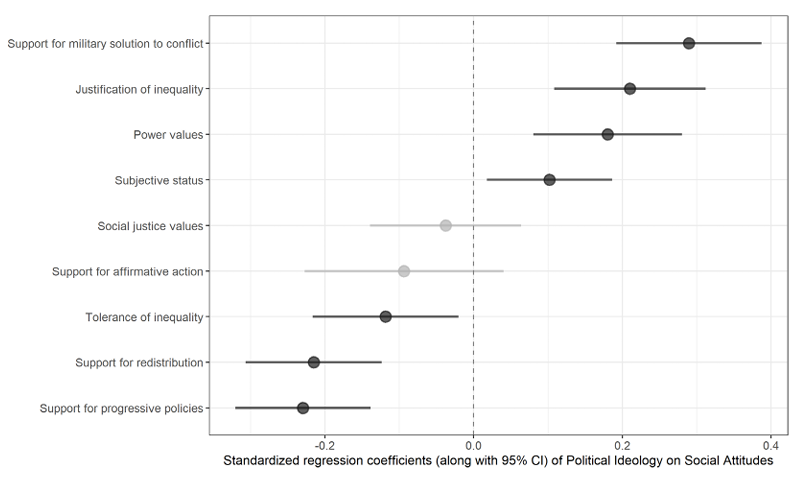
Note: Light gray-shaded dots indicate non-significant values.
Figure 1 Standardized Regression Coefficients of Political Ideology Predicting Social Attitudes in Study 1
The results of Study 1 suggested that people that position to the left side of the political spectrum were associated with greater support for progressive policies and lower justification of social inequality. These results are consistent with previous studies (Jahn, 2011; Jost, 2017), which indicated that values linked to the left- right political spectrum revolve around the theme of equality and social justice (Bobbio, 1996).
Study 2
The robustness of political ideology on the legitimacy of inequality can be tested by examining its consistency through different social domains. Gender relations represent one of the domains of public life where dynamics of inequality and domination between groups have been observed throughout history (Sidanius and Pratto, 1999). Therefore, Study 2 aims to test the influence of political ideology on the legitimization of gender inequality.
Participants
We used the Colombian sample that participated in the international project on gender perceptions and ideologies “Toward Gender Harmony”, which is a large- scale collaborative research focused on gender inequality across countries (Kosakowska-Berezecka et al., 2020). We only used the Colombian sample because it was the only one that included political ideology. Although the original sample consisted of 691 participants, our final sample was composed of 277 participants that provided information about their political ideology (Mage = 23.27, SD = 6.67; 66.43% Women, 31.41% Men, 2.16% non- binary or no response), from two cities in Colombia (Cali 92.36%, Barranquilla 7.64%). Data was collected between August and December 2019 through an on-line questionnaire. Participants replied to an open call to participate in this study and filled the questionnaire after consenting.
Measures
Political Ideology
Participants had to identify their political ideology according to their political affinity on a scale ranging from 1 “Extremely left-wing” to 10 “Extremely Right” (M = 3.52, SD = 1.92).
Awareness of Gender Inequality
A single item on the recognition of gender inequality in society was used adapted from Glick and Whitehead (2010) (i.e., “In general, our society currently treats women less fairly than men”). The response scale ranged from 1 “Strongly Disagree” to 7 “Strongly Agree” (M = 4.97, SD = 1.87).
Perception of Economic Gender Inequality
One item assessed the degree in which participants perceived gender income inequality “How large do you think the differences in economic income are between Men and Women in Colombia?” Participants rated their responses from 1. None (no differences), 2. Very small (men earn a little more than women), 3. Small, 4. Medium, 5. Large, 6. Very large (men earn much more than women) (M = 4.29, SD = 1.23).
Intolerance Towards Gender Inequality
An item was adapted to determine whether economic gender inequality was considered as excessive (García-Castro et al., 2019): “In Colombia, the differences in economic income between men and women are too large”. A 7-point scale was used (1 “Strongly Disagree” to 7 “Strongly Agree”) (M = 4.74, SD = 1.58).
Beliefs in Equal Opportunities
An item on the belief in the existence of equal job opportunities for men and women was adapted (Anonymous-reference-for-review): “In Colombia, women have the same opportunities for work and professional development as men”. Participants rated their responses from 1 “Strongly Disagree” to 7 “Strongly Agree” (M = 3.24, SD = 1.53).
Acceptance of Inequality - Egalitarian Ideology
Comprise the value of equality as a life’s principle and indicates people’s justification of inequality (Brandt and Reyna, 2017). Participants had to indicate the degree in which they resembled a person who “thinks it is important that all people in the world are treated equally”, and that “everyone should have equal opportunities in life.” The responses were rated in a scale from 1 “Not at all like me” to 7 “Very much like me” (M = 6.43, SD = 0.97).
Resistance to Social Change - Traditional Ideology
Participants indicated the degree in which they resembled a person who valued following traditions “tradition is important, following the customs given by religion and family”. The responses were rated in a scale from 1 “Not at all like me” to 7 “Very much like me” (M = 2.89, SD = 1.73).
Gender Zero-sum Ideology
It consists of the belief in the existence of a natural competition between men and women in terms of absolute losses or gains. This ideology was assessed though 7 items adapted from Ruthig et al. (2017), (e.g., “More good jobs for women mean fewer good jobs for men). The responses were rated in a scale from 0 “Strongly Disagree” to 5 “Strongly Agree”) (α = .79; M = 0.64, SD = 0.75).
Ambivalent Sexism
Refers to attitudes toward women that encompass stereotypical perceptions of gender roles and prejudice about women, using six items from Cárdenas et al. (2010). Exploratory factor analysis identified two dimensions, the first one related to benevolent sexism (3 items), which expresses traditional and subordinate roles of women in society (e.g., “Women should be loved and protected by men”) (α = .60; M = 2.01, SD = 1.27); and a second dimension related to hostile sexism or prejudicial attitudes toward women (3 items), (e.g., “Women seek to gain power by manipulating men.”) (α = .72; M = 1.25, SD = 1.07). Participants rated their responses from 0 “Strongly Disagree” to 5 “Strongly Agree”).
Gender Essentialism
Represents the belief in the existence of fundamental differences between men and women that reflect their nature (essence) and define their identity. The mean of three items adapted from Skewes et al. (2018) was calculated (e.g., Men and women have different abilities”). Responses were rated in a scale from 1 “Strongly Disagree” to 7 “Strongly Agree”) (α = .61; M = 4.24, SD = 1.50).
Collective Actions in Favor of Gender Equality
Four items evaluated activities that people are willing to carry out to claim equal rights for all genders (Tausch et al., 2011), (e.g., “participating in demonstrations”). Responses were rated in a scale from 1 “Not at all likely” to 7 “very likely”) (α = .80; M = 4.48, SD = 1.60).
Civic Actions in Favor of Gender Equality
Six items evaluated the willingness to support civic actions adapted to gender inequality issues (Alisat and Riemer, 2015) (e.g., “How likely are you to participate in a community event that focuses on gender issues?”). Responses were rated in a scale from “1 “Not at all likely” to 7 “Very likely” (α = .93; M = 4.54, SD = 1.71).
Results and Discussion
The main finding of Study 2 is that people scoring higher (vs. lower) in political conservatism were more likely to underestimate gender inequalities and endorse beliefs and discriminatory attitudes that reinforce social disparities (Pearson correlations between the variables included in Study 2 are available in Table S2 at the on- line supplementary material).
Regarding the attitudes toward gender inequality, it was found that the more people positioned further to the left, the greater their awareness of gender differences (β = - .31), the greater their perception of the magnitude of such gender differences (β = - .24), and the lower their belief that men and women have the same work opportunities (β = .16). Intolerance to gender inequality was not significantly linked to political ideology (β = - .10 n.s.).
In relation to ideologies justifying gender inequality, it was found that being further to the left on the political spectrum was associated with: a) greater support for egalitarian ideologies (β = -.18) and less support for traditional ideas (β = .19); b) lower belief that gender equality represents losses for men (β = .15); c) lower benevolent (β = .19) and hostile (β = .18) sexism; d) lower belief that there are essential differences between men and women (β = .20); and e) lower levels of religiosity (β = .21).
Regarding the disposition toward social change promoting gender equality, it was found that being more to the left in the political spectrum was associated with greater support for collective actions that condemn gender inequalities (β = -.30), and greater disposition to participate in civic actions that seek gender equality (β = -.29) (See Figure 2, see Table S5 in the supplementary material for complete information about regression coefficients).

Note: Light gray-shaded dots indicate non-significant values.
Figure 2 Standardized Regression Coefficients of Political Ideology Predicting Gender Attitudes in Study 2
These results are consistent with Study 1 findings, and with previous studies reported in the international literature on the relationship between political ideology, the legitimization of social inequality and the maintenance of the status quo (Jost, 2017). In this sense, it is shown that when people place themselves more to the left of the political spectrum, they report higher levels of rejection about different forms, subtle and explicit, of justifying gender inequality. These results are consistent with previous research that showed that right- wing political ideology is linked to higher levels of prejudice toward sexual diversity and sexism across different samples (López-Sáez et al., 2020a, 2020b). Therefore, the less people identified with the right side of the political spectrum, the lower they justify gender inequality and the more they are willing to mobilize for social change.
A limitation of Study 2 is that right- wing participants are underrepresented in this sample. Hence, it is difficult to state with certainty if this opposite tendency holds across the whole ideological spectrum and if the right- side is in fact associated to values and attitudes against social change. In addition, the fact that the participants from Studies 1 and 2 were university students, who are young adults, and hold levels of formal education above the national average, also limits the possibility of generalizing these results to Colombian society. For this reason, in Study 3 we used survey data to evaluate whether the legitimating function of political ideology holds with a larger and representative sample from Colombia; and whether it can be extended to a broader range of topics related to political inequalities linked public policies and social attitudes linked to the Colombian political climate, such as the armed conflict and political polarization.
Study 3
The aim of Study 3 is to determine the influence of political ideology on attitudes toward political inequality linked to the Colombian armed conflict and political polarization. This allows us to extend our previous results by confirming the inequality-legitimating function of political ideology on a different domain of the public life. Furthermore, we can examine the potential influence on political polarization surrounding public policies under discussion in Colombia about the peace agreements with left-wing armed political groups.
Participants
We used the Colombian sample of the eighth wave of the Americas Barometer (LAPOP - Latin American Public Opinion Project) collected between 2018-2019 (LAPOP, 2020). LAPOP is an inter-institutional initiative that explores public opinion on social, political and economic issues related to democracy throughout the Americas and the Caribbean. The sample was composed of 1555 participants who responded who informed their political ideology (Mage = 39.92 years, SD = 16.22; 48.55% Women, 51.45% Men). The study used a representative probabilistic design of the Colombian population in terms of geographical region, income, and ethnicity.
Measures
Political Ideology
Political orientation left-to-right was rated from 1 “Extremely Left” to 10 “Extremely Right” (M = 5.78, SD = 2.68).
Political System Support
Three items assessed the expressions of support for the country’s political system in general (e.g., “To what extent do you think that Colombia’s political system should be supported?”) (α = .73). The responses ranged from 1 “Not at all” to 7 “Very much” (M = 4.41, SD = 1.49).
Political Trust
We used four dimensions of trust toward political authorities and institutions. First, political trust (3 items), measured how much participants relied on their institutions (e.g., the judicial system) (α = .85; M = 3.34, SD = 1.32). Second, trust in the Military and Police Forces (r = .503, p < .001; M = 4.21, SD = 1.64). Third, trust in the president, at the time of data collection, Iván Duque (M = 3.99, SD = 2.13). Fourth, trust toward the political armed group that participated in the peace process in 2018 (i.e., the FARC-EP). All responses were rated from 1 “Not at all” to 7 “Very much” (M = 1.87, SD = 1.35).
Participation in Social Protests
A single item assessed the degree of participation in protests and collective movement (“In the last 12 months have you participated in a demonstration or public protest?”; 1 “Yes”, 11%: 0 “No”, 89%).
Attitudes Towards Social Inequality and Support for Redistribution
Five indicators evaluated participant´s sympathy with public measures targeted at reducing economic inequality: support for redistribution of income (i.e., “The Colombian government should implement strong policies to reduce income inequality between the rich and the poor”) (M = 5.39, SD = 1.68); support for redistribution of economic resources for helping the most disadvantaged (i.e., “The government should spend more on helping the poor”) (M = 6.09, SD = 1.38); support for redistribution of economic resources focused on the contribution of the better-off (i.e., “It is unfair that the rich pay a lot in taxes, but receive little in state services”) (M = 4.01, SD = 1.97); belief in unemployment as an individual problem rather than a governmental responsibility (i.e., “Most unemployed persons could find a job if they wanted to”) (M = 4.55, SD = 2.01); support for land redistribution (2 items, e.g., “To what extent do you agree that vacant land should be distributed to peasants who do not have enough land to farm”) (R = 0.30, p < .001, M = 4.25, SD = 1.30). All responses were rated from 1 “Strongly Disagree” to 7 “Strongly Agree”.
Resistance to Reconciliation
Two items evaluated the willingness to sympathize with demobilized combatants (e.g., “How strongly would you approve of a daughter/son of yours being friends with a demobilized FARC combatant”). Response scale from 1 “strongly disapprove” to 10 “strongly approve” (r = .612, p < .001) (M = 5.14, SD = 2.64).
Support for Peace Process With the ELN
One item measured support for the president to continue the peace talks with the ELN (Ejército de Liberación Nacional) (i.e., “The government of former President Juan Manuel Santos initiated a peace process with the ELN. To what extent do you agree with President Iván Duque continuing these negotiations?”). Responses were rated from 1 “Not at all” to 7 “Very much” (M = 5.04, SD = 1.92).
The ELN is one of the left-wing armed groups involved in the current Colombian political armed conflict.
Support for Peace Agreement Modification
One item evaluated support to modify the peace agreements signed between the government and the FARC- EP (i.e., “President Iván Duque proposed during his electoral campaign to modify the accords reached between the Colombian government and the FARC. To what extent do you agree or disagree with the president?”). Responses were rated from 1 “Not at all” to 7 “Very much” (M = 4.28, SD = 1.89).
Support for a Military Solution to the Armed Conflict
One item evaluated participant´s support for a military solution to the conflict with the guerrilla in Colombia. Two possible responses were offered: 1 “Use of military force” (29%) or 0 “Negotiation” (71%).
Sexist Ideologies
two items evaluated the perception of women’s submission in social relations (e.g., “When a woman says she is a victim of harassment at work, she is usually exaggerating”). Responses were rated from 1 “Strongly Disagree” to 7 “Strongly Agree”) (R = .279, p < .001; M = 3.52, SD = 1.67).
Approval of Progressive Policies
We computed the mean of four items that evaluated the acceptance of different social issues (e.g., homosexuality, euthanasia). Responses ranged from “1 strongly disapproves” to “10 strongly approves” (α = .81) (M = 5.46, SD = 2.55).
Religiosity
A single item assessed the importance of religion in the participant’s lives (i.e., “How important is religion in your life?”). Responses were rated from 1 “Not at all important” to 4 “Very important” (M = 3.52, SD = 0.84).
Political Polarization
The average of four items evaluated the willingness of participants to deny the rights of people with different opinions (e.g., “There are people who always speak poorly of the government in Colombia, not only of the current government, but of the system of government. How strongly do you approve or disapprove the right to vote of these people?). Similar indicators have been previously used for measuring polarization (Brown- Iannuzzi et al., 2020). Responses were rated from 1 “strongly disapprove” to 10 “strongly approve” (α = .71) (M = 4.93, SD = 1.95).
Affective Polarization
Affective polarization refers to the dispersion of feelings, positive (hope and pride) and negative (anger and fear), towards two political actors that represent the left and the right in Colombia (Gustavo Petro and Iván Duque). The measure proposed by Wagner (2021) calculated the difference and intensity of feelings towards these two political actors. As such, higher values indicate that individuals endorse both positive and negative feelings toward political actors (M = 2.45, SD = 1.15).
Where i = participant; sentim. = sentiment score; p = political group; n = number of political groups.
Results and Discussion
In general terms, in Study 3, we found that people scoring higher in political conservatism were more supportive of the status quo, and more reluctant to support social change measures associated with both progressive policies and the solution of the Colombian armed conflict. Furthermore, the greater the political conservatism, the more adherence to beliefs that sustain gender inequalities and the greater political and affective polarization. Interestingly, political ideology had no association with redistributive preferences in this sample (Pearson correlations are available at Table S3 in the supplementary material).
Regarding the support for the country’s political system, it was observed that the more to the right in the political spectrum, the greater support for the political system (β = .22), the greater the trust in the political institutions (β = .20), the armed forces (R = .16), and the Colombian president (β = .34) (Ivan Duque). Likewise, placing to the right side of the political spectrum was related to lower trust in the FARC- EP political party (leftwing group) (β = - .08), and lesser participation in protests (β = - .36) (See Figure 3, see Table S6 in the on- line supplementary material for complete information about regression coefficients).

Note: Light gray-shaded dots indicate non-significant values.
Figure 3 Standardized Regression Coefficients of Political Ideology Predicting Political Attitudes in Study 3
In relation to the support for measures to redress inequality, it was found that the more people placed to the right of the political spectrum, the more they believed that unemployed people could get a job if they wanted to (β = - .11). However, political ideology was not associated with any of the variables related to support for redistribution, such as support for rich taxation (β = - .04 n.s.), the government role for reduction of inequality (β = - .01 n.s.), the provision of social assistance to the disadvantaged (β = .01 n.s.), the land redistribution for peasants victimized by the armed conflict (β = .01 n.s.).
Regarding resistance to the peace process, it was found that placing more to the right in the political spectrum, was linked to less willingness to reconcile with demobilized combatants (β = - .10); greater support for modifying the peace agreement (β = .29); greater support for military solutions to the armed conflict (β = .13). Political ideology was not associated with support for the peace negotiations with the ELN armed group (β = .01 n.s.).
As for support for traditional values, placing to the right of the political spectrum was related to less support for progressive social policies (e.g., abortion, euthanasia, homosexual marriage) (β = - .08), greater acceptance of sexist ideologies (β = .14), and greater religion centrality (β = .10).
Regarding political polarization, greater identification with the right was associated with greater disposition to deny political rights to the opposition (β = .08), greater affective polarization (β = .07), and higher likelihood of voting for Ivan Duque in the 2018 presidential elections (β = 1.03).
General Discussion
The aim of this research was to examine the effect of political ideology on the legitimization of inequality and support for the status quo in Colombia. Then, we tested the association between ideological self- positioning and attitudes towards inequality in different domains, such as those related to economic, gender, and political attitudes.
The results confirmed that political ideology has a consistent effect on legitimating inequality and resisting social change in issues such as economic inequality (Study 1), gender inequality (Study 2) and political inequality (Study 3). Our results suggest that positioning further to the right on that political spectrum---understood as political conservatism---, people were less aware of inequalities and more willing to justify social disparities in terms of economic, political, and gender- based issues. We also found that political conservatism was consistently linked to higher levels of support for the status quo and resistance to change, more willingness to support military actions to deal with the armed conflict, higher rejection of the peace agreements and willingness to reconcile with demobilized combatants, and higher levels of affective and political polarization. In addition, the further people place to the right, the less they supported progressive and support social mobilizations to reduce inequality. Interestingly, we found that despite of such differences in inequality- related attitudes, in Study 3, we found that political ideology was not associated with any of redistributive policies aimed at reducing inequality. In sum, these results confirm that left- right political ideology remains a key concept for guiding attitudes towards inequality and social change (García- Castro, 2010; Jahn, 2011; Jost, 2017) (see summary of the findings in Table S8 in the supplementary material).
At a theoretical level, the present findings also confirm the conceptual proposal that posits that left- right political ideology revolves around issues of inequality and social justice (Bobbio, 1996; Hunt, 2014; Solano Silva, 2018). As suggested by the literature, political ideology plays a key role in the justification of the existing political system, and the maintenance of social inequalities (Jost et al., 2008; Jost and Hunyady, 2005). In this regard, the present study confirms that left- right political ideology is still a relevant category in the Colombian context linked to how people perceive, understand, position, and take actions on different social issues (Rutjens and Brandt, 2019). In addition, this study offers consistent evidence on how political ideology works transversally across different domains, such as economic, gender and political inequality.
These results contribute to the empirical study on political ideology and the justification of inequality in several ways. First, this article presents one of the first empirical studies showing the correlates of political ideology in Colombia. Although left- right political ideology is widely used in public debate, it is often confined to the positioning of specific political actors (e.g., candidates, political parties) or armed actors (e.g., guerrillas, paramilitaries), which excludes its implications for social and intergroup attitudes toward inequality and change. Moreover, some works on political ideology in Colombia adopt historical, political or sociological perspectives (Caviedes, 2016; González, 2011; Kajsiu, 2019; Rochlin, 2019), but does not explore into the belief systems associated with them and how they guide people’s behavior. Our contribution is to offer an empirical and psychosocial approach that allows us to support a critical and reflexive research agenda necessary to understand political life (Aristizábal, 2010; Dane, 2021). Thus, our findings allow us to define left- right political ideology beyond partisanship and critical historical events, and instead we map a set of political attitudes that legitimate inequality and sustain the status quo in Colombia. This psychosocial perspective on political ideology serves as a bridge between the historical discussion about socio- political issues and inequality, and individual attitudes that guide behaviors.
Second, our results provide insights for understanding the social divisions in Colombia that have become even more evident in the Colombian political climate related to social unrest and political campaigning (Rincón, 2021). For instance, we found differences between the political ideology of university students (Studies 1 and 2) and the general population (Study 3), the former placed further to the left and the latter further to the right. This ideological divergence appears to be related to age and education. Research shows that conservatism increases with age and that university education tends to promote progressive left- wing values (Jost, 2009; Thorisdottir et al., 2007). Therefore, the differences in political ideology among the samples in this research could also reflect the unequal access to social resources (e.g., education) that allow people to value different motives related to social, political, religious and economic issues (Miller, Dorcé, Uribe and Saavedra, 2021, Hatibovic, Bobowik, Faúndez, and Sandoval, 2017).
The political cleavages due to political ideology are not just expressed in terms of the legitimacy of economic inequality, but also in the levels of political and affective polarization. Thus, right- wing participants (vs. left- wing) showed extreme animosities toward out- party political leaders and supported denying opposition political rights. This finding is consistent with previous research showing that inequality- related issues are at the core of political polarization (Noureddine & Gravelle, 2021; Satherley, Sibley, et al., 2020). As such, differences between political stances are highly likely to exacerbate polarization and division in society (Rogowsky & Sutherland, 2016).
Furthermore, in Study 3, we also found no substantive differences in support for redistributive measures along the ideological spectrum, which seems to be counterintuitive with previous literature. Our interpretation of this finding is that, under extreme levels of inequality such as those experienced in Colombia, most of the people are aware of shocking inequalities and unfairness, which in turn leads them to support measures for redressing inequality. However, this was not the case of university students (Study 1 and 2), for whom political ideology did influence their redistributive preferences to redress inequality. These mixed results can be the by- product of different process of political socialization, as university students are likely to be more sensitive to social justice topics that the average person in Colombia. Further research should examine whether the influence of political ideology on political attitudes depend on people’s individual differences, socioeconomic status, educational level, among other potential moderators.
Third, ideological divisions rely on different ways of perceiving and understanding the world on issues such as economic inequality, gender inequality and political polarization: the left of the political spectrum is more sensitive for recognizing inequalities and social injustices, while the right is more conservative, traditionalist and authoritarian (Anderson and Singer, 2008). Although it is not possible to determine causal relations between ideological cleavages and social phenomena, the social outburst lived in Colombia during 2021 and the political climate during the 2022 presidential elections, have increased the salience of political ideologies in the public discourse. For instance, social mobilizations in 2021 revolved about inequality and justice (e.g., access to education, tax justice, etc.) topics (Movilizatorio, 2021) and political campaigns are concerned about policies related to left- wing political agendas. As such, perceptions of inequality shape political attitudes because it is linked to feelings of unfairness and relative deprivation for not having access to resources and opportunities (García-Sánchez et al., 2018). These perceptions are amplified by left- wing political ideology that makes people even more aware of inequality, and therefore, could be crucial components to mobilize people for demanding social change (van Zomeren et al., 2008; Noureddine and Gravelle, 2021). Therefore, we can affirm that political ideology shapes the way of perceiving, justifying and reacting to social reality.
Among the limitations of this work, there were two studies conducted with university students, which are not representative of the Colombian population. However, in Study 3 we used data from the general population, which confirmed most of the results found with university students. Besides, because of the correlational nature of our data we cannot imply causal relationships. These correlates, instead, could be interpreted as a way of defining left- right political ideology in attitudinal terms. Indeed, political ideology as a bipolar construct does not capture the complexity of the relationships that exist between so many social beliefs and attitudes (Azevedo et al., 2019; Rutjens and Brandt, 2019). Yet, left- right political ideology still performs adequately as a useful category to understand how people navigate through political issues. Importantly, a recent study suggests that economic conservatism can be one of the potential mechanisms through which social conservatism increase adherence to moral foundations values (Avendaño et al., 2021). Therefore, it is possible that political conservatism reflects different underlying dimensions about social, cultural, economic, and other domains that, in turn, will have different effects on political attitudes. Previous studies suggest that political conservatism can operate through other psychological processes, such as authoritarianism, social dominance orientation, traditionalism, among others (García-Sánchez et al., 2022; Rottenbacher, 2012; Rottenbacher and Cáceres, 2014; Rottenbacher and Guzmán, 2013). Future studies could delve deeper into the psychological underpinnings and mechanisms associated with the influence of political conservatism on social attitudes.
In addition, the effect sizes we found in our studies did not exceed a Pearson correlation of .30, which in the field of social psychology can be interpreted as small or medium effect sizes (Lovakov and Agadullina, 2021). However, this does not mean that it is of no theoretical or practical relevance. Indeed, the influence of political ideology on explaining inequality- related attitudes ranges on the average levels of effect sizes in psychology, which indicates it is still a substantial contribution. Furthermore, these effect sizes can have substantive pragmatical implications, since political ideology can be a driving force of political behaviors, such as political elections, demonstrations, and support for public policies. Thus, political ideology can serve as a political compass through which people navigate social life and guide their behaviors.
Another potential limitation of our studies is that we used survey indicators and scales that are not fully validated in the Colombian context. Fully validated measures about inequality in Colombia are relatively scarce, which reflects a limitation of the field in general. However, survey indicators are commonly used in social science, providing reliable findings similar to those discussed in sociology and political science research. Furthermore, we found that all the variables showed appropriate psychometric properties in terms of reliability and dimensionality. Further research in social and political psychology should continue working on validating new scales to advance empirical research in this area.
In summary, this research has shown that political ideology remains an important category for understanding and positioning oneself in the social world. The categories of left and right are historical and context- dependent constructions that intersects with people’s motivations to defend (or challenge) the status quo. In this paper we show that political conservatism is associated with greater justification of inequality and support for the status quo through different social attitudes toward diverse dimensions of political life. These differences are amplified in the Colombian public discourse by exacerbating emotions towards political figures (Movilizatorio, 2021). Thus, this article can help us to better understand what political ideology means in Colombia and, therefore, to acknowledge foundational ideological differences in perceptions and beliefs about inequality that could hinder the process to get a more just and egalitarian society.

