




 English (pdf)
 Article in xml format
 Article references
 Automatic translation
 Send this article by e-mail
 Cited by SciELO
  Cited by Google
  Similars in
SciELO
Similars in
SciELO  Similars in Google
 Permalink

Introduction
THE ROLE of higher education institutions in the provision and development of the workforce for sustainable economic growth and development in all countries is documented in the literature and recognized by educators, researchers, experts, and scholars around the world (Zettler, 2022). Higher education institutions are expected to be the source of information for the most specialized and skilled intellectuals due to their unique nature (van Kleef & Lelieveld, 2022). They train a qualified and adaptable workforce, generate new knowledge through basic and applied research, access existing global knowledge, and provide a platform for adapting this knowledge to local use by supporting knowledge- based economic growth and poverty reduction strategies (Jamil, 2016). The evidence of this was displaced by a high turnover in academic settings which has recently become a major concern for psychologists and researchers in African countries (Masoga, 2013), calling for a halt to the emigration of perceived knowledge workers. Due to the brain drain or loss of talented African academic staff, many countries on the African continent lack the skills needed to meet the challenges of economic development (Benedict & Ukpere, 2012). The constant strikes at higher education institutions in Nigeria are becoming a disturbing phenomenon in the education sector (Sajuyigbe, 2015; Enahoro & Adeyinka, 2013; Ojokuku, 2013; Ologunde, Asaolu & Elumide, 2012). The above scenario has resulted in a significant number of Nigerian scholars migrating from the search of greener pastures. The impact of this apparent reduction in the number of academic staff is that the lecturer/student ratio is high and can put a heavy burden on lecturers in the field, leading to reduced productivity and reduced quality of education in higher institutions of learning in Nigeria (Sajuyigbe, 2015). In the current scenario, employee retention is a major concern for researchers, educators, and policymakers. Employee retention is defined as an organization's ability to prevent employee turnover or the number of people who leave their jobs voluntarily or involuntarily over a while (Sajuyigbe, Eniola, Ayeni & Sanusi, 2021). Researchers have found that employees are more likely to stay and work successfully achieve their corporate goals if appropriate employee retention strategies are adopted and implemented by the company (Wilkinson, Gollan, Kalfa, & Xu, 2018; Ruck, Welch & Menara, 2017; Wood & De Menezes, 2011). Thereby positing that increasing employee retention has a direct impact on a company's productivity and success. Furthermore, Employee Voice has been identified as one of the employee retention strategies to prevent employee turnover. Employee retention is strongly and systematically linked to employee voices (Şimşek & Gürler, 2019). This link explains that when employees at all levels share their views and opinions, work together towards common goals, and share power and influence, they are no longer attracted to alternatives. In addition, organizational citizenship behavior was recognized by scientists and documented as one of the employee retention strategies in HR management that motivates employees to maintain maximum time in the organization and contribute effectively (Salami, 2009). Lavelle (2010), Gunnigle, and McDonnell (2010) show that an organization's citizenship behavior provides personal motivation beyond the need to provide something for fair treatment. Empirical evidence shows that employee voice and the organization's citizenship behavior can bring many valuable improvements to the organization, such as organizational commitment (Soieb, Othman & D'Silva, 2013), job satisfaction (Kanana, 2016), and employee retention (Abdullah, Maisoon & Islam, 2018). Employee voice, organizational citizenship behavior, employee retention, and conflict resolution have been independently studied and conceptualized in a variety of ways in both developed and developing countries (Soieb, Othman & D'Silva, 2013; Kanana, 2016; Abdullah, Maisoon & Islam, 2018). However, especially in the education sector, the role of mediating conflict resolution in the relationship between employee voice, organizational citizenship behaviour and employee retention has not been explored. Thus, this current study fills a gap in the human resource management literature by examining the mediating role of conflict resolution on the relationship between employee voices, organizational citizenship behaviour, and employee retention. The research is expected to provide valuable insights that government and university management can use to optimize educational environments through employee engagement, organizational citizenship behaviour, and conflict resolution.
Underpinning Theories
Prior studies have linked various theories such as Human Capital theory (Abdullah, Maisoon and Islam, 2018), equity theory (Ekabu, 2019), Maslow's Hierarchy of Needs Theory (Jagun, 2015), social exchange theory (Owence, Pinagase, and Molotsi, 2014), Path- Goal theory (Şimşek & Gürler, 2019), Resource- Based View Theory (Onyango, 2013), Strategic Contingency Theory (Odhong & Omolo, 2014), and Herzberg's Two- Factor theory (Owence, Pinagase & Molotsi, 2014) to establish the link between employee relationship management and employee retention. However, no or few studies used a mixture of different theories to explain the relationship between organizational citizenship behaviour, employee voice, conflict resolution, and employee retention. Thus, this study warrants details to address this contemporary gap in the literature by using Equity Theory and Path- Goal theory to explain the role of mediating conflict resolution in the relationship between employee voice, organizational citizenship behaviour, and employee retention. A good reason for using these theories is that equity theory represents a balance between academics' attitudes toward their academic careers and the intensity of their work. This theory argues that governments should be responsible for paying academics fairly to prevent staff turnover and the number of people seeking greener pastures in neighbouring countries. Furthermore, path- goal theory shows that the actions of the Nigerian government affect academic motivation, performance, and retention. Integrity may be determined by academic satisfaction, goals, and the government's ability to promote retention.
Equity Theory
The theory of Equity (1965) focuses on people's perceptions of how they are treated compared to others in terms of decision- making participation, freedom of expression, and collaborative learning (Miringu, 2017; Orina, 2014; Spector, 2008). According to Ekabu (2019), the theory is that employees are treated fairly, motivated to perform at their best, and even organizations make a round trip by engaging in organizational citizenship behaviour. Millis (2017) shows that equity theory is a moral theory in that it seeks to understand the causes of happiness and satisfaction. Conflicts can be explained by the difference in the relationship between work and compensation. Conflicts occur when an employee feels cheated in a relationship and is willing to leave. The theory demonstrates that the number of organizational citizenship behaviour patterns (OCBS) can be reduced if employees feel that the output/input ratio is below the reference value (Khalid et al., 2012; Rizwan & Ali, 2010). Alternatively, the person can be late, miss a job altogether, or quit the job. Therefore, this theory can be applied to understand the changing intentions of scholars in Nigerian higher education institutions. Academics then compare their working conditions and other aspects of the teaching profession with their equivalents in similar institutions in the public sector. This explains why the Nigerian University Academic Staff Union (ASUU) has made multiple strikes nationwide to demand better working conditions. In this study, the equity theory is used to connect the organizational voice with organizational citizenship behaviour. This arises from the requirement to comprehend an employee's ability to speak up and be heard in an organizational setting. This idea is thought to be a moral theory for achieving full organizational engagement to achieve a productive synergy. The productivity of the organization is said to reflect the synergy atmosphere. The authors' positions on this theory, as stated by Khalid et al., (2012) and Rizwan & Ali (2010), show that the number of organizational citizenship behaviour patterns (OCBS) can be lowered if employees believe the output/input ratio is below the reference value, in retrospect, the employee voice. The employee's ability to hear a note decides whether or not he is regarded as a citizen of the corporation (Miringu, 2017). Overall, what motivates an individual to act in the direction of making an opinion known is a function of the company's un- suppressiveness, which allows the employee's voice to be heard regardless of the situation in which the organization finds itself. As a result, there is a cultural obstacle to employee growth is removed. It is based on this premise that the theory intends to hypothetically relate the prowess of an employee voice to staff retention in the organization. In short, it can be concluded that constructivism allows approaching the vocational phenomenon in an alternative and innovative way, understanding it as a process that is inscribed in socio- historical contexts that are permanently created and recreated. This conception is consistent with Bruner's (2008) socio- cultural proposals on cognitive development, which guide the conceptualization proposed here (Gergen, 2007; Kang et al., 2017; Young & Collin, 2004). So, after recognizing the place of constructivism in this new conception of vocationality, next, this process will be approached from the notion of identity.
Perspective the Path-Goal Theory of Leadership
Path- Goal theory dates back to Martin Evans (1970) and was further developed by House (1971). The theory shows that leader behaviour depends on employee satisfaction, motivation, and performance. Leaders are expected to help followers reach their goals and provide the guidance and support they need to ensure that their goals are in line with the goals of the institution (Kasinathan & Rajee, 2017; Habeeb, 2019; Barsulai, Makopondo & Fwaya, 2019). An organizational goal that details the methods used by leaders. Wilkinson, Gollan, Kalfa, and Xu (2018) state that if a manager constantly consults with employees, seeks suggestions, allows participation in decision- making, protects employee well- being, treats them equally, and show confidence in their abilities, employees will exhibit organizational citizenship behaviour and be committed to organizational goals. Research shows that when managers make up for the shortcomings of either employees or the work environment, citizenship organizational behaviour, work satisfaction, and employee retention are positively impacted (Grego- Planer, 2019; Cherry, 2010). In the same direction, Masood, Siddiqui, Lodhi, and Shahbaz (2020) reveal that employees exhibit organizational citizenship behaviour and commitment when managers show a smooth, clear direction without obstacles to achieving the company's goals. Ram and Prabhakar (2011) argue that leaders can change the lives of the employees by changing their ambitions to leave the organization if they were motivated to participate in decision- making, treat them equally, and have confidence in their abilities. According to Şimşek and Gürler (2019), the Path- goal theory predicts that a leadership direction is an important tool in helping subordinates complete complex tasks beyond their - capabilities. Therefore, the Path- Goal theory applies to this study because the theory is emphasizing the need for the Nigerian universities' management and government to level out the educational challenges by encouraging academic staff to make decisions about non- payment of allowances, extended working hours, poor relationships, and industrial hazard. This helps academic staff demonstrate organizational citizenship behaviour and a high level of commitment to educational development. For the adoption of the path growth theory, it assumes to a certain degree that the voice of employees in an organization concerning diverse opinions will lead to a conflict but as the resolution of that occurs, the retentiveness of the employees in the organization on that job is harnessed. Wood & De Menezes, (2011) made it known that human nature naturally abhors conflict and the growth of any society is based on the proposition of an amicable way of solving conflicts as it arises. The assurance that such conflict will be solved will create an organizational allegiance vis-à-vis a reason for continuity within the organization (Rizwan & Ali, 2010). Thus, bringing the path growth theory into adoption for the study as it culminates the existence of a conflict resolution as a mediator to harness organizational citizenship behaviour from the belief of being retained in the organization based on the job path the employee believes will be attained. From a bird's eye view, the different entailed collective transitional factor for employee retention is based on the consistency of conflict resolution emanating from the organizational citizenship behaviour. The above-listed parameters are the ways in which employee retention operates from the consciousness of the path growth theory using conflict resolution acting as the mediating transit into participating in the organizational citizenship behaviour.
Employee Voice and Employee Retention
The roots of the concept of employee voice date back to the Industrial Revolution of the 18th century when agricultural societies became more industrialized and urbanized (Kaufman, 2015). According to Wilkinson, Gollan, Kalfa, and Xu (2018), employee voices have been in the limelight of human resource management and organizational behaviour (OB) since the 1980s. Rees, Alfes, and Gatenby (2013) describe an employee's voice as a broad and formal means of employee input, including involvement in decisions, conflict resolution, grievance procedures, suggestion systems, quality circles, employee- management meetings, ombudsman services, and work councils. The employee relationship management literature considers the employee's voice to be a fundamental democratic act for employees who have the right to express their opinions about workplace decisions in the organization (Wilkinson et al., 2018). Empirical research has shown that there is a positive correlation between employee voice and employee retention. For example, a study by Wood and De Menezes (2011) shows that employee voice is associated with low willingness to quit and employee involvement. In addition, Ruck, Welch, and Menara (2017) have also established a positive relationship between employee voice and employee retention. Han, Chiang, and Chang (2010) also found that employees with a corporate culture that encourages employee participation in decision- making tend to stay in the company. From the same perspective, Bakker and Demerouti (2008) argue that employees who autonomously, manage, and responsibly propose improvements within an organization tend to stay in the organization. In the same perspective, Path- Goal theory attests that if a leader constantly consults with employees, seeks suggestions, allows participation in decision- making, protects employee well- being, treats them equally, and show confidence in their abilities, employees will be committed to organizational goals. The above- consensus results should be reviewed in the context of Nigeria. Therefore, the following hypothesis is formulated:
H1: There is a positive and significant relationship between employee voice and employee retention.
Organizational Citizenship Behavior and Employee Retention
In the early 1980s, the term "organization- al citizenship" was used to describe employee behaviour within the social systems of various companies. Due to the increasing importance of autonomous and team- based work compared to the strict traditional hierarchy, it has since evolved into an important subject of research (Le Pine, Erez, & Johnson, 2002). Therefore, an understanding of Organizational Citizenship Behavior (OCB) is becoming increasingly important to the social structure of a company and the long- term sustainability of employee responsibilities. Employee roles and their behaviour are fundamental, both at the macro level for changes in all organizations and at the micro level for individual organizations. In previous studies, researchers found that the basic strategy of today's organizations for effective employee retention is organizational citizenship behaviour (Paille, 2009; Lam, Chen & Takeuchi, 2009; Paille & Grima, 2011). Citizenship is employee behaviour that is not part of an employee's contract or job description but is beneficial to the company's performance. Employees are motivated to support the company's core values and demonstrate these behaviours without expecting compensation. Organizational citizenship behaviour has been observed over time. Behaviour often provides ideas for minimizing the need for surveillance, improving work ethic, and reducing costs. Individual behaviour is visionary and tends to choose activities that it believes are part of its future position. Employees who are willing to exceed their obligations support the organization in dealing with change and unpredictability. According to Kasinathan and Rajee (2017), organizational citizenship behaviour is the willingness of employees to make voluntary and supportive gestures while empirically showing that organizational citizenship behaviour significantly predicts employee retention. Lavelle (2010) shows that organizational citizenship behaviour provides organizations with the personal motivation that goes beyond the need to do something for fair treatment. A study conducted by Paille (2009) finds a positive and significant relationship between organizational citizenship behaviour and employee retention. Habeeb (2019) also shows that organizational citizenship behaviour motivates employees to become involved and incorporated into the organization and is, therefore, willing to work beyond formal expectations. In addition, Barsulai, Makopondo, and Fwaya (2019) found in their study that employee retention and productivity are predicted by organizational citizenship behaviour. Equity theory argues if a leader should be responsible for paying fairly it will enhance OCB and prevent staff turnover (Masood et al., 2020). Thus, the following hypothesis is proposed:
H2: There is a positive and significant relationship between organizational citizenship behaviour and employee retention.
Construct Conflict Resolution as Mediating Factor
The term conflict resolution refers to the informal or formal process used by two or more parties to reach a peaceful resolution to a disagreement. As indicated by Weber (1946) the study of conflict resolution in the organization has now been subjugated by the rationalist tradition. Conflict, according to the rationalist viewpoint, is a threat to efficiency, and conflict resolution is the use of specialized tools to regulate or divert conflict into constructive endeavours. Cultural heritage, on the other hand, emphasizes how conflict resolution meanings and forms are socially constructed in organizations and institutional environments (Behfar, K, Friedman, & Brett, 2016). The systematic achievement of global relevance depends on the ability of managers to recognize and deal with conflicts in the workplace (Julia, Juriy, Maksim, & Valeria, 2020). Previous studies demonstrate that there is a direct relationship between conflict resolution, employee voice, organizational citizenship behaviour, and employee retention. For example, Roche (2016) discovers that conflict resolution in the workplace reduces stress, has impacts on trust between employees and leadership, and makes it easier for employees to stay engaged. The study conducted by Clardy (2018) reveals that conflict resolution has a positive link with employee involvement, organizational citizenship behaviour, and retention which brings organizations to the limelight of global relevance. Gramberg, Teicher, Bamber, and Cooper (2020) further reported that employee voice, organizational citizenship behaviour, and retention are predicted by conflict resolution. Additionally, Gramberg, Teicher, Bamber, and Cooper (2017) find that conflict resolution facilitates employee participation in decision- making, commitment, and employee retention. Dunford, Mumford, and Boss (2020) also retorted those employees whose managers engage in conflict resolution have the perception of involvement culture, organizational citizenship behaviour, and lower turnover rates. The study of Alam, Arora, and Gupta (2020) also confirms that conflict resolution dimensions such as problem- solving discussions, communication skills, team mediation, teamwork, departure, reaction, and effective listening have a significant influence on employee participation in decision- making, organizational citizenship behaviour, and intention to leave. Based on the empirical findings, the following hypothesis emerged:
H3: There is a positive and significant relationship between conflict resolution and employee retention.
H4: Conflict resolution mediates the relationship between employee voice and employee retention.
H5: Conflict resolution mediates the relationship between organizational citizenship behaviour and employee retention.

Method: Sample and Procedure
The study population comprises full-time academic staff members of the three selected universities, as it is primarily responsible for training the higher education level workforce. The sample was selected using non-probability sampling techniques. First, a purposive sampling technique was used to select the three universities (University of Ibadan, Ekiti State University, and Babcock University). Thereafter, a sample of academic staff was conveniently selected from the three universities. The sample comprises each from the universities. Consequently, copies of the questionnaire were administered by the researchers to participants who volunteered to participate in the study from th July to th November At the end of the period, copies of the questionnaires were returned representing a response rate of ˆ. ˆ of them came from the University of Ibadan, ˆ of respondents came from Ekiti State University, and only ˆ of them came from Babcock University. ˆ of the respondents were male and ˆ were female. This trend suggests that men make up the majority of lecturers. This distribution may be because, in most Third World countries, men are culturally more educated than women. Forty- five percent of respondents were between - years, ˆ were between - years, ˆ were between - years, and only ˆ were above years. The average age of most respondents is years. This means that most faculty members are still very young, energetic, and active. This development means that they can still make a meaningful contribution to academic development. Seventy- seven percent of respondents have a third- degree (PHD) as the highest educational qualification and ˆ have a second degree (M.Sc), but only ˆ of respondents have a first- degree (B.Sc) as the highest educational qualification. This means that more than ˆ of academic staff have a PHD, which can help improve the level of education of students. ˆ of respondents have been in university for to years, ˆ have been in university for years, and ˆ have been in university for over years. The average majority of respondents have more than years of the university experience. Years of university experience show that most of them understand the institutional structure and administrative background that inevitably determine their coping strategies.
Measurements
To test the hypothesis, a quantitative study was conducted with a structured questionnaire. This study uses a conflict resolution scale developed and validated by Magdalene (2016) to measure conflict resolution. The scale has seven items in phrase format, fixed to a 5- point Likert scale, and has the following degree of response: Strongly Disagree (1), to Strongly Agree (5). The following is an example of a sample item; Shifting ground helps to resolve issues in the university in a fast and dynamic way, and the application of confrontation in conflict management reinforces mutual trust and respect in the university. The author gave a reliability alpha coefficient of 0.845 for seven items. The Employee Voice Scale developed and approved by Kos (2015) was used to measure the voice of employees. The scale consists of 8 points in the form of phrases and is linked to a 5- point scale of the Likert type with the following degree of response: strongly disagree (1), strongly disagree (5). Examples of the sample items include; Employees at each level in the organization taking part in the decision- making process up to an extent, the organization giving rewards for making appropriate suggestions, and the organization consulting employees in strategic decision- making. The author gave an alpha reliability factor of 0.89 for 6 items. The employee retention scale developed and approved by Albaqami (2016) was used to measure employee retention. The scale consists of 7 items in the form of phrases and is linked to a 5- point scale of the Likert type with the following degree of response: strongly disagree (1), strongly disagree (5). Examples of the sample items include; I would prefer to spend the rest of my career with this university, there is no plan to leave this university soon and my career is secure in this University." The author gave an alpha reliability factor of 0.91 for 7 items. This current study uses the Organizational Citizenship Behavior Scale developed and validated by Jena and Pradhan (2018). It is a 5- point Likert- type scale in which the response ranges from strongly agree (5) to strongly disagree (1). The 8- item scale measures organizational citizenship behaviour among academic staff. Examples of the sample items include; I enjoy helping others with work problems, I believe in doing honest work for an honest day, paying attention to how someone's actions affect the work of others, and I am always up to date on changes in the organization. The author gave an alpha reliability factor of 0.92 for 7 items.
Results and Discussion

Pearson's r ranges between +1 and -1, with +1 indicating a perfect positive correlation, -1 indicating a perfect negative correlation, and 0 indicating no linear connection at all. Table 1 depicts a very moderate to high positive connection. Employee retention (ER) is more likely when there is more employee voice (EV) and organizational citizenship behaviour (OCB), and the effect is quite powerful. The Pearson Correlation indicates that the variables have moderate to high relationships. Similarly, the two-tailed significance value is .000. The usual alpha value is .05, indicating that the association is extremely significant and not just the result of random sampling error.
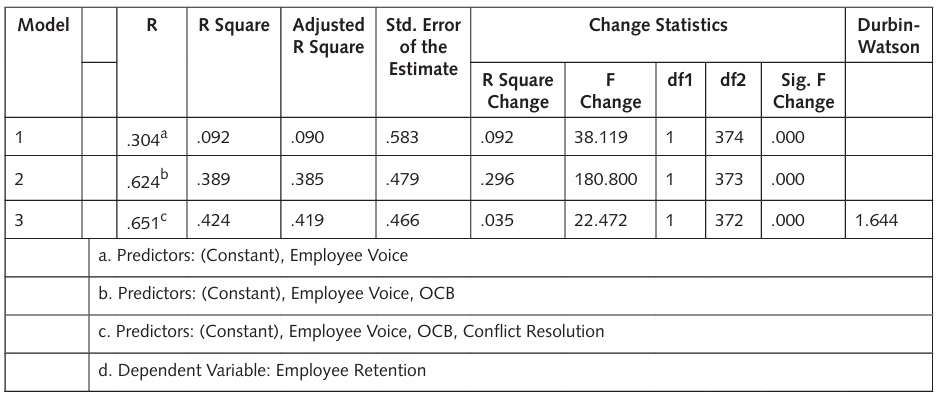
The model summary in Table 2 provides details about the characteristics of the model. In the present case, the study established an R-value, which is the multiple correlation coefficient of the study. The results show .304 for EV, .624 for OCB, and .651 for CR, suggesting the measure of the quality of the prediction of the dependent variable. This result further indicates that .304 for EV is a weak association between the predictor variables. However, when grouped into one model, .624, OCB, and .651, CR shows a good and strong level of prediction and an acceptable correlation between the predictor variables. Similarly, the coefficient of determination, measured by the R² of the total variables in the model, is .424 and indicates how much of the total variation in the dependent variable can be explained by the independent variable. This reveals that the regression model explains 9.2 percent of the changes in the EV, 38.9 percent of the changes in the OCB, and 42.4 percent of the variability observed in the target variable. Moreover, the adjusted R² of the total variables in the model is .419, with an R² of .424 indicating the variation of the sample results from the population in multiple regressions. It is required to have a difference between R- square and the adjusted R- square minimum. In this case, the value is .419, which is not far off from .424, which is good. Durbin- Watson = 1.644, which is between the two critical values of 1.5. The F- ratio obtained from the SPSS analysis for the ANOVA is similarly substantially more than one, indicating that the model is acceptable in describing the link between the predictor variables and the outcome variables. This was also reinforced by the zero p- values, which indicate that the model is significant and hence acceptable for understanding the connection between dependent and independent variables. Similarly, the linear regression F- test contains the null hypothesis that there is no linear connection between the two variables (R² = 0). The test is very significant with F = 91.125 and large degrees of freedom, therefore we may infer that the variables in the model have a linear relationship.
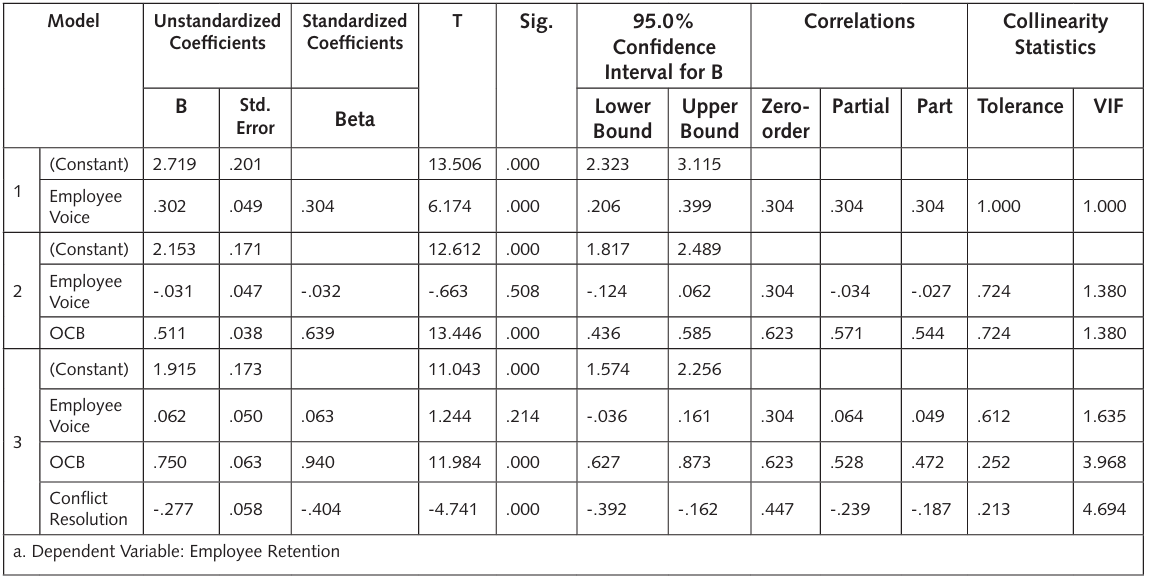
To examine these variables' conditions, SPSS was used to run the regression analyses as follows. The independent variable (employee voice - EV, organizational citizenship behaviour- OCB, and Conflict resolution) predicts the dependent variable (employee retention - ER). The mediator (Conflict resolution- CR) predicts the dependent variable (ER) while controlling for the effect of the independent variable; this indicates that the relationship is statistically significant. The outcomes offer a summary of the variables that have still to be included in the model. The hierarchical model was used in the study, and this summary explains the variables that have been defined to be input in the following phases. The summary computes a T- test for each predictor's estimated B- value if it was entered into the equation at this stage. Table 3 displays the SPSS regression output. This table displays the unstandardized and standardized regression coefficients, standard errors, the t and p values, and the 95% confidence interval for each analysis. The result shows that the independent variable (EV) is a significant predictor of the dependent variable (ER) (T = 6.174, P < .00). In other words, the direct effect (unstandardized coefficient = .302) is statistically significant. Hence, H1 is accepted. This result is in line with the study of Wood and De Menezes (2011) that employee voice is associated with low willingness to quit and employee involvement. In addition, Ruck, Welch, and Menara (2017) have also established a positive relationship between employee voice and employee retention. Similarly, when organizational citizenship behaviour- OCB was added to the model and analyzed the unstandardized and standardized regression coefficients, standard errors, the T and P values, and the 95% confidence interval for each analysis. The result shows that the independent variable (OCB) is a significant predictor of the dependent variable (ER) (T = 13.446, P < .00). In other words, the direct effect (unstandardized coefficient = .511) is statistically significant. Hence, H2 is accepted. The result conforms with the study of Kasinathan and Rajee (2017) that organizational citizenship behaviour is the willingness of employees to make voluntary and supportive gestures while empirically showing that organizational citizenship behaviour significantly predicts employee retention. Likewise, the study also agrees with Grego- Planer (2019), that found a positive link between organizational citizenship behaviour and employee retention. This shows that organizational citizenship behaviour motivates employees to become involved and incorporated into the organization and, therefore, willing to work beyond formal expectations (Habeeb, 2019). Table 3 is also the same for the mediating variable (CR) when entered as a significant predictor of the dependent variable (ER) (T = -4.741, P < .00). In other words, the direct effect (unstandardized coefficient = - .277) is statistically significant. In this scenario, the findings show that incorporating conflict resolution into the model has a substantial influence on the model's capacity to predict employee retention. Therefore, H3 is acceptable. This study confirms that conflict resolution in the workplace reduces stress, impacts trust between employees and leadership, and makes it easier for employees to stay engaged. Moreover, the results confirmed that when the three variables are entered jointly at the same time, the results confirmed that OCB and CR is a significant predictor of the dependent variable (ER) ((OCB) T = 11.984, P < .00; (CR) T = -4.741, P < .00). In other words, the direct effect (unstandardized coefficient (OCB) = .750 (CR)-277) is statistically significant, while EV is an insignificant predictor of ER. This study confirms the result of Clardy (2018) which reveals that conflict resolution has a positive link with employee involvement, organizational citizenship behaviour, and retention which brings organizations to the limelight of global relevance. However, this study is not in line with the results of Gramberg, Teicher, Bamber, and Cooper (2020) who reported that employee voice, organizational citizenship behaviour, and retention are predicted by conflict resolution.
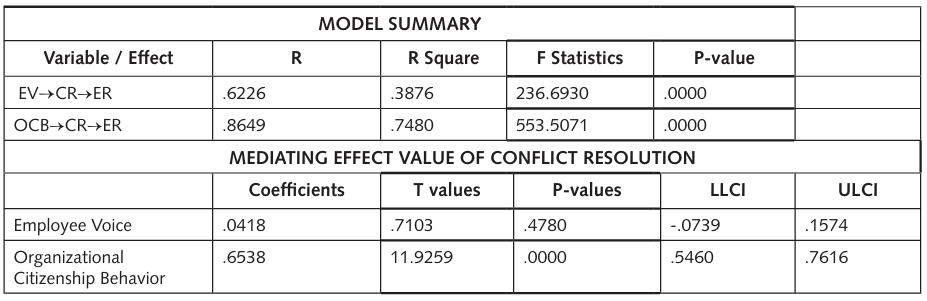
The mediated multiple regression models have been carried out through process macro conditional analysis in SPSS. The relationship between employee voice, Organizational Citizenship Behavior and employee retention in this study were mediated by Conflict resolution. The items were measured from Table 4 above, the results show the R² in the model with the mediating variable was 0.60 and 0.86 respectively, showing that R² changed for the model with the mediating variable. The results indicate that the mediating model was statistically significant with the model having F = 236.69 and 553.51 with a P- value = 0.000. This shows that the model is suitable for explaining the mediating influence of conflict resolution between Organizational Citizenship Behavior and employee retention. From Table 4, based on the mediation rule by Hayes (2013), conflict resolution partially mediates between Organizational Citizenship Behavior and employee retention with a P- value of 0.000. The rules state that the intervening term must be significant and if the intercession effect of the model values in both Lower- Level Confidence Interval (LLCI) and Upper- Level Confidence Interval (ULCI) has no zero value between them, the mediating variable has a significant effect on the model. The results further indicate that conflict resolution does not mediate the relationship between employee voice and employee retention with a P- value of 0.4780. Thus, H4 is confirmed and H5 is not supported.
Discussion of Findings
The results of this study establish that there is a positive linkage between organizational citizenship behaviour, employee voice, conflict resolution and employee retention. This implies that organizational citizenship behaviour, employee voice, and conflict resolution are managerial tools for employee retention. This means that employee retention is sacrosanct when academic staff are allowed to participate in decision- making that is germane to their career. This study aligns with Wood and De Menezes (2011) that employee voice is associated with low willingness to quit and employee retention. In addition, Ruck, Welch, and Menara (2017) also established that there is a positive relationship between employee voice and employee retention. In another study, Han, Chiang, and Chang (2010) found that employees with a corporate culture that encourages employee participation in decision- making are more likely to stay with the company. From the same perspective, Bakker and Demerouti (2008) argue that employees who lead autonomously within an organization and take responsibility for suggesting improvements tend to stay in the organization. Path- goal theory is also consistent with previous research that employee consultation, solicitation of suggestions, and participation in decision- making have a significant impact on employee retention. Evidence suggests that organizational citizenship behaviour is highly correlated with employee retention. This means that the academic staff's willingness to make spontaneous and supportive gestures is a predictor of staff retention. This study agrees with Kasinathan and Rajee (2017) that organizational civic behaviour significantly predicts employee retention. Lavelle (2010) also acknowledges that an organization's citizenship behaviour gives it a personal incentive beyond the need to do something to ensure fair treatment. Research by Paille (2009) confirms a significant positive correlation between organizational citizenship behaviour and employee retention. Similarly, Podsakoff, Whiting, Podsakoff, and Blume (2009) argue that organizational citizenship predicts productivity, efficiency, and retention when encouraged within an organization. A study by Grego-Planer (2019) also agrees with previous research that found a positive association between organizational citizenship behaviour and employee retention. Additionally, a study by Barsulai, Makopondo, and Fwaya (2019) found that employee retention and productivity are predicted by organizational citizenship behaviour. We also found that, with a P- value of of o.ooo, conflict resolution partially mediated between employee voice and employee retention, and between OCB and employee retention.
Conclusion and Recommendation
This study investigated the positioning of conflict resolution through the extemporization of 'employee voice, organizational citizenship behaviour, and employee retention using selected universities with the underlay history of established successive culture, being the first at various stages of setup in Southwest, Nigeria. Previous related works on the aforementioned variables, listing the linear relationship towards the outcome of conflict resolution on various paradigms, were referred to en route to this research. The findings revealed a significant linear relationship between all measured variables and the mediating variable. Furthermore, statistically, employee voice and organizational citizenship behaviour were found to predict employee retention. As a result, the relationship is statistically significant. While controlling for the effect of the independent variable, the mediator, conflict resolution, expects there to be an effect on employee retention. The research findings did not support this, with conflict resolution failing to mediate the relationship between employee voice and employee retention. A conflicting report from Nguyen et al., (2022) and Stephen et al., (2018) on the desire to harness employee retention. As a result of this finding, the study recommends that organizations, particularly tertiary institutions, enhance and value employee voice. It has been established as a follow- up for Organizational Citizenship Behavior, resulting in employee retention. The scheduling of periodic meetings in which all voices are given the necessary respect and opinions will change the positioning of the mediating variable.
Theoretical Implications
This study illustrates the relevance of equity theory and pass- goal theory to employee retention in academia. The results of this study support the premise of justice theory that academics can be retained by involving them in decision- making related to non- payment of bonuses, long working hours, deteriorating relationships, and industrial hazards. According to Ekabu (2019), the theory posits that at this facility, employees are treated fairly, motivated to do their best, and even reciprocated through the organization by engaging in organizational citizenship behaviour. Similarly, Millis (2017) shows that the theory of justice that seeks to understand the causes of happiness and satisfaction to achieve full organizational engagement and productive synergy is a moral theory. Khalid et al., (2012) argue that the number of Organizational Citizen Behavior Patterns (OCBS) can be reduced when employees perceive their output/input ratio to be below a baseline. Furthermore, path- goal theory shows that Nigerian government actions influence academic motivation, achievement, and retention. Recent research has shown that a leadership direction is an important tool in supporting subordinates to accomplish complex tasks beyond their capabilities (Şimşek & Gürler, 2019). Applying the path- goal theory to this study is how Nigerian university leaders and governments encourage faculty members to make decisions about non- payment of benefits, long working hours, deteriorating relationships, and industrial hazards served as a precautionary measure to offset educational challenges. The path- goal theory of leadership allows academic staff to demonstrate their organizational citizenship and a strong commitment to educational development with the goal of conflict resolution. This enables positive and inclusive growth of the organization.
Practical Implications
This research has practical implications for governments, and management of tertiary institutions. The organizational citizenship behaviour found in this study is moderated by conflict resolution, with the view that employee voice determines and thereby leads to employee retention. Through conflict resolution, the potential to mediate between employee voice, organizational citizenship, and employee retention can be demonstrated, thereby making any society prone to chaos and adopting the mindset of warfare. It has become clear that the current limitations can be overcome. Evidence, as opposed to a means of removing tension from an established conflict. Moreover, compared to Nigerian spaces where master- servant relationships existed, staff voices were found not to determine attachment (Ayeni, 2015). This determines the reasons for the decline in employee loyalty in an area that has received little research. Governments must therefore take responsibility for paying academics fairly, preventing staff turnover, and preventing numbers of people from seeking greener pastures in neighbouring countries. Universities should also promote and value employee participation. Scheduling regular meetings where all voices are given respect and input shifts the landscape of mediating variables.
Limitations and recommendations for further studies
The geographical scope was one of the major limitations encountered by the researcher while conducting this study, as it only focused on one of Nigeria's geopolitical zones. Furthermore, the sample population was limited to academic staff while excluding non- academic staff, which would have provided a more balanced viewpoint. The study was conducted in an academic setting, and one might wonder if it applies to other industries, as they may differ from other industries, showing a different path, and thus generalization cannot be used. In addition, the study looked at four (4) variables: organizational citizenship behaviour, employee voice, academic staff retention, and conflict resolution. This approach may have an impact on the adequacy of the constructs' components. Another limitation of this study is the use of a questionnaire as a quantitative data collection approach, which may limit the expense and discovery of other new variables in the data collection process. The study's findings and recommendations are strategic tools for persuading managers, administrators, and business owners to improve business performance. However, there are some suggestions for future research. The study's empirical research established a significant relationship between organizational citizenship behaviour, employee voice, academic staff retention, and conflict resolution. Since organizational citizenship behaviour and employee voice have been established, further research should consider issues such as work ethics, organizational structure, and economic stability. Additionally, the manner of conflict resolution should be studied to determine across contexts. Instead of using the selected parameters, the scope of the work was limited to three universities. A comparison of private and public universities. Furthermore, additional research can be conducted from the standpoint of state comparison by selecting a fixed number of universities to posit another or supplement the presented viewpoints. While the study uses a quantitative approach as its main measure of the instrument, a qualitative approach can be used as the main or sole instrument to gather more insights on the research across diverse institution strata in Nigeria.

