




 English (pdf)
 Article in xml format
 Article references
 Automatic translation
 Send this article by e-mail
 Cited by SciELO
  Cited by Google
  Similars in
SciELO
Similars in
SciELO  Similars in Google
 Permalink

Introduction
Tobacco use remains a leading global public health concern, as reported by the World Health Organization (WHO, 2023). In this context, graphic health warnings (GHWs) are recognized as a vital tool in combating the smoking epidemic (Flor et al., 2021). Health warnings effectively help smokers and nonsmokers by increasing quit intentions and preventing smoking initiation (Partos et al., 2013; Hammond et al., 2006). Integral to tobacco control policies, GHWs not only serve as reminders of smoking’s harmful effects but also engage individuals through diverse psychological pathways. Our research explores affective responses to GHWs in Colombia, where the warnings cover only 30% of cigarette packages, falling short of the WHO’s recommended 50% coverage. We examine how these affective responses differ between smokers and nonsmokers, seeking to identify key gaps and opportunities to enhance the effectiveness and psychological impact of GHWs (Adams et al., 2022).
GHWs facilitate important attitudinal and behavioral outcomes through two related psychological routes. The first is a deliberative, cognitive-controlled route that promotes self‑control, warning credibility, and cognitive elaboration (Andrews et al., 2014; Brennan et al., 2016). The second is an affective route, eliciting negative emotions, attracting attention, and enhancing risk perception (Loewenstein et al., 2001). These processes foster people’s informed health decisions, with affect serving as a crucial signal for assessing risks, motivating behavior, and prompting careful examination (Peters et al., 2016). Specifically, our research aims to contribute to this understanding by exploring the impact of GHWs on these psychological routes.
Understanding the affective route in health communication, particularly for GHWs, is crucial. Warnings that elicit strong negative emotional reactions are better recalled and can promote long‑term awareness of smoking hazards (Wang et al., 2015; Emery et al., 2014; Evans et al., 2015).
Emotionally‑appealing messages, more than those conveying just rational facts, effectively enhance warning credibility, risk perception, and quit intentions. For example, Noar et al. (2020) demonstrate that pictorial warnings on cigarette packs enhance cognitive elaboration and negative affect more effectively than text‑only warnings. Therefore, combining emotional appeal with factual information can maximize GHWs impact (Evans et al., 2016, 2015).
Investigating affective reactions also requires considering multiple response systems, including physiological, neural, subjective, attentional, and cognitive components (Droulers et al., 2017; Green et al., 2016; Stothart et al., 2016; Wang et al., 2015; Scheffels & Lund, 2013; Munafò et al., 2011; Moors et al., 2013). This type of research is essential for understanding the mechanisms behind GHWs’ effectiveness, particularly those influencing key outcome behaviors such as quitting smoking or preventing second‑hand smoke exposure (Bekalu et al., 2018; Memish et al., 2016; Maynard et al., 2014; Munafò et al., 2011). In this direction, a recent systematic review of longitudinal studies highlighted the significant role of GHWs in enhancing quit intentions and perceived health risks (Pang et al., 2021). This body of evidence underscores the importance of innovative research in diversifying GHWs formats and content.
Previous studies, such as the one conducted by Sillero‑Rejon et al. (2022) in our lab with a Colombian sample, have also provided valuable insights into reactions to GHWs. This research, using eye‑tracking and a discrete choice experiment, explored how cigarette packaging and warning label size influence visual attention and smoking preferences. We found that standardized packaging and larger warning labels significantly heighten visual attention to GHWs and reduce their smoking appeal. These findings, emerging from a local context familiar to our research, underscore the importance of GHW design elements like size and packaging in enhancing their effectiveness.
Interestingly, in line with our previous findings, smokers seem less sensitive to GHWs than nonsmokers. For example, Stothart et al. (2016) used electroencephalography (EEG) to measure the emotional reactions of smokers and nonsmokers to familiar GHWs. They found that smokers had weaker negative emotional responses to the GHWs compared to nonsmokers when measuring late positive potentials in the visual cortex. However, the study did not find any differences in attentional reactions between smokers and nonsmokers as measured by early positive potentials. This suggests that familiarity may dampen smokers’ emotional reactions, a point of particular interest for our present study.
A substantial body of research contrasting text‑only warnings with those including images shows that images more effectively elicit affective reactions, while text requires deeper cognitive processing to influence behavior (Borland et al., 2009; Van Dessel et al., 2018; Evans et al., 2016; Smith & De Houwer, 2015). Therefore, in our study we will focus on the immediate emotional impact of this imagery.
Building on the understanding of GHWs’ psychological impact, an important area to explore is the difference in explicit and implicit negative affect towards these warnings exhibited by smokers and nonsmokers. This distinction is crucial in gauging the full spectrum of emotional and attitudinal responses. Explicit measures typically involve self‑reflective representations and are influenced by conscious deliberation (see, e.g., Parra & Tamayo, 2021). In contrast, implicit measures tap into automatic processes that operate without conscious recognition, capturing spontaneous affective responses. While explicit measures often reflect the individual’s self‑concept, implicit measures have the unique capacity to assess unconscious affective processing (see, e.g., Greenwald et al., 2002; McClelland, 1988). Understanding the interplay between explicit and implicit responses is essential to comprehensively evaluate the affective processing of health warnings, as both contribute to the overall effectiveness of GHWs in influencing health‑related behaviors.
Examining implicit measures can potentially reveal smokers’ earlier emotional processing, before familiarity with GHWs has a chance to counteract negative emotions. This insight can help to explain how smokers reduce and bias their subjective emotional reactions to GHWs. Furthermore, it is crucial to study implicit emotional reactions, as implicit information is more likely to be retained longer than explicit information (Mitchell, 2006; Tamayo & Frensch, 2015), potentially leading to more lasting negative beliefs about smoking in the long term.
Previous research has shown that GHWs can increase implicit negative attitudes towards smoking (Macy et al., 2016). However, there is a gap in the literature when it comes to directly measuring implicit affective reactions towards GHWs. Our study aims to fill this gap by using an implicit task in Experiment 3 to measure implicit affective reactions, rather than just implicit attitudes towards smoking. The findings of this research shed light on the processes smokers inadvertently use to disengage from unpleasant GHWs, as illustrated by Sillero‑Rejon et al. (2020). Additionally, these findings suggest new methods for designing and evaluating the effectiveness of GHWs, particularly from a tobacco control policy perspective. This opens up future research possibilities to examine how GHWs might influence implicit attitudes over a longer term.
Overview of the Experiments
We present three experiments that compare the emotional reactions of smokers and nonsmokers using explicit and implicit behavioral tasks. Experiment 1 assesses explicit affective responses to familiar health warnings currently published on tobacco products. Experiment 2 assesses explicit affective responses to novel health warnings not currently published. Experiment 3 assesses implicit affective responses to the pictorial component of unpublished health warnings without text. The broad goal of our research is to compare the affective reactions of smokers and nonsmokers to health warnings. If smokers and nonsmokers differ in their explicit affective reactions to familiar warnings, it suggests habituation and “wear‑out” as a possible explanation. However, if smokers display reduced explicit affective reactions to novel warnings, this suggests that additional cognitive processes, such as cognitive dissonance or disengagement from an unpleasant stimulus, may be involved. Implicit measures, which are less susceptible to the cognitive biases explored in Experiments 1 and 2, are used in our last experiment. Here, we examine whether the implicit component of the affective reaction to unfamiliar pictorial elements in the health warnings differs between smokers and nonsmokers.
In Experiments 1 and 2, we used the Self‑Assessment Manikin (SAM; Bradley & Lang, 1994) to measure explicit affective reactions. For Experiment 3, we employed the Affect Misattribution Procedure (AMP; Payne et al., 2005) to measure implicit affective reactions. On the one hand, the SAM is a simple method to assess subjective reactions in at least two key dimensions: valence (from unpleasant to pleasant) and arousal (from calm to excited) on a 9‑point Likert scale. The SAM has a wide experimental and ecological validity to measure affective responses to GHWs (Droulers et al., 2017) and texts (Warriner et al., 2013). Comparisons with other response systems indicate that the SAM congruently reflects subjective responses to affective stimuli and that it has strong correlations with autonomic and neural markers of affective responses (Balconi et al., 2015; Sequeira et al., 2009).
On the other hand, the AMP is an experimental task designed to measure implicit affective responses (Payne et al., 2005). Typically, participants first see a prime image for a few milliseconds, and then they see a target Chinese character unfamiliar to them. The participant’s task is to rate the character as pleasant or unpleasant. This decision is ambiguous, as participants have little basis for their choice and must rely on spontaneous affective responses elicited by the prime. Participants are instructed not to let the prime influence their evaluation of the character. However, they often cannot avoid this influence, as emotions generated by the prime inadvertently transfer to the character (Payne et al., 2005, 2008). The AMP has internal consistencies higher than .80, making it an excellent tool for measuring implicit responses to GHWs. In fact, it has been successfully used to reliably assess affective responses to smoking‑inducing cues among smokers and nonsmokers (Payne et al., 2007).
Experiment 1
In Experiment 1, we aimed to compare the explicit emotional responses of smokers and nonsmokers to familiar GHWs of different sizes. We hypothesized that smokers would show decreased arousal and increased valence towards GHWs in comparison to nonsmokers. However, we considered that in Colombia GHWs are typically displayed at a 30% size on tobacco packages. We hypothesized that these smaller GHWs may have a weaker effect compared to control GHWs presented at full size (100% size without package). We focused on warning size in this experiment because it is a crucial element of tobacco control policy. It has been extensively studied and is known to influence the effectiveness of health warnings. To avoid potential confounding effects from cigarette packaging and branding, we used 100% size warnings in the control condition. This approach allowed for a more accurate assessment of how warning size impacts emotional responses.
Method
Design
In our study, we employed a mixed model design. This included two within‑subject variables: type of affective response (valence, arousal) and GHWs size (30%, 100%). Additionally, we had one between‑subjects variable: smoking status (smoker, non‑smoker).
Participants
We recruited 145 participants (70 female) between 18 and 69 years old. Younger participants were college students from the Universidad Nacional de Colombia (UNAL), and older participants were parents attending an information meeting at the University. We used all tobacco‑related questions from the Alcohol, Smoking, and Substance Involvement Screening Test (Ali et al., 2002) based on the criteria proposed by the WHO, to classify the smoking status. The inclusion criterion for smokers was that they reported smoking at least 2 times in the last 3 months (n = 58, Age: M = 22.03, SD = 5.34). Nonsmokers were identified as such if they reported never smoking in their lifetimes and no smoking in the last 3 months (n = 87, age: M = 23.94, SD = 10.75).
Materials
We used an Audience Response System (ARS, SunVote S50+) for timing, presenting the stimuli, and recording responses in real time. Each GHW published from 2016‑2017 on Colombian cigarette packs was displayed at the center of a PowerPoint slide. This was accompanied by either a valence or an arousal question, and the SAM, closely modeled after Lang et al. (2008). See Supplementary Materials (SM).
Procedure
We organized participants into groups ranging in size from 25 to 42. At the beginning of the session, the experimenter read the instructions aloud. The GHWs, questions and SAM were presented one at a time on a slide projected on a wide screen (4 meter wide, 3 meter high).
For arousal, the question “how relaxed or excited does this image make you feel?” appeared at the top of the slides. For valence, the question “how much do you like or dislike this image?” appeared at the top of the slides. Then, a GHW and the SAM appeared below each question. Participants provided ratings for four types of trials: 1) valence‑question and GHW presented on a branded cigarette packet (30% size), 2) valence‑question and GHW presented at full size (not on cigarette packet), 3) arousal‑question and GHW presented on a branded cigarette packet (30% size), and 4) arousal‑question and GHW presented at full size. For the 30% size, the warnings appeared on a cigarette packet. For the 100% size, they appeared without the context of the cigarette packet. In total, each participant provided four ratings for each of the six GHWs (see SM). To avoid fatigue or carry‑over influences by repetition, the four types of trials followed a semi‑random sequence: neither the same GHW nor the same question followed consecutively. After the 24 experimental trials, we collected sociodemographic data and information about tobacco consumption. The whole procedure took approximately 20 minutes.
Data Analysis
In our study, data analysis was conducted using a 2×2×2 mixed model. This model included smoking status (smoker, non‑smoker) as a between‑subjects factor, and GHWs size (30%, 100%) and affective response type (valence and arousal) as within‑subjects factors. The chosen model allowed us to effectively isolate and examine the interactions between these variables in determining affective responses to GHWs.
Results
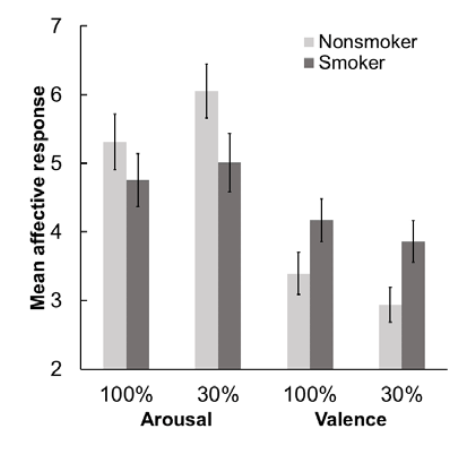
We conducted a mixed ANOVA to determine the effects of smoking and GHW size on explicit affective ratings (assumptions of ANOVA were met). There was a significant main effect for the type of affective response in which the arousal scores were statistically higher than valence ratings F(1, 143) = 59.696, p < .001, η² = 0.29, but no significant main effect of size F(1, 143) = 0.788, p = .376, η² = 0.005. There was a statistically significant three‑way interaction between affective response, size, and smoking status, F(1, 143) = 6.444, p = .012, η² = .05. There were significant two‑way interactions between affective response and smoking status F(1, 143) = 14.267, p < .001, η² = 0.10, and between affective response and size F(1, 143) = 50.950, p < .001, η² = 0.36, but there was no interaction between size and smoking status F(1, 143) = 1.849, p = .176, η² = 0.01. We ran four pairwise comparisons (Bonferroni adjusted) between smokers and nonsmokers for arousal and valence, to GHWs presented at 30% and 100% sizes. All mean differences were significantly different between smokers and nonsmokers (ps < .001), except for the arousal responses to 30% size (p = .061). See Figure 1.
Discussion
Smokers and nonsmokers differed in their affective ratings for arousal and valence, particularly when the warnings were presented at full size (100%) without the context of the branded cigarette packet. Affective reactions are presumably stronger to full size warnings than to smaller warnings because participants are not distracted by the brand. These findings replicate and extend previous studies showing that the presentation of cigarette packages decreases aversion to GHWs (Sillero‑Rejon, 2022).
Similarly, White et al. (2015) observed a diminishing impact of graphic health warnings among adolescents over time. Their study revealed that cognitive processing of these warnings returns to baseline levels after five years. This finding underscores the need for regular refreshment of warning messages to sustain their effectiveness. In our study, smokers showed less arousal and greater valence compared to nonsmokers. In this experiment, participants judged GHWs that have already been on the market. Consequently, we assume that familiarity with these GHWs led to habituation, which in turn differentially decreased the explicit affective impact on smokers compared to nonsmokers. This concept of habituation aligns with the findings of Woelbert and d’Hombres (2019), who reported both general and specific wear‑out effects of GHWs. Their research highlights the importance of regularly updating warning images to maintain their effectiveness.
Experiment 2
Experiment 2 had three different objectives. The first was to assess explicit affective responses to unfamiliar GHWs presented in full size (100%) without the context of the branded cigarette packet. Our working hypothesis posited that differences in explicit ratings of GHWs between smokers and nonsmokers would persist. This is based on previous evidence suggesting that smokers tend to display defensiveness or cognitive dissonance to familiar messages conveyed by GHWs (Bekalu et al., 2018; Harris et al., 2007; LaVoie et al., 2017; Smith & De Houwer, 2015). Second, we wanted to identify which specific warnings elicited the strongest and the weakest emotional responses. We hypothesized that high‑impact GHWs, that is, portraying explicit content of real patients and body damage (e.g., respiratory and cardiovascular diseases), would activate stronger emotional responses than GHWs portraying mental health effects or generic contents (e.g., ‘nicotine is addictive’ and ‘smoking kills’). Third, we intended to generate a higher number of images necessary to evaluate implicit affective responses in Experiment 3, where the AMP usually requires more primes than the SAM (Payne & Lundberg, 2014).
Method
Design
In our study, we employed a 2×2 mixed design. This design featured affective response type (arousal, valence) as a within‑subject factor and smoking status (smoker, non‑smoker) as a between‑subjects factor. This design allowed us to effectively examine the interaction between affective response and smoking status in shaping reactions to the health warnings.
Participants
The participants were 118 undergraduate students (50 women) from UNAL. They received course credit for their participation. Participants’ average age was 20.6 years (SD = 2.7, range 18‑30). Participants were classified as smokers (n = 50) and non‑smoker (n = 68) with the same criteria as in Experiment 1.
Materials
Unless otherwise stated, we used the same settings, materials, instruments, and procedures as in Experiment 1. We designed 36 new GHWs based on a survey and focus groups. These images were sourced from international and national databases for tobacco health warnings, including Mercosur and the Colombia Ministry of Health. An expert panel reviewed the texts and images for clarity and accuracy. As a result, six new warnings were created for each of the following six topics: 1) reproductive/sexual diseases, 2) pancreatic cancer, 3) respiratory diseases, 4) second‑hand smoke, 5) cardiovascular diseases, 6) mental health and smoking.
Procedure
The experiment began with instructions and four familiarization trials. Next, the 72 experimental trials made up of 36 GHWs followed. For each GHW, both valence and arousal ratings were collected in separate trials. We instructed participants to provide an intuitive and rapid rating about their feeling toward each GHW.
Data Analyzes
Initially, we conducted a 2×2 mixed ANOVA. This analysis used affective response type (arousal, valence) as a within‑subjects factor, and smoking status (smoker, non‑smoker) as a between‑subjects factor, involving the whole set of 36 GHWs.
Secondly, we calculated an impact score for each GHW. This score was computed by subtracting the mean average valence ratings of smokers from those provided by nonsmokers. We then divided this difference by the sum of the standard errors from each group. Through this method, the 36 GHWs were evenly divided into low‑ and high‑impact subsets based on their valence scores. The purpose of the impact score was twofold: it maximized the differences between smokers and nonsmokers in their explicit responses, and it facilitated a direct comparison of the same high‑ and low‑impact GHWs using implicit methods in Experiment 3.
Results
All assumptions of ANOVA were met in our study. This analysis revealed an interaction between smoking status and affective response F(1, 116) = 4.13, p = .044, η² = 0.04. Consequently, we conducted simple effect analyses for arousal and valence separately. There was evidence of a main effect of reduced arousal for smokers F(1, 116) = 4.31, p = .040, η² = 0.04, but no evidence of a main effect of smoking status for valence F(1, 116) = 2.41, p = .12, η² = 0.02.
Our second planned analysis showed a significant three‑way interaction between affect, GHW‑impact, and smoking status F(1, 116) = 3.26, p = .001, η² = 0.10. There were significant two‑way interactions between affect and smoking F(1, 116) = 4.13, p = .044, η² = 0.04, and between affect and impact F(1, 116) = 208.35, p < .001, η² = 0.64, but no interaction between smoking and impact F(1, 116) = 1.84, p = .177, η² = 0.02.
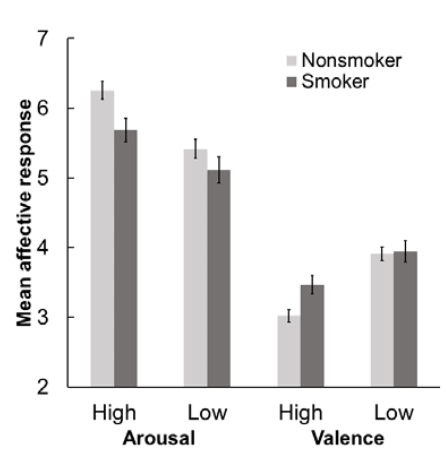
We ran four pairwise comparisons between smokers and nonsmokers for arousal and valence to high‑ and low‑impact GHWs (Bonferroni adjusted). As expected, mean differences between smokers and nonsmokers were statistically significant for high impact warnings for arousal and valence (ps < .009) but not for low impact warnings (ps > .178). See Figure 2.
Discussion
In Experiment 2, we observed that smokers showed decreased arousal compared to nonsmokers in response to unfamiliar GHWs. However, there were no significant differences in valence ratings between smokers and nonsmokers across the full set of 36 GHWs. To examine deeper, we conducted more detailed analyses. These were aimed at separating the variance caused by the increase in the number of GHWs from 6 in Experiment 1 to 36 in Experiment 2.
These further analyses revealed that not all warnings exert strong effects on explicit ratings. Factors such as smoking status, familiarity, and the warnings’ impact contributed to differences in explicit arousal and valence ratings. This information is crucial for Experiment 3, where we assess the effects of low‑ and high‑impact warnings on implicit responses separately.
Taken together, these data support the hypothesis that smokers explicitly evaluate aversive warnings in a biased way. They report feeling less aroused and they tend to rate high‑impact warning as more likeable compared with nonsmokers (see Figure 2). Experiment 2 suggests that the observed effect is not solely due to familiarity, wear‑out, or preexposure to the warnings, as we initially assumed in Experiment 1. These findings align with previous studies, which indicate that smokers’ biased explicit responses to GHWs may be influenced by defensiveness (Harris et al., 2007), reactance (LaVoie et al., 2017), or cognitive dissonance (Glock & Kneer, 2009), each triggered by negative affect.
Experiment 3
Experiment 3 was designed to determine if emotional reactions measured using an implicit procedure differed between smokers and nonsmokers. The rationale behind this experiment is rooted in the premise that implicit reactions, being more spontaneous and less prone to bias, should better reflect automatic affective associations with emotionally laden stimuli like the visual components of GHWs.
Previous research using the AMP has demonstrated that nicotine‑deprived smokers often show a higher proportion of implicit pleasant responses to rewarding smoking‑images compared with nonsmokers (Haight et al., 2012; Payne et al., 2007). In light of these findings, our aim was to investigate whether a reverse pattern occurs among smokers in response to aversive smoking‑images, such as those found in GHWs.
We predicted that implicit reactions should not differ between smokers and nonsmokers. This is based on the idea that defensiveness and cognitive dissonance require explicit appraisal of the anti‑smoking messages, which presumably occurs at a later processing stage. Thus, this experiment sought to shed light on the more automatic aspects of affective response, unaffected by conscious bias or rationalization processes.
Method
Participants
We recruited 83 undergraduate participants (44 women, mean age = 21.5, SD = 3.24). The criteria for nonsmokers were that they had smoked fewer than 100 cigarettes in their lifetime and had smoked none in the past 30 days. The inclusion criteria for smokers were that they smoked at least 2 days per week and smoked at least one cigarette per smoking day. In contrast to the previous 2 experiments, we used the same criteria to classify participants typically used in the AMP in order to replicate previous procedures. As a result, we tested 49 nonsmokers and 34 smokers (M = 5.79 cigarettes per day, SD = 4.6).
Materials
The GHW stimuli were exactly the same 36 images used in Experiment 2 but without text or the context of the branded cigarette packet. The control stimuli were 36 matched images taken from the International Affective Picture System (IAPS), selected if they had medium valence and arousal according to previous validations in culturally similar populations (Branco et al., 2023). In addition, we presented a gray square (GS) 36 times as a nonpictorial control prime. We used the GHWs, IAPS, and GS as primes in the AMP. The participants evaluated 108 Chinese target pictographs taken from a pool of 200 randomly selected for each participant. These targets were previously validated in other AMP studies (Payne et al., 2005, 2007; Payne & Lundberg, 2014).
Design
We utilized a 3×2 mixed design. The design incorporated a within‑subjects factor of prime type (Control, IAPS, GHW) and a between‑subjects factor of smoking status (smokers, nonsmokers). This design was selected to effectively examine how different prime types influence participants’ responses, depending on their smoking status.
Procedure
Participants completed the experiment in individual cubicles. For each trial, the computer presented a prime stimulus (GS, IAPS or GHW) for 75 ms, followed by a blank screen (125 ms), followed by a target kanji (100 ms). Finally, a visual mask remained on the screen until the participants provided an answer. At this point, the participants were instructed to decide if each Chinese pictograph was pleasant or unpleasant, by pressing one of two keys (E = pleasant or I = unpleasant). Participants completed 108 randomly presented experimental trials for 36 GHW, 36 IAPS images, and 36 GS. As usually modeled in the AMP, we instructed participants to avoid being influenced by the primes and to provide an honest and intuitive rapid response to the target. After the experimental trials, the participants completed questionnaires about their smoking habits and demographic data.
Data Analyzes
We scored responses by computing the proportion of pleasant responses to targets preceded by either 1) control GSs, 2) IAPS images, or 3) GHW images. These responses were analyzed in a 3×2 mixed ANOVA with a within‑subjects factor of prime type (control, IAPS, GHW) and a between‑subjects factor of smoking status (smokers, nonsmokers).
In a second step, we computed scores by splitting responses to high‑ versus low‑impact GHWs previously identified as in Experiment 2.
Results
The assumptions of ANOVA were met in our analysis. The results revealed a main effect of the prime type F(2, 162) = 33.500, p < .001, η² = .414, indicating that GHWs were less frequently associated with pleasant responses. However, no interaction was found between prime type and smoking status F(2, 162) = 0.291, p = .748, η² = .001. For more details, see Figure 3.
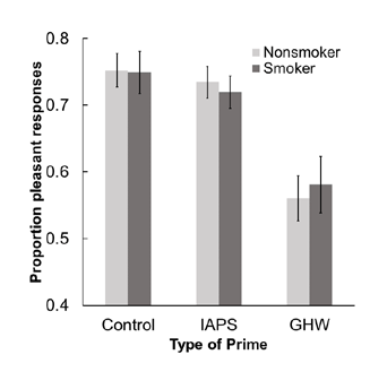
Figure 3. Overall results of Experiment 3. Mean proportion of implicit pleasant responses to nonpictorial control stimulus (grey square), 36 control images from the IAPS, and to the full set of 36 GHWs. Error bars depict ±1 SEM.
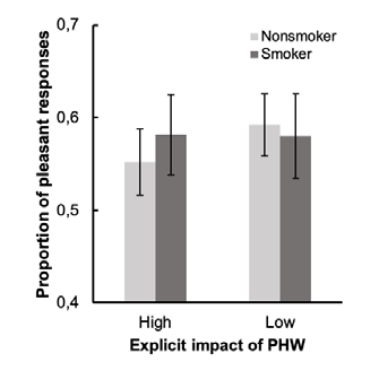
Additionally, we ran a mixed ANOVA to analyze possible differences between smokers and nonsmokers for GHWs previously classified as low‑ or high‑impact in Experiment 2. A mixed ANOVA with impact (low, high) as a factor and smoking status (smoker, non‑smoker) as a factor showed no interaction F(1, 79) = .554, p = .459, η² = .006, and neither main effects of smoking status F(1, 79) < .001, p = .992, η² < .001 nor impact of prime F(1, 79) = .420, p = .519, η² = .004. See Figure 4.
Discussion
In Experiment 3, we used an implicit task, the Affect Misattribution Procedure, to evaluate implicit affective responses to GHWs. We found that pictures that were meant to be aversive, triggered a lower proportion of positive responses compared to IAPS images and control stimuli (Figure 3). However, even when we used data from Experiment 2 to identify high impact images, there was no difference in implicit affective responses between smokers and nonsmokers (Figure 4).
The most parsimonious explanation for this finding is that by removing text from GHWs, the warnings become simply aversive stimuli. In this way, they do not favor different effects for smokers and nonsmokers, as the images alone do not target any specific group. However, the AMP has previously demonstrated enough sensitivity to capture different affective responses to appetitive visual smoking cues without text (Payne et al., 2007). Long texts are usually excluded in the AMP. This is due to the fact that at a presentation time of 75 ms complex information cannot be fully read or appraised (Payne & Lundberg, 2014).
The present study adds to the literature showing that the interaction between images and texts in GHWs is more complex than originally thought. This is particularly true at the implicit level, as evidenced by the works of Cameron et al. (2015), Van Dessel et al. (2018), and Droulers et al. (2017). Their research suggests that the synergistic effect of images and texts in GHWs assumed in earlier studies warrants a more nuanced understanding. Experiment 3 suggests that defensiveness or cognitive dissonance, typically encountered in smokers frequently exposed to aversive GHWs, is primarily a higher order explicit cognitive process. To our knowledge, this experiment is the first objective assessment of implicit affective responses to the pictorial component alone of GHWs using the AMP. This experiment highlights the effectiveness of a straightforward experimental approach like the AMP for assessing smokers’ affective reactions. Specifically, it proves useful in contexts where distinguishing between explicit emotional evaluations and implicit affective reactions to GHWs is particularly desirable.
General Discussion
The aim of this paper was to examine how smokers and nonsmokers differ in their explicit and implicit affective reactions to GHWs. Experiment 1 focused on comparing explicit SAM ratings of valence and arousal in response to familiar GHWs. We found that, generally, smokers exhibited reduced arousal and increased valence compared to nonsmokers. This was especially notable except in the case of arousal towards smaller warnings (30% size). These results align with previous studies, such as Moodie et al. (2016), which have demonstrated that branded cigarettes can lessen the impact of GHWs for both smokers and nonsmokers. Notably, our findings indicate that smokers tend to perceive GHWs as more pleasant compared to nonsmokers, a trend that is consistent with existing literature.
Experiment 2 involved comparing explicit SAM ratings given by smokers and nonsmokers to novel warnings. The results from this experiment indicate that smokers’ more positive evaluations of GHWs are not merely due to familiarity or ‘wear‑out’ of the message, as suggested by Borland et al. (2009). Rather, it appears that higher‑order cognitive processes, such as appraisal, may contribute to defensiveness or cognitive dissonance. This is particularly noticeable in responses to emotionally charged, high‑impact GHWs.
Finally, in Experiment 3, we observed that implicit affective reactions to the pictorial component of novel GHWs were similar among smokers and nonsmokers. This similarity suggests that both groups may share a comparable level of initial affective aversion to the images. Interestingly, GHWs apparently induce defensiveness or cognitive dissonance among smokers at an explicit cognitive level, as indicated from the SAM responses. Conversely, at a more automatic, implicit emotional processing level, these effects were absent, demonstrating a pattern we describe as early affective processing parity.
Taken together our three experiments, this paper introduces a novel methodology that distinctly separates the explicit responses of smokers from their implicit affective reactions. Specifically, it addresses how smokers’ explicit responses, largely influenced by cognitive appraisals, tend to favor defensiveness and dissonance. At the same time, our approach also captures the implicit affective responses that are part of the initial processing stages in emotional reactions to GHWs.
Interpreting our findings as early affective processing parity aligns well with previous research, such as that by Stothart et al. (2016). In their study, they highlight the distinction between early and late emotional responses to GHWs using EEG evidence. However, our approach, which employs a modified version of the AMP to measure implicit emotional responses and the SAM for explicit ones, offers a less expensive and less invasive alternative. More than just a cost‑effective method, our paper suggests a new way to assess automatic affective reactions to GHWs, as well as to health messages targeting other substances or behaviors (Maynard, 2017; Nuño Gutiérrez et al., 2018). Looking forward, our findings and methodology open avenues for future research to explore how GHWs engage these two potentially competing processes, aiming to maximize smoking prevention and enhance intentions to quit.
Our findings, however should be interpreted in light of the following limitations. Our research was not initially conceived to understand how GHWs influence long term attitudinal and behavioral outcomes. It was simply designed to develop and test a new methodology to measure implicit affective reaction to GHWs in the short term. Therefore, it remains unknown whether implicit or explicit measures of negative affect accurately predict behavioral outcomes such as quitting attempts or intentions to quit smoking. However, we provisionally suggest that implicit emotional reactions can usefully supplement explicit measures by observing the time course of both types of responses to GHWs.
A second limitation of our research is that we compared implicit and explicit measures of valence across different experiments. Future research should focus on examining if the observed patterns hold true in within‑subjects designs. In such studies, the same participants would provide both implicit and explicit ratings of their affective reactions to GHWs. This approach would further validate the consistency of responses across different methods of measurement. However, this not a straightforward experimental manipulation because despite counterbalancing, familiarity can bias responses for participants providing explicit judgements before implicit judgements.
Finally, we recognize a limitation in our participant sample composition. The convenience samples of smokers and nonsmokers used in our research may not fully capture the diversity among smokers, particularly those most at risk for smoking‑related issues. This limitation highlights the importance of broader, more inclusive participant selection in future studies to enhance the representativeness and generalizability of the findings.
This study, despite its limitations, incorporates key strengths, including the inclusion of both smokers and nonsmokers in all experiments. This approach was instrumental in detecting emotion processing biases in smokers’ responses to GHWs. Our research highlights the crucial role of implicit mechanisms in influencing negative emotional responses, vital for effective smoking prevention and cessation. One of the primary contributions of this study is the development of implicit emotional assessments for evaluating GHWs before they reach the public. This methodology holds considerable potential for broader application, offering other countries and jurisdictions the opportunity to enhance traditional explicit and attitudinal evaluations with these implicit assessments in the design and evaluation of health warnings and messages.

