




 English (pdf)
 Article in xml format
 Article references
 Automatic translation
 Send this article by e-mail
 Cited by SciELO
  Cited by Google
  Similars in
SciELO
Similars in
SciELO  Similars in Google
 Permalink

Introduction
The study of moral cognition has been useful for understanding people's social behavior precisely because individual and collective moral- ethical standards are a valuable reference for analyzing and predicting social behavior Bandura, 1991; Gómez & Durán, 2021a). Bandura (1999, 2002, 2016) points out that an individual's social behavior is fundamentally dependent on social- cognitive mechanisms. These mechanisms self- regulate human behavior according to moral standards and ease the understanding of what is right from what is wrong. Likewise, this self- regulation is related to the negative assessment of group norm violations and therefore self- sanctioning and self- censorship is activated (guilt, shame, self- condemning) (Bandura et al., 1996; Bandura et al., 2001; Moore, 2015).
However, self- sanctioning can be avoided by convincing oneself that ethical standards do not apply to oneself in a particular context. It involves a process of cognitive restructuring or reframing of destructive behavior as being morally acceptable without changing the behavior or the moral standards (Bandura, 1990; 2002; Giulio et al., 2018; Petruccelli et al., 2017). Individuals refrain from behaving in ways that violate their moral standards to avoid self- condemnation. Therefore, self- sanctions play a significant role in keeping conduct in line with these internal moral standards and hence in regulating inhumane conduct (Bandura et al., 1975; Gómez & Narváez, 2019). This cognitive restructuring process is known as moral disengagement. Bandura (1991, 1999, 2002, 2016) introduced eight moral disengagement mechanisms that explain how self- sanctioning is deactivated and disconnected from harmful behaviors.
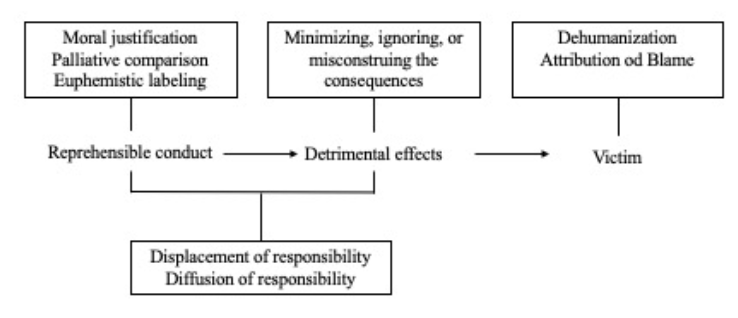
Empirical evidence from the last thirty years have found that both moral disengagement and social cognitive mechanisms are highly associated with the onset of not only antisocial and criminal behavior, but also bullying, cyber bullying and physical and verbal aggression in young samples (Bandura et al., 1996; Bakioğlu & Çapan, 2019; Caprara et al., 2014; Gini et al., 2014, 2015; Hyde et al., 2010; Hardy et al., 2015; Paciello et al., 2008; Runions et al., 2019). It has also been reported that moral disengagement predicts antisocial and criminal behaviors in young offenders (Giulio et al., 2018; Petruccelli et al., 2017; Shulman et al., 2011). Recent studies in young individuals have found a negative association between moral disengagement, empathy, emotional self- efficacy and prosocial tendencies and a positive association with callous- unemotional traits (Bandura et al., 1996; Gomez et al., 2019; Gomez & Narvaez, 2019; Muratori et al., 2017; Walters, 2017). These findings suggest that higher levels of moral disengagement led to an increased likelihood of aggressive behaviors and externalizing disorders, therefore, the chances to display prosocial behaviors towards the victim decrease.
Gender differences have also been described in young samples. Males have scored higher than women in moral disengagement tests (De Caroli et al., 2011; Bjaerehed et al., 2019; Gomez y Narvaez, 2019; Gomez & Duran, 2021b). These differences contributed to the differential effects when predicting externalizing behaviors in men (impulsive behavior, aggression, intimidation) (Cabrera et al., 2020; Charalampous et al., 2021; Espejo- Siles et al., 2020). Men scored higher than women on psychopathic traits (callous- unemotional and grandiose- manipulative) and reactive aggressive behavior (Orue et al., 2016). This trend could explain how some moral disengagement mechanisms operate and affect disruptive behaviors (Espejo- Siles et al., 2020).
Conversely, women scored higher than men in internalizing behaviors (anxiety, low self- esteem) - (Campos et al., 2019; Rescorla et al., 2018), impulsive- irresponsible traits (Orue et al., 2016), and higher levels of prosocial behavior and affective empathy toward others (Gomez & Duran, 2020; Longobardi et al., 2019; Mestre et al., 2009; Van der Graaff et al., 2014, 2018).
The tendency of men to show externalizing behaviors and of women to show internalizing behaviors, as well as differences in the use of moral disengagement, have been studied independently. However, the relationship between the effect of psychological factors on moral disengagement strategies based on gender differences is not yet clear. It could be an interesting and enriching field of study.
Currently, there is a lack of studies that focus on the relationship between trait impulsivity and moral disengagement in men, as interest has focused on aggressive and antisocial behavior, leaving aside the analysis of impulsivity as a potentially precipitating factor. The relationship between some internalizing traits in women, as self- esteem and anxiety, and their possible association with moral disengagement has also not been examined.
On one hand, most research is focused on the direct effect and mediating role of moral disengagement in predicting disruptive behavior in young populations. On the other hand, there is a lack of works related to the effects of psychological variables- anxiety, self- esteem and impulsivity- on social cognitive mechanisms of moral disengagement. Thus, more research is needed to analyze whether moral disengagement depends on these psychological variables in young samples. In addition, it is important to determine whether differences between males and females in variables as anxiety, self- esteem, and impulsivity have a differential effect on the mechanisms of moral disengagement.
Empirical evidence supporting this hypothesis is scarce and scattered. However, some authors have suggested that self- sanctioning disengagement, a product of the use of moral disengagement, allows people to maintain high positive evaluations of themselves even after committing immoral or cruel acts (Zhao et al., 2017; Liang et al., 2018). Moral self- image is related to the view of our own actions and is flexible to the cognitive assessment of social and moral behavior (Jordan et al., 2015). Thus, it is plausible that self- esteem, understood as how one evaluates and responds emotionally to oneself, is associated with moral disengagement.
In addition, impulsive people cannot postpone rewards, regulate emotions, make assertive decisions or acting without thinking (Georgiou et al., 2019). These factors are considered to predict aggressive, violent, and antisocial behavior in young populations (Carlotta et al., 2011; DeShong, & Kurtz, 2013; Dodaj et al., 2020). Thus, it is plausible that young people who tend to behave impulsively would resort more frequently to the different mechanisms of moral disengagement to change the valuational perception of their behaviors.
Furthermore, anxiety implies subjective feelings of intense fear and concern about daily situations and can increase when coping with psychological stress and lead to the development of maladaptive beliefs, psychological breakdowns, feelings of self- censorship, and social isolation. Anxiety is usually related to an individual's behavior and even to external situations that cause discomfort. Hypothetically, anxiety may be positively associated with moral disengagement as a way of avoiding emotional distress, justifying maladaptive actions and beliefs associated with anxiety symptoms.
A recent study analyzed the effects of Machiavellianism and ethical values on the anxiety of 115 young Chinese university students (Tang & Li, 2021). The results showed that both Machiavellianism—personality trait that denotes cunningness, the ability to be manipulative, and a drive to use whatever means necessary to gain power—and ethical values significantly influence anxiety. Specifically, in the sample of youth with strong ethical values, anxiety levels increased significantly as Machiavellianism levels increased. Those with high levels of Machiavellianism and strong ethical values showed higher levels of anxiety compared to those with low levels of Machiavellianism but similar ethical values. In contrast, among youth with weak ethical values, there was no significant difference in anxiety levels between those with high and low levels of Machiavellianism.
This study suggests that the conflict between Machiavellian beliefs and ethical values oriented towards benevolence and universalism generates anxiety and psychological distress. In this sense, in situations of dissonance between moral cognitions and actions —for example, believing that violence is immoral and engaging in violent behavior—a moral conflict is generated that leads to psychological stress and anxiety. To reduce these anxiety states, moral disengagement and its various mechanisms, which function as routes of cognitive reconstruction of immoral behavior, are resorted to. However, this relationship between anxiety and moral disengagement has not been explored in previous studies.
The association between self- esteem, impulsiveness, anxiety, and social cognitive mechanisms of moral disengagement in young samples based on gender is a rich field line that might explain how psychological factors impact moral agency. Besides, these associations are not clear in previous studies.
This study aimed at analyzing gender differences and the effect of self- esteem, impulsivity, and anxiety on social cognitive mechanisms of moral disengagement in young populations. This study also hypothesized:
H1: Men will score significantly higher than women on all moral disengagement mechanisms.
H2: Positive self- esteem (Self- Respect) has negative correlations and predictive effects, and negative self- esteem (Self- Deprecation) has positive correlations and effects on total moral disengagement mechanisms.
H3: Anxiety and impulsivity are positively correlated and predict moral disengagement.
H4: Impulsivity is a strong predictor of moral disengagement in males, whereas anxiety and self- esteem (positive and negative) are stronger predictors in females.
Method
This was a quantitative, observational, prospective, cross- sectional study. The scope of the study was associative.
Participants
A simple probability sample was taken from the total enrollment in higher education in Colombia (n = 2,355,603). The proportion of the university population is mostly female and between 16 and 20 years of age. Participants were 1419 young college students in two Colombian cities, Manizales (54.2%) and Medellin (45.8%) By gender, 971 participants were female (68.4%) 448 were males (31.6%). The mean age was 20.6 years old (SD = 3.32). Participants were between 16 and 30 years old (from 16- 20 years old (n = 861 60.7%) 21- 25 years old (n = 412,29%) and 26- 30 years old (n = 146,10.3%) -
Based on marital status, 61.2% of the sample were single, and 38.8% had some type of relationships: couples (32.3%) married (2.2%), common- law partners (3.7%), divorced/separated (0.6%). Likewise, 23.5% of the sample belong to low socioeconomic status (1 - 2), middle class (3 - 4) (66.7%), and high socioeconomic status (5 - 6) (9.8%)
Measures
Sociodemographic data.
Participants were required to fill a sociodemographic questionnaire that included age, sex, socioeconomic status and marital status.
Mechanisms of Moral Disengagement Scale-MMD
(Bandura et al., 1996). The scale was developed to assess the construct of moral disengagement and how it directly or indirectly influences transgressive behavior. The instrument was adapted and validated in Spanish with adolescent population in Spain (Rubio- Garay et al., 2017) and university population in Colombia (Gomez et al., 2023). The Spanish version consists of 32 items with a 5- point Likert scale (1 = Totally disagree) (5 = Totally agree). The instrument consists of four- item subscales, each corresponding to eight moral disengagement mechanisms. Moral justification, euphemistic labeling, palliative comparison, displacement of responsibility, diffusion of responsibility, distortion of consequences, attribution of blame, and dehumanization.
The psychometric properties of the Spanish validated test showed good fit index for the scale according to the eight moral disengagement mechanisms and for the general construct (Gomez et al., 2023; Rubio- Garay et al., 2017). This questionnaire has been used in young samples and showed a Cronbach s alpha between .82 and .93 (Bandura et al., 1996; Bandura et al., 2001; Gini et al., 2014; Gomez & Narvaez, 2019; Hardy et al., 2015; Paciello et al., 2008).
Barratt Impulsiveness Scale, v.11, BIS-11
(Barratt Impulsiveness Scale, v.11, BIS- 11 (Patton et al., 1995). The BIS- 11 is composed of 30 items with Likert- type questions in which participants report the frequency of different impulsive behaviors (from 1 rarely or never to 4 often or always). It measures global impulsivity and three main factors have been identified: Cognitive, motor, and non- planned impulsiveness. A previous systematic review suggested a cutoff score over 74 (global impulsiveness) in psychological studies (Stanford et al., 2009). Cronbach's alpha value in this study was .78 in the global score and .70 for subscales. The global impulsivity score was used in this study. Internal consistency for this study was assessed using McDonald's Omega (w) coefficient, and the results are shown in Table 1.
The Rosenberg Self-Esteem Scale-SRSEs
(Rosenberg, 1965). Is a widely accepted 10- item questionnaire used to assess global selfesteem. It assesses both positive and negative self- perceptions. The scale is generally considered to be unidimensional. Participants respond to each statement on a 4- point Likert scale ranging from "strongly agree" to "strongly disagree. Responses indicating low self- esteem are "disagree" or "strongly disagree" for items 1, 3, 4, 7, and 10, and "strongly agree" or "agree" for items 2, 5, 6, 8, and 9. Each item contributes to the overall self- esteem score. Validation studies have confirmed the excellent internal consistency of the scale and have identified both bifactorial (Cogollo et al., 2015; Gomez- Lugo et al., 2016; Hyland et al., 2014) and unifactorial (Martin-Albo et al., 2oo7) structures in different research contexts, allowing its use to assess global self- esteem, as negative (Self- Deprecation) and positive self- esteem (Self- Respect) factors. The internal consistency of the instrument for this study was assessed using McDonald's Omega Coefficient (ω) and the results are shown in Table 1.
Beck Anxiety Inventory, BAI
Beck et al., 1988). It consists of 21 items with a Likert scale ranging from o to 3 and raw scores ranging from o to 63. It measures the severity of an anxiety disorder in adults and adolescents. Because the items in the BAI describe the emotional, physiological, and cognitive symptoms of anxiety but not depression, it can discriminate anxiety from depression. The BAI scores are classified as minimal anxiety (o to 7), mild anxiety (8 to 15), moderate anxiety (16 to 25), and severe anxiety (30 to 63). It has been validated in Spanish in clinical and non- clinical contexts, with a reported Cronbach's alpha value of .93 and statistically significant correlations with the Beck Depression Index (BDI) (r = .63) (Magán et al., 2008). The internal consistency of the instrument for this study was assessed using McDonald's Omega Coefficient (ω) which results are shown in Table 1.
Procedure
The instruments were administered in university settings in both cities in Colombia. The procedure for administering the instruments was face- to- face in classrooms in groups of approximately 20 to 40 people. Participants completed the informed consent form and then completed the instruments with pencil and paper. Administration of the instruments took between 45 and 60 minutes per group, and data collection was completed over a three- month period. Ethical guidelines for studies considered to involve minimal risk to human subjects (Resolution o08430/1993) were followed. The study was funded and supported by the Universidad Catolica Luis Amigo, Colombia (0502029977). In accordance with Law 1090/2006 and Resolution o08430/1993, this study complies with the principles and procedures of ethical research (respect for the dignity and confidentiality of persons).
Data Analysis
The analyses were conducted on IBM SPSS Statistics 25 (IBM Corporation 2017). Missing data or incorrect answers were checked according to the instrument options and the distribution of the data was determined. McDonald's omega (ω) is based on factor loadings (Gerbing & Anderson, 1988), which allows for greater stability in calculations for multidimensional scales (McDonald, 1999). Unlike Cronbach's alpha, that can be affected by the number of items in a scale, the reliability estimate of omega is not as dependent on the number of items.
Then, descriptive analysis was performed to get mean values and standard deviations of the research variables. A comparative analysis of each disengagement mechanism, self- esteem, and anxiety was conducted controlling gender through Student's t for independent samples. The p- values of statistical significance and the effect size (Cohen's d) of the statistical difference were reported. Cohen's (1988) procedure and interpretation was used: small effect (d = 0.2), medium effect (d = 0.5), large effect (d = 0.8).
A correlation analysis was then performed using Pearson's r coefficient between the variables of self- esteem (global, positive, and negative), impulsivity, anxiety, and the mechanisms of moral disengagement. Finally, a multiple linear regression model was performed, and every moral disengagement mechanism was the response variable. A regression model was also calculated for males and females to be able to analyze the effects of the predictor variables according to gender. The input method was used for the regression analyses. The assumptions of non- collinearity, homoscedasticity, and independence of the residuals were examined. A collinearity diagnostic was performed, the dispersion of the standardized residuals was analyzed, and the Durbin- Watson statistic was used to assess the independence of the residuals.
Results
The descriptive analysis with measures of central tendency and dispersion and the analysis of internal consistency using McDonald's Omega are presented in Table 1.
Table 1 Reliability and descriptive analysis for moral disengagement, self-esteem, impulsiveness, and anxiety
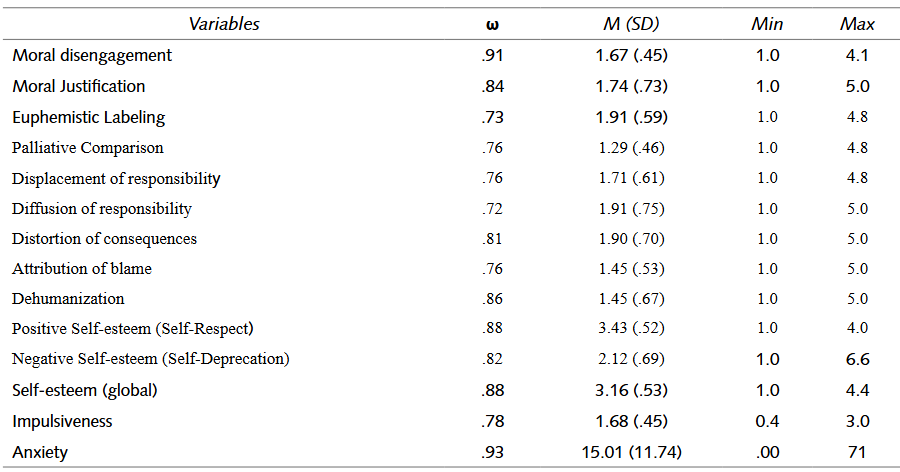
Table 2 shows comparisons based on gender. Results indicate that males scored significantly higher than females on moral disengagement, and the effect size was medium. Males also scored significantly higher on each specific mechanism of moral disengagement except diffusion of responsibility (p< .01). On the other hand, moral justification, euphemistic labeling, and dehumanization showed medium and large effect sizes (d≥ .5) (Cohen, 1988). Self- esteem (global), positive self- esteem (self- respect), and impulsivity also showed higher scores for males (p< .05), with small size effects (d≤ .4). Conversely, females scored significantly higher on anxiety (p = .001), and the effect size was small (d≤ .4).

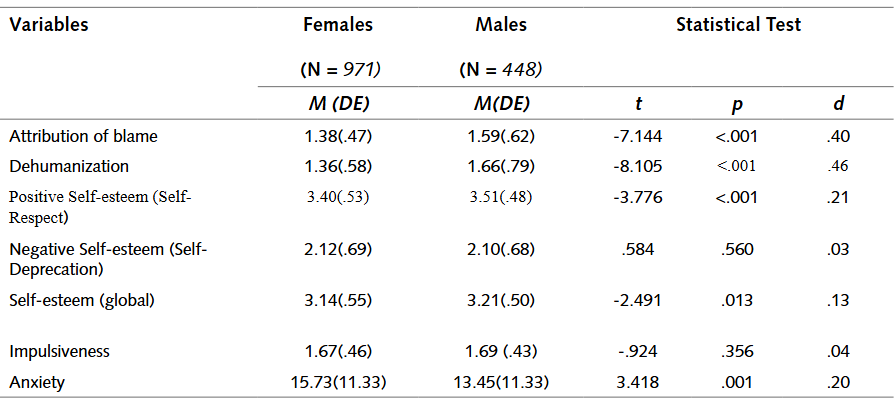
Table 3 shows the correlations between moral disengagement, self- esteem, impulsivity, and anxiety in males and females. Moral disengagement was negatively associated with self- esteem (global) and positive self- esteem (self- respect), but positively associated with negative self- esteem (self- deprecation), impulsivity, and anxiety. These correlations were significant for both males and females (p< .01)
Table 3 Pearson correlation coefficient (r) between moral disengagement, self-esteem, impulsiveness and anxiety in males and females.
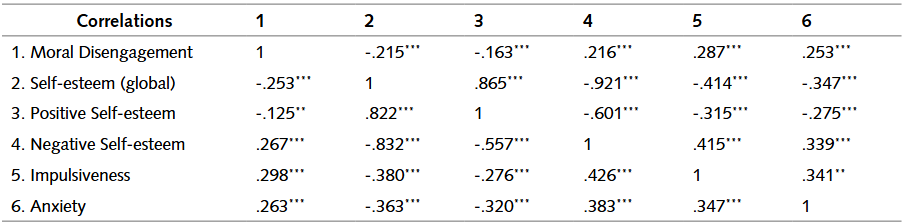
Table 4 shows correlations between social cognitive mechanisms of moral disengagement, self- esteem dimensions, impulsivity, and anxiety. Each moral disengagement mechanism correlated significantly and negatively with self- esteem (global) and positive self- esteem (self- respect), but positively with negative self- esteem (self- deprecation), impulsivity, and anxiety.
Moral Justification had the strongest correlation coefficients with negative self- esteem and Impulsivity. On the other hand, dehumanization showed the strongest correlations with self- esteem (global) and positive self- esteem (self- respect). Palliative comparison showed the strongest correlations with anxiety.
Table 4 Pearson correlation coefficient (r) between moral disengagement (specific mechanisms), self-esteem, impulsiveness, and anxiety
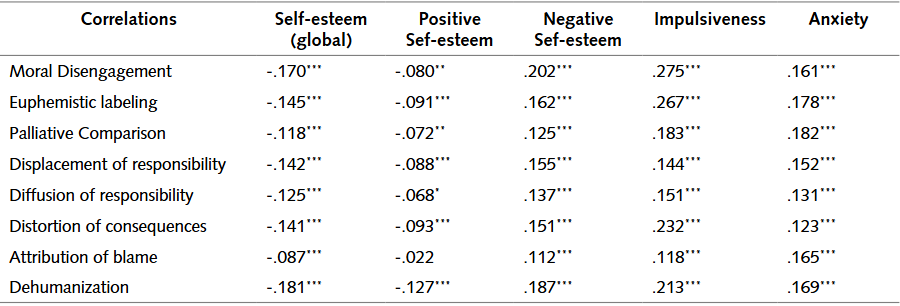
Table 5 shows the multiple regression analysis that facilitated the factors with the highest predictive effect on moral disengagement. Positive self- esteem (self- respect), negative self- esteem (self- deprecation), impulsivity, anxiety, and gender were the predictor variables and moral disengagement, and the eight mechanisms were the dependent variables. Results indicated that self- deprecation (β = 1.07, p = .001), impulsivity (β = .189, p< .001), anxiety (β = .149, p< .001) and gender (β = .274, p< .001) contributed a significant effect (p< .05) that explained 18% of the variance in moral disengagement (global) (R² = .177, F(5,1412) = 62.106, p< .001). Self- respect did not show a significant effect (p< .05).
Regarding the specific mechanisms of moral disengagement, results suggest that self- deprecation, impulsiveness, anxiety, and gender showed a significant effect (p< .05) at predicting: moral justification (R² = .203, F(5,1412) = 73.378, p< .001), displacement of responsibility (R² = .051, F(5,1412) = 16.127, p< .001), diffusion of responsibility (R² = .034, F(5,1412) = 11.004, p< .001), and dehumanization (R² = .109, F(5,1412) = 35.492, p< .001).
Impulsiveness, anxiety, and gender contributed a significant effect (p< .05) at predicting euphemistic labeling (R² = .140, F(5,1412) = 47.223, p< .001), palliative comparison (R² = .078, F(5,1412) = 25.114, p< .001), distortion of consequences (R² = .093; F(5,1412) = 30,163, p< .001).
Finally, blame attribution (R² = .072, F(5,1412) = 22.875, p< .001) is significantly predicted by self- respect (β = .065, p = .043), self- deprecation (β = .078, p = .021), anxiety (β = .158, p< .001), and gender (β = .194, p< .001).
According to the standardized beta coefficient (β), gender was the sociodemographic variable that contributed the strongest effects to the mechanisms of moral disengagement. On the other hand, impulsivity better explained the effects on moral disengagement (global), moral justification, euphemistic labeling, diffusion of responsibility, distortion of consequences and dehumanization. However, anxiety had the strongest effects on palliative comparison, diffusion of responsibility, and blame attribution.
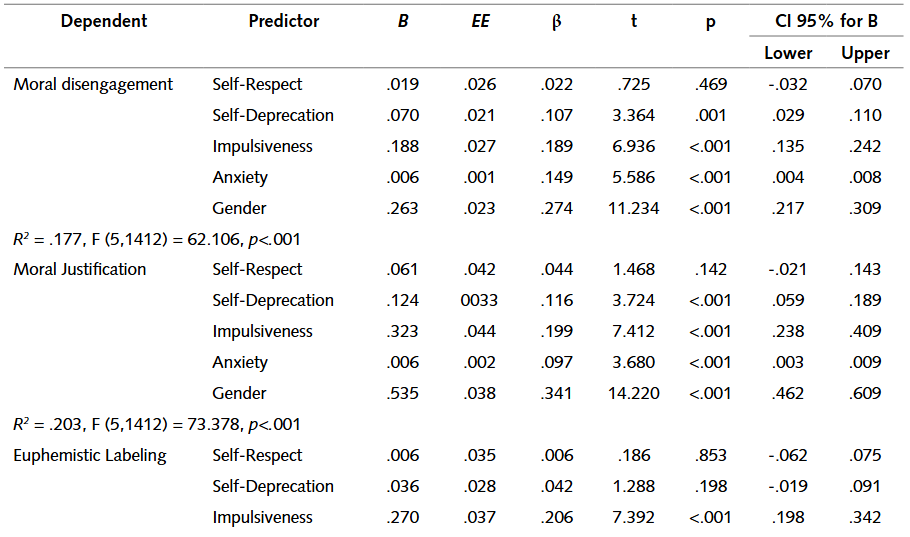
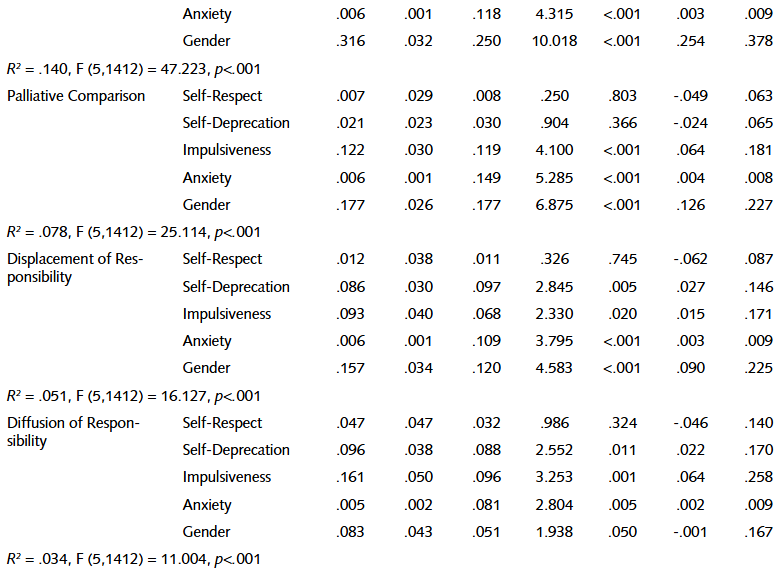
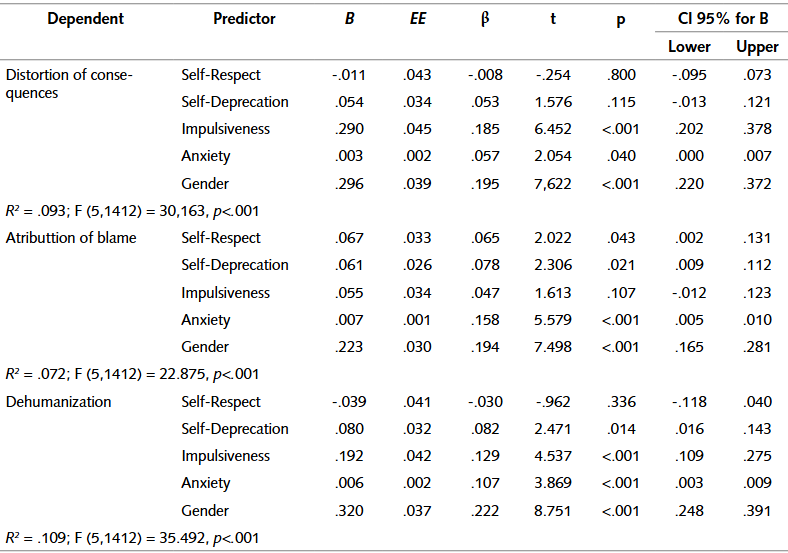
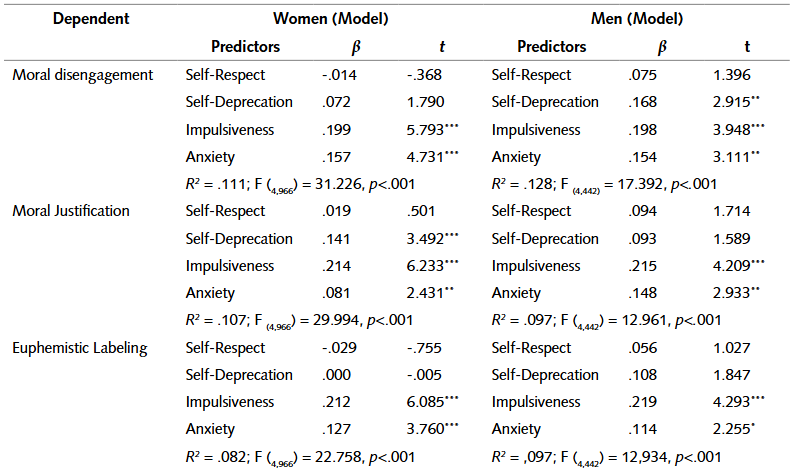
Table 6 displays the effects of the independent variables based on gender for the mechanisms of moral disengagement. For females, impulsivity (β = .119, p< .001) and anxiety (β = .157, p< .001) were found to have a significant effect, explaining 11% of the variance in total moral disengagement (R² = .111; F(4,466) = 31.226; p< .001). For males, self- deprecation (β = .168, p< .01), impulsivity (β = .198, p< .001), and anxiety (β = .154, p< .01) contributed with a significant effect, explaining 13% of the variance in moral disengagement (R² = .128; F(4,442) = 17.392, p< .001).
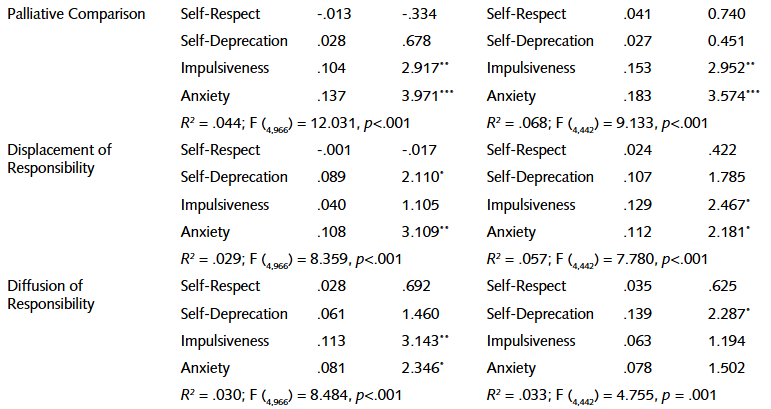
In both males and females, impulsivity and anxiety contributed significant effects predicting the mechanisms of euphemistic labeling, palliative comparison, and moral justification. Self- deprecation predicted moral justification only in females.
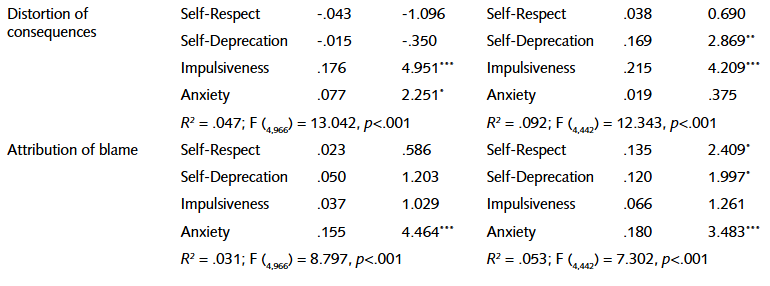
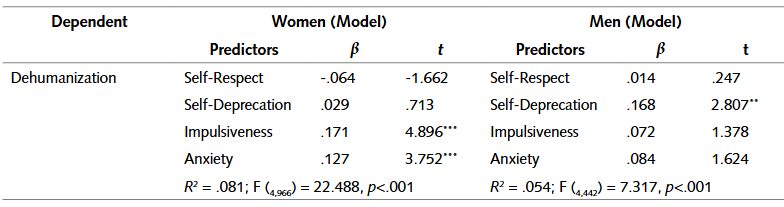
Differential effects by gender were also found. For women, anxiety contributed a significant effect in females at predicting attribution of blame. Self- Deprecation and anxiety contributed significant effects on displacement of responsibility. Impulsiveness and anxiety contributed significant effects at predicting diffusion of responsibility, distortion of consequences and dehumanization.
For men, displacement of responsibility is explained by the significant effect of impulsiveness and anxiety. On the other hand, diffusion of responsibility is explained by the effect of self- deprecation. Distortion of consequences was explained by self- deprecation and impulsiveness. Attribution of blame was explained by self- confidence, self- deprecation, and anxiety. Finally, dehumanization was explained by the significant effect of self- deprecation.
Discussion
The purpose of this study was to analyze gender differences and the effects of self- esteem, impulsivity, and anxiety on the social cognitive mechanisms of moral disengagement in young students. Results indicate that males scored significantly higher than females in every mechanism of moral disengagement, except diffusion of responsibility. Therefore, the first hypothesis (H1) was supported. These findings are consistent with previous research that showed that males are more prone to moral disengagement than females (De Caroli et al., 2011; Bjaerhed et al., 2019; Gomez & Narvaez, 2019; Gomez & Duran, 2021b).
These differences in young samples may have several explanations. First, the fact that males are more likely to engage in externalizing behaviors may increase the tendency to engage in moral disengagement to justify harmful behaviors toward others and to avoid self- blame. Conversely, adolescent females have scored higher than males on empathy and prosocial behaviors, which reduces moral disengagement to justify aggressive behavior. These differences between males and females have been previously published by other studies (Caprara et al., 2008; Gomez & Duran, 2020; Redondo et al., 2015; Mestre et al., 2009; Van der Graaff et al., 2014; Valois et al., 2017).
According to the gender schema theory (Martin & Halverson, 1981) and the social cognitive theory (Bandura, 1986; Bussey & Bandura, 1999) these differences in moral disengagement could be due to the effects of socialization, gender stereotypes, cognitive schemas related to several behaviors and moral values that were built around gender norms. However, biological perspectives cannot be ignored in explaining the differences between males and females in social behavior and moral agency (Dugatkin, 2007).
The second hypothesis (H2) was partially supported. Results suggest that the mechanisms of moral disengagement are positively correlated with self- deprecation (negative self- esteem), and negatively correlated with self- respect (positive self- esteem). Regression analysis showed that self- deprecation significantly predicted moral disengagement and the mechanisms of moral justification, displacement and diffusion of responsibility, attribution of blame and dehumanization, while self- respect only predicted attribution of blame. These findings suggest that positive self- esteem and its negative dimension play a crucial role in the use of social cognitive strategies of moral disengagement in young samples.
Self- esteem is a psychological construct that is composed of beliefs, emotions, and moral judgments about oneself and could potentially lead to self- deprecation and self- respect (Gomez- Lugo et al., 2016; Martin- Albo et al., 2007). Self- esteem is also about emotional responses and positive- negative assessments about oneself and the social world (Jordan et al., 2015; Liang et al., 2018). Other authors argue that self- esteem is a psychological trait that is present throughout the life course and consists of specific positive and negative self- evaluations, as self- respect and self- deprecation (Jordan et al., 2015; Rosenberg, 1986, 1989). These self- evaluations influence the psychological development of self- esteem, interpersonal relationships, and sociomoral behavior (Rosenberg, 1986, 1989).
According to the stated hypothesis, self- deprecation acts as a psychological factor that promotes the activation of moral disengagement to avoid the cognitive dissonance between the idea an individual may have about oneself- - values and beliefs- - and immoral behavior (Jordan et al., 2015). This psychological process and activation of moral disengagement has a regulatory function, which is to maintain a positive evaluation of the self. Even Bandura (2002) has stated that "Self- exonerations are used to neutralize self- censure and to preserve self- esteem" (p. 114).
Both social cognitive theory and empirical findings have found that moral disengagement contributes to cognitive restructuring strategies of immoral behavior, consequences, and victim roles so that people can avoid self- censorship, reduce psychological distress, and keep a positive self- image (Bandura, 2002, 2016; Jordan et al., 2015; Moore, 2015; Liang et al., 2018; Zhao et al., 2017).
Other studies have found that self- esteem and a positive view about oneself has a positive predictive effect on prosocial moral reasoning and prosocial behavior in young samples (Laible, Carlo & Roesch, 2004; Padilla- Walker & Carlo, 2014). This is consistent with the idea that low self- esteem may act as a psychological risk factor for moral disengagement. Future studies should examine whether self- esteem, self- deprecation, and self- respect act as mediating factors between moral disengagement and immoral or harmful behaviors in young samples.
On the other hand, the third hypothesis (H3) was fully supported, and the fourth hypothesis (H4) was partially accepted. Correlation and regression analysis showed that gender, anxiety, and impulsiveness have significant predicting effects on moral disengagement and its mechanisms. However, gender- based regression analysis showed that impulsivity and anxiety had similar effects in predicting moral disengagement, but no significant differences between men and women.
Bandura's theory (1999,2002,2016) poses that guilt and remorse feelings weaken as a consequence of moral disengagement, and these feelings are generated from the cognitive conflict between moral norms and principles and immoral or harmful behaviors. However, our findings suggest that anxiety influences the deactivation of regulatory processes that characterize moral disengagement and may help to reduce moral feelings of shame, guilt, and self- censorship. Thus, the data suggest that the higher the anxiety the higher the odds of implementing social cognitive strategies of moral disengagement to reduce emotional distress.
Recent works have shown that antisocial behavior and aggression are positively associated with anxiety in young samples (Hale et al., 2004; Shulman et al., 2021). Anxiety can even act as a mediating variable between psychopathy and aggression (Thomson et al., 2021). Regarding this matter, a meta- analysis (Derefnko, 2015) showed that although psychopathic traits and aggressive behavior are related to disinhibition, there is a partial lack of negative affect like anxiety.
These studies have found that anxiety is common in antisocial behaviors that may lead to moral disengagement to diminish negative affect (fear, guilt, anxiety). Others have shown that moral disengagement might reduce negative affect in young samples with aggressive behaviors and there are not evident signs of psychopathy (Bakioğlu et al., 2019; Gini et al., 2014; Runions et al., 2019). This supports the initial claim about how anxiety influences the conflict between moral beliefs and moral actions. Our results suggest that anxiety contributes to the use of cognitive strategies of moral disengagement to reduce negative affect and cognitive dissonance.
Returning to hypothesis four (H4), impulsive- irresponsible behavior and gender have also been found to predict moral disengagement in young samples (Georgiou et al., 2019; Gini et al., 2015). Impulsivity in young people has many facets, as making rash decisions, acting without considering consequences, seeking novelty, and having difficulty delaying gratification (Georgiou et al., 2019). It also includes a lack of planning skills to sustain attention and engagement in risky behaviors (Armstrong et al., 2015).
In this sense, the relationship between impulsivity and moral disengagement mechanisms suggests that young people who tend to act and think impulsively make greater use of moral disengagement and its respective mechanisms to justify their thoughtless actions. The data suggest that this relationship between impulsivity and moral disengagement is significant for both males and females.
Although there are no reasons to justify that the sample of this research showed aggressive behaviors, it has been demonstrated that impulsivity has a significant effect on moral disengagement. Therefore, it is reasonable to suggest that impulsivity is related to cognitive mechanisms that lead to justifying aggression in the future. Thus, both impulsivity and moral disengagement are considered psychological factors that may be related to an increased likelihood of aggression (Ball et al., 2018; Georgiou et al., 2019; Gini et al., 2015).
Psychological studies suggest that the effect of impulsivity on moral disengagement is greater in men than in women, because they exhibit a greater tendency toward sensation seeking and less sensitivity to punishment, both of which are associated with impulsivity (Page & Pina, 2018; Cross et al., 2011). In addition, men with moral disengagement attitudes are more likely to engage in nonviolent antisocial behaviors (Risser & Eckert, 2016).
However, the psychological and social factors associated with gender differences in the relationship between impulsivity and moral disengagement are less clear, warranting further research to identify differential psychosocial factors linking impulsivity and moral disengagement in men and women.
Anxiety was expected to have a stronger predictive effect on moral disengagement for women and impulsivity for men. Our results suggest that anxiety and impulsivity influence moral agency without a clear distinction between men and women. Moral disengagement may differ by gender due to the prevalence of different social behaviors. Recent studies on gender differences in aggressive and prosocial behaviors have found that females are more likely to engage in prosocial and empathetic behaviors, while males are more likely to engage in aggressive behaviors (Correa, 2017; Van der Graaff et al., 2014; Van der Graaff, Carlo, Crocetti et al., 2018). However, our findings suggest that the effects of impulsivity and anxiety on moral disengagement are not very different for men and women.
The social cognitive theory (Bandura, 1986; Bussey & Bandura, 1999) might have an explanation which states that socioemotional and moral development is influenced by social modelling (vicarious learning) along the life cycle and that might differ according to the gender stereotypes of a society. However, these differences are not properly explained by being male or female, but by the socio- cultural and educational factors associated with gender.
Due to the lack of work analyzing gender differences about the effects of psychological variables on moral disengagement, we cannot present empirical evidence about the data interpretation and further findings. Thus, future works should approach the influence of gender stereotypes and the effects of emotional variables on moral disengagement in young samples.
Conclusions, Future Studies, and Limitations
This study offers empirical evidence on gender differences in moral disengagement and their association with previously unexamined psychological factors. The data suggest that self- esteem, anxiety, and trait impulsivity influence the propensity for moral disengagement and thus relate to adolescents' moral agency. The results also showed that the propensity for moral disengagement differs for males and females. However, when the association with other psychological factors was examined, no gender differences were found.
This raises important questions for future studies about how gendered moral agency is constructed and whether there are different psychological mechanisms in males and females that inhibit or promote moral disengagement. We know that the differences lie not in the fact of being men or women, but in the sociocultural factors that surround the construction of gender and shape patterns of social behavior and moral agency. Therefore, a second trend for future studies is to include sociocultural factors related to gender and gender stereotypes to analyze their influence on how psychological factors (anxiety, self- esteem, impulsivity) relate to moral disengagement in young people.
In addition, it is recommended that future studies include assessment measures of antisocial and prosocial behavior to develop more comprehensive models in which moral disengagement may mediate the relationship between anxiety, self- esteem, impulsivity, and social behavior in adolescents. It is also recommended to examine whether self- esteem (positive and negative) acts as a mediating/moderating factor between moral disengagement and immoral or harmful behaviors in young samples.
This study has several limitations, and the results should be interpreted with caution because of these. This study did not assess social behaviors that could provide additional evidence of more complex patterns and mediation analyses between emotional, moral, and behavioral factors. This study also did not take into account sociocultural factors in the population that could provide additional information on gender differences in moral disengagement and their association with the psychological factors analyzed.
Due to the cross- sectional nature of the study, it was not possible to assess longitudinal changes in the effect of the independent psychological variables on the prediction of moral disengagement Therefore, longitudinal studies should be developed. Finally, the variables were assessed using selfreport measures, which undoubtedly introduces some bias. Future studies should be based on key informants (parents, friends) to contrast the results.

