




 English (pdf)
 Article in xml format
 Article references
 Automatic translation
 Send this article by e-mail
 Cited by SciELO
  Cited by Google
  Similars in
SciELO
Similars in
SciELO  Similars in Google
 Permalink

Introduction
Refugee Children and Mental Health
Life events can negatively impact children's mental health both before and during immigration due to traumatic experiences like war, losses (Adjukovic & Dean, 2009); Frounfelker, et al., 2020, separation from family, exposure to violence, sexual and physical abuse (Pinto-Wiesse & Burhorst, 2007). Children also face post-immigration adaptation problems, as having the status of asylumseeker and refugee, being unable to access mental health support services (Majumder et al., 2014), loneliness (Huemer et al., 2009), socio-economic and cultural factors (Reed et al., 2012), family relations (Henley & Robinson, 2011), adaptation to school, and peer problems (Karaman & Bulut, 2018); Schultz et al., 2012. Given the challenging life events that immigrant children experience before, during, and after immigration, they show symptoms of post-traumatic stress disorder (PTSD), anxiety disorders, mood disorders, and externalization disorders (Anognostopoulos et al., 2016); Khamis, 2019; Scharpf et al., 2021; Kisombe, 2020; Oppedal, Özer & Şirin, 2018; Scherer, et al., 2020. Similarly, post-traumatic stress disorder, depression, anxiety, somatic symptoms, isolation, loss of confidence, distress and worry, anger, and aggressive and risk-taking behaviors are among emotional and behavioral problems found by the interviews done with children and adolescents (Dehnel et al., 2022); McFarlane, Kaplan & Lawrence, 2011. Pre-immigration traumatic experiences and post-immigration asylum-seeker status and insufficient social support can all exacerbate and increase post-immigration problems (e.g., adaptation problems, discrimination, racist discourse, etc.) (Bronstein et al., 2012). Jabbar and Zaza (2014) compared Syrian child asylum-seekers who had been closely exposed to war, distantly witnessed war, or never subjected to war. The first two groups exhibited more signs of anxiety and depression.
Traumatic experiences as conflicts, residing in concentration camps, and natural disasters are described as challenging and life threatening experiences (Butcher et al., 2013). Derluyn and Broekaert (2007) found that anxiety, depression, and PTSD was more frequent among immigrant children who had lost family members and lived away from their family than those who lived with their families. Adaptation following traumas due to human-caused violence, crime, and terror may be more challenging than traumas following natural disasters (Herbert, 2007). Ehntholt and Yule (2006) found that the severity of war trauma can either accelerate or slow recovery among children and adolescents. When accompanied by incidents like losing a parent or home, this can cause multiple traumas, resulting in negative emotions.
The longevity of reactions to traumatic experiences can provide diagnostic information about PTSD (Bulut, 2010). For example, re-experiencing, avoidance, and alertness tend to decline about a year following traumatic experiences, so continued reactions can indicate chronic PTSD.
Hodes, Jagdev, Chandra, and Cunniff (2008) compared children that had experienced war and were abandoned with those who were not. The abandoned children had higher PTSD, with girls showing more depressive symptoms. In contrast, Thabet, Abed and Vostanis (2004) found not significant gender difference in children's PTSD scores. Several studies have shown that depression is positively related to post-immigration challenges, as having asylum-seeker status and financial difficulties, and problems between parents, perceived lack of support, and language problems among children (Duren & Yalcin, 2021); Green et al., 2021; Heptinstall, Sethna, & Taylor, 2004. Emery et al. (2015) reported that family rules and family engagement after immigration were associated with lower depression in children and adolescents and vice versa for physical abuse and post migration adversity.
Despite being at great risk of mental health problems, few refugee children use mental health services, with those most in need being the least likely to do (Ziaian et al., 2012). Depressive refugee adolescents have poor psychological schemas (perspective of self and the world), poor social relations skills, and no future plans. They often have conflicts with their parents and poor skills in regulating their environment (Begovac et al., 2004).
Depression in immigrant children is related to war-related trauma, gender challenges, being an immigrant and from an ethnic minority, and general acculturation problems and conflicts (Keles et al., 2016). Depression is also related to post-immigration exposure to violence and being a woman (Berthold, 2000).
Adaptational problems, immigration infrastructure, and changing culture can increase depression in the long term, whereas social support and alleviate the negative effects of depression (Oppedal & Idsoe, 2015).
Immigration and Social Support
Immigrants may experience social exclusion after immigration, as problems in renting accommodation, finding a job appropriate to their skills and effort, settling down in low socio-economic areas, and being excluded from community activities. They may also encounter insults and other discrimination due to cultural differences, and exclusion due to over-generalization of individual cases to all immigrants in politics, education, and health (Deniz et al., 2016); Nakeyar et al., 2018.
A number of studies have shown that problems can be mitigated. Although immigrant children may have problems with their peers (Almqvist & Brandell-Forsberg, 1997), but those who are living with their family in their home report better social relations (Correa-Velez et al., 2010). Providing psychoeducation for immigrant parents can mitigate children' depressive symptoms. Time is also important. For example, immigrant children who have lived in Sweden for years have similar social adaptation to their Swedish peers and fewer problems in peer relations than those who have only lived in Sweden for a shorter time (Dekeyser et al., 2011). Kağnıcı (2017) identified which tasks school psychological counselors should prioritize regarding refugee children's adaptation problems. In particular, knowledge of cultural adaptation and trauma and being advocates of children's rights are important to help immigrant children successfully adapt.
Method
Purpose of the Study
Research indicates that among immigrant children, depression and PTSD levels may be high, whereas perceived social support levels may be low. This can hinder their adaptation and impact their mental health. However, few studies have investigated refugee adolescents' mental health, despite the many wars, ethnic conflicts, and forced migration in Middle East countries in recent decades. This has made Arab children and adolescents particularly at great risk of mental health problems. Thus, the present study aimed to determine levels of PTSD, depression, and perceived social support among refugee adolescents in Türkiye, and examine the relationships between these three variables and other factors. This leads to the following two research questions:
What is the prevalence and severity of PTSD, depression, and perceived social support among refugee adolescents compared to local Turkish adolescent students?
Do refugee adolescents' scores of perceived social support, depression, and PTSD differ by nationality, gender, age, time spent in Türkiye, ability to speak Turkish, having a Turkish friend, and reasons for leaving their home country?
Do PTSD and perceived social support scores predict the depression scores of refugee adolescents?
Method
A correlational survey model was used for this research to explore the differences between variables and relationships between variables without any intervention (Fraenkel & Wallen, 2006). Research permissions were received from the researcher's university Institutional Review Board and ethical committees. The research purpose and scales were then submitted to the Provincial Directorate of National Education and Directorate General of Migration to receive official permissions. Permissions were granted via e-mail correspondence from the instrument developers, translators, and experts who made the adaptations. The survey packages were prepared in Turkish for local Turkish participants and in Arabic as the native language for refugee and immigrant adolescents. A pilot study was conducted with two groups of adolescents to check if the survey packages were understandable, and age and language appropriate. The surveys were distributed by the researchers, who provided necessary information when the participants had questions.
Study group
The study was carried out with 282 Iraqi and Syrian refugee children residing in Bolu Province, in northwest Turkey, and officially enrolled in the school system. All refugee students were initially targeted for inclusion. However, 21 students were deleted from the data set for providing outlier responses or leaving the survey instruments blank. Ultimately, 143 Turkish (M = 12.87, SD = 0.62) (36.8%), 109 Iraqi (M = 12.96, SD = 0.75) (28.1%) and 136 Syrian (M = 13.01, SD = 0.80) (35.1%) adolescent students participated.
Of these, 54.6% (N = 212) were boys and 45.4% (n = 176) were girls. Regarding age, 29.1% (N = 113), 47.7% (N = 185), and 23.1% (N = 90) were 12, 13, or 14 years or more, respectively. This population was chosen, as being mature enough to verbalize their emotions and able to complete self-report instruments comfortably.
About 46.5% (N = 114), 20% (N = 49), 16.3% (N = 40), and 17.2% (N = 42) of the immigrant students had been living in Turkey for one, two, three, or four years or longer, respectively. Moreover, 50.6% (N = 124) had had been studying for one year, 22% (N = 54) for two years, 13% (N = 32) for three years, and 14.4% (N = 35) for four years or more. Regarding reasons for immigration, 88.1% (N = 216) had immigrated due to conflicts in their countries and 11.9% (N = 29) for a better education. Regarding language level, 76.7% (N = 188) reported that they could speak Turkish fluently while 23.3% (N = 57) could not.
Measures
Child Post-Traumatic Stress Disorder Reaction Index (cPTSD-RI)
This instrument was developed by Pynoos et al. (1987). A 20-item self-report scale designed to assess posttraumatic stress reactions of children of 6 to 16 years following exposure to a broad range of traumatic events. Items are rated on a 0 to 4 scale. Scores were classified as "mild PTSD reaction" (total score of 12 to 24), "moderate" (25 to 39), "severe" (40 to 59), and "very severe" (above 60). The validity and reliability study for the Turkish version reported a test-retest reliability coefficient of .86 and a Cronbach's alpha reliability coefficient of .75. As a result of construct validity studies, the relationship of the scale with DSM-IV criteria was examined. Chi-square results were found to be significant (between P < .000 and P < .01) (Erden et al., 1999). The cPTSD-RI was adapted into Arabic by Thabet and Vostanis (1999). In the present study, the reliability coefficients were .84 and .81 for the Turkish and Arabic forms, respectively.
Children's Depression Inventory (CDI)
This instrument was developed by Kovacs (1981), based on Beck's Depression Inventory. The validity and reliability study for the Turkish version reported a test-retest reliability of .72 and a Cronbach Alpha's reliability coefficient of .86 (Öy, 1991). The 27-item scale is designed for children aged 6-17 years. Depending on their competency, the child can complete the scale independently or the items can be read to them. Responses are given on a scale from 0 to 2. For total scores beyond 19, higher scores indicate higher depression, with a maximum possible score of 54 (Öy, 1991). The CDI was adapted into Arabic by Ghareeb et al. (1995). Using the Beck Depression Inventory as a parallel form, the validity score was .87 while the test-retest reliability score was.77. In the present study, the reliability coefficients were .83 and .81 for the Turkish and Arabic forms, respectively.
Multi-Dimensional Scale of Perceived Social Support (MSPSS)
This instrument was developed by Zimet et al. (1988). The 12-item scale comprises three 4-item subscales: family, friends, and significant other. The total social support score is the sum of the subscale scores. Responses are given on a 7-point Likert-type scale, with higher scores indicating higher perceived social support (Eker & Arkar, 1995). The scale was adapted into Turkish by Eker and Arkar (1995). Cronbach's alpha scores varied between 0.80 and 0.90 and were high for all subscales (Eker et al., 2001). The scale was adapted into Arabic by Merhi and Kazarian (2012), who reported Cronbach alpha reliability coefficients of .85. In the present study, the coefficients for the Turkish version were also .85. The reliability coefficients were .66 for the Arabic forms.
Findings
Before the statistical analysis, normality assumptions were tested by the skewness-kurtosis values. Values between +2 and -2 were accepted as indicating normality (George & Mallery, 2011). For the ANOVA tests, homogeneity tests were performed to test for homogeneity of variances. The results revealed that the variances were homogeneous. An ANOVA results were used in cases where homogeneity was ensured and Tukey tests were performed for pairwise comparisons. For some analyses the homogeneity assumption was not met, so Brown-Forsythe and Welsch tests were used, and Games Howell test results were used for pairwise comparisons.
Immigrant, refuge, and local adolescent's levels of perceived social support, depression, and PTSD
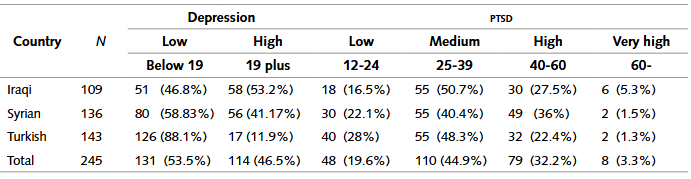
As no cutoff score was determined for perceived social support, it is not included in Table 1. For depression, a score above 19 indicates a high level. For PTSD, scores of 12-24, 24-39, 40-60, and 60+ indicate low, moderate, high, and very high levels, respectively.
Table 1 Distributions by cutoff scores for depression and PTSD scores
Note: Data presented as N (%).
As Table 1 shows, 53.2% (N = 58) of Iraqi students and 41.17% (N = 56) of Syrian students had high depression scores. For PTSD, 32.2% (N = 79) of immigrant students had high PTSD scores while 3.3% (N = 8) had very high PTSD scores. Regarding Iraqi students, specifically, 27.5% (N = 30) and 5.3% (N = 6) had high or very high PTSD scores, respectively. Among Syrian students, 36% (n = 49) and 1.5% (N = 2) had high or very high PTSD scores, respectively. In contrast, among Turkish students, 88.1% (N = 126) had low scores whereas only 11.9% (N = 17) had high depression scores while 22.4% (N = 32) had high and 1.3% (N = 2) had very high PTSD scores.
Table 2 Mean total perceived social support and subscale scores
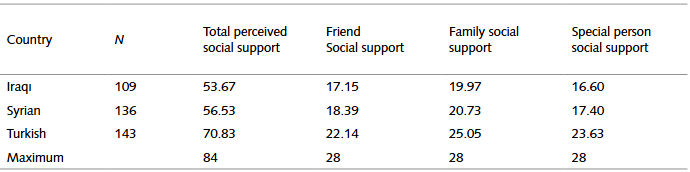
Note: Maximum possible scores for total and each subscale are 84 and 28, respectively.
Table 2 shows the perceived social support scores. Local Turkish children and adolescents had the highest (70.83) total scores, followed by Syrian (56.53) and Iraqi (53.67) adolescents. However, the total score and subscale scores were not significantly different between Syrian and Iraqi children and adolescents (p > 0.05). That is, they receive almost the same amount of perceived social support. The Turkish students scored higher than the other two groups for all three subscales. Iraqi students perceived the lowest level of social support in all three dimensions.
Difference Analysis
Table 3 presents the ANOVA results, which indicate no significant differences in scale scores related to gender or language (p > 0.05). However, there were significant differences in depression, PTSD, and social support scores related to nationality, peer relations in the new place of residence, time spent in Turkey, age, and reasons for immigration. Each of these are examined in turn below.
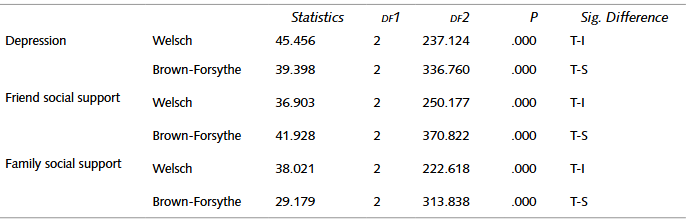
Table 3 One-way ANOVA results for PTSD and social support scores of Syrian, Iraqi, and Turkish adolescents

Note. T: Turkish, I: Iraqi, S: Syrian.
Nationality
The PTSD scores differed significantly by nationality (F2,385 = 9.718, P < 0.05, η2 = 0.048). There was a significant difference between Turkish students and Iraqi and Syrian students (P < 0.05), but no significant difference between Iraqi and Syrian students (P > 0.05). That is, the mean PTSD scores of Syrian and Iraqi students were higher than those of Turkish students (P < 0.05).
The perceived social support scores also differed significantly by nationality (F2,385 = 77.706, P < 0.05, η2 = 0.287). Turkish students had higher mean scores than Syrian and Iraqi students (P < 0.05). Mean scores for the social support from a special person subscale also differed significantly by nationality (F2,385 = 74.006, P < 0.05, η2 = 0.277), with Turkish students having higher scores (23.63) than both Syrian (17.40) and Iraqi (16.60) students, as reported in Table 2.
The depression scores of Iraqi and Syrian students (P > 0.05) did not differ significantly, although there was a significant difference between the scores of Turkish students and Iraqi and Syrian students (P < 0.05). The mean scores of Syrian and Iraqi students were higher than those of Turkish students (P < 0.05).
There were also significant differences between nationalities for peer and family social support scores (P < 0.05). Turkish students had significantly higher peer social support scores than both Iraqi and Syrian students (P < 0.05). Turkish students had significantly higher family social support scores than both Iraqi and Syrian students as reported in Table 4 (P < 0.05).
Based on these findings, data for Iraqi and Syrian students are combined for the following analyses as one immigrant group for comparison with local Turkish students.
Age
The only significant age-related differences were for PTSD scores (P < 0.05) for both Turkish and immigrant participants. Table 5 shows the results. The Games Howell test results indicated significant differences between the 14+ age group and the 12- and 13-year-old groups (P < 0.05), with 14-year-old students having higher mean PTSD scores (M = 39.62) than 12-year-old (M = 33.05) and 13-year-old students (M = 32.84).

Time Spent in Turkey
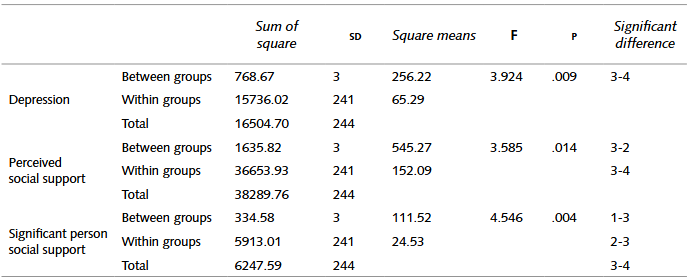
The only significant differences in relation to time spent in Turkey were for depression (F(3,241) = 3.924, P < 0.05, η2 = 0.046), perceived social support (F(3,241) = 3.585, P < 0.05, η2 = 0.042), and social support from a special person (F(3,241) = 4.546, P < 0.05, η2 = 0.053). Regarding pairwise comparisons, there was a significant difference in mean depression score between those living in Turkey for 3 years and 4 years or longer (P < 0.05), with the former having higher scores (M = 19.93) than the latter (M = 14.14). Regarding social support from a special person, the mean score was significantly higher (M = 14.40) for those living in Turkey for 3 years than those living in Turkey for 1, 2, or 4 plus years (P < 0.05), whose mean scores were 17.28, 17.32, and 18.09, respectively. Regarding pairwise comparisons, there was a significant difference in mean perceived social support score between those living in Turkey for 3 years than those living Turkey 2 and 4 plus years (P < 0.05).
Peer Relations in New Place of Residence
Perceived social support scores differed significantly in relation to peer relations (t243 = 2.128, P < 0.05, η2 = 0.018), with immigrant students who had a Turkish friend reporting significantly higher social support scores (M = 55.82) than those with no Turkish friends (M = 51.71). Family social support scores (t243 = 2.082, P < 0.05, η2 = 0.017) also differed significantly, with immigrant students who had Turkish friends reporting significantly higher family social support scores (M = 20.77) than those with no Turkish friends (M = 18.62).

Reason for Immigration (Forced or Voluntary)
Significant differences were found between voluntarily and forcefully left immigrant groups' scores for depression (t243 = 2.184, P < 0.05, η2 = 0.019) and family social support (t243 = -2.560, P < 0.05, η2 = 0.026). Surprisingly, students who had immigrated voluntarily for educational reasons had significantly higher scores (M = 20.44) than those who immigrated due to conflicts (M = 16.92), although the effect size was small. Regarding family support, students who immigrated due to conflicts had higher family social support scores (M = 20.71) than those who immigrated for education (M = 17.34).

Regression Analysis Results
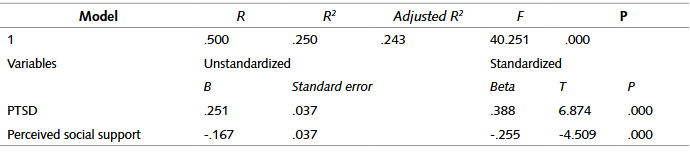
Before conducting the regression analysis, the inter-variable correlations were calculated and examined. Significant correlations were found between depression and PTSD, perceived social support, and social support scores, while PTSD, perceived social support, and family social support were highly correlated. Thus, they were considered independent variables. The relationships between the independent variables were examined to ensure that they were not too strong. The results revealed a high correlation between perceived social support and family social support. The regression analysis was run by holding depression as a constant and PTSD and perceived social support as predictor variables (Tabachnick & Fidell, 2011).
Model 1
As shown in Table 9, the multiple regression analysis results for Model 1 showed that PTSD and perceived social support are both significantly related to depression (R = 0.500, R2 = 0.250, F2,242 = 40.251, P < 0.05), together explaining approximately 25% of the variance in depression scores.
Model 2
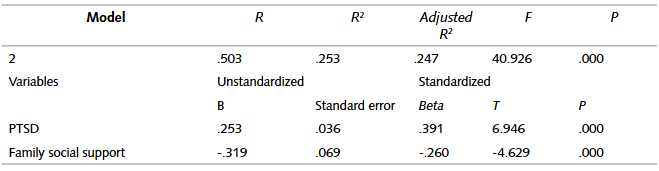
As shown in Table 10, the multiple regression analysis for Model 2 showed that PTSD and family social support both significantly related to depression (R = 0.503, R2 = 0.253, F2,242 = 40.926, P < 0.05), together explaining approximately 25.3% of the variance in depression scores.
Discussion
Results revealed surprising results. As such, over half of Iraqi students (53%) had depression scores above the cutoff limit of 19, while a majority had moderate or above moderate PTSD scores. While Syrian students had similar PTSD scores, fewer had high depression scores. Similarly, Derluyn and Broekaert (2007) found that 34.5% of refuge child and adolescents had PTSD scores or above the cutoff score while 47% of depression scores were above. In a study performed in conflict area of Palestine, Thabet and Vostanis (1999) reported PTSD prevalence of 40.6% for children, 26.9% for parents, and 43.6% for teachers.
Regarding the effects of nationality, Iraqi and Syrian students did not differ from each other but differed significantly from Turkish students. Turkish students had lower PTSD and depression scores, but higher social support scores. The lack of difference between Iraqi and Syrian students could be because their statuses (i.e., refugee, asylum-seeker, temporary protection) are not so distinct in Türkiye or they faced similar life events before immigrating. This contradicts Hodes et al. (2008), who found that among individuals from Middle East living in the UK, asylum-seekers had higher PTSD scores than refugees. Similarly, Dekeyser et al. (2011) found differences in social adaptation between children with Swedish parents and immigrant parents and more emotional problems among children with immigrant parents. In another study in Sweden, PTSD rates varied from zero to individuals who had never experienced trauma to 11% and 38% respectively, for those who had experienced trauma a few times and those who had experienced severe trauma (Almqvist & Brandell-Forsberg, 1997).
In the present study, age had no effect on depression, social support, and social support scores, whereas it significantly affected PTSD scores, with 14-year-old students having higher PTSD scores than 12- and 13-year-old ones. This is supported by Thabet et al. (2004), who found that older children are at higher risk for PTSD. Similarly, Correa-Velez, Gifford and Barnett (2010) reported that older children are at higher risk for mental health problems generally.
Surprisingly perhaps, immigrant students living in Türkiye for four years had significantly lower depression scores than those living there for only three years. This may be because the former had acquired social support systems and overcome adaptational problems. Similarly, Thabet and Vostanis (2000) found social avoidance drops from 27% to 14% as immigrant children and adolescents spend more time in the host county and learn the language and get better adjusted.
In the present study, immigrant children with Turkish friends reported higher family social support scores than those without. This could be because immigrant children facing difficulty adapting to the local culture may struggle to form peer relations, which leads to isolation (McFarlane et al., 2011). Such adverse outcomes may be avoided if immigrant families support their children through forming social relations, friendships, playing, and spending time with friends from the host country. More generally, previous studies have reported a relationship between family social support and psychological well-being. Correa-Velez et al. (2010) for example found that family social support had a positive effect on psychological well-being among refugee youth in Australia. Our findings are also consistent with Oppedal and Idsoe (2015), who found that immigrant children in Norway overcame communication barriers more easily and received peer support more successfully if they had more family social support. Thus, family attitudes and support appear imperative for immigrant children to develop positive attitudes to adjust better. In Türkiye, however, we observe that Arab immigrant families mostly have conservative Muslim backgrounds, making them fear that their children will lose their own cultural identity and weaken their conservative beliefs. It will take time, courage, and effort for them to realize that they can retain their own cultural ties and protect their own values while also learning the local culture and language and adjusting better to the host country.
Regarding reasons of immigration, students who immigrated for educational purposes had higher depression scores than those who immigrated due to civil war or ethnic conflicts. Those who immigrated for education also had lower family social support scores than those who immigrated due to conflicts. One possible explanation is that the former groups have felt safe after immigration, whereas the latter group may have been affected negatively by adaptation problems. It is thus important to have effective orientation processes for immigrant students, organized by school administrators, teachers, and psychological counselors (Eichler, 2019). An important step is providing Turkish lessons (Kağnıcı, 2017) because learning the host country's language will ease language difficulties and problems that immigrants can face in the new country.
Finally, regarding the multiple regression analyses, PTSD and perceived social support predicted depression in the first model while PTSD and family social support predict depression in the second model. These findings are supported by previous research. For example, Keles et al. (2016) found that social support problems stemming from acculturation explained 33% of the variance in depression among unaccompanied child refugees living in Norway. Similarly, PTSD explained 16% of the variance in depression among immigrant children in the UK (Bronstein, Montgomery & Ott, 2013). Finally, Oppedal and Idsoe (2015) found that social support negatively predicted depression among adolescent refugee children. This support did not have to involve face-to-face contact with immigrant family members because phone calls or other ways of communication also helped to ease the burden on these children.
In this study, it was revealed how the depression, PTSD and social support levels of children and adolescents who migrated from Syria and Iraq differed according to their demographic characteristics and the predictive power of PTSD and social support for depression. When the results were examined, the depression and PTSD levels of Syrian and Iraqi children and adolescents were higher than Turkish children and adolescents. Perceived social support levels of Syrian and Iraqi children and adolescents are lower. The results obtained were discussed in the context of the literature. It is important for psychological counselors who have immigrant and refugee students in their schools to know that migration is a traumatic experience in itself and to carry out studies that will accelerate the adaptation of students in schools.
When the limitations of the study are examined; the language problem experienced by immigrant and refugee children and adolescents and the fact that the study was conducted only with the immigrant group living in Bolu come to the fore. In addition to these, the study was carried out only with the feedback received from children and adolescents. It is thought that conducting more comprehensive studies in which teachers and families are also included in the process while studying the research topic will contribute to our understanding of refugee adolescents adoption and schooling.

