




 Spanish (pdf)
 Article in xml format
 Article references
 Automatic translation
 Send this article by e-mail
 Cited by SciELO
  Cited by Google
  Similars in
SciELO
Similars in
SciELO  Similars in Google
 Permalink
1. Introduction
The rapid emergence of antibiotic resistance poses a critical public health threat worldwide. Indiscriminate and excessive antibiotic use has resulted in resilient bacterial strains, thereby complicating infection management and heightening the need for innovative antibacterial solutions [1]. To address this, researchers are progressively turning to plant extracts as potent sources of antimicrobial compounds, potentially complementing or substituting traditional antibiotics.
Historically, plants have played a pivotal role in traditional medicine, with numerous species exhibiting antimicrobial traits useful for infection treatment [2]. These plants harbor an array of bioactive compounds, including alkaloids, terpenoids, flavonoids, and phenols, which curtail bacterial growth via varied mechanisms [3].
Recent studies on plant extracts have spotlighted compounds with considerable antibacterial prowess, propelling the hunt for plant-centric remedies to combat antibiotic resistance [4]. Understanding the mechanisms through which these compounds act can lead to the development of more targeted and effective therapeutic strategies [5].
From both sustainability and biodiversity perspectives, utilizing plant extracts as antibacterial resources carries notable benefits. Many of these plants thrive abundantly, particularly in tropical and subtropical zones known for their rich species diversity [6]. Moreover, being potentially more environmentally benign and less predisposed to induce resistance than their synthetic counterparts, plant extracts offer an eco-friendly alternative [7]. As a result, harnessing antibacterial agents from these extracts seems a strategic move in combating antibiotic resistance. They might either supplement or replace conventional antibiotics, leading to more efficient and sustainable medical treatments [6].
Platymiscium pinnatum (Jacq.) Dugand, locally known as "peraco" in Norte de Santander (Colombia) and also referred to as "guayacan trébol", "granadillo", "cristobal", and "cachimbo", is a tree species in the Fabaceae family. It can grow up to 30 m in height and 90cm in diameter. With its hard, heavy, and high-quality wood resistant to insects and fungal attacks, this tree is highly sought after in construction and carpentry [8].
While direct studies on the antimicrobial potential of Platymiscium pinnatum (Jacq) are limited, investigations into related species have shown promising results. For example, the wood extract of Platymiscium gracile has demonstrated antibacterial effectiveness against species such as Bacillus cereus and Staphylococcus aureus. In a detailed exploration of this species, a variety of extracts underwent separation and purification, yielding a number of notable compounds. From the n-hexane extract, three compounds were identified: scoparone (6,7-dimethoxycoumarin), homopterocarpin, and oleanolic aldehyde acetate. Additionally, the dichloromethane extract contained compounds such as calycosin, medicarpin, 8-hydroxyhomopterocarpin, 8-methoxyhomopterocarpin, 3,4-dimethoxycinnamaldehyde, and 3,4,5-trimethoxycinnamaldehyde. The ethyl acetate extract also revealed the presence of liquiritigenin and isoliquiritigenin. This marks the first discovery of several of these compounds in P. gracile, highlighting its potential as a rich source of diverse biochemicals including coumarin, chalcone, flavanone, triterpene, cinnamic aldehyde derivatives, and pterocarpans, with some present in high concentrations. [9]. Given the probable shared chemical characteristics within the Platymiscium genus, P. pinnatum might harbor similar antimicrobial attributes. This research aims to discern the antibacterial efficacy of ethanol extracts derived from P. pinnatum against four pathogenic bacteria and explore their implications in infectious disease treatment. We hypothesize that these extracts demonstrate significant antibacterial prowess. To validate this hypothesis, we embarked on a comprehensive experimental journey, spanning extraction, chemical extract profiling, and in vitro susceptibility tests against bacterial strains: Bacillus sp., Staphylococcus aureus, Escherichia coli, and Pseudomonas aeruginosa.
2. Material and methods
2.1. Collection of plant material
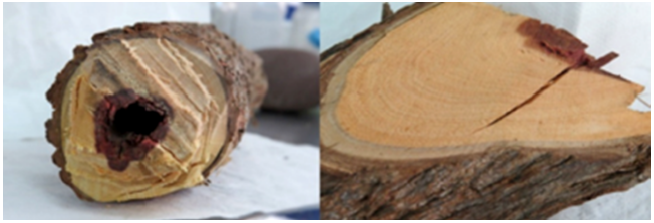
The bark of P. pinnatum was collected from trees located in the Peracos neighborhood (7°57 '09 "N 72°29 '57 " W), accessible via the old road to Puerto Santander, in the municipality of Cucuta, Norte de Santander, Colombia. The specific area of collection was chosen due to its natural abundance of P. pinnatum trees and its accessibility for sampling. Figure 1 presents a photographic representation of the collected bark material from Platymiscium pinnatum (Jacq). The photograph vividly captures the specific morphological components of the plant, such as the stem, bark, heartwood, and sapwood. Each component in the image is distinctly visible, and labeled accordingly for clarity and easy reference.
2.2. Preparation of ethanolic extract of P. pinnatum (Jacq)
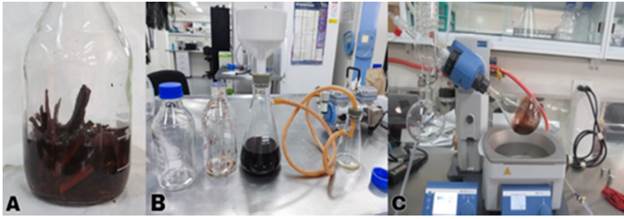
Bark samples from P. pinnatum (Jacq) were carefully processed into thin, fine flakes. The precisely weighed flakes were then transferred to graduated flasks. Absolute ethanol (Merck, Germany) was added according to a specific weight / volume ratio. The concoction was thoroughly agitated for a period of 48 hours, ensuring that the process occmred in total darkness to protect the integrity of the active compounds.
Post-agitation, the resulting ethanolic extract was filtered utilizing a vacuum pump (DOSIVAC, Buenos Aires, Argentina), in tandem with a ftmnel and a filter paper (Qual. Dia. 125mm, BOECO, Germany). The filtrate was subsequently concentrated under diminished pressure using a rotary evaporator (IKA®RV10, Wilmington, United States) as depicted in Figure 2. To maintain its stability, the concentrated extract was securely stored in amber-colored vials under a cool condition of 4°C. This preparation was later subjected to antibacterial scrutiny, targeting both Gram-positive strains (specifically Bacillus sp and Staphylococcus aureus) and Gram-negative strains (namely Pseudomonas aeruginosa and Escherichia coli).
2.3. Identification of secondary metabolites by gas chromatography coupled with mass spectrometry (GC-MS)
The ethanolic extract derived from the bark of P. pinnatum was subjected to gas chromatography-mass spectrometry for a comprehensive analysis of its chemical constituents. The GC-MS analysis was conducted on an AT 6890 Series Plus gas chromatograph coupled with an MSD 5973 mass spectrometer (Agilent Technologies, Santa Clara, United States). The chromatographic separation took place on a DB-5MS column (5 %-phenyl-poly(methylsiloxane), dimensions: 60 m x 0.23 mm x 0.25 ßm). The injection of the sample was facilitated in Split mode (30:1) utilizing the Solid-Phase Microextraction (SPME) technique. The acquired mass spectral data were sub-sequently compared and identified against reference spectra from the Adams, Wiley, and NIST databases.
2.4. Antimicrobial Activity Assessment of Platymiscium pinnatum (Jacq) Ethanolic Extracts
To evaluate the antimicrobial properties of the P. pinnatum bark's ethanolic extracts, we employed the Kirby-Bauer disk diffusion method. This was conducted against four bacterial strains: Bacillus sp, Staphylococcus aureus, Escherichia coli, and Pseudomonas aeruginosa.
2.5. Preparation of Test Samples
Extracts from P. pinnatum bark were diluted in varying ratios ranging from 1:0 (concentrated extract) to 1:5 (extract to ethanol). Sensidisks, impregnated with these varied dilutions, were prepared to assess their antibacterial activity against the target bacteria. The inhibitory effects of the extracts were evaluated quantitatively by measuring the zones of inhibition. Each test was replicated thrice to ensure reliability and for statistical verification.
2.6. Controls and Treatment Groups
Positive Controls: Kanamycin (1 mg/mL) and Ciprofloxacin (ranging from 0.1 to 1 mg/mL). Negative Controls: Distilled water (T2) and ethanol (T3). Treatment Groups: T4: Concentrated extract; T5: 1:1 Ethanol extract; T6: 1:2 Ethanol extract; T7: 1:3 Ethanol extract; T8: 1:4 Ethanol extract; T9: 1:5 Ethanol extract
3. Results and Discussion
The GC-MS (Gas Chromatography-Mass Spectrometry) analysis of the ethanolic extract from the bark of P. pinnatum revealed several major compounds (Figure 3). Escoparone was identified as the predominant component, accounting for 48.2% of the extract. Medicarpin contributed a significant 20.1 %, while homopterocarpin was present at 16.3 %. Methyl eudesmatewas found in smaller amounts, constituting 0.8 %. Additionally, several unidentified compounds (NI. Compound) were detected, with their relative amounts ranging from 1.6 % to 4.1 %, as detailed in Table 1.
Tabla 1: Major compounds identified in the ethanolic extract obtained from the bark of P. pinnatum (Jacq) by Gas Chromatography-Mass Spectrometry (GC-MS).
| RT (min) | Tentative identification | Relative amount (%) |
|---|---|---|
| 48.18 | Methyl eudesmate | 0.8 |
| 49.66 | NI. Compound M+ 240 | 2.0 |
| 51.18 | Escoparone | 48.2 |
| 52.06 | NI. Compound M+ 236 | 1.6 |
| 62.54 | Homopterocarpin | 16.3 |
| 63.54 | Medicarpin | 20.1 |
| 63.83 | NI. Compound M+ 270 | 2.1 |
| 64.90 | NI. Compound M+ 270 | 4.1 |
| 68.40 | NI. Compound M+ 286 | 2.8 |
| 69.93 | NI. Compound M+ 298 | 2.1 |
In the GC-MS results presented , there are several instances of "NI. Compound M+", a notation indicative of unidentified compounds within the sample. Specifically, the "M+"signifies its molecular ion peak, reflecting the compound's molecular weight. The subsequent numbers (e.g., 270, 240) specify the m/z (mass-to-charge ratio) values for these molecular ion peaks, representing the exact mass of the primary ion generated during the mass spectrometry. To elucidate, an entry like "NI. Compound M+ 270"suggests the presence of an unidentified compound with a molecular ion peak at an m/z value of 270. The multiple unidentified compounds detected unders-core the chemical complexity of the ethanolic extract from P. pinnatum bark, hinting at potential bioactive compounds that are yet to be explicitly identified or studied.
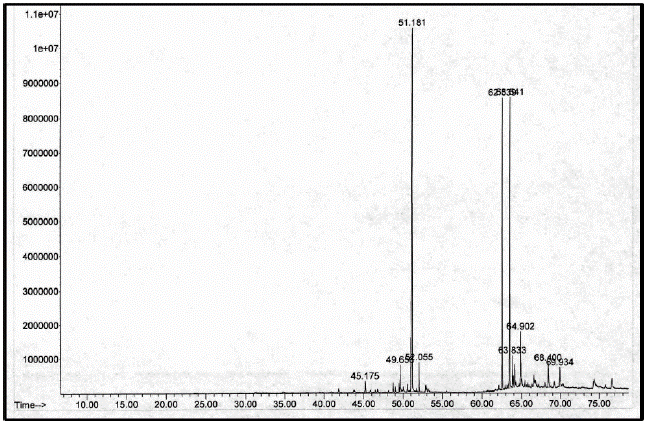
Figura 3: Chromatogram of the ethanolic extract obtained from the bark of P. pinnatum (peraco) analyzed using Gas Chromatography-Mass Spectrometry (GC-MS).
The majority of the compounds detected within the extract can be categorized under secondary metabolites. The extract contains terpenoids (Methyl eudesmate), isoflavonoids (homopterocarpin and Medicarpin), and coumarins (escoparone). Historically, these have been recognized for their broad-spectrum antimicrobial properties, and their efficacy against pathogens such as Escherichia coli, Salmonella, and Staphylococcus aureus has been documented in previous studies [10].
The ethanolic extract from P. pinnatum displayed noteworthy antibacterial activity against a range of both Gram-positive and Gram-negative bacteria. Notable zones of inhibition were observed across all extract dilutions tested against bacteria like Bacillus sp., Escherichia coli, Staphylococcus aureus, and Pseudomonas aeruginosa (Figure 4). An ANOVA (Analysis of Variance) further highlighted significant differences in inhibition between varied bacterial strains and treatments. These findings align with existing literature, suggesting that different extracts may exhibit higher antibacterial activity against different bacterial strains. In example a study on nine plant species highlighted C. triflora and H. roeperianum as demonstrating promising antimicrobial activities [11]. While the extract's efficacy didn't surpass that of a commercial antibiotic, the presence of moderate antibacterial compounds within the extract was evident. Application of the Tukey's HSD test elucidated three significantly different groups based on average inhibition in response to the P. pinnatum ethanolic extracts. Among them, Staphylococcus aureus exhibited the most considerable average inhibition, with Bacillus sp., Escherichia coli, and Pseudomonas aeruginosa following in its wake.
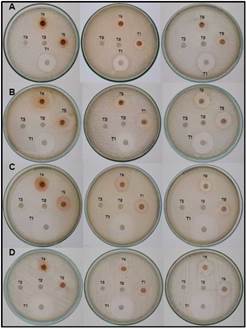
Figura 4: Comparative antibacterial activities of P. pinnatum ethanolic extract dilutions against four bacterial species. The figure contains four panels (A-D), each representing a distinct bacterial species: A) Bacillus sp., B) Staphylococcus aureus, C) Escherichia coli, and D) Pseudomonas aeruginosa. Each panel presents the results from three Petri dishes demonstrating the effects of the different treatments: T1) Kanamycin and Ciprofloxacin as positive controls, T2) distilled water as a negative control, T3) Ethanol, T4) the concentrated extract, and T5-T9) various dilutions of the concentrated extract, with T5-T9 representing dilutions 1:1, 1:2, 1:3, 1:4, and 1:5, respectively.
The significance of these findings lies in the potential therapeutic use of P. pinnatum extracts in treating infections caused by Staphylococcus aureus, a bacterium notorious for antibiotic resistance, including Methicillin-resistant Staphylococcus aureus (MRSA) [12]. The efficiency of P. pinnatum extracts against Staphylococcus aureus underscores its potential as a novel antibacterial treatment, especially in the context of antibiotic-resistant infections.
On the discussion front, there's a mounting global concern over increasing antibiotic resistance, posing a significant threat to public health and undermining the efficacy of current antimicrobial treatments. The unregulated use of antibiotics, both in human and veterinary medicine, has expedited the emergence of multidrug resistant bacterial strains, rendering infection treatments progressively challenging [13]. Thus, the quest for new antibacterial agents that can counter this escalating resistance is imperative.
Historically, natural products, especially plant extracts, have served as invaluable reservoirs of bioactive molecules, laying the foundation for many clinically relevant antibiotic classes [2]. These plants encompass a wealth of chemical compounds like alkaloids, terpenoids, flavonoids, and phenols, which possess antimicrobial properties. Their varied mechanisms of action could potentially counter existing antibiotic resistances [14]. Given that numerous plant species remain under-explored for their antimicrobial capabilities, there is tremendous potential to uncover novel therapeutic agents. This highlights the pressing need for continued investigation of natural resources, not just to identify but to harness these agents for more effective, targeted treatment strategies [15].
While the ethanolic extract of showcases antibacterial activity, it may not rival the potency of conventional antibiotics. Yet, it could emerge as a complementary alternative in treating Staphylococcus aureus-induced infections, especially when met with antibiotic resistance. The extract's effectiveness against Staphylococcus aureus can likely be attributed to the plant's secondary compounds like terpenoids, coumarins, flavonoids, and isoflavonoids, renowned for their broad-spectrum antimicrobial activity. While the precise antibacterial mechanism remains elusive, some researchers propose that these compounds, due to their lipophilic nature, induce alterations in bacterial outer membrane fatty acid composition, leading to increased permeability, ATP loss, ion leakage, culminating in cell lysis [16].
These findings could guide subsequent studies, focusing on the evaluation of alternative extracts or considering chemical alterations to boost their antimicrobial efficacy. The observed consistent susceptibility among the three bacterial strains suggests that the active compounds in P. pinnatum might exert a specific effect on Staphylococcus aureus or the used concentrations weren't sufficiently potent to inhibit the other bacteria significantly.
It's worth noting that the ethanol, employed as a solvent in the treatment dilutions, didn't impede bacterial growth. This observation reinforces the notion that the witnessed antibacterial activity in the treatments is attributable to bioactive compounds, not ethanol's effects, thereby bolstering the study's validity and facilitating more accurate inter-treatment comparisons. This lack of ethanol interference in bioactivity tests augments the credibility of findings regarding the antibacterial activity of evaluated treatments.
The study's results gain traction considering the clinical significance of Staphylococcus aureus, an opportunistic bacterium capable of triggering a plethora of infections, thereby emerging as a public health challenge. This bacterium also exhibits resistance to various antibiotic groups. Thus, the pronoun-ced antibacterial activity of the P. pinnatum ethanolic extract against Staphylococcus aureus emerges as a promising find. While it didn't match a commercial antibiotic's efficiency used in the study, it could serve as a pivotal starting point in devising novel antimicrobial agents or as an adjunct strategy in treating Staphylococcus aureus-induced infections.
4. Conclusion
In the persistent pursuit of natural antimicrobial agents within pharmacognosy, this study offers essential insights. Our findings indicate that the ethanolic extract of P. pinnatum exhibits noteworthy antibacterial efficacy, particularly against the Gram-positive bacterium, Staphylococcus aureus. The phytochemical analysis, revealing the presence of secondary metabolites like flavonoids, isoflavonoids, terpenes, and coumarins, accentuates the potential of P. pinnatum. These compounds are distinguished for their broad-spectrum biological activities, inclusive of antimicrobial properties. Consequently, the ethanolic extract derived from the bark of P. pinnatum could emerge as a prospective contender in formulating novel antimicrobial agents tailored to combat infections triggered by Staphylococcus aureus. Nonetheless, before integrating this extract into clinical practice, it's paramount to rigorously assess its efficacy, safety, and any potential side effects across varied populations and under specific medical circumstances.

