




 English (pdf)
 Article in xml format
 Article references
 Automatic translation
 Send this article by e-mail
 Cited by SciELO
  Cited by Google
  Similars in
SciELO
Similars in
SciELO  Similars in Google
 Permalink
1 Introduction
The presence of heavy metal ions in wastewater is a serious problem due to the discharge of contaminated effluents into the environment [1]. Among the pollutants generally discharged to water bodies are heavy metals; these are found in the wastewater from industrial processes such as inks, metallurgy, batteries, oil, mining, tanneries, among others [2]. Chromium occurs in aqueous systems in the form +3 and +6, being the hexavalent chromium much more toxic than the trivalent [3]; these ions are widely used in the manufacture of inks, industrial dyes and paint pigments, chrome plating, aluminum anodizing and other cleanings, coating and electroplating operations of metals, gold mining, among others [4].
Several removal methods have been used in the capture of Hexavalent Chromium due to its toxic health effects [5]; these technologies include filtration, chemical precipitation, adsorption, electrodeposition, and membrane systems or even ion exchange processes [6]. Among these methods, bio-adsorption is one of the most economically favorable methods, technically easier, with high availability of adsorbents and the possibility of reuse [7]. The removal of hexavalent chromium has been studied using dead biomasses of different origin, such as corn residues [8], coffee pulp [3], kenaf [9], oil palm ash [5], and peels of lime [4], nut [10], chitosan [11], orange [12] and plantain [], obtaining good performance of biomaterials due to the presence of hydroxyl, carboxyl, amino, and carbonyl functional groups, due to their lignocellulosic nature [14].
Waste disposal on the northern coast of Colombia represents a severe problem for the environment and public health because agriculture has a significant impact on the total volume of solid waste generation, and dispersed agricultural sources contribute 84% of the biochemical oxygen demand of surface waters [15, 16]. In the northern region of Colombia, yam (Dioscorea rotundata) is a medium-grown crop tuber grown in the northern part of Colombia, where it is widely used in the common diet of the inhabitants of this area of the country and is also an export product to the U.S. and European markets that generates for the country revenues of more than U.S. $2.5 M annually, with account for 18% of total production [17]. However, the industrial production and consumption of white yam generates a large amount of waste that is improperly disposed of in the environment [18]. Since the white yam is a starch-rich tuber and the peel is composed of more than 45% elemental carbon, its use as as an adsorbent material with good physicochemical properties is possible.
In addition, the African oil palm (Elaeis guineensis) extraction industry generates large volumes of waste during its process, including palm fiber and palm kernel shell. Due to the 60% increase in palm oil production, approximately 500,000 tons of waste are generated each year [19]. Although the palm kernel shell is generally used as fuel for boilers and composting, the residual fiber is a rejected product that is not utilized after being generated. Therefore, the valorization of waste such as residual fiber is of great importance to mitigate its environmental effects and ensure a sustainable process. Among the various applications that could be given to palm residual fiber, its use as an adsorbent in the treatment of water contaminated with heavy metals is found, among a wide range of applications, wastewater treatment seems attractive due to the reported removal yields for similar waste [20]. The advantage of adsorbents prepared from waste is that they are low-cost and ideal as adsorbents due to their properties of high surface area, high adsorption capacity, mechanical stability, compatibility, easy accessibility, ease of regeneration, cost-effectiveness, simple procedures, and high selectivity [21].
Fort he above, in the studies of hexavalent chromium adsorption using bio-adsorbents, several variables have been evaluated such as adsorbent dose, initial concentration, particle size, and temperature; which are parameters that influence the availability of active sites of the adsorbent, the diffusive and mass transfer phenomena of the pollutant from the solution to the adsorbent, the exposed surface area and the mechanisms that dominate the adsorption of the pollutant [22]. In this sense, the determination of the adsorption isotherm and thermodynamic parameters (change in Gibss free energy, enthalpy, and entropy), are necessary studies that help to understand the mechanisms and phases involved in chromium adsorption [23]. Thus, the objective of this study was to determine the effect of adsorbent dose, particle size, and temperature on the adsorption capacity of Chromium (VI) using yam hulls (YH) and oil palm residues (OPW) in a batch system. Adsorption equilibrium on bioad-sorbents was studied and fitted to Langmuir, Freundlich, and Dubinin-Radushkevich isothermal models. Thermodynamic parameters were estimated by the Van't Hoff graphical method.
2 Methodology
2.1 Materials and reagents
Oil palm waste (OPW) was obtained as a rejection product of the oil extraction process and yam hulls as a by-product of post-harvest handling in the department of Bolivar (Colombia). The lignocellulosic material was washed, sun-dried to a constant mass, subjected to size reduction in a roller mill, and size classification in a sieve type shaker on stainless steel meshes. The 100 mg/L chromium solution used in the adsorption tests was prepared with analytical grade potassium dichromate (K2Cr2O7). To adjust the pH it was used Hydrochloric Acid (HCl) and sodium hydroxide (NaOH) 0.5 M solutions to adjust to pH 2 [8].
2.2 Adsorption tests
The YH and OPW waste were washed, sun-dried to remove moisture and reduced in size in a hand-roller mill, and sized in a vibrating sieve machine using stainless steel meshes.
The materials were stored in airtight plastic bags to keep them in good condition. Adsorption experiments were performed in a batch system using an orbital shaker by contacting 100 mL of solution at pH 2, 200 rpm per 24 h, at different conditions of adsorbent dosage (0.03, 0.15, 0.325, 0.5 and 0.62 g), particle size (0.14, 0.355, 0.5,1.0 and 1.22 mm) and temperature (29.8, 40, 55, 70 and 80 °C). The remaining concentration of hexavalent chromium in the solution was determined by the standard method 1,5-diphenylcarbazide, in a Biobase spectrophotometer BK-UV1900. at 540 nm [24]. The adsorption capacity was determined according to Equation 1, where q t (mg/g) is the adsorption capacity of the material, Co and C f (mg/L) is the initial and final concentration of Chromium, V (L) is the volume of solution and m (g) is the mass of adsorbent.

2.3 Adsorption equilibrium
Adsorption isotherm describes the equilibrium of the material's adsorption on a surface at a constant temperature; it represents the amount of material bound to the surface as a function of the material present in the gas phase or dissolution, as well as for determining the interactions that control the process [25]. Adsorption experiments were carried out by varying the concentration of the solution (25, 50, 75, 100, 125, and 150 mg/L), keeping the agitation constant at 200 rpm, at the best conditions found during the adsorption tests. The experimental data were adjusted to the models of Lang-muir, Freundlich, and Dubinin-Radushkevich. Freundlich's isotherm (Equation 2), assumes the formation of multilayers during the adsorption process due to the different activation energies and affinities of the active centers of the adsorbent [26].

Where k f is the Freundlich constant and represents the distribution coefficient (L/g), n represents the adsorption intensity and indicates the heterogeneity of the active sites, q t is the amount of metal adsorbed at equilibrium (mg/g), and Ce is the residual metal concentration in solution (mg/L) [27]. Langmuir's adsorption isotherm (Equation 3) quantitatively describes the deposition of ions uniformly on an adsorbing surface as a function of the concentration of the adsorbed material in the liquid with which it is in contact [28].

Where q t is the amount of the adsorbed metal in the bioad-sorbent (mg/g), Cf is the residual metal concentration in solution (mg/L), q max is the maximum adsorption of the Langmuir model (mg/g), and KL is the Langmuir constant and can be correlated with the variation of the adsorption area and the porosity of the adsorbent [27].
The Dubinin-Radushkevich isothermal model (Equation 4), is a semi-empirical equation applied to express the mechanism of adsorption with Gaussian energy distribution on heterogeneous surfaces and is only suitable for an intermediate range of adsorbate concentrations because it exhibits asymptotic behavior. It assumes a multilayer character involving Van Der Waals forces, applicable for physical adsorption processes; it is usually applied to differentiate between physical and chemical adsorption of metal ions [29].
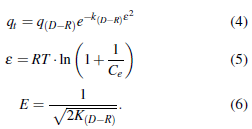
Where ε2 is the Polanyi potential, k (D-R) is the Dubinin-Radushkevich constant related to adsorption energy (mol2/kJ2), E is the average adsorption energy per molecule of adsorbate required to transfer E is the average adsorption energy per molecule of adsorbate required to transfer one mol of ion from solution to the adsorbent surface (kJ/mol), R is the gas constant (8.31 J/mol.K) and T is the absolute temperature.
2.4 Estimation of thermodynamic parameters
The thermodynamic parameters were estimated using the graphical method based on the Vant't Hoff equation in order to determine the spontaneity, type of adsorption, and predict the magnitude of changes on the surface of the adsorbent, respectively [30]. The analysis of these parameters will make it possible to estimate the feasibility of the adsorption process and the effect of temperature on it [31]. It was estimated the change in Gibbs' standard free energy (ΔG°), the standard enthalpy (ΔH°), and standard entropy (ΔS°). Adsorption experiments were performed by varying the temperature from 29.8 to 81°C, considering the conditions established in the design of experiments; then, a graph Ln(Kc) vs. T-1 was made and the parameters were calculated using the following equations:
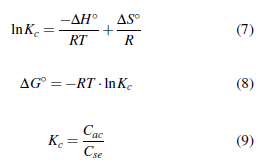
Where R is the constant of the ideal gases (8.31 J/mol.K), K c is the constant of balance, C ac is the concentration of the adsorbate in the equilibrium contained on the surface of the adsorbent Cse is the concentration in solution at equilibrium, T is the absolute temperature. AH° and AS° are determined from the slope and the intercept with the y-axis of Arrhenius graph of lnKc vs T-1, respectively.
3 Results
3.1 FTIR analysis of the bioadsorbents
In order to determine the difference in the functional groups of the biomass, sawdust and unmodified biochar, a comparison of FTIR spectra was carried out. Figure 1 shows the differences between the infrared spectra of the bioadsorbents under study before and after the Cr (VI) adsorption.
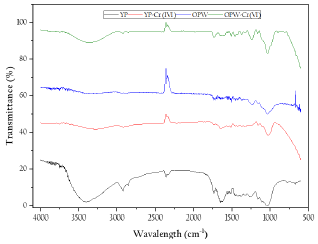
For OPW and YP before adsorption an evident stretching between frequencies of 3500 and 3800 cm-1 corresponds to the hydroxyl (O-H) functional group [32], while the presence of primary and secondary amines is indicated by the stretching of the N-H bond between 3200 and 3450 cm-1 [33]. In addition, a deformation of the C-H group and carboxylic acid can be observed between the frequencies of 2700 and 3000 cm-1, as well as the stretching of carbon dioxide O=C=O close to the band at 2400 cm-1 [34]. Nearly the band between 1600 and 1650 cm-1, a stretch of the carbonyl group of pectin, cellulose, and hemicellulose carboxylic acids can be observed, while between 900 and 1200 cm-1, vibrations corresponding to the C-O group of alcohols and phenols are evident [35]. The presence of these multiple adsorption peaks confirms the heterogeneous nature and structural complexity of the bioadsorbents under study.
After the C>r (VI) adsorption, changes in the functional groups of the biomasses can be observed, and the difference in the vibrations is remarkable. This is attributed to the incorporation of the metals under study onto the surface of the biomass, whereby they are joined to different functional groups on it [36]. The change in the intensity of the bands of the groups OH, CH, CO, NH, and C=C evidences the union of the ions; active and present functional groups in the biomass are key to the mechanism of adsorption of cationic pollutants [23]. Between 900 and 1800 cm-1, the presence of aromatic rings in the lignin and stretching of the C-O groups can be observed [10]. The vibrations of the bands between 700 and 00 cm-1 present inorganic groups attributed to the heavy metals on their structure [37].
3.2 Effect of adsorbent dose, particle size, and temperature
From the hexavalent chromium adsorption tests using YP and OPW as bioadsorbent, were evaluated the effect of temperature, particle size, and amount of metal adsorbent by calculating the hexavalent chromium adsorption capacity using Equation 1. Figure 2 summarizes the effect of the dose of adsorbent on the adsorption capacity of the metal ion, finding that at 0.03 g of biomaterial the best performance is achieved for both biomaterials, reaching 159.77 mg/g when using YP and 325.88 mg/g with OPW.
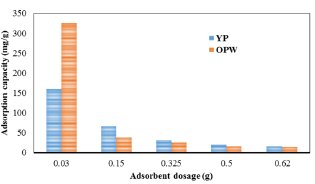
Figure 2: Effect of the adsorbent dose on the adsorption capacity of hexavalent chromium using YP and OPW
There is evidence of a decrease in adsorption capacity as the number of biomaterial increases, which is due to the diversity of the biomasses evaluated, so there are a large number of active adsorption sites available due to the presence of the hydroxyl, carbonyl, amine and hydrocarbon groups present in the structure of lignin, hemicellulose, cellulose and pectin [26]. Due to this presence of active adsorption centers, it would appear that the greater the amount of adsorbent, the greater part of these would remain free after the process, thus decreasing the adsorption capacity [38].
Figure 3 shows the temperature performance for the adsorption capacity, finding that at 55 °C the best performance was obtained. This is due to the activation of the active adsorption centers with the increase in temperature, as well as the increase in the intraparticle diffusion speed from the solution to the adsorbent, assuming that the diffusion is an endothermic process at the initial temperatures evaluated [33].
The effect of particle size on the adsorption capacity of hexavalent chromium on YP and OPW is shown in Figure 4; it is evident that the adsorption capacity increases with particle size in the range of 0.14 mm to 0.5 mm, and then decreases from 1.0 mm to 1.2 mm. This is explained by the influence of particle size on the surface contact area of the bioadsorbents, which increases when the particle size is smaller, and in turn, favors the rate of diffusion increased by increasing temperature [39]. However, a very small size would resist diffusive surface phenomena and subsequent mass transfer through the pores [40].
3.3 Adsorption isotherm
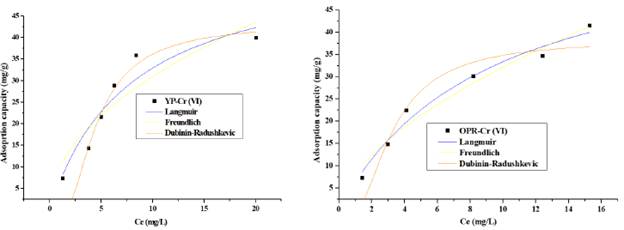
The effect of the initial concentration on the adsorption capacity of Cr (VI) was evaluated, for which experiments were carried out varying the concentration of the contaminant in intervals of 25 mg/L to 150 mg/L, at pH 2, per 24 h, in order to understand the driving forces involved in the removal [41]. Figure 5 shows the non-linear fitting of experimental data to Langmuir, Freundlich, and Dubinin-Radushkevich models; the fitting parameters are summarized in Table 1.
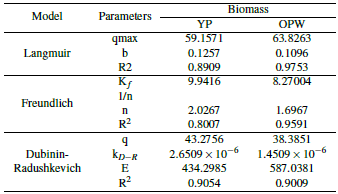
The results reveal that Dubinin-Radushkevich's model describes the equilibrium of hexavalent chromium adsorption on OPW are Langmuir's and Freundlich's models adjust the isotherm of ion adsorption in the study on OPW, because it is established that the physical and chemical adsorption phenomena control the adsorption process, thus the retention of the contaminant occurs inside and in the internal pores of the adsorbent [42]. While Dubinin-Radushkevich's model adjusts the isotherm on YP, with an average energy of adsorption of the ions per sorbate (E) of 434.2985 kJ/mol, which is much higher than 8 kJ/mol, indicating that the process is mostly controlled by chemical adsorption with strong interactions between the active sites and the hex-avalent chromium [43]. Dubinin-Radushkevich's model presents a good fit for the equilibrium of chromium adsorption using the two bioadsorbents evaluated because the calculated maximum adsorption capacity (qDR) values are the closest to the experimental ones with R2 > 0.9 in both cases. This means that the bioadsorbents under study present a heterogeneous structure, which is required for a good fitting by the Dubinin-Radushkevich isotherm, as shown in the FTIR (Figure 1) and the EDS spectra (Figures 2 and 3) [44].
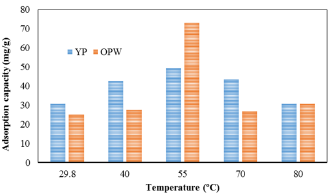
Figure 3: Effect of temperature over the adsorption capacity of hexavalent chromium using YP and OPW
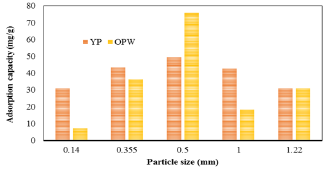
Table 2 presents a comparative of results from previous studies when using lignocellulosic based adsorbents for removing Cr (VI). It is observed that, in cases when the evaluated pH was not acid the adsorption capacity decreases. Thus, because at low pH the surface of the adsorbents are protonated and the existing species of chromium are anions, such as chromates and dichromates, then they can be easily linked to the adsorbent due to electrostatic forces [24]. Also, it is noted that in previous studies is used more adsorbent, so it can be the result of a higher adsorption capacity in the monolayer, due to the higher availability of active sites.

3.4 Thermodynamic Adsorption Parameters
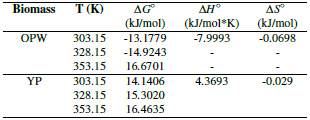
By calculating the thermodynamic parameters it is possible to establish the feasibility, the adsorption mechanism, the energetic character of the process (endothermic or exothermic), and the spontaneity of the adsorption; this is done by determining the entropy (ΔS°), enthalpy (ΔH°) and the change in Gibss Free Energy (ΔG°), respectively. The thermodynamic parameters of hexavalent chromium adsorption on OPW and YP are summarized in Table 3. From the positive value of AH° when using YP it is established that the processes of chromium removal are endothermic, consequently, energy must be supplied to the system to promote the diffusive phenomena in the solution and inside the pores of the adsorbent [39]; while on OPW the process is exothermic and the limiting step is chemical adsorption [49]. The negative value of AS° shows that on the surface there was a good bond between the metal and the biomass, thus obtaining a low possibility of reversibility, also the probability of some structural changes due to the formation of bonds with functional groups at the interface [43], as shown by FTIR (Figure 1) [8].
4 Conclusion
From the adsorption experiments, the highest adsorption capacity is obtained at 0.03 g of adsorbent, 55 °C and 0.5 mm. The equilibrium of adsorption on OPW is described by Langmuir and Freundlich models, while YP is described by Dubinin-Radushkevich model, whose parameters of fitting suggest that adsorption is given by ion exchange between the active centers and the metal ion. The thermodynamic parameters determined that the removal on YP is endothermic, irreversible, and non-spontaneous, while for OPW it is exothermic, spontaneous at low temperatures, and irreversible. The rapid removal rate and high adsorption capacities obtained show that the bioadsorbents evaluated are effective in the removal of hexavalent chromium present in aqueous solution.

