


 English (pdf)
 Article in xml format
 Article references
 Automatic translation
 Send this article by e-mail
 Cited by SciELO
  Cited by Google
  Similars in
SciELO
Similars in
SciELO  Similars in Google
 Permalink

1 Introduction
1.1 General context
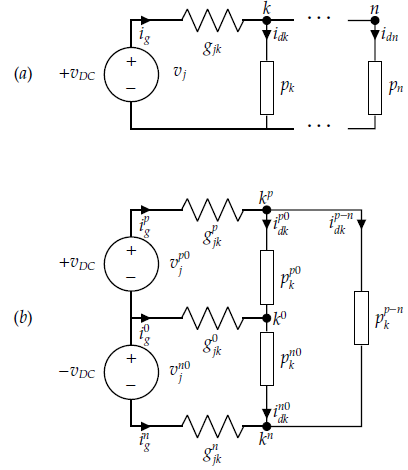
Bipolar direct current (DC) technology is gaining increasing traction in modern power systems, encompassing both highland low-voltage applications. These networks are viewed as a multipole extension of classical monopolar DC systems and comprise three conductors: a positive pole (+v DC), a negative pole (-v DC), and a neutral wire (0v DC) [1]. Figure 1 illustrates the typical topologies of monopolar and bipolar DC networks. The monopolar DC network, shown in Fig. 1(a), consists of a positive conductor and a neutral wire that serves as the return path. In contrast, the bipolar DC network includes both positive and negative poles along with a neutral conductor, as depicted in Fig. 1(b). This configuration supports the integration of both monopolar and bipolar loads, thereby increasing the total number of supported loads compared to a monopolar setup. As a result, bipolar DC systems offer several advantages, including enhanced power transfer capability and greater flexibility in accommodating a wider variety of load types.
1.2 Motivation
Among the benefits of bipolar DC networks, two stand out: (a) the capacity to transfer twice the power to end users compared to monopolar DC networks, achieved with only a 33.34% increase in infrastructure costs due to additional wiring and bipolar converters [1]; and (b) the possibility of connecting loads directly between the positive and negative poles (bipolar loads, p k p-n ), which can operate at twice the nominal pole-to-neutral voltage [2]. However, a major drawback of bipolar systems is their tendency to operate under unbalanced conditions due to monopolar loads (connected between one pole and the neutral wire, i.e., p k p0 and p k n0 ) [3], which leads to voltage unbalances and increased power losses.
1.3 Literature review
Analyzing bipolar DC networks under steady-state conditions, due to their nonlinearities and unbalanced operative conditions, requires practical optimization tools to define their best possible operation scenario as a function of the resources available [4]. Multiple authors have proposed efficient power flow methodologies based on derivative-based [2], and derivative-free methods to determine the steady-state operative conditions of the network [5]. In the case of the optimization analyses, one of the most studied problems for bipolar DC networks with asymmetric loading corresponds to the optimal power flow solution with convex methods to minimize grid power losses [6], [7], nodal marginal prices [8], [9], and reduce voltage unbalance caused by the asymmetric loading [1], [10], among other optimization problems.
Most of these power flow and optimal power flow formulations assume that the neutral wire can operate under two main conditions [5], i.e., the neutral wire solidly grounded in all nodes of the network or the neutral wire floating in all the nodes, except in the substation bus. These operative characteristics have an essential influence on the expected grid power losses of the network, which are higher when the neutral wire is considered floating due to the neutral current flows caused by the unbalanced monopolar loads [11]. Even if the complete neutral grounded operative condition is the ideal operative condition for any electrical network [12], regarding the number of power losses, it is essential to note that when the number of nodes of the bipolar DC networks starts to increase, it can be an impractical operation scenario due to the costs associated with preparing all the conditions to ensure an excellent neutral solidly grounded operative conditions in a particular node. The study by [13] developed an optimal power flow (OPF) formulation for bipolar DC networks using a branch flow model and converted it into a convex SOCP model. This approach guarantees global optimality and fast convergence. Simulations on 21- and 85-node systems showed accurate and efficient results, closely matching the original nonlinear model. The work by [14] proposed a generalized Broyden's method to solve the power flow problem in bipolar asymmetric DC networks. This Newton-based approach efficiently handles the nonlinearities involved, including scenarios with grounded or floating neutral wires. Simulations on 21-, 33-, and 85-node test systems confirm the method's accuracy and its equivalence to classical backward/forward sweep techniques. The study by [15] proposed a novel convex OPF model for bipolar DC distribution networks using power injection-based equations instead of current injection formulations. The model leverages SOCP relaxation combined with McCormick envelopes and a sequence bound tightening algorithm to improve solution tightness. Case studies demonstrate its effectiveness in both planning and operational tasks, significantly reducing the relaxation gap compared to traditional SOCP approaches. The authors in [16] proposed a mixed-integer convex model for optimal neutral grounding in bipolar DC networks aimed at minimizing power losses. To achieve convexity, the model linearized the relationship between power and voltage in constant power loads using the first-order Taylor approximation. Additionally, a recursive algorithm was implemented to mitigate the approximation errors introduced by this linearization.
1.4 Contribution and scope
This paper proposes a mixed-integer quadratic convex (MIQC) optimization model to determine the optimal set of nodes where the neutral wire should be solidly grounded. The goal is to minimize power losses in bipolar DC networks operating under asymmetric loading conditions. The proposed MIQC model is a convex reformulation of the original mixed-integer nonlinear programming (MINLP) problem, achieved by relaxing the hyperbolic relationship between voltages and constant power demands using conic approximations [17]. The model is validated on 4-, 21-, 33-, and 85-bus test systems, demonstrating its effectiveness in selecting grounding nodes to approach the ideal (fully grounded) power loss performance.
1.5 Document structure
This paper is organized as follows: Section 2 presents the formulation of the optimal neutral grounding problem in bipolar DC networks, aiming to minimize power losses. Section 3 reformulates this problem as a mixed-integer quadratic convex (MIQC) model by applying relaxations to the original non-convex constraints, thereby ensuring global optimality. Section 4 describes the test feeders used for validation and discusses the key simulation results. Finally, Section 5 outlines the main conclusions drawn from this study.
2 Optimal neutral grounding problem
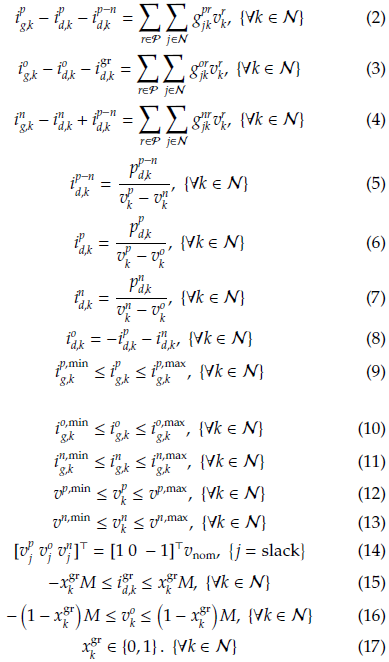
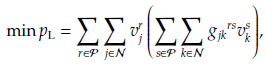
The problem of efficiently selecting the best nodes to implement a solid grounding strategy for the neutral wire to minimize the total grid power losses can be formulated as a mixed-integer nonlinear programming (MINLP) model presented below (see equations (1) to (17)).

Set of constraints:
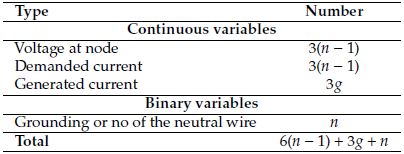
Binary variables in the mathematical model are associated with whether to ground the neutral wire at a particular node. In contrast, continuous variables are related to powers, voltages, and currents. Other nonlinearities are caused by the hyperbolic relation associated with constant power loads defined in terms of voltage and currents.
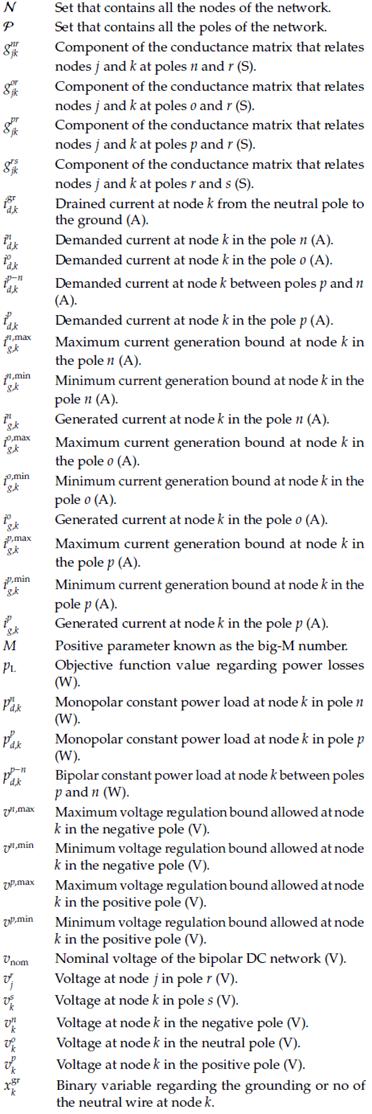
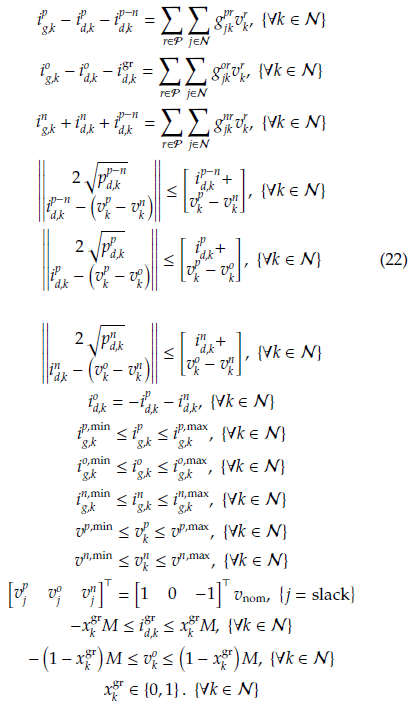
The interpretation of the MINLP model (1)-(17) is the following: Equation (1) presents the objective function, which corresponds to the minimization of total power loss; Equations (2) to (4) are the current balance at each node and pole of the network; These equations come from the application of the first Kirchhoff's law; Equations (5) to (8) define the hyperbolic relation between voltage and powers in each constant power load (monopolar and bipolar users); Box constraints (9)-(11) define the lower and upper bounds of the current generation in the slack generation source; Box constraints (12) and (13) present the voltage regulation condition applicable to the positive and negative poles; Equation (14) defines the assigned voltage to the slack node as equal to the grid operative voltage; inequality constraint (15) represents the upper and lower bounds applicable to the current flow from the neutral wire to the electrical ground; box constraint (16) defines the minimum and maximum bounds for the neutral wire as a function of its grounding possibility; finally, constraint (17) confirm the binary nature of the decision variable regarding the neutral wire grounding.
Some characteristics of the MINLP model (1)-(17) are the following: (i) most of the equalities and inequalities are from the family of mixed-integer convex optimization problems, i.e., a total of 14 equations of 17 are convex; which implies that the only set of non-convex equations is the hyperbolic relations between voltages and powers defined from (5) to (7); and (ii) for each combination of binary variables regarding the neutral grounding or no (i.e., xk gr), the optimization problem (1)-(17) is reduced to classical power flow problem for bipolar DC networks with unbalanced loads.
The characteristics mentioned above show that if the set of Equations (5) to (7) are convexified. The complete optimization model (1)-(17) will transform an MINLP model into a mixed-integer quadratic programming (MIQP) model. The main advantage of using a MIQP model is that combining the Branch and Cut is possible. The interior point method to reach the optimal global solution of the relaxed model coincides with the solution of the exact MINLP formulation.
3 An MIQP formulation
Model (1)-(17) can be transformed into a mixed-integer convex optimization problem by using relaxations on the non-convex constraints. In particular, by relaxing the equality constraints related to the constant power consumptions in all the poles of the network, i.e., Equations (5) to (7). The main characteristic of these equations is their hyperbolic structure, which can be analyzed using conic models as given below [18], [19].
3.1 Conic reformulation of the demanded currents
To obtain a convex equivalent for each one of the hyperbolic constraints (5) to (7), let us consider a generic hyperbolic function with the structure defined in (18).

where α is a positive parameter, l is a positive variable, and v - ω is positive. Equation (18) can be represented as follows:

which corresponds to the hyperbolic representation of the product of two variables. In addition, Equation(19) canbe represented as a l2-norm, as defined in (20).
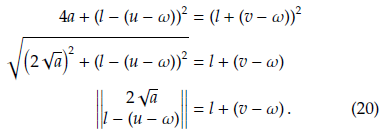
Observe in (20) that it is a conic constraint, but it is not convex due to the equality condition. However, as recommended by authors of [18], it can be relaxed as a convex cone if the equal condition is relaxed as a lower equal condition as follows.

Now, with the relaxed equivalent in (21), it is possible to rewrite the MINLP model (1)-(17) as a MIQC model, with the structure presented in (22). However, it is essential to highlight that in the case of the hyperbolic relation between the monopolar load connected in the negative pole with respect to the ground, the signs of i n d , k and V n k - V 0 k are modified since both are negatives.

3.2 Numerical example
To illustrate the effect of the optimal grounding of the neutral wire in some specific nodes to reduce the expected grid power losses, let us consider a small numerical example composed for a low-voltage grid operated with ±220 V in the slack source with the structure presented in Figure 3.
For this test system, the possibility of solidly grounding each demand node exists. Note that there are three demand nodes, so the number of possible grounding combinations is 23 = 8. Table 2 presents all the possible solutions for this 4-node test system.
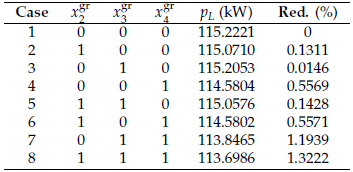
Numerical results in Table 2 show that: (i) the first and last simulation cases correspond to the operation of the distribution grid considering the neutral floating and the solidly grounded operative cases in all the nodes of the network, which, as expected, when the neutral wire is floating in all the nodes, the peak power losses are higher (115.2221 W); whereas, when all the nodes are solidly grounded, these are the minimum expected power losses with a value of 113.6986 W; (ii) when only one node can be solidly grounded (cases 2 to 4), it is observed that the best node for implementing the grounding strategy corresponds to Node 4, which reduces the expected power loss about 0.5569 % with respect to the neutral wire floating (i.e., case 1); and (iii) when two nodes are candidates for grounding strategy, Nodes 3 and 4 are the best options, since this solution reaches a reduction of about 1.1939% being at least two times better than the combination of nodes 2 and 4, and eight times better than the combination of Nodes 2 and 3, respectively.
Note that all the numerical validations of the proposed example were verified with the MATLAB/Simulink environment through the implementation of the circuit in Figure 3 in the Simscape simulation tool. In addition, the first and last simulation cases were verified by applying the successive approximation power flow method for unbalanced bipolar DC networks presented by authors of [11].
4 Test feeders
The validation of the proposed optimization model to select the set of nodes where the neutral wire must be solidly grounded is made in three test feeders composed of 21, 33, and 85 nodes. These systems were recently reported by authors of [6] to solve the optimal power flow problem in bipolar DC networks via convex optimization. The nodal connections in three test feeders are depicted in Figure 4. The complete branch and load parameters information can be consulted in [11] and [6], respectively. The power losses with only neutral grounding at the slack node are 95.4237 kW, 344.4797 kW, and 489.5759 kW, respectively.
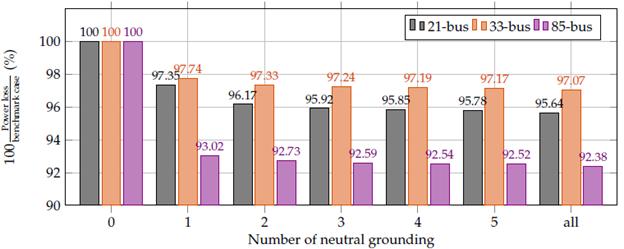
Figure 5 illustrates the power loss in three test systems as the number of grounded nodes increases from 0 to 5 nodes. Additionally, the case that all nodes are grounded is also shown.
In Figure 5, it can be observed that power losses in the three test systems are not reduced significantly after the third neutral grounding. This shows that connecting more than three neutral grounds does not considerably improve the power losses in the three test systems. This is supported by analyzing that the power loss reduction is imperceptible from three neutral grounding since in the interval between 3 to all neutral nodes grounded, the power losses are just reduced by 0.29%, 0.17%, and 0.22% for the 21-, 33-, and 85-bus test systems, respectively.
Table 3 lists the selected nodes by the proposed optimization model to be grounded.
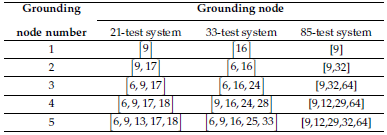
According to the results shown in Table 3, it can note that in three test systems, the same always appears node, which indicates that this node is more sensitive to reduce the power loss in the test system.
5 Conclusions
The problem of the optimal grounding of the neutral wire in bipolar DC networks with asymmetric loading was addressed in this research by reformulating the exact MINLP model as a MIQC approximation. A conic representation of the product of three variables was used for relaxing the hyperbolic relation between voltage and powers in the constant power terminals. Numerical results in the 21-, 33-, and 85-bus grids showed that with about 5 nodes solidly grounded, the expected power losses are reduced until 4.22%, 2.83% and 7.48%, which are pretty near to the ideal solution (all the nodes solidly grounded), which are 4.36%, 2.93% and 7.62%. These results confirmed that the adequate selection of the nodes where the solid grounding strategy must be implemented could significantly reduce the expected grid power loss with minimum investment costs.
For future works, it will be possible to conduct the following works: (i) to obtain a relaxed model via Taylor series expansion to define the set of nodes for optimal neutral grounding combined with the optimal load redistribution problem, and (ii) to extend the proposed convexification method to bipolar DC networks with a high presence of distributed energy resources.
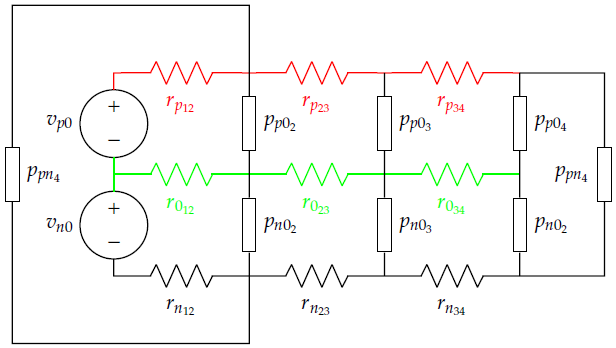
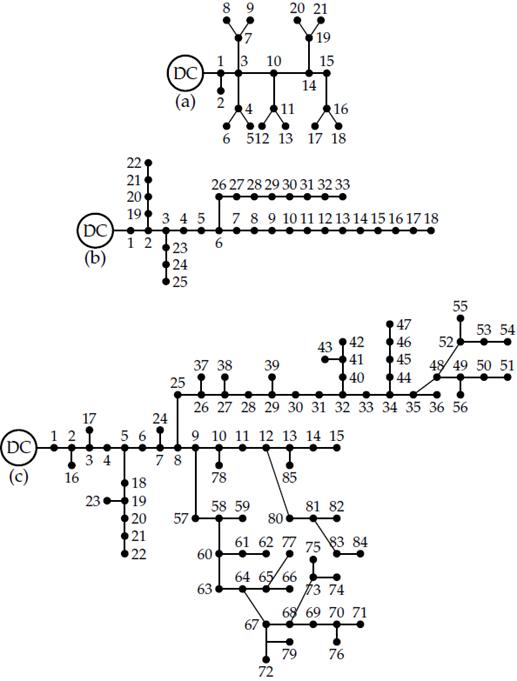
Figure 4: Single-line diagrams of the bipolar DC networks: (a) 21-bus grid, (b) 33-bus grid, and (c) 85-bus grid.