




 English (pdf)
 Article in xml format
 Article references
 Automatic translation
 Send this article by e-mail
 Cited by SciELO
  Cited by Google
  Similars in
SciELO
Similars in
SciELO  Similars in Google
 Permalink

1 Introduction
Remote sensing involves the observation of the Earth's surface from space or air and can be defined as a technology that enables the measurement and analysis of objects or phenomena without direct contact with them, utilizing the detection of electromagnetic radiation reflected or emitted by objects, which is captured by sensors that may be located on platforms such as satellites, drones, or aircraft [1, 2, 3, 4]. Compared to traditional methods, remote sensing offers advantages such as temporal efficiency, cost-effectiveness, and the ability to collect data beyond the visual range [5].
One of the most widely used remote sensing methods is hyperspectral imaging, which integrates spectroscopy into conventional images to obtain three-dimensional data known as "datacubes," incorporating two spatial dimensions (x, y) and one spectral dimension (λ) [6, 7, 8]. In this way, each pixel in the datacube includes a complete spectrum that represents the absorption and scattering properties of light in the sampled spatial area [7, 9]. In this sense, given that each material has a representative spectral signature, this signature enables the classification of different types of land cover materials, such as vegetation, rocks, water bodies, and artificial structures, even when they appear visually similar [10,11].
Several studies have been conducted for the detection of asbestos-cement in hyperspectral images. Thus, in [12,13,14], hyperspectral images in the shortwave infrared (SWIR: 10002500 nm) range have been used for the detection and classification of asbestos minerals, such as amosite, crocidolite, and chrysotile, where these identifications are based on the unique spectral signatures of each mineral, which are related to hydroxyl absorption bands. On the other hand, in [14,15], hyperspectral images have been used to identify asbestos-containing materials in construction and demolition waste, enabling the separation of non-hazardous materials through multivariate analysis methods such as principal component analysis and partial least squares discriminant analysis. Likewise, in [16], hyperspectral images have been utilized in asbestos mine restoration projects to assess the distribution of this material before and after remediation, demonstrating high accuracy in detecting treated and untreated areas.
Now, regarding the challenges of hyperspectral images, it is important to mention that they contain a large amount of data due to their high dimensionality, which complicates data processing and analysis due to redundancy in the spectral band information [17,18]. For this reason, in the domain of hyperspectral imaging, it is necessary to employ computationally efficient processing and analysis techniques [19, 20]. Likewise, it is important to highlight that traditional algorithms for analyzing these images are often computationally intensive, which limits their applicability for real-time analysis and in systems with limited resources [21, 22]. Given these challenges, it is essential to develop methods that are computationally efficient while providing results as effective as those of traditional methods for material detection in hyperspectral images.
In this article, a new computational method is proposed as a contribution for the detection of asbestos-cement in hyperspectral images, based on the binarization of the spectral signature of this material and the application of the normalized Hamming distance between the binarized signature and the binarized signatures of the other pixels. It is worth mentioning that, for the binarization process, the binarization threshold that allows the best differentiation was determined by evaluating the method with different thresholds on a sample of spectral signatures of asbestos and other materials. Based on the optimal binarization threshold determined, a case study was developed in which the proposed method was applied to a hyperspectral image of the Manga neighborhood in the city of Cartagena de Indias, aiming to identify asbestos-cement areas and quantify their corresponding percentage within the image. This is particularly useful for governmental authorities in formulating asbestos mitigation strategies, considering the implications for respiratory diseases among individuals exposed to this material [31, 32, 33]. Similarly, the proposed method was evaluated in terms of effectiveness and computational efficiency compared to the correlation method, which is one of the most widely used approaches for material detection in the context of hyperspectral imaging [23, 24]. For the implementation of the method, advantages provided by open-source technologies within the Python programming language were leveraged, including the spectral library for accessing and managing hyperspectral data, as well as the numpy library for implementing binarization and the Hamming distance. In this sense, the proposed method is accessible for replication or extrapolation in the detection of asbestos-cement and other materials in the domain of hyperspectral imaging [25, 26, 27].
The present study contributes significantly on two key fronts. First, from a public health perspective, early detection of asbestos-containing materials is crucial to mitigate the risks associated with prolonged exposure. Accurate identification of asbestos-cement coverings in urban environments allows for more effective monitoring and remediation strategies, contributing to environmental and health policy decisions. Thus, from the computational point of view, this work introduces an innovative methodology based on spectral signature binarization and Hamming distance comparison. This approach allows the detection of the material using a significantly reduced amount of information with respect to the original spectral signature, which represents an advantage in terms of computational efficiency and handling of the high dimensionality inherent to hyperspectral images.
The remainder of the article is organized as follows: Section 2 presents the methodological phases employed for the development of this research. Section 3 describes the obtained results, which include the determination of binarized signals of the asbestos spectral signature based on different thresholds associated with the mean and various statistical quantiles; the evaluation of the different binarized signals using sample spectral signatures of asbestos and other materials to determine the optimal quantile that allows the creation of the binarized signal with the best detection capability; the implementation of the method on the reference hyperspectral image corresponding to the Manga neighborhood in the city of Cartagena; and the evaluation of the effectiveness and efficiency of the proposed method compared to the correlation method. Finally, Section 4 presents the conclusions and future work derived from this research.
2 Materials and methods
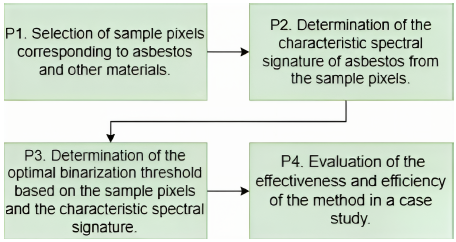
For the development of this research, four methodological phases were defined (see Figure 1): P1. Selection of sample pixels corresponding to asbestos and other materials, P2. Determination of the characteristic spectral signature of asbestos from the sample pixels, P3. Determination of the optimal binarization threshold based on the sample pixels and the characteristic spectral signature, and P4. Evaluation of the effectiveness and efficiency of the method in a case study.
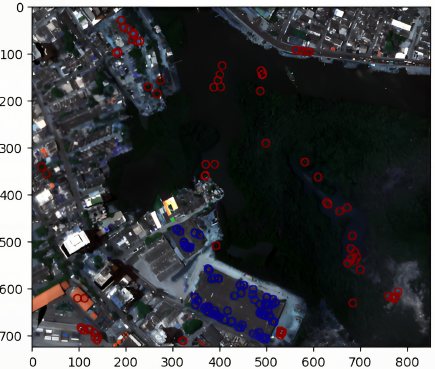
In Phase 1 of the methodology, a set of 75 asbestos pixels and 75 pixels of other materials were selected through visual inspection from the RGB representation of a hyperspectral image of 725x850 pixels, each containing a total of 380 reflectance bands. In this way, in Figure 2, it is possible to observe the RGB representation of the hyperspectral image of the Manga neighborhood in the city of Cartagena, where the 75 sample pixels of asbestos-cement are highlighted in blue, and the 75 sample pixels of other materials are highlighted in red.
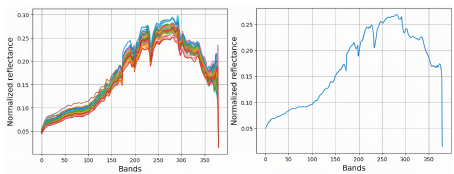
In this same sense, in Phase 2 of the methodology, the characteristic pixel of asbestos-cement was determined by computing the mean of the 380 bands from the asbestos sample pixels selected in Phase 1. Thus, in Figure 3, the spectral signature of the asbestos-cement sample pixels is presented along with the average pixel, or characteristic pixel, obtained.
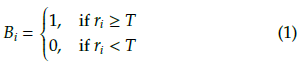
Similarly, in Phase 3 of the methodology, different binarization thresholds were evaluated using the asbestos and non-asbestos sample pixels to determine the threshold that provides the best differentiation of asbestos-cement pixels. For threshold variation, the values associated with the 100 percentage quantiles of the spectral signature were considered. Thus, for each threshold value, the binarized signature of the average pixel was obtained, and the similarity percentage was calculated based on the normalized Hamming distance between this signature and the binarized signatures of each of the 150 sample pixels of asbestos and other materials, aiming to determine the maximum difference between the minimum similarity percentage with asbestos pixels and the maximum similarity percentage with pixels of other materials. In this sense, for the calculation of the binarized signature of the average pixel and other pixels, Equation (1) was used, where the filter with threshold T is applied to the normalized reflectance array of 380 positions R = [r1, r2,..., r380], yielding the binarized array Bi as the result.
Similarly, to obtain the similarity between the binarized array corresponding to the average pixel and the binarized arrays of the other pixels, Equation (2) was used, which represents the normalized Hamming distance between two binarized arrays, A and B. It is worth mentioning that, in this case, n corresponds to the total number of bands in the hyperspectral image.

On the other hand, in Phase 4 of the methodology, a case study was conducted using the hyperspectral image corresponding to the Manga neighborhood in the city of Cartagena. The proposed method was applied to the entire image, and the percentage of asbestos-cement within the image was obtained. This percentage was compared to the percentage of asbestos-cement detected in the same image using the correlation method, which has been widely used for material detection in hyperspectral images. Finally, within this phase, a 20x20 pixel region of the image, containing 380 bands, was selected for the execution of both the proposed method and the correlation method at 25, 50, 75, and 100 repetitions to determine the average execution time and the total average time for each method. In this way, based on the total average time of each method, the relative computational efficiency of the proposed method was determined.
3 Results and discussion
At the results level, the first step was to obtain the binarized spectral signature of the average asbestos pixel, using the median value of the spectral signature as the threshold (threshold = 0.171). In this way, Figure 4 presents the binarized spectral signature of asbestos-cement based on the mentioned threshold.
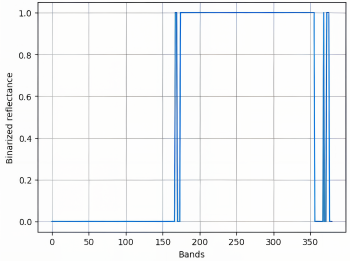
In this way, in Figure 4, it can be observed how the binarized spectral signature of asbestos oscillates between 0 and 1 across different bands. Initially, the signal remains at 0 in the first bands, indicating low reflectance in those wavelengths. Subsequently, around band 150, the signal abruptly shifts to 1, maintaining this value until approximately band 320, suggesting a high reflectance range. Finally, in the last bands, the signal exhibits fluctuations between 0 and 1, reflecting variations in the absorption and scattering properties of the material in those spectral regions.
Using the binarized spectral signature of asbestos-cement presented in Figure 4, the similarity was calculated based on the normalized Hamming distance between this signature and the signatures of the 75 asbestos pixels and the 75 pixels of other materials, obtaining the minimum and maximum normalized distances for each group of pixels, as shown in Figure 5.
From Figure 5, it is possible to observe that the maximum percentage-normalized Hamming distance with non-asbestos pixels (99.947%) exceeds the minimum normalized distance with asbestos pixels (99.908%), indicating the presence of overlap. Consequently, the threshold value set at the median does not allow the method based on the binarization of the asbestos spectral signature and the Hamming distance to effectively differentiate asbestos pixels from pixels of other materials.
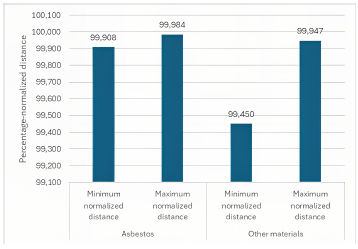
Figure 5: Evaluation of the method with asbestos and nonasbestos pixels with threshold at the median.
Taking this into account, the previous procedure was repeated by iterating through different thresholds, using as thresholds those corresponding to each of the 100 quantiles of the characteristic spectral signature or average pixel of asbestos-cement. In this way, Figure 6 presents only the quantiles that, through their thresholds and binarized signatures, achieved a positive difference between the minimum percentage-normalized Hamming distance with asbestos pixels and the maximum percentage-normalized Hamming distance with pixels of other materials.
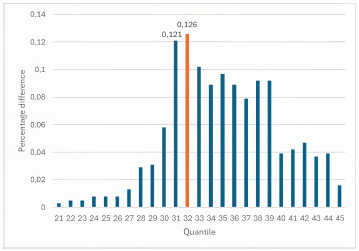
According to the results presented in Figure 6, it can be observed that the greatest differences between the minimum percentage-normalized Hamming distance with asbestos pixels and the maximum percentage-normalized Hamming distance with pixels of other materials are obtained in the 31st and 32nd quantiles of the spectral signature, both exceeding a difference of 0.12. The 32nd quantile exhibits the highest difference, with a value of 0.126 and a threshold value of 0.115.
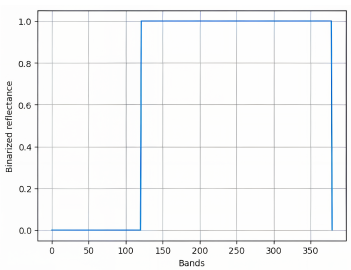
Thus, this threshold value resulted in a minimum Hamming percentage distance for detection of 99.939%, which was used for the implementation of the method on the complete reference image. In this way, the binarized spectral signature of the average or characteristic pixel of asbestos-cement, corresponding to the optimal threshold (0.115), is presented in Figure 7.
According to Figure 7, the binarized pixel of asbestos-cement transitions from 0 to 1 between band 100 and band 150, before returning to 0 after band 350. This behavior indicates a high reflectance range in the spectral region between these bands, suggesting a strong response at these wavelengths. The stability of the signal at 1 within this interval highlights the material's coherence in terms of its spectral properties, while the return to 0 after band 350 suggests a decrease in reflectance in those spectral regions.
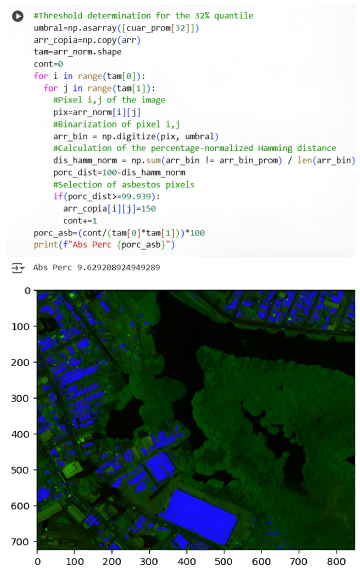
Based on the binarized signature from Figure 7 and the minimum detection percentage obtained with this signature, the proposed method was applied to the complete reference image of the Manga neighborhood in the city of Cartagena. As shown in Figure 8, this implementation utilized the spectral and numpy libraries, with the detected asbestos-cement areas highlighted in blue.
It can be observed in Figure 8 that the digitize method from the numpy library was used to obtain the binarized spectral signature of both the average pixel and each pixel in the image. Likewise, array operations in numpy enabled the implementation of the normalized Hamming distance between the binarized spectral signatures of the average pixel and each pixel in the image. Similarly, it is worth mentioning that as a result of applying the proposed method to the complete hyperspectral image, it was determined that 9.63% of the pixels correspond to asbestos pixels. This percentage, along with the detected areas in the case study image, is highly useful for formulating strategic decisions by governmental authorities regarding the mitigation of asbestos-cement, considering the significant public health implications of this material.
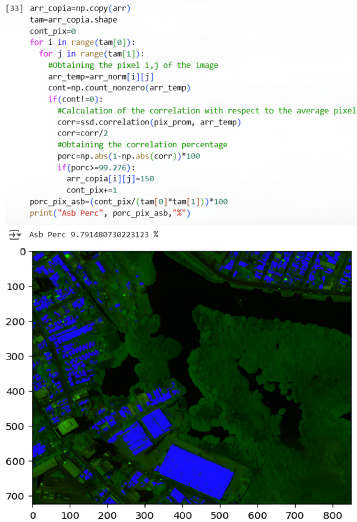
In order to evaluate the effectiveness of the proposed method compared to the correlation method, which has been widely used for material detection in hyperspectral images, the implementation of this method was carried out primarily using the spectral, scipy, and numpy libraries, as shown in Figure 9.
Based on the results obtained in Figure 9, it can be observed that the correlation method identified 9.79% of the pixels in the case study image as asbestos-cement. Compared to the proposed method, the correlation method detected only 0.16% more asbestos pixels, allowing us to conclude that the proposed method is as effective as the correlation method. In the same sense, to evaluate the computational efficiency of the proposed method relative to the correlation method, a 20x20 pixel region was selected, with each pixel containing 380 reflectance bands, and both methods were executed on this region for 25, 50, 75, and 100 repetitions. The processing times for each method are presented in Figure 10. It is worth mentioning that these results were obtained using Python's timeit library, which allows for measuring the processing time of a method across different executions.
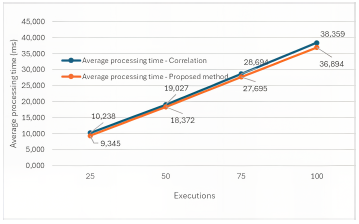
According to the results presented in Figure 10, it can be observed that across all four execution groups, the correlation method exhibits slightly higher processing times compared to the proposed method. Consequently, when computing the overall average across different executions, it is determined that the correlation method is 1.05 times slower than the proposed method, meaning that the proposed method is 4.92% more efficient than the correlation method.
As a discussion, it is important to highlight that this article proposed a method for the detection of asbestos-cement in hyperspectral images as a contribution, utilizing the Hamming distance to compare the binarized spectral signature of asbestos with the binarized spectral signatures of other pixels. The results showed that this method is as effective as the correlation method while being 4.92% more efficient. Thus, this method emerges as a viable and competitive alternative for use in studies where the correlation method has been employed for material detection in hyperspectral images [23]. On the other hand, given the computational efficiency achieved by the proposed method, it also presents itself as a suitable option for asbestos detection in hyperspectral images compared to machine learning-based methods for detecting this material [14,15]. Finally, since the implementation of the proposed method relied on open-source tools for both accessing the spectral information of the image and implementing and evaluating the method, this research is accessible for replication and extrapolation by universities and research centers for the detection of asbestos and other materials in hyperspectral images. This makes it a competitive alternative to proprietary tools currently used for material detection in remote sensing [28, 29, 30].
4 Conclusions and future work
Given the need for efficient methods for material detection in hyperspectral images, this article proposed a new method for asbestos detection in hyperspectral images as a contribution, utilizing the Hamming distance to compare the binarized spectral signatures of the average asbestos pixel with those of the other pixels in the image. Considering that the proposed method proved to be as effective as the correlation method and slightly more efficient, it can be considered for integration into environmental monitoring systems based on hyperspectral images, given the necessity in these contexts to efficiently process large-volume images. To obtain the binarized spectral signature of asbestos-cement, the first step was to determine the conversion threshold, revealing that the threshold associated with the median exhibited overlap in distinguishing asbestos pixels from pixels of other materials. In this sense, by evaluating different thresholds associated with various quantiles of the spectral signature, it was determined that the 32% quantile allows for the maximum differentiation, enabling the detection of 9.63% of asbestos pixels in the implementation of the method. In this regard, depending on the type of material, it is essential to first identify the threshold that optimally enables the detection of each material.
The results obtained in this study highlight two main contributions. First, the development of an efficient computational method for the detection of asbestos-cement coverings in hyperspectral images, based on the binarization of spectral signatures and Hamming distance. This approach allows reducing the dimensionality problem while maintaining an effective detection capability, which may favor the implementation of faster and scalable solutions in environmental monitoring systems. On the other hand, the application of this method has a direct impact on public health, as it provides a useful tool for the identification of potentially hazardous materials in urban environments. Its implementation in remote sensing studies and government initiatives can facilitate the planning of asbestos mitigation and removal strategies in existing structures.
Considering that the case study developed in this article allowed the proposed method to determine that the hyperspectral image of the Manga neighborhood in the city of Cartagena contains 9.63% asbestos pixels, with a 0.16% difference compared to the correlation method, this method demonstrates similar effectiveness. Consequently, it can be considered valid for integration and hybridization in material detection systems based on spectral images.
From a computational perspective, the proposed method was evaluated alongside the correlation method through 25, 50, 75, and 100 repetitions on a 20x20 pixel region of the reference image, with each pixel containing 380 bands. The results showed that the correlation method is 1.05 times slower than the proposed method, meaning that the proposed method is 4.92% more efficient than the correlation method. This finding suggests that the proposed method can be considered for remote sensing applications where it is necessary to process large-scale hyperspectral images, enabling the generation of results in a shorter time compared to more sophisticated methods.
This research demonstrated the relevance of using open-source tools for the processing and analysis of asbestos in hyperspectral images. In this way, the spectral library proved to be suitable for accessing the reflectance data of different pixels in the image, retrieving these data as numpy arrays. In turn, the numpy library was primarily useful for binarizing spectral signatures and implementing the normalized Hamming distance. Likewise, the scipy library facilitated the implementation of the correlation method, which was used to validate the computational efficiency of the proposed method. Furthermore, the matplotlib library enabled the generation of graphical representations of both conventional and binarized asbestos spectral signatures. In the same sense, the timeit library allowed for measuring the execution times of the methods under multiple repetitions. Thus, based on the libraries used, this work is intended to be replicable, scalable, and adaptable for the detection of different materials in hyperspectral images, serving as a competitive alternative to proprietary hyperspectral image processing tools.
Finally, as a future research direction derived from this study, the effectiveness and efficiency of discretizing the spectral signature of asbestos-cement into more than two levels will be evaluated. Likewise, this method is intended to be extended for the detection of other materials of interest in the environmental domain, allowing for the assessment of its feasibility in the detection of vegetation and water bodies.

