
SciELO - Scientific Electronic Library Online

 
vol.31 issue2Suffering in patients with fibromyalgia and its relationship with impact on quality of life, loneliness, emotional state, and vital stressSARS-CoV-2 and post-COVID-19 syndrome in paediatric rheumatology: A scoping review author indexsubject indexarticles search
Home Pagealphabetic serial listing  

Services on Demand

Journal

Article

Indicators

Related links

  • On index processCited by Google
  • Have no similar articlesSimilars in SciELO
  • On index processSimilars in Google

Share


Revista Colombiana de Reumatología

Print version ISSN 0121-8123

Rev.Colomb.Reumatol. vol.31 no.2 Bogotá Apr./June 2024  Epub July 22, 2025

https://doi.org/10.1016/j.rcreue.2023.02.001 

Consensus statement

Clinical practice guidelines for the early detection, diagnosis, treatment, and follow-up of patients with rheumatoid arthritis. Colombian Association of Rheumatology, 2022

Carlos Enrique Toro-Gutiérrez a   *  

Álvaro Arheláez-Cortés b  

Andrés R. Fernández-Aldana c  

Rossana A. Mejía-Romero d  

Paul Méndez Patarroyo e  

Gerardo Quintana L. f  

Oscar O. Ruiz-Santacruz g  

Pedro Santos-Moreno h  

Daniel G. Fernández-Ávila i  

a Centro de Referencia en Osteoporosis, Reumatología & Dermatología, Pontificia Universidad Javeriana, Cali, Colombia, Grupo de Estudio de Artritis Reumatoide, Asociación Colombiana de Reumatología, Bogotá, Colombia

b Clínica Imbanaco, Grupo Quirónsalud, Cali, Colombia, Grupo Interinstitucional de Medicina Interna (GIMI1), Universidad Libre, Cali, Colombia

cCoordinación Médica, Inmunar, Ibagué, Colombia

dPrograma de Artritis Reumatoide CAYRE IPS, CIREEM IPS, Bogotá, Colombia, Grupo Keralty, Bogotá, Colombia

eGrupo Reumavance, Sección de Reumatología, Departamento de Medicina Interna, Hospital Universitario Fundación Santa Fé de Bogotá, Bogotá, Colombia, Departamento de Medicina Interna, Facultad de Medicina, Universidad de Los Andes, Bogotá, Colombia

fGrupo de Reumavance, Sección de Reumatología, Departamento de Medicina Interna, Hospital Universitario Fundación Santa Fé de Bogotá, Bogotá, Colombia, Departamento de Medicina Interna, Facultad de Medicina, Universidad Nacional de Colombia, Bogotá, Colombia, Departamento de Medicina Interna, Facultad de Medicina, Universidad de Los Andes, Bogotá, Colombia

g Programa Artritis Reumatoide Sanitas EPS-Grupo Keralty, Riesgo de Fractura CAYRE IPS, Bogotá, Colombia

h Dirección Científica, Biomab IPS, Bogotá, Colombia

i Unidad de Reumatología, Pontificia Universidad Javeriana-Hospital Universitario San Ignacio, Bogotá, Colombia


ABSTRACT

Clinical practice guideline 2022 for the early detection, diagnosis, treatment, and follow-up of patients with rheumatoid arthritis developed by the rheumatoid arthritis study group of the Colombian Association of Rheumatology. Rheumatoid arthritis (RA) is the most common autoimmune disease in adults. Worldwide, RA has a prevalence of 0.5%-1%, with an age-standardised prevalence rate of 246.6 per 100,000 population, being more common in women than in men and with peak presentation between the ages of 60 and 64 years. The disease is characterised by joint pain and inflammation and in some cases can cause extraarticular manifestations such as dry syndrome, vasculitis, pericarditis, pleuritis, scleritis, among others. RA causes great morbidity, impairment of quality of life, severe disability, high direct and indirect costs to health systems, disability, and absenteeism from work.

This guideline was developed for rheumatologists, primary care physicians, specialists in related areas, and other actors in the system with the aim of providing the most relevant information on the early detection of the disease, and its correct diagnosis, treatment, and follow-up.

Keywords: Rheumatoid arthritis; Clinical practice guidelines; Methotrexate

RESUMEN

Guía de práctica clínica 2022 para la detección temprana, el diagnóstico, el tratamiento y el seguimiento de los pacientes con artritis reumatoide (AR) desarrollada por el grupo de estudio de artritis reumatoide de la Asociación Colombiana de Reumatología. La AR es la enfermedad autoinmune más frecuente en adultos. A nivel mundial, la AR tiene una prevalencia de entre el 0,5 y el 1%, con una tasa de prevalencia estandarizada por edad de 246,6 por cada 100.000 habitantes, siendo más frecuente en mujeres que en varones y con un pico de presentación entre los 60 y los 64 anos. Esta enfermedad se caracteriza por dolor e inflamación articular, y en algunos casos puede causar manifestaciones extraarticulares como síndrome seco, vasculitis, pericarditis, pleuritis y escleritis, entre otras. La AR produce gran morbilidad, afectación de la calidad de vida, discapacidad grave, altos costos directos e indirectos para los sistemas de salud, incapacidad y ausentismo laboral. Esta guía ha sido desarrollada para reumatólogos, médicos de atención primaria, especialistas de áreas afines y otros actores del sistema con el objetivo de brindar la información más relevante relacionada con la detección temprana de la enfermedad, así como su correcto diagnóstico, tratamiento y seguimiento.

Palabras clave: Artritis reumatoide Guías práctica clínica; Metotrexato

Background

Rheumatoid arthritis (RA) is the most common autoimmune disease in adults. On a global scale, it has a prevalence of between 0.5 and 1%, with an age-standardized prevalence rate of 246.6 per 100,000 inhabitants; it is more common in females than males, while its peak presentation is between 60 and 64 years.1,2 In Colombia, its estimated prevalence ranges between 0.52 and 1.49%, representing the most common autoimmune disease with inflammatory joint involvement in the country, with a female: male ratio of 4.2:1 and a higher prevalence in the age range of 70-74 years.3,4

This disease is characterized by joint pain and inflammation, and in some cases, it can present extraarticular manifestations such as sicca syndrome, vasculitis, pericarditis, pleuritic, and scleritis, among others. It entails great morbidity, impact on quality of life, severe inability, high direct and indirect costs for health systems, disability, and work absenteeism.5 Patient management includes non-pharmacological and pharmacological interventions to improve quality of life through the reduction of symptoms and the prevention or reduction of joint damage and complications of the disease.6

Scientific evidence has shown that disease progression can be delayed with timely and appropriate treatment. In recent years, new therapeutic strategies have appeared that positively impact patients' quality of life and improve their functionality.5 In this context, the Colombian Association of Rheumatology (ASOREUMA) developed this clinical practice guideline (CPG) to provide evidence-based recommendations regarding early diagnosis, comprehensive treatment (pharmacological and non-pharmacological), and follow-up of adults with a diagnosis or suspected diagnosis of RA, regardless of the time of evolution and the clinical disease status.

This guideline is primarily aimed at all health professionals involved in the care of patients with RA at different levels: general practitioners, specialists, and other health professionals. Likewise, it can constitute a support tool for the different actors in the health system in Colombia, including decision-makers.
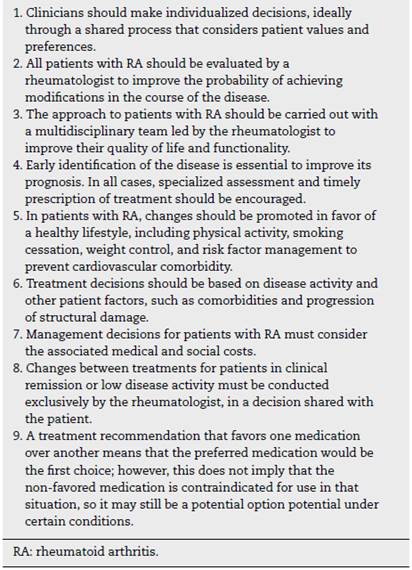
Table 1 General principles in the management of patients with rheumatoid arthritis. 

Methods

The development of this CPG included the participation of clinical experts in rheumatology, patients with RA, and a methodological technical team from the EpiThink consultant (the list of participants and declaration of interests can be checked in Supplementary material 1). The recommendations presented here were constructed following the Grade-Adolopment methodology7 (methodological details are found in Supplementary material 2). In general, the development group formulated the clinical questions and outcomes of interest for the CPG approach (Supplementary material 3), carried out a systematic search for guidelines, and performed a quality assessment using the AGREE II instrument.8 Due to its high quality, adaptability, and convenience, the Clinical Practice Guideline for the Management of Patients with Rheumatoid Arthritis of the Spanish Society of Rheumatology9 was chosen as a source for updating the literature searches.

Once the matching recommendations for each posed question were identified, the original strategies were reproduced in the Medline (via PubMed), Embase (Elsevier), and Cochrane databases. Additionally, the LILACS database was used to include Latin American evidence. To search the literature for questions not posed in the source guideline, strategies were created that combined free and controlled language terms according to the Thesaurus corresponding to each database (the strategies and search results can be consulted in Supplementary material 4). The selection of the identified references was conducted by two reviewers who independently evaluated the documents under the eligibility criteria, initially screening the references by title and abstract, and then reviewing the full text of the potentially relevant articles (see Prisma in Supplementary material 5). A quality assessment was carried out on selected articles and the evidence was summarized in tables following the GRADE methodology (the summary of evidence is found in Supplementary material 6).

Each expert in the development group, constituted of 9 specialists in rheumatology, reviewed the original recommendations of the source guideline, along with the new evidence resulting from the update, and defined at their discretion whether the original recommendation should be adopted or adapted. Subsequently, in multiple discussion sessions, the construction of the recommendations was performed. Finally, in a session with 23 specialists in rheumatology and 2 representatives of patients with RA, the posed questions, the supporting evidence for each topic, and the recommendations formulated for each clinical issue were presented. Panel participants voted on each of the recommendations and discussed the risk-benefit balance, feasibility of implementation, and possible impact on resource use. A preliminary version of the guideline manuscript was reviewed and adjusted by all members of the development group and was subsequently sent for external peer review.

All aspects covered in this guideline are subject to periodic review as warranted by the evolution of medical knowledge, technology, and practice (see the updating process in Supplementary material 2).

Key definitions and general principles

The recommendations presented in this guideline are indicative but do not constitute a rigid guide for the care of patients with RA. Clinicians must make individualized decisions, ideally through a shared process that considers patient values and preferences. Therapeutic decisions may be limited by the realities of a specific clinical setting and resource availability, among others.

Tables 1 and 2 outline the key definitions and general principles applicable to this guideline.
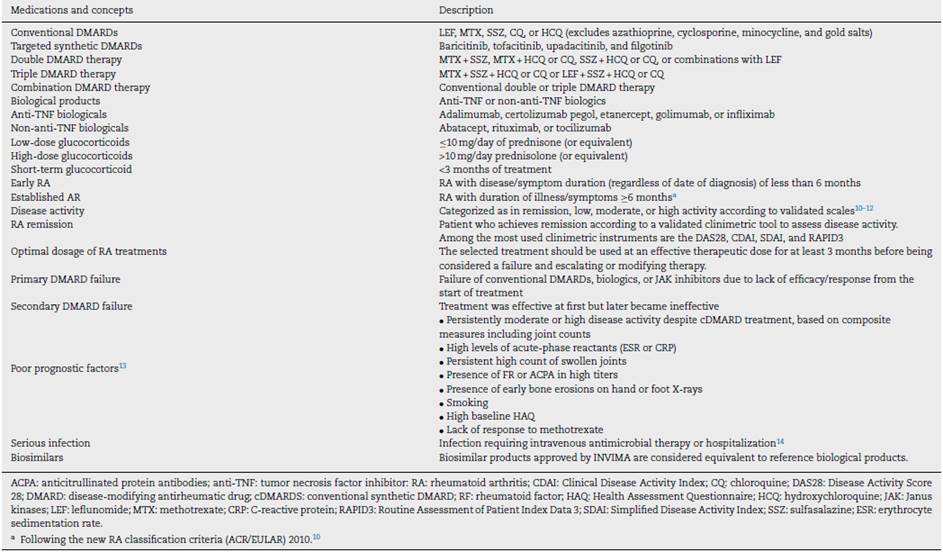
Table 2 Definitions in the context of rheumatoid arthritis. 

Recommendations

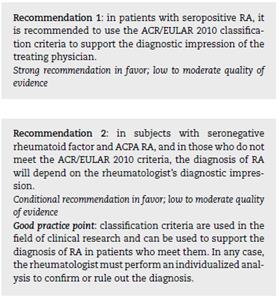
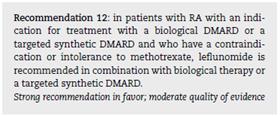
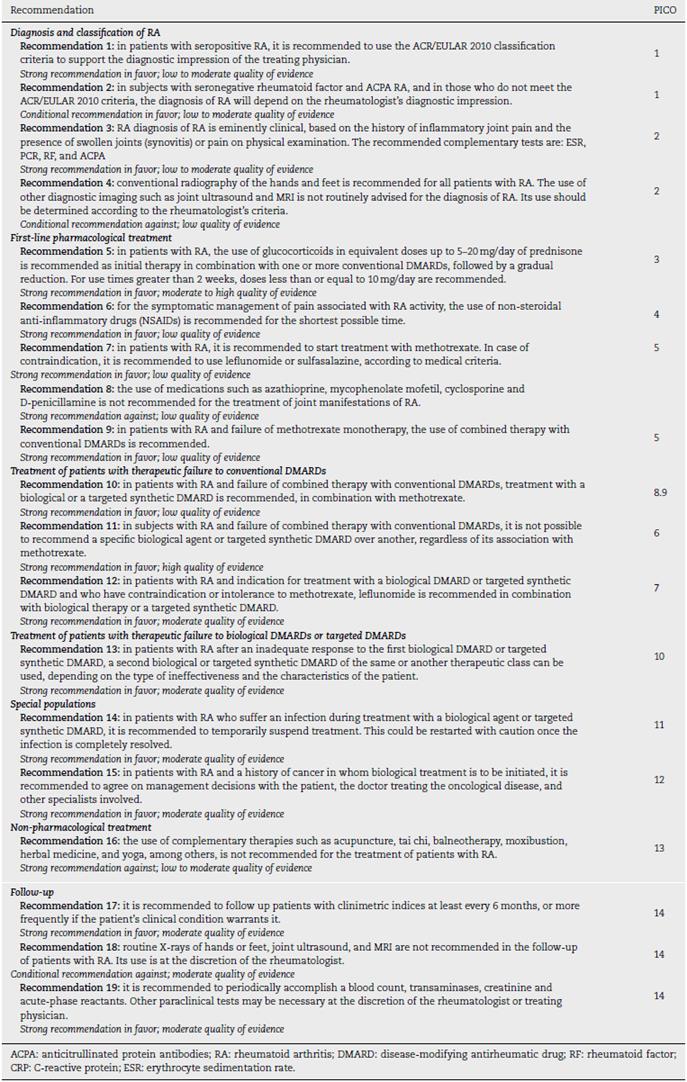
Table 3 and Fig. 1 summarize and outline the recommendations for the early detection, treatment, and follow-up of patients with RA.

Table 3 Recommendations for the detection, treatment, and follow-up of patients with RA in Colombia. 
Diagnosis and classification of Rheumatoid Arthritis

Summary of evidence and panel discussion

The evidence obtained from 16 observational studies15-34 that compared the performance of 1987 against the 2010 criteria for RA classification, in general, agrees that the 2010 criteria applied in individuals with early-onset arthritis are more sensitive, but less specific than the 1987 criteria. However, their sensitivity is greatly reduced in patients with negative RF and ACPA, which can generate false negatives in these patients. In turn, subjects with few swollen joints, but who have a positive RF and a slight elevation of ESR, may be misclassified as RA. Experts note that the use of the 1987 criteria is part of the clinical judgment of the treating physician and that it is possible that there are individuals with established disease who meet the 1987 criteria and not those of 2010, so their use should not be ruled out in certain clinical situations.

Summary of evidence and panel discussion

Five observational studies35-39 were identified that assessed the performance of ACPA and RF for the diagnosis of RA. In general, the evidence supports the use of RF and ACPA together and associates the presence of high ACPA titers with a worse prognosis. The expert panel considers that laboratory tests are complementary to the physical examination. Currently, the use of RF and ACPA accompanied by imaging studies is supported in cases where it is considered pertinent. However, these studies are not mandatory and should not delay diagnosis or the start of treatment.40,41 Nevertheless, it is important to keep in mind that patients who present typical RA lesions on diagnostic images, such as bone erosions, structural involvement, or characteristic extraarticular manifestations, can be directly diagnosed as RA.42
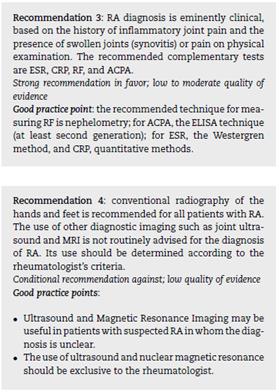
Regarding the use of diagnostic images, five studies43-47 were identified that evaluated the performance of joint ultrasound and nuclear magnetic resonance in RA diagnosis. About joint ultrasound, although it is useful for the detection of subclinical inflammation, no differences were identified concerning conventional radiography for bone erosion detection.
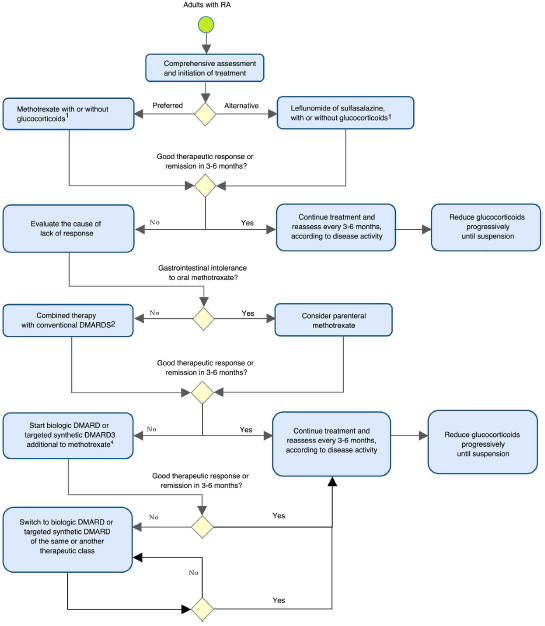
1Glucocorticoids should be used at the lowest possible dose and discontinued as soon as possible.

2 Leflunomide or sulfasalazine.

3It is recommended to carry out an appropriate assessment of cardiovascular risk, infection, and malignancy in patients.

4In case of contraindication or intolerance to methotrexate, consider the use of leflunomide.

Note: the evaluation of the patient with RA should include non-pharmacological considerations regarding therapeutic adherence, education and self-care, physical therapy, and rehabilitation, among others.

Fig. 1 Algorithm for the prevention, evaluation, and management of rheumatoid arthritis in adults. DMARD: disease-modifying antirheumatic drug. 

Although some studies have reported that the use of joint ultrasound is related to earlier diagnosis and initiation of DMARDs, studies are not conclusive on this topic, and, in general, the quality of the evidence is low. The panel of experts considers that, in our setting, the use of ultrasound is limited by the low availability of trained personnel to perform this technique, in addition to being an operator-dependent study.

Evidence of the usefulness of MRI in the diagnosis of patients with RA comes from a systematic review46 that concludes that synovitis, osteitis, and erosions obtained with 1.5 Tesla MRI images are valid and useful to evaluate inflammation and joint damage for RA of the wrist/hand. However, this evidence comes from studies with high heterogeneity. Due to the quality of the evidence and the possible usefulness of this diagnostic image, experts consider that MRI should only be used in selected cases and at the discretion of the rheumatologist.
First-line pharmacological treatment

Summary of evidence and panel discussion

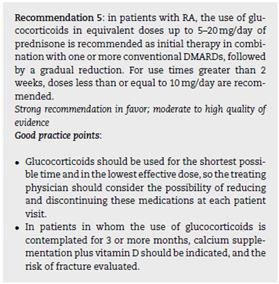
The evidence on the use of glucocorticoids in RA comes from moderate and high-quality clinical trials, in which the interventions are combined with DMARDs in different regimens.48-57 All regimens that combined DMARDs with glucocorticoids were effective in patients with early RA up to 2 years. The use of low doses (<10 mg/day of prednisone or its equivalent) in the initial treatment of RA has been shown to improve the signs, symptoms, and radiological progression of the disease, being associated with fewer side effects than the use of higher doses.48 In all the clinical trials reviewed, a gradual reduction of the initial dose of glucocorticoids is performed with the intention of discontinuing them.49 For more information, consult the ASOREUMA glucocorticoid-induced osteoporosis Clinical Practice Guideline.
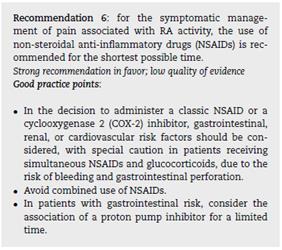
Summary of evidence and panel discussion

The evidence regarding conventional analgesics in RA is scarce and generally comes from low-quality studies, with a small sample size and short duration, with a high risk of bias. The reports evaluate diclofenac and celecoxib in comparison with other analgesic treatments. The reported risk-benefit profile of diclofenac is comparable to that of other analgesic treatments.58 As for celecoxib, it may improve symptoms, relieve pain, and contribute to little or no difference in physical function compared to placebo. The results for short-term serious adverse events and cardiovascular events are uncertain.59 The panelists emphasize the need to assess the benefits and consider the risks in everyone to make therapeutic decisions and monitor those subjects managed with NSAIDs and glucocorticoids or with multiple medications due to the risk of gastrointestinal bleeding. Likewise, emphasis is placed on the rational use of proton pump inhibitors because, although these medications are safe and widely used, they are not free of adverse events.
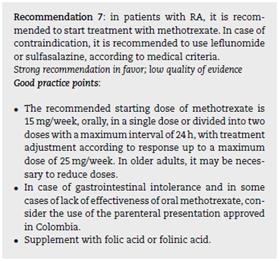
Summary of evidence and panel discussion

Based on moderate to high-quality evidence, significant clinical benefit (improvement in ACR50 response and functionality) of methotrexate (weekly doses between 5 and 25 mg) compared with placebo in short-term treatment (12-52 weeks) of RA patients was found, although its use was associated with a 16% discontinuation rate due to adverse events.60 Regarding the use of leflunomide, a systematic review that evaluated its efficacy and side effects with methotrexate in patients with RA as the first DMARD, reported an odds ratio [OR] of 0.88, with a 95% CI of 0.74-1.06 for the probability of achieving ACR 20 response, with a trend in favor of methotrexate, and a greater reduction in swollen joint count for methotrexate (mean difference = 0.82; 95% CI: 0.24-1.39). No differences were observed in tender joint count, physician global assessment, HAQ-DI, and serum CRP levels.61 The panel considers that the first therapeutic option in a patient with early RA is methotrex-ate. If contraindicated, leflunomide or sulfasalazine can be administered.

Concerning the use of parenteral methotrexate, the evidence comes from a meta-analysis that compared its efficacy with that of oral methotrexate in patients with RA and reported that the parenteral presentation was more likely to achieve a reduction in disease activity than the oral presentation.62 Due to the convenience in the administration of oral methotrexate, experts consider that this drug is of choice for the initiation of treatment in patients with RA; regarding parenteral methotrexate, they highlight that it is an option in cases of gastrointestinal intolerance to oral methotrexate and not necessarily as a prior step to escalating therapy.
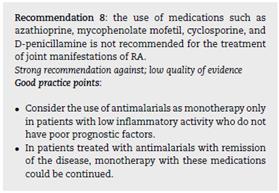
Summary of evidence and panel discussion

Regarding azathioprine, mycophenolate mofetil, cyclosporine, and D-penicillamine, no evidence was identified to demonstrate that they improve disease progression in terms of joint involvement. A systematic review, which aimed to assess the clinical efficacy of hydroxychloroquine in the joints of patients with RA, reported lower efficacy compared to methotrexate or sulfasalazine in monotherapy. Hydroxy-chloroquine, combined with other DMARDs, could increase clinical efficacy.63 The panel of experts considers that, due to its widespread use in Colombia, this medication can be considered in patients with low inflammatory activity who do not have poor prognostic factors, such as high-titer positive RF and ACPA, moderate or high activity at the beginning of the disease, failure of 2 previous conventional DMARDs or early structural damage. Additionally, those RA subjects with low inflammatory activity currently treated with hydrox-ychloroquine and disease control can continue using this medication.
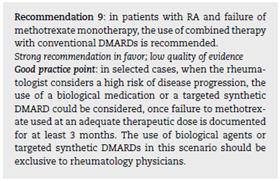
Summary of evidence and panel discussion

The evidence regarding the use of combinations of DMARDs comes from clinical trials,64-66 with low to moderate certainty of the evidence, mainly due to imprecision. The findings suggest improvement in long-term disease activity of combination therapy; however, it is not conclusive regarding functional outcomes and remission, compared with monotherapy with conventional DMARDs. Considering the socioeconomic context and the Colombian health system, the preferred strategy includes combined interventions with conventional DMARDs in different regimens and with an early start within the "window of opportunity".67,68 Only in selected cases, such as in those individuals with intolerance to methotrexate and leflunomide, can the use of a targeted synthetic biologic or DMARD be considered in this scenario.

Treatment of patients with therapeutic failure to conventional DMARDs

Summary of evidence and panel discussion

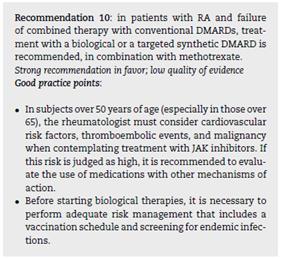
In terms of efficacy and safety, biological DMARDs and targeted synthetic DMARDs have demonstrated clinical benefit in patients with RA, both as monotherapy and in combination with methotrexate. Clinical trials comparing biological DMARDs with placebo in individuals previously treated with conventional DMARDs showed an effective reduction in signs and symptoms, regardless of the mechanism of action (anti-TNF or non-anti-TNF). Regarding JAK inhibitors, tofacitinib has been studied in multiple clinical trials and has demonstrated its effectiveness in monotherapy or combination with placebo in patients with RA without response to conventional DMARDs; baricitinib demonstrated efficacy compared to placebo in patients with a lack of response to conventional DMARDs and early RA as monotherapy or in combination with methotrexate; upadacitinib demonstrated to be effective compared to placebo in patients with RA without prior methotrexate or with lack of response to conventional DMARDs; and filgotinib was shown to be effective in reducing the signs and symptoms of RA in combination with methotrexate and as monotherapy.69

Regarding the safety of JAK inhibitors, a post-marketing study-ORAL Surveillance (ORALSURV)-assessed the safety of tofacitinib compared to anti-TNF therapy in subjects with RA over 50 years of age (especially in those over 65) with cardiovascular risk factors; an incidence rate of malignant neoplasms of 1.13 (95% CI: 0.87-1.14) was observed for individuals treated with tofacitinib at 5 mg/2 times a day, and 1.13 (95% CI: 0.86-1.14) for those treated with tofacitinib at 10 mg twice daily, compared with 0.77 (95% CI: 0.55-1.04) for patients treated with TNF inhibitors (hazard ratio [HR]: 1.48; 95% CI: 1.04-2.09). Based on these results, the United States Food and Drug Administration (FDA) generated an alert that recommends treating physicians evaluate the risks and benefits of the use of JAK inhibitors in patients with RA, especially those with a history of smoking, cancer, and cardiovascular risk.70,71

Experts consider that the choice of treatment with a biological DMARD or a targeted synthetic DMARD is part of the criteria of the rheumatologist, who must perform a risk-benefit balance, especially in patients with cardiovascular risk factors or cancer history.

Summary of evidence and panel discussion

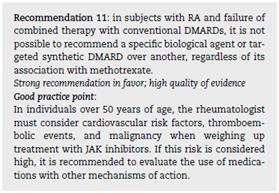
Concerning the superiority of some biological medications over others, high-quality evidence from clinical trials that compared adalimumab vs. abatacept,72-74 rituximab vs. etanercept and adalimumab,75 certolizumab pegol vs. adalimumab,76 etanercept vs. adalimumab,77 sarilumab vs. adalimumab,78,79 and tocilizumab vs. adalimumab,80 is not conclusive, so it is not possible to recommend a certain biological agent over another.

Direct evidence for comparison between JAK inhibitors and anti-TNF revealed no clinically important differences in efficacy.81-83 Indirect evidence, from network meta-analysis, reported similar efficacy of biological DMARDs and JAK inhibitors. The preference of medications may be determined by their safety profile and cost-effectiveness.69
Summary of evidence and panel discussion

The evidence regarding the use of combinations of biological DMARDs with conventional DMARDs other than methotrexate comes from observational studies84-90 with moderate quality. The findings suggest that there are no differences in disease activity, functionality, and adverse events in combinations of leflunomide and anti-TNF compared with methotrexate plus anti-TNF or monotherapy. Leflunomide has demonstrated efficacy and adequate tolerance in clinical trials in patients with RA intolerant to methotrexate.
Treatment of patients with therapeutic failure to biological or targeted DMARDs

Summary of evidence and panel discussion

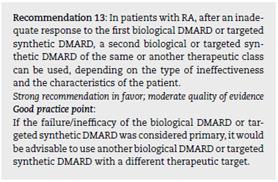
The moderate quality evidence comes from 2 systematic reviews 91,92 that assessed the efficacy of different biological DMARDs and targeted synthetic DMARDs in patients who had presented an inadequate response to the first anti-TNF. Greater efficacy was found for all biologics (anti-TNF and non-anti-TNF) and targeted synthetic DMARDs compared to placebo. There is a trend to observe greater efficacy of non-anti-TNF over anti-TNF after failure to anti-TNF.

About the efficacy of abatacept compared with an anti-TNF or other non-anti-TNF, conflicting results were found concerning the superiority of abatacept in subjects who failed an anti-TNF. No studies were identified that compared biological DMARDs with targeted synthetic DMARDs in the setting of therapeutic failure. With the available evidence, it is not possible to recommend one biological DMARD or targeted synthetic DMARD over another for the treatment of RA patients with anti-TNF failure.

Experts indicate that the cause of therapeutic failure must be evaluated to determine the conduct regarding treatment modification. When choosing treatment in the context of therapeutic failure of a first biological DMARD or targeted DMARD, in addition to efficacy, the safety profile and availability of the medication must be considered.

Likewise, in the case of patients with active disease and intolerance to conventional DMARDs and who require treatment with biological DMARDs or targeted synthetic DMARDs, there is some evidence that may favor the choice of using IL-6 inhibitors or JAK inhibitors in this context, but according to the group developing the CPG, it was not considered conclusive enough to develop a standard recommendation for all patients on monotherapy.

Special populations
Summary of evidence and panel discussion

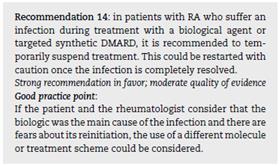
The evidence on restarting treatment in RA patients treated with biological medications is scarce and comes from observational studies14,93-96 with low quality of evidence. In the selected studies, it is reported that the rate of serious infection in patients treated with anti-TNF after a serious infection event is 18% patient/year compared to non-biological DMARDs (21.4% patient/year).14 In these real-life studies, it was observed that, after an infection that required hospitalization in RA patients who were being treated with anti-TNF, most subjects continued with the same anti-TNF and only a minority changed medications. The drugs with the lowest rates of subsequent serious infections are abatacept and etanercept.95 The expert panel agrees that individuals with special conditions such as severe infections should temporarily suspend biological treatment and restart it once the infection resolves. A change in treatment may also be considered if the infection is considered a consequence of the use of the biological agent.
Summary of evidence and panel discussion

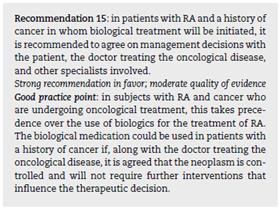
The evidence, of moderate quality, regarding the safety of treatment with biological drugs in patients with RA and cancer comes from cohort studies.97-103 Overall, no significant differences in overall survival were observed between patients who received biological agents and those who did not. However, there is insufficient information concerning other cancer outcomes, such as recurrence and progression, and there is no data to define the influence of each drug on cancer recurrence or survival in populations of patients with advanced cancer. This evidence does not allow us to recommend any specific biological treatment.

In patients undergoing oncological treatment (chemotherapy, radiotherapy, among others), treatment decisions must be taken in conjunction with the doctor treating the underlying oncological disease. To date, there is no evidence to recommend a specific biological treatment in cancer patients. Previously, caution was exercised over using anti-TNF in this population, as it was considered to increase the proliferation of tumor cells; however, this information has been reevaluated.104

Non-pharmacological treatment

Summary of evidence and panel discussion

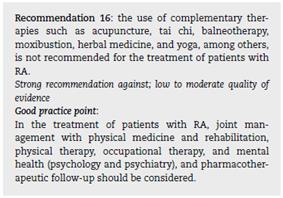
A search for evidence was conducted that included multiple non-pharmacological and non-surgical therapies, including physical activity, diet, acupuncture, tai chi, yoga, moxibustion, balneotherapy, among others.105-110 The only intervention with moderate to high-quality evidence that showed benefits in terms of pain and functionality was physical activity.110 For other non-pharmacological therapies, in general, the evidence is scarce, of low quality, and with inconclusive results.106-109 The panel of experts considers that it is necessary to emphasize the multidisciplinary management of patients with RA, considering not only rehabilitation but also mental health care and monitoring of adherence and drug interactions.
Follow-up

Summary of evidence and panel discussion

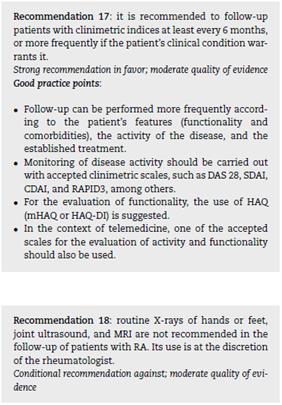
The evidence regarding the parameters for monitoring patients with RA is heterogeneous and of moderate quality, with differences in assessment methods and comparators. Published data indicate that all activity indices that include swollen joints are related to radiographic progression, while of the individual components, only swollen joints and acute-phase reactants are associated with this outcome.111 The expert panel considers that composite activity indices are the optimal tool to monitor disease activity in RA, and the frequency of their application and patient follow-up will depend on patients' characteristics, disease activity, and established therapy, among others, which must also be defined by the treating doctor.
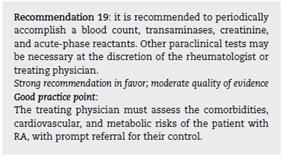
Regarding the use of images for the follow-up of patients with RA, the evidence is scarce and of moderate quality.112,113 Ultrasound and resonance studies can be a useful complement to evaluate the patient's response to treatment; however, the findings require further validation. The panel of experts considers that routine imaging for the follow-up of patients with RA is only necessary in those cases selected by the rheumatologist.

Applicability, dissemination, and implementation

This guideline, produced by the Colombian Association of Rheumatology, aims to guide the decision-making of health professionals in charge of caring for patients with RA in Colombia. The recommendations were constructed considering the socioeconomic context of the country and the structure of the health system, based on the most recent evidence regarding the diagnosis, treatment, and follow-up of RA, with the expertise of a group of rheumatologists from different regions of the country and the perspectives of patient representatives.

After the analysis of the determining factors for the implementation of this guideline, the coverage of the Colombian health system (close to 100%) and the inclusion of most of the medications and paraclinics recommended in this guideline in the health benefits plan were identified as facilitating factors. Resistance to change on the part of health professionals, lack of training of health personnel to care for these patients, absence of availability of laboratory and imaging tests in certain regions of the country, the lack of personnel trained in performing joint ultrasound, the difficulties in accessing specialized assessment (internal medicine and rheumatology), and the absence of educational programs and comprehensive care for patients with RA, were identified as barriers that must be overcome.

Thus, to put this guideline into practice, health personnel must be socialized at all levels of care and together with the corresponding government entities and the entities that administer the benefit plans, and access to specialized assessment for rheumatology must be guaranteed in all regions of the country, which can be developed with structured telemedicine programs. Other actions necessary for the implementation of the guidelines include ensuring access to laboratories, images, and medications throughout the national territory and promoting the creation of educational and comprehensive care programs for patients with RA.

Concerning the potential impact of this guideline on the use of resources, although no economic studies were carried out to determine the cost-effectiveness of each of the interventions in our context, in general, it is considered that they do not lead to the use of additional resources, since, as previously mentioned, the vast majority of the technologies (paraclinical and medications) recommended in this guideline are included in the health benefits plan and the judicious and phased use of the therapies suggested here leads to a rational use of higher cost medications.

The dissemination of this guideline will be done through publication in the Revista Colombiana de Reumatología, the official organ of ASOREUMA, through free access, and socialization at academic events supported by the Association.

To support the implementation process, assess adherence to the recommendations and the impact of the CPG, the indicators for audit and evaluation of the Ministry of Health and Social Protection Specific to AR are adopted, which can be consulted in the Supplementary material 7. The indicator board covers aspects of structure (characteristics of the health system), process (measurement of adherence), and results (consequences or outcomes in health), applicable to the implementation of the CPG.

Acknowledgments

Thematic experts: Paola Coral Alvarado, Wilson Bautista, Jairo Hernán Cajamarca, Luis Javier Cajas, Sebastián Herrera Uribe, María Constanza Latorre, Yimy Medina, Javier Ramírez Figueroa, Diana Nathalie Rincón, Wilmer Gerardo Rojas, Diego Saaibi, Lina María Saldarriaga, Adriana Vanegas, Kelly Vega, and Juan Manuel Bello.

Patient Representatives: Maria Mercedes Rueda, Luz Maria Sierra, and the Colombian Foundation for Rheumatic Support (FUNDARE).

Methodological team: Linda Ibatá, Susan Martínez, and Epi-Think Health Consulting.

REFERENCES

1. Safiri S, Kolahi AA, Hoy D, Smith E, Bettampadi D, Mansournia MA, et al. Global, regional and national burden of rheumatoid arthritis 1990-2017: a systematic analysis of the Global Burden of Disease study 2017. Ann Rheum Dis. 2019;78:1463-71, http://dx.doi.org/10.1136/annrheumdis-2019-215920. [ Links ]

2. Myasoedova E, Davis J, Matteson EL, Crowson CS. Is the epidemiology of rheumatoid arthritis changing? Results from a population-based incidence study, 1985-2014. Ann Rheum Dis. 2020;79:440-4, http://dx.doi.org/10.1136/annrheumdis-2019-216694. [ Links ]

3. Londono J, Ballestas IP, Cuervo F, Angarita I, Giraldo R, Rueda JC, et al. Prevalencia de la enfermedad reumática en Colombia, según estrategia COPCORD-Asociación Colombiana de Reumatología. Estudio de prevalencia de enfermedad reumática en población colombiana mayor de 18 años. Rev Colomb Reumatol. 2018;25:245-56, http://dx.doi.org/10.1016/j.rcreu.2018.08.003. [ Links ]

4. Fernández-Ávila DG, Rincón-Riano DN, Bernal-Macías S, Gutiérrez Dávila JM, Rosselli D. Prevalence of rheumatoid arthritis in Colombia based on information from the Ministry of Health registry. Rev Colomb Reumatol. 2019;26:83-7, http://dx.doi.org/10.1016/j.rcreu.2019.01.003. [ Links ]

5. Gwinnutt JM, Verstappen SM, Humphreys JH. The impact of lifestyle behaviours, physical activity and smoking on morbidity and mortality in patients with rheumatoid arthritis. Best Pract Res Clin Rheumatol. 2020;34:101562, http://dx.doi.org/10.1016/j.berh.2020.101562. [ Links ]

6. Caporali R, Fakhouri WKH, Nicolay C, Longley HJ, Losi S, Rogai V. New rheumatoid arthritis treatments for 'old' patients: results of a systematic review. Adv Ther. 2020;37:3676-91, http://dx.doi.org/10.1007/s12325-020-01435-6. [ Links ]

7. Schünemann HJ, Wiercioch W, Brozek J, Etxeandia-Ikobaltzeta I, Mustafa RA, Manja V, et al. GRADE Evidence to Decision (EtD) frameworks for adoption, adaptation, and de novo development of trustworthy recommendations: GRADE-ADOLOPMENT. J Clin Epidemiol. 2017;81:101-10, http://dx.doi.org/10.1016/j.jclinepi.2016.09.009. [ Links ]

8. AGREE Next Steps Consortium, Available from: The AGREE II Instrument [Electronic version]; 2013 https://www.agreetrust.org/wp-content/uploads/2013/10/ AGREE-n-Users-Manual-and-23-item-Instrument_2009_ UPDATE_2013.pdfLinks ]

9. Grupo de Trabajo de la GUIPCAR. Guía de Práctica Clínica para el Manejo de Pacientes con Artritis Reumatoide. Sociedad Espannola de Reumatología; 2018. [ Links ]

10. Aletaha D, Ward MM, Machold KP, Nell VP, Stamm T, Smolen JS. Remission and active disease in rheumatoid arthritis: defining criteria for disease activity states. Arthritis Rheum. 2005;52:2625-36, http://dx.doi.org/10.1002/art.21235. [ Links ]

11. Pincus T. The American College of Rheumatology (ACR) core data set and derivative "patient only" indices to assess rheumatoid arthritis. Clin Exp Rheumatol. 2005;23:S109. [ Links ]

12. Wells GA, Boers M, Shea B, Brooks PM, Simon LS, Strand CV, et al. Minimal disease activity for rheumatoid arthritis: a preliminary definition. J Rheumatol. 2005;32:2016-24. [ Links ]

13. Smolen JS, Landewé RB, Bijlsma JW, Burmester GR, Dougados M, Kerschbaumer A, et al. EULAR recommendations for the management of rheumatoid arthritis with synthetic and biological disease-modifying antirheumatic drugs: 2019 update. Ann Rheum Dis. 2020;79:685-99, http://dx.doi.org/10.1136/annrheumdis-2019-216655. [ Links ]

14. Accortt NA, Bonafede MM, Collier DH, Iles J, Curtis JR. Risk of subsequent infection among patients receiving tumor necrosis factor inhibitors and other disease-modifying antirheumatic drugs. Arthritis Rheumatol. 2016;68:67-76, http://dx.doi.org/10.1002/art.39416. [ Links ]

15. Boeters DM, Gaujoux-Viala C, Constantin A, van der Helmvan Mil AHM. The 2010 ACR/EULAR criteria are not sufficiently accurate in the early identification of autoantibody-negative rheumatoid arthritis: Results from the Leiden-EAC and ESPOIR cohorts. Semin Arthritis Rheum. 2017;47:170-4, http://dx.doi.org/10.1016/j.semarthrit.2017.04.009. [ Links ]

16. Ji L, Deng X, Geng Y, Song Z, Zhang Z. The additional benefit of ultrasonography to 2010 ACR/EULAR classification criteria when diagnosing rheumatoid arthritis in the absence of anti-cyclic citrullinated peptide antibodies. Clin Rheumatol. 2017;36:261-7, http://dx.doi.org/10.1007/s10067-016-3465-9. [ Links ]

17. Ye H, Su Y, Li R, Zhao J, Liu X, Mei Y, et al. Comparison of three classification criteria of rheumatoid arthritis in an inception early arthritis cohort. Clin Rheumatol. 2016;35:2397-401, http://dx.doi.org/10.1007/s10067-016-3281-2. [ Links ]

18. Le Loët X, Nicolau J, Boumier P, Daragon A, Mejjad O, Pouplin S, et al. Validation of the 2010-ACR/EULAR-classification criteria using newly EULAR-defined erosion for rheumatoid arthritis on the very early arthritis community-based (VErA) cohort. Joint Bone Spine. 2015;82:38-41, http://dx.doi.org/10.1016/j.jbspin.2014.03.008. [ Links ]

19. Kasturi S, Goldstein BL, Malspeis S, Karlson EW, Costenbader KH. Comparison of the 1987 American College of Rheumatology and the 2010 American College of Rheumatology/European League against Rheumatism criteria for classification of rheumatoid arthritis in the Nurses' Health Study cohorts. Rheumatol Int. 2014;34:407-11, http://dx.doi.org/10.1007/s00296-013-2865-2. [ Links ]

20. Zhao J, Su Y,Li R, Ye H, Zou Q, Fang Y,et al. Classification criteria of early rheumatoid arthritis and validation of its performance in a multi-centre cohort. Clin Exp Rheumatol. 2014;32:667-73. [ Links ]

21. Berglin E, Dahlqvist SR. Comparison of the 1987 ACR and 2010 ACR/EULAR classification criteria for rheumatoid arthritis in clinical practice: a prospective cohort study. Scand J Rheumatol. 2013;42:362-8, http://dx.doi.org/10.3109/03009742.2013.776103. [ Links ]

22. Biliavska I, Stamm TA, Martinez-Avila J, Huizinga TWJ, Landewé RBM, Steiner G, et al. Application of the 2010 ACR/EULAR classification criteria in patients with very early inflammatory arthritis: analysis of sensitivity, specificity and predictive values in the SAVE study cohort. Ann Rheum Dis. 2013;72:1335-41, http://dx.doi.org/10.1136/annrheumdis-2012-201909. [ Links ]

23. Mäkinen H, Kaarela K, Huhtala H, Hannonen PJ, Korpela M, Sokka T. Do the 2010 ACR/EULAR or ACR 1987 classification criteria predict erosive disease in early arthritis? Ann Rheum Dis. 2013;72:745-7, http://dx.doi.org/10.1136/annrheumdis-2012-201943. [ Links ]

24. Salehi I, Khazaeli S, Khak M. Early diagnosis of rheumatoid arthritis: an introduction to the newly designed Iran criteria for rheumatoid arthritis. Rheumatol Int. 2013;33:45-50, http://dx.doi.org/10.1007/s00296-011-2349-1. [ Links ]

25. Zhao J, Li G, Xu J, Zhang X, Zhang Z. Performance of the American College of Rheumatology/European League Against Rheumatism 2010 criteria for the diagnosis of rheumatoid arthritis in Chinese patients. Joint Bone Spine. 2013;80:482-7, http://dx.doi.org/10.1016/j.jbspin.2012.11.006. [ Links ]

26. Cornec D, Varache S, Morvan J, Devauchelle-Pensec V, Berthelot JM, Le Henaff-Bourhis C, et al. Comparison of ACR 1987 and ACR/EULAR 2010 criteria for predicting a 10-year diagnosis of rheumatoid arthritis. Joint Bone Spine. 2012;79:581-5, http://dx.doi.org/10.1016/j.jbspin.2012.01.015. [ Links ]

27. De Hair MJH, Lehmann KA, van de Sande MGH, Maijer KI, Gerlag DM, Tak PP. The clinical picture of rheumatoid arthritis according to the 2010 American College of Rheumatology/European League Against Rheumatism criteria: is this still the same disease? Arthritis Rheum. 2012;64:389-93, http://dx.doi.org/10.1002/art.33348. [ Links ]

28. Kennish L, Labitigan M, Budoff S, Filopoulos MT, McCracken WA, Swearingen CJ, et al. Utility of the new rheumatoid arthritis 2010 ACR/EULAR classification criteria in routine clinical care. BMJ Open. 2012;2:1-6, http://dx.doi.org/10.1136/bmjopen-2012-001117. [ Links ]

29. Reneses S, Pestana L, García A. Comparison of the 1987 ACR criteria and the 2010 ACR/EULAR criteria in an inception cohort of patients with recent-onset inflammatory polyarthritis. Clin Exp Rheumatol. 2012;30:417-20. [ Links ]

30. Britsemmer K, Ursum J, Gerritsen M, Van Tuyl L, van Schaardenburg D. Validation of the 2010 ACR/EULAR classification criteria for rheumatoid arthritis: slight improvement over the 1987 ACR criteria. Ann Rheum Dis. 2011;70:1468-70, http://dx.doi.org/10.1136/ard.2010.148619. [ Links ]

31. Cader MZ, Filer A, Hazlehurst J, de Pablo P, Buckley CD, Raza K. Performance of the 2010 ACR/EULAR criteria for rheumatoid arthritis: comparison with 1987 ACR criteria in a very early synovitis cohort. Ann Rheum Dis. 2011;70:949-55, http://dx.doi.org/10.1136/ard.2010.143560. [ Links ]

32. Kaneko Y, Kuwana M, Kameda H, Takeuchi T. Sensitivity and specificity of 2010 rheumatoid arthritis classification criteria. Rheumatology (Oxford). 2011;50:1268-74, http://dx.doi.org/10.1093/rheumatology/keq442. [ Links ]

33. Van Der Linden MPM, Knevel R, Huizinga TWJ, van der Helm-Van Mil AHM. Classification of rheumatoid arthritis: comparison of the 1987 American College of Rheumatology criteria and the 2010 American College of Rheumatology/European League Against Rheumatism criteria. Arthritis Rheum. 2011;63:37-42, http://dx.doi.org/10.1002/art.30100. [ Links ]

34. Varache S, Cornec D, Morvan J, Devauchelle-Pensec V, Berthelot JM, Le Henaff-Bourhis C, et al. Diagnostic accuracy of ACR/EULAR 2010 criteria for rheumatoid arthritis in a 2-year cohort. J Rheumatol. 2011;38:1250-7, http://dx.doi.org/10.3899/jrheum.101227. [ Links ]

35. Alfatlawi R, Al-Mashhadi H. Comparative study between anti-CCP and rheumatoid factor as diagnostic value of rheumatoid arthritis patients. Ann Trop Med Public Health. 2019;23:604-8. [ Links ]

36. Arumugam S, Jeyasekaran V, Sivasubramaniam J, Shanmugam P. Evaluation of the diagnostic utility of second generation anti-cycli citrullinated antibodies and rheumatoid factor IgM isotype in clinically suspected rheumatoid arthritis patients. J Clin Diag Res. 2019;13:DC05-8. [ Links ]

37. Nam JL, Hunt L, Hensor EMA, Emery P. Enriching case selection for imminent RA: the use of anti-CCP antibodies in individuals with new non-specific musculoskeletal symptoms - a cohort study. Ann Rheum Dis. 2016;75:1452-6, http://dx.doi.org/10.1136/annrheumdis-2015-207871. [ Links ]

38. Dogan T, Feyzioglu B, Özdemir M, Baykan M. Comparison of the diagnostic values in rheumatoid arthritis: anti-CCP antibodies and other serological tests. Biomed Res. 2014;25:381-6. [ Links ]

39. Boman A, Brink M, Lundquist A, Hansson M, Mathsson-Alm L, Rönnelid J, et al. Antibodies against citrullinated peptides are associated with clinical and radiological outcomes in patients with early rheumatoid arthritis: a prospective longitudinal inception cohort study. RMD Open. 2019;5:e000946, http://dx.doi.org/10.1136/rmdopen-2019-000946. [ Links ]

40. van Nies JAB, Krabben A, Schoones JW, Huizinga TWJ, Kloppenburg M, van der Helmvan Mil AHM. What is the evidence for the presence of a therapeutic window of opportunity in rheumatoid arthritis? A systematic literature review. Ann Rheum Dis. 2014;73:861-70, http://dx.doi.org/10.1136/annrheumdis-2012-203130. [ Links ]

41. Quinn MA, Emery P. Window of opportunity in early rheumatoid arthritis: possibility of altering the disease process with early intervention. Clin Exp Rheumatol. 2003;21 Suppl 31:S154-7. [ Links ]

42. Aletaha D, Silman NT, Funovits AJ, Felson J, Bingham DT 3rd, Birnbaum NS, et al. 2010 Rheumatoid arthritis classification criteria: an American College of Rheumatology/European League Against Rheumatism collaborative initiative. Arthritis Rheum. 2010;62:2569-81, http://dx.doi.org/10.1002/art.27584. [ Links ]

43. Uribe L, Cerón C, Amariles P, Llano JF, Restrepo M, Montoya N, et al. Correlación entre la actividad clínica por DAS-28 y ecografía en pacientes con artritis reumatoide. Rev Colomb Reumatol. 2016;23:159-69, http://dx.doi.org/10.1016/j.rcreu.2016.05.002. [ Links ]

44. Kelly S, Davidson B, Keidel S, Gadola S, Gorman C, Meenagh G, et al. The impact of rheumatologist-performed ultrasound on diagnosis and management of inflammatory arthritis in routine clinical practice. BMC Musculoskelet Disord. 2017;18:487, http://dx.doi.org/10.1186/s12891-017-1850-4. [ Links ]

45. Navalho M, Resende C, Rodrigues AM, Pereira da Silva JA, Fonseca JE, Campos J, et al. Bilateral evaluation of the hand and wrist in untreated early inflammatory arthritis: a comparative study of ultrasonography and magnetic resonance imaging. J Rheumatol. 2013;40:1282-92, http://dx.doi.org/10.3899/jrheum.120713. [ Links ]

46. Woodworth TG, Morgacheva O, Pimienta OL, Troum OM, Ranganath VK, Furst DE. Examining the validity of the rheumatoid arthritis magnetic resonance imaging score according to the OMERACT filter-a systematic literature review. Rheumatology (Oxford). 2017;56:1177-88, http://dx.doi.org/10.1093/rheumatology/kew445. [ Links ]

47. Anari H, Enteshari-Moghaddam A, Pourfarzi F, Ramazani N. Diagnostic value of ultrasonography in the detection of bone erosions in patients with rheumatoid arthritis: a comparison with conventional radiography. Mediterr J Rheumatol. 2019;30:110-3, http://dx.doi.org/10.31138/mjr.30.2.110. [ Links ]

48. Boers M, Verhoeven AC, Markusse HM, van de Laar MAFJ, Westhovens R, van Denderen JC, et al. Randomised comparison of combined step-down prednisolone, methotrexate and sulphasalazine with sulphasalazine alone in early rheumatoid arthritis. Lancet. 1997;350:309-18, http://dx.doi.org/10.1016/S0140-6736(97)01300-7. [ Links ]

49. Choy EHS, Smith CM, Farewell V, Walker D, Hassell A, Chau L, et al. Factorial randomised controlled trial of glucocorticoids and combination disease modifying drugs in early rheumatoid arthritis. Ann Rheum Dis. 2008;67:656-63, http://dx.doi.org/10.1136/ard.2007.076299. [ Links ]

50. Degboé Y, Schiff M, Weinblatt M, Fleischmann R, Ahmad H, Constantin A. Background glucocorticoid therapy has no impact on efficacy and safety of abatacept or adalimumab in patients with rheumatoid arthritis. J Clin Med. 2017;2020, http://dx.doi.org/10.3390/jcm9062017. [ Links ]

51. De Jong PH, Hazes JM, Han HK, Huisman M, van Zeben D, van der Lubbe PA, et al. Randomised comparison of initial triple DMARD therapy with methotrexate monotherapy in combination with low-dose glucocorticoid bridging therapy; 1-year data of the tREACH trial. Ann Rheum Dis. 2014;73:1331-9, http://dx.doi.org/10.1136/annrheumdis-2013-204788. [ Links ]

52. Goekoop-Ruiterman YPM, de Vries-Bouwstra JK, Allaart CF, van Zeben D, Kerstens PJSM, Hazes JMW, et al. Clinical and radiographic outcomes of four different treatment strategies in patients with early rheumatoid arthritis (the best study): a randomized, controlled trial. Arthritis Rheum. 2005;52:3381-90, http://dx.doi.org/10.1002/art.23364. [ Links ]

53. Hua L, Du H, Ying M, Wu H, Fan J, Shi X. Efficacy and safety of low-dose glucocorticoids combined with methotrexate and hydroxychloroquine in the treatment of early rheumatoid arthritis: a single-center, randomized, double-blind clinical trial. Medicine (Baltimore). 2020;99:e20824, http://dx.doi.org/10.1097/MD.0000000000020824. [ Links ]

54. Landewé RBM, Boers M, Verhoeven AC, Westhovens R, van de Laar MAFJ, Markusse HM, et al. COBRA combination therapy in patients with early rheumatoid arthritis: long-term structural benefits of a brief intervention. Arthritis Rheum. 2002;46:347-56, http://dx.doi.org/10.1002/art.10083. [ Links ]

55. Stouten V, Westhovens R, Pazmino S, de Cock D, van der Elst K, Joly J, et al. Effectiveness of different combinations of DMARDs and glucocorticoid bridging in early rheumatoid arthritis: two-year results of CareRA. Rheumatology (Oxford). 2019;58:2284-94, http://dx.doi.org/10.1093/rheumatology/kez213. [ Links ]

56. Van Tuyl LHD, Boers M, Lems WF, Landewé RB, Han H, van der Linden S, et al. Survival, comorbidities and joint damage 11 years after the COBRA combination therapy trial in early rheumatoid arthritis. Ann Rheum Dis. 2010;69:807-12, http://dx.doi.org/10.1136/ard.2009.108027. [ Links ]

57. Verschueren P, de Cock D, Corluy L, Joos R, Langenaken C, Taelman V, et al. Effectiveness of methotrexate with step-down glucocorticoid remission induction (COBRA Slim) versus other intensive treatment strategies for early rheumatoid arthritis in a treat-to-target approach: 1-year results of CareRA, a randomised pragmatic open-label superiority trial. Ann Rheum Dis. 2017;76:511-20, http://dx.doi.org/10.1136/annrheumdis-2016-209212. [ Links ]

58. Van Walsem A, Pandhi S, Nixon RM, Guyot P, Karabis A, Moore RA. Relative benefit-risk comparing diclofenac to other traditional non-steroidal anti-inflammatory drugs and cyclooxygenase-2 inhibitors in patients with osteoarthritis or rheumatoid arthritis: a network meta-analysis. Arthritis Res Ther. 2015;17:66, http://dx.doi.org/10.1186/s13075-015-0554-0. [ Links ]

59. Fidahic M, Jelicic Kadic A, Radic M, Puljak L. Celecoxib for rheumatoid arthritis. Cochrane Database Syst Rev. 2017;6:CD012095, http://dx.doi.org/10.1002/14651858. [ Links ]

60. Lopez-Olivo MA, Siddhanamatha HR, Shea B, Tugwell P, Wells GA, Suarez-Almazor ME. Methotrexate for treating rheumatoid arthritis. Cochrane Database Syst Rev. 2014;2014:CD000957 [Accessed 20 February 2022] Available from: Available from: https://www.ncbi.nlm.nih.gov/pmc/articles/PMC7047041Links ]

61. Alfaro-Lara R, Espinosa-Ortega HF, Arce-Salinas CA. Systematic review and meta-analysis of the efficacy and safety of leflunomide and methotrexate in the treatment of rheumatoid arthritis. Reumatol Clin. 2019;15:133-9, http://dx.doi.org/10.1016/j.reuma.2017.07.020. [ Links ]

62. Bujor AM, Janjua S, LaValley MP, Duran J, Braun J, Felson DT. Comparison of oral versus parenteral methotrexate in the treatment of rheumatoid arthritis: a meta-analysis. PLoS One. 2019;14:e0221823, http://dx.doi.org/10.1371/journal.pone.0221823. [ Links ]

63. Rempenault C, Combe B, Barnetche T, Gaujoux-Viala C, Lukas C, Morel J, et al. Clinical and structural efficacy of hydroxychloroquine in rheumatoid arthritis: a systematic review. Arthritis Care Res (Hoboken). 2020;72:36-40, http://dx.doi.org/10.1002/acr.23826. [ Links ]

64. Dougados M, Combe B, Cantagrel A, Goupille P, Olive P, Schattenkirchner M, et al. Combination therapy in early rheumatoid arthritis: a randomised, controlled, double blind 52 week clinical trial of sulphasalazine and methotrexate compared with the single components. Ann Rheum Dis. 1999;58:220-5, http://dx.doi.org/10.1136/ard.58.4.220. [ Links ]

65. Haagsma CJ, van Riel PL, de Jong AJ, van de Putte LB. Combination of sulphasalazine and methotrexate versus the single components in early rheumatoid arthritis: a randomized, controlled, double-blind, 52 week clinical trial. Br J Rheumatol. 1997;36:1082-8, http://dx.doi.org/10.1093/rheumatology/36.10.1082. [ Links ]

66. De Jong PH, Hazes JM, Barendregt PJ, Huisman M, van Zeben D, van der Lubbe PA, et al. Induction therapy with a combination of DMARDs is better than methotrexate monotherapy: first results of the tREACH trial. Ann Rheum Dis. 2013;72:72-8, http://dx.doi.org/10.1136/annrheumdis-2011-201162. [ Links ]

67. Burgers LE, Raza K, van der Helm-van Mil AH. Window of opportunity in rheumatoid arthritis - definitions and supporting evidence: from old to new perspectives. RMD Open. 2019;5:e000870, http://dx.doi.org/10.1136/rmdopen-2018-000870. [ Links ]

68. Van Aken J. Radiological outcome after four years of early versus delayed treatment strategy in patients with recent onset rheumatoid arthritis. Ann Rheum Dis. 2004;63:274-9, http://dx.doi.org/10.1136/ard.2003.010298. [ Links ]

69. Camean-Castillo M, Gimeno-Ballester V, Rios-Sanchez E, Fenix-Caballero S, Vázquez-Real M, Alegre-del Rey E. Network meta-analysis of tofacitinib versus biologic treatments in moderate-to-severe rheumatoid arthritis patients. J Clin Pharm Ther. 2019;44:384-96, http://dx.doi.org/10.1111/jcpt.12795. [ Links ]

70. Winthrop KL, Cohen SB. Oral surveillance and JAK inhibitor safety: the theory of relativity. Nat Rev Rheumatol. 2022;18:301-4, http://dx.doi.org/10.1038/s41584-022-00767-7. [ Links ]

71. Ytterberg SR, Bhatt DL, Mikuls TR, Koch GG, Fleischmann R, Rivas JL, et al. Cardiovascular and cancer risk with tofacitinib in rheumatoid arthritis. N Engl J Med. 2022;386:316-26, http://dx.doi.org/10.1056/NEJMoa2109927. [ Links ]

72. Fleischmann R, Weinblatt ME, Schiff M, Khanna D, Maldonado MA, Nadkarni A, et al. Patient-reported outcomes from a two-year head-to-head comparison of subcutaneous abatacept and adalimumab for rheumatoid arthritis. Arthritis Care Res (Hoboken). 2016;68:907-13, http://dx.doi.org/10.1002/acr.22763. [ Links ]

73. Weinblatt ME, Schiff M, Valente R, van der Heijde D, Citera G, Zhao C, et al. Head-to-head comparison of subcutaneous abatacept versus adalimumab for rheumatoid arthritis: findings of a phase IIIb, multinational, prospective, randomized study. Arthritis Rheum. 2013;65:28-38, http://dx.doi.org/10.1002/art.37711. [ Links ]

74. Schiff M, Weinblatt ME, Valente R, van der Heijde D, Citera G, Elegbe A, et al. Head-to-head comparison of subcutaneous abatacept versus adalimumab for rheumatoid arthritis: two-year efficacy and safety findings from AMPLE trial. Ann Rheum Dis. 2014;73:86-94, http://dx.doi.org/10.1136/annrheumdis-2013-203843. [ Links ]

75. Porter D, van Melckebeke J, Dale J, Messow CM, McConnachie A, Walker A, et al. Tumour necrosis factor inhibition versus rituximab for patients with rheumatoid arthritis who require biological treatment (ORBIT): an open-label, randomised controlled, non-inferiority, trial. Lancet. 2016;388:239-47, http://dx.doi.org/10.1016/S0140-6736(16)00380-9. [ Links ]

76. Smolen JS, Burmester GR, Combe B, Curtis JR, Hall S, Haraoui B, et al. Head-to-head comparison of certolizumab pegol versus adalimumab in rheumatoid arthritis: 2-year efficacy and safety results from the randomised EXXELERATE study. Lancet. 2016;388:2763-74, http://dx.doi.org/10.1016/S0140-6736(16)31651-8. [ Links ]

77. Jobanputra P, Maggs F, Deeming A, Carruthers D, Rankin E, Jordan AC, et al. A randomised efficacy and discontinuation study of etanercept versus adalimumab (RED SEA) for rheumatoid arthritis: a pragmatic, unblinded, non-inferiority study of first TNF inhibitor use: outcomes over 2 years. BMJ Open. 2012;2:e001395, http://dx.doi.org/10.1136/bmjopen-2012-001395. [ Links ]

78. Burmester GR, Lin Y, Patel R, van Adelsberg J, Mangan EK, Graham NMH, et al. Efficacy and safety of sarilumab monotherapy versus adalimumab monotherapy for the treatment of patients with active rheumatoid arthritis (MONARCH): a randomised, double-blind, parallel-group phase III trial. Ann Rheum Dis. 2017;76:840-7, http://dx.doi.org/10.1136/annrheumdis-2016-210310. [ Links ]

79. Strand V, Gossec L, Proudfoot CWJ, Chen CI, Reaney M, Guillonneau S, et al. Patient-reported outcomes from a randomized phase III trial of sarilumab monotherapy versus adalimumab monotherapy in patients with rheumatoid arthritis. Arthritis Res Ther. 2018;20:129, http://dx.doi.org/10.1186/s13075-018-1614-z. [ Links ]

80. Gabay C, Emery P, van Vollenhoven R, Dikranian A, Alten R, Pavelka K, et al. Tocilizumab monotherapy versus adalimumab monotherapy for treatment of rheumatoid arthritis (ADACTA): a randomised, double-blind, controlled phase 4 trial. Lancet. 2013;381:1541-50, http://dx.doi.org/10.1016/S0140-6736(13)60250-0. [ Links ]

81. Fleischmann R, Mysler E, Hall S, Kivitz AJ, Moots RJ, Luo Z, et al. Efficacy and safety of tofacitinib monotherapy, tofacitinib with methotrexate, and adalimumab with methotrexate in patients with rheumatoid arthritis (ORAL strategy): a phase 3b/4, double-blind, head-to-head, randomised controlled trial. Lancet. 2017;390:457-68, http://dx.doi.org/10.1016/S0140-6736(17)31618-5. [ Links ]

82. Fleischmann R, Pangan AL, Song I, Mysler E, Bessette L, Peterfy C, et al. Upadacitinib versus placebo or adalimumab in patients with rheumatoid arthritis and an inadequate response to methotrexate: results of a phase III, double-blind, randomized controlled trial. Arthritis Rheum. 2019;71:1788-800, http://dx.doi.org/10.1002/art.41032. [ Links ]

83. Strand V, van Vollenhoven RF, Lee EB, Fleischmann R, Zwillich SH, Gruben D, et al. Tofacitinib or adalimumab versus placebo: patient-reported outcomes from a phase 3 study of active rheumatoid arthritis. Rheumatology (Oxford). 2016;55:1031-41, http://dx.doi.org/10.1093/rheumatology/kev442. [ Links ]

84. Chatzidionysiou K, Lie E, Nasonov E, Lukina G, Hetland ML, Tarp U, et al. Effectiveness of disease-modifying antirheumatic drug co-therapy with methotrexate and leflunomide in rituximab-treated rheumatoid arthritis patients: results of a 1-year follow-up study from the CERERRA collaboration. Ann Rheum Dis. 2012;71:374-7, http://dx.doi.org/10.1136/annrheumdis-2011-200003. [ Links ]

85. De Stefano R, Frati E, Nargi F, Baldi C, Menza L, Hammoud M, et al. Comparison of combination therapies in the treatment of rheumatoid arthritis: leflunomide-anti-TNF-alpha versus methotrexate-anti-TNF-alpha. Clin Rheumatol. 2010;29:517-24, http://dx.doi.org/10.1007/s10067-009-1349-y. [ Links ]

86. Finckh A, Dehler S, Gabay C. The effectiveness of leflunomide as a co-therapy of tumour necrosis factor inhibitors in rheumatoid arthritis: a population-based study. Ann Rheum Dis 2009;68:33-9, http://dx.doi.org/10.1136/ard.2007.085696. [ Links ]

87. Manders SHM, Kievit W, Jansen TLTA, Stolk JN, Visser H, Schilder AM, et al. Effectiveness of tumor necrosis factor inhibitors in combination with various csDMARD in the treatment of rheumatoid arthritis: data from the DREAM registry. J Rheumatol. 2016;43:1787-94, http://dx.doi.org/10.3899/jrheum.151014. [ Links ]

88. Narváez J, Díaz-Torné C, Magallares B, Hernández MV, Reina D, Corominas H, et al. Comparative effectiveness of tocilizumab with either methotrexate or leflunomide in the treatment of rheumatoid arthritis. PLoS One. 2015;10:e0123392, http://dx.doi.org/10.1371/journal.pone.0123392. [ Links ]

89. Richter A, Strangfeld A, Herzer P, Wilden E, Bussmann A, Listing J, et al. Sustainability of rituximab therapy in different treatment strategies: results of a 3-year followup of a German biologics register. Arthritis Care Res (Hoboken). 2014;66:1627-33, http://dx.doi.org/10.1002/acr.22327. [ Links ]

90. Bazzichi L, Nacci F, Sinigaglia L, Bianchino L, Caporali R. Subcutaneous tocilizumab alone or with a csDMARD in rheumatoid arthritis patients: subanalysis of Italian data from a multicenter phase IIIb/IV trial. Clin Rheumatol. 2019;38:841-9, http://dx.doi.org/10.1007/s10067-018-4327-4. [ Links ]

91. Singh JA, Hossain A, Ghogomu ET, Mudano AS, Maxwell LJ, Buchbinder R, et al. Biologics or tofacitinib for people with rheumatoid arthritis unsuccessfully treated with biologics: a systematic review and network meta-analysis. Cochrane Database Syst Rev. 2017;3:CD012591, http://dx.doi.org/10.1002/14651858.CD012591. [ Links ]

92. Roodenrijs NMT, Hamar A, Kedves M, Nagy G, van Laar JM, van der Heijde D, et al. Pharmacological and non-pharmacological therapeutic strategies in difficult-to-treat rheumatoid arthritis: a systematic literature review informing the EULAR recommendations for the management of difficult-to-treat rheumatoid arthritis. RMD Open. 2021;7:e001512, http://dx.doi.org/10.1136/rmdopen-2020-001512. [ Links ]

93. Paul D, Patil D, McDonald L, Patel V, Lobo F. Comparison of infection-related hospitalization risk and costs in tumor necrosis factor inhibitor-experienced patients with rheumatoid arthritis (RA) treated with abatacept or other targeted disease-modifying anti-rheumatic drugs (tDMARDs). J Med Econ. 2020;23:1025-31, http://dx.doi.org/10.1080/13696998.2020.1772271. [ Links ]

94. Vinson D, Molet-Benhamou L, Degboé Y, den Broeder A, Ibrahim F, Pontes C, et al. Impact of tapering targeted therapies (bDMARDs or JAKis) on the risk of serious infections and adverse events of special interest in patients with rheumatoid arthritis or spondyloarthritis: a systematic analysis of the literature and meta-analysis. Arthritis Res Ther. 2020;22, http://dx.doi.org/10.1186/s13075-020-02188-x, 97-97. [ Links ]

95. Yun H, Xie F, Delzell E, Levitan EB, Chen L, Lewis JD, et al. Comparative risk of hospitalized infection associated with biologic agents in rheumatoid arthritis patients enrolled in medicare. Arthritis Rheum. 2016;68:56-66, http://dx.doi.org/10.1002/art.39399. [ Links ]

96. Grøn KL, Glintborg B, Nørgaard M, Mehnert F, Østergaard M, Dreyer L, et al. Overall infection risk in rheumatoid arthritis during treatment with abatacept, rituximab and tocilizumab; an observational cohort study. Rheumatology (Oxford). 2020;59:1949-56, http://dx.doi.org/10.1093/rheumatology/kez530. [ Links ]

97. Pundole X, Zamora NV, Siddhanamatha H, Lin H, Tayar J, Leung CH, et al. Overall survival in patients with rheumatoid arthritis and solid malignancies receiving biologic disease-modifying antirheumatic therapy. Clin Rheumatol. 2020;39:2943-50, http://dx.doi.org/10.1007/s10067-020-05318-7. [ Links ]

98. Raaschou P, Frisell T, Askling J. TNF inhibitor therapy and risk of breast cancer recurrence in patients with rheumatoid arthritis: a nationwide cohort study. Ann Rheum Dis. 2015;74:2137-43, http://dx.doi.org/10.1136/annrheumdis-2014-205745. [ Links ]

99. Silva-Fernández L, Lunt M, Kearsley-Fleet L, Watson KD, Dixon WG, Symmons DP, et al. The incidence of cancer in patients with rheumatoid arthritis and a prior malignancy who receive TNF inhibitors or rituximab: results from the British Society for Rheumatology Biologics Register-Rheumatoid Arthritis. Rheumatology (Oxford). 2016;55:2033-9, http://dx.doi.org/10.1093/rheumatology/kew314. [ Links ]

100. Phillips C, Zeringue AL, McDonald JR, Eisen SA, Ranganathan P. Tumor necrosis factor inhibition and head and neck cancer recurrence and death in rheumatoid arthritis. PLoS One. 2015;10:e0143286, http://dx.doi.org/10.1371/journal.pone.0143286. [ Links ]

101. Raaschou P, Söderling J, Turesson C, Askling J. Tumor necrosis factor inhibitors and cancer recurrence in Swedish patients with rheumatoid arthritis. Ann Intern Med. 2018;169:291-9, http://dx.doi.org/10.7326/M17-2812. [ Links ]

102. Dixon W, Watson K, Lunt M, Mercer L, British Society for Rheumatology Biologics Register Control Centre Consortium, Hyrich K, et al. Influence of anti-tumor necrosis factor therapy on cancer incidence in patients with rheumatoid arthritis who have had a prior malignancy: results from the British Society for Rheumatology Biologics Register. Arthritis Care Res (Hoboken). 2010;62:755-63, http://dx.doi.org/10.1002/acr.20129. [ Links ]

103. Strangfeld A, Hierse F, Rau R, Burmester GR, Krummel-Lorenz B, Demary W, et al. Risk of incident or recurrent malignancies among patients with rheumatoid arthritis exposed to biologic therapy in the German biologics register RABBIT. Arthritis Res Ther. 2010;12:R5, http://dx.doi.org/10.1186/ar2904. [ Links ]

104. Leombruno JP, Einarson TR, Keystone EC. The safety of anti-tumour necrosis factor treatments in rheumatoid arthritis: meta and exposure-adjusted pooled analyses of serious adverse events. Annals Rheum Dis. 2009;68:1136-45, http://dx.doi.org/10.1136/ard.2008.091025. [ Links ]

105. Genel F, Kale M, Pavlovic N, Flood VM, Naylor JM, Adie S. Health effects of a low-inflammatory diet in adults with arthritis: a systematic review and meta-analysis. J Nutr Sci. 2020;9:e37, http://dx.doi.org/10.1017/jns.2020.31. [ Links ]

106. Mudano AS, Tugwell P, Wells GA, Singh JA. Tai Chi for rheumatoid arthritis. Cochrane Database of Syst Rev. 2019;9:CD004849, http://dx.doi.org/10.1002/14651858.CD004849.pub2. [ Links ]

107. Wang Y, Lu S, Wang R, Jiang P, Rao F, Wang B, et al. Integrative effect of yoga practice in patients with knee arthritis. Medicine. 2018;97:e11742, http://dx.doi.org/10.1097/MD.0000000000011742. [ Links ]

108. Seca S, Miranda D, Cardoso D, Nogueira B, Greten HJ, Cabrita A, et al. Effectiveness of acupuncture on pain, physical function and health-related quality of life in patients with rheumatoid arthritis: a systematic review of quantitative evidence. Chin J Integr Med. 2019;25:704-9, http://dx.doi.org/10.1007/s11655-018-2914-x. [ Links ]

109. Shen B, Sun Q, Chen H, Li Y, Du X, Li H, et al. Effects of moxibustion on pain behaviors in patients with rheumatoid arthritis. Medicine (Baltimore). 2019;98:e16413, http://dx.doi.org/10.1097/MD.0000000000016413. [ Links ]

110. Santos EJF, Duarte C, Marques A, Cardoso D, Apóstolo J, da Silva JAP, et al. Effectiveness of non-pharmacological and non-surgical interventions for rheumatoid arthritis: an umbrella review. JBI Database System Rev Implement Rep. 2019;17:1494-531, http://dx.doi.org/10.11124/JBISRIR-D-18-00020. [ Links ]

111. Navarro-Compan V, Gherghe AM, Smolen JS, Aletaha D, Landewe R, van der Heijde D. Relationship between disease activity indices and their individual components and radiographic progression in RA: a systematic literature review. Rheumatology (Oxford). 2015;54:994-1007, http://dx.doi.org/10.1093/rheumatology/keu413. [ Links ]

112. Conaghan PG, Østergaard M, Troum O, Bowes MA, Guillard G, Wilkinson B, et al. Very early MRI responses to therapy as a predictor of later radiographic progression in early rheumatoid arthritis. Arthritis Res Ther. 2019;21:214, http://dx.doi.org/10.1186/s13075-019-2000-1. [ Links ]

113. Szkudlarek M, Terslev L, Wakefield RJ, Backhaus M, Balint PV, Bruyn GAW, et al. Summary findings of a systematic literature review of the ultrasound assessment of bone erosions in rheumatoid arthritis. J Rheumatol. 2016;43:12-21, http://dx.doi.org/10.3899/jrheum.141416. [ Links ]

Financing This CPG was developed in its entirety by the Colombian Association of Rheumatology (ASOREUMA), which received financial support from AbbVie. However, ASOREUMA developed this CPG independently, and the funders were not involved in the development, guideline content, or final recommendations.

Appendix A. Supplementary data

Supplementary material related to this article can be found, in the online version, at doi: https://doi.org/10.1016/j.rcreue.2023.02.012.

Received: January 24, 2023; Accepted: February 15, 2023

Corresponding author. E-mail address: carlostororeumatologo@gmail.com (C.E. Toro-Gutiérrez).

Conflict of interest All participants in this CPG declared their interests related to its development and none of them presented a conflict of interest.

Creative Commons License This is an open-access article distributed under the terms of the Creative Commons Attribution License