




 English (pdf)
 Article in xml format
 Article references
 Automatic translation
 Send this article by e-mail
 Cited by SciELO
  Cited by Google
  Similars in
SciELO
Similars in
SciELO  Similars in Google
 Permalink
Dear Editor,
Calcific tendinitis of the rotator cuff is a leading cause of omalgia.1 It is caused by basic calcium phosphate crystals' deposition in tendons, affecting predominantly middle-aged women. (2 It generally appears 1-2 cm away from the supraspinatus (SS) humeral enthesis. It affects the SS ten don in 63% of cases, both SS and subscapularis tendons in 20%, infraspinatus tendon in 7% and subscapularis tendon in 3% of cases. (3 If untreated, and while being self-limited, it might cause tendon tears or adhesive capsulitis. Accord ing to Uhthoff and Loehr, (4 and their theory of reactive calcification, this condition travels three main phases: (a) precalcific, characterized by fibrocartilaginous metaplasia; (b) calcific, subdivided in formative (deposition of calcium), rest ing and resorptive (phagocytosis by macrophages and giant cells); (c) postcalcific, where granular tissue replaces the cal cific deposits. Acute inflammatory pain mainly occurs on the resorptive process. Both radiography and ultrasound can help differentiate dense, well-organized calcifications from fragmented, cloudy ones. Conservative treatment amounts a success rate of 30-80%.2 When ineffective, ultrasound-guided percutaneous lavage (UGPL) is recommended, (5 especially in non-resorptive phases (since in resorptive ones, calcification degradation in already transpiring, thus steroid injections should be prioritized). UGPL achieved satisfactory results in 70% of patients. (6 Reports have successfully used topical sodium thiosulfate (STS) in treating other conditions charac terized by ectopic calcifications. (7,8
To compare the efficacy/safety of UGPL using STS ver sus using saline solution (standard of care - SOC) in this disease, we designed a double-blinded randomized clinical trial involving adults with calcific tendinitis and experi encing omalgia for >3 months. Patients needed to have >1 positive shoulder impingement test and dense type A calcifications (according to Molé Classification) (9 >5 mm in diameter. Participants were randomly assigned to either the STS or the SOC lavage group, and informed consent was obtained. Both groups were evaluated at week 1, month 1, and month 3 after UGPL. Visual Analogue Scale (VAS) at rest and during activities, shoulder range of motion (ROM) and strength, impingement tests, Disabilities of the Arm, Shoulder and Hand (DASH) scores, DASH-Work scores, EuroQol five-dimensional (EQ5D) scores, University of California at Los Angeles (UCLA) scores, ultrasound (US) and radiographic eval uations, were performed during follow-up visits. Statistical analysis was conducted using SPSS software, with a signifi cance level set at two-sided p < 0.05. This work was previously presented at the EULAR meeting on June 1st 2023, as abstract AB1409.
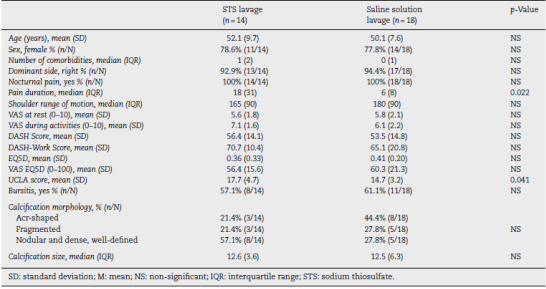
Thirty-two patients were enrolled, with 78.1% being women and an average age of 51.0 years (SD = 8.5). The mean duration of pain before the procedure was 16.3 months (SD = 22.3). Eighteen patients (56.3%) did the SOC lavage and
14 (43.8%) the STS lavage. Table 1 describes baseline features. According to a dynamic patient inclusion, we had 28 patients at week 1 (SOC = 15 and STS = 13), 26 patients at month 1 (SOC = 14 and STS = 12) and 21 patients at month 3 (SOC = 10 and STS = 11). Both UGPL procedures resulted in numerical improvements in pain, ROM, function, and calcification size. However, only the SOC group statistically reduced calcification size (p = 0.005), and improved EQ5D, DASH-Work, and UCLA scores (p = 0.021, 0.042 and 0.03). Both the STS and the SOC lavage demonstrated a statistically significant reduction in the DASH score (p = 0.014 and 0.06). Importantly, no adverse effects or complications were reported.
Despite being well tolerated with no side effects, STS UGPL did not demonstrate the same benefits as the SOC for calcific tendinopathy. Regardless sodium thiosulfate's potent calcium chelator, antioxidant, and vasodilator effects, and its efficacy in entities as calciphylaxis, (10 the theoretical improvement in calcific tendinitis is yet to be proven. Further studies are nec essary to determine the effectiveness of STS in treating this condition. The ongoing work will be reassessed with a larger sample size.

