




 English (pdf)
 Article in xml format
 Article references
 Automatic translation
 Send this article by e-mail
 Cited by SciELO
  Cited by Google
  Similars in
SciELO
Similars in
SciELO  Similars in Google
 Permalink
1. INTRODUCTION
Although oil has been replaced by other energy sources in numerous sectors, it maintains its importance given the power it derives from the transportation sector (Masera & Hossain, 2023). Although oil consumption in land transportation has been steadily declining in OECD countries, it has been increasing significantly in developing countries (India, China, Latin American countries, etc.), and this is also true for petroleum products used in maritime and air transportation. Crude oil needs to be processed, as its area of use is limited. The processing of crude oil ends up with products such as fuel oil, liquefied petroleum gas, gasoline, DF, and jet fuel. Although these products are used in numerous fields such as transport, heating, and several other industries, their role is predominant the transportation sector (Altarazi et al., 2022; Örs, 2014; EMRA, 2013). It has been accepted by many scientists that verey soon, conventional energy resources like crude oil, coal, and natural gas will be insufficient to meet global energy demand because of their nature (Shafiee & Topal, 2009; Almodares & Hadi, 2009; Demirbas, 2008). In addition, petroleum, and other fossil-based fuels result in considerable damage to human health and the environment, both during their production and utilization, added to other issues like global warming. This has led scientists and governments to search for renewable energy resources (Withey et al., 2019; Martins et al., 2019).
In today's world, technological developments and industrial activities are constantly growing to find innovative and efficient energy sources. This is necessary in many areas, from industry to transportation. In this sense, DF plays a crucial role in meeting energy needs with its high energy efficiency, durability, and versatility (Hoseini et al., 2017). DFs enable the use of large vehicles, freight trucks, trains, and ships that travel long distances, while allowing industrial equipment to operate longer and more efficiently (Tsai et al., 2014). At the same time, DFs are specific to diesel engines that operate on the principle of CI. These engines have more power, high torque, and fuel efficiency as compared to spark-ignition engines (Prabu et al., 2017; Tan et al., 2023).
In spite of the benefits derived from diesel engines, their emissions into the atmosphere are destructive to human health and the environment (Vellaiyan & Amirthagadeswaran, 2016). Hence, controlling these harmful emissions and finding sustainable energy solutions is of great importance. Today, efforts to make DF more sustainable and environmentally friendly translate into alternative fuels in which environmental impacts are more emphasized (Ren et al., 2022; Zhao & Guan, 2022).
BD is an environmentally friendly alternative resource as it is produced from biological raw materials. Numerous studies on reduction of emissions in CI engines powered by BD are supported by several tests and analyses (Lapuerta et al., 2008). The impact of varying proportions of BD blends (B7-B20) on the emissions in a CI engine was reliably reported by Miron et al. (2021). At 2400 rpm, NOx emissions were recorded to be 5.4 g/kWh for DF and 4.7 g/kWh for B20. Szabados & Bereczky (2018) conducted an emission and combustion analysis of pure DF and BD blends in a diesel engine. With the same engine speed and load, BD showed a noticeable mitigation in CO emissions concerning DF. To conclude, HC emissions decreased with the infusion of BD produced from vegetable oil-derived feedstock compared to DF (Kalligeros et al., 2003). BD can be synthesized from several raw materials like vegetable oils, animal fats, and waste oils. Sadaf et al. (2018) produced BD from waste cooking oil (WCO), determining some remarkable characteristics such as acid content, cetane number, viscosity, and energy content. Based on these findings, the use of BD significantly decreased the negative environmental impacts. Labecki et al. (2012) synthesized BD from vegetable oil obtained from rapeseed. The researchers experimentally investigated the combustion and emission behavior of the fuels tested in a multi-cylinder, direct-injection (DI) CI engine.
Engine performance varies greatly with the chemical and physical structure of the fuel used in the engine (Chhetri et al., 2008). The physical properties of BD have unique specifications due to the chemical structure of the feedstock used during its production. Generally, BD has a very high viscosity in comparison with DF (Tate et al., 2006). In diesel engines, fuel viscosity has great influence on the engine characteristics. Fuel with high viscosity creates problems during spraying and compression in the combustion chamber. Alcohol is specified for enhancing engine performance and mitigating emissions. Given the low density and viscosity of alcohols, the spray characteristics are improved by adding them to BD (Musthafa et al., 2023). Therefore, adding alcohol to the fuel during BD production improves the fuel quality and physicochemical properties. Alcohol types such as methanol, butanol, hexanol, or ethanol are commonly used in BD synthesis (Verma et al., 2016; Erol et al., 2023).
In the last century, energy efficiency has meant the use of energy with the minimum loss and the highest benefits in technologies used for transmission, energy production, and consumption. The increase in energy costs helps to better understand the importance of studies on the efficient employment of (Saidur et al., 2012). To ensure the optimum use of energy resources, a complete thermodynamic analysis was necessary. Therefore, for many years, some scientists have used a new technique that combines first and second laws at the same time. Such analysis techniques are known as "Availability Analysis" or "Exergy Analysis". Therefore, exergy analysis has become a useful tool to bring about significant changes in the energy utilization process (Yilbaji, 2007). Sayin Kul and Kahraman (2016) performed exergy and energy analyses on a CI engine using DF, BD, and ethanol (5%) blends. The fuel used in the study were DF, D92B3E3, D85B10E5, D80B15E5, and D75B20E5. The leading exergy efficiency of 31.42% was observed for the D92B3E5 fuel at 1400 rpm. Zaharin et al. (2017) conducted various analyses of alcohol-BD blends obtained by adding different types and proportions of alcohol to BDs in diesel engines. Due to the low viscosity of alcohol, the quality and spray behaviors of BD were improved. Karami and Gharehghani (2021) conducted an experimental study in a CI engine by doping CeO2 nanoparticles at different ratios to DF and BD blends. According to the results obtained, there was a significant enhancement in exergy efficiency by increasing the ratio of nanoparticles and BD in the tested fuel. The highest exergy efficiency of 36.6% was observed in B15W5N120 (15% BD-5% water-120 ppm nanoparticles) fuel. Najafi et al. (2018) used WCO for BD production. The results showed that B20 and B10 blend fuels rendered better results in energy and exergy efficiency than pure DF. Özcan (2019) obtained blended fuel by doping Al2O3 nanoparticles into BD and DF. Thermodynamic analyses of the blended fuels were comprehensively investigated in a CI engine. It was concluded that the doping of nanoparticles to the fuel improved the exergy and energy efficiency values by 7.28% and 8.15%, respectively. Altun et al. (2008) experimentally tested DF-BD (derived from sesame oil) blend and pure DF in a CI engine and compared the results. Engine power was slightly higher with the BD-DF blend (2 kW) than with DF (1.5 kW) at constant speed (2100 rpm). The use of the fuel blend also led to positive results in CO and NOx emissions. Karagöz et al. (2021) performed exergy and exergoeconomic analyses by adding various nanoparticles (SiO2, Al2O3, and TiO2) to a BD-DF blend in a CI engine. The maximum exergetic efficiency was computed to be 28% for D90B10Al2O3 fuel at the load of 10 Nm. According to the results obtained, the addition of Al2O3 nanoparticles provided the best improvement in fuel. Raja et al. (2022) added CNT nanoparticle additives at different ratios to BD with peanut oil as feedstock and produced different blended fuels. Hence, performance, exergy, and emission analysis of the fuels were investigated at 25%, 50%, 75%, and 100% loads. After the data were analyzed, it was shown that BD and nanoparticle additives had a positive effect on the performance and emission values of the CI engine, but there was no noticeable change in exergy efficiency. Panigrahi et al. (2018) obtained BD from a plant species called simarouba. They performed energy and exergy analyses of DF and BD blend (B20). According to the results from the research, B20 had higher energy and exergy efficiencies than DF. The exergy efficiency outcomes for DF and B20 fuel were calculated as 34.8% and 35%, respectively. Channapattana et al. (2023) conducted an exergy analysis of DF, BD, and nickel oxide nanoparticle-doped BD blend in a diesel engine. The nanoparticle ratio added to the fuel blend was 25 ppm and 50 ppm. The maximum amount of exergy destruction was monitored to be 14.5 kW for the pure DF. Exergy destruction decreased with the addition of BD and nanoparticles to the fuel content. While the exergy destruction in B25 fuel is 13 kW, this value is 12 kW in B25+50 ppm fuel. Sekmen and Yilbaji (2011) experimentally tested BD and commercial DF in a four-cylinder diesel engine. The thermal efficiency was calculated as 29.54% and 30.85% for DF and BD, respectively, at a load of 1000 Nm. Uysal et al. (2022) synthesized graphene oxide nanoparticles in their study. The obtained nanoparticle was blended with a DF-BD mixture. The exergoeconomic, exergy, and sustainability analyses of the fuel blends were tested experimentally in a CI engine. The highest exergy efficiency was found to be 28.5% for D85B15GO100 at a load of 12 Nm. Nemati et al. (2016) compared five different fuel blends (B5, B20, B50, B100) created with BD-DFs derived from waste oil with DF in a CI engine by modeling. Ascending the amount of BD in the fuel led to an increase in exergy efficiency. The exergy efficiencies of B20 and B50 fuels are 27.5% and 28%, respectively. Doğan et al. (2023) added silver oxide (Ag2O) and titanium dioxide (TiO2) nanoparticles to BD whose feedstock is cotton oil. The exergy analysis of the blended fuels was tested experimentally in a CI engine. Exergy efficiency was monitored to be higher for the blended fuel with nanoparticles compared to BD. At the load of 30 Nm, the exergetic efficiency for BD and CTi-75 (100% BD-75 ppm TiO2) blend fuel is 32% and 38%, respectively. Tamilvanan et al. (2019) obtained BD from tamanu oil in their study. They conducted performance and emission analyses in a single-cylinder CI engine by adding copper nanoparticles to BD. The results showed that the infusion of nanoparticles to BD enhanced the thermal efficiency and mitigated the NOx and HC emissions.
The depletion of petroleum-based fuels and the increase in energy demand in the world have made the search for alternative energy necessary. EMRA in Türkiye had decisions published in the Official Gazette on June 16, 2017, with number 30098. According to the articles, BD must be produced from domestic agricultural products and blended into DF (Official Gazette, 2017). The linseed plant, a local agriculture product, will also be an alternative in the blending of BD due to the obligation set out in the communiqué. Ethanol or ethyl alcohol contains 2 carbon atoms in its chemical structure. Ethanol also stands out as a very important energy source as it is a substance that can be produced from domestic agricultural products. At the same time, although the infusion of ethanol is likely to slightly descend the cetane number and energy content on account of the specifications of alcohols, it is aimed to enhance low-temperature properties, reduce exhaust emissions, and thus produce an environmentally friendly fuel suitable in winter conditions (John et al., 2022).
Their is observed in the literature that studies are using different BDs. However, studies on BD produced from linseed are limited. In the case of BD addition to DF in CI engines, the use of alcohol is common for reducing engine problems and environmental damage from emissions. In this study, linseed crude oil was obtained from the linseed thanks to a screw press and BD was produced from this oil using the transesterification method. Linseed oil BD was blended with DF at 20% by volume., 5% and 10% ethanol was added to this blend,and B20E5 and B20E10 fuels were prepared. The test fuels were tested in a diesel engine at varying loads (25%, 50%, 75%, and 100%), and their economic and environmental evaluation was performed by thermodynamic analysis. In addition to performance and emission-based comparisons in alternative fuel investigations in recent years, there have been studies involving economic and environmental evaluations according to the first and second laws of thermodynamics. In this context, this study is an innovative analysis research using exergoenvironmental, exergoeconomic, and sustainability analyses.
MATERIALS AND METHODS
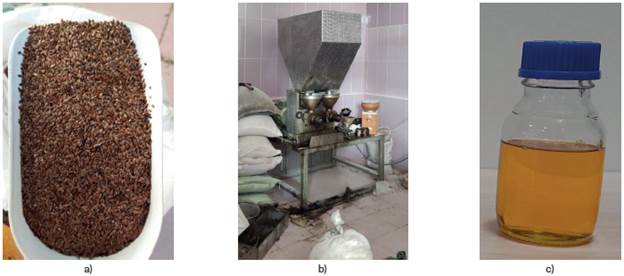
The linseed (Figure 1 -a) was obtained from a local market in Yozgat. Visible impurities in the seeds were removed. Then, they were kept under the sun for a week to reduce the moisture content that directly affects the crude oil percentage. Then, the linseed crude oil (Figure 1 -c) was extracted from the linseed using a screw oil extraction press (Figure 1 -b). This oil was then passed through a fine filter to remove any remaining impurities.
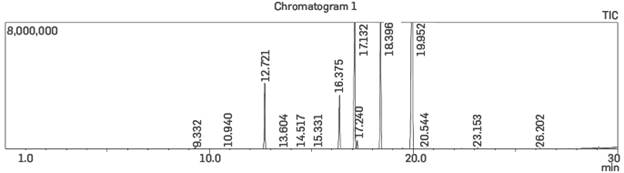
The fatty acid profile of linseed crude oil was detected by Shimadzu brand QP2010 model (Kyoto, Japan) gas chromatography device and the results were tabulated in Table 1. Furthermore, the chromatogram graph is also shown in Figure 2. As observed, linseed oil is rich in alpha-linolenic acid (51.23%), oleic acid (19.38%), and linoleic acid (15.87%).
Table 1 Fatty acid profile of linseed oil
| Fatty acids | % |
|---|---|
| Myristic acid | 0.06 |
| Pentadecanoic acid | 0.03 |
| Palmitic acid | 6.24 |
| Palmitoleic acid | 0.06 |
| Margaric acid | 0.05 |
| Margoleic acid | 0.04 |
| Stearic acid | 5.85 |
| Oleic acid | 19.38 |
| Elaidic acid | 0.80 |
| Linoleic acid | 15.87 |
| alpha-Linolenic acid | 51.23 |
| Gondoic acid | 0.12 |
| Behenic acid | 0.17 |
| Lignoceric acid | 0.10 |
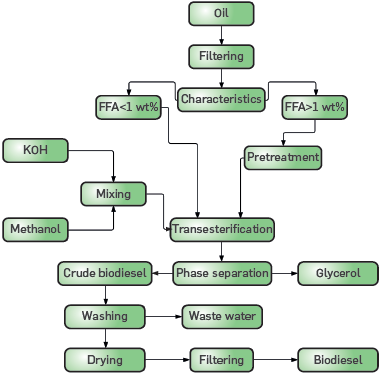
As the quantity of free fatty acids, which is important in determining the number of stages of BD production, is below the limit value, a single-stage transesterification was implemented. The feedstock that contains a high proportion of free fatty acids forms soap through the consumption of a large amount of catalyst. Water is formed as a byproduct and needs to be removed. The use of oils with high free fatty acids is recommended after pre-treatment instead of using them directly in the transesterification reaction. If the amount of free fatty acids is higher than the recommended levels, a 2-stage transesterification process should be used, or else, a single-stage transesterification process, if it is within the recommended levels. In the transesterification process, methanol and KOH were preferred. In the transesterification reaction, the alcohol:oil molar ratio was 6:1, the catalyst ratio was 1.0%, the temperature was 60 °C, and the reaction time was 60 minutes. Figure 3 is the flow chart showing the path followed for BD production 3.
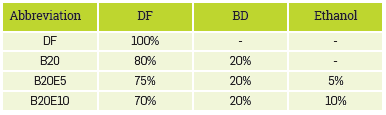
The produced Linseed oil BD was mixed with DF at 20% by volume. To investigate the influence of ethanol addition, the fuels listed in Table 2 were prepared by volume and used in subsequent trials.
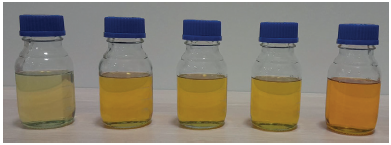
Some essential properties of the tested fuels are shown in Table 3

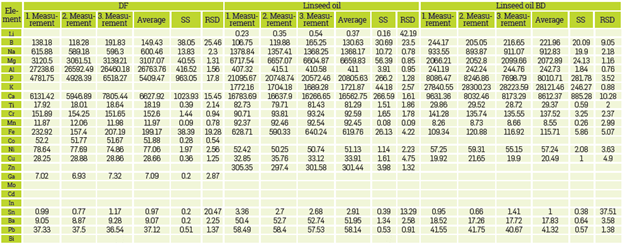
Elemental analysis of linseed oil, linseed oil BD, and DF used as reference was measured in a Thermo Scientific ICAPQC (USA) device and the analysis results are shown in Table 4.
Engine trials were conducted at the Engines Laboratory of the Automotive Technology Department at Kinkkale University. The test fuels were compared to DF, which was used as a reference point, DF was obtained from a fuel station in Yozgat, and the seller's firm certified that it complies with EN 590 requirements. The study tested DF, B20, B20E5, and B20E10 fuels in a single-cylinder, four-stroke, water-cooled, naturally-aspirated, DI diesel engine at a stable speed of 1500 rpm and varying loads of 25%, 50%, 75%, and 100%. Table 5 provided the technical specifications of the test engine, while Figure 5 illustrated the test unit used for the experiments.
Table 5 Features of the engine
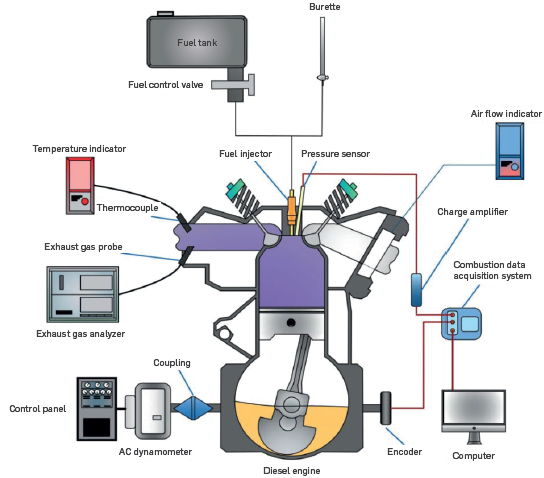
In thermodynamic analysis, the temperatures occurring at different points of the engine should be used. In the measurement of these temperatures, PtlOO type thermocouples (measurement range: 0-100°C) and Abustek brand Fr Block model K type thermocouples (measurement range: 0-1200°C) were placed at appropriate points and temperatures were recorded. Another important and necessary parameter in thermodynamic analysis is the fuel consumption results. Yokogawa brand EJA110E-JMS5J-912NN model fuel consumption meter was used to determine the consumption of test fuels. The amount of air consumption during the experiments was determined with a flow meter model SL-1-A-MQA-ND-ZA4Z-ZZZ from WIKA. As mentioned before, experiments were carried out under different load conditions. An air-cooled Galen-Tech brand AC dynamometer with a power of 11 kW was used to bring the test engine to the appropriate load conditions. The control of this dynamometer was provided by Siemens brand Sinamics G120 PM250 model Power Module. Sensotronics Sanmar Ltd brand 60001 model S type load cell with 0-50 kg capacity was used in the system. Kubler brand 8.KIS40.1361.0360 model encoder was installed in an appropriate place to determine the engine speed. ICEngineSoft program was used for precise recording of engine performance data to the computer. This program can work integrated with the data processing system (16-bit DAQ, NI-USB-6210).
Bilsa brand MOD 2210 model emission measurement device was used for the analysis of exhaust gases. CO2, CO, O2, NOX, and HC emissions can be measured with the exhaust gas analyzer. In addition, the emission device can calculate the lambda. Technical details of the exhaust gas analyzer were included in Table 6.
Table 6 Technical specifications of Bilsa MOD2210 model emission device
| Feature | Unit | Measurement range | Accuracy |
|---|---|---|---|
| NOX | ppm | 0-5000 | 1 ppm |
| CO2 | % | 0-19.99 | 0.001% |
| CO | % | 0-10 | 0.001% |
| O2 | % | 0-25 | 0.01% |
| HC | ppm | 0-10000 | 1 ppm |
| Air/fuel ratio | - | 5-30 | - |
| Lambda | - | 0-5000 | 0.001 |
| Detection time | s | <5 | - |
| Operating temperature | °C | 0-40 | 0.01% |
| Supply frequency | Hz | 50 | - |
| Supply voltage | V AC | 220 | - |
The test fuels, the preparation of which is thoroughly described, were subjected to re-mixing before the engine tests to eliminate possible homogenization problems. The compression ratio was kept constant at 18:1 throughout the trials. The ambient temperature observed ranged between 20 and 25°C during the experiments.
In the experiments, the reference fuel was tested first and the data was recorded. Then, other binary and ternary fuel blends were tested at several loads (25%, 50%, 75%, and 100%). After the engine tests of each test fuel were completed, the fuel line and fuel filter were cleaned to prevent possible residual fuels from affecting the experimental results. An important factor during the engine experiments is the engine reaching the operating temperature. Before each experiment, the engine was allowed to reach the operating temperature of the engine oil temperature given by the manufacturer, then starting the process of recording the experimental results. Preliminary tests were carried out and the main test process was started after all the problems were eliminated. Tests were repeated three times. The test outcomes were averaged and used in thermodynamic analysis.
3 STATE OF THE TECHNIQUE
Experimental studies are conducted under dynamic test conditions to assess the suitability of fuels for use in internal combustion engines (ICEs). This allows the assessment of the performance and emissions of alternative fuels and various fuel blends in laboratory experiments. The resulting data can be used to perform analyses pursuant to the first and second laws of thermodynamics. The assumptions used to facilitate calculations when applying the first and second laws of thermodynamics to the control volume are as follows:
Steady-state operating conditions for tested engine.
Chemical equilibrium for combustion products.
Considering ideal gases properties for combustion air and exhaust gases.
Same characteristics for flow at any point of the control volume.
Neglecting potential energy and kinetic energy of fuel, combustion air, and exhaust gases.
Accepting ambient temperature: 20°C and pressure: 100 kPa (Khoobbakht et al., 2016; Nabi et al., 2020).
3.1 ENERGY ANALYSIS
Calculating useful work (W) is critical for determining motor performance. Useful work occurs when the engine produces rotational motion or performs some other mechanical work. This calculation is based on the relationship between the two fundamental characteristics of the engine, namely the number of revolutions (n) and the engine torque (T), as given in Equation 1. The data were obtained from experiments carried out on an engine test rig (Agbulut, Ü., 2022).

A visualization of the control volume selected in the present analyses was illustrated in Figure 6.
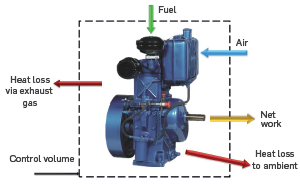
The energy of the fuel is released during the combustion process in the engine. There are two main common ways to use the above mentioned energy. First, this energy is converted into mechanical power and expressed as useful work. However, some thermal losses also occur during engine operation. Consequently, in ICE, the fuel energy is equal to the sum of the useful work and thermal losses as shown in the following equations (Gümüs. and Atmaca, 2013; Sarikoç et al., 2020).
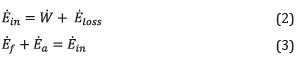
The fuel energy (Ė f ), in ICE, is the sum of air energy in the engine (Ė α ) and the thermal losses (Ė los ).
The fuel energy is calculated from the following equation depending on the fuel flow rate (c) and the lower heating value (LHV f ). Here, (ṁ f ) is the rate of fuel consumption per unit of time, and (LHV f ) is the maximum amount of energy that the fuel can release during combustion (Ozer & Doğan, 2022).

During the engine tests, parameters such as the flow rate of air entering the engine (ṁ a ), inlet temperature (T 1), and ambient temperature (T 0) were measured. These measurements are used to calculate the energy carried by the air and are found with the help of Equation 5 (Yaman, 2022).

The total energy losses in the motor are determined using the equation given below (Odibi et al., 2019).

Thermal efficiency can be calculated using Equation 7. Energy losses and thermal efficiency provide important data to evaluate how effectively the engine is operating, and to make improvements where necessary (Yesilyurt, 2020).

3.2 EXERGY ANALYSIS
Exergy is a term that measures the quality or availability of energy and plays a critical role in energy conversion systems such as ICEs. Because of the second law of thermodynamics, energy conversion and heat transfer between energy sources and systems is not always fully efficient. Therefore, exergy shows how much of the energy carried by the fuel can be converted into useful work. The exergy balance of the control volume was formed by the following equation (Jafarmadar & Nemati, 2016).

Here; Ė x f is the exergy of fuel, Ė x ex is the exhaust exergy, Ė x heat is the exergy of heat transferred from the engine casing and Ė x dest is the exergy dissipated. The exergy of the air taken into the cylinder is denoted by Ė x a (Karagoz et al., 2021).
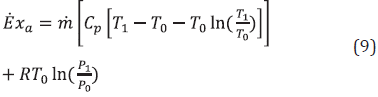
Where; C p is the specific heat, R is the specific gas constant, T 1 is the inlet temperature of the air, T 0 is the ambient temperature, P t is the inlet pressure and P 0 is the ambient pressure. Exergetic power (Ėx w ) represents the useful work produced by the engine (Yesilyurt, 2020). The exergy of fuels is calculated using Equation 10 (Khoobbakht et al., 2016).

The exergy factor (φ) is determined by analyzing the chemical composition of the fuel and is calculated from the following equation (Amid et al., 2021).

When calculating the exergy of the exhaust gases, the sum of the physical (ε p ) and chemical exergies (ε c ) is determined for each of them (Doğan & Erol, 2023).

Physical and chemical exergy calculations are performed using the equations given below (Yildiz et al., 2020).

The values of the percentages of gases in the atmosphere (y^e) in Equation 14 are taken from Aghbashlo et al. (2017). The exergy of heat transferred from the engine surface to the ambient was calculated from the following formula.

Where; T s refers to the engine surface temperature.
The amount of exergy lost is calculated according to Equation 9
(Yesilyurt & Arslan, 2019).

Exergy efficiency is calculated from the following formula (Karagoz et al., 2021). This efficiency measures the relationship between the exergy values of the inputs and outputs of the system and indicates how much of the energy in the system is converted into useful work.

3.3. EXERGOECONOMIC ANALYSIS
The increase in fuel costs in recent years shows that the cost should be taken into account as well as the amount of power from the engine. In exergy analysis, the amount of fuel entering the control volume per unit time is the most important parameter in the calculations. In exergoeconomic analysis, the cost of fuel entering the control volume is important.
Using the cost coefficient (c) of each component in the control volume, the cost balance is given by the following equation (Çakmak and Bilgin, 2017).

Where Z is the investment cost ratio of the engine. Sources in the literature were used for investment rate calculations (Doğan et al., 2022). It is assumed that the test engine runs for 10 hours per day, and has a total lifetime of 20 years. The current initial investment cost of this engine is $5500.
The cost of useful work from the test engine is determined from the following equation.

In addition, the exergoeconomic factor (f) and relative cost difference (r) calculations were taken from the study by Doğan et al. (2020).
3.4 EXERGOENVIROECONOMIC ANALYSIS
In engine tests, the amount of CO2 emitted to the atmosphere under several operating conditions was determined. In this study, the cost of harmful CO2 emissions to the environment is calculated by exergy-economic-environmental analysis. The amount of CO2 emitted to the environment for 1 kW of power produced in the engine as a result of fuel combustion is multiplied by the exergy of the fuel and the emission in one hour is determined. The total environmental pollution caused by CO2 emission is determined after the engine's operating life is estimated (Hosseinzadeh-Bandbafha et al., 2021).

Where; PCO 2 is the environmental damage cost of CO 2 emission, NCO 2 is the mass amount of CO 2 emission, N is the lifetime and t is the daily operating time. The CO 2 emission price was taken as 0.0145 $/ kg Co 2 in the present analysis. In addition, the lifetime of the engine is assumed to be 20 years, and the daily operating time is assumed to be 10 hours.
3.5 SUSTAINABILITY ANALYSIS
In order to benchmark with sustainability analysis, a sustainability index should be determined from the following formula. The index is used to evaluate the sustainability of the energy conversion and resources of the system and to compare the sustainability performance of different systems (Uysal et al., 2022).

4. RESULTS AND DISCUSSION
This study conducted tests at four different loads using DF, BD produced from linseed oil, and DF-BD-ethanol blends in a CI engine, with the engine operating at a stable speed of 1500 rpm. As shown in Table 7, fuel consumption increased with load increases. With the same operating conditions, the fuel consumption of the DF-BD binary blend was lower than that of DF-BD-ethanol ternary fuel blends. This is caused by the lower energy content of alcohol as compared with DF and BD, as shown in Table 3,. Ethanol is added to reduce the negative effects on the engine due to the high viscosity of BD. This results in increased fuel consumption, but less engine deterioration. At 100% load, the fuel consumption for DF, B20, B20E5, and B20E10 was 1.385 kg/h, 1.567 kg/h, 1.645 kg/h and 1.717 kg/h, respectively. Ashok et al. (2017) examined the utilization of LPO20, LPO40, LPO50, and LPO100 fuel blends, which contained DF and BD derived from lemon peel oil, in a DI CI engine. The study found that the use of BD resulted in increased fuel consumption compared to DF. In similar operating conditions, the fuel consumption of LPO100 and DFs was 0.45 kg/kWh and 0.40 kg/kWh, respectively. It is worth to note that CO2 emissions have a harmful impact on the environment due to the greenhouse gas effect. The engine tests showed that DF had the highest CO2 emissions at all loads. B20 fuel produces lower CO2 emissions compared to DF. For instance, at 100% load, CO2 emissions for DF and B20 fuels are 10.56% and 9.69% respectively. The infusion of ethanol to binary fuel blends reduces CO2 emissions due to its lower carbon content compared with DF (refer to Table 3). Nabi et al. (2018) carried out a study on the emissions of DF and BD blends. The outcome indicated that the use of BD-containing blends as fuel significantly reduced CO emissions compared to DF. Specifically, under the same operating conditions, CO emissions were 5 g/kWh for MaD blend fuel and 45 g/kWh for DF. Can et al. (2017) monitored the variation of exhaust emissions in a CI engine using different ratios of canola oil-DF blends. Due to the lower caloric value of BD compared to DF, the CO2 emissions decreased. However, the increase in load led to higher CO2 emissions. The study measured CO2 emissions of B10 blend fuel at 8 Nm and 12 Nm, which were 4.5% and 7%, respectively.
Table 7 Engine characteristics and emission results
| Fuel | Engine load (%) | Fuel consumption | Exhaust outlet temperature (°C) | Coolant outlet temperature (°C) | CO (%) | CO2 (%) | O2 (%) |
|---|---|---|---|---|---|---|---|
| DF | 25 | 0.541 | 176.08 | 21.25 | 0.050 | 3.92 | 15.77 |
| 50 | 0.899 | 243.74 | 24.65 | 0.100 | 5.46 | 15.04 | |
| 75 | 1.191 | 284.61 | 23.64 | 0.350 | 7.85 | 10.21 | |
| 100 | 1.385 | 313.34 | 23.49 | 0.540 | 10.56 | 6.27 | |
| B20 | 25 | 0.564 | 169.35 | 32.11 | 0.042 | 3.73 | 15.26 |
| 50 | 0.929 | 209.04 | 34.83 | 0.082 | 5.20 | 12.98 | |
| 75 | 1.270 | 265.00 | 37.05 | 0.283 | 7.48 | 9.53 | |
| 100 | 1.567 | 305.00 | 41.45 | 0.435 | 9.69 | 6.76 | |
| B20E5 | 25 | 0.599 | 155.80 | 23.61 | 0.039 | 3.55 | 16.01 |
| 50 | 0.977 | 192.32 | 25.97 | 0.073 | 4.97 | 12.58 | |
| 75 | 1.330 | 243.80 | 28.58 | 0.254 | 7.14 | 10.57 | |
| 100 | 1.645 | 280.60 | 31.34 | 0.393 | 9.19 | 7.41 | |
| B20E10 | 25 | 0.625 | 149.03 | 32.06 | 0.036 | 3.49 | 15.34 |
| 50 | 1.028 | 183.96 | 31.09 | 0.069 | 4.87 | 12.86 | |
| 75 | 1.383 | 233.20 | 34.90 | 0.242 | 6.98 | 10.00 | |
| 100 | 1.717 | 268.40 | 37.82 | 0.371 | 9.03 | 6.63 |
The thermodynamic analysis of an ICE involves determining its thermal efficiency and losses. To conduct an energy analysis, the energy of the fuel and air taken into the cylinder is calculated first. As air is sucked directly from the atmosphere, its energy is considered to be zero. The amount of the fuel's energy used in power generation in the engine is then determined. It is remarkable to note that this analysis does not take into account any subjective evaluations. Finally, the thermal losses from the exhaust to the cooling water are calculated. Table 8 shows that increasing the load ascends the total energy entering the control volume. The quantity of fuel ensured to the cylinder in an engine cycle significantly affects total energy entering the control volume. Increasing the fuel intake of the cylinder boosts the engine's fuel consumption and, consequently, affects the total energy. Table 8 shows that the B20E10 fuel blend has higher fuel energy than DF and all other fuels at all loads. The addition of BD and ethanol to DF increased the fuel energy. At 75% load, the energy of DF is 14.268 kW while the energy of the B20E5 fuel is 15.291 kW. The fuel energy increases with increasing load.
At 25% and 100% loads, the energy of B20 fuel is 6.613 kW and 18.367 kW, respectively. Aghbashlo et al. (2015a) conducted tests in a CI engine to compare the performance of biodiesel (BD) derived from waste oil, pure diesel fuel (DF), and a BD-DF blend fuel. The findings demonstrated that the fuel blends with BD addition had higher fuel energy compared to DF. Specifically, at a constant speed, the fuel energy was 26.73 kW for DF and 31.64 kW for B5P75 fuel. Furthermore, an increase in engine speed resulted in an increase in fuel energy. The thermal losses were reduced in the ICE when using a DF-BD binary fuel blend or DF-BD-ethanol ternary fuel blend. This positive effect was observed due to the improved fuel quality and clean and efficient combustion provided by the addition of BD and ethanol to the fuels. For instance, at 100% load, the thermal losses of DF and B20E10 fuels were 1.8291 kW and 1.4433 kW, respectively. However, it is considerable to note that increasing the engine load can have a substantial impact on the internal operating conditions of the engine. This can lead to higher temperatures and pressures, which in turn can increase the energy lost through thermal losses. For example, when the load was increased by 50% using B20 fuel, a thermal loss of 0.5794 kW was observed by Panigrahi et al. (2014). Additionally, the researchers produced biodiesel using oil obtained from the tropical tree, mahua. The study found that using BD-containing blended fuel in the engine resulted in a mitigation of energy loss compared to DF. Specifically, under the same operating conditions, the energy loss of DF was 1.51 kW while that of B20 blend fuel was 1.37 kW. The energy of exhaust gases is dependent on the fuel content and combustion conditions. Notably, the highest exhaust gas energy was observed in DF at all loads. However, the addition of BD and ethanol to the fuels led to a reduction in exhaust gas energy in the ICE. At 100% load, the exhaust gas energies of DF, B20E5, and B20E10 fuels were 7.881 kW, 7.164 kW, and 6.852 kW, respectively. Karami et al. (2022) used binary and ternary fuel blends of BD derived from apricot kernel, papaya, and tomato wastes, and found that DF had the highest exhaust gas energy. At 1400 rpm, the exhaust gas energy of TD blend fuel was 31%, while that of DF was 25%. Increasing the engine speed also significantly increased the exhaust gas energy.
Table 8 Energy analysis results
| Fuel | Engine load (%) | Inlet energy (kW) | Heat transfer to cooling water (kW) | Energy of exhaust gases (kW) |
|---|---|---|---|---|
| DF | 25 | 6.476 | 0.8279 | 2.862 |
| 50 | 10.765 | 1.1781 | 3.289 | |
| 75 | 14.268 | 1.5692 | 5.305 | |
| 100 | 16.598 | 1.8291 | 7.881 | |
| B20 | 25 | 6.613 | 0.5631 | 2.378 |
| 50 | 10.888 | 0.8406 | 4.199 | |
| 75 | 14.881 | 1.1425 | 4.862 | |
| 100 | 18.367 | 1.3941 | 7.787 | |
| B20E5 | 25 | 6.887 | 0.5364 | 2.187 |
| 50 | 11.225 | 0.8492 | 3.863 | |
| 75 | 15.291 | 1.1952 | 4.473 | |
| 100 | 18.908 | 1.6217 | 7.164 | |
| B20E10 | 25 | 7.041 | 0.5318 | 2.092 |
| 50 | 11.593 | 0.9808 | 3.695 | |
| 75 | 15.593 | 0.9881 | 4.279 | |
| 100 | 19.361 | 1.4433 | 6.852 |
Exergy analysis was conducted using the second law of thermodynamics to indicate the maximum useful work that can be produced by various fuel blends in ICEs. The fuel exergy is the total exergy of the engine entering the control volume during this analysis. The exergy analysis provides a detailed examination of the engine's efficiency and power-generating capacity. Table 9 presents the results of the exergy analysis calculations for different fuels. The highest fuel exergy value of 21.051 kW was obtained for B20E10 fuel at 100% engine load. The addition of BD and ethanol to DF increased the fuel exergy, but also increased fuel consumption. At 75% load, the fuel exergy was 15.682 kW for DF and 16.325 kW for B20 blend fuel. Furthermore, the exergy of all fuels increased as the engine load increased. At 25% and 100% load conditions, the exergy values for B20E10 fuel were 7.655 kW and 21.051 kW, respectively. Gad et al. (2022) produced BD from jatropha, corn, and WCO, which are popular biofuel sources. The use of BD resulted in an increase in fuel exergy. Specifically, at the same load, the exergy of DF was 17 kW, while the exergy of a JB20 blend fuel was 22 kW. The heat generated by the combustion of the fuel blends in the cylinder caused an increase in exergy transferred to the cooling water. An increase in fuel consumption also increases the cooling requirement for the engine. For all fuel blends, increasing load results in an increase in the exergy transferred to the cooling water. The cooling water exergy for B20E10 fuel at 25%, 50%, and 100% engine loads is 0.2563 kW, 0.5436 kW, and 0.9431 kW, respectively. The addition of BD to DF leads to an increase in cooling water exergy. At 100% load, the cooling water exergy for DF and B20 fuels is 0.6779 kW and 0.8292 kW, respectively. The addition of ethanol in B20 fuel results in a significant increase in the cooling water exergy. For instance, when the load is at 100%, the cooling water exergy of B20E5 and B20E10 fuels is 4.84% and 12% higher than that of B20 fuel, respectively. Aghbashlo et al. (2015a) demonstrated that the maximum exergy value of cooling water in a CI engine was 4.15 kW for fuel containing BD. Additionally, the cooling water exergy increased with increasing engine speed. The exergy of the exhaust is dependent on the exhaust temperature. In this study, the mass flow rate of each fuel played an important role in determining the exhaust exergy, assuming the exhaust gases were perfect gases. The lowest exhaust exergy value was calculated for DF. The addition of BD to DF increased the exhaust exergy. At 100% load, the exhaust gas exergy of B20E5 fuel is 1.787 kW, while that of B20E10 fuel is 1.774 kW. The exergy of the exhaust gas is also high at high engine loads. As the load increases, the heat energy contained in the exhaust gases also increases. Therefore, the exhaust exergy also increases with the load. The exhaust exergy values of B20 fuel at 25% and 75% loads are 0.826 kW and 1.362 kW, respectively. Yesilyurt (2020) analysed the performance of BD derived from peanuts and DF. The use of BD in diesel engines resulted in an increase in exhaust gas exergy. The exhaust gas exergy of BD ranged from 0.9 kW to 1.09 kW, while that of DF ranged from 0.70 kW to 0.9 kW.
Table 9 Exergy analysis results
| Fuel | Load (%) | Fuel exergy (kW) | Coolant exergy (kW) | Energy of exhaust gases (kW) |
|---|---|---|---|---|
| DF | 25 | 7.118 | 0.1972 | 0.654 |
| 50 | 11.832 | 0.4504 | 0.968 | |
| 75 | 15.682 | 0.6686 | 1.303 | |
| 100 | 18.243 | 0.6779 | 1.770 | |
| B20 | 25 | 7.255 | 0.2081 | 0.826 |
| 50 | 11.944 | 0.4641 | 1.069 | |
| 75 | 16.325 | 0.7273 | 1.362 | |
| 100 | 20.148 | 0.8292 | 1.802 | |
| B20E5 | 25 | 7.557 | 0.2324 | 0.819 |
| 50 | 12.318 | 0.4916 | 1.057 | |
| 75 | 16.780 | 0.7661 | 1.354 | |
| 100 | 20.749 | 0.8714 | 1.787 | |
| B20E1 | 25 | 7.655 | 0.2563 | 0.812 |
| 50 | 12.605 | 0.5436 | 1.048 | |
| 75 | 16.954 | 0.8226 | 1.346 | |
| 100 | 21.051 | 0.9431 | 1.774 |
Thermal efficiency is a crucial parameter for measuring engine efficiency. Figure 7 shows the thermal efficiency, which varies depending on the load and fuel type. The highest thermal efficiency value was calculated as 31.33% for DF. The thermal efficiency declined with the infusion of ethanol and BD into DF. At 75% load, the thermal efficiencies of B20 and B20E5 fuels amounted to 26.879% and 26.159%, respectively. On the other hand, an increase in thermal efficiency was monitored with increasing load. Inthe engine using B20E10 fuel, quadrupling the engine load inceeased the efficiency by 6.973%. The lowest thermal efficiency was 19.884% at 25% load and B20E10 fuel. In their study on DF and three different BD-containing fuel blends, Nabi et al. (2018) reported that the thermal efficiency of DF is slightly higher compared to the blend fuels, although not significantly different. Specifically, at 100% load, the thermal efficiency for DF is 30%, while it is 29% for WcD fuel. Sayin Kul and Kahraman (2016) also investigated the use of BD-DF blends and commercial DF in a diesel engine and found that thermal efficiency increased with increasing engine speed up to 2400 rpm. At a speed of 1800 rpm, the thermal efficiencies of D92B3E5 and D75B20E5 fuels are 28% and 26%, respectively. Erol et al. (2023) used BD, DF, and BD-DF blends obtained from cotton oil in a diesel engine. Although there was no noticeable difference, the maximum efficiency was observed in DF. At 75% load, the thermal efficiency amounted to 28% for DF and 26% for B50 fuel.
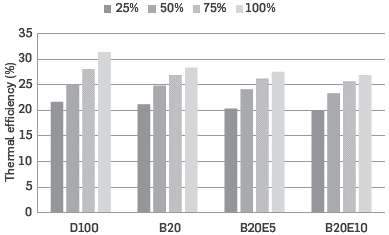
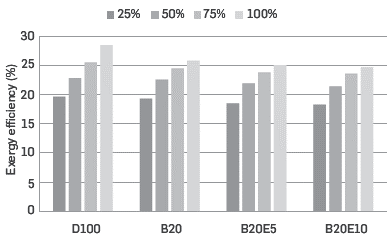
Exergy represents the quality of energy and the potential of a system to perform the work. In ICEs, exergy efficiency is a crucial thermodynamic concept that measures the relationship between the exergy values of the inputs and outputs of the system, taking into account energy losses. Figure 8 illustrates the exergy efficiencies of fuels. The study results indicate that the addition of BD and ethanol to DF has a negative impact on exergy efficiency. At the maximum load, the exergy efficiency decreased by 1.107% when 10% ethanol was added to B20 fuel. López et al. (2014) produced BD using pomace oil from olive fruit. The addition of BD to DF slightly reduced exergy efficiency. At 100% load, the exergy efficiencies of DF and B50 fuels were found to be 24.27% and 23.98%, respectively.
The exergy efficiency increased with the load, similar to the thermal efficiency. When using DF as fuel, the exergy efficiencies were 22.819% and 25.510% at 50% and 75% engine loads, respectively. Hoseinpour et al. (2017) conducted a study using BD, DF, and BD-DF blend fuels derived from WCO. The results showed that BD had lower exergy efficiency as compared to DF. The exergy efficiency of DF was 22% at 100% load, while that of B20 fuel was 20%. In their 2019 study, §anli et al. (2019) conducted an exergy analysis using data obtained from the use of BD and DF produced from palm and poppy oil in a diesel engine. The exergy efficiency of DF was reported to be slightly higher than that of BD. The maximum exergy efficiencies of palm oil BD, poppy oil BD, and DF were 32%, 32.6%, and 33.6%, respectively.
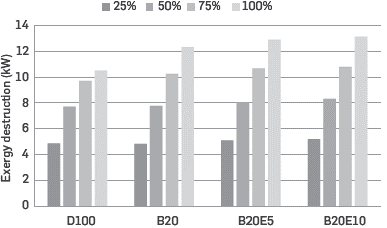
In ICEs, introducing a fuel with higher energy content into the cylinder increases thermal diffusion. This, in turn, increases the power generated by the engine. However, it also leads to an increase in thermodynamic irreversibility, resulting in exergy destruction. The study indicated that the highest exergy destruction was observed in B20E10 fuel, as shown in Figure 9. The addition of BD and ethanol to DF also increased the amount of exergy destroyed. At a constant load, the exergy dissipation is 9.710 kW for DF and 10.785 kW for B20E10 fuel. Additionally, increasing the load resulted in an increase in exergy destruction. The exergy destruction of B20 fuel was found to be 4.820 kW and 12.17 kW at 25% and 100% load, respectively. According to Karami et al. (2022), the use of TD BD increased the exergy destruction compared to DF, with the exergy destruction of TD fuel being 58% at 100% load, while that of DF was 56.5%. Yesilyurt (2020) conducted a study on exergy destruction, which found that at full load, DF had an exergy destruction of 4.5 kW, while BD had 5.6 kW. At 75% and 100% load, the exergy destruction values for BD were 4.2 kW and 4.8 kW, respectively.
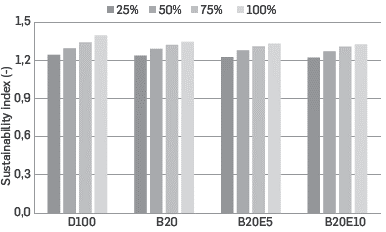
The evaluation of a fuel's ability to produce useful work related to its total exergy losses is crucial for a sustainability analysis. This study calculates the SI of the fuels and presents the SI results of the test fuels at ranging loads in Figure 10. For the B20E10 fuel, SI parameters at 25% and 100% loads are 1.224 and 1.328, respectively. Similarly, for the B20 fuel, the SI at the same engine loads is calculated as 1.239 and 1.348, respectively. The SI of B20 fuel is higher than those of B20E5 and B20E10 at all loads due to the lower energy content of ethanol. At 75% load, the SI of DF, B20, and B20E10 fuels are 1.342, 1.325, and 1.309, respectively. The SI of B20E5 fuel is very close to that of B20E10 fuel at all engine loads. The addition of ethanol to B20 fuel can be considered suitable in terms of sustainability. According to the study conducted by Aghbashlo et al. (2015b), increasing engine load resulted in an increase in SI. Gad et al. (2022) found that SI parameter increased with increasing engine load for B5P75 blend, with values of 1.3 and 1.7 at 25% and 100% loads, respectively. Additionally, a lower SI was observed in fuels containing BD compared to DF. The SI for DF and CB20 fuel at the same load were reported as 1.42 and 1.25, respectively.
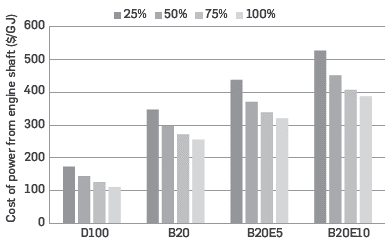
The fuels used in this study in Turkey are DF, BD, and ethanol, with pump prices of $1.4/L, $8.99/L, and $12.49/L, respectively. These prices are crucial in the economic analysis. Figure 11 plots the results of . cwork of the fuels at several loads. The cost of the power taken from the engine shaft is lower when using DF because of its lower pump price in comparison with B20 fuel blend. The cost of power taken from the engine shaft was around 111 $/GJ when using DF at the highest load, compared to 256 $/GJ for B20 fuel. However, the cost of power from the engine shaft when using B20E5 and B20E10 fuels at the same engine load was approximately 320 $/ GJ and 387 $/GJ, respectively. As engine power increased with the load for all fuels, the cost of power taken from the engine shaft decreased. For B20E10 fuel at 25%, 50%, and 75% loads, cwork was approximately 526 $/GJ, 451 $/GJ, and 407 $/GJ, respectively. As reported by Doğan et al. (2020), cwork decreased with increasing load for all fuels. The minimum value of cwork was calculated as 0.2 $/MJ at maximum load and HP0 fuel.
The exergoeconomic factor indicates the impact of the engine's investment cost ratio on the total exergy loss costs resulting from fuel usage. Table 10 presents the results of the exergoeconomic factor calculated for various fuels used in the test engine. As shown in Table 10, an increase in engine load led to a decrease in the exergoeconomic factor values. The reason for the increase in exergy losses is the increase in engine load. The exergoeconomic factor values for B20E10 fuel were 2.894%, 1.847%, and 1.162% at 25%, 50%, and 75% engine loads, respectively. The addition of BD in DF reduces the exergoeconomic factor because the cost of exergy losses is much higher in BD than in DF due to the high pump price of BD. At maximum load, the exergoeconomic factor values for DF and B20 are 4.196% and 1.781%, respectively. Upon analysis of all engine loads, it is evident that the exergoeconomic factor of DF is approximately twice as high as that of B20 fuel. At 75% load, the exergoeconomic factor values for B20, B20E5, and B20E10 fuels were calculated as 2.152%, 1.715%, and 1.419%, respectively. The addition of ethanol to B20 fuel results in a decrease in the exergoeconomic factor. Cavalcanti et al. (2019) pointed out that an increase in engine load resulted in an increase in the exergoeconomic factor. At a 9 kW load, the exergoeconomic factor of D25B75 fuel was 0.19%, while at a 27 kW load, it was 0.13%. Similarly, the use of BD in the engine also decreased the exergoeconomic factor. The exergoeconomic factors of B100 and D95B5 fuels are 0.16% and 0.35%, respectively, at a constant load.
Table 10 Exergoeconomic factor and relative cost difference results for test fuels
| Fuel | Engine load (%) | Exergoeconomic factor (-) | Relative cost difference (-) |
|---|---|---|---|
| DF | 25 | 9.084 | 3.884 |
| 50 | 5.887 | 3.068 | |
| 75 | 4.662 | 2.570 | |
| 100 | 4.196 | 2.128 | |
| B20 | 25 | 4.425 | 3.637 |
| 50 | 2.849 | 2.975 | |
| 75 | 2.152 | 2.627 | |
| 100 | 1.781 | 2.421 | |
| B20E5 | 25 | 3.495 | 3.806 |
| 50 | 2.266 | 3.071 | |
| 75 | 1.715 | 2.723 | |
| 100 | 1.414 | 2.522 | |
| B20E10 | 25 | 2.894 | 3.838 |
| 50 | 1.847 | 3.148 | |
| 75 | 1.419 | 2.743 | |
| 100 | 1.162 | 2.562 |
The relationship between cwork and the cost of fuel in the cylinder is demonstrated by the relative cost difference. Therefore, it will be easier to reduce the cost of power from the engine shaft as the engine load increases. Table 10 presents the relative cost difference values calculated for DF, B20, B20E5, and B20E10 fuels in a CI engine at various loads. The infusion of BD into DF reduces the relative cost difference at all loads. For instance, the relative cost difference values for DF and B20 fuels at 100% engine load were calculated to be 2.128 and 2.421, respectively. The relative cost difference increases with the addition of ethanol to B20 fuel. At 100% engine load, the relative cost difference values for B20E5 and B20E10 fuels were calculated as 2.522 and 2.743, respectively. Aghbashlo et al. (2017) reported that the relative cost difference decreased as load increased. They calculated relative cost difference values of 2.1 and 1.5 for B5P25 fuel at loads of 25% and 75%, respectively.
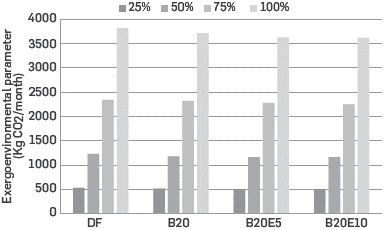
Due to the presence of hydrocarbons in liquid fuels, combustion results in the release of CO2 into the atmosphere, one of the most significant environmental issues worldwide. ICEs are responsible for a significant part of these emissions. Figure 12 illustrates the impact of ethanol addition to BD-DF blends on CO2 emissions. CO2 is a crucial parameter in terms of complete combustion among exhaust emissions. BD has a lower carbon/hydrogen ratio than that of DF, resulting in lower CO2 emissions. Additionally, the addition of ethanol has a positive influence on CO2 emissions because of the oxygen molecule in its chemical structure, which plays a vital role in engine combustion evaluation. At 100% load, the exergoenvironmental parameters for DF, B20, B20E5, and B20E10 fuels were calculated as 3669.56 kg CO2/month, 3652.48 kg CO2/month, 3629.65 kg CO2/month, and 3619.51 kg CO2/month, respectively. The increase in engine load causes a noticeable increase in CO2 emissions. For B20E10 fuel, the exergoenvironmental parameters were 508.11 kg CO2/month and 2253.30 kg CO2/month at 25% and 75% loads, respectively.
Based on the data presented in Table 11, DF incurs the highest cost at all operating conditions. At 50% engine load, the monthly cost of environmental damage caused by CO2 emissions from DF is approximately 5% higher than that of B20E10. At maximum load, the environmental damage costs of DF, B20, B20E5, and B20E10 fuels are calculated as $55.417/month, $53.878/month, $52.629/ month, and $52.483/month respectively.
CONCLUSIONS
In this study, the engine characteristic results and emission parameters were used to perform energy, exergy, exergoeconomic, exergoenvironmental, and sustainability analyses. The addition of BD to DF resulted in a decrease in thermal efficiency and exergy efficiency. The thermal and exergy efficiencies of a DF-BD binary fuel blend declined with the infusion of alcohol. It is noteworthy noting that the language used in this text is clear, objective, and value-neutral, adhering to the desired characteristics of the writing style. This decrease is due to an increase in exergy losses caused by irreversibilities. At 100% load, the thermal efficiency of DF is 9.6% and 14.2% higher than B20 and B20E10 fuels, respectively. Exergy destruction is higher for B20, B20E5, and B20E10 than for DF. The largest entropy production was calculated to be 0.044 kW/K for B20E10 at the highest load. It should be noted that ethanol and BD have higher prices, resulting in higher cwork for DF. Additionally, the highest cost of environmental damage of fuels was calculated for DF at all engine loads. Notably, the cost of environmental damage was significantly mitigated for DF-BD-ethanol ternary fuel blends compared to DF-BD binary blends. At 100% load, the cost of environmental damage for DF, B20, and B20E5 fuels was $55.417/month, $53.878/month, and $52.483/month, respectively. This study suggests that if the costs of BD and ethanol decrease in the future, their use with DF will be more environmentally friendly. Furthermore, the fact that ethanol can be produced from renewable resources highlights the significance of this study. In our world, where oil reserves are decreasing day by day, ethanol is considered a potential alternative given its superior properties compared to many alcohols, as reported by most researchers. It is possible that ternary-blend fuels, together with BD, may become a viable option in the near future, potentially reducing costs.
Energy and exergy analyses are crucial in determining the first and second law efficiencies of fuels. In the future, researchers will gain a different perspective on fuels' economic and environmental evaluations based on the results obtained from energy and exergy analysis. Exergy economic and exergy environmental analyses offer an economic evaluation of environmental concerns and performance in alternative fuel studies.

