




 English (pdf)
 Article in xml format
 Article references

 Automatic translation
 Send this article by e-mail
 Cited by SciELO
 Cited by Google
 Similars in
SciELO
 Similars in Google

 Permalink

Introduction
Currently, 75 % of the enzymes used on an industrial scale are hydrolytic enzymes, with the carbohydrolases, proteases and lipases dominating the enzyme market 1. Lipases (EC 3.1.1.1) and esterases (EC 3.1.1.3) belong to the family of a/p hydrolases, which are characterized by their capacity to hydrolyse and to form ester bonds in organic molecules, such as lipids and fats 1)-(3. These enzymes are industrially important due to their capacity to act in environments with a low concentration of water, allowing them to perform esterification, transesterification, aminolytic and acidolytic reactions 4 with high efficiency and stability. The lipases are able to catalyse enzymatic reactions with efficiency, stability and chemo-, region- and enantio- selectivity, as well as not requiring cofactors and high activity levels in organic solvents make them versatile biocatalysers for industrial purposes 5, including food, dairy, agrochemical, pharmaceutical, cosmetic, and detergent production 5), (6 due to their unique properties, associated with their broad substrate range 7.
By 2017, the industrial demand for lipolytic enzymes will rise 6.2% 5, which means that it is necessary to continue to research and develop technology relating to them. Many of the lipolytic enzymes have poor stability during industrial processes, are denatured at high temperatures or extreme pH (alkaline or acid) and tend to lose activity over time at room temperature, resulting in inefficient catalysts. The industrial demand for lipolytic enzymes that are active at moderate and high temperatures and extreme pH has particularly encouraged the search for extremophilic microorganisms as source of thermostable enzymes 8)-(10. Extremophilic microorganisms are the best source of extremozymes that catalyse reactions at extreme temperatures, extreme pH (acidic or alkaline pH), in the presence of solvents, high salinity, high radiation levels, low water activity or high concentrations of metals, among other environmental conditions 11. However, some of these organisms exhibit slow and scarce growth, hindering the production of enzymes and therefore their subsequent purification and application. Identifying the culture variables that optimize the growth of the organisms that produce the enzymes is an important step in their production 12), (13 .To improve the microbial enzymatic production, it is necessary to consider several factors such as nutrients (sources of carbon and nitrogen), metal ions, pH, temperature, inoculum volume, among others 14.
The microbial communities of acidic environments are characterized by having very diverse and active metabolisms 15, mainly autotrophic and/or mixotrophic. These microorganisms produce active metabolites, including sesquiterpenoids, polyketide-terpenoid metabolites, berkeleydione, and berkeleytrione 16),(17. They also produce stable extremozymes in conditions of extreme temperature and pH and are tolerant to solvents and detergents. Therefore, the search for extremozymes produced by acidophilic microorganisms represents a major challenge, and the exploration of pristine habitats offers possibilities to find enzymes with previously unreported features. The acidophilic organisms have been investigated not only for possible connections to ancient organisms but also for particular physical, structural, and molecular properties that allow them to live in acidic environments 18)-(19. During our previous studies on microbial diversity of acid hot springs in Los Nevados National Natural Park (Los Nevados NNP), we isolated several thermo and mesophilic acidophilic organisms with lipolytic activity tested on different substrates.
We evaluated the strain USBA-GBX-505 (CMPUJ U505 Acidocella, WDCM857), previously isolated from the acidic hot spring “El Coquito”(A4) (Los Nevados NNP) located at 3,973 m.a.s.l (4° 52’ 41.99” N; 75° 16’ 23.41” W) 20, as a source of lipolytic enzymes because our previous studies demonstrated that it is capable of hydrolyzing lipid substrates at ~55 °C. Additionally, we observed the highest lipolytic activity in the intracellular fraction compared to the extracellular fraction, but the strain exhibited a slow growth rate. In the present study we identified the growth factors of A. facilis strain USBA-GBX-505 that allow a higher production of biomass, which facilitated the partial purification and biochemical characterization of the lipolytic enzyme 505 LIP.
Materials and Methods
Microorganism and culture conditions
The acidophilic strain USBA-GBX-505 20 was cultured in modified basal salt medium 991 (M991) 21 containing the following: (g.L-1) (NH4)2SO4 1.3, KH2PO4 0.28, MgSO4 PH2O 0.25, CaCl2 • 2H2O 0.07, and FeSO4 0.02, supplemented with 1 g-L-1 yeast extract, 5 g.L-1 peptone and 10 ml.L-1 trace element solution SL-10 22. The pH was adjusted to 3.5 by using 5 N H2SO4. The microorganism was incubated at 30 °C with agitation at 200 r/min. The inoculum used for all assays was standardized at an absorbance of 0.3 - 0.4 at 580 nm, corresponding to a concentration of ~4 x 10⁸ CFU.mL-1, obtained during the mid-exponential phase of growth (48 hours).
Extraction of intracellular proteins
The biomass was concentrated by centrifugation at 8,000 g for 20 min at 10 °C. The cells were washed twice with Tris-HCl buffer (50 mM, pH 7.5). Then, the biomass was resuspended in the same buffer with 200 pg.mL-1 of lysozyme (Sigma-Aldrich, U.S.A.), and the mixture was incubated at 37 °C for 10 min and placed on ice for 30 min. Cell lysis was performed through sonication using a QSonica Q125 sonicator (Qsonica, Newtown, CT, U.S.A.), in 15 cycles of 30 s sonication pulses at 30% amplitude and 30 s breaks at 0 °C. Finally, the lysate was centrifuged at 8,000g for 25 min at 4 °C, and the supernatant was considered to be the intracellular protein extract 20.
Evaluation of the intracellular lipolytic activity using p-nitrophenyl ester (pNP-ester)
The lipolytic activity was measured spectrophotometrically using the pNP- decanoate (pNP-C10) as a substrate. The enzymatic reaction was performed under the following conditions: 425 pl of Tris-HCl buffer (50 mM, pH 7.5), 25 pl of the substrate pNP- ester at a final concentration of 0.5 mM and 25 pl of the sample 23. The absorbance at 405 nm was measured using a HACH DR 5000™ UV-Vis Spectrophotometer (HACH Loveland, CO, U.S.A.). The blank was Tris-HCl buffer (50 mm, pH 7.5) containing the substratepNP-C10 (0.5 mM). All of the measurements were performed by triplicate. The molar extinction coefficient used was 1.336 x 107 cm2. mol-1.
The specific lipolytic unit was defined as the amount of enzyme that catalysed the formation of 1 pmol of p-nitrophenol (pNP) per min per 1 mg of protein (U.mg-1). Quantification of the total protein was performed using the Bradford technique, with spectrophotometry at 595 nm 24 using bovine serum albumin as the standard.
Identification of culture variables for A. facilis strain USBA-GBX-505
We used a Plackett-Burman (PB) fractional factorial design in order to identify the culture variables that favoured higher levels of biomass production and therefore enzymatic activity. The response surface methodology (RSM) was employed for obtaining the optimum concentration of individual variables that potentially influence the response (lipolytic activity) 25. The PB included eight culture factors at two levels, high (+1) and low (-1): peptone and yeast extract (5 and 10 g.L-1) as the organic nitrogen source; ammonium chloride (NH4Cl, 0.1 and 1.0 g.L-1) and ammonium sulfate ((NH4)2SO4, 0 and 1.0 g.L-1) as the inorganic nitrogen source; Tween 80 and ethyl oleate (0.1 and 1% (v/v)) as the carbon source and inducer of lipolytic activity; pH (3.0 and 5.0); and agitation (0 and 200 r/min). Each experimental round was conducted by triplicate. The dependent variable was the specific intracellular lipolytic activity (U.mg-1) obtained from the cultured biomass after 96 h of incubation.
We used Design-Expert (version 8) software (Stat-Ease, Inc. U.S.A.) to determine the level of experimental error, corroborate the fit of the first-order model and perform regression analysis of the experimental results obtained.
Central composite design (CCD)
The experimental region of the CCD comprised five levels (-1.68, -1, 0, 1, and 1.68) of each of the factors under evaluation 26. The levels of yeast extract, Tween 80® and agitation were evaluated in twenty treatments using Design-Expert (version 8) software, generating a CCD matrix that included axial and central points. All of the treatments were evaluated by triplicate. The dependent variable was the specific intracellular lipolytic activity (U.mg-1).
Statistical analysis of experimental designs
The quality of fit obtained using the first-order-model equation was expressed as the determination coefficient R2; its significance was determined using an F (Fisher) test, and the statistical significance of the regression coefficients was corroborated using the Student’s t test. Analyses of variance were performed to evaluate the results obtained using the PB design, CDD and quadratic model of cultures of A. fadlis USBA-GBX-505 to be used for the production of lipolytic enzyme. Data obtained from the RSM on lipase production were subjected to analysis of variance (ANOVA).
Partial purification of lipase 505 LIP
We used the following culture conditions for the production of USBA-GBX-505 microbial biomass: modified basal salt 991 medium, supplemented with 6.6 g.L-1 of yeast extract and 1% (v/v) Tween 80®, and incubation at 30 °C for 4 d, with agitation at 200 r/min. The intracellular protein obtained as described above, was concentrated and pre-purified using an Amicon ultrafiltration unit of 50 kDa (Merck Millipore Corporation, Darmstadt, Germany) with centrifugation at 3,000 g for 15 min. The resulting extract was loaded on a BioSep-SEC-3000 size-exclusion column (Shodex®, Germany) of 30 cm x 0.78 cm that had been equilibrated with 50 mM Tris-HCl buffer (pH 7.5) and was subsequently eluted at a flow rate of 1 mL.min-1 at 35 °C for 20 min, with detection at 215 nm. We collected and then concentrated by ultrafiltration fractions of 2.5 mL for subsequent protein quantification, evaluation of enzymatic activity and enzyme purification. The fraction exhibiting enzymatic activity that was collected using size-exclusion chromatography (SEC) was loaded on an IEC-DEAE-2025 ion-exchange column (Shodex®) of 15 cm x 2 cm. Then, 50 mM Tris-HCl buffer, pH 7.5 was applied at a flow rate of 1 mL.min-1 at 35 °C for 20 min, after which a gradient of 0 to 1 M NaCl in 50 mM Tris-HCl, pH 7.5 was applied between 20 and 110 min, with detection at 280 nm. We collected, desalted and concentrated by ultrafiltration the subsequent fractions for the quantification of the protein and lipolytic enzymatic activity. The fractions obtained using SEC and ionexchange chromatography (IEC) were evaluated using a diode array detector.
The resulting protein fractions were analysed by electrophoresis in a 10% (w/v) polyacrylamide gel containing sodium dodecyl sulfate (SDS-PAGE) using a Mini-Protean II® system (BioRad, Bio-Rad Laboratories, Inc, U.S.A.) according to the Laemmli protocol 27. Gel staining was performed using an ammoniacal silver-staining protocol 28. The protein molecular weight marker used was V849A (Promega, USA).
Biochemical characterization of purified enzyme 505 LIP
For all the characterization assays, the quantification of the lipolytic activity of enzyme 505 LIP was performed using the p-nitrophenyl-ester technique, with 0.5 mM pNP decanoate (C10) as the substrate, except for substrate specificity evaluations. We calculated the lipolytic activity as the percentage of the residual activity, with 100% activity corresponding to the control (the enzyme without any interfering compound). The evaluations were performed using pNP-C10 at 55 °C in Tris-HCl buffer (50 mM, pH 7.5).
Substrate specificity evaluations
Spectrophotometric method
The evaluation was done using p-NP ester substrates (Sigma-Aldrich) (described above) with different chain lengths at 50 °C and Tris-HCl buffer (50 mM, pH 7.5). The p-NP esters evaluated were acetate (C2), butyrate (C4), octanoate (C8), decanoate (C10), dodecanoate (C12), hexadecanoate (C16) and octadecenoate (C18). All p-nitrophenyl esters were dissolved in 2-propanol to a final concentration of 0.5 mM. The p-nitrophenyl esters > C10 were also mixed with Triton X-100 (0.002 % (w/v) final concentration) (Sigma-Aldrich).
Titrimetric method
We used the titration method to determine the free fatty acids concentrations, according to Seghal et al. (2014) 7. Briefly, the reaction mixture contained 5% (w/v) of the lipidic substrate (tributyrine, tricapryline and trioleate) in Tris-HCl buffer (50 mM, pH 7.5) and 1% of Triton X-100. The reactions were incubated at 50 °C and 200 r/min for 30 min. Then, we added acetone-ethanol mixture (1:1 v/v). The final analysis was carried out using a potentiometric titration technique with 50 mM KOH (end point pH 8.0).
Evaluation of the optimal temperature and pH for enzymatic activity
We evaluated the enzymatic activity at different temperatures in order to determine the optimal one, by exposing the enzyme for 30 min to temperatures ranging between 30 °C and 90 °C in Tris-HCl buffer (50 mM, pH 7.5). Then, the lipolytic activity was quantified as described above. To evaluate the enzymatic activity under different pH conditions, different buffer solutions were used at 50 mM, including MES (pH 5.2 - 6.7), Tris HCl (pH 7.0 - 9.0), HEPES (pH 6.8 - 8.2), BICINE (pH 7.6 - 9.0) and sodium carbonate (pH 9.0 - 11.0). The enzyme was incubated for 30 min at room temperature (23 °C ± 2) and then the lipolytic activity was quantified at 55 °C using pNP-C10.
Effect of various additives on the activity of 505 LIP
We evaluated the effect of different chemical substances on the enzymatic activity by incubating the protein in the presence of each substance for 1 h at room temperature (23 °C ± 2). We evaluated the effect of metallic ions as Ca2+, Fe3+, Mg2+, Zn2+, Cu2+, and Mn2+ at two concentrations, 1 mM and 10 mM, except for the Fe3+ ion, which was evaluated at 1 mM and 5 mM due to the interference caused by the colour formation at 10 mM. The effect of sodium dodecyl sulfate (SDS), Tween 20, Tween 80 and Triton X-100 was evaluated at concentrations of 1 and 5% (v/v). The effect of the inhibitors phenylmethylsulfonyl fluoride (PMSF), ethylenediaminetetraacetic acid (EDTA), 2-mercaptoethanol (2-ME), and dithiothreitol (DTT) was evaluated at 5 mM as final concentration.
Effect of organic solvents on the stability of 505 LIP
The enzymatic activity was also evaluated in the presence of several organic solvents, including 1-butanol, acetonitrile, acetone, 1-propanol, 2-propanol, methanol, ethanol, glycerol and dimethyl sulfoxide (DMSO) at 15 and 30% (v/v).The stability of the enzyme was determined in the presence of 15% (v/v) methanol and 30% (v/v) glycerol at room temperature (23 °C ± 2) for 192 h. The reaction conditions were 55 °C and pH 7.5, and the substrate used was p-NPC10 at 0.5 mM.
All of the chemical products used were of the purest grades available.
Results and Discussion
While searching for extremozymes produced by thermophilic and acidophilic microorganisms in the acidic hot springs at Los Nevados NNP, we isolated several microorganisms with diverse characteristics and lipolytic activities such as the thermoacidophilic alpha-Proteobacterium Aadicaldus USBA-GBX-499 15 and the A. faciis strain USBA-GBX-505 20.
In order to identify the factors that significantly affect the growth of A. fadlis USBA-GBX-505 for the production of biomass and lipolytic enzymes, a PB fractional factorial design was developed. Treatment 2 exhibited the highest lipolytic activity (0.23 U.mg-1). This treatment consisted of the organic nitrogen sources (peptone and yeast extract) and ethyl oleate at a high level (10 g.L-1 and 1% v/v), the sources of inorganic nitrogen (NH4Cl and (NH4)2SO4) at a low level (0.1 g.L-1 and 0 g.L-1, respectively), and the cultures incubated at high level agitation rate (200 r/min). In contrast, the lowest level of activity was detected in treatment 8 (0.002 U.mg-1) and no lipolytic activity was detected (0 U.mg-1) in treatments 10 and 12. All three of these treatments had low levels of agitation (0 r/min) and yeast extract (5 g.L-1). These results showed that little or no growth of the microorganism occurred in the absence of agitation or with a low level of yeast extract.
The analysis of variance (ANOVA) of the PB design (Table 1) showed that the variables yeast extract, Tween 80® and agitation were the culture factors that significantly (p < 0.05) affected the production of biomass and hence of lipolytic enzymes. The nitrogen source for any microorganism serves as a secondary energy source for growth and enzyme secretion; the nitrogen is especially important in regulating the synthesis of hydrolases 29. Sharma et al., (2012) 30 showed that yeast extract was the main nitrogen source for lipase production by B. licheniformis MTCC-10498. In contrast, ammonium phosphate was the main source of nitrogen for lipase production by G. thermoleovoransDA2 31. The Tween 80® is widely used as a carbon source by microorganisms producing esterases such as Acidphi/um sp. AIU (formally, Acidocella facilis)32 and Acidocella aminolytica33. From our results, ethyl oleate, peptone, inorganic nitrogen sources ((NH4)2SO4, NH4Cl) and pH did not have a significant effect.
Table 1 Matrix and analysis of variance (ANOVA) of the Plackett-Burman experimental design used to evaluate various culture factors of Acidocella facilis USBA-GBX-505 for the production of lipolytic enzymes. T80: Tween 80®, EO: Ethyl oleate, Pep: Peptone, YE: Yeast extract, Dp Dummyl, D2: Dummy2, D3: Dummy3, TTo: Treatment. ^Specific intracellular lipolytic activity after 48 h of culture at 30 °C.
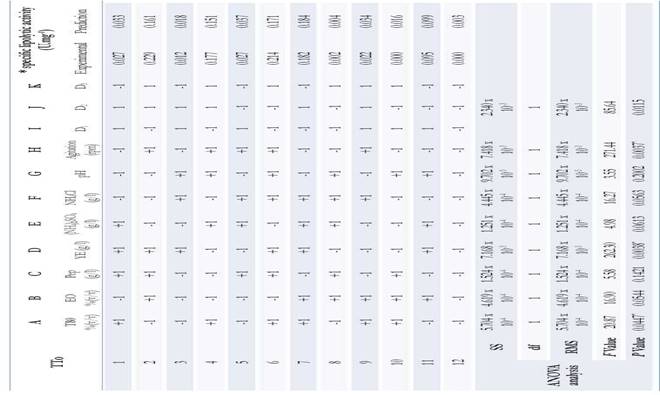
The first-order model generated through the data analysis indicated a sample variation of 98.9%. Therefore, we can deduce that there was a relationship between the culture factors of A. faalis USBA-GBX-505 and its production of lipolytic enzyme. Only 1.1% of the total variation could not be explained by the model. Even the R2 Pred of 0.929 demonstrated that there was a strong correlation between the experimental values and the values predicted using the following linear model:
Equation 1. First order model:
 ()1
where A: Tween80®, B: Ethyl oleate, C: Peptone, D: Yeast extract, E: (NH4)2SO4, F: NH4Cl, G: pH, H: Agitation, and K Dummy2.
The positive regression coefficient of 0.024 (p = 0.0038), 0.025 (p = 0.0037) and 6.9 x 10⁻³ (p=0.0447) for yeast extract, agitation and Tween 80®, respectively, confirmed that these factors had a significantly positive effect on the production of lipolytic enzymes by A. facilis USBA-GBX-505. Therefore, we used these factors in the CCD experiment.
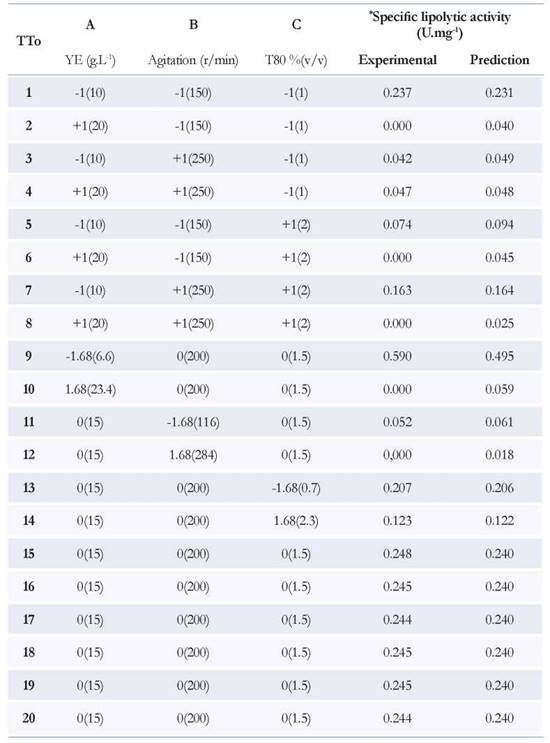
Considering that all three significant factors had a positive effect in the PB-design- based experiment, we decided that the highest levels of yeast extract and Tween 80®, previously evaluated using the PB design, would be the low levels in the CCD-based experiment. Hence, in the CCD-based experiment, the low level of yeast extract was 10 g.L-1 and that of Tween 80® was 1 % (v/v). In the PB-design-based experiment, two agitation levels were evaluated, low (0 r/min) and high (200 r/min), and a tendency towards a higher lipolytic activity was observed in the treatments with a high agitation level; therefore we decided to evaluate agitation rates that were lower and higher than 200 r/min. Three factors were evaluated at 5 levels for a total of 20 treatments. Table 2 shows the composition of each of the experimental treatments and their respective specific lipolytic activities.
Treatment 9 had the maximal intracellular lipolytic activity of 0.6 U.mg-1 experimental and 0.5 U.mg-1 predicted, as well as the highest biomass level of 8 x 10⁷ CFU. mL-1. In contrast, treatments 2, 6, 8, 10 and 12 did not show any lipolytic activity (Table 2). Table S1 shows the ANOVA results used to compare the mean values at p = 0.001 (p < 0.05), which demonstrated that there were significant differences among the treatments. The results confirmed that treatment 9 independently stimulated the production of lipases by A. facilis USBA-GBX-505 and that the levels of Tween 80®, yeast extract and agitation used in treatment 9 enhanced the production of lipolytic enzymes by this chemoorganotrophic organism whose growth is favoured by protein substrates 34. These substrates most likely served not only as nitrogen sources but also as sources of B-complex vitamins, as reported before 35. Moreover, previous reports indicate that the sources of organic nitrogen affect the growth of the organism and are directly related to the production of lipases 36.
Table 2 Matrix of the experimental central composite design (CCD) used to evaluate 3 culture factors of Aadocellafacilis USBA-GBX-505 for the production of lipolytic enzymes. YE: Yeast extract, TTo: Treatment. ^Specific intracellular lipolytic activity after 48 h of culture at 30 °C
The experimental data obtained were analysed using the surface response methodology, and the fit of the second-order model was evaluated and the coefficients of the second-order polynomial were generated through multiple regressions. The quality of the fit of the model (p = 0.0433) was evaluated using the determination coefficients and an ANOVA. The quadratic model of the response surface was adjusted using the following equation:
Equation 2. Second-order model:
 ()2
where: A: Yeast extract, B: Agitation, and C: Tween 80®.
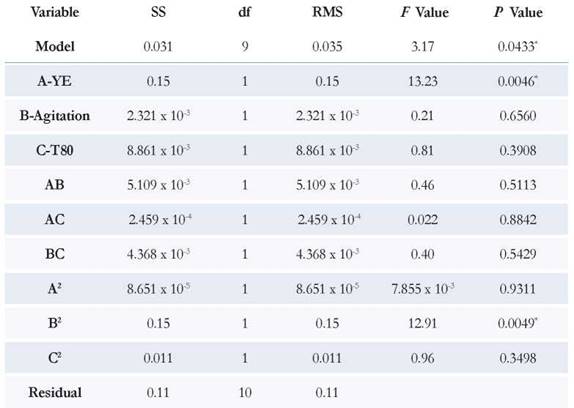
Based on the results of the ANOVA of the CCD-based experiment (Table 3), the Fisher F value at 3.17 and the p value (0.0433,p < 0.05), we consider that the model (Equation 2) was significant. The highest F values were observed for yeast extract (A) and agitation2 (B2); therefore, these two values had a significant effect (p < 0.05) on the growth of A. facilis USBA-GBX-505 for the production of lipolytic enzymes. Likewise, as shown in Table 3, the quadratic effect of the agitation rate (p = 0.0049) was significant compared with its linear effect (p = 0.6560). The other significant value for the production of lipases was the linear effect of the yeast extract level (p = 0.0046). In summary, yeast extract and agitation were the factors that had a significant effect (p < 0.05) on the growth of A. facilis USBA-GBX-505 for the production of lipolytic enzymes. Figure 1 shows the interaction between these two factors in which the best response was observed using an agitation rate of 200 r/min and 10 g.L-1 of yeast extract. An inversely proportional linear effect of the yeast extract level and the specific lipolytic activity was also observed. This result indicated the possibility that at a yeast extract concentration of less than 10 g.L-1, lipase production might increase. This result is similar to that reported for Burkholderia sp. strain C20, for which a concentration of yeast extract greater than 2 g.L-1 caused a decrease in lipase production, likely due to substrate inhibition of the nitrogen source 37. The other significant factor for the production of lipolytic enzymes by A. facilis USBA-GBX-505 was the agitation rate. The agitation rate is one of the most important culture parameters because increasing this rate increases the oxygen transfer rate as well as the mixing efficiency of the culture, finally leading to increased cellular growth and lipase production 38. Such is the case of Acinetobacter radiomistens, for which the optimal yield of lipases was observed at an agitation rate of 600 r/min 39.
Table 3 Analysis of variance (ANOVA) of the data obtained using the CCD-based quadratic model of Aadocella facilis USBA-GBX-505. SS: Sum of squares, df: Degrees of freedom, RMS: Root mean square R2. 0.7954, R2 Adjust: 0.5970, Adeq Precision: 6.932, CV%: 9.69, Std Dev: 0.10 ^Significance atp < 0.05.
In summary, we observed the highest specific activity in treatment 9, which increased the enzymatic activity level by 4.5-fold compared with that obtained using the initial culture conditions (agitation at 0 r/min, 5 g.L-1 peptone, 1 g.L-1 yeast extract and 1% (v/v) Tween 80®), under which the intracellular specific enzymatic activity was only 0.13 U.mg-1 (data not shown). Tween 80® is one of the factors improving the production of the lipase enzyme by A. faciis strain USBA-GBX-505 in the first screening experiments conducted with the PB-based design; it has also been reported to be important for other organisms, such as Burkholderiaglumae PG1 40 and Staphylococcus epidermidis AT2 41. Tween 80®, a surfactant agent, is also used as a substrate for the production of lipases and esterases, in many cases efficiently increasing their synthesis rate 42. For A. facilis USBA-GBX-505, this compound could serve as the only carbon source and as an inducer of lipolytic activity.
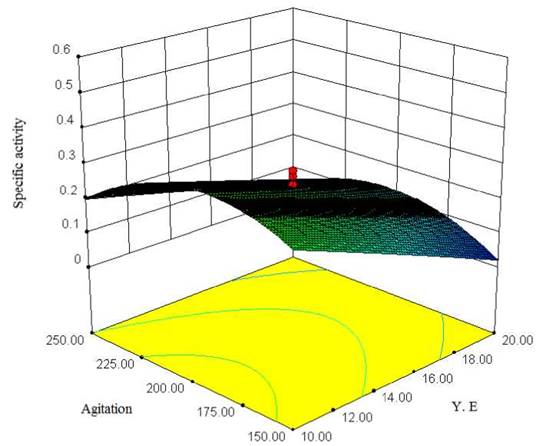
Fig. 1 Response surface curve showing the effect of yeast extract (YE) and agitation on the culture of Acidocella facilis USBA-GBX-505 for the production of lipolytic enzymes.
The analysis of the factors associated with the production of microbial lipolytic enzymes has been the focus of various studies because it is known that each microorganism has specific requirements and particular conditions for the maximization of the production of enzymes. Among the factors associated with the production of lipases are lipid inducers, which are mainly used as carbon sources, organic and inorganic nitrogen sources and oligo elements, among others 36. To date, the only knowledge regarding optimization of the production of lipolytic enzymes by an acidophilic microorganism concerned a strain of Bacillus pumilus, which grows at pH 1.0, for which the production of an acid lipase was enhanced by optimizing the pH, temperature and lipid-substrate concentration (palm oil: 5% (v/v)) 43. Likewise, there are reports concerning fungi such as Aspergillus wentii that grow at a pH lower than 5.0, for which the yield of lipase was increased by adding peptone and yeast extract to the culture medium 44.
Our results demonstrated the culture conditions for A. facilis strain USBA-GBX-505 that increased its lipase production, which were as follows: modified 991 medium supplemented with yeast extract at 6.6 g.L-1 and Tween 80® at 1.5% (v/v), with an agitation rate of 200 r/min. Next, we proceeded to culture A. facilis USBA-GBX-505 under these particular conditions to obtain a protein extract with lipolytic activity and then to biochemically characterize the lipolytic enzyme it produces.
Partial purification of the lipolytic enzyme of A. facilis USBA-GBX-505
We established a purification method for lipolytic enzymes based on semi-preparative high-performance liquid chromatography (HPLC). The intracellular protein extract, obtained as previously described, was concentrated using 50 kDa Amicon ultrafiltration units, yielding two fractions: the first fraction containing proteins of < 50 kDa and the second fraction containing proteins of > 50 kDa. Assessing the lipolytic activity of the two fractions demonstrated that the second fraction had lipolytic activity. Therefore, we used this fraction for subsequent purification using SEC, from which three fractions were collected; the first fraction, collected between 5 and 7.5 min, showed lipolytic activity. This fraction was concentrated using a filtration system designed for 50 kDa proteins, after which IEC was used to increase the purity level of the active fraction. This fraction was eluted from the ion-exchange column at 180 min in 0.8 M NaCl/50 mM Tris-HCl (pH 7.5). The changes in the purity level of the active fraction throughout the partial purification process and the molecular mass of the enzyme were determined using SDS-PAGE (Figure 2). In the third lane of the SDS-PAGE gel shown in Figure 2, which corresponds to the active fraction obtained using IEC, multiple bands were observed, indicating that the active protein was partially purified. This enzyme, denominated 505 LIP, had a molecular weight greater than 77 kDa. The extracellular esterase that was isolated and purified from A. facilis strain AIU409 using genomic methods had a molecular weight of ~64 kDa 45, indicating that that esterase and the 505 LIP are two different kinds of esterases, which are expressed in two different strains of the same species.
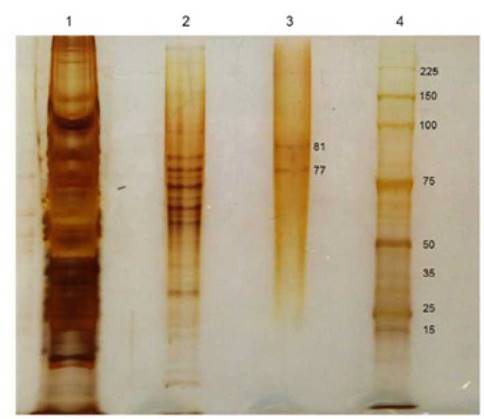
Fig. 2 SDS - PAGE electrophoresis gel (10% (w/v)) of AddoceHafaciHs strain USBA-GBX-505 lipase purification process. Lane 1: Crude extract, Lane 2: Active fraction collected using size-exclusion chromatography (SEC), Lane 3: Active fraction collected using ion-exchange chromatography (TEC). Lane 4: 6.5-200 kDa V849A (Promega, USA).
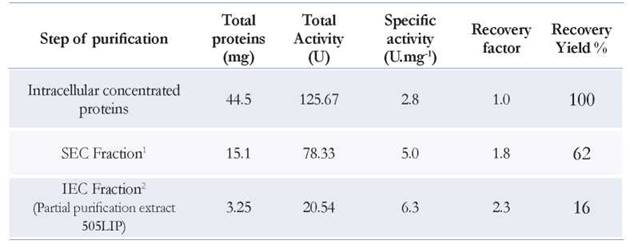
The enzyme 505 LIP was purified with a recovery yield of 16%. The specific activity of this enzyme was 6.3 U.mg-1, and the recovery factor of its activity was 2.3 times greater than prior to purification (Table 4). Several authors have stated that protein purification yields of between 2 and 20 % could be due to the formation of protein aggregates during purification because a large amount of enzyme can be lost as insoluble material, particularly when solutions with a pH of < 12 are used 46)-(47.
Table 4 Results of the strategy used to purify the lipolytic enzyme 505 LTP of Addocella facilis USBA-GBX-505. 1Active fraction collected using a size-exclusion column (SEC), 2Active fraction collected using an ion-exchange column (TEC).
Biochemical characterization of the lipolytic enzyme 505 LIP
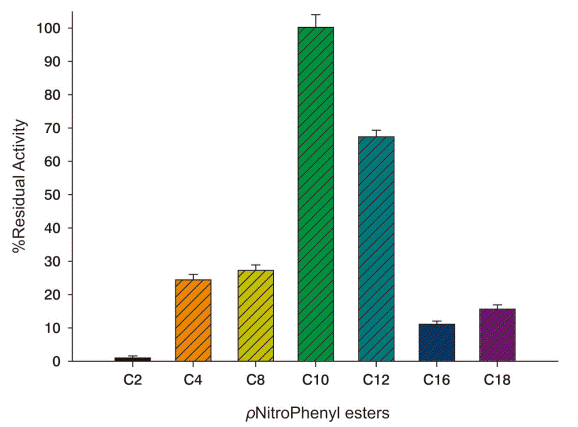
The highest enzymatic activity of the 505 LIP was exhibited towards medium-chained pNP esters (Figure 3), such as decanoate (C10) and dodecanoate (C12), a finding that allowed to establish that the 505 LIP is a lipase, given that true lipases are enzymes that hydrolyse long-chain acylglycerols (with > 10 carbon atoms) and natural lipids 3. However, its activity towards C16- and C18-acylglycerols was greatly decreased and a low level of enzymatic activity towards short- (C4) and medium-chained (C8) substrates was observed. Moreover, we evaluated the lipolytic activity on tributyrine, tricapryline and trioleate, and the results showed partial hydrolysis of 5, 40 and 10 % respectively after 24 h of reaction.
The optimal temperature for the 505 LIP activity was measured in the range of 30 °C to 90 °C (Figure 4) using pNP-C10 as the substrate. The highest levels of activity were observed between 45 °C and 60 °C, with 55 °C being the temperature at which the maximal activity toward pNP-C10 was detected. The lipolytic activity decreased by more than 50% at temperatures of less than 40 °C and greater than 65 °C. Therefore, the enzyme 505 LIP is classified as moderately thermophilic, with an optimal lipolytic activity temperature of 55 °C. The optimal temperature of the enzyme 505 LIP also differed from that of the esterase produced by A. facilis AIU409, which had an optimal temperature of 70 °C 45. However, the optimal temperature of the 505 LIP is similar to that of the lipase derived from the acidophilic organism B. pumilus (50 °C). Other lipolytic enzymes derived from acidophilic organisms include the lipolytic enzyme produced by the thermoacidophilic microorganism Alicyclobacillus acidocaldarius, with an optimal temperature of 60 °C 48, and the thermophilic esterase produced by Acidicaldus sp. USBA-GBX-499, with an optimal temperature of 55 °C 23.
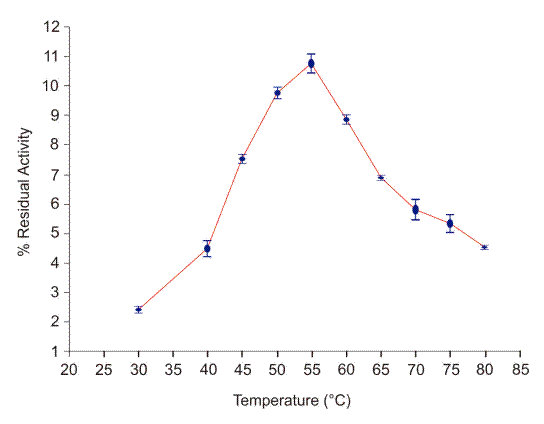
Fig. 4 Evaluation of lipolytic activity of the enzyme 505 LIP on p-nitrophenyl (pNP) esters with fatty acid chains of 4 to 18 C-atoms. Activities are shown as percentages of the maximum activity (10.96 U/mg). Values are means ± SD from three independent experiments.
The lipolytic activity of the 505 LIP was detected at pH values of between 6.0 and 9.0, with maximal activity observed at pH 7.5 (9.76 U^mg-1 lipolytic activity of 505 LIP), and the enzymatic activity decreased as the pH became more alkaline. In contrast, the optimal pH for the growth of A. facilis strain USBA-GBX-505 was pH 3.5. The optimal pH value for the growth of this strain is probably different to the intracellular pH values of several acidophilic organisms that have various strategies for adaptation under acidic pH conditions, which are related to maintaining their intracellular pH at an approximately neutral value 49. This result contrasts with that reported for the extracellular esterase of A. facilis AIU409, whose optimal activity was observed at pH 4.0 45. This optimal pH also differs from that of the lipase produced by the acidophilic microorganism B. pumilus, which had an optimal enzymatic activity at pH 1.0. The enzyme activity also could be affected by the buffer composition, because the enzymes have preferences for ionic strength (salt concentration) and major cation (sodium or potassium).
Effect of metallic ions on the activity of the enzyme 505 LIP
The activity of the enzyme 505 LIP decreased in the presence of various ions at 1 and 10 mM (Table 5), by between 40 and 100%, becoming totally inhibited in the presence of Fe2+ ions. This finding is contrary to those previously reported on lipolytic enzymes, which showed that metallic ions can play an important role in maintaining enzymatic structural stability and integrity 50, for example the presence of Fe3+ and Mn2+ at 1 mM increased the relative enzymatic activity of the 499EST esterase of Acidicaldus USBA-GBX-499 23. Moreover, under particular conditions, the presence of metallic cofactors facilitated the correct folding of an enzyme 51 and stabilized the structure of the catalytic site of Geobacillus zaihae lipase 52. The negative effects of metallic ions on the activity of proteins could be explained by undesired interactions occurring between ions and the lateral chains of their amino acids, specifically those involving their surface amino acids, causing ionization of these amino acids 53.
Table 5 Effect of different chemical compounds on the activity of the enzyme 505 LIP determined usingjfi>NP-C10 as the substrate at pH 7.5 and 55 °C. A total of 100% activity was set as that observed in the absence of the compound under evaluation. *Fe3+ was the only ion evaluated at 1 and 5 mM due to the interference caused by the color of the 10 mM ionic solution. 100% Activity = 6.3 U.mgA The assays were performed in triplicate, and the mean values and standard deviations are shown.

The organic solvents 1-butanol and DMSO inhibited the activity of the 505 LIP. The loss of enzymatic activity in an organic medium has been found to be due to destabilization of the hydrophobic zone of the evaluated protein, and even polar solvents were found to penetrate the protein and induce structural changes 54. The activity of the enzyme 505 LIP decreased in the presence of acetonitrile, ethanol, 1-propanol and 2-propanol but was not totally inhibited. The lipolytic activity of the 505 LIP was enhanced in the presence of acetone at 15% (v/v), methanol at 15% (v/v) and glycerol at 30% (v/v) (Table 5). The positive effect of these factors on lipolytic activity levels has been reported for other lipolytic enzymes, e.g., the Pyrococcus furiosus phospholipase, which has an increased level of enzymatic activity in the presence of methanol and ethanol 55 and the Aspergillus carneus thermal-alkaline-resistant esterase, which has an increased level of activity and thermal stability in the presence of glycerol 56. Stability in the presence of organic solvents is an important property for lipolytic enzymes that are used in non-aqueous systems because it ensures that catalytic reactions can occur under these conditions 57. This can expand the repertoires of transformations catalysed by lipases, where numerous reactions might be used in the field of synthetic and polymeric chemistry with high selectivity 58. The presence of organic solvents, such as glycerol in the reaction medium of a lipolytic enzyme, can improve enzymatic activity because they can promote the formation of some hydrogen bonds under anhydrous conditions, generating stable conformations and avoiding structural rigidity and the occurrence of strong electrostatic interactions 59)-(60. Lipases with stability on organic solvents are required for the synthesis of many useful products, such as the production of biopolymeric materials, biodiesel and in the synthesis of fine chemicals 61)-(62.
Effect of methanol and glycerol on the stability of the enzyme 505 LIP
Since methanol at 15 % (v/v) and glycerol at 30 % (v/v) increased the enzymatic activity, the stability of this protein in the presence of those substrates was evaluated (Figure 5). We found that the enzyme 505 LIP not only remained stable in the presence of glycerol for 8 d at room temperature (23 °C ± 2) but that its activity increased by 50 %. On the other hand, in the presence of methanol, the enzymatic activity increased during the first 24 h of incubation and then decreased by 96 %. The enzymatic stability in the presence of solvents is relevant because they can increase the solubility of nonpolar substrates and the thermal stability of enzymes as well as decrease the levels of water-dependent secondary reactions 60)-(63. The polymerization reactions and transesterifications demand harsh conditions provided by the presence of organic solvents and/or high temperature, furthermore industrial lipolytic enzymes are often used in organic media rather than aqueous media 64.
Effect of detergents on the activity of the enzyme 505 LIP
Regarding the effect of detergents on the enzymatic activity (Table 5), this enzyme exhibited only 10 % of activity in the presence of SDS, in contrast to Triton X-100 and Tween 80, which showed an enzymatic activity of 80 - 90 %. The SDS molecules bind to proteins mainly via hydrophobic interactions, causing the unfolding of their tertiary structures and affecting their activities 65. In contrast, non-ionic surfactants such as Tween 20® increased the enzymatic activity of the 505 LIP by up to 22 %.
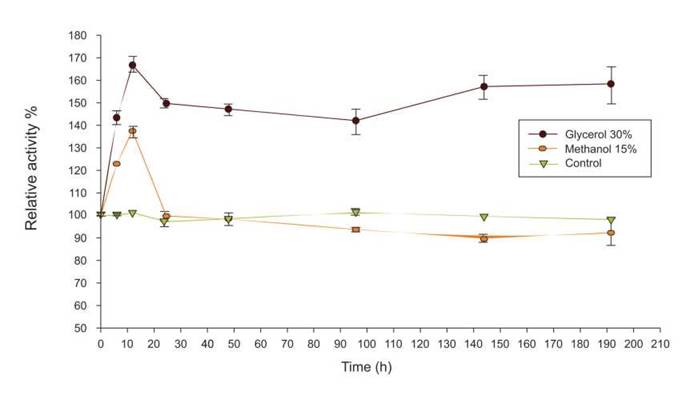
Fig. 5 Evaluation of lipolytic activity of the enzyme 505 LIP on y-nitrophenyl (pNP) esters with fatty acid chains of 4 to 18 C-atoms. Activities are shown as percentages of the maximum activity (10.96 U/mg). Values are means ± SD from three independent experiments.
Supplementation with a detergent is widely used in biocatalytic settings to resolve pharmaceutical intermediates in non-aqueous media 66. Additionally, non-ionic surfactants can prevent the denaturation and aggregation of proteins 67. It has also been reported that Tween 80® can adversely affect protein stability by causing oxidative damage generated by residual peroxides of Tween 80® that have undergone autooxidation 68.
Effect of inhibitors on the activity of the enzyme 505 LIP
The evaluation of the effect of inhibitors on the enzymatic activity (Table 5) shows that EDTA inhibited this activity by 70 % and that PMSF inhibited this activity by 73 %. PMSF is known to inhibit enzymatic activity by affecting the serine in the catalytic site 10, and it is likely that the decrease in the enzymatic activity was caused by modification of an essential serine residue in the active site 63. The reduced enzymatic activity observed in the presence of the reducing agents DTT and (3-ME could be due to the reduction of covalent disulfide bonds between the cysteine residues within this protein, thereby affecting its stability and structure.
Conclusions
The yeast extract and agitation were key factors in increasing the biomass of A. facilis strain USBA-GBX-505 and therefore increasing its growth-associated lipolytic activity. The activity of intracellular lipolytic enzyme from A. facilis strain USBA-GBX-505 was improved by 4.5-fold once the strain was cultured with supplementation of 6.6 g.L-1 yeast extract and 1 % (v/v) Tween 80®, and incubation at 30 °C for 4 d, with agitation at 200 r/min. The partial purification of this enzyme using SEC and IEC provided a recovery yield of 16%. The partially purified enzyme, the 505 LIP, is a moderately thermophilic, intracellular lipase (55 °C) that exhibited the highest enzymatic activity toward middle-chain substrates, particularly ^NP-C10, at a neutral pH (pH 7.5). The activity of this enzyme is favoured by organic solvents such as glycerol and methanol. This enzyme is stable in the presence of these solvents for a period of 8 d. These characteristics differed from those reported for the esterase produced by A. facilis strain AIU409 (called AIU409), suggesting that the enzyme 505 LIP is a novel enzyme produced by a member of the Acidocellafacilis species. In further studies, the esterification and transesterification reactions of the 505 LIP will be evaluated based on the biochemical characteristics already determined in this study.

