




 text in
 English (pdf)
 Article in xml format
 Article references

 Automatic translation
 Send this article by e-mail
 Cited by SciELO
 Cited by Google
 Similars in
SciELO
 Similars in Google

 Permalink


INTRODUCTION
The Guajira Peninsula is the northernmost point of Colombia and the South American subcontinent. This semi-arid territory has a generally low coast, with sandy and saline plains, and an extensive marine continental shelf. The development of reef terraces in the region is limited by various factors: the absence of sufficiently firm substrates to allow the settlement of sessile organisms; the predominant winds from the east and northeast, which transport clayey sediments from the continent, generating waves and strong tides that cause resuspension and high turbidity; and the influence of an upwelling phenomenon that cools and enriches the surface waters (21 - 25°C) in the first months of the year (Díaz et al., 2000).
Until now, the literature had recorded the existence of coral formations in La Guajira in the bays of Portete (Garzón-Ferreira and Díaz, 2003) and Tukakas, with Portete being the most developed and extensive (Prahl and Erhardt, 1985; Solano, 1994; Díaz et al., 2000). These formations are found in shallow seabeds, at depths not exceeding 5 m (Garzón-Ferreira and Díaz, 2003). In Bahía Hondita, seagrass meadows and mangrove forests were known, while in Bahía Honda only a small seagrass meadow had been recorded on its northeastern side (Díaz et al., 2003).
Bahía Honda (Figure 1), the smallest of the three bays in Alta Guajira, is located at coordinates 12° 21´ 11.14´´ N, 71° 47´ 0.4´´ W, between Hondita Bay to the north and Portete Bay to the south. It is characterized by the absence of mangroves, its low elevation, limited to a few cliffs on the southwestern side, and a small resident human population. On its western side, there is the wreck of a cargo ship that has been stranded near the coast for more than 20 years. According to the local communities, navigation from that point to the end of the bay is not advisable due to the presence of rocks in shallow, rough and very turbid waters.
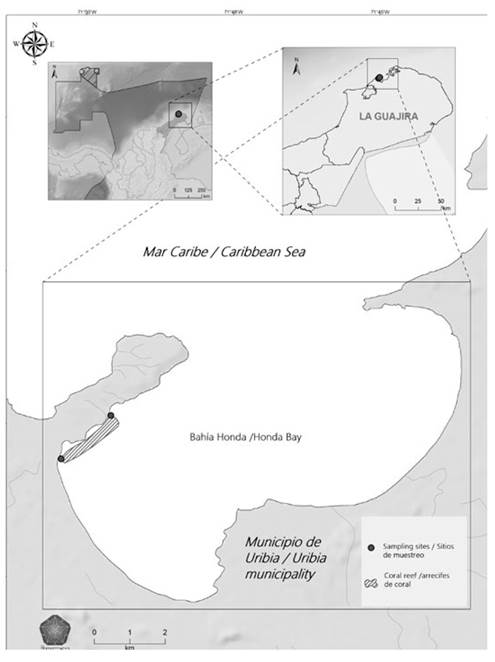
Figure 1 Geographic location of Bahía Honda, shape and location of the mixed coral reef and Acropora palmata. Prepared by the Research Services Laboratory, Invemar
During an expedition carried out on August 15, 2022 to the Hondita, Honda and Portete bays, in the framework of the GIZ-Invemar agreement, Invemar researchers and Corpoguajira officials found that visibility in Bahía Honda exceeded 5 m both horizontally and vertically. This made possible the observation of a coral reef never described before, on the eastern side of the ship wreck.
Bahía Honda reef (Figure 1) is made up of two sections differentiated by the dominant ecological unit. The first section, with an extension of 30 m long by 20 m wide and located between 2 and 4 m deep, is characterized as an ecological unit of mixed corals, with a considerable number of coral species (Table 1). In this section, massive growth corals predominate, among which Colpophyllia natans, Pseudodiploria strigosa and Siderastrea siderea stand out for their abundance and size (Figure 2 A, B and F). This unit is consistent with that previously recorded in Portete Bay by Prahl and Erhardt (1985), Solano (1994), Díaz et al. (2000) and Reyes et al. (2010).
The mixed coral section is in an excellent conservation status. Among the observed species, the presence of elkhorn coral, Acropora palmata, colonies of considerable size stands out (Figure 2 E), a species listed as “critically endangered” by the IUCN (2022) and “endangered” by Ardila et al. (2002) . Some colonies of Acropora prolifera were also observed. Other observed species such as Stephanocoenia intersepta and Mycetophyllia ferox are also considered Vulnerable or Endangered (Ardila et al., 2002).
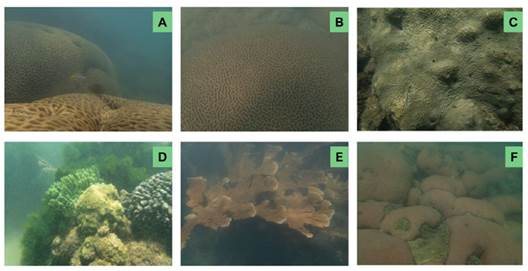
Figure 2 Some of the coral species observed in the initial portion of the reef in Bahía Honda in 2022.. A) Colpophyllia natans, B) Pseudodiploria strigosa, C) Pseudodiploria clivosa, D) Porites astreoides and Porites porites, E) Acropora palmata and F) Siderastrea siderear..
The second section corresponds to a shallow fringing reef that extends about 1.8 km in a northeasterly direction, towards the tip of the bay. In this area, A. palmata formations are predominant, which possibly makes this reef the largest in the Colombian continental Caribbean with this species at present. This formation had not been documented in previous publications on Colombian coral areas (Prahl and Erhardt, 1985; Solano, 1994; Díaz et al., 2000; Reyes et al., 2010), nor in the last report about A. palmata formations in the Colombian continental Caribbean (García-Urueña et al., 2022), in which the formations of the Tayrona National Natural Park are mentioned as the northernmost.
The backterrace of the reef, with less than 0.5 m depth is dominated by skeletons of A. palmata, colonies of hydrocorals Millepora complanata and M. alcicornis, as well as by crustose colonies of Porites astreoides, Siderastrea radians, Favia fragum and recruits of A. palmata. Colonies of elkhorn coral are abundant on the crest and descend to approximately 3 m depth, where they are replaced by large colonies of C. natans, P. strigosa and S. siderea (Figure 3 A and E).
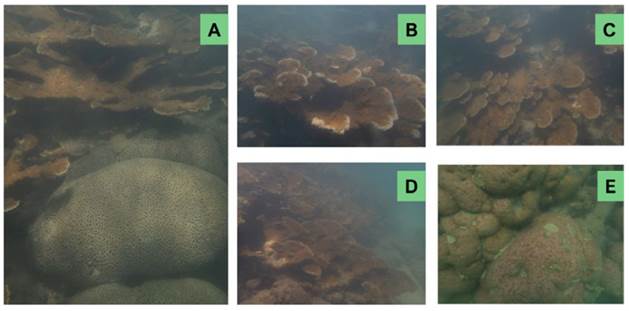
Figure 3 Images of the A. palmata reef in Bahia Honda. A) A. palmata boundaries and succession of large hemispherical colonies of C. natans and P. strigosa; B, C and D) views of the distribution, density and conformation of A. palmata colonies, and E) S. siderea colonies located at the base of the barrier, affected by dark spot disease..
In this initial exploration, 22 species of hermatypic corals were recorded (Table 1), eight of which had not been previously recorded for La Guajira (Prahl and Erhardt, 1985; Díaz et al., 2000; Reyes et al., 2010): A. palmata, A. prolifera, Diploria labyrinthiformis, Mycetophyllia lamarckiana, M. ferox, Meandrina meandrites and Dichocoenia stockesii, all of which are common in the Colombian continental Caribbean. Special mention should be made of the presence of at least ten colonies of a Millepora ecoform, dispersed in the mixed coral ecological unit at different depths. These colonies are sphere-shaped, with sizes varying between 30 cm and 1 m in diameter (Figure 4). The branches are arranged uniformly, without protruding from the surface of the sphere. This particular shape has not been mentioned in previous studies such as that of Wedler (2017), where only other ecoforms of M. complanata and M. alcicornis are described. Both species were observed both in the mixed coral fringe and in the A. palmata barrier, dominating the shallow areas, as occurs on the terrace of Portete bay (Solano, 1994).
Tabla 1 List of hermatypic coral species observed in the Bahia Honda reef formation. The numbers correspond to records published previously and are listed below: X observation by the authors; 1) Prahl and Erhardt (1985); 2) Díaz et al. (2000); 3) Solano (1994); 4) Reyes et al. (2010). LC - Low Concern; VU - Vulnerable; EN - Endangered..
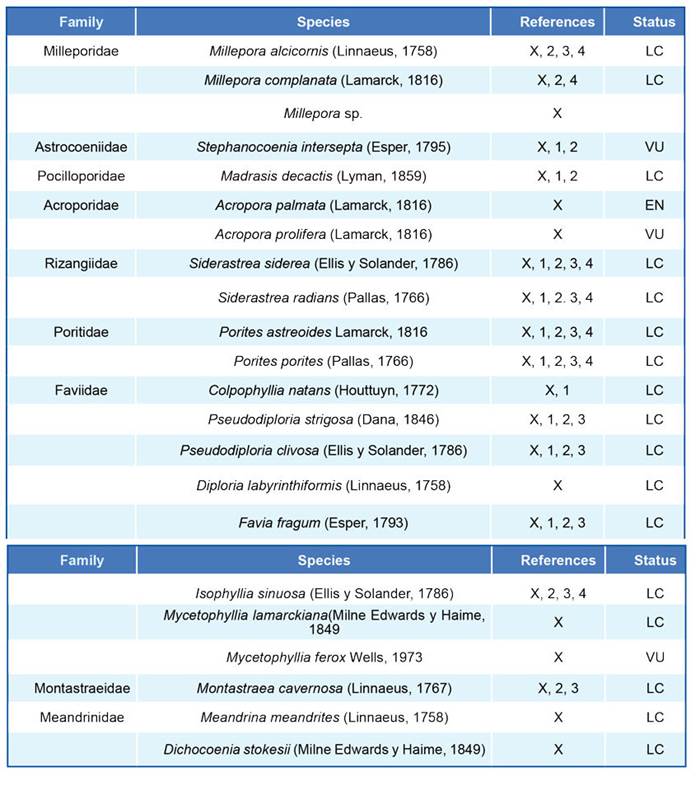
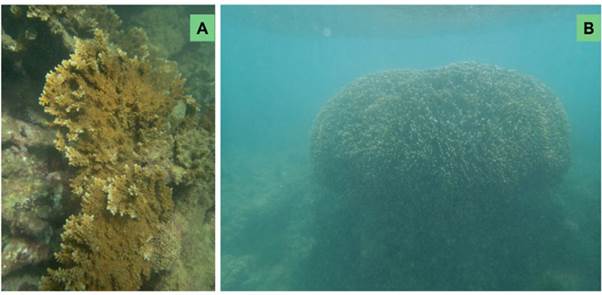
Figura 4 (A) Acropora prolifera specimen and (B) unrecorded Millepora ecoform observed on the Bahía Honda reef.
Compared to the reefs of Bahía Portete, where Prahl and Erhardt (1985) recorded 13 species and Díaz et al. (2000) 26, important differences were observed in species number and composition in this reef. In Bahía Honda; structuring species such as Orbicella annularis and O. faveolata, present in Portete Bay, were not recorded. This could be due to local conditions or the need for more in-depth characterization.
Regarding coral health, the Bahía Honda reef is in good general condition, with Dark Spot Disease (DSD) (Gil-Agudelo et al., 2009; Navas-Camacho et al., 2010) affecting only S. siderea colonies, with no evidence of associated mortality (Figure 3 E). No damage caused by anchors, nets or dynamite was observed, probably due to local fishermen’s lack of knowledge of the reef’s existence and its richness in fish.
Regarding fish, 30 species from 12 families were identified (Table 2). Among them, Lutjanus cyanopterus stands out (Figure 5), a large species that, in this reef, was observed in groups of up to 12 young individuals of approximately 60 cm in length, which suggests that the reef and the nearby wreck are being used as nurseries.
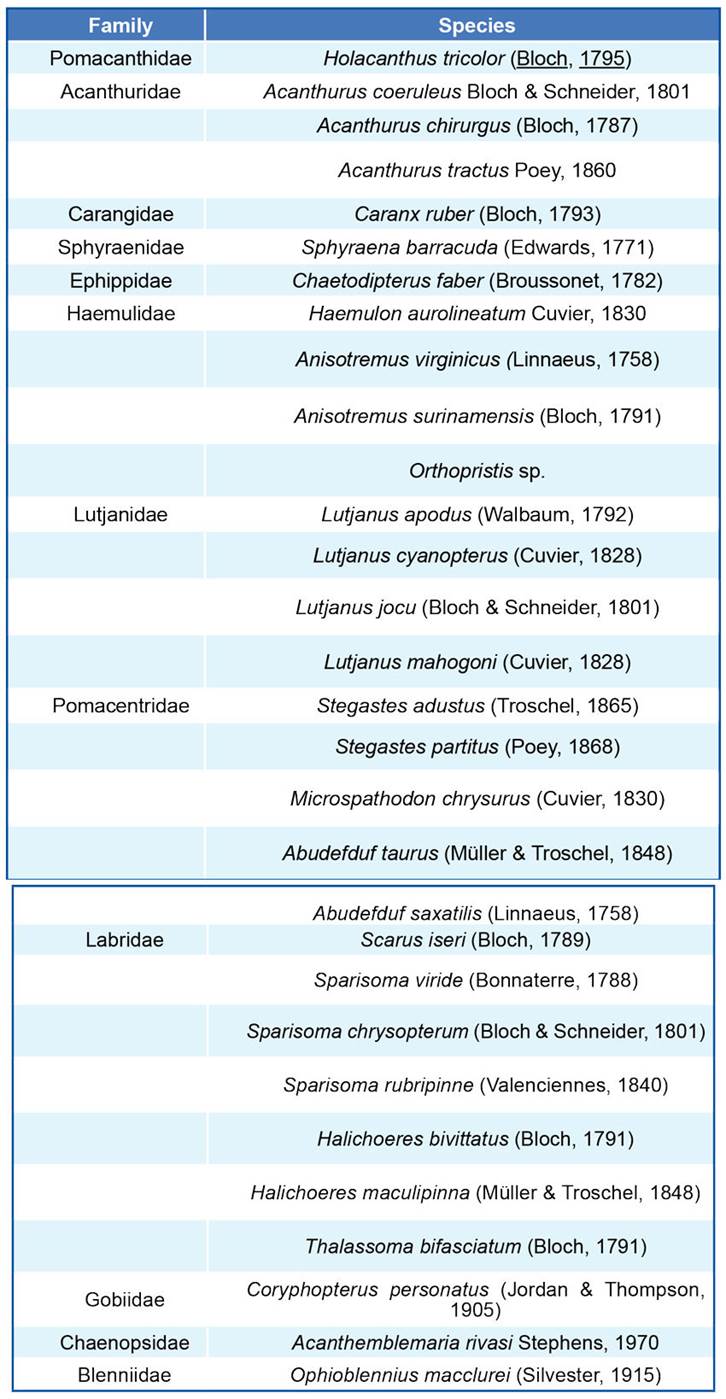
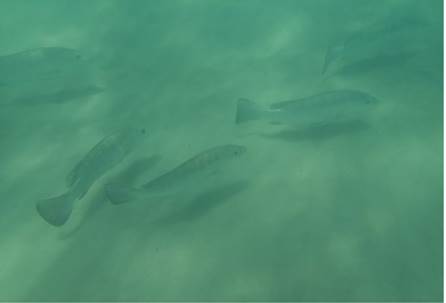
Figura 5 Group of specimens of the cuberasnapper Lutjanus cyanopterus present in the Bahía Honda reef.
The Bahía Honda fringing reef, particularly the extensive A. palmata barrier, constitutes a relevant coral ecosystem for Alta Guajira and the Colombian continental Caribbean. Its good state of conservation could be attributed to factors such as low population density, water turbidity, and the local perception of corals as “stones,” which limits human activities in the area. This finding becomes more important in light of the project to build a port in Bahía Honda, highlighting the need for its conservation and research to ensure its future preservation.

