



 text in
  English (pdf)
 Article in xml format
 Article references
 Automatic translation
 Send this article by e-mail
 Cited by SciELO
  Cited by Google
  Similars in
SciELO
Similars in
SciELO  Similars in Google
 Permalink

INTRODUCTION
In recent decades, marine pollution associated with solid waste has gained relevance, being considered one of the most concerning environmental issues (UNEP, 2021, Cerri et al., 2025), with an increase in plastic production of approximately 17% annually (620% between 1975 and 2012) (Jambeck et al., 2015). Currently, it is estimated that approximately eight million metric tons of waste can be deposited in marine ecosystems each year (Ocean Conservancy, 2024), generating multiple ecological and environmental impacts (Bappy et al., 2025; Deakin et al., 2025). Additionally, the quantity of raw materials used for plastic manufacturing has increased, generating additional environmental impacts, with a recorded annual increase of 4% (368 million tons in 2019) (PlasticsEurope, 2020). In this context, it is estimated that plastic production for the year 2050 will be 1,100 million tons (UNEP, 2022).
Marine pollution by solid waste is not only composed of plastics; marine debris is considered to be any persistent, manufactured, or processed solid material that is discarded, disposed of, or abandoned in the marine and coastal environment (Jeftic et al., 2009; Obonaga et al., 2025), including: fabrics, foams, processed wood, paper, among others. However, it has been reported globally that the majority of marine debris (60-90%) consists of plastics (Derraik, 2002; De et al., 2023). This has also been reported for Colombia, where plastic percentages close to 90% have been found in the Ciénaga Grande de Santa Marta (Garcés-Ordóñez et al., 2019; Garcés-Ordóñez et al., 2025) and in Buenaventura (Sánchez-Giraldo, 2025).
One of the ecosystems most vulnerable to pollution from marine debris are mangrove forests, as they exhibit morphological adaptations primarily in the roots (Martin et al., 2019; Vorsatz et al., 2025). Mangroves, being in the transition zone from aquatic to terrestrial environments and from freshwater to marine water, must withstand strong environmental changes, developing additional support structures and physiological adaptations (Duke, 2017; Mendes et al., 2025; Das et al., 2025). Likewise, the support structures related to root development facilitate the accumulation of sediments and living biomass, and prevent coastal erosion by attenuating waves (Romañach et al., 2018). Through this same mechanism, they may also possibly retain large amounts of marine debris and act as a sink for other pollutants (Martin et al., 2019; Kesavan et al., 2025; Kiruba-Sankar et al., 2025).
Considering that annually more than two million tons of plastics enter marine ecosystems from rivers (Lebreton et al., 2017) and that in Colombia the annual plastic consumption per person is 24 kg (1'250,000 tons/year) (Greenpeace, 2018), with more than half being single-use plastics, this issue is of special interest to the coastal regions of Colombia. Marine waste pollution has been mainly reported for the coastal zone of the Colombian Caribbean (Rangel-Buitrago et al., 2018, 2021; Garcés-Ordóñez et al., 2019; Garcés-Ordóñez et al., 2019, 2025) ; however, there is little information available for mangrove ecosystems in Colombia (Garcés-Ordóñez et al., et al., 2019, 2025; Riascos et al., 2019), although there are records of plastic pollution (Vásquez-Molano et al., 2021; Vidal et al., 2021; Vivas-Sánchez et al., 2023; Arboleda et al., 2024; Cañón Bastidas et al., 2025) and other contaminants (Panesso Guevara, 2017; Molina et al., 2023) in Buenaventura and the coastal zone of the Colombian Pacific (Mondragón Díaz, 2023). Taking the above into account, this research aims to determine the variability in the abundance and types of marine debris in mangrove forests in relation to the degree of anthropogenic influence in the Bay of Buenaventura and Málaga Bay, Colombian Pacific.
MATERIALS AND METHODS
Study Area
The present research was conducted in four mangrove forests located in the bays of Buenaventura and Málaga, in the department of Valle del Cauca, Colombian Pacific (Figure 1). In the Colombian Pacific, most of Colombia’s mangrove forests are found (38% within conservation areas) and are composed of the species Rhizophora mangle (red mangrove), Avicennia germinans (black mangrove), Laguncularia racemosa (white mangrove), Conocarpus erectus (buttonwood mangrove), Rhizophora racemosa (pava or caballero mangrove), Rhizophora harrisonii (grafted mangrove), Pelliciera rhizophorae (piñuelo mangrove), and Mora oleifera (nato mangrove) (INVEMAR, 2021). Likewise, the P. rhizophorae and M. oleífera are classified as “Vulnerable-VU” according to the IUCN Red List (Duke et al., 2007; Polidoro et al., 2010), due to trade and urbanization issues. Being the dominant species in the Colombian Pacific R. mangrove, with abundances exceeding 80% in the study areas.
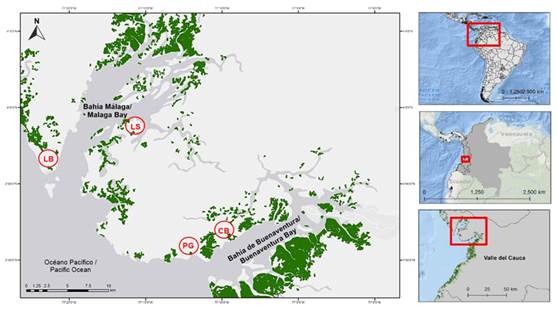
Figure 1 Sampling points in the mangrove forests in Buenaventura Bay (Piangüita - PG; Comba - CB) and in Málaga Bay (La Barra - LB; La Sierpe - LS). Source: Own.
Bahía Málaga is located in the central region of the Pacific coast of Colombia (3° 56’ - 4° 05’ N; 77° 19’ - 21’ W), approximately 36 km north of the port of Buenaventura and has an approximate area of 136 km² in the marine-coastal part. It is characterized by having several biotopes located in a scattered manner throughout its length, such as: mangrove forests, sandy beaches, rocky beaches, tertiary cliffs, among others (INVEMAR et al., 2006). This bay is located within the Uramba Bahía Málaga National Natural Park, which covers an area of 471 km² with ecosystems of very humid tropical forest, beaches, cliffs, islands, and a body of water with soft and rocky sea beds. Regarding the climatic conditions, it has a warm climate with permanent rain throughout the year, temperatures between 18 and 25 °C, and a surface water temperature of 27 °C (National Natural Parks of Colombia, 2010).
In Bahía Málaga, the mangrove forests of La Barra and La Sierpe were studied (Figure 1). The mangrove of La Barra is exposed to greater anthropic pressure due to tourism and its proximity to larger populated centers. The mangrove of La Sierpe is located in the inner part of the bay and experiences less anthropic pressure, despite being in an area valuable for tourism. On the outer part of the bay, fringe mangroves are found, and on the inner part, riverine mangroves (Lucero et al., 2012).
The Bay of Buenaventura is an estuarine system located in the central region of the Colombian Pacific (03° 52′ - 56′ N; 77° 01′ - 16′ W) and is one of the most important ports in the country. It has an approximate area of 682 km2, with a narrow and elongated shape, featuring sediments such as gravel, sand, and mud (Otero, 2005). In this bay, the Dagua and Anchicayá rivers flow into it (POT, 2001). Most of the coastal population is located in the urban area of Buenaventura (the main port of the Colombian Pacific), and in the villages of Piangüita and Punta Soldado (Invermar, 2015).
In Buenaventura, the sea surface temperature is 28.2 °C (Otero, 2005), and it is one of the most humid places in the world (Cantera and Blanco, 2001) with an average annual precipitation of 6508 mm (Lobo-Guerrero, 1993). From January to June, there is a period of low rainfall (dry season), with an average monthly precipitation of 200 to 500 mm, and from July to December, a season of high rainfall, with an average monthly precipitation of 500 to 700 mm (Molina et al., 2020). In Buenaventura, the forests of Piangüita and Comba were evaluated (Figure 1). The Piangüita mangrove is exposed to greater anthropogenic influence due to its proximity to the populated center and shows signs of deforestation. For its part, the Comba mangrove is not frequented by people, so one might expect a lesser anthropogenic influence.
Field phase
The marine debris samples were collected by adapting the methodologies proposed by Cheshire et al. (2009), Lippiatt et al. (2013) and Jeyasanta et al. (2020). The samples were collected in four mangroves at low tide, during the rainy season (October) of 2019. This period was selected for sampling because it is a time of high tourist influx associated with humpback whale watching, which represents a high anthropogenic influence in the region. To ensure a reliable estimation of marine debris, transects of 100 m in length and 10 m in width (1000 m2) were used, located along the high tide line, in areas of mangrove forests with little community influx. The samples were taken in three 1 m² quadrants, randomly located within the transects. Within each quadrant, all marine debris (MD) (including hazardous waste) larger than 5 mm was collected, using tweezers or manually depending on the size and characteristics of the debris. The collection included waste found up to 5 cm deep. All the waste collected in each quadrant was stored in labeled bags for transport to the laboratory.
Laboratory phase
The collected RM were washed with clean water to remove dirt and sand, and dried at room temperature for 24 hours to avoid alterations in the mass of the residues (Adnan et al., 2015; Sánchez-Giraldo, 2025). Subsequently, each item of the marine debris was counted, weighed with an analytical balance (precision of 0.0001 g), and classified based on the categories of the guide for monitoring marine debris on beaches in the maritime area (OSPAR, 2010; Lippiatt et al., 2013).
Data analysis
To evaluate changes in the accumulation of marine debris, PERMANOVA analyses were conducted for each of the different types of debris, using the sampled mangrove forests as the source of variation (p<0.05). The analyses were conducted with square root transformed data, 10,000 iterations, and Monte Carlo (MC) tests when necessary, using the PRIMER 7 software. Additionally, for the categorization of the different mangroves studied and the comparison with other areas, two indices were applied: the Clean Coast Index (CCI) and the Plastic Abundance Index (PAI).
Clean Coast Index
The Clean Coast Index (CCI) proposed by (Alkalay et al., 2007) is suggested as a tool for evaluating the cleanliness of coastal areas (Equation 1.). This index measures the RM as an indicator of coastal area cleanliness in an easy way, avoiding biases from the evaluator.
Equation 1.

For statistical reasons Alkalay et al., (2007) defined k=20 as a constant.
The results obtained with this index facilitate the categorization of the beach and allow for an understanding of the complexity of the area regarding RM pollution.
Plastic Abundance Index
The Plastic Abundance Index (PAI) was used, developed by (Rangel-Buitrago et al., 2021), which evaluates the presence of plastic in coastal areas by calculating the ratio between the amount of plastic and the total amount of waste collected (Equation 2).
Equation 2.

Where PAI is the number of plastic residues per square meter, considering the existing relationship between plastics and the log10 of all elements collected throughout the sampling area. The PAI allows categorization in terms of plastic presence according to the following five classes:
0: Absence (no presence of plastics)
0.1 - 1: Low abundance (some plastics are in the sampling area)
1.1 - 4: Moderate abundance (considerable amounts of plastics are visible)
- 8: High abundance (there is a lot of plastic in the sampling area)
>8: Very high abundance (most of the sampling area has plastics)
RESULTS AND DISCUSSION
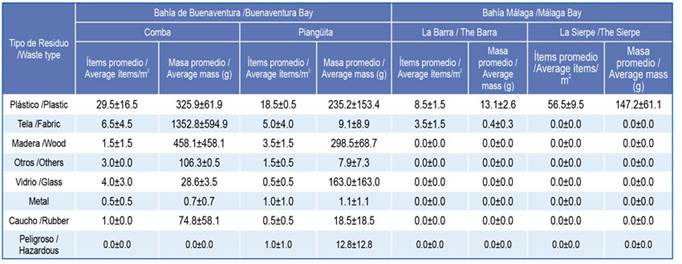
A total of 438 marine debris items were collected, with a mass of 9762.3 g, in the two bays (Buenaventura and Málaga), grouped into eight types according to the OSPAR classification (2010): plastic, metal, rubber, glass, wood, fabric, hazardous, and others; this last type corresponds to ordinary waste such as hair, cotton, natural fibers, and face masks, which are not included in the categories of the guide for monitoring marine litter on the beaches of the maritime area.
Plastic was the most abundant type of marine debris, with 339 items/m2 (77%) of all the items found. The second most abundant type of waste was fabric with 45 items/m2 (10%), while wood, glass, metal, rubber, and others totaled 51 items/m2, representing only 12%. Additionally, within the sampling, a total of 3 items/m2 of hazardous waste were presented, representing 1% (syringe, used diaper, and a medical cannula); these wastes, according to OSPAR (2010), are recognized as medical and sanitary waste, while in Colombian legislation (Resolution 1164/2022 and Resolution 591/2024), this type of waste is classified as hazardous. On the other hand, the type of waste that represented the largest amount by mass was fabric with 4086.9 g (41.9%), followed by wood with 2269.8 g (23.2%) and plastic with 2164.3 g (22.2%). The mass of the other types of waste was 1241.3 g, equivalent to 12.7%.
The quantity of marine debris in terms of number of items and mass was significantly different between the bays (p(PERM) < 0.05), being higher in Buenaventura with 38.7±10.3 items/m2 (mean±standard deviation) and 1546.7±1132.2 g; and lower in Bahía Málaga with 34.2±31.5 items/m2 and 80.4±82.8 g. On the other hand, significant differences were found between the mangrove forests (p(PERM) < 0.05) in terms of the number of items and mass (Figures 2 and 3). La Sierpe presented a greater number of items (7.06±3.4 items/m2), followed by Comba (5.75±5.5 items/m2), Piangüita (3.94±1.2 items/m2), and La Barra (1.5±0.7 items/m2). Regarding the mass of the waste, the largest accumulation was recorded in Comba (293.4±238.3 g), followed by Piangüita (93.3±67.5 g), La Sierpe (18.4±21.6 g), and La Barra (1.69±0.9 g).
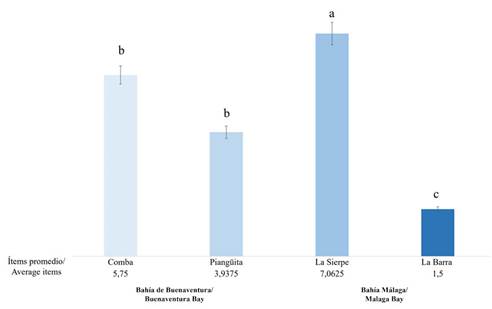
Figure 2 Items of waste per mangrove forest (Average±SE). Significant differences between mangrove forests are represented with lowercase letters; Permanova [p(PERM)< 0.05 ].
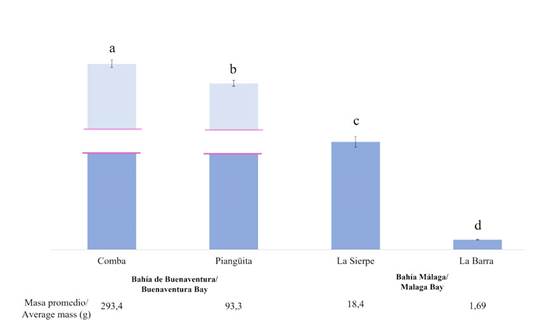
Figure 3 Mass (g) of waste by mangrove forest (Mean±SE). Significant differences between mangrove forests are represented by lowercase letters; Permanova [p(PERM)< 0.05 ].
A greater variety of marine debris was evidenced in the mangroves of Piangüita and Comba in the Bay of Buenaventura, with all types of waste being found. Meanwhile, in Bahía Málaga, in the La Barra mangrove, only two types of waste were found (plastic and fabric); and in the La Sierpe mangrove, only one type of waste (plastic) was found (Table 1).
The types of plastic were classified according to their use (tourism, household, and miscellaneous) for each of the mangrove forests studied. Disposable cups, single-use bags, Styrofoam disposables, soda bottles, and snack packaging were associated with recreational and tourist activities. Personal care items, food packaging from the basic household basket, and plastic tableware were associated with household items. Plastic remnants that are unrecognizable due to their degree of degradation were classified under the miscellaneous category (Figure 4).
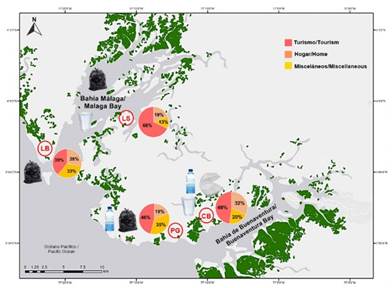
Figure 4 Proportion of marine debris according to its use in the four evaluated mangrove forests. The waste represented with images corresponds to the most abundant in each mangrove. (Own source).
In all the mangrove forests, tourism was the activity generating the most waste, accounting for an average of 50% of the waste. The mangroves evaluated in the Bay of Buenaventura showed similar percentages of waste associated with tourism, with the second most abundant type of waste in Comba being household-related, and in Piangüita, miscellaneous waste (Figure 4). For their part, the mangroves evaluated in Bahía Málaga showed contrasting trends. On one hand, the La Sierpe mangrove, despite being located far from populated centers and in a protected area, showed the highest proportion of waste associated with tourism, with more than two-thirds of the waste found, and on the other hand, the La Barra mangrove, despite being an area with a strong tourism vocation, showed the lowest proportions of waste associated with tourism (Figure 4).
Regarding the most common waste in the Comba mangrove, they were Styrofoam packaging, plastic bottles, and disposable cups. In Piangüita, they were single-use bags (low density) and plastic bottles. In La Sierpe, single-use bags (low density) and disposable cups, and in La Barra, single-use bags (low density) (Figure 4). The most abundant waste was mainly associated with tourist activities.
Plastic waste was present in all mangrove forests, showing high abundances: 100% for La Sierpe, 78.8% for La Barra, 64.1% for Comba, and 58.7% for Piangüita. Finally, according to the CCI and PAI indices, all the evaluated mangroves are classified in the highest contamination categories, being “Extremely dirty” according to the CCI and with a “Very high abundance” of plastics according to the PAI.
The average abundance of marine debris in Buenaventura Bay and Málaga Bay (38.7 items/m2 and 34.2 items/m2, respectively) was higher compared to Providencia Island (3.22 items/m2) and the Ciénaga Grande de Santa Marta (0.728 items/m2) in the Colombian Caribbean (Garcés-Ordóñez et al., 2019; Portz et al., 2022), and similar to the Republic of Mauritius in the Western Indian Ocean (40.0 ± 30.5 items/m2) (Rambojun et al., 2023).
The composition of marine debris in the bays shows that plastics make up the majority of marine litter (Riascos et al., 2019). This result is consistent with some studies that have shown that plastic is the type of waste most retained in mangrove forests (Ivar do Sul et al., 2014; Dennis Vorsatz et al., 2023). This is possibly due to the physical characteristics of plastics, which give them a lower density, such as expanded polystyrene and plastic films, facilitating their movement and entry into the mangrove through environmental processes like winds and tides (Dennis Vorsatz et al., 2023). In addition to this, plastic currently accounts for 60 to 80% of marine litter and 90% of floating particles, highlighting its slow degradation rates, and it can become trapped in mangrove roots for hundreds of years (Riascos et al., 2019; Xia et al., 2020; Daoud-Taha et al., 2021; Issac and Kandasubramanian, 2021).
It is important to highlight that hazardous waste was frequently observed in the mangroves of the Bay of Buenaventura, but that in the mangroves of the Bay of Buenaventura, hazardous waste was frequently observed, but located outside the sampled quadrants. These wastes included used batteries, syringes, and medications, which can pose both ecological risks and impacts on nearby human populations. Hazardous waste has been reported in different coastal areas, being a type of waste that requires special attention (Chowdhury et al., 2021; Asefi and Attaran-Fariman, 2022). This type of waste was not found or observed in the mangroves of Bahía Málaga, possibly due to the smaller population and the lower discharge of rivers that could contribute this type of waste.
According to the significant statistical differences found between bays, it is important to highlight that Buenaventura Bay ranks fourth among the most polluted coastal areas in the world, indicating that the mangrove forests located near the city are more susceptible to pollution compared to protected areas, such as in the case of Málaga Bay, and that the estuaries show a greater potential to act as traps for anthropogenic waste (Riascos et al., 2019). The large amount of plastic waste found in the mangrove forest of La Sierpe, mostly consisting of disposables, bags, and food packaging related to tourism and recreation, matches the larger quantity of marine debris found in El Morro in the Bay of Tumaco, which consisted of plastic bags and plastic bottles, food consumed by tourists (Preciado and Laarenas, 2020). This could be explained by the rise of ecotourism, despite the fact that in 2008, Colombia’s National Natural Parks declared the La Sierpe Regional Natural Park as a protected area with a total of 25,178 hectares (Ladino, 2018). It is important to note that in La Sierpe, waste that was partially buried was collected more frequently than at the other sampling sites, potentially becoming trapped in the fine fractions of the sediment, as has been reported for other mangrove forests (Zhou et al., 2020; Deng et al., 2021; Zamprogno et al., 2021).
On the other hand, in La Barra the movements of the tides have a direct influence on the coastline, depositing solid waste along the beach (Restrepo, 2023). However, despite being a potentially tourist beach and suffering the effects of the tides (Posso, 2018), the local community has taken management measures for cleaning the beach, preventing waste from accumulating in the same way in the mangrove, which could explain the small amount of waste found compared to La Sierpe.
In the case of Piangüita, although the beach is cleaned periodically thanks to its economic dynamics based on tourism, its strategic location at the mouth of the bay (Narváez et al., 2006; Riascos et al., 2019), and the pressure of its population growth, could explain the accumulation and variety of waste, including hazardous ones. Additionally, in Piangüita, the plastic waste found was associated with tourism and miscellaneous use (characterized by fragments). This association with the fragments contributes to the characterization of these environments as “microplastic factories” (Duarte et al., 2023). This is consistent with the results of (Vidal et al., 2021), where a higher concentration of fragments and a greater density of microplastics were presented in the outer estuary of the Bay of Buenaventura, resulting from the fragmentation of larger waste, possibly accumulated over decades in the mangrove forest.
Comba presented the largest mass accumulation of marine debris, considering its location in the bay and its low population. Additionally, since tourist activities in this area are scarce, the large amount of waste can be related to the dynamics of the currents. Due to its high-water recirculation, driven by the tides (Mouret et al., 2020), it receives a considerable amount of marine litter, in this case coming from other areas, leading to its accumulation in the mangrove forests. The lack of adequate infrastructure and basic sanitation services, along with poor waste management and a lack of environmental awareness in the Pacific coastal areas, forces local populations to burn waste or dispose of it directly into the sea, which could contribute to the observed pollution (Garcés-Ordóñez et al., 2023).
Finally, mangrove ecosystems are affected by different types of physical and anthropogenic stress; however, it has been shown that the main factor of alteration is the waste accumulated in the mangrove forest, deteriorating the quality of the ecosystem (Preciado and Laarenas, 2020). It is important to establish actions aimed at the management and proper handling of waste in the coastal areas of the Colombian Pacific, as there are strategic ecosystems for biodiversity and conservation here, which provide essential ecosystem services for the communities.
CONCLUSIONS
In Bahía Málaga, a smaller amount of waste was found, totaling 482.2 g, as it is a protected marine area with a low population density. In contrast, Bahía de Buenaventura showed a higher incidence of marine litter, with a total mass of 9280.1 g. This is due to its proximity to populated centers, rivers, and various human and port activities, exceeding the quantity of marine debris found in Bahía Málaga by 19 times. Plastic was the predominant and ubiquitous type of waste in each of the sampling areas, representing 77% of the total waste by item. Most of the waste found in Comba and La Sierpe was plastic, which could be related to transportation by ocean currents and the rise of ecotourism. In all the mangrove forests, tourism was the activity generating waste with the highest incidence. Finally, according to the CCI and PAI indices, all the evaluated mangroves were classified as “Extremely dirty” with a “Very high abundance” of plastics.

