Notes
Record of the spotted burrfish Chilomycterus spinosus (Diodontidae) in Taganga Bay, Colombian Caribbean
Registro del pez globo Chilomycterus spinosus (Diodontidae) en la bahía de Taganga, Caribe colombiano
1Instituto de Investigaciones Marinas y Costeras , Invemar Calle 25 No 2-55, El Rodadero, Santa Marta, Colombia
2Instituto de Investigaciones Marinas y Costeras , Invemar Calle 25 No 2-55, El Rodadero, Santa Marta, Colombia
3Instituto de Investigaciones Marinas y Costeras , Invemar Calle 25 No 2-55, El Rodadero, Santa Marta, Colombia shanly.coneo@invemar.org.co
ABSTRACT
The spotted burrfish Chilomycterus spinosus, which belongs to the family Diodontidae, has been recorded in the department of Magdalena, Colombian caribbean. An individual of this species was sighted in August 2022 in Taganga Bay, at a depth of 4 m. Recent records indicate that the species is more common in shallow waters of the Colombian continental Caribbean than was previously thought, and that its habitat distribution may be more diverse than previously reported.
Key words: fish diversity; Magdalena; continental Caribbean
RESUMEN
Se registra la presencia en el departamento de Magdalena, Caribe colombiano, del pez globo Chilomycterus spinosus perteneciente a la familia Diodontidae. Un individuo de esta especie fue avistado en agosto de 2022 en la bahía de Taganga, a una profundidad de 4 m. Los registros recientes indican que la especie está más presente de lo pensado en aguas someras del Caribe continental colombiano y que su distribución de hábitats puede ser más variada a lo registrado anteriormente.
Palabras clave:
Diversidad íctica; región de Santa Marta; Caribe sur
The family Diodontidae is widely distributed in tropical waters and has around 75-recorded species, making it very frequent taxa in different marine ecosystems (Leis, 2006). The family comprises the genus Chilomycterus, which includes a group of fishes widely distributed in the Atlantic and Indo-Pacific oceans (Garrido et al., 2014) and in tropical waters (Acero and Polanco, 2006). In the Americas, a total of five species of this genus are recorded, which are presented in Table 1.
Table 1 Species of the genus Chilomycterus recorded in the Americas
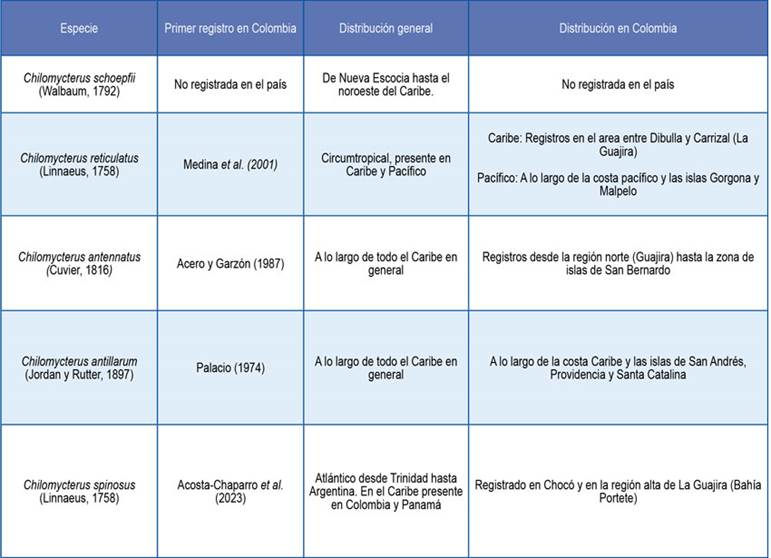
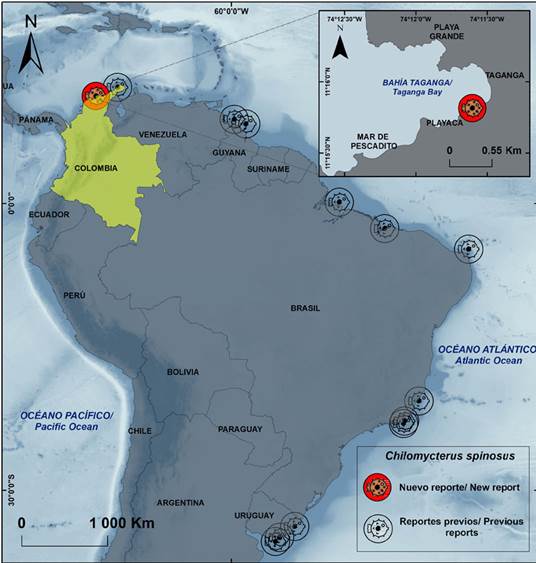
The table above shows a lack of additional sighting records for C. spinosus, and suggests that its distribution and abundance are generally limited or have not yet been fully evaluated in the country. A new sighting of an individual of this species was recorded in Taganga Bay, Magdalena Department, Colombian Caribbean (Fig 1.). This area, with an approximate area of 3.2 km2, has a great diversity of marine fauna distributed in different coastal marine ecosystems such as the rocky coastline, seagrass meadows, coral reef, soft bottoms, sandy beaches, neritic zone, pelagic environment, among others (Salazar et al., 2020). The sighting was recorded on August 31, 2022, at a depth of about 4 m, in an area characterized by a dominance of crustose corals (such as Pseudodiploria strigosa and P. clivosa), soft and sandy bottoms (with presence of octocorals). The individual was specifically observed at coordinates 11°15’48.9 " N 74°11’36.3 " W on a soft sandy bottom close to the rocky coastline.
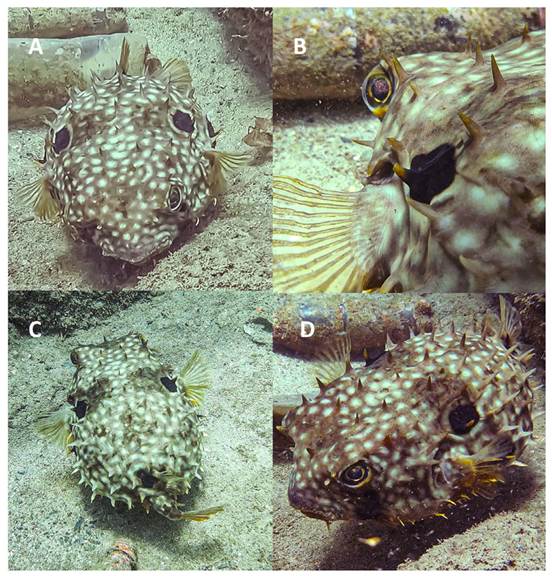
The specimen’s morphology (Figure. 2) is consistent with the documented characteristics of C. spinosus, as reported previously. This observation aligns with the findings of researchers such as Figueiredo and Menezes (2000), Sampaio and Nottingham (2008), Robertson and Van Tassell (2019), and Acosta-Chaparro et al. (2023) with an absence of tiny black lines and dots along the body and fins, a spine length less than the orbital diameter, and the presence of three distinct spots above and below the pectoral fins, as well as below the dorsal fin. These characters differentiate it markedly from the other three species recorded in the country, allowing for visual identification of the individual. This is further facilitated by the distinctive markings of C. reticulatus, which exhibits large black dots along the entire body, C. antennatus, which has black dots and irregular spots, and finally, C. antillarum, which has a pattern of black lines as polygons.
The presence of a new record of this species in the country suggests the possibility of a wider distribution in the southwestern Caribbean, as well as in the Colombian continental caribbean, potentially extending to areas between the departments of Magdalena and La Guajira. In addition, the Magdalena and Taganga Bay record represents a new finding for the area. According to the work of Salazar et al. (2020), previous studies have documented the presence of 28 species of fish belonging to diverse feeding group (Polanco et al., 2016). This recent discovery marks the first documented record of the genus Chilomycterus in the area. Conversely, its occurrence near to the rocky coast suggests that its habitat may exhibit greater variability, especially compared to the findings of Robertson and Van Tassell (2019), who reported its association with reef environments, and those of Acosta-Chaparro et al. (2023), who noted its association with seagrass meadows. This recent record constitutes a significant addition to the nation’s biodiversity, particularly in the Magdalena department within the Colombian Caribbean region.
LITERATURE CITED
Acero P. A, Garzón JF. Peces arrecifales de la región de Santa Marta (Caribe colombiano). I. Lista de especies y comentarios generales. Acta Biológica Colombiana. 1987;1383-105.
[ Links ]
Acero P. A, Polanco F. A. Peces del orden Tetraodontiformes de Colombia. Biota Colombiana. 2006;71155-164.
[ Links ]
Acosta-Chaparro AF, Navas Camacho R, Polanco-Fernández A. Primer registro del pez globo Chilomycterus spinosus (familia Diodontidae) en el Caribe colombiano. Boletín de Investigaciones Marinas y Costeras. 2023;522179-184. https://doi.org/10.25268/bimc.invemar.2023.52.2.1290
[ Links ]
Figueiredo JL, Menezes NA. Manual de peixes marinhos do sudeste do Brasil. VI. Teleostei (5). São Paulo: Museu de Zoologia, Universidade de São Paulo. 2000.
[ Links ]
Garrido A, Ibáñez-Yuste AJ, Norman C, Terrón-Sigler A. First record of Chilomycterus spinosus mauretanicus (Osteichthyes: Diodontidae) in the Mediterranean Sea. Marine Biodiversity Records. 2014.
[ Links ]
Leis JM. Nomenclature and distribution of the species of the porcupinefish family Diodontidae (Pisces, Teleostei). Memoirs of Museum Victoria. 2006;63177-90.
[ Links ]
Medina J, Acero A, Viaña J, Manjarrés L. Primer registro de Chylomycterus reticulatus (Linnaeus) (Pisces: Tetraodontiformes: Diodontidae) para el Caribe colombiano. Boletín Investigaciones Marinas y Costeras. 2001;30213-218.
[ Links ]
Palacio JF. Peces colectados en el Caribe colombiano por la Universidad de Miami. Boletín del Museo del Mar. 1974;61-137.
[ Links ]
Polanco A, Acero A, Bolaños N, González JD. (2016) Peces de la reserva de Biosfera Seaflower. In: Vides, M., Alonso, D., Castro, E., Bolaños, N., eds. Biodiversidad del mar de los siete colores, Serie de Publicaciones Generales del Invemar No. 84.
[ Links ]
Robertson DR, Van Tassell J. Shorefishes of the Greater Caribbean: online information system. Version 2.0. Balboa: Smithsonian Tropical Research Institute. 2019.
[ Links ]
Robins R. UF FLMNH Ichthyology. Version 117.407. Florida Museum of Natural History. Occurrence dataset. 2025. https://doi.org/10.15468/8mjsel
[ Links ]
Rubio E, Gutiérrez B, Franke R. Peces de la isla Gorgona. Cali: Universidad del Valle. 1987.
[ Links ]
Sampaio CL, Nottingham MC. Guia para identificação de peixes ornamentais brasileiros: espécies marinhas. 1. Ibama. 2008.
[ Links ]
Salazar L, Acosta A, Acero P. A, Bocanegra V, Borrero-Perez G, Campos C. N, Díaz C, Dueñas P, Guerrero-Kommritz J, Puyana M, Romero C, Ruíz-Pino D, Vera M, Zea S. Fauna Marina: Bahía de Taganga. Bogotá. 2018.
[ Links ]





 text in
  English (pdf)
 Article in xml format
 Article references
 Automatic translation
 Send this article by e-mail
 Cited by SciELO
  Cited by Google
  Similars in
SciELO
Similars in
SciELO  Similars in Google
 Permalink