

SciELO - Scientific Electronic Library Online

 
vol.55 issue1Record of the spotted burrfish Chilomycterus spinosus (Diodontidae) in Taganga Bay, Colombian CaribbeanFirst record on the central Venezuelan coast of the species Sigmops elongatus (Gonostomatidae, Stomiiformes) and data on its distribution in the country author indexsubject indexarticles search
Home Pagealphabetic serial listing  

Services on Demand

Journal

Article

Indicators

Related links

  • On index processCited by Google
  • Have no similar articlesSimilars in SciELO
  • On index processSimilars in Google

Share


Boletín de Investigaciones Marinas y Costeras - INVEMAR

Print version ISSN 0122-9761

Bol. Invest. Mar. Cost. vol.55 no.1 Santa Marta Jan./June 2026  Epub June 11, 2026

https://doi.org/10.25268/bimc.invemar.2026.55.1.1369 

Notes

New findings of Chaceon eldorado Manning and Holthuis, 1989 (Brachyura, Geryonidae) in Venezuela, with the first description of the male pleopods

Nuevos hallazgos de Chaceon eldorado Manning y Holthuis, (Brachyura, Geryonidae) en Venezuela, con la primera descripción de los pleópodos masculinos

1Centro Nacional de Investigación de Pesca y Acuicultura (Cenipa), Avenida Lecuna, Parque Central, torre este, piso 13, Caracas, Venezuela

2Laboratorio de Ecología de Peces Marinos, Departamento de Biología, Núcleo de Sucre, Universidad de Oriente, Estado Sucre, Venezuela afarina46@yahoo.com

3Laboratorio de Zoología y Carcinología. Grupo de Investigación en Carcinología (Gicudone), Universidad de Oriente, Núcleo Nueva Esparta. Apartado postal 6304. Calle Principal - La Marina, Boca del Río, Nueva Esparta, Venezuela carloslirag@gmail.com

4Centro Nacional de Investigación de Pesca y Acuicultura (Cenipa), Avenida Lecuna, Parque Central, torre este, piso 13, Caracas, Venezuela ruthvasquezlevy@gmail.com

5Centro Nacional de Investigación de Pesca y Acuicultura (Cenipa), Avenida Lecuna, Parque Central, torre este, piso 13, Caracas, Venezuela ericricardom@gmail.com


ABSTRACT

The genus Chaceon has the greatest species richness within the Geryonidae family, with 34 described species. Of these, C. eldorado is the only one recorded in Venezuelan waters, with a single valid report dating back more than three decades, coinciding with its original description. Based on a recent assessment of deep-water fishing areas off the central coast of Venezuela, new records of this species are presented. Furthermore, the description of the male pleopods is provided for the first time, and relevant ecological and biological aspects are discussed in anticipation of the potential initiation of its commercial fishing.

Key words: Portunoidea; crustaceans; crabs; deep sea; geryonids fisheries

RESUMEN

El género Chaceon posee la mayor riqueza especifica dentro de la familia Geryonidae, con 34 especies descritas. De ellas C. eldorado es la única registrada en aguas venezolanas, con un único registro válido que data de hace más de tres décadas, coincidiendo con su descripción original. A partir de una evaluación reciente de áreas de pesca en aguas profundas del litoral central de Venezuela, se presentan nuevos registros de esta especie. Además, se proporciona por primera vez la descripción de los pleópodos masculinos y se discuten aspectos ecológicos y biológicos relevantes ante un eventual inicio de su explotación pesquera.

Palabras clave: Portunoidea; cangrejos; aguas profundas; geriónidos; pesquería

INTRODUCTION

Geryonidae Colosi is a family of deep-sea portunoid marine crabs widely distributed on continental slopes and deep waters, between 100 and 3,500 m deep (Manning, 1990; Poupin and Buat, 1992). It currently includes eight genera and 50 recent species, and also has a good fossil record (DecaNet, 2025). Among the geryonids, the genus Chaceon Manning and Holthuis contains the greatest richness, with 34 species, characterized by five teeth on the anterolateral margin of the carapace, well-developed frontal teeth, rounded orbits, and not markedly inflated gill regions (Manning and Holthuis, 1989).

Species in this genus are highly commercially important and are subject to strong fishing pressure worldwide (Pezzuto et al., 2006; Tallack, 2007; Robinson, 2008; Wahle et al., 2008; Pezzuto and Sant’Ana 2009; Mzungu et al., 2024). However, life-history characteristics such as slow growth, late reproduction (Hastie, 1995), and apparently restricted spatial distribution of stocks (Pezzuto et al., 2006) make them highly vulnerable to overexploitation (Groeneveld et al., 2013).

According to Tavares and Pinheiro (2011), nine species of the genus Chaceon are present in the western Atlantic: C. atopus Manning and Holthuis (Saint Helena Island), C. eldorado Manning and Holthuis (Colombia, Venezuela, Lesser Antilles, and French Guiana), C. fenneri (Manning and Holthuis) (east Florida to the Gulf of Mexico), C. inghami (Manning and Holthuis) (Bermuda), C. linsi Tavares and Pinheiro (northeast Brazil), C. notialis Manning and Holthuis (southwest Brazil, Uruguay, and Argentina), C. quinquedens (Smith) (northwest Atlantic to the Gulf of Mexico), C. ramosae Manning, Tavares, and Albuquerque (southern Brazil) and C. sanctaehelenae Manning and Holthuis (Saint Helena Island, also known from the off-shore of São Tomé Island, West Africa).

Since its description in 1989, based on material collected partly in Venezuela, C. eldorado has not been the subject of new findings in the country, possibly due to limited sampling efforts in deep waters. This research reports new encounters of this species in Venezuelan waters and discusses some taxonomic and ecological aspects.

The material analyzed comes from the first three samplings of an annual scientific fishing project in the mesopelagic zone of the central Venezuelan coast. The purpose is to explore the benthic zone between 400 and 600 m depth to identify new fishing areas, assess potential fishery resources, and potentially undescribed species. The study area is located 5.6 to 7.4 km north of Chichiriviche de la Costa, La Guaira state (Figure 1).
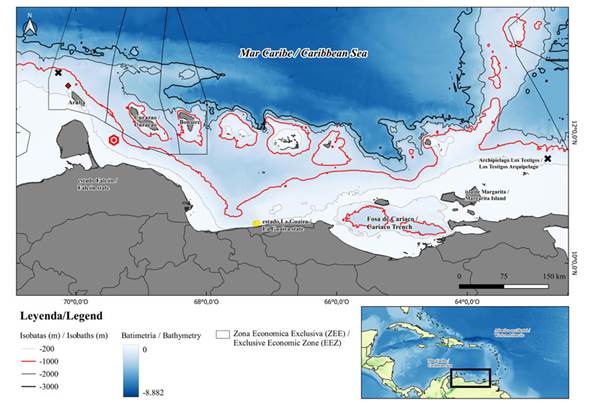
Figure 1 Geographic locations of the records of Chaceon eldorado Manning and Holthuis from Venezuela, or referred so: Taissoun (1988): red diamond; Manning and Holthuis (1989): red hexagon (type locality) and black X; present study: yellow circles. Bathymetry layer: modified from GEBCO (2024). 

The sex of the specimens was determined by the presence of gonopods in the pleon of males, the shape of the pleon (slender in males, rounded in females), and the location of the genital pore in females. The carapace width (CW) was measured, considered the greatest transverse distance from the longitudinal axis of the carapace in dorsal view. The specimens were photographed and subsequently deposited in the reference collections of the Grupo de Investigación en Carcinología (GIC) of the Universidad de Oriente and the Margarita Marine Museum (MMM), Margarita Island, Venezuela.

Family Geryonidae Colosi, 1923

Chaceon eldoradoManning and Holthuis, 1989

Fig. 2 - 3

Geryon quinquedens non Smith, 1879, Taissoun (1988): 173; Taissoun (2022): 111, fig. 37.

Chaceon eldoradoManning and Holthuis, 1989: 61, fig. 7-8; Campos et al. (2005) : 228, fig. 191; Tavares and Pinheiro (2011): 65, fig. 5D; Poupin and Corbari (2016): 84, fig. 18D; Poupin (2018): 292.

Material examined: 01/30/2025, 17 males (unmeasured), 2 females (unmeasured), 5.9 km north of Chichiriviche de La Costa, 570 m depth, collector: Fariña, A. 02/26/2025, 6 males (152 - 169 mm CW), 6.1 km north of Chichiriviche de La Costa, 574 m depth, collector: Fariña, A., GIC-944. 03/19/2025, 20 males (133 - 176 mm CW), 42 non-ovigerous females (103 - 151 mm CW), 1 ovigerous female (126 mm CW), 7.4 km north of Chichiriviche de La Costa, between 462 - 574 m depth, collector: Fariña, A., MMM-crust-447 to 449.

General description: Manning and Holthuis (1989) .

Description of male pleopods: First pair relatively short, robust, coriaceous, wider in the proximal half, inner margin rounded, finely setose, apex acute, tubular, curved outwards (Fig. 3A-B). Second pair slender, almost as long as the first pair, with a curved spine on the inner margin of the distal quarter, perpendicular to the longitudinal axis of the pleopod, with setae on its inner edge; From this spine, the pleopod becomes thinner and more sinuous (Fig. 3A-C), the apex does not exceed the 6/7 sternal suture.

Records from Venezuela: Falcón state (641 m depth) and northeast of the Los Testigos archipelago (531 m depth) (Manning and Holthuis, 1989).

General distribution: Colombia to French Guiana; Guadeloupe and Martinique (Poupin and Corbari, 2016).

Comments: Taissoun (1988) was the first to report the presence of the family Geryonidae in Venezuela, based on two females collected “south of Aruba” and wrongly identified as Geryon quinquedens; however, the geographic coordinates he provided actually corresponded to the north of Aruba, outside Venezuelan jurisdictional waters. A year later, Manning and Holthuis (1989) described Chaceon eldorado based on a specimen (selected as the holotype) from Venezuela, 42.6 km east of the Paraguaná Peninsula, Falcón State (11°53‵N - 69°25‵W) (Fig. 1). Additionally, these same authors selected two paratypes, also from Venezuela; however, one of them actually came from Aruba, like the Taissoun material.

The species of this genus are morphologically similar (Poupin and Corbari, 2016), in this sense, C. eldorado can be easily confused with C. notialis and C. ramosae, since they share dorsoventrally depressed dactyls of the pereiopods, poorly developed anterolateral teeth of the carapace and the merus of the fifth pair of pereiopods without a distodorsal spine (Manning and Holthuis, 1989; Manning et al., 1989; Tavares and Pinheiro, 2011). Chaceon eldorado can be differentiated from C. notialis by the length of the merus of the fifth pair of pereiopods, which does not exceed the last anterolateral tooth of the carapace in the latter species, while in C. eldorado the merus exceeds the last anterolateral tooth of the carapace. On the other hand, C. eldorado can be differentiated from C. ramosae by having a short gonopod 2, which does not reach the 6/7 thoracic suture (gonopod 2 extends beyond the 6/7 suture in C. ramosae); furthermore, the merus of fifth pair of pereiopods is more than twice the length of the dactyl in C. eldorado (twice the length of the dactyl in C. ramosae) (Tavares and Pinheiro, 2011).

Male pleopods have proven very useful for separating morphologically very similar species of portunidae (Williams, 1974), pseudotelfusids (Rodríguez, 1982), xanthoids (Martin and Abele, 1986), and grapsoids (Abele, 1992), among others; however, they have received little attention in gerionids, so their potential as a taxonomic tool is uncertain. The material examined fits the species descriptions by Manning and Holthuis (1989) ; however, it presents slight differences, such as the relative length of the merus in relation to the carapace width in a female, which was 0.47, which is considerably smaller than the registered ratio (0.56). These differences, however, appear to be due to morphological variations within the species.

Several specimens showed strong epibiosis by Poecilasmatidae barnacles, being particularly abundant in the pereiopods and thoracic sternites (Figure 3A); chitinolytic lesions were also observed (identifiable as blackened areas of the carapace) (Figure 2A - 3B). This type of lesions is very common among geryonids (Poupin and Buat, 1992; Cartes, 1993), and can affect up to 90% of crabs in certain populations (Pinho et al., 2001). If the lesions are extensive, the crabs may appear unappealing and their commercial value in the market may be affected, requiring processing to sell only the meat, raising production costs (Shields, 2012).
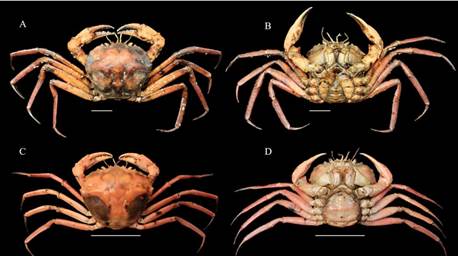
Figure 2 Chaceon eldorado Manning and Holthuis, male, A) dorsal view; B) ventral view; ovigerous female, C) dorsal view; D) ventral view. Scale bars: 100 mm. 
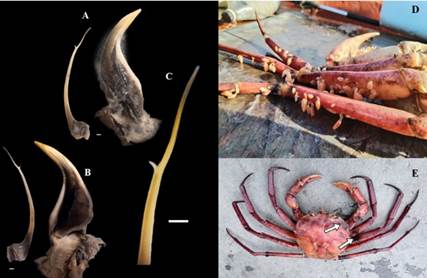
Figure 3 Chaceon eldorado, first (right) and second male pleopod (left) A) dorsal view; B) ventral view; C) second pleopod apex. D) infested by Poecilasmatidae barnacles on the pereiopods. E) male specimen with chitinolytic lesions (white arrows) on the dorsal region. Scale bars: 1 mm. D and E Photographs by Martha Montes. 

Many ecological and life cycle aspects of Geryonidae remain unknown, including their reproductive periods, sex ratio, and geographic distribution (Wahle et al., 2008; Groeneveld et al., 2013; Mzungu et al., 2024). Such is the case of C. eldorado, whose presence in the scientific literature is based on scattered records (Campos et al., 2005; Poupin and Corbari, 2016; Poupin, 2018). Understanding these aspects is especially relevant due to the economic interest that this family represents from a fisheries perspective. Several biological traits of Geryonidae, such as their high longevity, slow growth, late sexual maturity (Armstrong, 1990), large body size (Fernández-Vergaz et al., 2000), long incubation periods and irregular recruitment (Hastie, 1995), together with spatial patterns of sexual segregation according to depth (Masello and Defeo, 2016) and spatial aggregation related to sexual maturity (Martínez-Rivera et al., 2020) make them highly vulnerable to overexploitation.

Therefore, it is essential to implement rigorous management measures including, among other elements, preliminary stock assessments, the establishment of harvest quotas, determination of the size at first sexual maturity and the minimum catch size, as well as the definition of closed periods and areas. Furthermore, constant monitoring of the fishery is required to allow for timely corrective action when necessary.

ACKNOWLEDGMENTS

To Omar Correa, Jhonder Palma, Miguel Muñoz, Emilio Véliz, Benigno Morales, and Frank Hernández for their collaboration during the exploratory fishing operations, and to all the fishermen of the People’s Power Council of Fishermen, Fisherwomen, Aquaculturists (CONPPA) of La Zorra. The results presented are part of the project: “Evaluation of fishery resources captured in demersal zones of the mesopelagic oceanic layer off the central coast of Venezuela”, code 139-2024, implemented by the National Center for Fisheries and Aquaculture Research (CENIPA) and funded through the National Fund for Science, Technology, and Innovation (Fonacit). To Martha Montes (CENIPA) for photographing some specimens, and to Professor Thomas Blanco (CENIPA / Bolivarian University of Venezuela, UBV) for his help in preparing the photographic material.

LITERATURE CITED

Abele L. A review of the grapsoid crab genus Sesarma (Crustacea: Decapoda: Grapsidae) in America, with the description of a new genus. Smithsonian Contributions to Zoology. 1992;5271-60. https://doi.org/10.5479/si.00810282.527Links ]

Armstrong D. Commentary on crab management and the east coast United States geryonid fisheries. 23-29. En: Lindberg, WJ., Wenner, EL. Geryonid crabs and associated continental slope fauna: A research workshop report. Florida Sea Grant College, Florida. 1990. [ Links ]

Campos NH, Navas GR, Bermúdez A, Cruz N. Los crustáceos decápodos de la franja superior del talud continental (300-500 m) del Caribe colombiano. Universidad Nacional de Colombia. Facultad de Ciencias. Instituto de Ciencias Naturales, Bogotá. 2005. [ Links ]

Cartes JE. New records of the deep sea crab Chaceon mediterraneus Manning & Holthuis, 1989, in the Western Mediterranean (Decapoda, Brachyura, Geryonidae). Crustaceana. 1993;642221-225. https://doi.org/10.1163/156854093X00252Links ]

DecaNet. DecaNet. Geryonidae Colosi, 1924. World Register of Marine Species. 2025. https://www.marinespecies.org/aphia.php?p=taxdetails&id=106762Links ]

Fernández-Vergaz V, López Abellán LJ, Balguerias E. Morphometric, functional and sexual maturity of the deep-sea red crab Chaceon affinis inhabiting Canary Island waters: Chronology of maturation. Marine Ecology Progress Series. 2000;204169-178. http://doi.org/10.3354/meps204169Links ]

Groeneveld JC, Everett BI, Fennessy ST, Kirkman SP, Santos J, Robertson WD. Spatial distribution patterns, abundance and population structure of deep-sea crab Chaceon macphersoni, based on complementary analyses of trap and trawl data. Marine and Freshwater Research. 2013;64507-517. http://doi.org/10.1071/MF12263Links ]

Hastie LC. Deep-water geryonid crabs: a continental slope resource. Oceanography and Marine Biology. An Annual Review. 1995;33561-584. [ Links ]

Manning RB. Studies on systematics of geryonid crabs: 1-2. En: Lindberg, WJ., Wenner, EL. Geryonid Crabs and associated continental slope fauna: A research workshop report. Florida Sea Grant College, Florida. 1990. [ Links ]

Manning RB, Holthuis L. Two new genera and nine new species of Geryonid crabs (Crustacea, Decapoda, Geryonidae). Proceedings of the Biological Society of Washington. 1989;102150-77. [ Links ]

Manning RB, Tavares MS, Albuquerque EF. Chaceon ramosae, a new deep-water crab from Brazil (Crustacea: Decapoda: Geryonidae). Proceedings of the Biological Society of Washington. 1989;1023646-650. [ Links ]

Martin JW, Abele LG. Notes on male pleopod morphology in the brachyuran crab family Panopeidae Ortmann, 1893, Sensu Guinot (1978) (Decapoda). Crustaceana. 1986;50182-198. http://doi.org/10.1163/156854086X00205Links ]

Martínez-Rivera S, Long WC, Stevens BG. Physiological and behavioral sexual maturity of female red deep-sea crabs Chaceon quinquedens (Smith, 1879) (Decapoda: Brachyura: Geryonidae) in the Mid-Atlantic Bight. Journal of Crustacean Biology. 2020;40330-340. http://doi.org/10.1093/jcbiol/ruaa007Links ]

Masello A, Defeo O. The deep-sea red crab Chaceon notialis (Geryonidae) in the southwestern Atlantic Ocean: Spatial patterns and long-term effects of fishing. Fisheries Research. 2016;183254-262. http://doi.org/10.1016/j.fishres.2016.06.016Links ]

Mzungu R, Makokha G, Fondo E, Siljander M, Mueni E, Kiilu B. Population, distribution structure, and fishery potential of the golden deep-sea crab, Chaceon somaliensis in the Kenyan coast in East Africa. Journal of Geography and Environmental Earth Science International. 2024;28693-111. https://doi.org/10.9734/jgeesi/2024/v28i6784Links ]

Pezzuto PR, Sant’Ana R. Sexual maturity of the deep-sea royal crab Chaceon ramosae Manning, Tavares & Albuquerque, 1989 (Brachyura: Geryonidae) in southern Brazil. Latin American Journal of Aquatic Research. 2009;373297-312. http://doi.org/10.3856/vol37-issue3-fulltext-3Links ]

Pezzuto PR, Pérez J, Wahrlich R. O ordenamento das pescarias de caranguejos-de-profundidade (Chaceon spp.) (Decapoda: Geryonidae) no sul do Brasil. Boletim do Instituto da Pesca. 2006;322229-247. [ Links ]

Pinho MR, Gonçalves JM, Martins HR, Menezes GM. Some aspects of the biology of the deep-water crab, Chaceon affinis (Milne-Edwards and Bouvier, 1894) off the Azores. Fisheries Research. 2001;51283-295. http://doi.org/10.1016/S0165-7836(01)00252-1Links ]

Poupin J. Les crustacés décapodes des Petites Antilles: Avec de nouvelles observations pour Saint-Martin, la Guadeloupe et la Martinique. Muséum National d’Histoire Naturelle, Paris. 2018. [ Links ]

Poupin J, Buat P. Discovery of deep-sea crabs (Chaceon sp.) in French Polynesia (Decapoda: Geryonidae). Journal of Biological Studies. 1992;122270-281. https://doi.org/10.2307/1549080Links ]

Poupin J, Corbari L. A preliminary assessment of the deep-sea Decapoda collected during the KARUBENTHOS 2015 Expedition to Guadeloupe Island. Zootaxa. 2016;41901-107. http://doi.org/10.11646/zootaxa.4190.1.1Links ]

Robinson M. Minimum landing size for northeast Atlantic stocks of deep-water red crab, Chaceon affinis (Milne-Edwards and Bouvier, 1894). ICES Journal of Marine Science. 2008;65148-154. http://doi.org/10.1093/icesjms/fsm189Links ]

Rodríguez G. Les crabes d´eau douce d´Amérique. Familie des Pseudothelphusidae. Faune Tropicale XXII. ORSTOM, Paris. 1982. [ Links ]

Shields JD. The impact of pathogens on exploited populations of decapod crustaceans. Journal of Invertebrate Pathology. 2012;110211-224. http://doi.org/10.1016/j.jip.2012.03.011Links ]

Taissoun E. Los cangrejos decápodos Brachyura de las costas de Venezuela. III. Familias Leucosiidae Dana 1852 y Geryonidae (Beurlen 1930). Boletín del Centro de Investigaciones Biologicas. 1988;17121-140. [ Links ]

Taissoun E. Cangrejos marinos (Decapoda Brachyura) de las islas y costas de Venezuela. Ediciones Astro Data, S.A., Maracaibo. 2022. [ Links ]

Tallack SML. Escape ring selectivity, bycatch, and discard survivability in the New England fishery for deep-water red crab, Chaceon quinquedens. ICES Journal of Marine Science. 2007;641579-1586. http://doi.org/10.1093/icesjms/fsm107Links ]

Tavares M, Pinheiro AP. A new species of Chaceon Manning & Holthuis, 1989, from the southwestern Atlantic, with a key to the western Atlantic species (Crustacea, Decapoda, Geryonidae). Zootaxa. 2011;308657-68. http://doi.org/10.11646/zootaxa.3086.1.3Links ]

Wahle RA, Bergeron CE, Chute AS, Jacobson LD, Chen Y. The northwest Atlantic deep-sea red crab (Chaceon quinquedens) population before and after the onset of harvesting. ICES Journal of Marine Science. 2008;65862-872. http://doi.org/10.1093/icesjms/fsn058Links ]

Williams A. The swimming crabs of the genus Callinectes (Decapoda: Portunidae). Fishery Bulletin. 1974;723685-798. [ Links ]

Citation: Rodríguez, P.; Fariña, A.; Lira, C.; Vásquez, R.; Martínez, E. (2025). Nuevos hallazgos de Chaceon eldorado Manning y Holthuis, 1989 (Brachyura, Geryonidae) en Venezuela, con la primera descripción de los pleópodos masculinos. Bol. Invest. Mar. Cost. 55 (1) 211-219

Received: July 24, 2024; Accepted: April 04, 2025

Creative Commons License This is an open-access article distributed under the terms of the Creative Commons Attribution License